ACG 3103 Chapter 8 (Intermediate Financial Accounting)
Study these flashcardsFree · spaced repetition · iPhone, Android, Mac & web
All cards
1
Net Realizable Value (NRV)
Net Realizable Value is either relating to accounts reievables: the estimated amount a business expects to get from selling goods or services (includes recivable sbecoming uncollectible, sales returns, allowances and discounts to incnetive early payment)
or
Relating to inventory: Selling price of all Inventory minus the remaining cost of their inventory to be a finish good, minus the cost to sell (as in direct selling costs, like commsions, NOT general advertiisng) and minus the cost to ship. (PS: NRV for invnetory is typically done for each product, NOT all products grouped together)
2
Lower-of-cost-or-net realizable value (LCNRV)
*Only applied to inventory
Lower-of-cost-or-net realizable value (LCNRV) is an accounting rule that requires a company to report inventory on its balance sheet at whichever is lower: its historical cost or its net realizable value (NRV)
3
Explain the two methods for adjustment inventory value to NRV?
Following the Lower-of-cost-or-net realizable value rule, when NRV of the invneotry is lower than the hsitorical value, you must use the lower value of NRV.
ex) If the Inventory value NRV value is \$35,000, and the hisotrical value is at \$40,000
1st method: Cost-of-Goods-Sold Method
Dr COGS 5,000
__Cr Inventory 5,000
2nd Method: Loss Method
Dr Loss on Inventory 5,000
__Cr Inventory 5,000
4
Profit Margin formula
(Net Profit ÷ Total Revenue) × 100
5
1)Lower-of-cost-or-market (LCM).
2) How to determine the market value fo inventory (for the LCM)? (Full Explanation)
1) To record inventory at whicever is lower: its original historical cost or its current market value
2) How to determine the market value of inventory (for the LCM)?
-The Ceiling (Net Realizable Value)
-The Floor (NRV minus a normal profit margin)
-Replacement Cost (the amount the company would pay to replace the inventory)
Then, Pick the Middle Number: Look at three numbers: Replacement Cost, Ceiling, and Floor. Whichever number falls in the middle is your official "Market" value.
(PS: So, if Replacement > Ceiling, then use Ceiling as the market value, and is Replacement < Floor, then use the Floor as the market value, and if Floor < Replacement Cost < Ceiling, then use replacement costs as the market value)
Ultiamtely, you would compare that middle "Market" number to your original Historical Cost, and pick whichever is lower. (PS: The official term for the market value is the "Designated Market Value" in this scenerio.)
*PS, you help you better understand: So the Ceilling (aka Upper limit) would be the maximum amount the market value for inventory can be, and the floor is the minimum value the market value for inventory can be.
6
J/E for if invnetory is following the LCM rule and its recorded inventory at its histroical cost, but now the historical value of inventory is \$40,000 & the designated market valye is at \$35,000?
1. Cost of Goods Sold Method
Dr Cost of Goods Sold 5,000
___Cr Inventory 5,000
2. Loss Method
Dr Loss of Inventory 5,000
___Cr Inventory 5,000
7
J/E for if invnetory is following the LCM rule and its recorded inventory at its designated market cost (since it went to \, but now the historical value of inventory is \$35,000 & the designated market valye is at \$40,000?
NO JOURNAL ENTRY!!!
IMPORTANT!: Once inventory is written down to a lower market value, you are never allowed to write it back up, even if the market value recovers.
8
1) Under GAAP, what choices do comapnies have to what mehtod they use ot value invneotry?
2) What rare exceptions does GAAP have in this ?
1) Under US GAAP, valuing inventory is a two-step process:
1st Step: Companies first choose a cost flow assumption (FIFO or LIFO or Wieghted Average Costing or Specific Indetification) to track initial cost
2nd Step: Must check for drops in value using either LCNRV or LCM.
2) GAAP has a rare exception which allows companies to value inventory at Net Realizble costs, even if it is above historical cost. In order to be permitted for this exception, all thre conditions must be meet.
1. There is a controlled market with a quoted price applicable to all quantities.
2. No significant costs of disposal are involved.
3. The product is available for immediate delivery.
9
Lump-Sum purchase (aka, Basket Purchase)
A lump-sum purchase (or basket purchase) is when a company buys multiple different assets or inventory items together in a single transaction for one combined price, rather than paying separate prices for each item.
10
Purchase Commitments
Purchase commitments are agreements to buy inventory weeks, months, or even years in advance.
11
For Purchase Commitments, explain fully the J/E's you should know (which follow GAAP)
So, for purchasing commitments (only those that are un-cancelable, since if they were cancelable you could easily opt-out and make it not applicable to you), when purchasing inventory, if their is a loss before I have ownership, then I would record that loss as
Dr Loss on Purchase Commitments \$XXX
___Cr Estimated Liability on Purchase Commitments \$XXX
But, you also need to reports gain to the inventory (in the same circumstances: pre ownership, un-canceable purchase commitment), but you can ONLY report gains if there a loss, and the MAX amount of gains you report is that amount you previsouly reported as a loss. To record the gain, it would be this J/E below
Dr Estimated Liability on Purchase Commitments \$XXX
___Cr Gain on Purchae COmmitments \$XXX
12
The Gross Profit Method of Estimating Inventory"
The Gross Profit Method is a shortcut technique used to estimate the dollar value of ending inventory without doing a physical count.
Step 1) Calcuate Cost of Goods Available for Sale (COGAS)
-COGAS = Beginning Inventory + Net Purchases
Step 2) Estimate Cost of Goods Sold (COGS)
-Estiamted COGS = Net Sales × (1 - Gross Profit Margin %)
Step 3) Find Estimated Ending inventory
- COGAS - Estimated COGS = Estimated Ending Inventory
(PS: Step 3 = Just Step 1 - Step 2)
IMPORTANT!!
Net Purchases = Sales Revenue - Sales Returns & Allowances - Sales Discount (Discount for early payment)
Net Purchases = Purchases - Purchases Returns & Allowances - Purchase Discounts (Discounts for early payment) + Freight-In (Is shipping cost from supplier to your business warehouse, for you to obtain the product you want to sell, NOT the cost to ship to a buyer)
13
Gross Profit Magrin (aka Gross Profit Percentage ) Formula
Gross Profit Magrin (decimal) = (Net Sales - COGS) / Net Sales
Gross Profit Magrin (%) = [(Net Sales - COGS) / Net Sales ] x 100
14
1) What is Markup on Cost
2) What is its formula?
1) Markup on Cost: The % of the originals cost of the item, that is added on top of the items original cost to set its selling price.
2) Formula
Markup on Cost (decimal) = Gross Profit / COGS
Markup on Cost (%) = (Gross Profit / COGS) x 100
OR
Markup on Cost (decimal) = (Net Sales - COGS) / COGS
Markup on Cost (%) = [(Net Sales - COGS) / COGS] x 100
15
How to find Markup on Cost from Gross Margin?
Markup on Cost (decimal) = Gross Profit Margin (Decimal) / 1 - Gross Profit Margin (Decimal)
16
How to find the Gross Profit Margin from Markup Cost?
Gross Profit Margin (Decimal) = Markup on Cost (Decimal) / 1 + Markup on Cost (Decimal)
17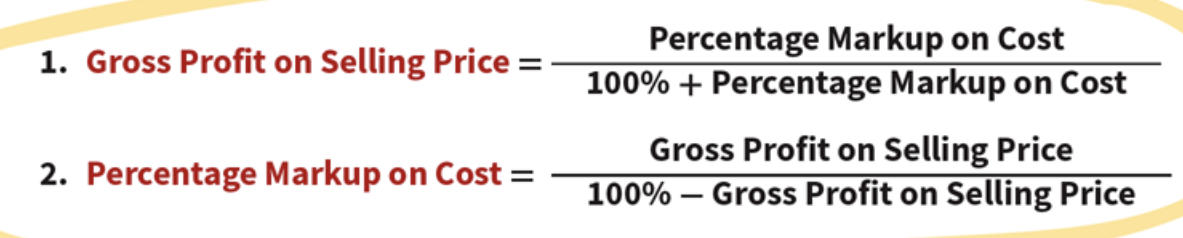
Formula's for
1)Gross Profit on Selling price
2) Percentage Markup on Cost
18
The retail inventory method
Retail inventory method is a method used to estimate the cost of the ending inventory.
Step 1) Calculate COGAS (Cost of Goods Availble for Sale) at Both Cost and Retail
COGAS = Beginning Inventory + Net Purchases (Purchases - Purchases Returns & Allowances - Purchase Discounts (Discounts for early payment) + Freight-In)
Step 2) Calculate the Cost-to-Retail Ratio
Cost-to-Retail Ratio = COGAS at Cost / COGAS at Retail
Step 3) Calculate Ending Inventory at Retail
Ending Inventory at Retail = COGAS at Retail - Net Sales
Step 4) Convert Ending Inventory at retail to Estimated Ending Inventory at Cost
Estimated Ending Inventory at Cost = Ending Inventory at Retail x Cost-to-Retail Ratio
NEED TO FINISH!
More Business & economics flashcards
Introduction to EconomicsBusiness & economics · EnglishrikishakennedyIAS 36 ImpairmentsBusiness & economics · EnglishEllaConsumer welfare and protection Business & economics · EnglishamongusTürsteuerung, Aufgaben ZGF, Streckenliste & ZughakengrenzlasBusiness & economics · GermanJuliaBusiness in the real worldBusiness & economics · EnglishesmeeObchodní a účetní terminologieBusiness & economics · CzechZuzanaeconomic developments 1871-1914Business & economics · EnglishemiF2 Foreign Currency TranslationBusiness & economics · EnglishEllaModule 7: Organizational Management PBusiness & economicsAngelicMIS Final ReviewBusiness & economics · EnglishLexieChapter 15 Vocab - Marketing ManagementBusiness & economics · Englishbevo612E2 Business ModelsBusiness & economics · EnglishElla
All Business & economics decks
Study these decks in the app
Free on iPhone, Android, Mac and the web. Add any deck to your account in one tap.

