BIOL 223 Final Review: Special Senses
Study these flashcardsFree · spaced repetition · iPhone, Android, Mac & web
All cards
1
What is the function of the nervous system?
To detect stimuli, process information and control responses
2
Which part of the nervous system is responsible for problem solving?
The cerebrum
3
What does the central nervous system consist of?
The brain and spinal cord
4
What does the peripheral nervous system include?
- Brain and spinal cord
- Nerves, ganglia and sensory receptors
- Only cranial nerves
- Only spinal nerves
5
How many pairs of cranial and spinal nerves are there?
12 cranial pairs and 31 spinal pairs
6
Where are the cell bodies of the peripheral nervous system located?
In ganglia
7
The sensory (afferent) division conveys action potentials to where?
- Muscles
- The CNS
- Glands
- Ganglia only
8
Where does the motor division transmit impulses?
To effectors (muscles and glands)
9
Which part of the nervous system regulates digestion?
The autonomic nervous system
10
Where does protein synthesis occur in neurons?
- Axon
- Dendrite
- Cell body
- Axon terminal
11
What are dendrites?
Short, branched processes that receive input toward the cell body
12
What is the function of axons?
Conduct action potentials away from the cell body
13
What do synaptic vesicles contain, and in which terminal?
Neurotransmitter, in the presynaptic terminal
14
Which neuron carries action potentials from one neuron to another?
- Sensory neuron
- Motor neuron
- Interneuron
- Schwann cell
15
What is a unipolar (pseudo-unipolar) neuron?
One process that splits in two; most sensory neurons
16
What is a bipolar neuron?
One dendrite and one axon, as in the retina and olfactory epithelium
17
Which neuron has many dendrites and one axon?
- Unipolar
- Bipolar
- Multipolar
- Pseudo-unipolar
18
What is a multipolar neuron?
Many dendrites and one axon; most motor neurons and interneurons
19
What are neuroglia?
The supporting cells of the nervous system
20
Which of these is a neuroglial cell?
- Osteocyte
- Astrocyte
- Melanocyte
- Hepatocyte
21
What is the blood–brain barrier?
Capillaries with tight junctions plus astrocytes that restrict what enters the brain
22
What kinds of substances cross the blood–brain barrier?
Lipid-soluble substances, water, O₂, CO₂ and glucose (by carriers)
23
What are the phagocytic cells of the CNS?
Microglia
24
Which condition involves damage to the CNS myelin sheath?
- Parkinson disease
- Multiple sclerosis
- Muscular dystrophy
- Glaucoma
25
What are astrocytes?
Star-shaped glia that support neurons and help form the blood–brain barrier
26
What are oligodendrocytes?
CNS glia that form the myelin sheath
27
Which cells form myelin in the PNS?
- Oligodendrocytes
- Astrocytes
- Schwann cells
- Microglia
28
What are ependymal cells?
Glia lining the ventricles and central canal; they produce and circulate CSF
29
What are satellite cells?
Glia surrounding neuron cell bodies in ganglia
30
What is saltatory conduction?
- Continuous conduction along unmyelinated axons
- Action potentials jumping between nodes of Ranvier
- Conduction across a synapse
- Conduction along muscle fibers
31
What are nodes of Ranvier?
Gaps in the myelin sheath where action potentials are regenerated
32
What is white matter?
Myelinated axons
33
What is gray matter?
Neuron cell bodies, dendrites and unmyelinated axons
34
If you cut bundles of axons and their myelin in the PNS, what have you cut?
- A ganglion
- A nerve
- A tract
- A nucleus
35
If a virus increases K⁺ permeability, what happens to the cell's charge?
K⁺ leaves and the cell becomes more negative (hyperpolarized)
36
What happens if Na⁺ permeability increases?
Na⁺ enters the cell, causing depolarization
37
What is a local potential?
- A localized graded change in membrane potential
- An all-or-none spike
- Release of neurotransmitter
- The resting potential
38
What is depolarization?
The membrane potential becomes less negative
39
What is hyperpolarization?
The membrane potential becomes more negative
40
Voltage-gated Na⁺ channels are sensitive to extracellular levels of which ion?
- Potassium
- Calcium
- Chloride
- Magnesium
41
What increases or decreases in direct proportion to stimulus strength?
The amplitude of a local potential
42
What follows a rapid influx of Na⁺ into a nerve cell?
Depolarization, then repolarization as K⁺ leaves
43
When does an action potential occur?
When depolarization reaches threshold
44
What does "all or none" mean?
- Size varies with stimulus
- An action potential occurs fully or not at all
- Only motor neurons fire
- Two stimuli are needed
45
What happens to a neuron when repolarization is complete?
It returns to resting potential and can respond again
46
Burn patients are prone to which condition because cells release their contents?
Hyperkalemia (high blood K⁺)
47
What happens during the absolute refractory period?
- No new action potential can be generated
- A stronger stimulus triggers a spike
- Neurotransmitter is released
- The neuron is at rest
48
As stimulus strength increases, what happens to action potential frequency?
The frequency increases
49
What is the junction between two neurons called?
A synapse
50
What is released from the presynaptic terminal?
- Hormones
- Neurotransmitter
- Calcium only
- Acetylcholinesterase
51
What is the role of neurotransmitters?
Carry the signal across the synaptic cleft
52
At a chemical synapse, where do signals go from the presynaptic terminal?
To the postsynaptic membrane
53
What is an EPSP?
A depolarization that makes an action potential more likely
54
What is an IPSP?
- Depolarization that raises the chance of firing
- Hyperpolarization that makes an action potential less likely
- An all-or-none spike
- A refractory period
55
What are oscillatory circuits of neurons?
Circuits with feedback that produce repeated rhythmic activity
56
Which is the longest muscle in the body?
The sartorius
57
Which is the largest muscle in the body?
- Sartorius
- Gluteus maximus
- Gastrocnemius
- Biceps brachii
58
Which is the smallest skeletal muscle?
The stapedius
59
Which vertebra has a dens?
The axis (C2)
60
How many carpal bones are there?
- 6
- 7
- 8
- 10
61
How many tarsal bones are there?
7
62
What comes out of a herniated disc?
The nucleus pulposus
63
Which ribs attach directly to the sternum?
True ribs (vertebrosternal, ribs 1–7)
64
How many false ribs are there?
- 5
- 7
- 3
- 2
65
What is the sternal angle used for?
A landmark for counting ribs
66
What forms the shoulder joint?
The humerus and the glenoid fossa of the scapula
67
What is the pointed part of the elbow?
- Coracoid process
- Olecranon process
- Styloid process
- Acromion
68
What is the acetabulum?
The socket of the hip where the femur sits
69
What do we sit on?
The ischial tuberosity
70
Which bone has the medial malleolus?
- Fibula
- Tibia
- Femur
- Talus
71
Which bone has the lateral malleolus?
The fibula
72
Where is the greater trochanter?
On the femur
73
What does the talus do?
Transmits body weight from the tibia to the foot
74
What is a gomphosis?
- Joint between skull bones
- Joint of a tooth in its socket
- Freely movable joint
- Joint with a cartilage disc
75
Which membrane secretes the fluid that keeps joints moist?
The synovial membrane
76
What is a bursa and what does it do?
A fluid-filled sac that reduces friction around joints
77
What do the cruciate ligaments do?
- Hold the patella
- Prevent the femur and tibia sliding anteriorly or posteriorly
- Join the pelvis
- Form the foot arches
78
Where is the meniscus?
A cartilage pad between the femur and tibia in the knee
79
How many arches does the foot have?
3
80
What type of joint is the knee?
- Ball-and-socket
- Modified hinge
- Pivot
- Gliding
81
What causes osteoarthritis?
Wear and tear of joint cartilage
82
What is muscle contractility?
The ability to shorten forcefully
83
What is muscle excitability?
The ability to respond to a stimulus
84
What is muscle elasticity?
- Ability to respond to a stimulus
- Ability to be stretched
- Ability to recoil to original length
- Ability to shorten forcefully
85
What are the connective tissue layers of a muscle?
Endomysium (fiber), perimysium (fascicle), epimysium (whole muscle)
86
What are the thick and thin filaments?
Thick = myosin; thin = actin
87
G-actin is part of which filament?
- Thick
- Thin
- Intermediate
- Elastic
88
Which sarcomere component binds calcium?
Troponin
89
What are T-tubules?
Extensions of the sarcolemma that carry action potentials into the fiber
90
What does the sarcoplasmic reticulum store?
- Sodium
- Potassium
- Calcium
- ATP
91
Do actin and myosin shorten during contraction?
No, they slide past each other
92
What neurotransmitter do synaptic vesicles contain at the neuromuscular junction?
Acetylcholine
93
Where are the presynaptic terminal, synaptic cleft and postsynaptic membrane found?
At the neuromuscular junction
94
What happens when acetylcholine binds the sarcolemma?
- Depolarization and an action potential
- Hyperpolarization
- Calcium reabsorption
- Muscle relaxation
95
What happens if acetylcholinesterase is missing?
ACh stays; the muscle contracts continuously
96
What happens with too much acetylcholinesterase?
ACh is broken down too fast; the muscle cannot contract properly
97
What happens if a drug blocks acetylcholine receptors?
- Continuous contraction
- The muscle cannot respond
- Faster contraction
- Cramps
98
What is treppe?
A gradual increase in contraction strength with repeated stimulation
99
What is rigor mortis?
Muscle stiffening after death due to lack of ATP
100
What is oxygen debt?
- Oxygen taken up before exercise
- Extra oxygen used after exercise to replenish ATP
- Loss of blood oxygen
- Failure to breathe
101
What are the benefits of aerobic exercise?
Greater efficiency, fatigue resistance and vascularity
102
What is muscle atrophy?
A decrease in size of a muscle
103
What is muscular dystrophy?
Inherited disease causing progressive muscle degeneration
104
Which muscles form the quadriceps femoris?
- Biceps femoris and semitendinosus
- Rectus femoris and three vastus muscles
- Sartorius and gracilis
- Gluteus medius and maximus
105
Which muscles make up the posterior thigh?
The hamstrings: biceps femoris, semitendinosus, semimembranosus
106
What does tensor fasciae latae do?
Flexes and abducts the thigh and tenses the iliotibial tract
107
What does the gracilis do?
- Abducts the thigh
- Adducts the thigh
- Extends the knee
- Plantar flexes the foot
108
Which muscle causes crow's feet wrinkles?
Orbicularis oculi
109
Which muscle puckers the mouth?
Orbicularis oris
110
Which muscle is used in smiling and laughing?
- Buccinator
- Zygomaticus major
- Masseter
- Platysma
111
Which muscle is a safe injection site, avoiding the sciatic nerve?
The gluteus medius
112
How many cervical spinal nerves and cervical vertebrae are there?
8 nerves and 7 vertebrae
113
What does damage to the phrenic nerve cause?
Paralysis of the diaphragm
114
What does the medulla oblongata control?
- Balance
- Appetite
- Heart rate, breathing and blood pressure
- Speech
115
What does damage to the medulla cause?
Often fatal loss of cardiorespiratory control
116
What is the function of the cerebellum?
Balance and coordination
117
Trouble regulating appetite, water intake and temperature points to which structure?
- Thalamus
- Hypothalamus
- Pons
- Cerebellum
118
What is the sequence of the brainstem from top to bottom?
Midbrain → pons → medulla
119
What is the function of the corpus callosum?
It bridges the two cerebral hemispheres
120
What fills the subarachnoid space?
- Blood
- Air
- Cerebrospinal fluid
- Lymph
121
Where is the subarachnoid space?
Between the arachnoid and pia mater
122
Which cranial nerves are purely sensory?
I, II and VIII ("Some Say Marry Money, But My Brother Says Big Brains Matter More")
123
Which cranial nerves are both sensory and motor?
V, VII, IX and X
124
What type of nerve is the trigeminal?
- Sensory only
- Motor only
- Both sensory and motor
- Special sense only
125
Which nerve is damaged if a person cannot close an eye and the mouth corner droops?
The facial nerve (VII)
126
Damage to which area causes halting, distorted speech (expressive aphasia)?
Broca's area
127
Which area is needed to understand speech?
- Broca's area
- Wernicke's area
- Precentral gyrus
- Insula
128
What is the anatomical position?
Standing upright, facing forward, arms at sides, palms forward
129
Name the three main planes of the body.
Sagittal, frontal (coronal) and transverse
130
Which plane divides the body into left and right parts?
- Frontal
- Sagittal
- Transverse
- Oblique
131
What do proximal and distal mean?
Proximal = closer to the trunk or attachment; distal = farther
132
What do superior and inferior mean?
Superior = above (toward the head); inferior = below
133
What is colitis?
Inflammation of the colon
134
Hepatitis is inflammation of which organ?
- Kidney
- Heart
- Liver
- Lung
135
What is pericarditis?
Inflammation of the pericardium
136
What is pleuritis?
Inflammation of the pleura covering the lungs
137
Which is an example of homeostasis?
- Bone growth
- Sweating to regulate body temperature
- Digestion of food
- Muscle atrophy
138
Which body cavity is superior, the thoracic or the abdominopelvic?
The thoracic cavity
139
What is the function of the diaphragm?
A muscle for breathing that separates the thoracic and abdominal cavities
140
What is the function of the plasma membrane?
- Make ATP
- Regulate what enters and leaves the cell
- Store DNA
- Package proteins
141
What do intracellular and extracellular mean?
Intracellular = inside the cell; extracellular = outside
142
What are voltage-gated channels?
Channels that open when the membrane potential changes
143
What are ligand-gated channels?
Channels that open when a chemical binds
144
What are non-gated channels?
- Always open
- Open with voltage
- Open with a ligand
- Open with ATP
145
What are receptor molecules?
Proteins that bind ligands and trigger a response
146
What are G proteins and where are they found?
Proteins in the plasma membrane that link receptors to effectors
147
What is a second messenger?
- An intracellular molecule such as cAMP that relays the signal
- A hormone
- A neurotransmitter
- A ribosome
148
Give examples of passive transport.
Diffusion, osmosis and filtration
149
Which organelle packages substances in vesicles?
The Golgi apparatus
150
Which organelle produces ATP?
- Golgi apparatus
- Ribosome
- Mitochondrion
- Peroxisome
151
Which type of transport requires ATP?
Active transport
152
What is the role of mRNA?
Carries the genetic code from DNA to the ribosome
153
What are peroxisomes and where are they abundant?
Organelles for detoxification, abundant in the liver
154
Glycolysis is the breakdown of what?
- Fat to fatty acids
- Glucose to pyruvic acid
- Protein to amino acids
- ATP to ADP
155
Which organelle is used most during exercise?
The mitochondrion
156
What is transcription?
DNA is copied into RNA
157
What is translation?
- DNA to mRNA
- mRNA to protein
- Protein to RNA
- DNA replication
158
In mRNA, which base replaces thymine?
Uracil
159
What is the difference between mitosis and meiosis?
Mitosis makes 2 identical cells; meiosis makes 4 haploid gametes
160
What do tight junctions do?
- Let cells share cytoplasm
- Seal cells together to prevent leakage
- Anchor cells to the cytoskeleton
- Store calcium
161
What are gap junctions?
Channels that let ions and small molecules pass between cells
162
What is the difference between endocrine and exocrine glands?
Endocrine glands have no ducts; exocrine glands have ducts
163
What is a holocrine gland?
The whole cell ruptures to release its secretion
164
What do proteoglycans do?
- Make collagen
- Trap large amounts of water
- Carry oxygen
- Produce ATP
165
What is fluid connective tissue?
Blood
166
A child born without brown fat would have problems with what?
Maintaining body temperature
167
Why suture a large wound?
- Increase scarring
- Heal faster and reduce infection
- Stop nerve damage
- Prevent edema
168
Why does cartilage heal slowly?
It is avascular
169
Where are lamellae found?
In compact bone
170
Cancellous bone contains what?
- Osteons
- Trabeculae
- Lamellae only
- Haversian canals
171
Where is reticular tissue found?
In lymphatic organs
172
What are the characteristics of muscle tissue?
Contractility, excitability, extensibility and elasticity
173
What type of joint is freely movable?
Synovial
174
What are the signs of inflammation?
- Pallor, cold and numbness
- Redness, heat, swelling and pain
- Itching and rash
- Fever only
175
What is edema and how does it happen?
Swelling: inflammatory chemicals make vessels permeable so water leaks into tissue
176
Where is hemopoietic tissue found?
In red bone marrow
177
What happens to tissues with aging?
- They become less elastic and heal slowly
- They become more elastic
- They heal faster
- They gain collagen
178
Which epithelium covers the skin?
Keratinized stratified squamous epithelium (epidermis)
179
Does the hypodermis regulate body temperature?
No; the skin regulates temperature, and the hypodermis stores fat
180
Which skin layer do stretch marks form in?
- Epidermis
- Dermis
- Hypodermis
- Stratum corneum
181
What is a keloid?
Excessive scar tissue
182
How should incisions be made to avoid keloids?
Along cleavage lines, not across them
183
What is desquamation?
Shedding of dead skin cells
184
What forms fingerprints?
- Dermal papillae
- Hair follicles
- Sweat glands
- Melanocytes
185
How are burn degrees distinguished?
By depth; second degree burns form blisters
186
What influences melanin production?
Genetics, hormones and sun exposure
187
How do melanocytes differ between light and dark skin?
- The number is the same but dark skin's melanocytes are more active
- Dark skin has more melanocytes
- Light skin has more melanocytes
- Light skin has none
188
What is lanugo?
Fine fetal hair (baby hair)
189
What does the arrector pili muscle do?
Causes goose bumps
190
Which glands cause body odor?
- Eccrine
- Apocrine
- Sebaceous
- Ceruminous
191
Why is skin abrasion a problem?
It is a portal for microorganisms
192
Which vitamin is made with sunlight exposure?
Vitamin D
193
What is a feature of thick skin?
It has a stratum lucidum and no hair follicles (palms and soles)
194
Which is the deepest layer of the epidermis?
- Corneum
- Lucidum
- Basale
- Granulosum
195
What are the bone shapes?
Long, short, flat and irregular
196
What is the diaphysis?
The shaft of a long bone
197
What is the growth plate?
- Compact bone layer
- Cartilage where long bones lengthen
- Joint capsule
- Marrow cavity
198
What are epiphyses and the epiphyseal line?
Epiphyses are the ends of a long bone; the epiphyseal line is the adult remnant of the growth plate
199
What is hydroxyapatite?
Calcium phosphate crystals that make bone strong
200
Which hormone counteracts calcitonin?
- Parathyroid hormone (PTH)
- Growth hormone
- Insulin
- Thyroxine
201
What are canaliculi?
Tiny canals connecting osteocytes
202
Intramembranous ossification forms which bones?
Flat bones such as the skull
203
Endochondral ossification forms which bones?
Most bones, including long bones
204
Normal bone growth requires which elements?
- Calcium, vitamin D and phosphate
- Sodium, vitamin C and iron
- Iron, vitamin A and chloride
- Potassium and vitamin K
205
What happens if a child secretes excess growth hormone?
Height increases, but sexual development is not affected
206
What do osteoblasts do?
They build bone
207
What do osteoclasts do?
- Build bone
- Break down bone
- Make marrow
- Store calcium
208
What is the sequence of bone repair?
Hematoma, callus formation, callus ossification, remodeling
209
What does the coronal suture connect?
The frontal and parietal bones
210
What does the lambdoid suture connect?
- Frontal and parietal
- Parietal and occipital
- Temporal and parietal
- Both parietals
211
What does the sagittal suture connect?
The two parietal bones
212
What does the squamous suture connect?
The temporal and parietal bones
213
What keeps the head erect?
The posterior neck muscles and nuchal ligament
214
What does the sella turcica hold?
- Pineal gland
- Pituitary gland
- Thalamus
- Hypothalamus
215
What passes through the foramen magnum?
The spinal cord
216
What causes cleft palate?
The maxillae fail to fuse
217
Which bone forms the upper jaw?
- Mandible
- Maxilla
- Zygomatic
- Palatine
218
Which bone is the cheekbone?
The zygomatic
219
Where is the popliteal region?
Behind the knee
220
Where is simple cuboidal epithelium found?
- Skin
- Kidney tubules and glands
- Mouth
- Respiratory tract
221
Where is stratified squamous epithelium found?
The mouth (nonkeratinized)
222
Where is keratinized stratified squamous epithelium found?
The skin
223
Where is ciliated epithelium found?
The respiratory tract
224
What is keratin?
- Yellow pigment
- Protein that waterproofs and toughens skin
- Blue pigment
- Hormone
225
What is cyanosis?
Bluish skin from low oxygen
226
What is osteomyelitis?
Bone inflammation
227
What is osteomalacia?
- Softening of bone
- Brittle bone
- Bone tumor
- Bone inflammation
228
What is rickets?
Bowed legs in children from vitamin D and calcium deficiency
229
What is osteogenesis imperfecta?
A genetic disorder causing brittle bones
230
What is lordosis?
- Hunchback
- Exaggerated lower back curve
- Lateral curvature
- Neural tube defect
231
What is kyphosis?
An exaggerated thoracic curve (hunchback)
232
What is scoliosis?
A lateral spinal curvature
233
What is spina bifida?
The vertebral arches fail to fuse properly
234
What is a cataract?
- Opacity of the lens
- Opacity of the cornea
- Detached retina
- Raised eye pressure
235
What is macular degeneration?
Loss of the macula causing loss of acute vision
236
What do rods do?
Provide vision in dim light
237
Where are rods and cones located?
- Brain
- Cornea
- Retina
- Choroid
238
What does the bulbar conjunctiva cover?
The anterior surface of the eyeball
239
What is the tympanic membrane?
The eardrum separating the outer and middle ear
240
Which cranial nerve is the vestibulocochlear nerve?
- VII
- VIII
- IX
- X
241
What is the main function of the cochlea?
Hearing
242
The contains the fovea centralis.
The macula lutea contains the fovea centralis.
243
The contains blood vessels and nerves of the skin.
The dermis contains blood vessels and nerves of the skin.
244
Which skin gland is holocrine?
- Sebaceous
- Eccrine
- Apocrine
- Ceruminous
245
Which skin layer houses dermal papillae and hair follicles?
The dermis
246
What is A?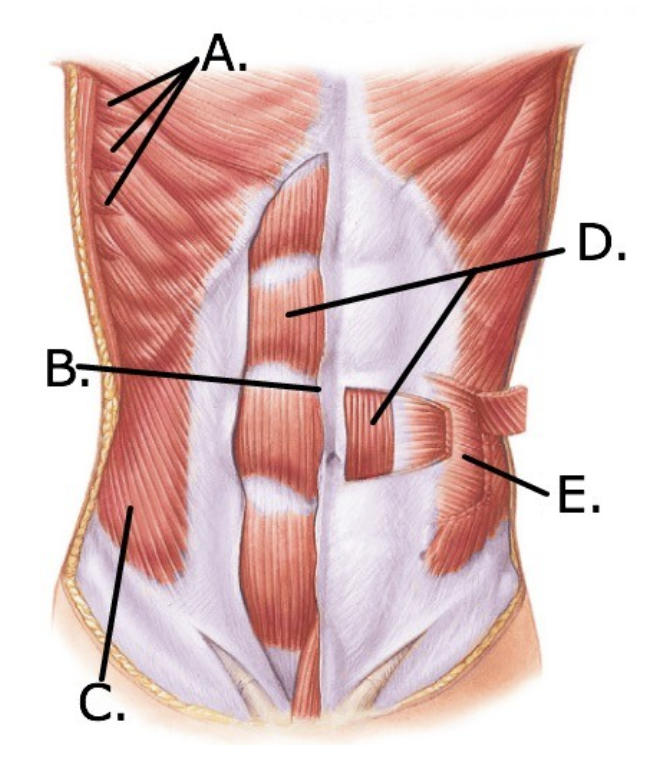
serratus anterior
247
what is B?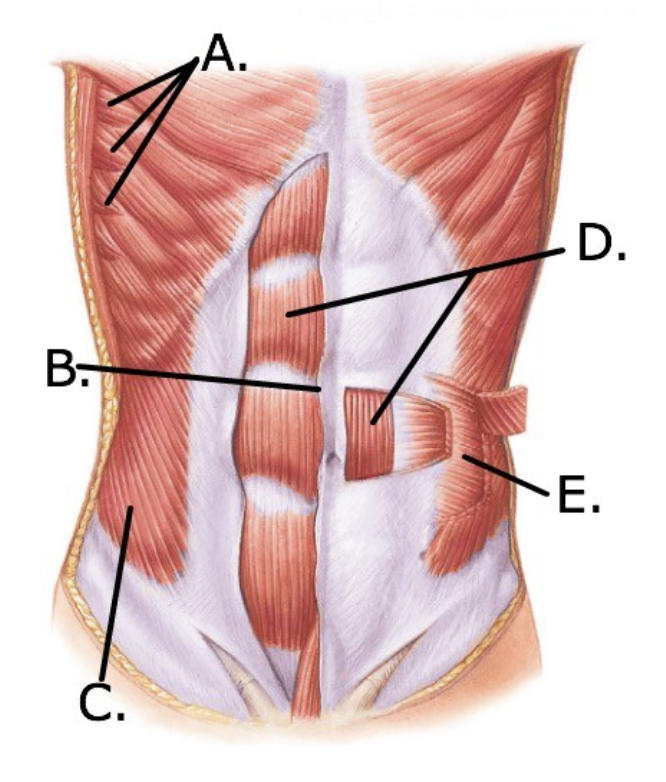
Linea alba
248
what is C?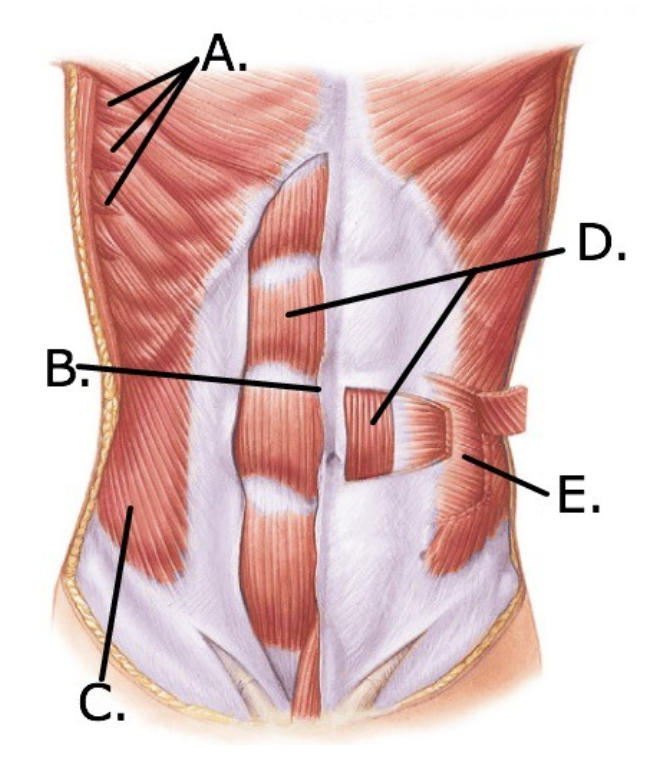
external oblique
249
what is D?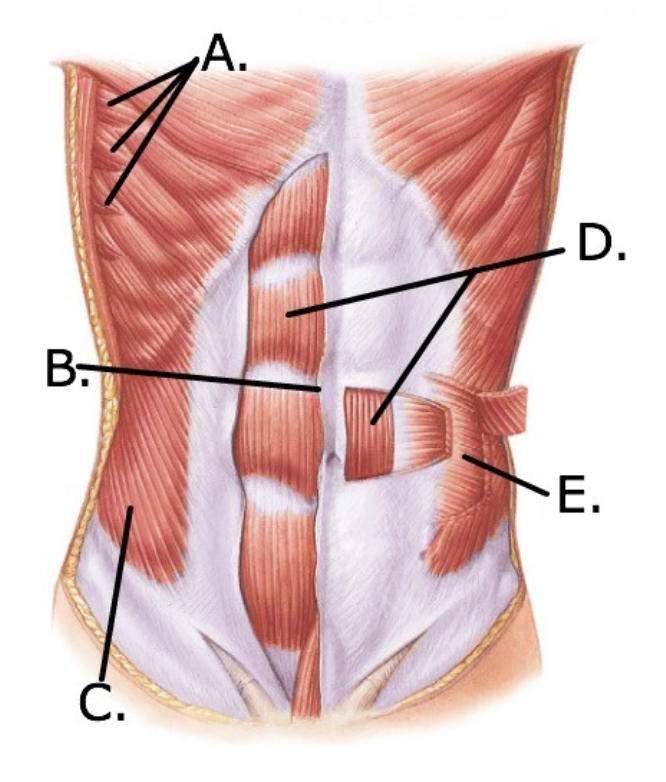
rectus abdominis
250
what is E?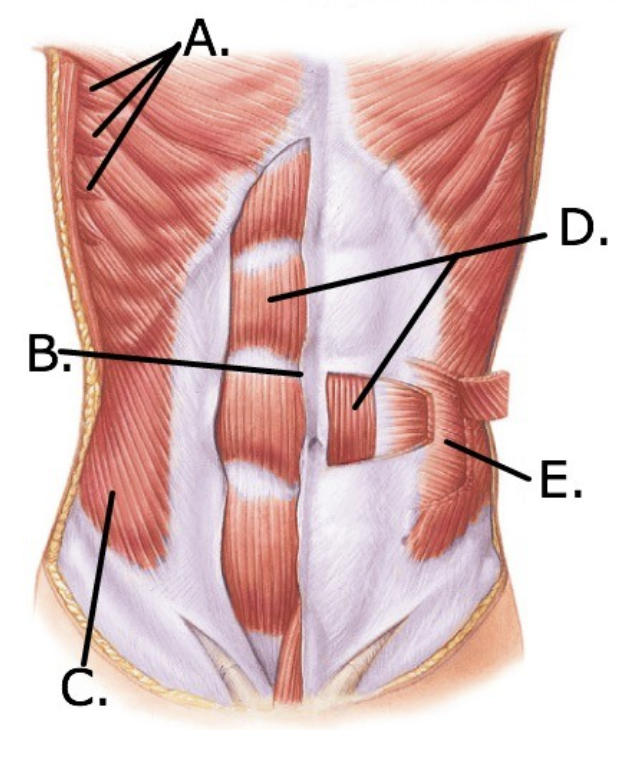
internal oblique
251
what is C?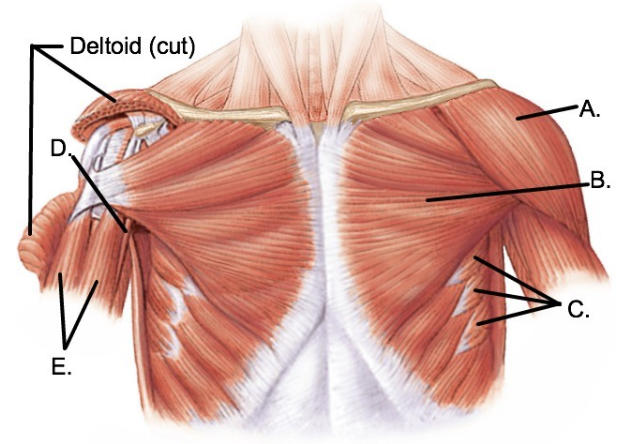
serratus anterior
252
what is D?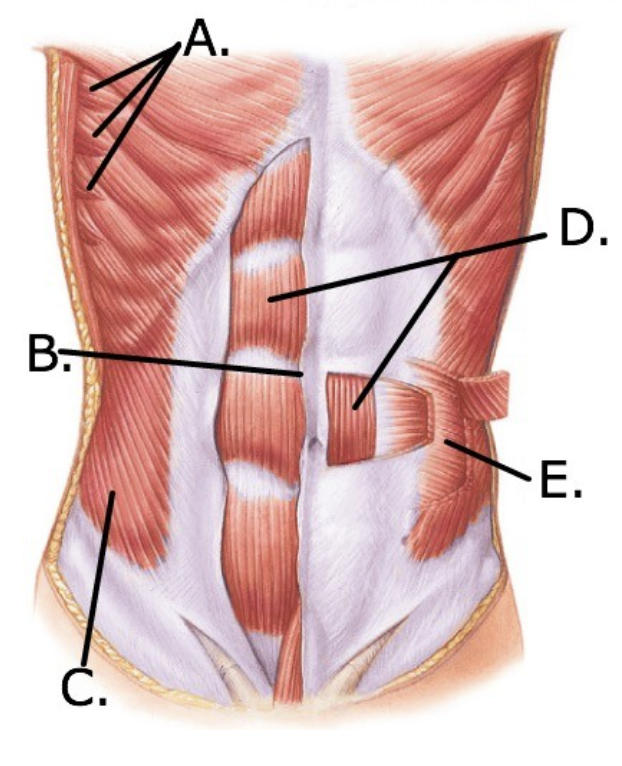
coracobrachialis
More Medicine & health flashcards
Top 200 Drugs: Counseling PointsMedicine & health · EnglishhikaruHepatic Failure, Encephalopathy, Alcohol Intoxication, GI BlMedicine & health · EnglishAImmunology: MHC and AntigensMedicine & health · EnglishJESSQTRANInmunologíaMedicine & health · SpanishLauraJoints and MovementMedicine & health · EnglishEshaAdaptations to PregnancyMedicine & health · EnglishSammieTop 250 Part 1Medicine & health · Englishplane23mail révision HTAMedicine & health · FrenchClaraNURSING THEORYMedicine & health · Englishan OutLearn studentGenetic Syndromes and InheritanceMedicine & health · EnglishAnshiyabone markingsMedicine & health · EnglishelijahRA 7305: Magna Carta of Public Health WorkersMedicine & health · EnglishALICE
Study these decks in the app
Free on iPhone, Android, Mac and the web. Add any deck to your account in one tap.

