ACG2021 Chapter 11 (Principles of Financial Accounting)
Study these flashcardsFree · spaced repetition · iPhone, Android, Mac & web
All cards
1
Three main characteristics of a liability
1. They occur because of a past transaction or event.
2. They create a present obligation for future payment of cash or services.
3. They are an unavoidable obligation.
2. They create a present obligation for future payment of cash or services.
3. They are an unavoidable obligation.
2
Current Liabilities vs Long-term liability
Current Liabilities must be paid within one year or within the entity’s operating cycle if the cycle is longer than a year.
ex)
Accounts Payable, Notes Payable due within one year, Salaries Payable, Interest Payable, Income Tax Payable and Unearned Revenue
Long-term Liabilities are liabilities that do not need to be paid within one year or within the entity’s operation cycle, whichever is longer.
ex)
Notes Payable
ex)
Accounts Payable, Notes Payable due within one year, Salaries Payable, Interest Payable, Income Tax Payable and Unearned Revenue
Long-term Liabilities are liabilities that do not need to be paid within one year or within the entity’s operation cycle, whichever is longer.
ex)
Notes Payable
3
1) What is Sales Tax?
2) Journal Entries
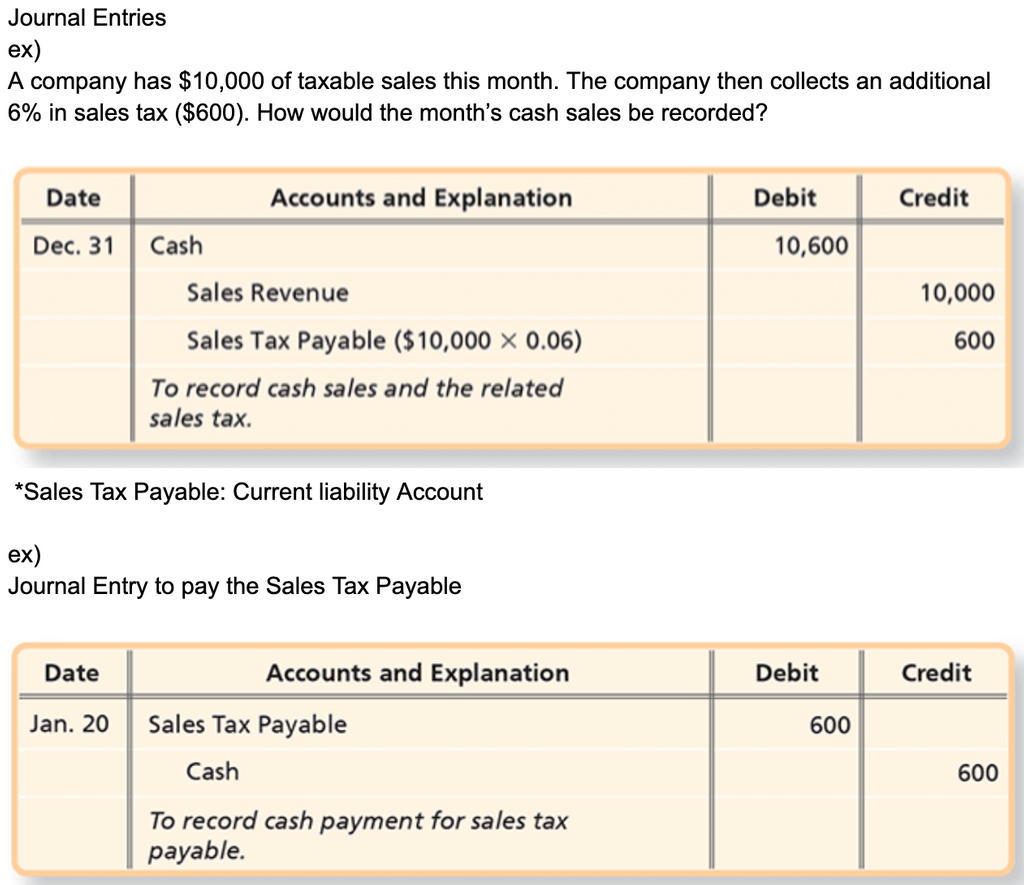
ex) A company has 10,000 of taxable sales this month.The company then collects an additional 600). How would the month’s cash sales be recorded?
ex) A company then pays off its Sales Tax Payable
2) Journal Entries
ex) A company has 10,000 of taxable sales this month.The company then collects an additional 600). How would the month’s cash sales be recorded?
ex) A company then pays off its Sales Tax Payable
1) Although Sales taxes are the responsibility of the retailer to pay, the retailer passes this cost onto the consumer.
4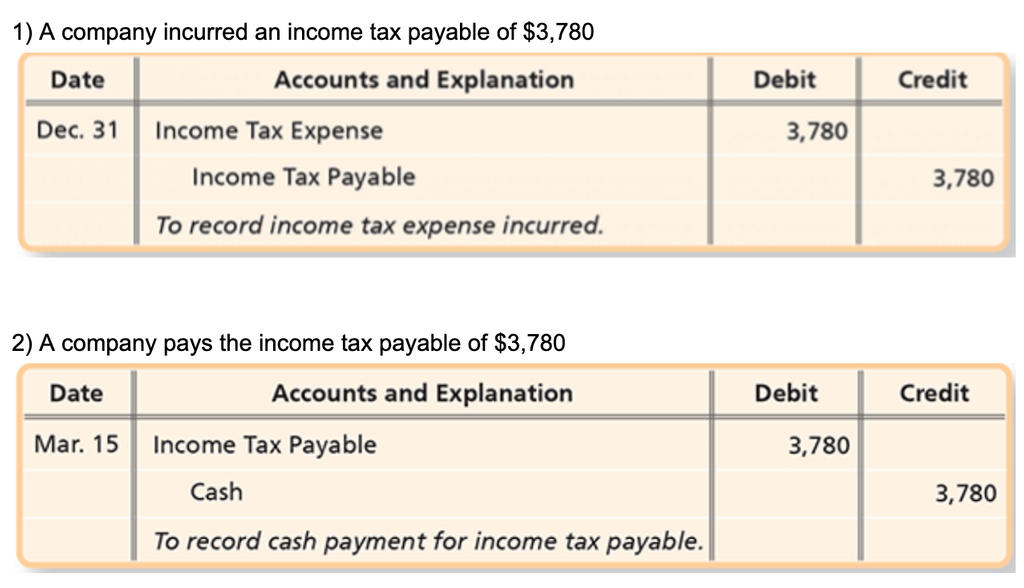
Income Tax Journal Entries
1) A company incurred an income tax payable of \$3,780
2) A company pays the income tax payable of \$3,780
1) A company incurred an income tax payable of \$3,780
2) A company pays the income tax payable of \$3,780
5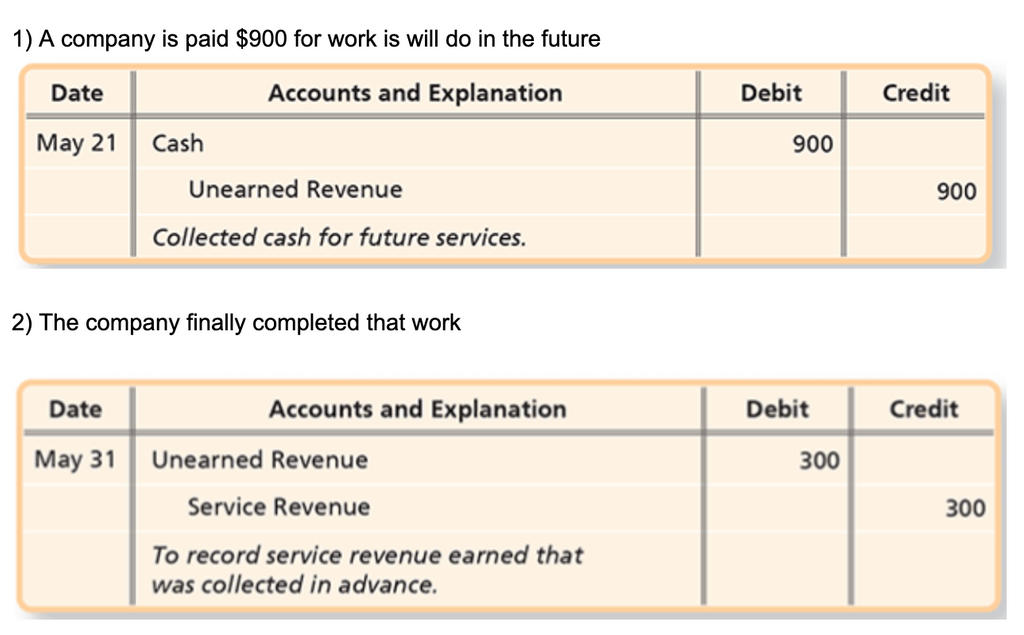
Unearned Revenue Journal Entries
1) A company is paid \$900 for work is will do in the future
2) The company finally completed that work
1) A company is paid \$900 for work is will do in the future
2) The company finally completed that work
6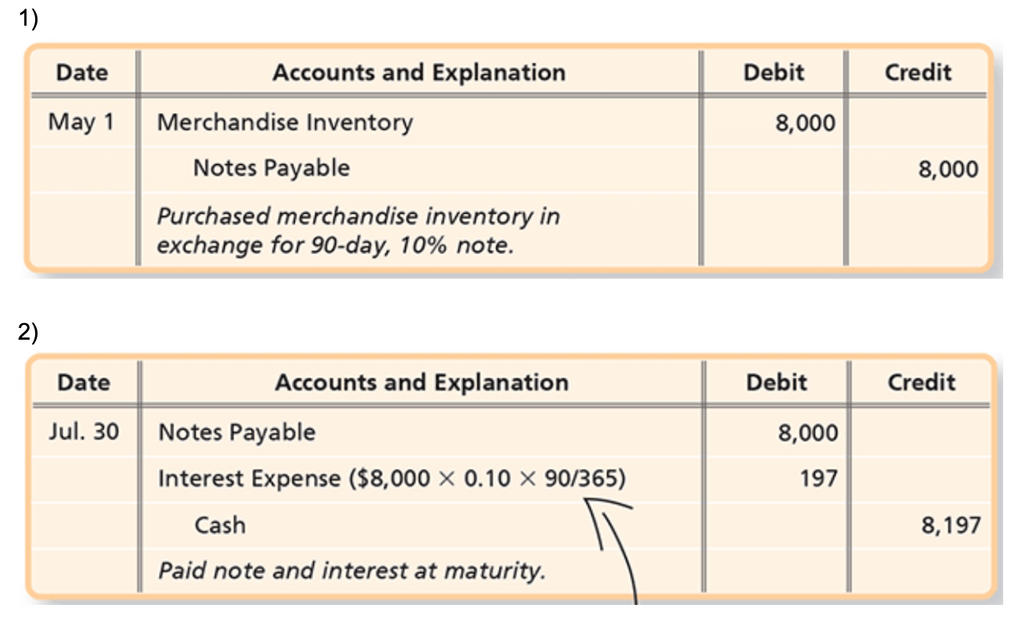
Short Term Notes Payable (for when the maturity date is in the same year)
ex)
1) On May 1, a company purchased merchandise inventory for 8,000 at 10% interest rate due in 90 days.
2)Then the company paid it off on July 30.
ex)
1) On May 1, a company purchased merchandise inventory for 8,000 at 10% interest rate due in 90 days.
2)Then the company paid it off on July 30.
7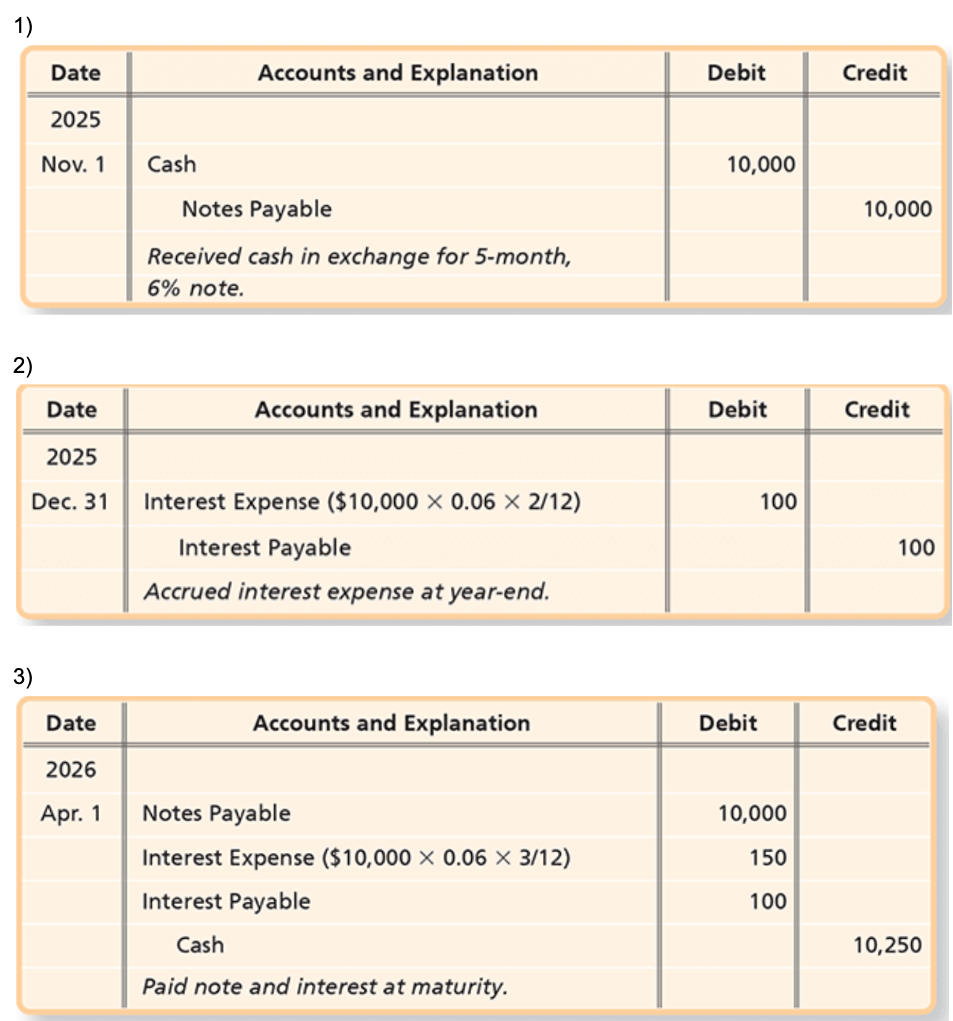
Short Term Notes Payable (for when the maturity date is next year)
ex)
A company borrows \$10,000 at 6% interest for five months, then they pay it all at the end. What are ALL the journal entries?
ex)
A company borrows \$10,000 at 6% interest for five months, then they pay it all at the end. What are ALL the journal entries?
8
Current Portion of Notes Payable
The amount of the principal that is payable within one year of the balance sheet date (Dec 31)
So, if you borrowed \$20,000 for 4 years, and gave \$5,000 each year, that \$5,000 you will give this year would be classified as a current liability. The other \$15,000 would be classified as a long-term liability.
So, if you borrowed \$20,000 for 4 years, and gave \$5,000 each year, that \$5,000 you will give this year would be classified as a current liability. The other \$15,000 would be classified as a long-term liability.
9
Straight-time vs Over Time
“Businesses pay employees at a base rate for a set period—called straight time. For additional hours—overtime—the employee may get a higher pay rate”
10
Gross Pay vs Net Pay
Gross Pay: The total amount of salary, wages, commission, bonuses and any other compensation earned deductions (Taxes would be included as a deduction)
Net Pay: Gross Pay minus deductions.
Net Pay: Gross Pay minus deductions.
11
Two types of Deductions
1) Required Deductions: Deductions that are required by federal, state or local laws. (ex, state income tax)
2) Optional Deductions: “including insurance premiums, retirement plan contributions, charitable contributions, and other amounts that are withheld at the employee’s request.”
2) Optional Deductions: “including insurance premiums, retirement plan contributions, charitable contributions, and other amounts that are withheld at the employee’s request.”
12
Federal Insurance Contribution Act (FICA)
The federal act that created social security tax.
Two parts
1. OASDI: Provides benefits based on old age, survivors, and disability insurance
2. Medicare: healthcare for people that are old or disabled
Two parts
1. OASDI: Provides benefits based on old age, survivors, and disability insurance
2. Medicare: healthcare for people that are old or disabled
13
Payroll Register
A schedule that summarizes the earnings, withholdings, and net pay for each employee.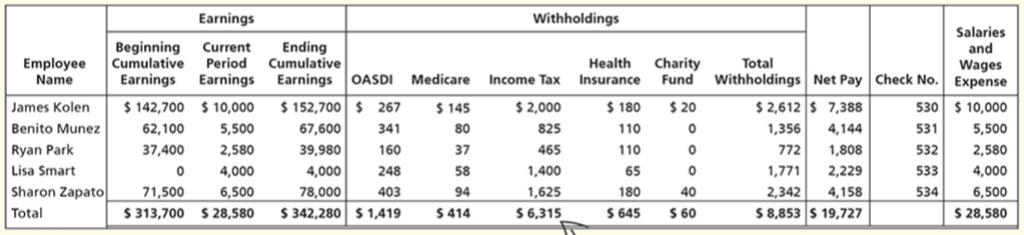
14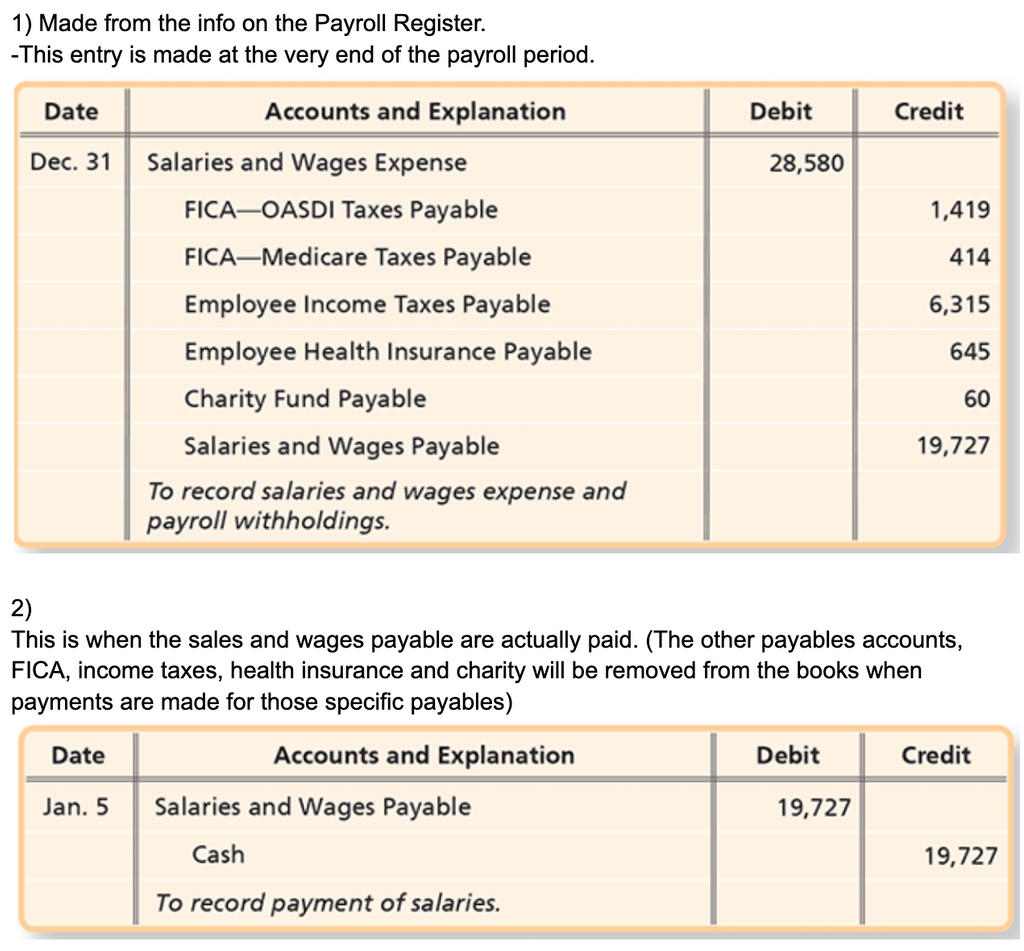
Journal Entries for Employee Payroll
15
Employer Payroll Tax
Employers must pay three payroll taxes. These taxes are not withheld from employees gross earnings but instead paid by the employer.
1. Employer FICA tax (OASDI & Medicare)
2. State unemployment compensation tax (SUTA)
3. Federal unemployment compensation tax (FUTA)
*Image shows “How Employer payroll taxes will be calculated”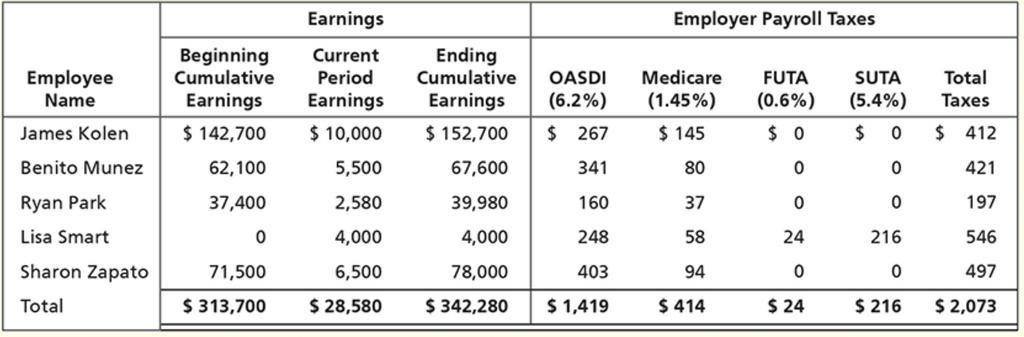
1. Employer FICA tax (OASDI & Medicare)
2. State unemployment compensation tax (SUTA)
3. Federal unemployment compensation tax (FUTA)
*Image shows “How Employer payroll taxes will be calculated”
16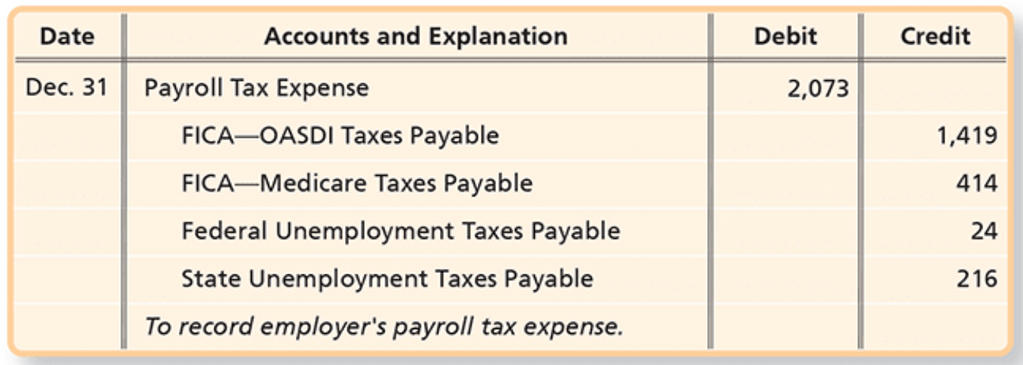
Journal Entry made at the end of the payroll period to record Employer Pay roll
17
Explain this journal Entry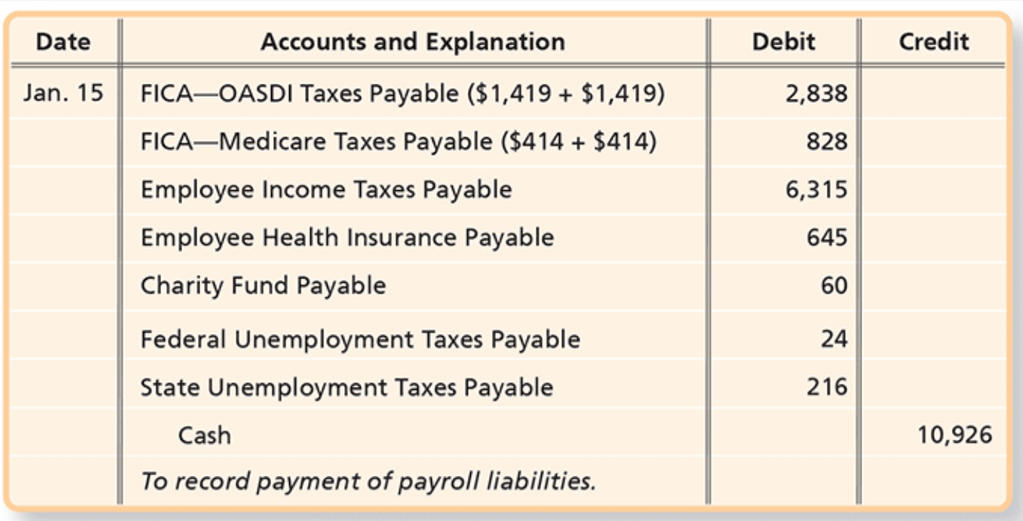
After the pay roll period ended on December 31st, on January 15th, the company is paying all its payables from the payroll of BOTH employer and employee payroll.
18
Internal Controls of Payroll
Main two
1. Controls for efficiency: All payroll processing is ideally done by computer processing.
2. Controls to Safeguard: Hiring and firing employees should be separate from accounting and from passing checks. (Someone could “hire” a fictitious person and just keep the checks themselves)
1. Controls for efficiency: All payroll processing is ideally done by computer processing.
2. Controls to Safeguard: Hiring and firing employees should be separate from accounting and from passing checks. (Someone could “hire” a fictitious person and just keep the checks themselves)
19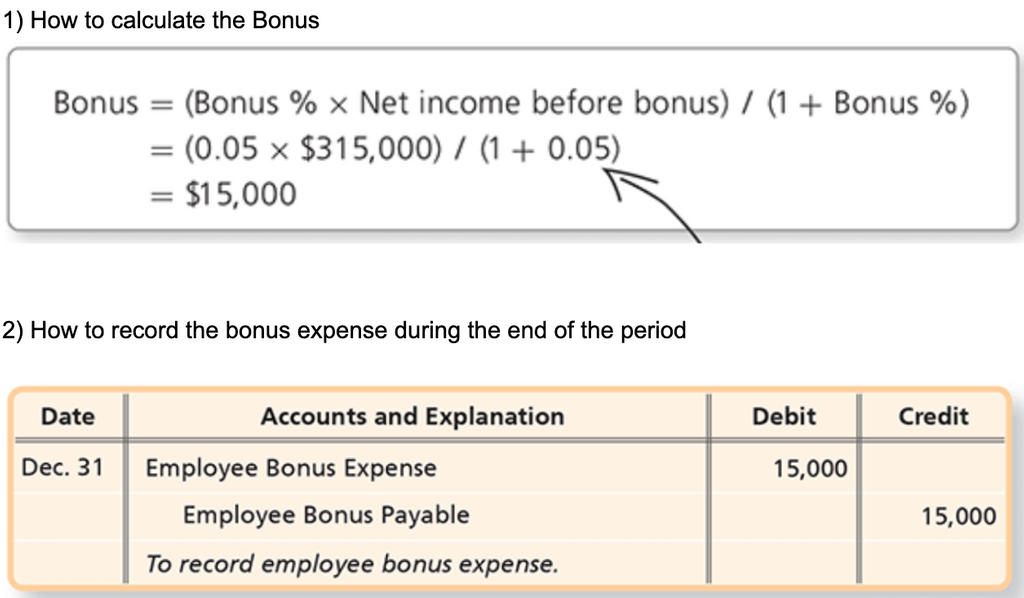
At the end of the period, due to the matching principle, expenses must be recorded when incurred. But, they don’t know exactly how much they have to give in bonuses. So, they have to estimate it.
1)How do they estimate it?
2) How do they record that expense?
1)How do they estimate it?
2) How do they record that expense?
20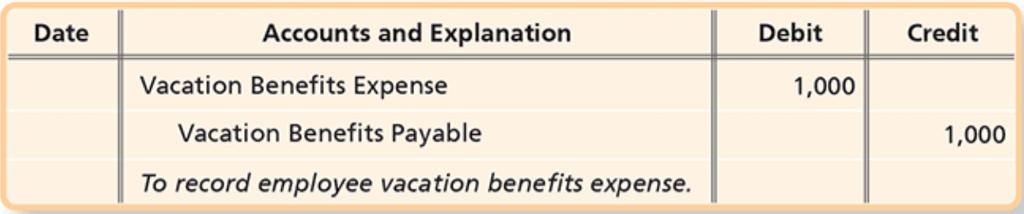
How to record vacation expense during the end of the period (But, your obviously going to pay for it after the period ends)
21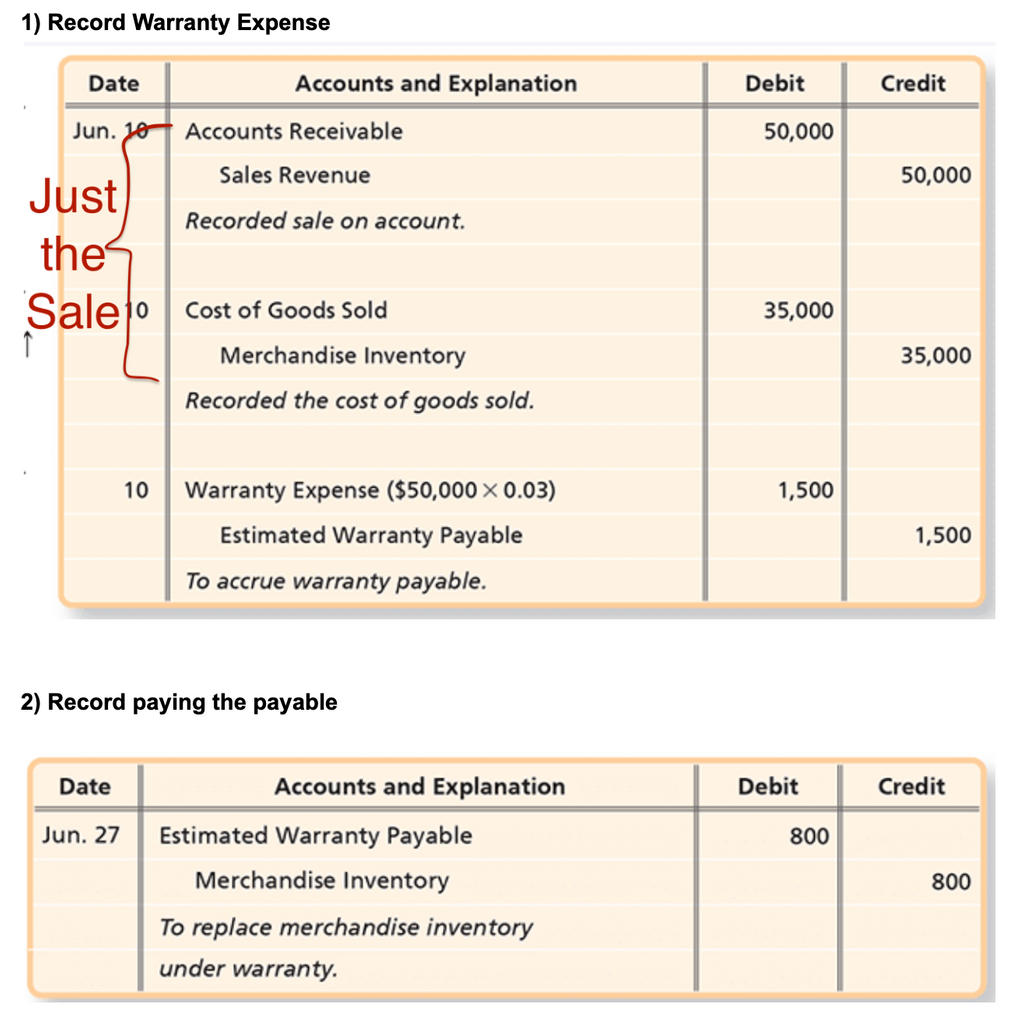
How to record warranties expense during the end of the period (Since you have to record the expenses when they are incurred)
22
What is a contingent Liability? How to report on financial statements?
A potential liability that depends on a future event.
ex)
The company gets sued. They may lose the lawsuit, and have to pay 500,000, but the outcome hasn’t been determined.
3 Types
1. Remote
2. Reasonably Possible
3. Probable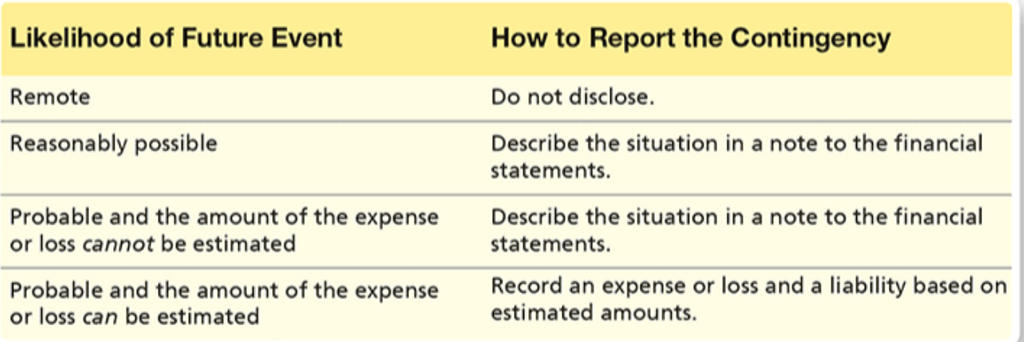
ex)
The company gets sued. They may lose the lawsuit, and have to pay 500,000, but the outcome hasn’t been determined.
3 Types
1. Remote
2. Reasonably Possible
3. Probable
23
Times-interest-earned ratio
Evaluate a business's ability to earn interest. The ratio measures the number of times earnings before interest and taxes can cover interest expense.
The equation is EBIT (earnings before interest & taxes) and interest expense.
Times-interest-earned ratio = (Net Income + Income Tax expense + Interest expense) / Interest Expense
The equation is EBIT (earnings before interest & taxes) and interest expense.
Times-interest-earned ratio = (Net Income + Income Tax expense + Interest expense) / Interest Expense
24
Liabilities!
"probable future sacrifices of economic benefits arising from past transactions"
Liabilities!
More Business & economics flashcards
Auditing Exam 2 NotesBusiness & economics · EnglishwowiepowE2 Leadership & ManagementBusiness & economics · EnglishEllaMan Acc FinalBusiness & economics · EnglishLexieBUSN 325 Digital Marketing Midterm Business & economics · EnglishOwenMineral Resources (2)Business & economics · EnglishNecole03Aggregate demandBusiness & economics · Englishan OutLearn studentDSP Module 1-4 -- Cumulative ExamBusiness & economics · EnglishZackJChapter 9 The Entrepreneurial FirmBusiness & economics · Englishbevo612Aeronautical Decision MakingBusiness & economics · EnglishSamuelMicroeconomicsBusiness & economics · EnglishJShin05CPA Review - Financial AccountingBusiness & economics · EnglishyamlambsC425 Healthcare Management and PolicyBusiness & economics · Englishnightmare
All Business & economics decks
Study these decks in the app
Free on iPhone, Android, Mac and the web. Add any deck to your account in one tap.

