ACG2021 Chapter 3 (Principles of Financial Accounting)
Study these flashcardsFree · spaced repetition · iPhone, Android, Mac & web
All cards
1
1. Cash Basis Accounting
2. Accural Basis Accounting
Two methods of accounting
1. Cash Basis Accounting
2. Accural Basis Accounting
2
Cash Basis Accounting
You only record cash flow. When cash is received, revenues are recorded. When cash is paid, expenses are recorded.
*This does not follow GAAP but many small business use it since its simplicity
*This does not follow GAAP but many small business use it since its simplicity
3
Accural Basis Accounting
It only records revenue if it has been earned and only records expenses if they have been incurred.
"Incurred" means the business has received the benefit
ex)
-So, if I paid for next months electricity, it is considered an asset until I "incur" or use that electricity.
-So, if workers worked the last week of december, and I pay them in january, the expense is incurred in December since them working created an obligation that I have to pay them.
*This follows GAAP
"Incurred" means the business has received the benefit
ex)
-So, if I paid for next months electricity, it is considered an asset until I "incur" or use that electricity.
-So, if workers worked the last week of december, and I pay them in january, the expense is incurred in December since them working created an obligation that I have to pay them.
*This follows GAAP
4
Time Period concept
Assumes that business activities can be sliced into time segments and that financial statments can be prepared for a specific period
5
Fiscal Year
An accounting year of any 12 consecutive months that may or may not concide with the calendar year
6
Revenue Recognition Principle
The revenue recognition principle tells accountants when to record revenue and requires companies follow a five-step process:
1. Identify the contract with the customer
2. Identify the performance obligation in the contract.
-What good or service does the business have to provide
3. Determine the transaction price
-What amount of revenue does the business get
4.Allocate the transaction price to the performance obligations in the contract. If the transaction has multiple performance obligations, the transaction price will need to be allocated among the different performance obligations.
5.Recognize revenue when the entity satisfies each performance obligation
1. Identify the contract with the customer
2. Identify the performance obligation in the contract.
-What good or service does the business have to provide
3. Determine the transaction price
-What amount of revenue does the business get
4.Allocate the transaction price to the performance obligations in the contract. If the transaction has multiple performance obligations, the transaction price will need to be allocated among the different performance obligations.
5.Recognize revenue when the entity satisfies each performance obligation
7
Matching Principle
(Sometimes called the expense recognition principle)
Guides accoutning for expenses and ensures
1.All expenses are recorded when they are incurred during a period
2.You record an expense at the same time that expense helped generate revenue
ex)
1.If I buy 1200 of insurance for next year, for each passing month, \$100 will be recorded as an expense.
2.If you buy \$60 shoes on December and sell them for \$100 in January. That expense of shoes is recorded will be recorded in January. The shoes in december are recorded as an asset.
Guides accoutning for expenses and ensures
1.All expenses are recorded when they are incurred during a period
2.You record an expense at the same time that expense helped generate revenue
ex)
1.If I buy 1200 of insurance for next year, for each passing month, \$100 will be recorded as an expense.
2.If you buy \$60 shoes on December and sell them for \$100 in January. That expense of shoes is recorded will be recorded in January. The shoes in december are recorded as an asset.
8
Adjusting Entry
An entry made at the end of the accounting period that is used to record revenue in the period they are earned and record expenses in the period they are incurred.
9
Defferals
In a deferral's, the cash payment occurs before an expense is incurred or the cash receipt occurs before the revenue is earned.
*So cash is given or recieved, but the exepense or rveenue is delayed
*So cash is given or recieved, but the exepense or rveenue is delayed
10
accurals
An accrual records an expense before the cash is paid, or it records the revenue before the cash is received.
*You incured an expense before it was paid
*You got accured revenue
*No cash
*You incured an expense before it was paid
*You got accured revenue
*No cash
11
Four types of adjustment entries
1. Deferred expenses (deferral)
2. Deferred revenues (deferral)
3. Accrued expenses (accrual)
4. Accrued revenues (accrual)
2. Deferred revenues (deferral)
3. Accrued expenses (accrual)
4. Accrued revenues (accrual)
12
Deferred Expeneses
*Also called, prepaid expenses
"They are deferrals because the expense is not recognized at the time of payment but deferred until they are used up. Such payments are considered assets rather than expenses until they are used up."
"They are deferrals because the expense is not recognized at the time of payment but deferred until they are used up. Such payments are considered assets rather than expenses until they are used up."
13
Plant Assets
Property, Plant and Equipment
-Long lived, tangible assets, such as land, buildings, and equipment used in the operation of a business
-Long lived, tangible assets, such as land, buildings, and equipment used in the operation of a business
14
The process at which a business spreads the cost of plant asset's over its useful life
The useful life is a just a reasonable estimate.
*This is to help record expenses when incurred in accrual accounting
Deprication
The process at which a business spreads the cost of plant asset's over its useful life
The useful life is a just a reasonable estimate.
*This is to help record expenses when incurred in accrual accounting
15
Residual Value
The expected value of a depreciable asset at the end of its useful life.
16
Straight Line method
A method to calculate depreciation
(Cost - Residual Value) / Useful Life
ex)
A company buys furniture for \$18,000, but after 5 years believes that the furniture will be worth nothing.
(\$18,000 - \$0)/5 years
\$3,6000 expense per year
(Cost - Residual Value) / Useful Life
ex)
A company buys furniture for \$18,000, but after 5 years believes that the furniture will be worth nothing.
(\$18,000 - \$0)/5 years
\$3,6000 expense per year
17
How to record a depriciaition
Lets say you buy furnture where would it be depcricated?
Lets say you buy furnture where would it be depcricated?
It WOULD NOT be a decrease in the furitnute (asset) account. You still need to follow the cost principle.
Instead, you can record the in a separate Accumulating depreciation account (asset account) .
This account increases over time and has a normal credit balance.
*In a balance sheet, the account will be subtracted from the asset amount
Instead, you can record the in a separate Accumulating depreciation account (asset account) .
This account increases over time and has a normal credit balance.
*In a balance sheet, the account will be subtracted from the asset amount
18
Contra Account
1)A contra account is paired with and is listed immediately after its related account in the chart of accounts and associated financial statement.
2) A contra account’s normal balance (debit or credit) is the opposite of the normal balance of the related account.
ex)
Accumulating depreciation account would be the contra account to the furniture account.
2) A contra account’s normal balance (debit or credit) is the opposite of the normal balance of the related account.
ex)
Accumulating depreciation account would be the contra account to the furniture account.
19
A depicrable assets cost minus accululated depreciation
Book Value
A depicrable assets cost minus accululated depreciation
20
Are adjusting entries only made at the end of the accounitng period?
Yes
21
Amount of interest FORMULA
Amount of interest = Principle x Interest Rate x Time
22
Revenue which as been earned, but is yet to gte collected
accured revenue
Revenue which as been earned, but is yet to gte collected
23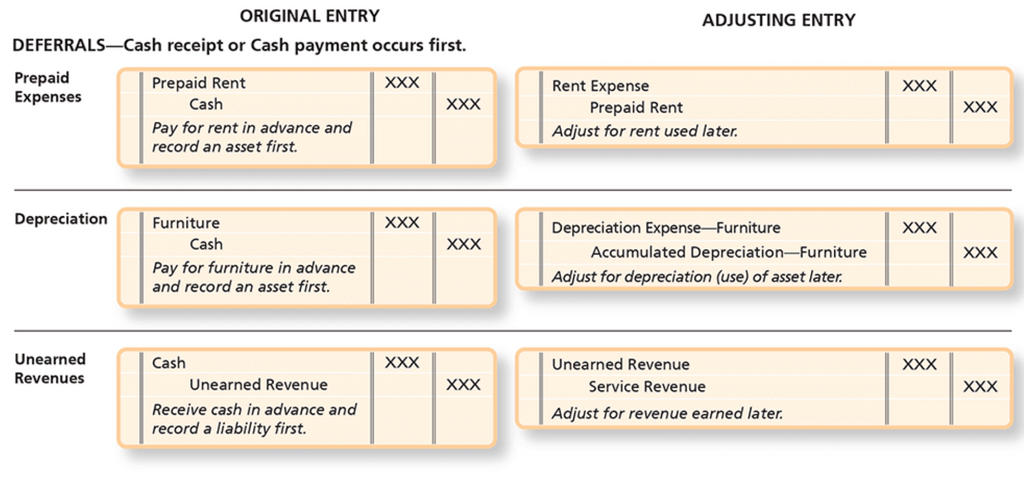
Deferrals, main three
24
Two rules of adjusting Entries
1) They NEVER involve cash
2)Adjusting entries either
-Increase a revenue account (credit revenue)
-or, Increase an expense account (debit expense)
2)Adjusting entries either
-Increase a revenue account (credit revenue)
-or, Increase an expense account (debit expense)
25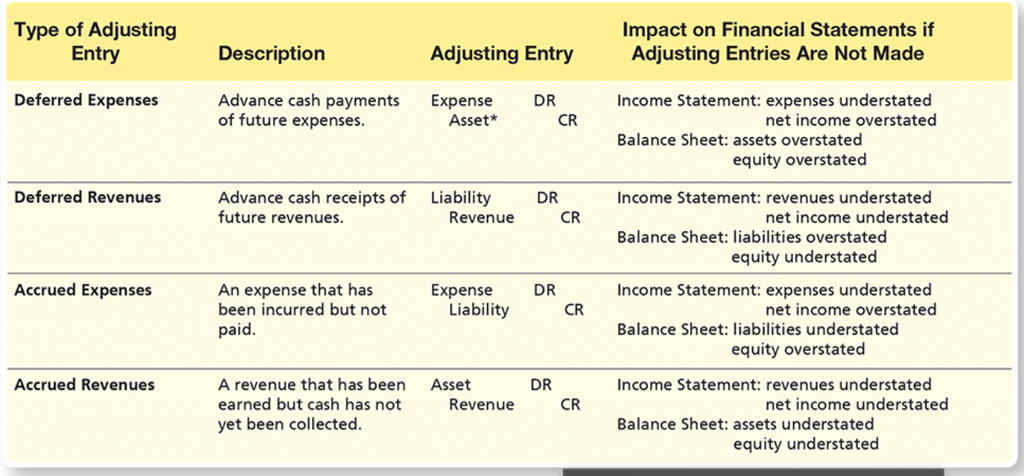
The effect of not adjusting entries on financial statmenta table
26
Deprication EXPENSE (you forgot)
Accumulated Deprication - Building
If a building is experceing depreication, what is reocrded
Deprication EXPENSE (you forgot)
Accumulated Deprication - Building
27
Step 5: Business journalize and post adjusting entries to record revenues to the period in which they are earned and the expenses to the period in which they occur.
Step 6: Prepare the adjusted trial balance
Accounting Cycle (This chapter, you learned step 5. and 6.)
Step 5: Business journalize and post adjusting entries to record revenues to the period in which they are earned and the expenses to the period in which they occur.
Step 6: Prepare the adjusted trial balance
28
Worksheet
A worksheet is an internal document that helps summarize data for the preparation of the financial statements.
-IT IS NOT a journal, ledger or any other financial documents. It only helps prepare financial statements.
-IT IS NOT a journal, ledger or any other financial documents. It only helps prepare financial statements.
29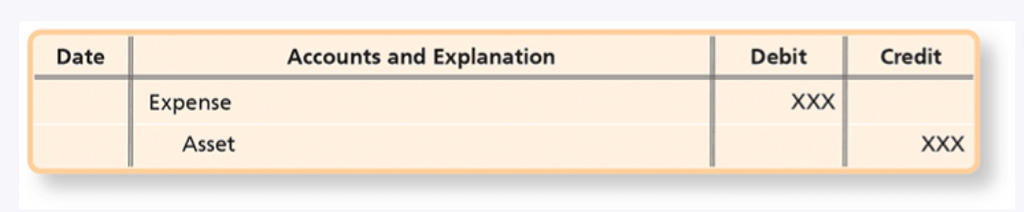
Journal Entry of Deffered Expenses
30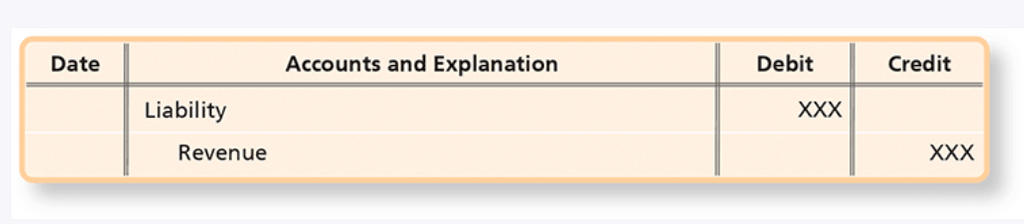
Journal Entry of Deffered Revenue
31
Journal Entry of Accural Expenses
32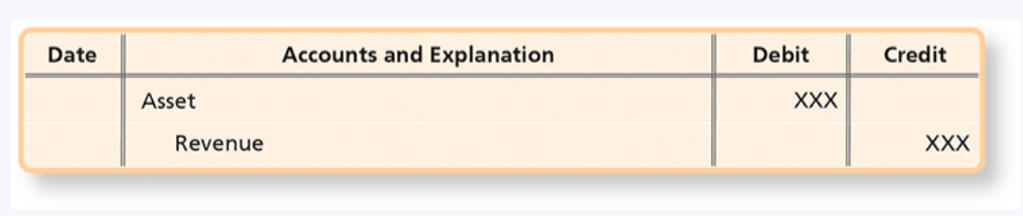
Journal Entry of Accural Revenue
33
The company will use the adjument trail balane to ___________.
preprare financial statements.
More Business & economics flashcards
BA 11: Introduction to Management and MarketingBusiness & economics · EnglishJanineBusiness ActivityBusiness & economics · EnglishHriteshECON Exam 2Business & economics · EnglishJosh4 Role of the Marketing PlanBusiness & economics · EnglishJohnFin 332 Midterm Chaps 3-4Business & economics · Englishmattmc03Chapter 4 Vocab - Global BusinessBusiness & economics · Englishbevo612H5 Marketingbeleid en organisatieBusiness & economics · DutchDemiBChapter 11 Vocab - Marketing ManagementBusiness & economics · Englishbevo612Chap 13, 15, 17 Finance FinalBusiness & economics · Englishmattmc03TaxBusiness & economics · EnglishEllaCalifornia Real Estate ExamBusiness & economics · Englishan OutLearn studentBusiness Management Theme 3Business & economics · EnglishDsobo
All Business & economics decks
Study these decks in the app
Free on iPhone, Android, Mac and the web. Add any deck to your account in one tap.

