ACG2021 Chapter 2 (Principles of Financial Accounting)
Study these flashcardsFree · spaced repetition · iPhone, Android, Mac & web
All cards
1
An account is the detailed record of all increases and decreases that have occurred in an individual asset, liability, or equity during a specified period
Account
An account is the detailed record of all increases and decreases that have occurred in an individual asset, liability, or equity during a specified period
2
An economic resource that are expected to benefit the business in the future
Asset
An economic resource that are expected to benefit the business in the future
3
Accounts Recivable
A customer promises to pay in the future. Listed as an asset
4
Notes Recievable
A customer promises to pay a fixed amount of money (principle) and interest
5
A payment of an expense in advance. It is considered an asset since it is an economic resources that provides an expected benefit to the business in the future.
ex)
You spend \$1,200 on house insurance. This is considered an asset.
But, ever month \$100 goes to insurance expense.
Prepaid Expense
A payment of an expense in advance. It is considered an asset since it is an economic resources that provides an expected benefit to the business in the future.
ex)
You spend \$1,200 on house insurance. This is considered an asset.
But, ever month \$100 goes to insurance expense.
6
Libaility
Debt, something a business owes
7
Account Payable
(Include examples)
(Include examples)
A promise made by the business to pay a debt in the future.
*Money you owe and you have recieved an invoice.
ex), Suppliers & Utilites; that is because these usually aways have an invoice
*Money you owe and you have recieved an invoice.
ex), Suppliers & Utilites; that is because these usually aways have an invoice
8
Notes Payable
A promise made by a business to pay a debt, usually involving interest, in the future
9
Accured Liability
(Include Examples)
(Include Examples)
A promise made by the business to pay a debt in the future.
*Money you owe even tough no invoice exist
ex)Wages, Interest, Taxes; You owe this money, but you will not receive an invoice
*Money you owe even tough no invoice exist
ex)Wages, Interest, Taxes; You owe this money, but you will not receive an invoice
10
Occurs when a company recives cash from a cosutomer but as not yet provided the good or serviuce.
LIABILITY
Unearned Revenue
Occurs when a company recives cash from a cosutomer but as not yet provided the good or serviuce.
LIABILITY
11
Chart of Accounts
Things to keep in mind
-The number system for accounts differs from each business
-Account numbers are just short-hand versions for the account
-It is typical though that Assets are 1, Liabilities are 2, Equity is 3, Revenue is 4 and Expenses are 5.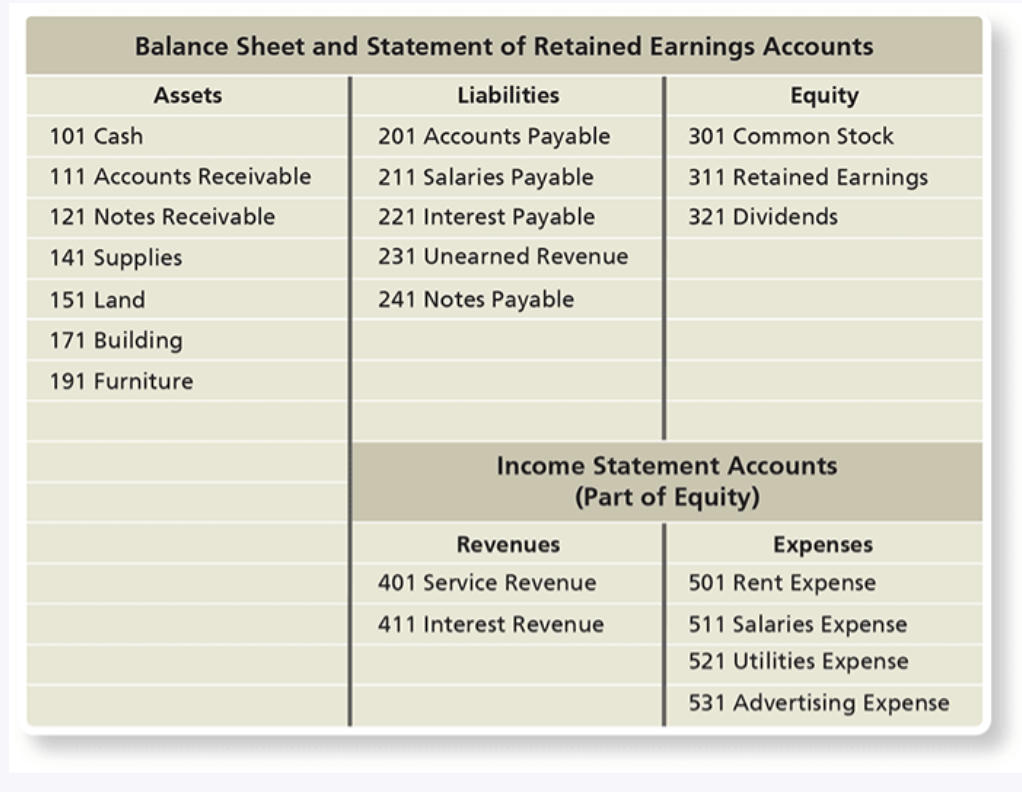
-The number system for accounts differs from each business
-Account numbers are just short-hand versions for the account
-It is typical though that Assets are 1, Liabilities are 2, Equity is 3, Revenue is 4 and Expenses are 5.
12
Ledger
A ledger is similar to a chart of accounts but also includes the changes in those accounts.
So a ledger as all the accounts, the account numbers, just like a chart of accounts.
But, a ledger also includes the changes in the balance of those accounts and contians a detialed record of transations from those accounts
So a ledger as all the accounts, the account numbers, just like a chart of accounts.
But, a ledger also includes the changes in the balance of those accounts and contians a detialed record of transations from those accounts
13
Double Entry system
A system in accounting where in which ever transaction effects at least two accounts
ex)You buy land
Cash (Goes down)
Land (Goes up)
ex)You buy land
Cash (Goes down)
Land (Goes up)
14
T-account
A way to seperate the left side and the right side the accounting equation
1)A way to seperate the account increasing and the account decreasing
2)A way to make sure the accounting equation always stays balances.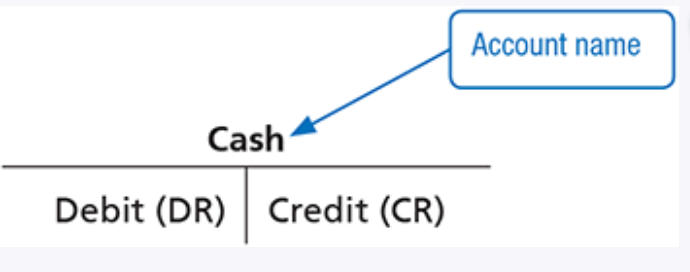
1)A way to seperate the account increasing and the account decreasing
2)A way to make sure the accounting equation always stays balances.
15
Increaes and decreases in T-Accounts inthe Accounting equation
So, if you were to record a transaction in the Asset section, if it were to increased the asset, then it woud go into the debit side on the left.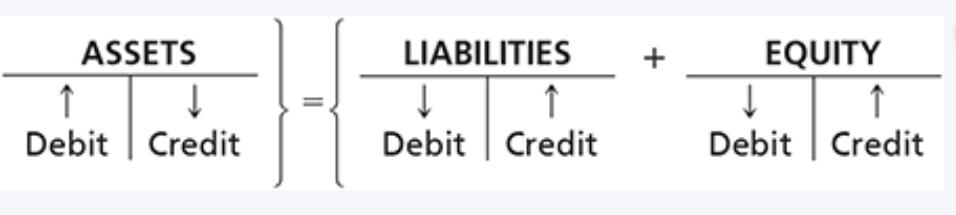
16
Increase and decreases in T-Accounts in the Expanded Accounting equation
Dividends and Expenses both and a increase for debit and a decrease for credit.
This is because they both decrease Equity
This is because they both decrease Equity
17
The "normal balance" of an T-account is the side that makes the account increase
ex) The normal balance of the Asset account is debit.
Normal Balance
The "normal balance" of an T-account is the side that makes the account increase
ex) The normal balance of the Asset account is debit.
18
If your cash account as a "Credit Balance", what does that mean
It means you withdrawed more money than was comming in. Your balance is negative.
*(In the T-account, the credit is higher than the debit)
*(In the T-account, the credit is higher than the debit)
19
If your land account as a "Credit Balance", what does that mean
You made a mistake. You can't have negative land.
20
If your Accounts payable account as a debit balance
You have more money leaving for that account, then coming in.
The credit side increases when I get the Account Payable. When I pay it, it should be that exact amount.
If I over pay it, then the account becomes a debit balance. More money leaving then coming in. Thats a problem
The credit side increases when I get the Account Payable. When I pay it, it should be that exact amount.
If I over pay it, then the account becomes a debit balance. More money leaving then coming in. Thats a problem
21
What increase equity and what decreases equity
Increases Equity: Revenue and Common Stock
Decreases Equity: expenses and Dividends
Decreases Equity: expenses and Dividends
22
How to detemrine the balance of a T-account
1)Add both from the right side and add then all from the left side.
2)Then subtracting the smaller number from the larger number
3)The balance is always put on the side with the highest number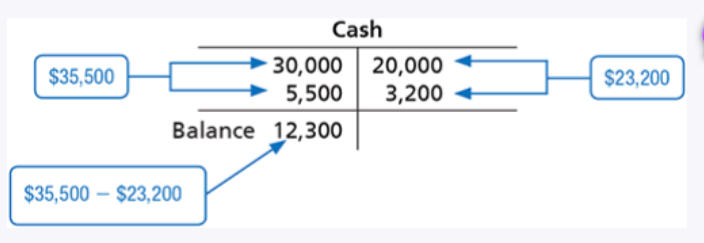
2)Then subtracting the smaller number from the larger number
3)The balance is always put on the side with the highest number
23
How to determine if a change would be recoreded as a credit (CR) or a debit (DR).
1) Which of the six does it belong too
2) Does it decrease of increase the account. If cash increased, then it would increase an asset, and therefore be recorded as a debit.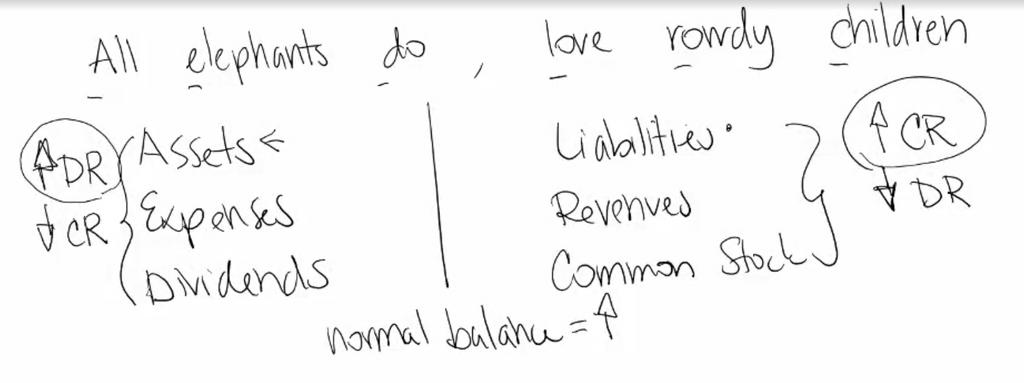
2) Does it decrease of increase the account. If cash increased, then it would increase an asset, and therefore be recorded as a debit.
24
Would the change be recoreded as a credit (CR) or a debit (DR)
↑ Interest Revenue
↑ Interest Revenue
Asstes, Expenses, Dividends, Liabilites, Revenues, Common Shares
It would be a Revenue. And it would increase it and that would be a credit
answer: CREDIT (CR)
It would be a Revenue. And it would increase it and that would be a credit
answer: CREDIT (CR)
25
Source documents
Provides the evidence and data for accounting transactions
26
Invoices
Documents that tell the business how much and when to pay a vendor for purchases on account
27
Journal
A record of transactions in date order
28
Posting
Transferring Data from the Journal to the Ledger
29
Compound Jounral Entry
A journal entry that is characterized by having mutliple debtis and/or mutliple credits
30
Four-Column Account
(Also, re-explain what a T-account looks like and what a four-colum account looks like)
(Also, re-explain what a T-account looks like and what a four-colum account looks like)
An alternative to the T-account. It also shows the running balance. It is typically used more often compared to the T-account since it offers more information.
*Post ref. is related to posting. In a computerized system, if you cliked on it, it would show you the related journal entry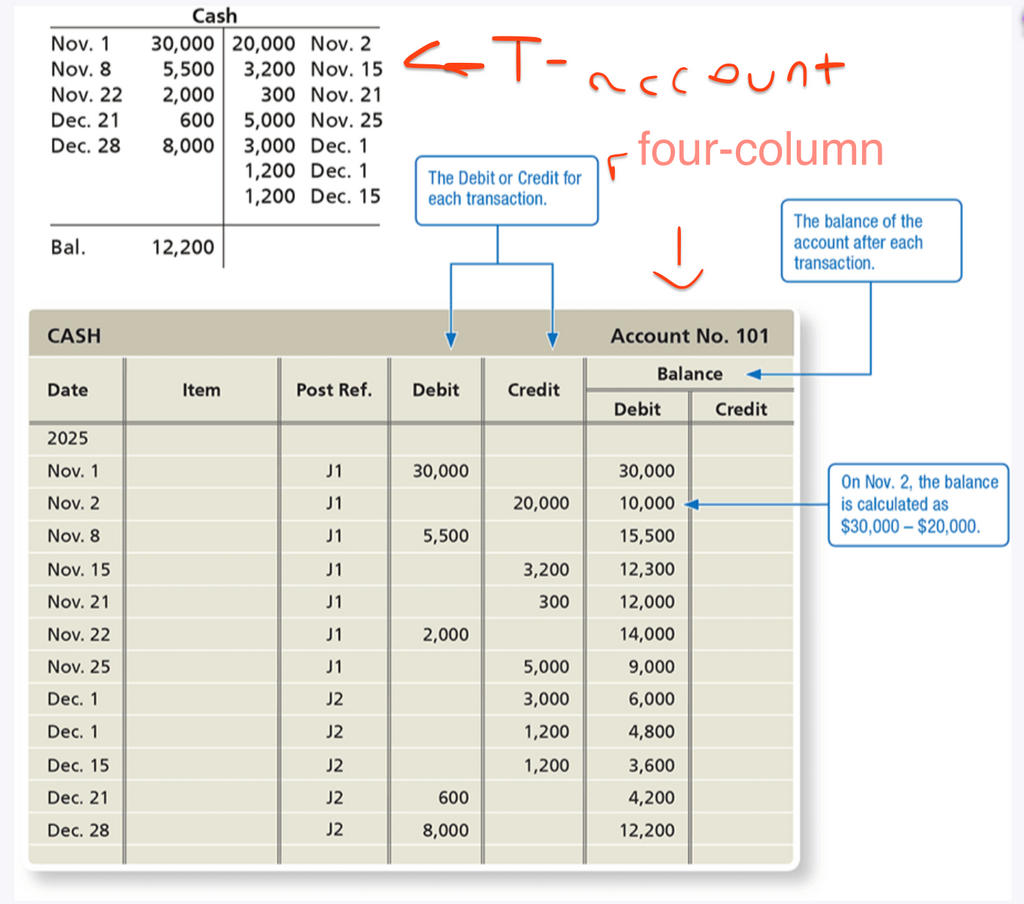
*Post ref. is related to posting. In a computerized system, if you cliked on it, it would show you the related journal entry
31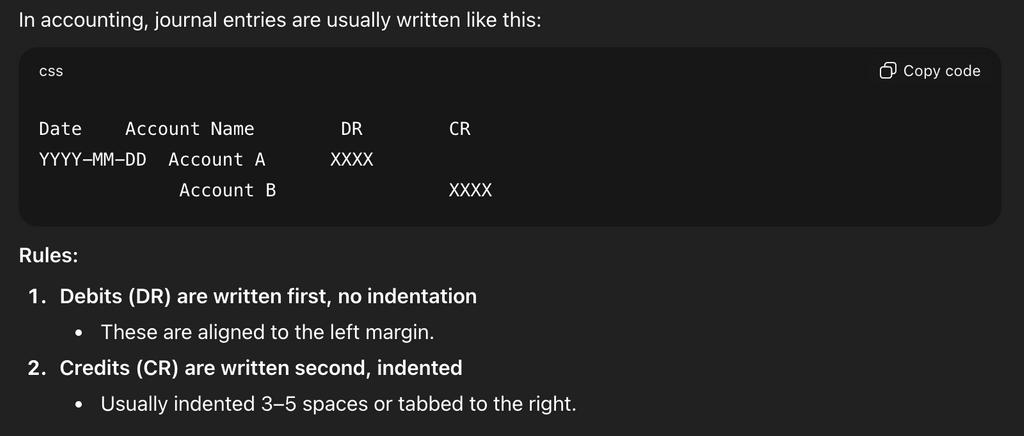
How are journal entries typically written?
32
Trial Balance
A trail balance summarizes the ledger by listing all the accounts and their balances. Assets first, then liabilities and then Equity.
The purpose is to add up all the debits and credits and see if they are equal to each other. If they are not, a mistake as been made.
*It says "unadjusted Trial Balance" for some reasons we will learn next chapter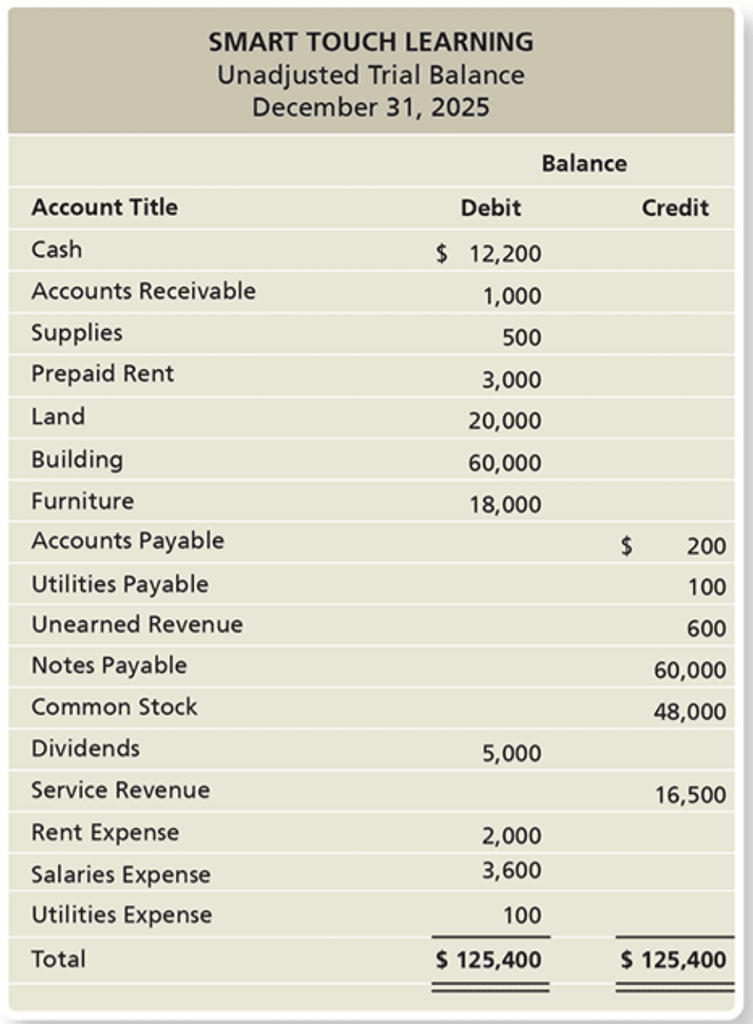
The purpose is to add up all the debits and credits and see if they are equal to each other. If they are not, a mistake as been made.
*It says "unadjusted Trial Balance" for some reasons we will learn next chapter
33
Writing 1,000 as 100
Slide error
Writing 1,000 as 100
34
Transposition
Writing 1,200 as 2,100
35
In a trail balance, if the debits and credits are equal, does that mean there are no errors..
In a trail balance, if the debits and credits are equal, does that mean there are no errors..
.NO!-There is still a possibility of an error
36
Accounting Cycle form the financial documents
Accounting Cycle form the financial documents
1. Charts of Account
-Defines which accounts exist and their codes
2. Journal
-Analyze source documents and record on here
3. Ledger
-Data from the Journal is "posted" onto the ledger. The ledger includes a running balance.
4. T-accounts / Four-column account
-These are two formats that the ledger can take to record financial data. Four-column is most commonly used since it has more info.
5. Trail Balance
-Check if debits = credits
-Defines which accounts exist and their codes
2. Journal
-Analyze source documents and record on here
3. Ledger
-Data from the Journal is "posted" onto the ledger. The ledger includes a running balance.
4. T-accounts / Four-column account
-These are two formats that the ledger can take to record financial data. Four-column is most commonly used since it has more info.
5. Trail Balance
-Check if debits = credits
37
The process by which companies produce their financial statements for a specific period of time
Accounting Cycle Definiton
The process by which companies produce their financial statements for a specific period of time
38
Accounting Cycle Steps 1 - 4
1. Start with the begining balances. Make sure to have this data
2. Analyze source documents and record transactions in journals
3. Post journal entries in the ledger (This is done automatically in accounting software)
4. Preprare the unadjusted trail balance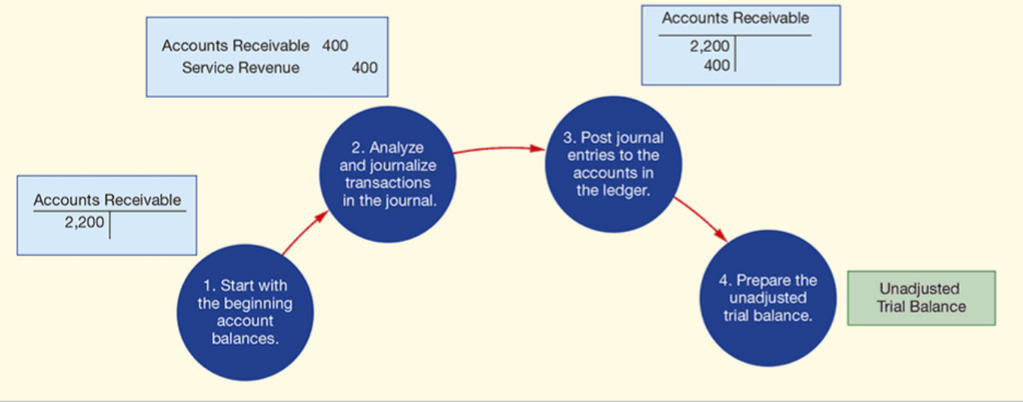
2. Analyze source documents and record transactions in journals
3. Post journal entries in the ledger (This is done automatically in accounting software)
4. Preprare the unadjusted trail balance
39
Debt Ratio
Total Liabilites / Total Assets
*The higher the debt ratio, the higher the risk
*The higher the debt ratio, the higher the risk
40
What word is this the definiton of
"A list of all accounts with their balances at a point in time"
"A list of all accounts with their balances at a point in time"
Trail Balance
41
June 18: Received a bill for utilities to be paid next month, \$ 250.
How is this put in a jhounral entry?
How is this put in a jhounral entry?
42
What is the Post Reference number in the four column account
It is the page number of the journal that the journal entries are from. (To cross reference them)
ex) If the journal entries that you are putting on four-column account are from page 10 of the journal, then the post reference number is J10
ex) If the journal entries that you are putting on four-column account are from page 10 of the journal, then the post reference number is J10
43
I need to plug in the running balance for the account.
How do I put it in
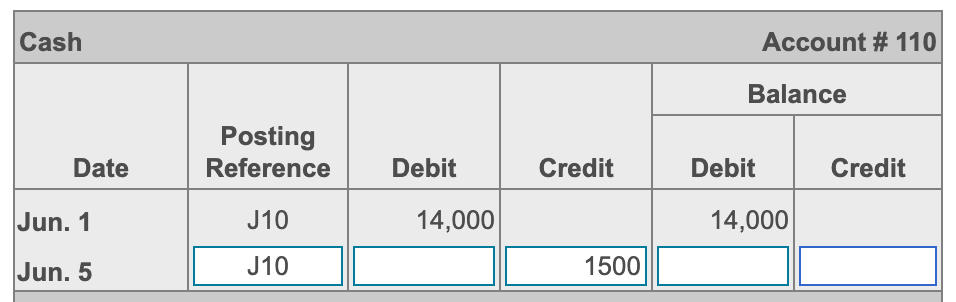
How do I put it in
You use the NORMAL BALANCE of the account. So, just subtract the credit from the debit and put the balance in the NORMAL BALANCE.
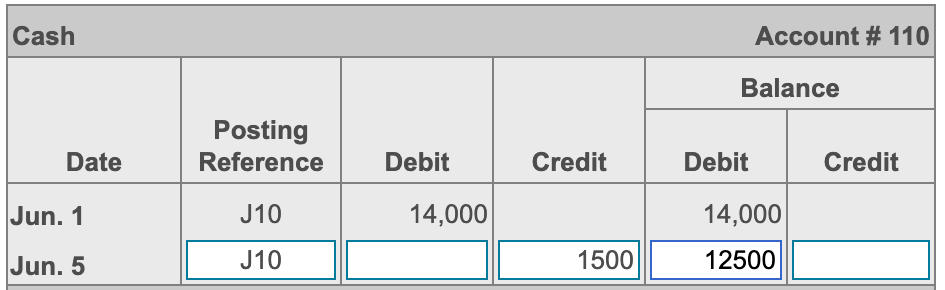
44
Enter 1.72% as a "whole percent".
2%
More Business & economics flashcards
ACC Chapter 2Business & economics · EnglishTaylorFinanceBusiness & economics · English17AICE Business Unit 4: OperationsBusiness & economics · EnglishAkshayF2 Analysis of financial perfromance and positionBusiness & economics · EnglishEllaExam 3 ReviewBusiness & economics · EnglishwowiepowE2 Business Models in Digital EcosystemsBusiness & economics · EnglishEllasambaBusiness & economics · EnglishJimmyNeutron69[A3] Waste Management Business & economics · EnglishroroDSCG AUDIT - UE 4 Business & economics · FrenchNoéEntrepreneurship Business & economics · EnglishTolentino,Corporate Treasury ManagementBusiness & economics · EnglishAprilMarketing Chapters 9-18Business & economics · EnglishDarius
All Business & economics decks
Study these decks in the app
Free on iPhone, Android, Mac and the web. Add any deck to your account in one tap.

