T-cell Development and TCR Structure
Study these flashcardsFree · spaced repetition · iPhone, Android, Mac & web
All cards
1
What is the main goal of T-cell development?
Produce diverse T cells with functional TCRs while removing strongly self-reactive T cells.
2
What are the major structural similarities between BCRs and TCRs?
Both have antigen-binding sites, variable regions, constant regions, and transmembrane regions.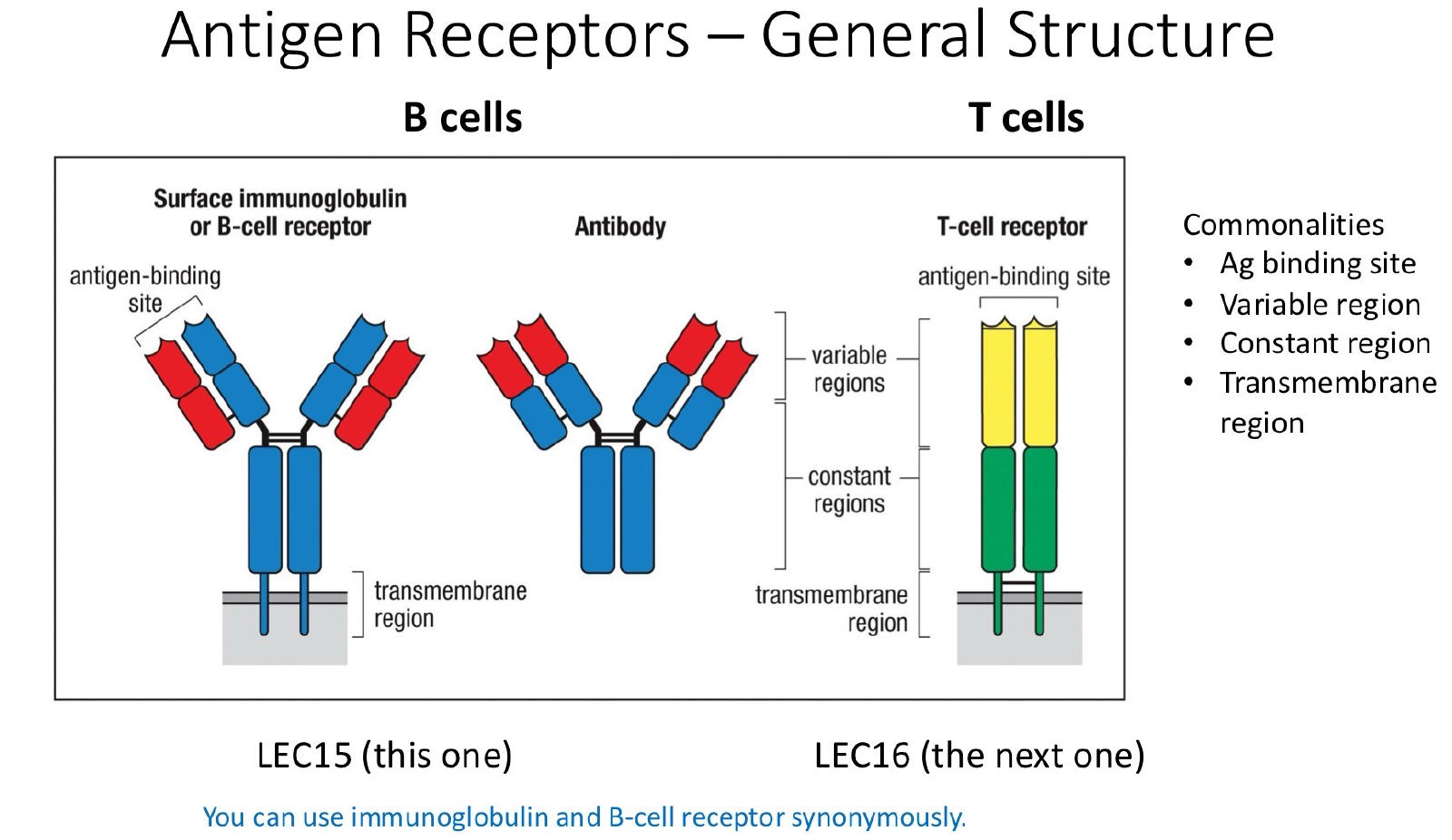
3
What is the basic structure of a T-cell receptor (TCR)?
A heterodimer of two chains linked by a disulfide bond.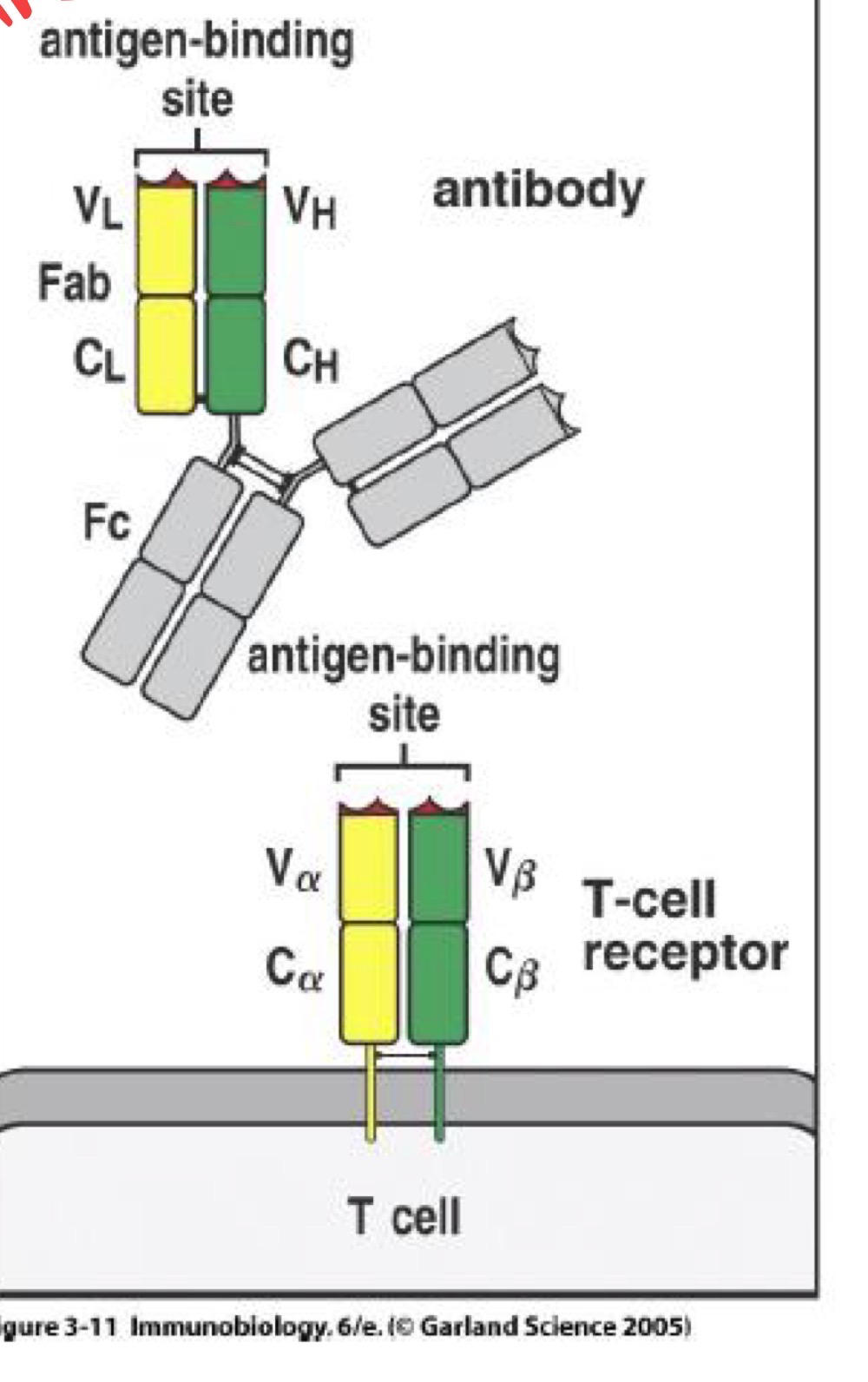
4
What regions does each TCR chain contain?
One variable region and one constant region.
5
How many antigen-binding sites does a TCR have?
One.
6
Can a TCR be secreted like an antibody?
No; TCRs remain membrane-bound.
7
What are the two major classes of TCR?
αβ TCR and γδ TCR.
8
Which TCR type makes up the majority of T cells?
αβ T cells (>95%).
9
Which animals can have relatively high numbers of γδ T cells?
Ruminants, where they may make up to 35% of peripheral T cells.
10
How is TCR diversity generated?
Through V(D)J recombination during T-cell development in the thymus.
11
What two major properties are tested during thymic selection?
TCR functionality and self-reactivity.
12
What type of epitope do most T cells recognize?
Peptide epitopes.
13
What type of epitope does a T cell recognize?
A linear peptide epitope presented by an MHC molecule.
14
T-cells DO NOT recognize
antigen or epitopes in their native state
15
What is a major difference between B-cell and T-cell antigen recognition?
B cells bind antigen directly; T cells recognize processed antigen presented by MHC.
16
What is the role of an antigen-presenting cell (APC)?
Process antigen and present peptide fragments on MHC molecules to T cells.
17
What is an important professional antigen-presenting cell?
Dendritic cell.
18
Where is MHC I expressed?
On nearly all nucleated cells, T cells, B cells, Macrophages, Dendritic cells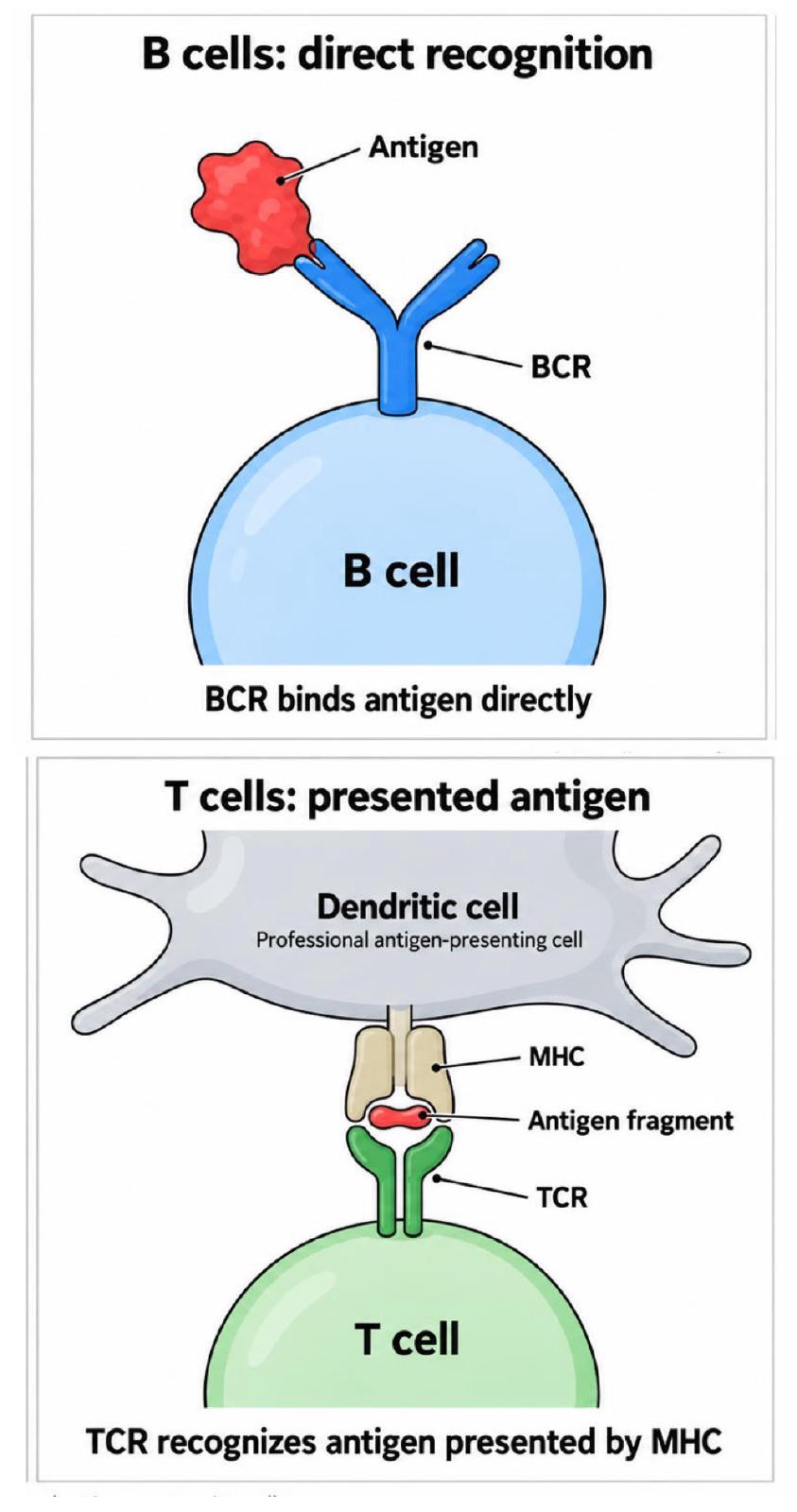
19
Where is MHC II primarily expressed?
On professional antigen-presenting cells, B cells, macrophages, dendritic cells
20
What type of antigen is generally presented by MHC II?
Peptides derived from external antigens.
21
How does an APC prepare an external antigen for MHC II presentation? 4 steps
Phagocytosis → lysosomal digestion → peptide loading onto MHC II → surface presentation.
22
Why is the MHC locus described as highly polymorphic?
Many different alleles exist in the population.
23
Why is MHC polymorphism important?
Different MHC variants can present different peptides to T cells.
24
What are anchor residues?
Specific amino acids that help anchor a peptide to an MHC molecule.
25
Which T-cell co-receptor binds MHC II?
CD4, helper T cells
26
What is the main function of CD4+ T cells?
Helper T-cell functions and coordination of immune responses.
27
Which T-cell co-receptor binds MHC I?
CD8, cytotoxic T cells
28
What is the main function of CD8+ T cells?
Cytotoxic killing of infected or abnormal cells.
29
Where do T-cell progenitors originate before traveling to the thymus?
Bone marrow.
30
What is a double-negative (DN) developing T cell?
A T cell that is CD4− and CD8−.
31
What is a double-positive (DP) developing T cell?
A T cell that is CD4+ and CD8+.
32
What is a single-positive (SP) T cell?
A mature T cell that is either CD4+CD8− or CD4−CD8+.
33
What is the general co-receptor sequence during T-cell development?
Double negative → double positive → single positive.
More Science flashcards
Basic TerminologyScience · EnglishJShin05Monatomic IonsScience · LatinToshaydude The genetic code and nucleic acidsScience · EnglishLoganCalvin Cycle Chapter 8Science · EnglishEmanbiology cellular control Science · EnglishEmilyIsomersScience · EnglishEmanProteinsScience · EnglishAshBiologia: Budowa komórki roślinnejScience · PolishLuvenCell Membrane and FunctionScience · EnglishKrisMedCardsprotein assembly 2Science · EnglishzazzyCE4013 DefinitionsScience · EnglishMarkinheritanceScience · Englishmischa
Study these decks in the app
Free on iPhone, Android, Mac and the web. Add any deck to your account in one tap.

