Calcium Metabolism and Nutrition in Livestock
Study these flashcardsFree · spaced repetition · iPhone, Android, Mac & web
All cards
1
What are the major functions of calcium in the body?
Bone and teeth formation, nerve conduction, muscle contraction, and enzyme regulation.
2
How does calcium contribute to neurotransmitter release? EXAM
Ca²⁺ enters the presynaptic neuron and triggers vesicle fusion and acetylcholine (ACh) release.
- release and dampens
3
What dietary factors can interfere with calcium absorption? EXAM
Phosphorus, magnesium, excessive zinc, and oxalates.
4
How do high dietary oxalates cause kidney damage? EXAM
Oxalates bind calcium, forming insoluble calcium oxalate crystals that precipitate in the kidneys.
5
Which livestock are most susceptible to oxalate poisoning, and how can ruminants adapt? EXAM
Sheep, then cattle; gradual exposure increases rumen oxalate-degrading bacteria.
6
What regulates intestinal calcium absorption?
Activated vitamin D (calcitriol), influenced by PTH, promotes calcium absorption through intestinal transport proteins.
7
Parathyroid Hormone acts to increase the ___ in the ECF back into the desired concentration. EXAM
Ca2+
8
How does PTH affect bone? EXAM
It stimulates bone resorption to release calcium; young animals respond faster 12-24 hrs than older animals 24-48 hrs
9
How does PTH affect renal calcium and phosphorus handling? EXAM
It increases calcium reabsorption but promotes phosphorus excretion, raising blood Ca²⁺ and lowering phosphorus.
10
How does PTH influence vitamin D activation? EXAM
It stimulates renal conversion of calcidiol into active calcitriol.
11
What stimulates calcitonin release, and what is its function? EXAM
High blood Ca²⁺; calcitonin promotes calcium deposition into bone and urinary calcium loss.
12
What is the difference between vitamin D₂ and D₃?
Vitamin D₂ is ergocalciferol; vitamin D₃ is cholecalciferol.
13
How does calcitriol increase blood calcium and phosphorus?
Increases intestinal absorption, renal reabsorption, and bone resorption of calcium and phosphorus.
14
What is the first step of vitamin D₃ synthesis in the skin?
UV light converts 7-dehydrocholesterol into previtamin D₃, which becomes vitamin D₃ by thermal isomerization.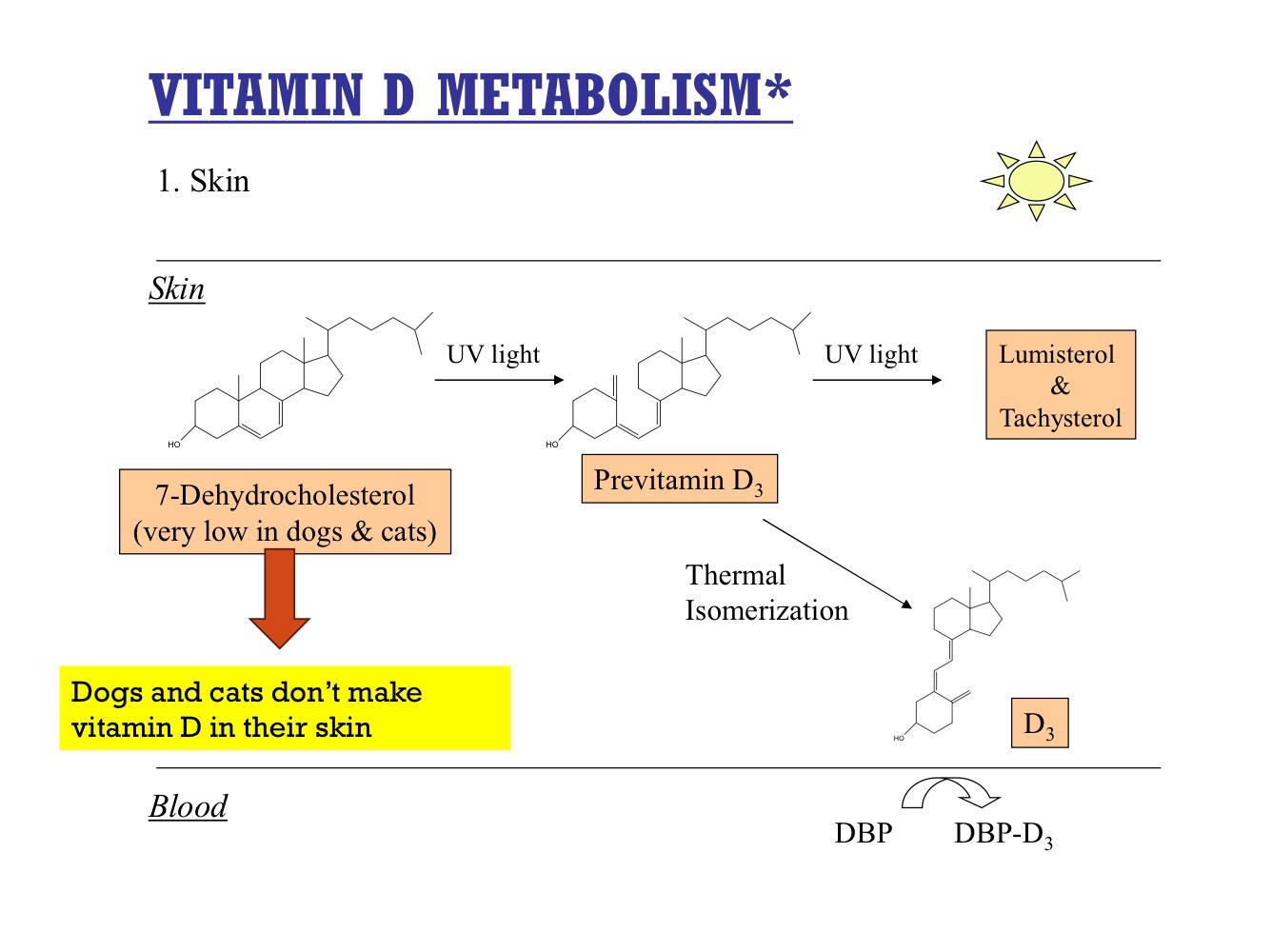
15
Why must dogs and cats obtain vitamin D through their diet? EXAM
They have insufficient skin 7-dehydrocholesterol for meaningful vitamin D synthesis.
16
How is dietary vitamin D absorbed?
With dietary fat and bile in the jejunum and ileum, then transported in chylomicrons.
17
What happens to vitamin D in the liver?
Vitamin D 25-hydroxylase converts vitamin D₂ or D₃ into calcidiol (25-OH vitamin D).
18
What happens to calcidiol in the kidneys?
1α-hydroxylase converts it to active calcitriol; 24-hydroxylase can form 24,25-dihydroxyvitamin D.
19
What is milk fever, and which animals are most susceptible? EXAM
Acute periparturient hypocalcemia, acute flaccid paralysis that results from depleted serum calcium as it is lost into colostrum and milk, especially in older high-producing dairy cows
- can affect beef cows, ewes, does
20
Milk Fever: older cows…
bone and gut less responsive to PTH and 1,25(OH)2D than heifers
21
Periparturient hypocalcemia is relatively rare in
heifers
22
What are the clinical signs of Stage 1 milk fever?
Standing, apprehension, hypersensitivity, and muscle tremors from increased neuronal excitability.
23
How is milk fever treated, and why must calcium be given slowly? EXAM
Slow IV calcium borogluconate (23%, 1–2 mL/kg over 15–20 min); rapid infusion risks cardiac arrest.
24
How can milk fever be prevented nutritionally? EXAM
Low-calcium diet ~1 month prepartum or anionic salts ~2 weeks prepartum; ensure adequate magnesium for PTH release.
25
What is nutritional secondary hyperparathyroidism, and how do rickets and osteomalacia differ?
Ca/vitamin D deficiency causes increased PTH and bone demineralization; rickets affects growing animals, osteomalacia adults.
26
What are the major functions and dietary sources of phosphorus?
Bone and teeth, phospholipids, and ATP; sources include grains, wheat bran, and supplements.
27
What dietary Ca:P ratio is often considered acceptable, and what matters most?
Approximately 2:1 to 1:2; adequate absolute calcium and phosphorus amounts matter more than the ratio alone.
28
How does the body respond to low phosphorus availability? EXAM
Calcitriol increases intestinal phosphorus absorption and bone resorption; kidneys normally reabsorb most filtered phosphorus.
29
How does the body respond to excess phosphorus? EXAM
FGF-23 and PTH promote urinary phosphorus excretion by reducing renal phosphate reabsorption; calcitriol activation decreases.
30
How can high phosphorus and low calcium cause rubber jaw?
Chronic PTH elevation stimulates bone resorption, weakening and demineralizing the jaw.
31
Why can high-grain diets cause urinary stones in ruminants?
Excess phosphorus can promote phosphate-based uroliths, including magnesium ammonium phosphate (struvite).
32
How can phosphate urolithiasis be prevented in ruminants? EXAM
Balance dietary Ca:P and promote water intake and dilute urine; the lecture describes salt supplementation.
33
Why is soluble inorganic phosphorus in pet food concerning? EXAM
It is often more bioavailable than naturally occurring insoluble phosphorus, increasing phosphorus exposure.
34
What renal changes occurred in cats fed high inorganic phosphorus in the lecture study?
Increased creatinine, decreased GFR, and renal echogenicity changes in 92% of test cats.
35
What are the major physiological functions of magnesium? EXAM
Enzyme cofactor, modulation of calcium activity, acetylcholinesterase function, and PTH release.
36
Why can magnesium deficiency cause hypocalcemia?
Magnesium is required for normal PTH release, so deficiency impairs calcium regulation.
37
High nitrogen (protein) in a ruminant’s diet, as well as high dietary K+ will…
reduce magnesium absorption from the rumen partly as the electric gradient would change
38
Why does grazing lush, rapidly growing pasture increase grass tetany risk? EXAM
High dietary potassium and nitrogen decrease ruminal magnesium absorption.
39
What is the mechanism of muscle tetany during hypomagnesemia? EXAM
Reduced Mg competition with Ca²⁺ increases ACh release, while impaired ACh breakdown prolongs muscle stimulation.
40
What are the clinical signs of hypomagnesemic grass tetany?
Early: fasciculations, hyperesthesia, stiff gait; late: tetany recumbency, sustained contractions, convulsions, possible death.
41
What are the major roles of sodium, and how does aldosterone regulate it?
Na⁺ regulates extracellular osmolarity, acid-base balance, and transport; aldosterone increases Na⁺ reabsorption and K⁺ excretion.
42
Why is sodium included in animal diets, and when might restriction be indicated?
Improves palatability in horses/ ruminants and promotes water intake; restrict when indicated for cardiovascular disease or hypertensive kidney disease.
43
What are the major functions and deficiency signs of potassium?
K⁺ regulates intracellular osmolarity and membrane potentials; deficiency causes weakness, feline plantigrade stance, and arrhythmias.
44
What are the major consequences of excess potassium?
Increased grass tetany and milk fever risk; hyperkalemia may cause dangerous bradyarrhythmias.
More Medicine & health flashcards
EXP 6: Ointments and Hydrocarbon BasesMedicine & health · EnglishALYSSAAcute Heart FailureMedicine & health · EnglishAveryIV Week 1Medicine & health · EnglishTaylorC2.2: neural signalingMedicine & health · EnglishMicahLecture 4 Anatomy Medicine & health · EnglishKrisMedCardsFood Sanitation ProgramMedicine & health · EnglishALICELEUKEMIAMedicine & health · EnglishelleezeeeeBones and Fractures: Medical TermsMedicine & health · EnglishyesilMuscle Structure and PhysiologyMedicine & health · EnglishLeahChapter 2: The Human Body in Health and DiseaseMedicine & health · EnglishfortwinnyHealth Assessment OrientationMedicine & health · EnglishZahraaLab 8: PharynxMedicine & health · EnglishKai
Study these decks in the app
Free on iPhone, Android, Mac and the web. Add any deck to your account in one tap.

