Lecture 4 Anatomy
Study these flashcardsFree · spaced repetition · iPhone, Android, Mac & web
All cards
1
How many vertebrae are there?
32-33
7 cervicle
12 thoracic
5 lumbar
5 sacral (fused)
3 or 4 coccygeal (fused)
7 cervicle
12 thoracic
5 lumbar
5 sacral (fused)
3 or 4 coccygeal (fused)
2
Describe the curvature on the graph 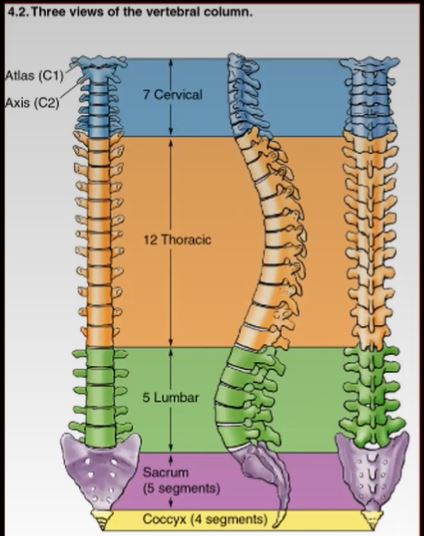
Posteriorly
C - Convex anteriorly
T - Concave posteriorly
L- Convex posteriorly
Saccrum and Coccyx are concave
C - Convex anteriorly
T - Concave posteriorly
L- Convex posteriorly
Saccrum and Coccyx are concave
3
What is the role of a vertebreal disc?
Shock absorber and distribute axial load
4
How are vertebral discs named?
Numbered by the vertebral body above the disk
5
What type of joint is an intervertebral joint?
Fibrocartilaginous joint (limited movement)
6
What are the two parts of the intervertebral disk?
The annulus fibrosus (outer hard shell) and the nucleus pulposus (inner, soft, gel-like and elastic)
7
What occurs when the nucleus pulposus herniated?
It compresses the nerve root which can cause pain and muscle paresis
8
Where is herniation most common?
In the part of the spinal column that are most mobile (i.e. C5/C6, C6/C7, and L4/L5)
9
The herniated nucleus pulposus is most commonly is a direction to the strength and position of the .
The herniated nucleus pulposus is most commonly is a posterolateral direction to the strength and position of the posterior logitudinal ligament.
10
The herniated disc will normally compress the spinal nerve root below the involved disc.
The herniated disc will normally compress the spinal nerve root one number below the involved disc.
11
Check understanding: Where is disc L4?
Located between L4 and L5
12
The herniated disc will normally compress the spinal nerve root the involved disk.
The herniated disc will normally compress the spinal nerve root one number below the involved disk.
13
Herniation of disk L4 will cause compression of what root?
L5
14
Is the posterior or anterior ligament thicker?
The anterior ligament
15
If you herniate, do you typically herniate in the direction of the anterior or posterior ligament. Why?
The posterior ligament because it is thinner
16
If you herniate between C 7 and T1, which never