Hemostasis and Clot Formation
Study these flashcardsFree · spaced repetition · iPhone, Android, Mac & web
All cards
1
What is hemostasis?
The process of stopping bleeding while maintaining normal blood flow.
2
What are the three major physiological components involved in hemostasis?
Plasma proteins, platelets, and blood vessels.
3
What are the three main components of clot formation emphasized in the lecture?
Fibrinogen (coagulating protein), thrombin (initiator), and platelets (facilitators).
4
What are the four major events of hemostasis in order?
Vasoconstriction → primary hemostasis → secondary hemostasis → fibrinolysis.
5
What is the purpose of arteriolar vasoconstriction after vessel injury?
Reduce blood flow and blood loss at the injury site.
6
What occurs during primary hemostasis?
Platelets adhere, activate, and aggregate to form an initial platelet plug.
7
What occurs during secondary hemostasis?
Coagulation factors generate fibrin to stabilize the platelet plug.
8
What is tertiary hemostasis?
Fibrinolysis, the controlled breakdown of fibrin clots.
9
What four opposing processes maintain hemostatic balance?
Procoagulation, antifibrinolysis
Less coagulation: fibrinolysis, anticoagulation
Less coagulation: fibrinolysis, anticoagulation
10
Why are checks and balances essential in hemostasis?
To form clots where needed while preventing excessive clotting or bleeding.
11
What is the primary function of thrombin in coagulation?
Convert soluble fibrinogen into insoluble fibrin.
12
Where are most coagulation factors produced?
The liver.
13
In what form do most coagulation factors circulate?
Inactive proenzymes (zymogens) that become activated through proteolysis.
14
What two cofactors are required by many coagulation reactions?
Calcium (Ca²⁺) and phospholipids.
15
Which coagulation factors function primarily as protein cofactors?
Factors 10 and 13a.
16
Which two coagulation factors are NOT proteases?
Factor I (fibrinogen) and factor III (tissue factor).
17
Which coagulation factors are vitamin K-dependent?
Factors 2, 7, 9, 10 and the anticoagulant proteins C and S.
2+7=9 add a 1 and it’s a 10
2+7=9 add a 1 and it’s a 10
18
How does vitamin K contribute to coagulation?
It enables post-translational carboxylation needed for functional coagulation proteins.
19
Which vitamin K-dependent coagulation factor has the shortest circulating half-life?
Factor 7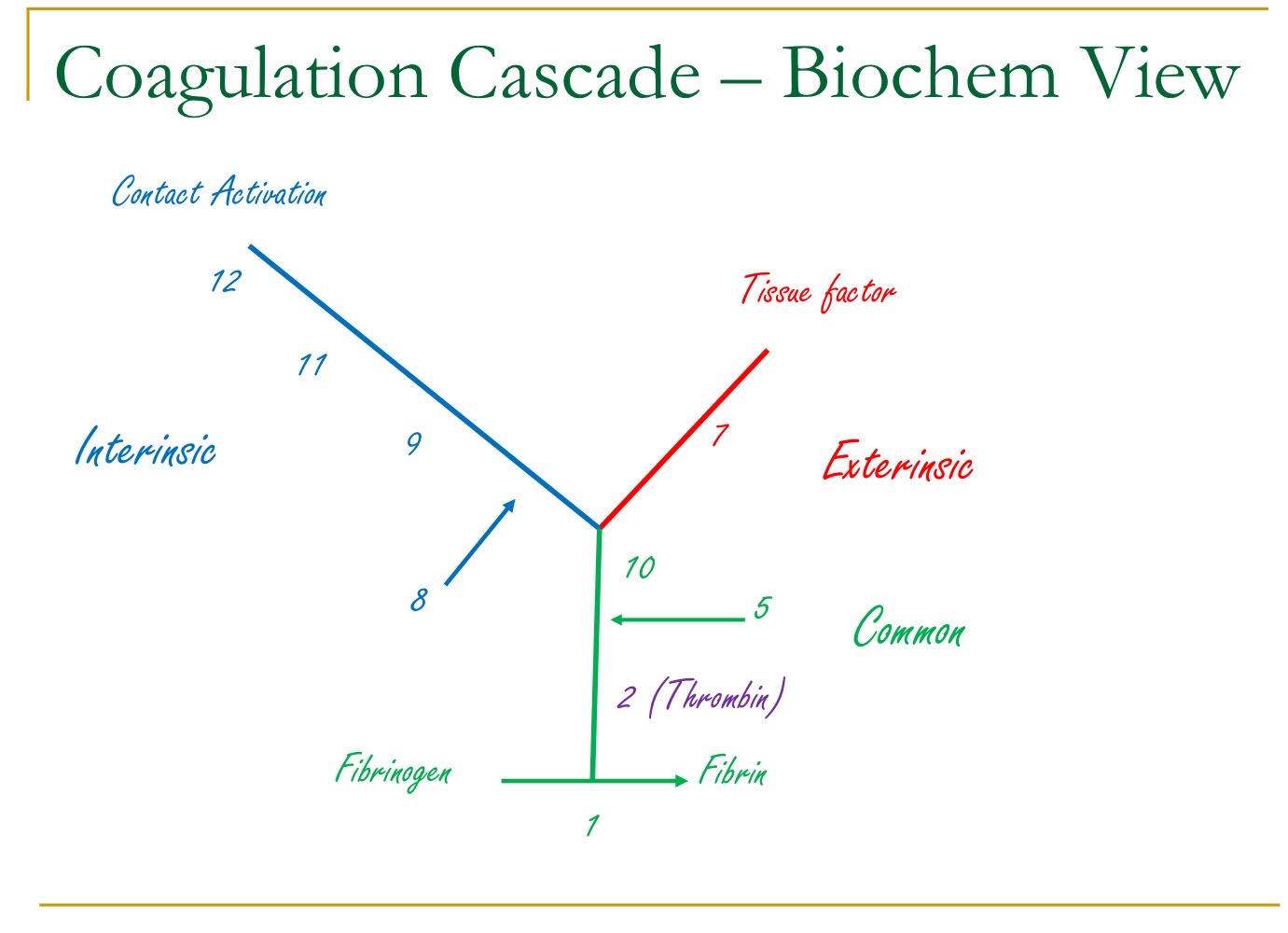
20
Why is coagulation described as an amplification cascade?
Each activated factor activates multiple downstream molecules, rapidly increasing thrombin and fibrin production.
21
Why is the traditional intrinsic/extrinsic cascade model limited?
It explains laboratory coagulation testing but does not fully represent coagulation in living tissues.
22
Where is tissue factor normally found?
On exposed subendothelial tissues and fibroblasts after vessel injury.
23
Why are endothelial cells and platelets important in the cell-based coagulation model?
They provide surfaces and signals that control where and when coagulation occurs.
24
What occurs during initiation in the cell-based coagulation model?
Blood contacts tissue factor-bearing cells, generating a small amount of thrombin.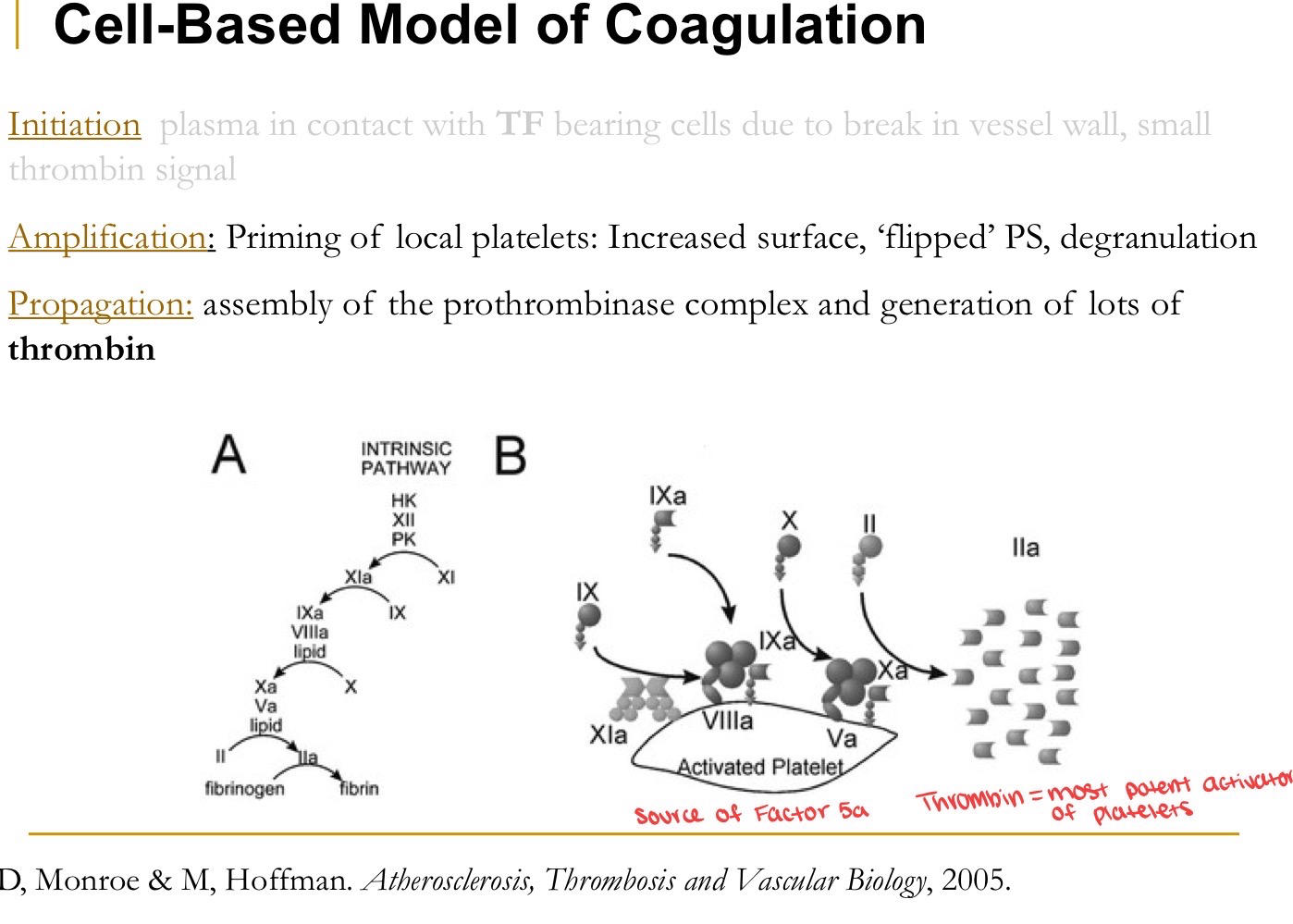
25
What occurs during amplification in the cell-based coagulation model?
Thrombin activates nearby platelets, causing shape changes, degranulation, and increased procoagulant surface.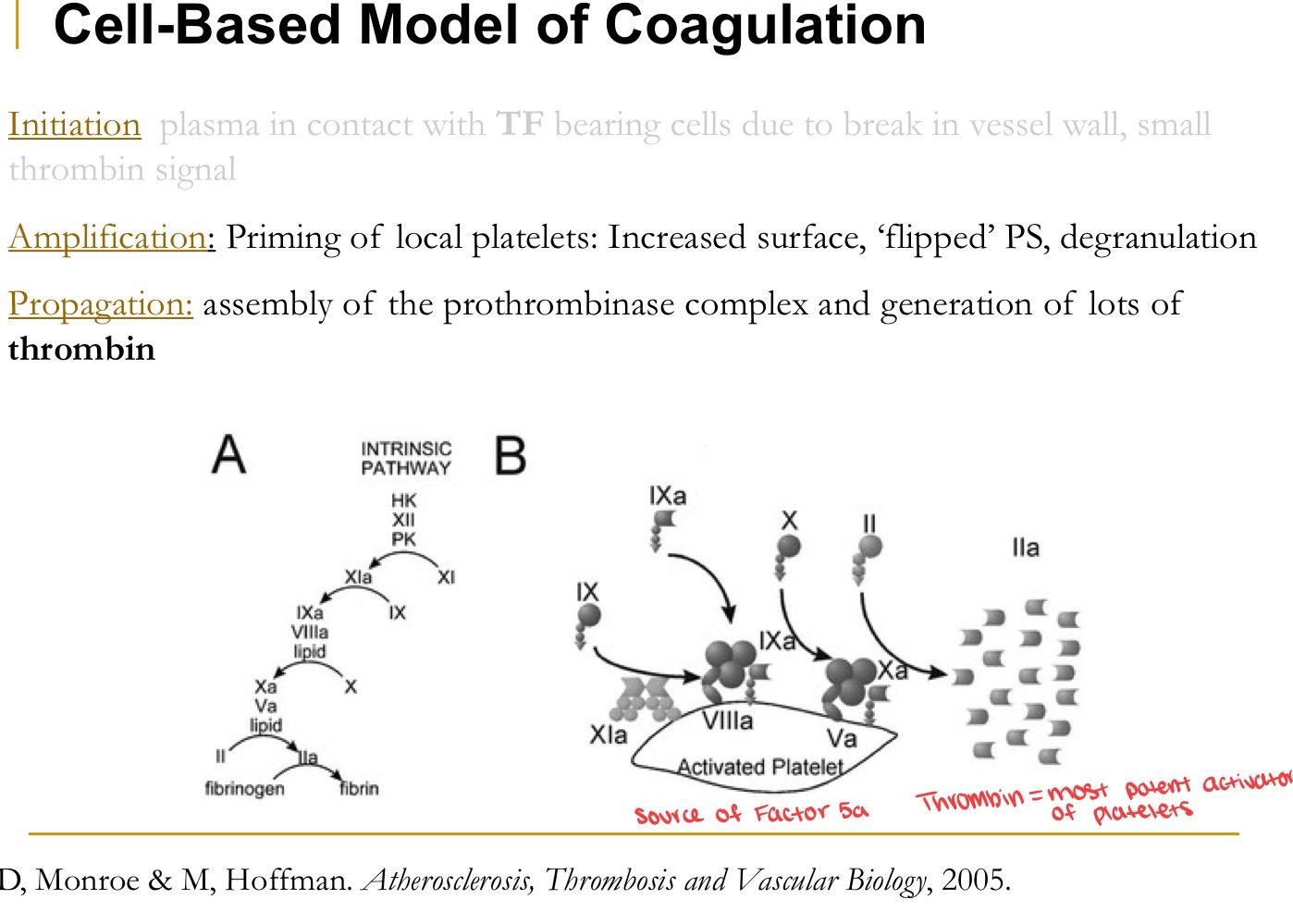
26
What happens to phosphatidylserine (PS) during platelet activation?
It flips to the outer platelet membrane, providing a negatively charged surface for coagulation complexes.
27
What occurs during propagation in the cell-based coagulation model?
Coagulation complexes assemble on activated platelets, generating a large burst of thrombin.
28
How do platelets facilitate secondary hemostasis?
They provide phospholipid surfaces where coagulation factors assemble and activate.
29
How is a platelet plug converted into a stable fibrin clot?
Thrombin generates fibrin, which polymerizes and is cross-linked by factor 13a.
30
Where does fibrinolysis primarily occur?
Within developing clots where plasminogen and its activators bind fibrin.
31
What converts plasminogen into plasmin?
Plasminogen activators, especially tissue plasminogen activator (tPA).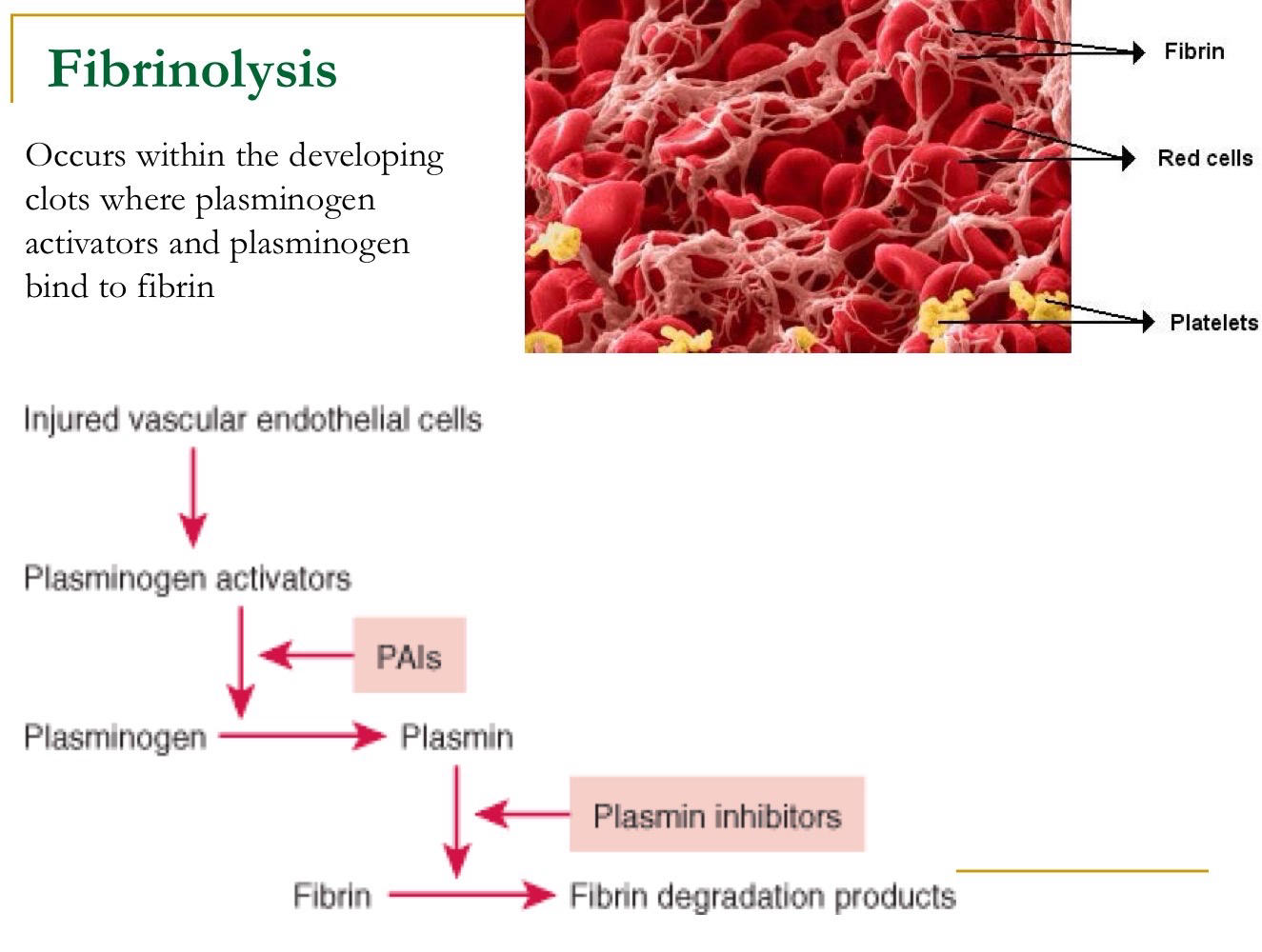
32
What is the primary function of plasmin?
Degrade fibrin into fibrin degradation products.
33
What is the function of plasminogen activator inhibitors (PAIs)?
Inhibit plasminogen activators to limit fibrinolysis.
34
What is the function of α2-antiplasmin?
Inhibit plasmin to prevent excessive fibrin breakdown.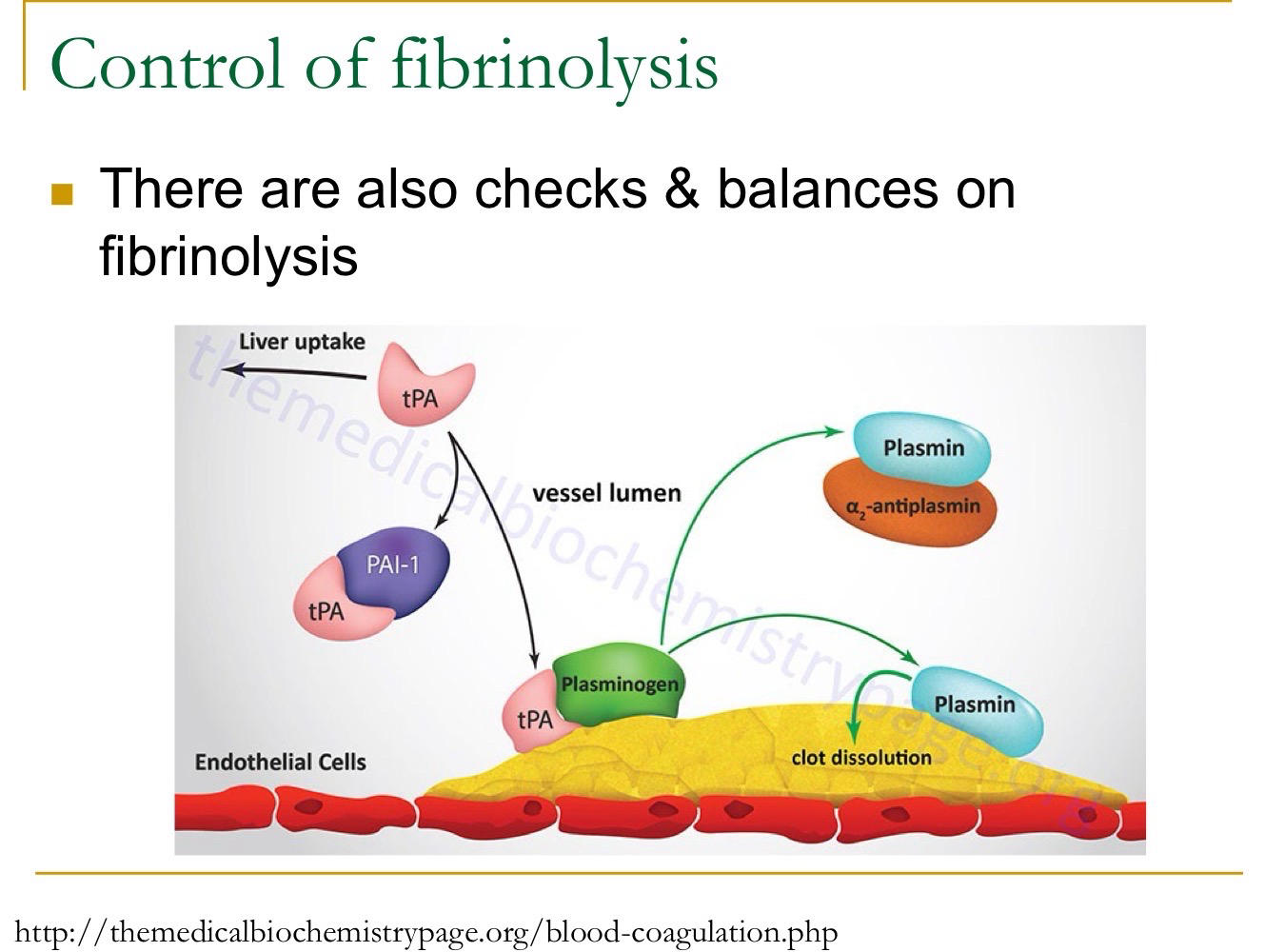
35
What are the three major natural anticoagulant systems?
Antithrombin, protein C/protein S, and tissue factor pathway inhibitor (TFPI).
36
What is antithrombin, and which activated factors does it inhibit?
A liver-produced plasma protease inhibitor that inactivates thrombin, 9a, and 10a.
37
How does heparin exert its anticoagulant effect?
It enhances antithrombin activity, increasing inhibition of coagulation factors.
38
How is protein C activated?
Thrombin binds endothelial thrombomodulin and activates protein C.
39
What does activated protein C (APC) do with protein S?
Inactivates factors 5a and 8a to reduce coagulation.
40
What does tissue factor pathway inhibitor (TFPI) inhibit?
Factirs 2,7,9,10 complex.
41
How does healthy vascular endothelium prevent excessive platelet activation?
Through nitric oxide (NO), prostacyclin (PGI₂), and adenosine diphosphatase activity.
42
How do the liver and blood flow help regulate coagulation?
The liver (hepatocytes) clears activated factors and degradation products; blood flow removes activated factors from the injury site.
43
Besides producing fibrin, how does thrombin promote coagulation?
Activates factors 5, 8, 11, 13 and platelets, promoting aggregation and thromboxane A₂ production.
44
How can thrombin also produce anticoagulant, fibrinolytic, and inflammatory effects?
It activates protein C, promotes NO/PGI₂ and tPA release, activates leukocytes, and increases endothelial integrin expression.
More Medicine & health flashcards
Hand Lecture Part 1Medicine & health · Englishjocyt9BLD 204Medicine & health · EnglishRemyStapparmement - Les mécanisme de fonctionnement des armes Medicine & health · FrenchRaymanChapter 48 PharmMedicine & health · EnglishMadiruth2Neuroplasticity and NeuroscienceMedicine & health · EnglishRoranteurFluid Balance and EdemaMedicine & health · EnglishJESSQTRANChapter 6 Gram Positive BacteriaMedicine & health · EnglishKrisMedCardsHistology: Tissue Processing and MountingMedicine & health · EnglishDanielaFoie Medicine & health · FrenchINSTINCTPosi 2 Medicine & health · EnglishDarylLección 7Medicine & health · SpanishEmilioPhlebotomy Medicine & health · EnglishMARIA
Study these decks in the app
Free on iPhone, Android, Mac and the web. Add any deck to your account in one tap.

