Nervous system 3 & 4
Study these flashcardsFree · spaced repetition · iPhone, Android, Mac & web
All cards
1
Cell body
Main part of the cell where the neucleous is
2
Dendrites
Recieving end of the neuron
3
Axon
Extention of thew cell body where electrical signals pass through
4
Myelin Sheath
fatty insulation of axons that speeds up the speed of electrical signals
5
Axon Terminal
Contains vesicles filled with neurotransmitters
6
Agonists
Drugs that strengthen the effect of a neurotransmitter
7
Sympathomimetic
Drug that mimics the effect of the sympathetic nervous system
8
Antagonists
Drugs that disrupt signaling between two neurons (e.g., block receptors)
9
Sodium potassium pumps
Pumps 2 potassium in for every 3 sodium out
10
Three proteins for cells
Na K pumps, K leak channel, Na leak channel
11
Threshold for action potential
-55mV; if reached, the neuron fires an action potential
12
Graded potentials
Local changes in membrane potential that make a cell more or less likely to fire
13
Chemically gated potassium (K) channel
Activated by neurotransmitter, allows more K to leave the cell making it more negative (hyperpolarized
14
Chemically gated Sodium (Na) channel
Allows sodium to enter the cell making it more positive and more likely to fire (excitatory)
15
Action potential
Voltage gated sodium channels open at -55mV letting in more sodium causing a chain reaction that travels down the axon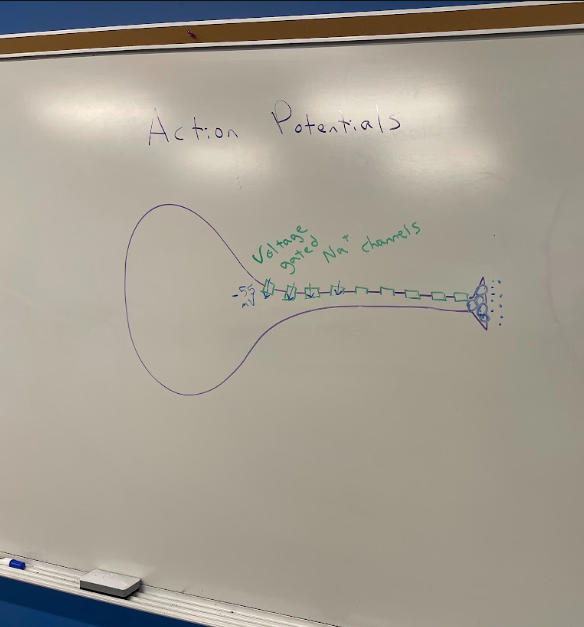
16
All or none principle
A neuron either sends an action potential or it doesn't; signal strength is the same every time
17
Increasing signal urgency
If an urgent signal needs to be sent, the frequency of action potentials goes up (e.g., 1
18
Sodium potassium pumps during action potential
Go into overdrive to bring the neuron back to rest
19
Spinal cord outer layer
White because of myelin around axons
20
Spinal cord inner layer
Grey because it is where all the cell bodies are
21
Ventral horn
On the anterior; contains cell bodies of somatic motor neurons
22
Dorsal horn
On the posterior; where all sensory information enters the spinal cord
23
Ventral rootlets
Somatic neuron axons that merge to form a ventral root sending motor information to the body
24
Dorsal rootlets
Combine to form a dorsal root which sends sensory information to the brain
25
Spinal nerve
Formed when the ventral and dorsal roots combine
26
Ganglion
Cluster of cell bodies in the Peripheral Nervous System (bump where dorsal rootlets meet the root)
27
Nucleus (spinal cord context)
Cluster of neuron cell bodies in the Central Nervous System
28
Anterior spinal artery
Supplies a large part of the spinal cord with blood (roughly 80%)
29
Posterior spinal arteries
Supply the back part of the spinal cord with blood (about 10% per artery)
30
Reflex
Fast, involuntary, stereotyped motor response to a specific sensory stimulus
31
Neuroglia
Support cells that enhance neurons so they can do their job
32
Astrocytes
Maintain the blood brain barrier
33
Schwann cells
Myelinate peripheral neurons
34
Oligodendrocytes
Myelinate central nervous system
35
Ependymal cells
Make cerebrospinal fluid (distributes nutrition and prevents brain trauma)
36
Microglia
Immune cells in the central nervous system
37
Membrane potential
Electrical charge along the membrane
38
Resting membrane potential
Electrical charge at rest
39
Most important ions for charge
Sodium and potassium
40
Ion distribution
Potassium is mostly inside the cell, sodium is mostly outside the cell
41
Sodium potassium pump ATP cost
Takes a lot of ATP (up to 70% of all ATP a cell makes)
42
Leak channels
Allow potassium to leave the cell or sodium to enter
43
Potassium leaking effect
Potassium is positively charged, so as it leaks out the cell becomes negative
44
Potassium equilibrium
Once the cell becomes negative, potassium slows down and reaches balance with the outside
45
Sodium permeability effect
If the cell were permeable to sodium, sodium would enter making the cell positive until repelled and balanced
46
Sodium equilibrium potential
+60mV
47
Potassium equilibrium potential
-90mV
48
Resting membrane potential (actual value)
-70mV because potassium has more channels so it tends toward potassium's resting number
49
Myelination and speed
The more myelinated a neuron is, the faster a signal is sent
50
Neuron regrowth
Neuron can regrow if endoneurium scaffolding and myelin remain; grows about 1 millimeter per day
51
Multipolar neuron
Many dendrites and one axon (most common)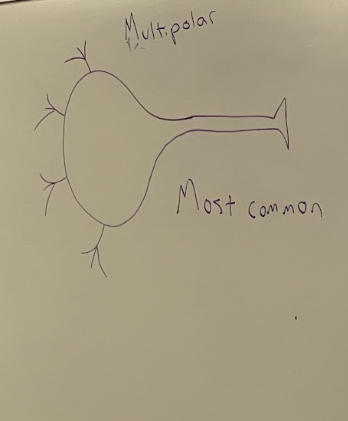
52
Bipolar neuron
One dendrite and one axon (rarest)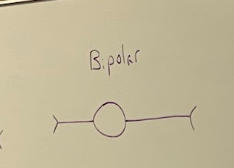
53
Pseudounipolar neuron
Cell body off to the side; single dendrite and axon look like a single line (all somatosensory neurons)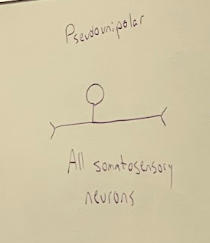
More Medicine & health flashcards
Physiology: Synapses and Excitable CellsMedicine & health · EnglishEleanorLymphatic and Immune System FlashcardsMedicine & health · EnglishVickyIntroduction to endocrine Pharmacology Medicine & health · EnglishYemidalePSY201 Quiz 2 (Bradley University 2025)Medicine & health · EnglishMarlowSCORE 7-9Medicine & health · Englishyyl109Popelka 14Medicine & health · EnglishDavidApparato urinario - Vescica e uretraMedicine & health · ItalianWalterCancer pulmonaire Dr RAHLIMedicine & health · FrenchMevlude2- cavités nasalesMedicine & health · FrenchOcéaneHypertensionMedicine & health · EnglishBrittanyLEC 21 BIOL 431Medicine & health · EnglishDDFLCPhysiology: Human Body SystemsMedicine & health · Englishan OutLearn student
Study these decks in the app
Free on iPhone, Android, Mac and the web. Add any deck to your account in one tap.

