ARRT Bontrager Ch6 Ch7 + ARRT Lower Extremity Exam-style questions
Study these flashcardsFree · spaced repetition · iPhone, Android, Mac & web
All cards
1
For an AP oblique projection of the second through fifth toes, which rotation best demonstrates the phalanges with reduced overlap?
- 30–45° medial rotation
- 60° medial rotation
- 45° rotation
- 90° lateral rotation
2
An AP oblique foot radiograph is requested to demonstrate the cuboid with minimal superimposition. Which positioning is most appropriate?
- 30° lateral rotation
- 15° plantar flexion
- 30° medial rotation
- 45° dorsiflexion
3
On a properly positioned lateral ankle radiograph, where should the distal fibula appear relative to the tibia?
- Directly anterior to the distal tibia
- Superimposed over the anterior half of the distal tibia
- Completely separate from the tibia
- Superimposed over the posterior half of the distal tibia
4
A proximal tibiofibular joint is obscured on an AP knee radiograph. Which additional projection best demonstrates this articulation?
- AP oblique knee with 45° medial rotation
- AP oblique knee with lateral rotation
- Tangential patella projection
- PA axial intercondylar fossa projection
5
A patient with a suspected patellar fracture needs a lateral patella radiograph. Which knee position minimizes the risk of fragment displacement?
- 90° flexion
- 5–10° flexion
- 45° flexion
- Full flexion
6
An AP knee obtained without weight bearing shows relatively preserved joint spaces, but standing arthritis evaluation is requested. Why acquire a weight-bearing AP knee?
- To demonstrate the intercondylar fossa in profile
- To eliminate magnification of the patella
- To remove superimposition of the fibular head
- To better reveal joint-space narrowing under load
7
For the PA axial intercondylar fossa projection using the Camp-Coventry method, how is the central ray directed relative to the flexed lower leg?
- Caudad approximately equal to the knee flexion angle
- 40° cephalad regardless of knee flexion
- 15° cephalad regardless of knee flexion
- Perpendicular to the tabletop
8
Which foot structure is best demonstrated by a tangential projection of the first metatarsophalangeal joint?
- Sesamoid bones
- Navicular tuberosity
- Base of the fifth metatarsal
- Talar trochlea
9
For a unilateral AP oblique frog-leg hip projection in a patient without suspected fracture, which positioning best places the femoral neck nearly parallel to the receptor?
- Extend the hip and rotate the limb externally 90°
- Flex the knee without abducting the thigh
- Flex the hip and knee and abduct the thigh approximately 45°
- Internally rotate the extended leg 45°
10
A routine AP femur image demonstrates the femoral shaft but excludes the hip joint. What is the most appropriate evaluation?
- Incomplete because both adjacent joints should be demonstrated
- Incomplete only if the lesser trochanter is visible
- Acceptable if the knee is fully included
- Acceptable when the central ray is perpendicular
11
Which AP axial pelvic projection demonstrates the pelvic brim and helps assess anterior-posterior displacement of pelvic ring fractures?
- Outlet projection with cephalad angulation
- Iliac oblique acetabular projection
- Bilateral frog-leg projection
- Inlet projection with caudad angulation
12
For an AP axial outlet projection of the pelvis, which central ray direction is generally required?
- 40° caudad
- Cephalad toward the pubic symphysis
- Perpendicular to the pubic symphysis
- 15° caudad toward the iliac crest
13
In the Judet acetabular series, which oblique position best demonstrates the anterior column and posterior rim of the acetabulum?
- AP axial inlet pelvis
- Obturator oblique with affected side up
- Bilateral frog-leg pelvis
- Iliac oblique with affected side down
14
In the Judet acetabular series, which oblique view best demonstrates the posterior column and anterior rim of the acetabulum?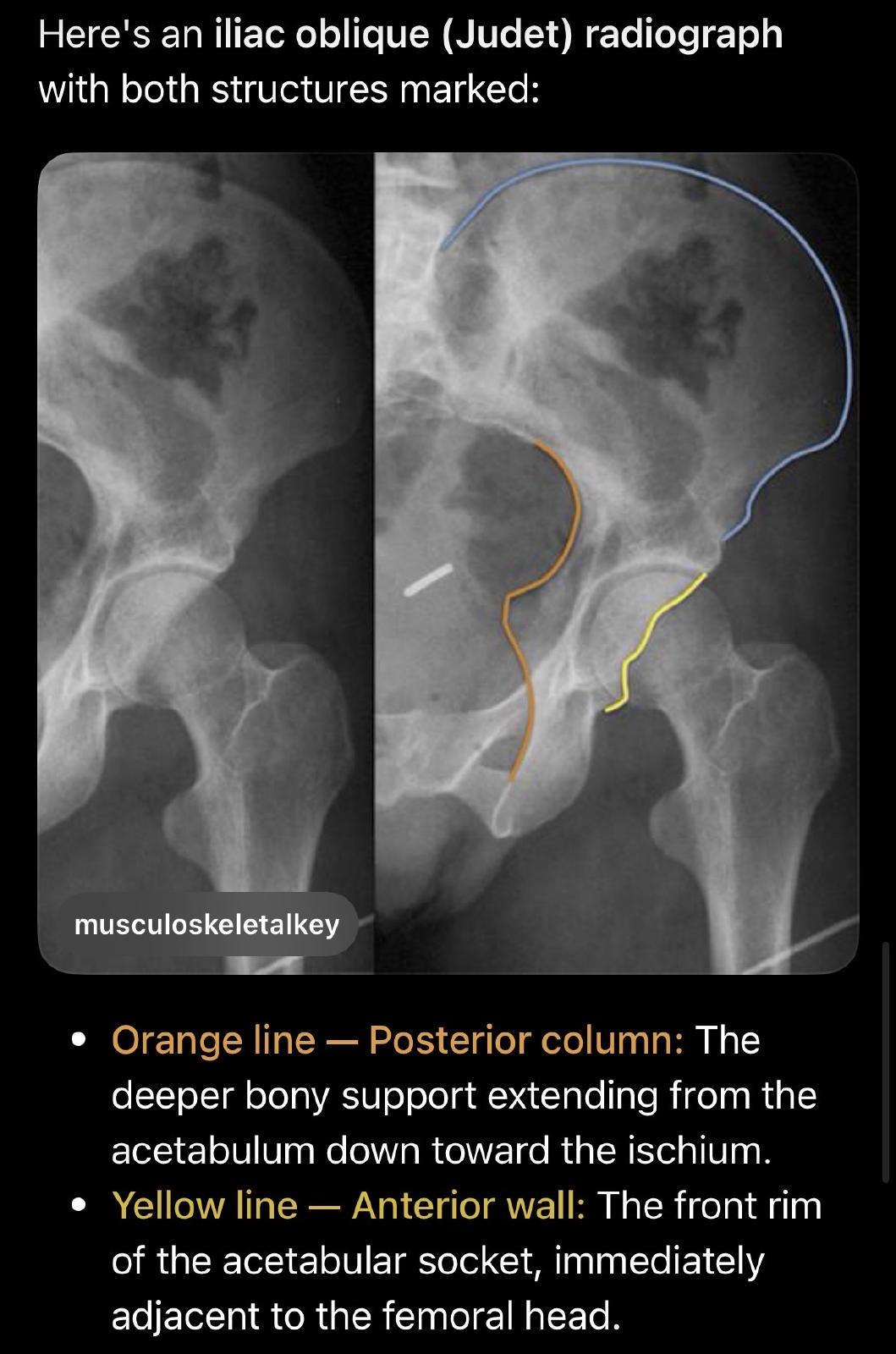
- Lateral hip with external rotation
- Obturator oblique with affected side up
- AP axial outlet pelvis
- Iliac oblique with affected side down
15
A patient cannot raise the unaffected leg sufficiently for a standard Danelius-Miller cross-table lateral hip. Which alternative trauma projection is specifically designed for this limitation?
- Unilateral frog-leg hip
- AP axial inlet pelvis
- Modified Cleaves bilateral hip
- Clements-Nakayama axiolateral hip
16
An AP axial projection of the foot is performed with the central ray angled 10° posteriorly toward the heel. What is the primary purpose of this angulation?
- To demonstrate the subtalar joint without superimposition
- To reduce foreshortening of the metatarsals
- To open the interphalangeal joints
- To demonstrate the calcaneus in profile
17
An AP mortise ankle radiograph demonstrates superimposition of the distal fibula over the lateral talus. Which correction is most appropriate?
- Increase internal rotation of the leg and foot
- Rotate the leg externally 15°
- Angle the central ray 10° cephalad
- Plantar flex the foot
18
A patient has a suspected proximal femur fracture and cannot move the affected leg. Which lateral projection is most appropriate?
- Frog-leg lateral
- Modified Cleaves method
- Axiolateral inferosuperior (Danelius-Miller)
- AP axial projection with 15° internal rotation
19
Which relationship should be demonstrated on a correctly positioned lateral knee radiograph?
- Femoral condyles separated by 20°
- Fibular head completely free of tibial superimposition
- Patella superimposed over distal femoral shaft
- Posterior femoral condyles superimposed
20
An AP pelvis image shows bilateral prominent lesser trochanters. With no trauma contraindication, what correction should be made?
- Externally rotate both legs 15–20°
- Internally rotate both legs 15–20°
- Flex both knees 45°
- Angle the central ray 15° caudad
21
For an AP axial calcaneus projection with the plantar surface perpendicular to the IR, which CR direction is used?
- 40° cephalad toward the base of the third metatarsal
- 15° caudad toward the ankle joint
- Perpendicular to the medial malleolus
- 25° cephalad toward the fifth metatarsal
22
A lateral foot radiograph shows the fifth metatarsal excessively in profile and poor superimposition of the metatarsals. Which correction is best?
- Increase medial rotation by bringing the knee closer to the table
- Increase plantar flexion of the ankle
- Decrease rotation by moving the knee away from the table
- Angle the central ray 15° toward the heel
23
Which projection demonstrates the distal femoral intercondylar fossa with the patient prone and the knee flexed approximately 40–50°?
- AP oblique knee with medial rotation
- Tangential patella (Merchant)
- AP weight-bearing knee
- PA axial knee (Holmblad)
24
An AP tibia-fibula examination must include which anatomy?
- Only the tibial shaft and fracture site
- Entire tibia and fibula, including knee and ankle joints
- Knee joint and proximal half of tibia
- Ankle joint and distal two-thirds of fibula
25
A patient with a suspected patellar fracture cannot tolerate knee flexion. Which approach is most appropriate?
- Force the knee into 45° flexion for tangential imaging
- Perform a Merchant projection with 90° flexion
- Obtain AP and horizontal-beam lateral projections without forcing flexion
- Internally rotate the leg 45° to demonstrate the patella
26
An AP mortise ankle image shows an open medial tibiotalar joint space, but the fibula overlaps the lateral talus and the distal tibiofibular joint is poorly seen. What is the most likely cause?
- Excessive internal rotation of the leg
- Insufficient internal rotation of the leg
- Excessive dorsiflexion of the foot
- Incorrect cephalad CR angulation
27
An AP pelvis image shows symmetric obturator foramina and iliac wings, prominent lesser trochanters bilaterally, and foreshortened femoral necks. What is the most likely explanation?
- The pelvis is rotated toward one side, requiring MSP repositioning
- Both lower extremities are excessively internally rotated
- Both lower extremities are insufficiently internally rotated
- The central ray is centered too far inferiorly
28
A lateral knee radiograph shows vertical separation of the posterior femoral condyles, with the medial condyle projecting inferior to the lateral condyle. What correction is most appropriate?
- Increase the cephalad CR angle
- Decrease the cephalad CR angle
- Externally rotate the knee 5°
- Internally rotate the knee 5°
29
A patient with a suspected femoral neck fracture has an externally rotated injured leg and a prominent lesser trochanter on AP hip imaging. What is the best next step for the lateral view?
- Internally rotate the leg 15–20° and perform a frog-leg lateral
- Leave the injured leg in its current position and perform a cross-table lateral
- Rotate the leg internally until the lesser trochanter disappears, then perform a cross-table lateral
- Abduct the injured leg 45° to demonstrate the femoral neck
More Medicine & health flashcards
7- cage thoraciqueMedicine & health · FrenchOcéaneTD chimiothérapieMedicine & health · FrenchClaraCriptococosisMedicine & health · SpanishMajoExam 1 StatPearlsMedicine & health · EnglishMadiNervous SystemMedicine & health · EnglishEmanThe skeletonMedicine & health · Englishan OutLearn studentNervous system chapter 12Medicine & health · EnglishLucieX-ray Production and Target InteractionsMedicine & health · EnglishZAsthma/COPDMedicine & health · EnglishcathsimsUrinalysis: Physical Examination and Urine VolumeMedicine & health · EnglishCHRISTYDigestive System Vocabulary (Chapter 5)Medicine & health · EnglishJulieLecture 4 - Muscle Tendon Disorders InterventionMedicine & health · EnglishEsha
Study these decks in the app
Free on iPhone, Android, Mac and the web. Add any deck to your account in one tap.

