Ego Defense Mechanisms and Classical Conditioning
Study these flashcardsFree · spaced repetition · iPhone, Android, Mac & web
All cards
1
is a type of conditioning where a natural response is elicited by a conditioned/learned stimulus that was previously presented with an unconditioned stimulus
Classical conditioning is a type of conditioning where a natural response is elicited by a conditioned/learned stimulus that was previously presented with an unconditioned stimulus
2
Which ego defense is defined as expressing unacceptable feelings and thoughts through actions?
Which ego defense is defined as expressing unacceptable feelings and thoughts through actions?
Acting out (immature defense)
Acting out (immature defense)
3
Which ego defense is defined as avoiding the awareness of some painful reality?
Which ego defense is defined as avoiding the awareness of some painful reality?
Denial (immature defense)
Denial (immature defense)
4
Which ego defense is defined as redirection of emotions / impulses to a neutral person or object?
Which ego defense is defined as redirection of emotions / impulses to a neutral person or object?
Displacement (immature defense)
Displacement (immature defense)
5
Which ego defense is defined as temporary, drastic change in personality, memory, consciousness, or motor behavior to avoid emotional stress?
Which ego defense is defined as temporary, drastic change in personality, memory, consciousness, or motor behavior to avoid emotional stress?
Dissociation (immature defense)
Dissociation (immature defense)
6
Which ego defense is defined as partially remaining at a more childish level of development?
Which ego defense is defined as partially remaining at a more childish level of development?
Fixation (immature defense)
Fixation (immature defense)
7
Which ego defense is defined as expressing extremely positive thoughts of self/others while ignoring negative thoughts?
Which ego defense is defined as expressing extremely positive thoughts of self/others while ignoring negative thoughts?
Idealization (immature defense)
Idealization (immature defense)
8
Which ego defense is defined as a largely unconscious expression of the characteristics, qualities, or traits of another person or group that is perceived to be more powerful / prestigious?
Which ego defense is defined as a largely unconscious expression of the characteristics, qualities, or traits of another person or group that is perceived to be more powerful / prestigious?
Identification (immature defense)
Identification (immature defense)
9
Which ego defense is defined as using facts and logic to emotionally distance oneself from a stressful situation?
Which ego defense is defined as using facts and logic to emotionally distance oneself from a stressful situation?
Intellectualization (immature defense)
Intellectualization (immature defense)
10
Which ego defense is defined as separating feelings from ideas and events?
Which ego defense is defined as separating feelings from ideas and events?
Isolation of affect (immature defense)
Isolation of affect (immature defense)
11
Which ego defense is defined as demonstrating hostile feelings in a non-confrontational manner?
Which ego defense is defined as demonstrating hostile feelings in a non-confrontational manner?
Passive aggression (immature defense)
Passive aggression (immature defense)
12
Which ego defense is defined as misattributing one's own unconscious, undesired thoughts or feelings to another person who does not actually have them?
Which ego defense is defined as misattributing one's own unconscious, undesired thoughts or feelings to another person who does not actually have them?
Projection (immature defense)
Projection (immature defense)
13
Which ego defense is defined as proclaiming logical reasons for actions actually performed for other reasons (usually to avoid self-blame)?
Which ego defense is defined as proclaiming logical reasons for actions actually performed for other reasons (usually to avoid self-blame)?
Rationalization (immature defense)
Rationalization (immature defense)
14
Which ego defense is defined as unconsciously replacing an idea or feeling with its opposite?
Which ego defense is defined as unconsciously replacing an idea or feeling with its opposite?
Reaction formation (immature defense)
Reaction formation (immature defense)
15
Which ego defense is defined as involuntarily reverting to the behavior of a younger person/child?
Which ego defense is defined as involuntarily reverting to the behavior of a younger person/child?
Regression (immature defense)
Regression (immature defense)
16
Which ego defense is defined as involuntarily withholding an idea or feeling from conscious awareness?
Which ego defense is defined as involuntarily withholding an idea or feeling from conscious awareness?
Repression (immature defense)
Repression (immature defense)
17
Which ego defense is defined as believing that people are either all good or all bad at different times due to intolerance of ambiguity?
Which ego defense is defined as believing that people are either all good or all bad at different times due to intolerance of ambiguity?
Splitting (immature defense)
Splitting (immature defense)
18
is a major defense mechanism seen in patients with borderline personality disorder
Splitting is a major defense mechanism seen in patients with borderline personality disorder
19
Splitting is a major defense mechanism seen in patients with personality disorder
Splitting is a major defense mechanism seen in patients with borderline personality disorder
20
Which ego defense is defined as replacing an unacceptable wish with a course of action that is similar to the wish but does not conflict with one's value system?
Which ego defense is defined as replacing an unacceptable wish with a course of action that is similar to the wish but does not conflict with one's value system?
Sublimation (mature defense)
Sublimation (mature defense)
21
Which ego defense is defined as alleviating negative feelings via unsolicited generosity which provides gratification?
Which ego defense is defined as alleviating negative feelings via unsolicited generosity which provides gratification?
Altruism (mature defense)
Altruism (mature defense)
22
Which ego defense is defined as intentionally withholding an idea or feeling from conscious awareness (temporary)?
Which ego defense is defined as intentionally withholding an idea or feeling from conscious awareness (temporary)?
Suppression (mature defense)
Suppression (mature defense)
23
Which ego defense is defined as appreciating the amusing nature of an anxiety-provoking or adverse situation?
Which ego defense is defined as appreciating the amusing nature of an anxiety-provoking or adverse situation?
Humor (mature defense)
Humor (mature defense)
24
The mature mechanisms of ego defense may be remembered with the mnemonic "SASH":
The mature mechanisms of ego defense may be remembered with the mnemonic "SASH":
Sublimation
Altruism
Suppression
Humor
Sublimation
Altruism
Suppression
Humor
25
Patients with conversion disorder are often aware, but indifferent towards their symptoms (e.g., blindness, mutism); known as " "
Patients with conversion disorder are often aware, but indifferent towards their symptoms (e.g., blindness, mutism); known as "la belle indifférence"
26
Bipolar I vs Bipolar II
Bipolar I: mania, if mania with psychosis, then Bipolar I by definition
Bipolar II: hypomania with MDD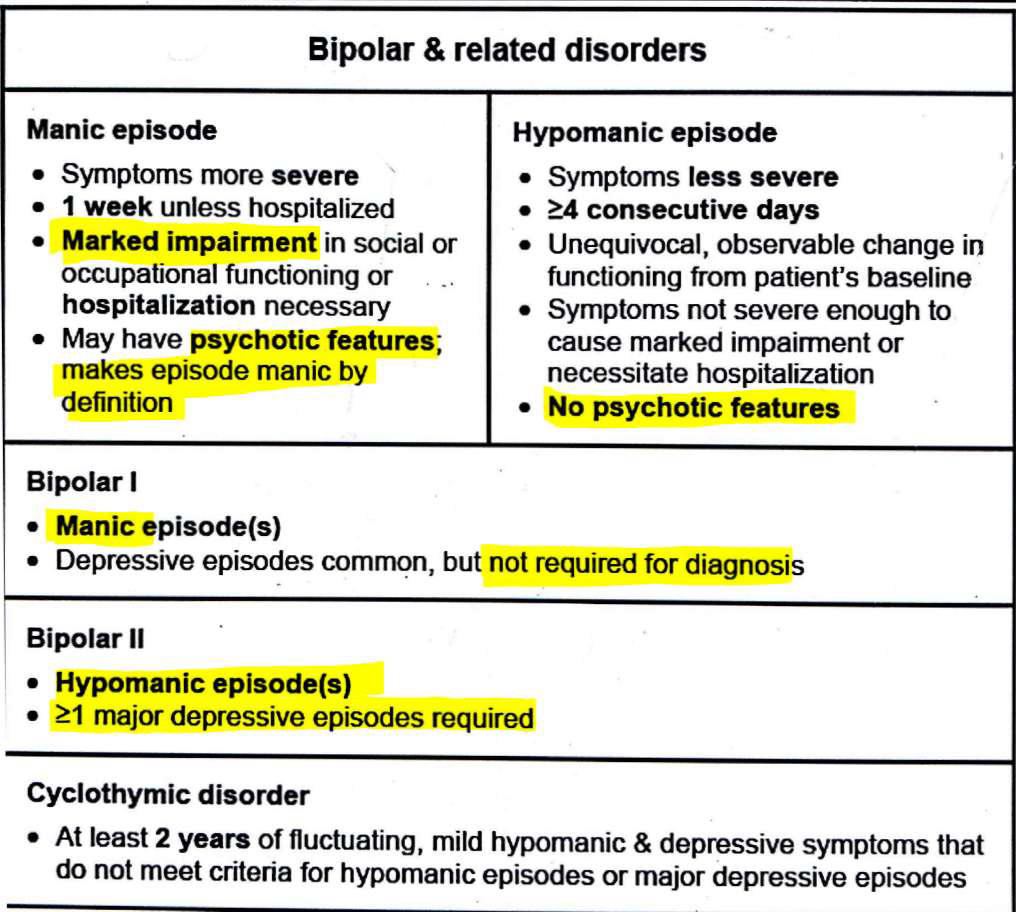
Bipolar II: hypomania with MDD
27
What is the likely diagnosis in a middle-aged woman with fatigue and chronic widespread pain with focal areas of tenderness? Serum creatine kinase, ESR, and CRP are within normal limits
What is the likely diagnosis in a middle-aged woman with fatigue and chronic widespread pain with focal areas of tenderness? Serum creatine kinase, ESR, and CRP are within normal limits
Fibromyalgia
Fibromyalgia
28
What drug withdrawal presents with acute depression ("crash"), fatigue, hypersomnia, increased appetite, and vivid dreams?
What drug withdrawal presents with acute depression ("crash"), fatigue, hypersomnia, increased appetite, and vivid dreams?
Cocaine withdrawal
Cocaine withdrawal
29
What neuroimaging findings are most consistently found in patients with schizophrenia?
-
-
-
-
What neuroimaging findings are most consistently found in patients with schizophrenia?
- Ventriculomegaly (particularly of the lateral cerebral ventricles)
- Cortical atrophy
- Ventriculomegaly (particularly of the lateral cerebral ventricles)
- Cortical atrophy
30
Major depressive disorder is associated with levels of cortisol
Major depressive disorder is associated with increased levels of cortisol
31
is when the doctor project feelings onto the patient
Countertransference is when the doctor project feelings onto the patient
32
In which condition of infant deprivation does the child indiscriminately attach to strangers?
Disinhibited social engagement disorder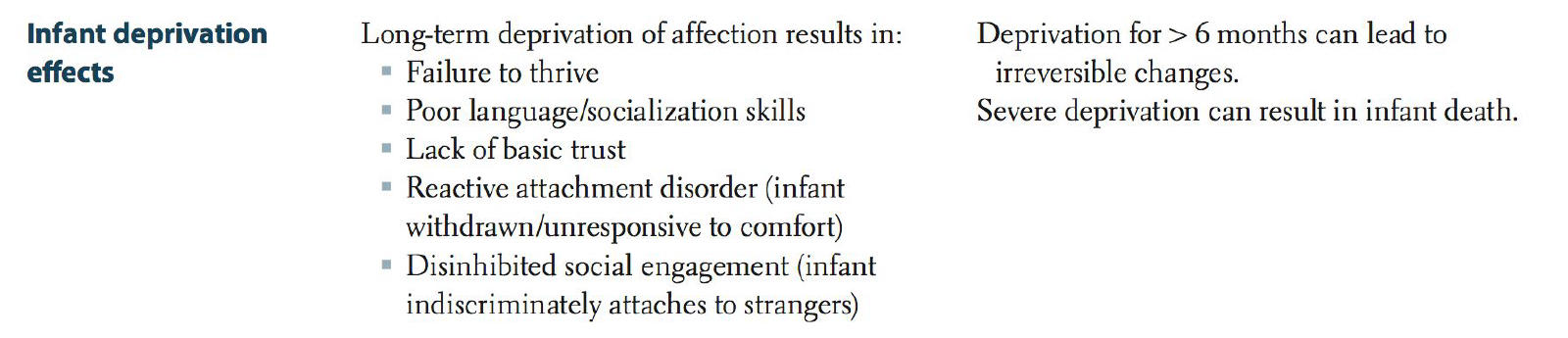
33
describes a deprived infant who is withdrawn and unresponsive
Reactive attachment disorder describes a deprived infant who is withdrawn and unresponsive
34
19 y/o man is brought to office by his mother and is diagnosed with MDD. He is prescribed SSRIs. His mother is concerned that antidepressants can cause people to become suicidal. Most appropriate response?
The slightly ↑ risk of suicidal thoughts needs to be weighted against risk of competed suicide in untreated population.
FDA says that all patients <25 yrs age should be informed about small risk of becoming suicidal during initiation of antidepressant.
The benefits of antidepressants for moderate to severe depression outweigh the risks.
Pt should be monitored for ↑ suicidal thoughts esp following initiation of antidepressant therapy
35
Acute lithium toxicity = side effectsChronic lithium toxicity = side effects
Acute lithium toxicity = GI side effectsChronic lithium toxicity = neurologic side effects
36
If anorexia nervosa patient has wt for ht < %, then it is an indication for hospitalization.
If anorexia nervosa patient has wt for ht <20%, then it is an indication for hospitalization.
37
Sense of familiarity in unfamiliar situation:
Sense of familiarity in unfamiliar situation: Deja vu
38
Sense of unfamiliarity in familiar situation:
Sense of unfamiliarity in familiar situation: Jamais Vu
39
Incapacitated patient has a advanced directive regarding the treatment. Physician believes that the directive is not in the best interest of the patient.NBS?
Incapacitated patient has a advanced directive regarding the treatment. Physician believes that the directive is not in the best interest of the patient.NBS?
Send application to the mental health board to review/alter the advanced directive
Send application to the mental health board to review/alter the advanced directive
40
Is commiting suicide criminal offence in India?
Is commiting suicide criminal offence in India?
NO
NO
41
Bereavement means
Bereavement means loss of a loved one
42
Persistent complex bereavement disorder- C/F and treatment?
aka complicated grief/pathological grief
Prolonged grief(>6-12mo), difficulty accepting death, persistent yearning, difficulty envisioning life without deceased, guilty ruminations surrounding circumstances of death..
So its basically a person who doesn't meet criteria for Major depressive disorder but is depressed for a long time after death of a close one and can't accept that he's gone. Sometimes feels guilty that couldn't save him, can wish to die to join them/or because the world without them isn't worth living.
Tx: psychotherapy
43
Diagnosis:
Hypomania
Episodes of Depression
Hypomania
Episodes of Depression
Diagnosis:
Hypomania
Episodes of Depression
Bipolar 2
Hypomania
Episodes of Depression
Bipolar 2
44
Diagnosis:
Mania episode lasting 1wk
Mania episode lasting 1wk
Diagnosis:
Mania episode lasting 1wk
Bipolar 1
Mania episode lasting 1wk
Bipolar 1
45
is a questionnaire used to screen for pospartum depression
Edinburgh Depression scale is a questionnaire used to screen for pospartum depression
46
Edinburgh Depression scale is a questionnaire used to screen for
Edinburgh Depression scale is a questionnaire used to screen for pospartum depression
47
For diagnoses of dysthymia, symptoms of depressed mood should be present for at least
For diagnoses of dysthymia, symptoms of depressed mood should be present for at least 2 years
48
What type of hallucinations are classic for psychiatric disease?
What type of hallucinations are classic for psychiatric disease?
Auditory
Auditory
49
What type of hallucinations are more common in alcohol intoxication?
What type of hallucinations are more common in alcohol intoxication?
Visual
Visual
50
What type of hallucinations are more common in organic disease states?
What type of hallucinations are more common in organic disease states?
Visual
Visual
51
Olfactory hallucinations are seen in lobe epilepsy
Olfactory hallucinations are seen in temporal lobe epilepsy
52
waves on EEG are seen in awake and alert person
ß waves on EEG are seen in awake and alert person
53
ß waves on EEG are seen in
ß waves on EEG are seen in awake and alert person
54
In light anesthesia, EEG will show waves on EEG
In light anesthesia, EEG will show ßwaves on EEG
55
If an adult closes his eyes, waves will be shown on EEG.
If an adult closes his eyes, α waves will be shown on EEG.
56
waves will be seen normally in deep sleep.
Delta waves will be seen normally in deep sleep.
57
Delta waves will be seen normally in .
Delta waves will be seen normally in deep sleep.
58
Theta waves are more common in
Theta waves are more common in children
59
Minimum frequency for binge eating or compensatory behavior to diagnose bulimia nervosa is /wk
Minimum frequency for binge eating or compensatory behavior to diagnose bulimia nervosa is 1/wk
60
Drugs for acute managemennt of panic attacks?
Drugs for acute managemennt of panic attacks?
Benzodiazepines
Benzodiazepines
61
has symptoms of psychosis lasting for <1months
Brief psychotic disorder has symptoms of psychosis lasting for <1months
62
Brief psychotic disorder has symptoms of psychosis lasting for
Brief psychotic disorder has symptoms of psychosis lasting for <1months
63
has symptoms of psychosis lasting for 1month - 6months
Schizophreniform disorder has symptoms of psychosis lasting for 1month - 6months
64
Schizophreniform disorder has symptoms of psychosis lasting for
Schizophreniform disorder has symptoms of psychosis lasting for 1month - 6months
65
has symptoms of psychosis lasting for > 6months
Schizophrenia has symptoms of psychosis lasting for > 6months
66
Schizophrenia has symptoms of psychosis lasting for
Schizophrenia has symptoms of psychosis lasting for > 6months
67
During major depressive disorder,
Rem latency:
Total REM sleep:
Slow wave sleep:
Rem latency:
Total REM sleep:
Slow wave sleep:
During major depressive disorder,
Rem latency: ↓
Total REM sleep: ↑
Slow wave sleep: ↓
Rem latency: ↓
Total REM sleep: ↑
Slow wave sleep: ↓
68
syndrome: Patients complain that they have lost all their possessions and even their internal organs. They also feel that the world has reduced to nothingness. They might believe that thay are dead and stop eating. (nihilistic delusional disorder)
Cotard syndrome: Patients complain that they have lost all their possessions and even their internal organs. They also feel that the world has reduced to nothingness. They might believe that thay are dead and stop eating. (nihilistic delusional disorder)
69
syndrome: Patients think that their spouse is cheating
Othello syndrome: Patients think that their spouse is cheating
70
P-SPIKES protocol for breaking bad news has following components:
Setting up the stage
Patient's perception
Invitation
Knowlegde
Empathy
Summary
Setting up the stage
Patient's perception
Invitation
Knowlegde
Empathy
Summary
P-SPIKES protocol for breaking bad news has following components:
Preparation
Setting up the stage
Patient's perception
Invitation
Knowlegde
Empathy
Summary
Preparation
Setting up the stage
Patient's perception
Invitation
Knowlegde
Empathy
Summary
71
P-SPIKES protocol for breaking bad news has following components:
Preparation
Patient's perception
Invitation
Knowlegde
Empathy
Summary
Preparation
Patient's perception
Invitation
Knowlegde
Empathy
Summary
P-SPIKES protocol for breaking bad news has following components:
Preparation
Setting up the stage
Patient's perception
Invitation
Knowlegde
Empathy
Summary
Preparation
Setting up the stage
Patient's perception
Invitation
Knowlegde
Empathy
Summary
72
P-SPIKES protocol for breaking bad news has following components:
Preparation
Setting up the stage
Invitation
Knowlegde
Empathy
Summary
Preparation
Setting up the stage
Invitation
Knowlegde
Empathy
Summary
P-SPIKES protocol for breaking bad news has following components:
Preparation
Setting up the stage
Patient's perception
Invitation
Knowlegde
Empathy
Summary
Preparation
Setting up the stage
Patient's perception
Invitation
Knowlegde
Empathy
Summary
73
P-SPIKES protocol for breaking bad news has following components:
Preparation
Setting up the stage
Patient's perception
Knowlegde
Empathy
Summary
Preparation
Setting up the stage
Patient's perception
Knowlegde
Empathy
Summary
P-SPIKES protocol for breaking bad news has following components:
Preparation
Setting up the stage
Patient's perception
Invitation
Knowlegde
Empathy
Summary
Preparation
Setting up the stage
Patient's perception
Invitation
Knowlegde
Empathy
Summary
74
P-SPIKES protocol for breaking bad news has following components:
Preparation
Setting up the stage
Patient's perception
Invitation
Empathy
Summary
Preparation
Setting up the stage
Patient's perception
Invitation
Empathy
Summary
P-SPIKES protocol for breaking bad news has following components:
Preparation
Setting up the stage
Patient's perception
Invitation
Knowlegde
Empathy
Summary
Preparation
Setting up the stage
Patient's perception
Invitation
Knowlegde
Empathy
Summary
75
P-SPIKES protocol for breaking bad news has following components:
Preparation
Setting up the stage
Patient's perception
Invitation
Knowlegde
Summary
Preparation
Setting up the stage
Patient's perception
Invitation
Knowlegde
Summary
P-SPIKES protocol for breaking bad news has following components:
Preparation
Setting up the stage
Patient's perception
Invitation
Knowlegde
Empathy
Summary
Preparation
Setting up the stage
Patient's perception
Invitation
Knowlegde
Empathy
Summary
76
P-SPIKES protocol for breaking bad news has following components:
Preparation
Setting up the stage
Patient's perception
Invitation
Knowlegde
Empathy
Preparation
Setting up the stage
Patient's perception
Invitation
Knowlegde
Empathy
P-SPIKES protocol for breaking bad news has following components:
Preparation
Setting up the stage
Patient's perception
Invitation
Knowlegde
Empathy
Summary
Preparation
Setting up the stage
Patient's perception
Invitation
Knowlegde
Empathy
Summary
77
is a finding seen in narcolepsy
Cataplexy is a finding seen in narcolepsy
78
Which medication is used to control autonomic symptoms associated with opioid withdrawal?
Which medication is used to control autonomic symptoms associated with opioid withdrawal?
Clonidine
Clonidine
79
Diagnosis: personality disorder
1) Sexually provocative, seductive
2) Drawing attention to oneself by way of physical appearance3) Dramatic speech
1) Sexually provocative, seductive
2) Drawing attention to oneself by way of physical appearance3) Dramatic speech
Diagnosis: Histrionic personality disorder
1) Sexually provocative, seductive
2) Drawing attention to oneself by way of physical appearance3) Dramatic speech
1) Sexually provocative, seductive
2) Drawing attention to oneself by way of physical appearance3) Dramatic speech
80
Lithium side effects on thyroid and parathyroid:
Lithium side effects on thyroid and parathyroid:
Hypothyroidism and hyperparathyroidism
Hypothyroidism and hyperparathyroidism
81
Dx of schizophrenia requires the presence of of the the following, out of which atleast one should be #
Delusions
Hallucinations
Disorganized speech
Disorganized behaviour
-ve symptoms
Delusions
Hallucinations
Disorganized speech
Disorganized behaviour
-ve symptoms
Dx of schizophrenia requires the presence of 2 of the the following, out of which atleast one should be #1, 2or 3
Delusions
Hallucinations
Disorganized speech
Disorganized behaviour
-ve symptoms
Delusions
Hallucinations
Disorganized speech
Disorganized behaviour
-ve symptoms
82
Schneiderian first rank symptoms of schizophrenia:
1) 3 auditory phenomenon:
2) 3 thought phenomenon:
3) 3 made phenomenon: Made impulse (brief motor act), Made voition (complex activity), Affect (emotion)
4) Somatic passivity: Delusion of control
5) Primary delusional experience (delusional idea/memory/mood/perception)
1) 3 auditory phenomenon:
2) 3 thought phenomenon:
3) 3 made phenomenon: Made impulse (brief motor act), Made voition (complex activity), Affect (emotion)
4) Somatic passivity: Delusion of control
5) Primary delusional experience (delusional idea/memory/mood/perception)
Schneiderian first rank symptoms of schizophrenia:
1) 3 auditory phenomenon: 1st/2nd/3rd person hallucinations
2) 3 thought phenomenon: Insertion/Withdrawal/Broadcast
3) 3 made phenomenon: Made impulse (brief motor act), Made voition (complex activity), Affect (emotion)
4) Somatic passivity: Delusion of control
5) Primary delusional experience (delusional idea/memory/mood/perception)
83
Schneiderian first rank symptoms of schizophrenia:
1) 3 auditory phenomenon: 1st/2nd/3rd person hallucinations
2) 3 thought phenomenon: Insertion/Withdrawal/Broadcast
3) 3 made phenomenon:
4) Somatic passivity: Delusion of control
5) Primary delusional experience (delusional idea/memory/mood/perception)
1) 3 auditory phenomenon: 1st/2nd/3rd person hallucinations
2) 3 thought phenomenon: Insertion/Withdrawal/Broadcast
3) 3 made phenomenon:
4) Somatic passivity: Delusion of control
5) Primary delusional experience (delusional idea/memory/mood/perception)
Schneiderian first rank symptoms of schizophrenia:
1) 3 auditory phenomenon: 1st/2nd/3rd person hallucinations
2) 3 thought phenomenon: Insertion/Withdrawal/Broadcast
3) 3 made phenomenon: Made impulse (brief motor act), Made voition (complex activity), Affect (emotion)
4) Somatic passivity: Delusion of control
5) Primary delusional experience (delusional idea/memory/mood/perception)
84
Schneiderian first rank symptoms of schizophrenia:
1) 3 auditory phenomenon: 1st/2nd/3rd person hallucinations
2) 3 thought phenomenon: Insertion/Withdrawal/Broadcast
3) 3 made phenomenon: Made impulse (brief motor act), Made voition (complex activity), Affect (emotion)
4)
5) Primary delusional experience (delusional idea/memory/mood/perception)
1) 3 auditory phenomenon: 1st/2nd/3rd person hallucinations
2) 3 thought phenomenon: Insertion/Withdrawal/Broadcast
3) 3 made phenomenon: Made impulse (brief motor act), Made voition (complex activity), Affect (emotion)
4)
5) Primary delusional experience (delusional idea/memory/mood/perception)
Schneiderian first rank symptoms of schizophrenia:
1) 3 auditory phenomenon: 1st/2nd/3rd person hallucinations
2) 3 thought phenomenon: Insertion/Withdrawal/Broadcast
3) 3 made phenomenon: Made impulse (brief motor act), Made voition (complex activity), Affect (emotion)
4) Somatic passivity: Delusion of control
5) Primary delusional experience (delusional idea/memory/mood/perception)
85
Schneiderian first rank symptoms of schizophrenia:
1) 3 auditory phenomenon: 1st/2nd/3rd person hallucinations
2) 3 thought phenomenon: Insertion/Withdrawal/Broadcast
3) 3 made phenomenon: Made impulse (brief motor act), Made voition (complex activity), Affect (emotion)
4) Somatic passivity: Delusion of control
5)
1) 3 auditory phenomenon: 1st/2nd/3rd person hallucinations
2) 3 thought phenomenon: Insertion/Withdrawal/Broadcast
3) 3 made phenomenon: Made impulse (brief motor act), Made voition (complex activity), Affect (emotion)
4) Somatic passivity: Delusion of control
5)
Schneiderian first rank symptoms of schizophrenia:
1) 3 auditory phenomenon: 1st/2nd/3rd person hallucinations
2) 3 thought phenomenon: Insertion/Withdrawal/Broadcast
3) 3 made phenomenon: Made impulse (brief motor act), Made voition (complex activity), Affect (emotion)
4) Somatic passivity: Delusion of control
5) Primary delusional experience (delusional idea/memory/mood/perception)
86
+ belief of Bodily dysfunction/putrification = Cotard syndrome
Nihilistic delusion + belief of Bodily dysfunction/putrification = Cotard syndrome
87
Nihilistic delusion + = Cotard syndrome
Nihilistic delusion + belief of Bodily dysfunction/putrification = Cotard syndrome
88
Nihilistic delusion + belief of Bodily dysfunction/putrification = syndrome
Nihilistic delusion + belief of Bodily dysfunction/putrification = Cotard syndrome
89
A boy is experiencing low mood, decreased energy, and decreased interest in his surroundings. He is not taking food for the past one week. The thought sample says "I lost my head. I am dead. How can I eat?". What is the delusion seen in this case?
A boy is experiencing low mood, decreased energy, and decreased interest in his surroundings. He is not taking food for the past one week. The thought sample says "I lost my head. I am dead. How can I eat?". What is the delusion seen in this case?
Nihilistic delusion(lack of putrefaction)
Nihilistic delusion(lack of putrefaction)
90
What is of Conversion disorder ?
Gait disturbances
Gait disturbances
What is astasia-abasia of Conversion disorder ?
Gait disturbances
Gait disturbances
91
What is astasia-abasia of Conversion disorder ?
What is astasia-abasia of Conversion disorder ?
Gait disturbances
Gait disturbances
92
Astasia-abasia is seen in disorder
Astasia-abasia is seen in Conversion disorder
93
Which anorexia nervosa variant has ?
Atypical anorexia nervosa
Atypical anorexia nervosa
Which anorexia nervosa variant has normal BMI ?
Atypical anorexia nervosa
Atypical anorexia nervosa
94
Which anorexia nervosa variant has normal BMI ?
Which anorexia nervosa variant has normal BMI ?
Atypical anorexia nervosa
Atypical anorexia nervosa
95
aka Magnan's symptoms which refers to the sensation of insects crawling beneath the skin, is a feature of cocaine abuse
Formication aka Magnan's symptoms which refers to the sensation of insects crawling beneath the skin, is a feature of cocaine abuse
96
Formication
Formication aka Magnan's symptoms which refers to the sensation of insects crawling beneath the skin, is a feature of cocaine abuse
97
(also known as floccillation) refers to the action of trying to pick imaginary objects
Carphologia (also known as floccillation) refers to the action of trying to pick imaginary objects
98
Carphologia (also known as ) refers to the action of trying to pick imaginary objects
Carphologia (also known as floccillation) refers to the action of trying to pick imaginary objects
99
Carphologia (also known as floccillation) refers to the
Carphologia (also known as floccillation) refers to the action of trying to pick imaginary objects
100
intake can lead to a delirious state and may show carphologia
Datura intake can lead to a delirious state and may show carphologia
101
According to ICD-11, dependence on any substance is characterized by:
1. Strong to use the substance
2. Increased is given to the use of the substance over other activities.
3. Persistence of substance use despite .
4. Presence of the subjective sensation of to use the substance.
5. to the effect of the substance
6. Appearance of on cessation or reduction in the dose of the substance.
The diagnosis of dependence can be made if these symptoms are present for at least a period of 3 months
According to ICD-11, dependence on any substance is characterized by:
1. Strong internal drive to use the substance
2. Increased priority is given to the use of the substance over other activities.
3. Persistence of substance use despite harmful consequences.
4. Presence of the subjective sensation of urge or craving to use the substance.
5. Tolerance to the effect of the substance
6. Appearance of withdrawal symptoms on cessation or reduction in the dose of the substance.
The diagnosis of dependence can be made if these symptoms are present for at least a period of 3 months
102
According to ICD-11, dependence on any substance is characterized by:
1. Strong internal drive to use the substance
2. Increased priority is given to the use of the substance over other activities.
3. Persistence of substance use despite harmful consequences.
4. Presence of the subjective sensation of urge or craving to use the substance.
5. Tolerance to the effect of the substance
6. Appearance of withdrawal symptoms on cessation or reduction in the dose of the substance.
The diagnosis of dependence can be made if these symptoms are present for at least a period of
According to ICD-11, dependence on any substance is characterized by:
1. Strong internal drive to use the substance
2. Increased priority is given to the use of the substance over other activities.
3. Persistence of substance use despite harmful consequences.
4. Presence of the subjective sensation of urge or craving to use the substance.
5. Tolerance to the effect of the substance
6. Appearance of withdrawal symptoms on cessation or reduction in the dose of the substance.
The diagnosis of dependence can be made if these symptoms are present for at least a period of 3 months
103
Which anti-psychotic is associated with prolactinemia?
Aripiprazole
Aripiprazole
Which anti-psychotic is associated with hypoprolactinemia?
Aripiprazole
Aripiprazole
104
Which anti-psychotic is associated with hypoprolactinemia?
Which anti-psychotic is associated with hypoprolactinemia?
Aripiprazole
Aripiprazole
105
Which anti-psychotic is associated with ?
Quetiapine
Quetiapine
Which anti-psychotic is associated with cataract?
Quetiapine
Quetiapine
106
Which anti-psychotic is associated with cataract?
Which anti-psychotic is associated with cataract?
Quetiapine
Quetiapine
107
What is rett syndrome counterpart for males ?
What is rett syndrome counterpart for males ?
Heller syndrome
Heller syndrome
108
Delirium tremens.Acute Mgt ?
1. Diazepam
2. Thiamine
3. Naltrexone
4. Flupenthixol depot injection
Which of above ?
1. Diazepam
2. Thiamine
3. Naltrexone
4. Flupenthixol depot injection
Which of above ?
Delirium tremens.Acute Mgt ?
1. Diazepam
2. Thiamine
3. Naltrexone
4. Flupenthixol depot injection
Which of above ?
1 and 2
1. Diazepam
2. Thiamine
3. Naltrexone
4. Flupenthixol depot injection
Which of above ?
1 and 2
109
Drugs for Mgt of delirium tremens ?
Drugs for Mgt of delirium tremens ?
Diazepam and Thiamine
Diazepam and Thiamine
110
SSRI during pregnancy can cause -
1.
2.
3.
4.
1.
2.
3.
4.
SSRI during pregnancy can cause -
1. Developmental delay
2. Low APGAR score
3. ADHD
4. Persistent pulmonary hypertension
1. Developmental delay
2. Low APGAR score
3. ADHD
4. Persistent pulmonary hypertension
111
- Difficult to diagnose due to the shell of physician's pride
- Women physicians, substance abuse, relationship troubles
- Women physicians, substance abuse, relationship troubles
Depression - Difficult to diagnose due to the shell of physician's pride
Suicide - Women physicians, substance abuse, relationship troubles
Suicide - Women physicians, substance abuse, relationship troubles
112
- State of emotional and physical exhaustion caused by prolonged stress, relieved after relaxation
- The feeling goes away as soon as you leave the hospital
- The feeling goes away as soon as you leave the hospital
Burnout - State of emotional and physical exhaustion caused by prolonged stress, relieved after relaxation
Overworking - The feeling goes away as soon as you leave the hospital
Overworking - The feeling goes away as soon as you leave the hospital
113
There should be a minute gap between nicotine gum and coffee/soda/acidic food as they decreases its absorption
There should be a 15 minute gap between nicotine gum and coffee/soda/acidic food as they decreases its absorption
114
There should be a 15 minute gap between gum and coffee/soda/acidic food as they decreases its absorption
There should be a 15 minute gap between nicotine gum and coffee/soda/acidic food as they decreases its absorption
115
Which Nicotine therapy provides highest level of nicotine ?
Nicotine
Nicotine
Which Nicotine therapy provides highest level of nicotine ?
Nicotine lozenges
Nicotine lozenges
116
- Mental state with Subnormal intelligence
Oligophrenia - Mental state with Subnormal intelligence
117
Oligophrenia - Mental state with
Oligophrenia - Mental state with Subnormal intelligence
118
is also known as Oneirophrenia
Oneiroid state is also known as Oneirophrenia
119
Oneiroid state is also known as
Oneiroid state is also known as Oneirophrenia
120
What is first line treatment for OCD ?
What is first line treatment for OCD ?
SSRI
SSRI
121
Triad of confusion, ophthalmoplegia, and ataxia is seen in
Triad of confusion, ophthalmoplegia, and ataxia is seen in wernicke encephalopathy
122
Retrograde amnesia in is a classic example of Ribot's law
Retrograde amnesia in Alzheimer's disease is a classic example of Ribot's law
123
- Anterograde amnesia + loss of recent memory + change in personality
Korsakoff syndrome - Anterograde amnesia + loss of recent memory + change in personality
124
Korsakoff syndrome - amnesia + loss of recent memory + change in personality
Korsakoff syndrome - Anterograde amnesia + loss of recent memory + change in personality
125
Korsakoff syndrome - Anterograde amnesia + loss of recent memory + change in
Korsakoff syndrome - Anterograde amnesia + loss of recent memory + change in personality
More Psychology & society flashcards
psychopatho TDPsychology & society · FrenchganeDev. Psych Exam 1 Flashcards (Study Guide)Psychology & society · EnglishJaceyPsychology: Animal Studies (Attachment)Psychology & society · Englishriaclassical conditioning (main)Psychology & society · EnglishjasmoneErikson’s theory/Attitude on AgingPsychology & society · EnglishLunaHistoire de la psychologie : repères historiquesPsychology & society · FrenchganeSocial Psychology: Personality and AttributionPsychology & society · EnglishRidhimaSociology: Classical Theorists and StratificationPsychology & society · EnglishkatePsychology: Testing and MeasurementPsychology & society · EnglishnormaldereConceptes sociològics de Max WeberPsychology & society · CatalanMariaSociological Strain Theories and AnomiePsychology & society · EnglishSANGALLApsychologyexamPsychology & society · EnglishCarson
All Psychology & society decks
Study these decks in the app
Free on iPhone, Android, Mac and the web. Add any deck to your account in one tap.

