FRST 395: Mammal Taxonomy
Study these flashcardsFree · spaced repetition · iPhone, Android, Mac & web
All cards
1
Class: Mammalia
Warm blooded vertebrates
Presence of mammary glands
Hair or fur
Specific ear and jaw bones
Muscular diaphragm
2
Order: Artiodactyla
I 0/3, C 0-1/1, P 3/3, M 3/3 = 32 - 34
Blunt incisors
Diastema (Gap between incisors and cheek teeth)
Sharp enamel ridges grind food as molars slide over each other
Hooves
Tracks: 2 toes visible, no palm/pad
Scat: small, round/oblong pellets
3
Order: Artiodactyla; Family: Bovidae
Herbivores
Single lacrimal foramen (except bison)
True horns: bone with keratin sheath
4
Order: Artiodactyla; Family: Cervidae
Deer
Herbivores
Two lacrimal foramina
Antlers (velvety) – shed annually, can be branched
5
Order: Carnivora
Presence of carnassial teeth
Scat (Canidae & Felidae): tubular
Scat (Ursidae): tubular to loose piles
6
Order: Carnivora; Family: Canidae
I 3/3, C 1/1, P 4/4, M 2/3
Carnivores / omnivores
Long snout
Walk on toes
Pronounced sagittal crest
Transversely elongated molar
Tracks: X or H shaped negative space, non-retractable claws show up in track, 4 visible toes
7
Order: Carnivora; Family: Mustelidae
Weasels, martens, minks, etc
I 3/3, C 1/1, P 3-4/3-4, M 1/1-2
Smaller than other carnivores
Long body, short limbs
Unique dumbbell shaped molars
Carnivores / omnivores
8
Order: Carnivora; Family: Felidae
I 3/3, C 1/1, P 2-3/2, M 1/1
Tiny back molar
Big orbital crest
Retractable claws
Strictly carnivores
Short strong jaw
Tracks: C shaped negative space, retractable claws won’t show up in track, 3 lobed back of pad, 4 visible toes
9
Order: Carnivora; Family: Ursidae
Bears
I 3/3, C 1/1, P 2-4/4, M ⅔ = 38 - 42
Walk on whole foot
Large thick skulls
Omnivore
Tracks: 5 visible toes, claws visible, heel prominent on hind feet, wide palm
10
Order: Chiroptera
Bats
Can fly
Adapted for echolocation
No incisors
Insectivore / frugivore
11
Order: Eulipotyphla
Shrews and moles
Tiny eyes
Sharp teeth
Hard to see ears
Shrews: black teeth
Thin or non-existent zygomatic arch (cheek bones)
Insectivore
12
Order: Lagomorpha
Rabbits and pikas
Double upper incisor (4 not 2)
Incisors don't stop growing
Fenestrated maxillary bone
No canines
Herbivores
Diastema
13
Order: Didelphimorphia
Opossums
I 5/4, C 1/1, P 3/3, M 4/4
Long hairless tail
Opposable rear thumb
Carnivores
14
Order: Rodentia
Rodents (marmots, beavers, mice, rats)
Single pair of lower incisors
Diastema
Herbivores
15
Class: Reptilia
Skin: scales, plates, shields
Physical defence: claws, teeth, hard shells, venom (injected from teeth)
Temperature regulation: ectothermic & poikilothermic
Fertilization: internal
Direct development: no larval stages
Breathe through lungs
16
Order: Testudines
Turtles and tortoises
Testudo = turtle/tortoise (Latin)
Long-living
Some tortoises live up to 200 years
Shells on front and back
Protection and structure
Can feel through their shell
Semi-aquatic
Turtles: aquatic
Tortoises: terrestrial
17
Order: Squamata
Lizards and snakes
Squamata = scale (Latin)
95% of all reptiles
Ectothermy
Indeterminate growers → size depends on environment
3 suborders
Serpentes
Iguania
Autarchoglossa
18
Order: Squamata; Suborder: Serpentes
Snakes
Serpens = snake (Latin)
No legs
Covered in scales
Unhingeable jaw → huge prey
Quadrate bone allows jaw to open up to 150o
70% lay eggs
Oviparous: egg laying
Viviparous: live birth
19
Order: Squamata; Suborder: Iguania
Spiny and horny lizards
Iwana = lizard (Taino)
Scales, covered in spines/spikes
4 legs
Catch prey with tongue (defining factor)
20
Order: Squamata; Suborder: Autarchoglossa
Skinks and alligator lizards
Autarchos = self-governing (Greek)
Glossa = tongue (Greek)
“Free-tongue”
They use jaw and teeth to catch prey
Chemosensory tongue → smell and taste
Generally smooth skin
21
Class: Amphibia************
Cold blooded vertebrate that lacks scales
Skin → moist, scale-less
Most breathe through their skin
Highly permeable (gas and water exchange)
Need to keep moist
22
Order: Anura
Frogs and toads
An = without (Latin)
Oura = tail (Greek)
Body specialized for jumping
Frogs and toads aren’t divided based on taxonomy
Frogs → adapted for water (smooth skin, streamlined physique, long legs)
Toads → life on land (tough/rough skin, squat body, short legs)
23
Order: Caudata
Salamanders and newts
Cauda = tail
“Fire lizard” or “tailed ones”
Tails & four legs for movement
Cannot jump or hop
Newts → rougher skin than salamanders
Sometimes called Urodela
24
Order: Apodiformes
Swifts and hummingbirds
Tiny and “footless”
Smallest birds
Bright plumage
Bill: slender and straight to feed on insects and nectar
Long, flat wings
Hummingbirds can fly backwards
25
Order: Caprimulgiformes
Nightjars
Brown/streaked/barred plumage for camouflage
Short neck and large eyes
Feet: short and weak with pectinated middle toe
Bill: wide gape, rictal bristles
Wings: long and pointed
Aerial forager/insectivore
26
Order: Columbiformes
Pigeons and doves
Small heads and large body
Perching or ground-dwelling
Cooing voices
Nod their heads while walking
Bill: short with fleshy base (cere)
Feet: anisodactyl
27
Order: Galliformes
Fowl (game birds): turkey, chicken, grouse, quail, ptarmigan
Large breasts
Short and rounded wings → short bursts rather than long flights
28
Order: Charadriiformes
Shore birds: gulls, oystercatchers, sandpipers, auks
Wading or aquatic and tend to have longer legs to stand in water
Carnivorous
Range of feet types, although all are webbed (none lobbed)
Range of bill types
Long and straight beaks for sandpipers
Short and triangular beaks for puffins
Three main groups useful for identification: i) sea birds, ii) sandpipers and plovers (waders), and iii) gulls, terns, jaegers
29
Order: Procellariiformes
Seabirds: albatross, petrels, fulmars, shearwaters
Tube noses good for smelling
Have gland that removes salt
Feet: palmate
Wings: long and narrow
30
Order: Pelecaniformes
Pelicans, bitterns, herons
Mostly marine
Distinctive bills → gular pouch for fish
Feet: not webbed or partially webbed (except pelicans which have totipalmate feet)
31
Order: Suliformes
Gannets, cormorants, and relatives
Break: thin and hooked
Feet: totipalmate
Gular pouch
32
Order: Gruiformes
Coots, rails, cranes
“Crane-like”, “mud-ducks”
Bill: long and tapered
Long legs for wading
Hard to distinguish from waders of charadriiformes
Have more robust body and shorter bills
33
Order: Podicipediformes
Grebes
Bill: slim and pointed
Feet: lobed
Legs far back for diving
Duck-like swimmers and divers
Feed on insects, fish, small crustaceans
34
Order: Gaviiformes
Loons
Bill: large and sharply pointed
Feet: webbed (palmate)
Legs far back for diving
Duck-like swimmers and divers
Feed on fish primarily or crustaceans
35
Order: Accipitriformes
Hawks, goshawks, eagles, osprey
Wings: square wings
Bill: hooked with cere (fleshy area where nostrils are)
Feet: anisodactyl
Predatory with talons for hunting
36
Order: Cathartiformes
Vultures and condors
Scavengers (feed on carrion)
Strong sense of smell
Bald heads and large nostrils
Bill: strong and hooked
Feet: similar to accipitriformes, but not as strong
37
Order: Anseriformes
Waterfowl (ducks, geese, swans)
Bill: depressed (wider than it is long) or narrow with hook
Sieve-like beak: lamellate -- keratin; to filter food
Feet: webbed (have toenails)
Cavity nests (wood duck, hooded merganser
Wetland edges: depends on riparian habitats
Tails: short and rounded for stability and steering (flight and swimming)
Wings: short and pointy for agility
Some are secondary cavity nesters
38
Order: Coraciiformes
Kingfishers
Arboreal and solitary
Bright plumage; crested head
Piscivores (only eat fish)
Bill: strong, long straight
Feet: weak, syndactyl
Wings: short and rounded
Tail: typically short-medium for diving
Cavity nesters
Excavate nest burrows into sand/soil of a bank (primary excavator)
Some will nest in excavated tree cavities (secondary cavity nester)
39
Order: Falconiformes
Wings: angel
Feel: anisodactyl
Bills: short and hooked
Tomial tooth to sever spinal cord
Bill used for killing
Tail: long for maneuverability
Nesting behaviour: Cliff ledges, Secondary cavity nester
40
Order: Passeriformes
Perching birds (crows, jays, sparrows, finches)
More than half of all living bird species
Wide range of sizes
Varying beaks - Eat seeds and insects
Feet: anisodactyl with booted tarsus
Secondary cavity nesters
41
Order: Piciformes
Woodpeckers
Arboreal insectivores -- Adapted for foraging on tree trunks
Bill: chisel-like
Long, sticky tongue
Cushions brain
Feet: zygodactyl
Tail: stiff and long
Wings: short and elliptical (rounded) -- Maneuver through trees & Short bursts of fight
Primary cavity excavator
42
Order: Strigiformes
Owls
Nocturnal birds of prey
Facial disk collects sound
Wings and plumage: soft fringe on outer edge of primary feathers (reduce sound)
Feet: zygodactyls
Strong talons for hunting
Bills: strong and hooked
Tail: typically short and wide for stability while flying
Fixed, forward facing eyes
Some are secondary cavity nesters
43
Primary excavators
Piciformes (woodpeckers)
Coraciiformes (kingfishers)
44
Secondary cavity nesters
Strigiformes (owls)
Anseriformes (waterfowl)
Falconiformes (falcoons)
Passeriformes (perching birds)
45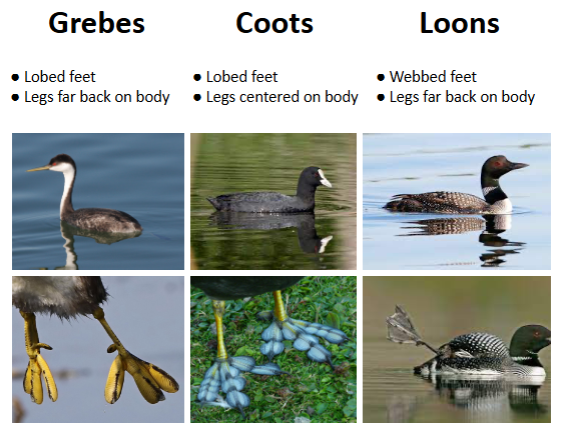
Image occlusion: name the hidden labels
46
Image occlusion: name the hidden labels
47
Image occlusion: name the hidden labels
48
broad wings
soaring, glliding, stability, control
slower to take off
49
long and pointy wings
efficient long-distance flights
50
short and pointy wings
speed, agility
51
short and round wings
short flights, quick takeoff
52
braod tails
stability and balance while soaring
no quick maneuvers
53
long tails
control and maneuverability but less stability
quick turns
54
short and stumpy tail
better for diving in water (less drag)
quick takeoff
55
long and stiff tails
stability while pecking
56
forked tails
highly maneuverable (less drag)
57
Artiodactyla dental formula
I 0/3, C 0-1/1, P 3/3, M 3/3
58
Canidae dental formula
I 3/3, C 1/1, P 4/4, M 2/3
59
Mustelidae dental formula
I 3/3, C 1/1, P 3-4/3-4, M 1/1-2
60
Felidae dental formula
I 3/3, C 1/1, P 2-3/2, M 1/1
61
Ursidae dental formula
I 3/3, C 1/1, P 2-4/4, M 2/3
62
Lagomorpha dental formula
I 2/1, C 0/0, P 3/2, M2-3/3
63
Didelphimorphia dental formula
I 5/4, C 1/1, P 3/3, M 4/4
More Science flashcards
LEC 25 BIOL 431Science · EnglishDDFLCevoluce člověka Science · Czechan OutLearn studentGROUP VIBScience · EnglishLlanceB.2.3 cell specializationScience · EnglishMicahBiological Molecules 1 exam qs Science · EnglishBelle🌸Animal Form and FunctionScience · EnglishTerryAviation MeteorologyScience · EnglishmaxwschuCell Biology: Cell SignalingScience · EnglishColeGeology: Folds and FaultsScience · EnglishMelLecture 1 - Intro to MycologyScience · EnglishkarebearAstronomy 2022 November 21-23Science · EnglishEmmaEnzymes unit 1Science · Englishmischa
Study these decks in the app
Free on iPhone, Android, Mac and the web. Add any deck to your account in one tap.

