ACG2021 Chapter 6 (Principles of Financial Accounting)
Study these flashcardsFree · spaced repetition · iPhone, Android, Mac & web
All cards
1
A business should use the same accounting methods and procedures from period to period
Consistency Principle
A business should use the same accounting methods and procedures from period to period
2
Disclosure Principle
A businesses’ financial statements must report enough information for outsiders to make knowledgeable decisions about the company.
3
Materiality Concept
States that all significant information that could influence the decisions of users of financial statements must be reported
*A \$10,000 could be significant for a small business, but insignificant for a large business.
*A \$10,000 could be significant for a small business, but insignificant for a large business.
4
Conservatism
A business should report the least favorable figures in financial statements when two or more options are present
-Anticipate no gains but provide for all probable losses.
-If in doubt, record an asset at the lowest reasonable amount and a liability at the highest reasonable amount.
-When there’s a question, record an expense rather than an asset.
-When you are faced with a decision between two possible options, you must choose the option that undervalues, rather than overvalues, your business.
5
Stock Out
-When a company runs out of inventory
6
How often should a physical account of the inventory be taken?
Once a Year
7
Inventory Costing Methods
A method used to determine the COGS and the ending inventory when the unit cost during the period changes.
*If the unit cost during the period did not change, then you would just use
Ending Merchandise Inventory = Number of units on hand x Unit Cost
Cost of Goods Sold = Number of units sold x Unit Cost
The four types of methods are
1)Specific Identification
2)First-in, First-out (FIFO)
3)Last-in, First-out (LIFO)
4)Weighted-average
8
An inventory costing method which is based on the cost of a specific unit of inventory. So, that specific unit has an easily identifiable unit that has a specific cost attached to it.
Specific Identification
An inventory costing method which is based on the cost of a specific unit of inventory. So, that specific unit has an easily identifiable unit that has a specific cost attached to it.
9
First-in, First-out (FIFO)
An inventory costing method.
The first units purchased are assumed to be the first unit sold. So, the first unit sold has the Cost attached to the first unit purchased.
*Understand on the table why it is FIFO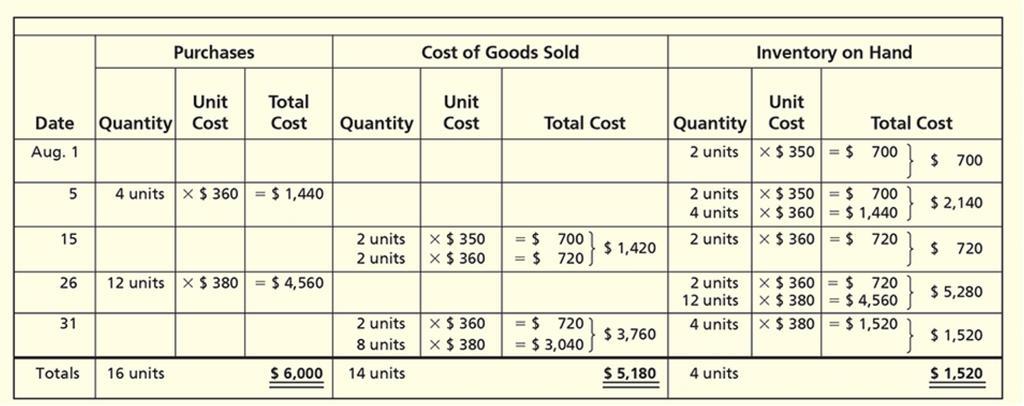
The first units purchased are assumed to be the first unit sold. So, the first unit sold has the Cost attached to the first unit purchased.
*Understand on the table why it is FIFO
10
Last-in, First-out (LIFO)
An inventory costing method.
The last units purchased are assumed to be the first units sold. So, the first unit sold has the Cost attached to the last unit purchased.
*Understand on the table why it is LIFO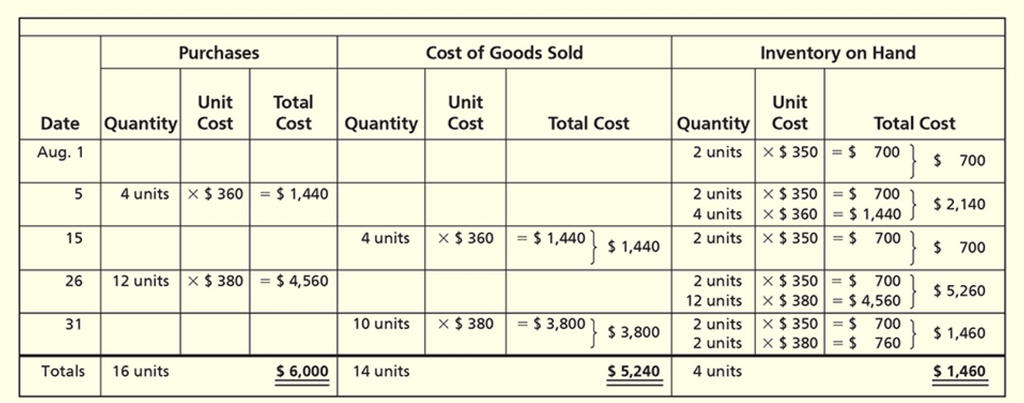
The last units purchased are assumed to be the first units sold. So, the first unit sold has the Cost attached to the last unit purchased.
*Understand on the table why it is LIFO
11
Answer: Its \$1,000 (Always keep moving back)
LIFO DILEMA
Purchase 6 units @ \$1,000
Purchase 6 units @ \$1
Sale 6 units <-(Recorded with cost of \$1nit)
Sale 6 units <- How is this recorded
Purchase 6 units @ \$1,000
Purchase 6 units @ \$1
Sale 6 units <-(Recorded with cost of \$1nit)
Sale 6 units <- How is this recorded
Answer: Its \$1,000 (Always keep moving back)
12
Weighted-Average Method
(aka moving average method)
An inventory costing method.
Weighted-average unit cost = Total Cost of goods available for sale / Number of units available for sale
*Understand on the table why it is weighted-average method
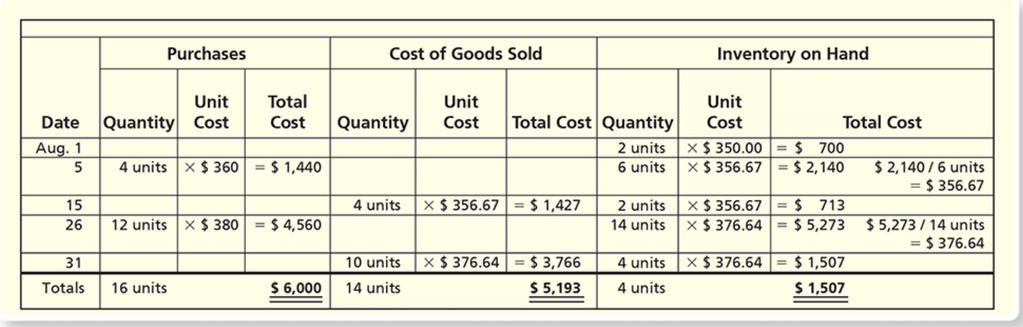
An inventory costing method.
Weighted-average unit cost = Total Cost of goods available for sale / Number of units available for sale
*Understand on the table why it is weighted-average method
13
How do companies choose which Inventory costing method to choose
The FIFO is better during times of increasing cost since it improves their financial position and attracts inventors.
The LIFO during times of increasing cost is worse since it worsens their financial positions and does not attract investors as well. But, it decreases the taxable income, so they pay the lowest income tax.
The weighted average cost is a middle ground between the FIFO and LIFO.
The LIFO during times of increasing cost is worse since it worsens their financial positions and does not attract investors as well. But, it decreases the taxable income, so they pay the lowest income tax.
The weighted average cost is a middle ground between the FIFO and LIFO.
14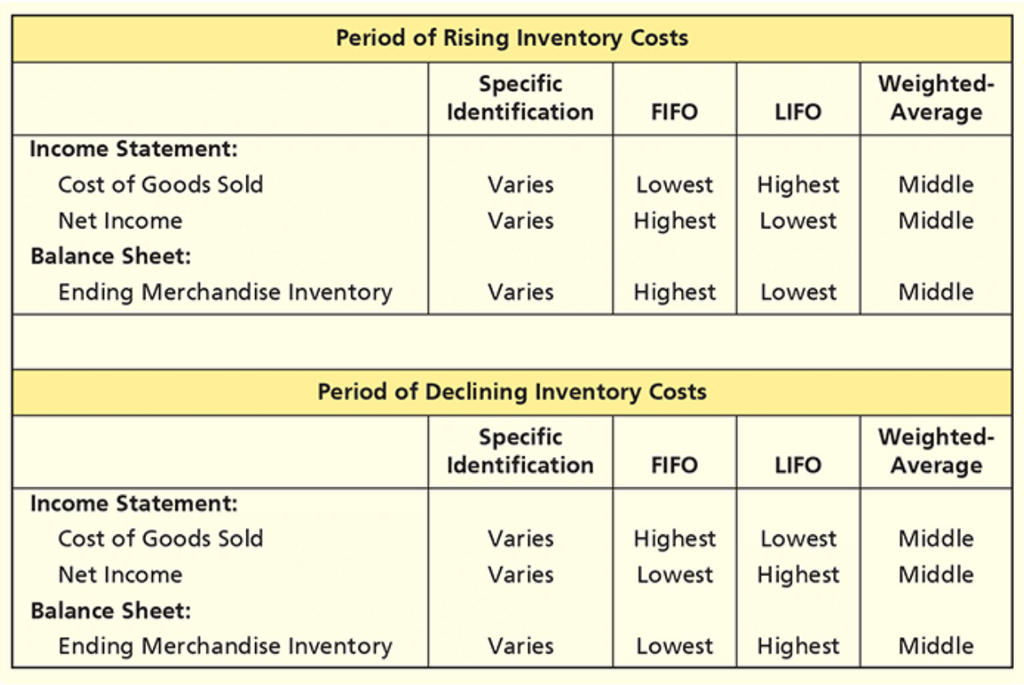
Effects on the Financial Statements During Periods of Rising and Declining Inventory Costs?
15
Lower-of-cost-or-market (LCM) rule and Journal Entry
Rule that merchandise inventory should be reported in the financial statements at whichever is lower - its historical cost or its market value.
*The market value is determined by the CRC (Current Replacement Cost)
*The historical cost is the original cost to acquire or produce a good
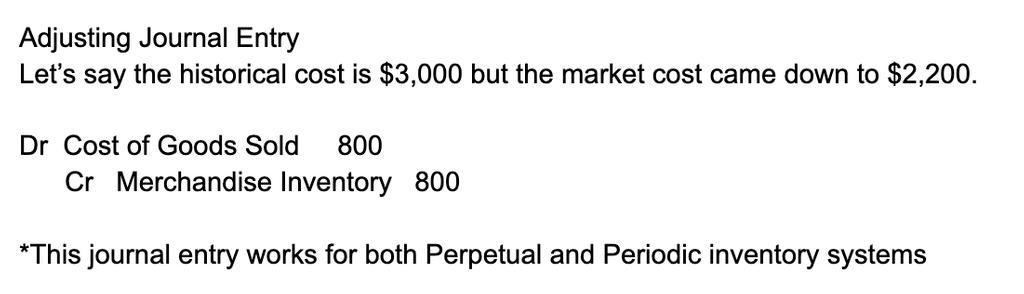
*The market value is determined by the CRC (Current Replacement Cost)
*The historical cost is the original cost to acquire or produce a good
16
Inventory Turn Over Formula
-Shows how quickly merchandise inventory is sold
Inventory Turn-Over = Cost of Goods Sold / Average Merchandise Inventory
Average Merchandise Inventory = (Beginning Merchandise Inventory + Ending Merchandise Inventory) / 2
*Higher is better since they are selling quickly, and the inventory isn't just sitting their collecting dust
*Used as Inventory Turn over in days' sales of inventory formula
17
Days’ sales in Inventory
Days’ sales in Inventory = 365 days / Inventory Turnover
ex)
The Inventory turnover is 4 times per year.
So, the Days’ sales in Inventory is 91.25 days.
*Companies seek to have a high inventory turnover, which translates into a low days’ sales in inventory. So, lower is better.
ex)
The Inventory turnover is 4 times per year.
So, the Days’ sales in Inventory is 91.25 days.
*Companies seek to have a high inventory turnover, which translates into a low days’ sales in inventory. So, lower is better.
18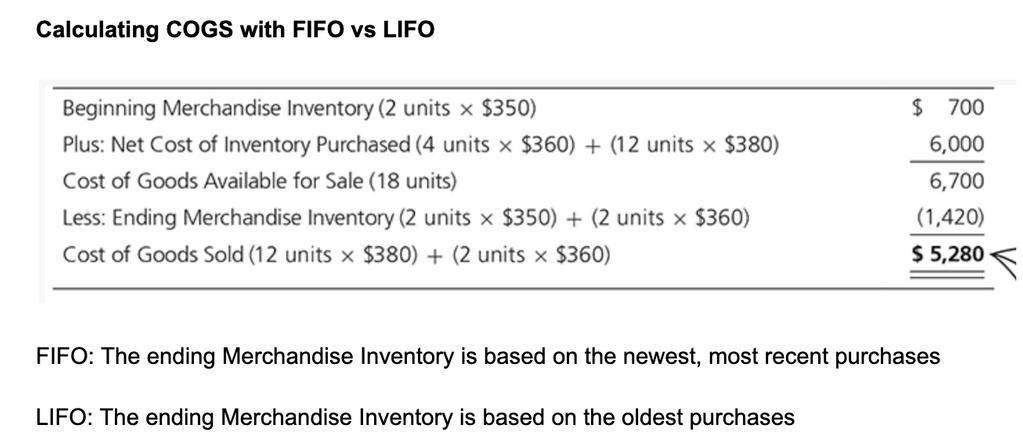
Calculating COGS with FIFO vs LIFO
19
Gross Profit formula
(Also, how is it shown in the Income statment for a merchandise store)
(Also, how is it shown in the Income statment for a merchandise store)
Gross Profit = Total Revenue - COGS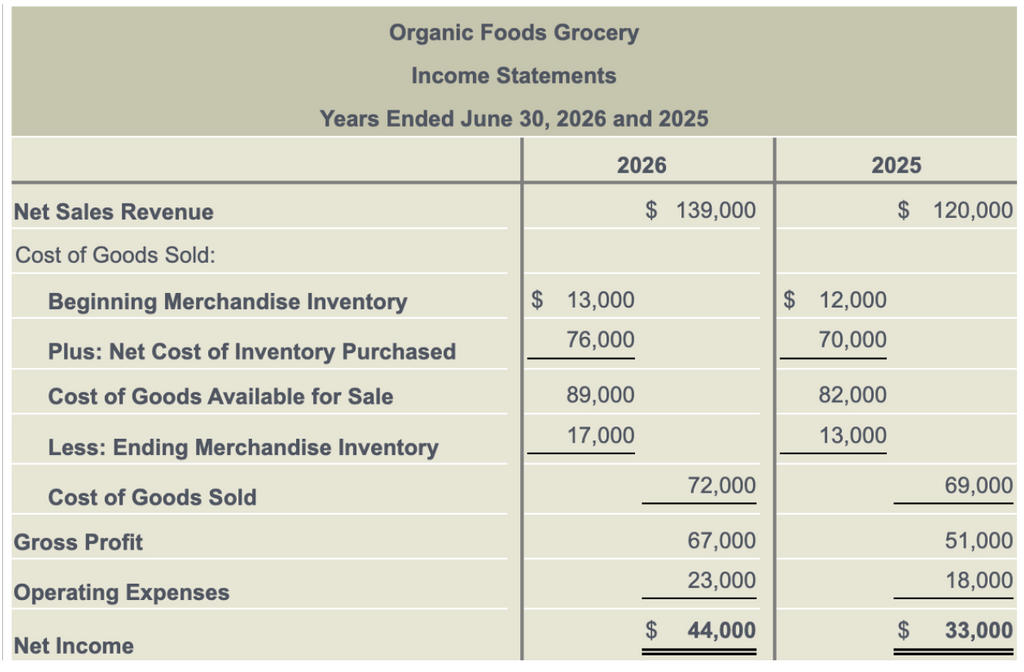
20
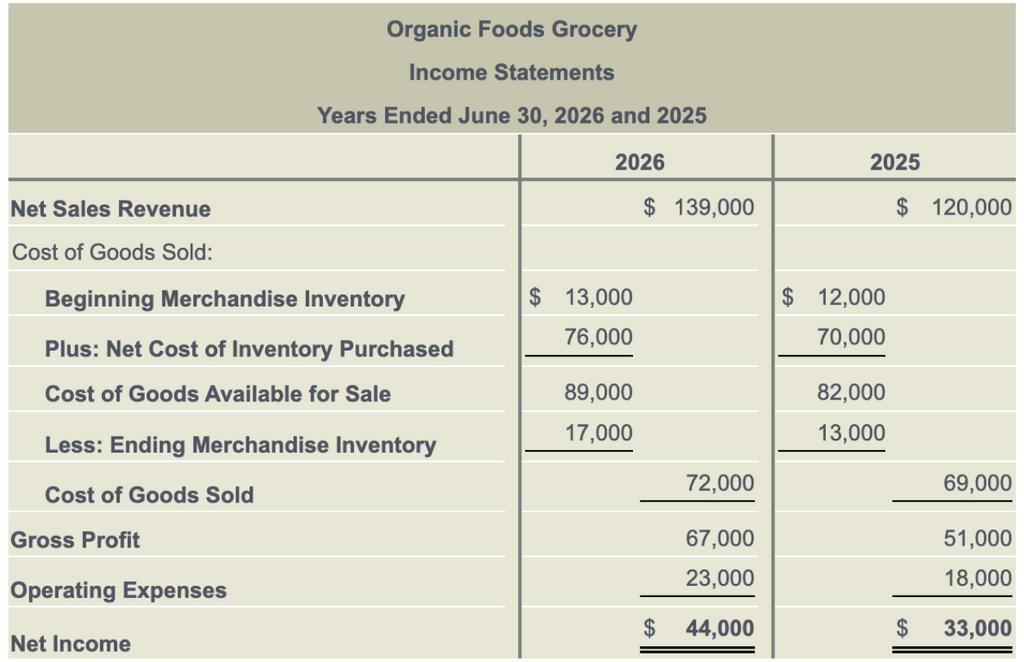
Cost of Goods Sold Formula
(Also, how is it shown in the Income statment for a merchandise store)
(Also, how is it shown in the Income statment for a merchandise store)
COGS = Cost of Goods Available for Sale - Ending Merchandise Inventory
*(also, another formula is # of units sold x unit cost)
*(also, another formula is # of units sold x unit cost)
21
Perptual Inventory Record
*This is perpetual and not peridoic because it keeping a running balance tthorughout the month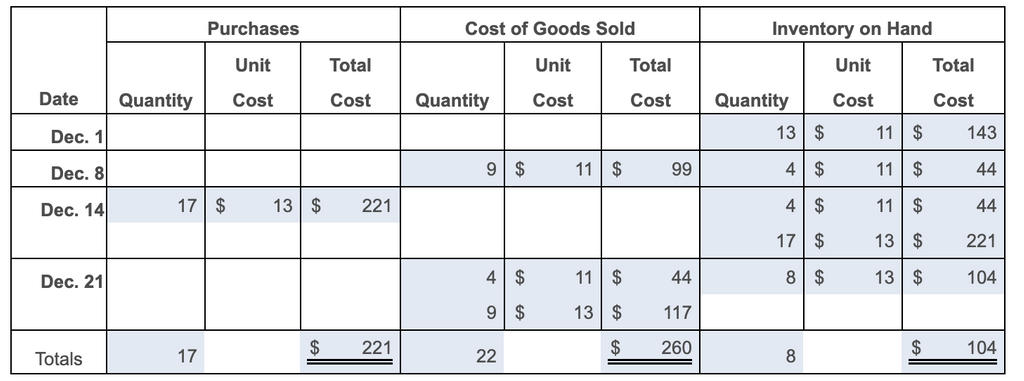
More Business & economics flashcards
Gr 11 Hfst 7 Professionalisme en etiese optredeBusiness & economics · DutchSnipperkas11- Commerical BanksBusiness & economics · EnglishMercedesECON301 Chapter 1Business & economics · EnglishRainaGlobal StrategyBusiness & economics · EnglishrikishakennedyComprehensive Practice Exam Pt 1Business & economics · EnglishLevimarketing clusterBusiness & economics · EnglishfhoiaanegeoBusiness Ethics and Environment (Bus 2000)Business & economics · EnglishTiredofBus2000Management: Employee Benefits and CompensationBusiness & economics · EnglishLexieTaxesBusiness & economics · EnglishTaraBIR FORMSBusiness & economics · EnglishKathrinaChapter 16 Vocab - Marketing ManagementBusiness & economics · Englishbevo612Chapter 8 Global & Regional IntegrationBusiness & economics · Englishbevo612
All Business & economics decks
Study these decks in the app
Free on iPhone, Android, Mac and the web. Add any deck to your account in one tap.

