Pharmacology: Renal Drug Elimination
Study these flashcardsFree · spaced repetition · iPhone, Android, Mac & web
All cards
1
What is the major route of drug excretion?
Renal excretion through urine.
2
Why is polarity important for renal elimination?
Polar drugs are water-soluble and less likely to diffuse back into the bloodstream.
3
What are the three major processes involved in renal drug elimination?
Glomerular filtration, active tubular secretion, and tubular reabsorption.
4
What is the equation for total renal drug elimination?
Filtration + secretion − reabsorption.
5
What is glomerular filtration?
Movement of substances from glomerular blood into Bowman's capsule.
6
What is glomerular filtration rate (GFR)?
The volume of plasma filtered by the kidneys per minute.
7
What molecular weight is generally freely filtered by the glomerulus?
What molecular weight is generally not filtered by the glomerulus? EXAM
Below approximately 5,000 daltons.
Above approximately 70,000 daltons.
8
Why does plasma protein binding limit glomerular filtration?
Large protein-drug complexes generally cannot cross the filtration barrier.
9
Why is serum albumin poorly filtered by the kidneys? EXAM
Its large molecular weight restricts passage across the glomerular filtration barrier.
10
What is active tubular secretion?
What type of drug can be transported during active tubular secretion?
1. Energy-dependent transport of drugs from blood into renal tubular fluid.
2. Ionized drugs
11
How does active tubular secretion differ from glomerular filtration?
Secretion uses active transporters; filtration is pressure-driven.
12
Why is active tubular secretion generally less affected by plasma protein binding?
Transport can remove free drug, allowing more drug to dissociate from bound plasma proteins.
13
How does probenecid affect penicillin excretion?
It competes for tubular secretion, decreasing penicillin elimination.
14
What happens to penicillin plasma concentrations when its tubular secretion is inhibited?
Penicillin concentrations can increase and persist longer.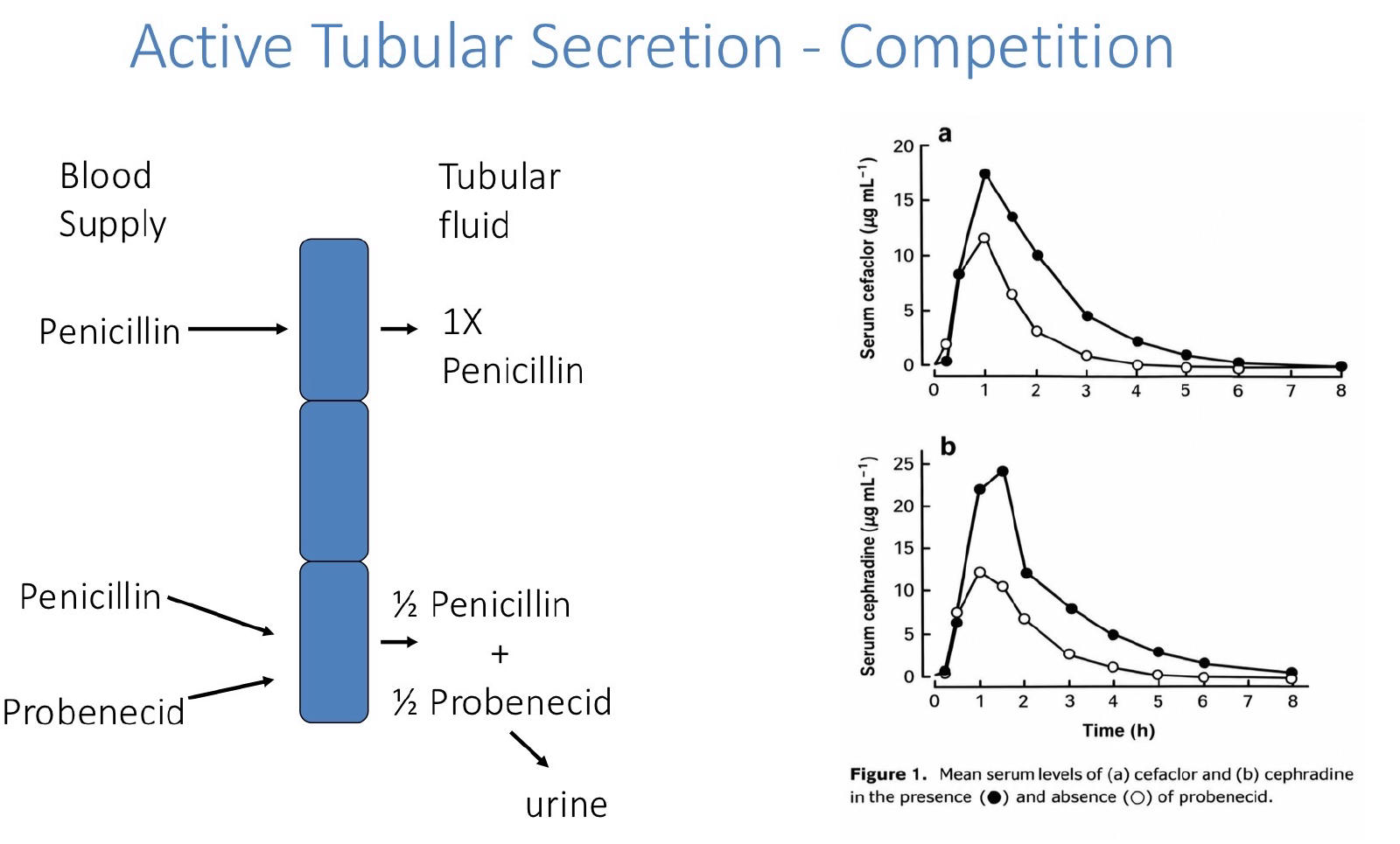
15
What is passive tubular reabsorption?
Movement of drug from renal tubular fluid back into the bloodstream.
16
Which drug properties favor passive tubular reabsorption?
Lipid solubility and an unionized state.
17
What factors influence tubular reabsorption?
Concentration gradient, urine flow, lipid solubility, urine pH, and ionization.
18
What is ion trapping in the kidneys?
Ionized drugs remain in tubular fluid because they cannot easily diffuse back across membranes.
19
How does alkaline urine affect weak acid drugs?
How does acidic urine affect weak base drugs?
They become more ionized, decreasing reabsorption and increasing excretion.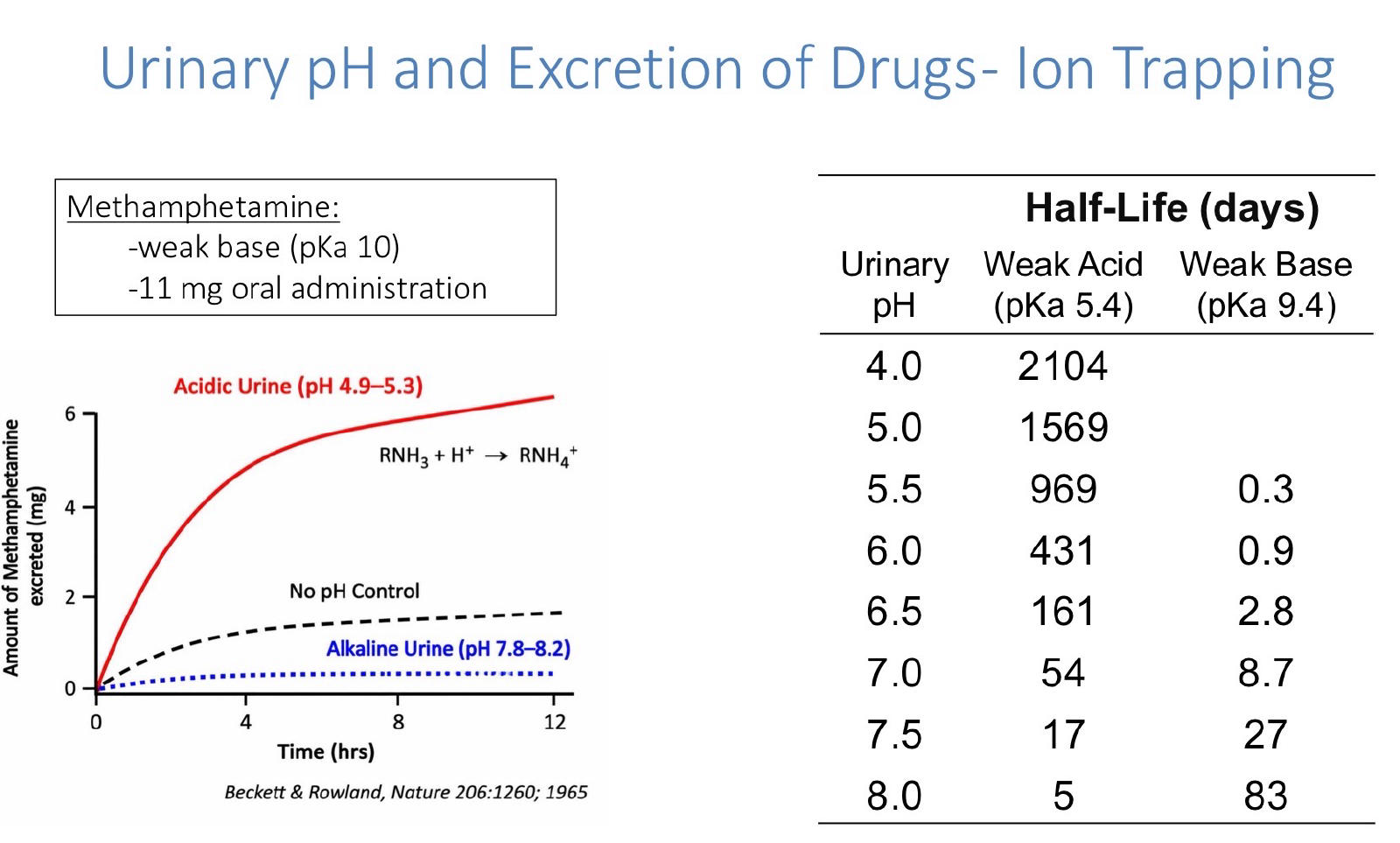
20
How does acidic urine affect weak acid drugs?
How does alkaline urine affect weak base drugs?
They become more unionized, increasing reabsorption and decreasing excretion.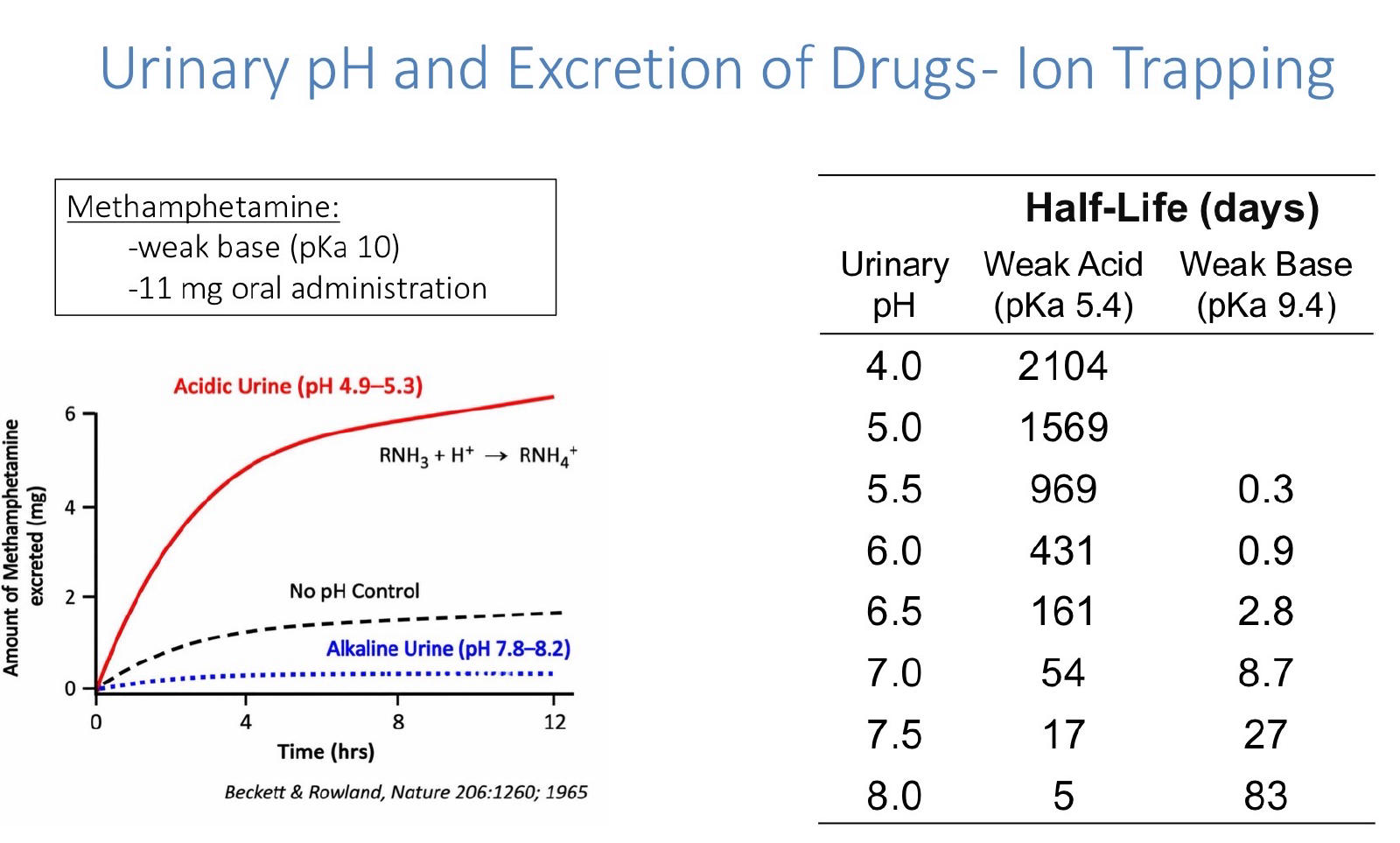
21
A weak acid has a pKa of 5.4. Would urine pH 4 or 8 favor faster excretion?
pH 8, because alkaline urine favors the ionized form.
22
A weak base has a pKa of 9.4. Would acidic or alkaline urine favor faster elimination?
Acidic urine, because the drug becomes ionized and less easily reabsorbed.
23
How can reduced kidney function affect drug concentrations?
Decreased clearance may cause drug accumulation and toxicity.
24
What is renal clearance (CLr)?
The volume of plasma cleared of a drug by the kidneys per unit time.
25
What does renal clearance greater than fu × GFR indicate?
Net active tubular secretion.
26
What does renal clearance less than fu × GFR indicate?
Net tubular reabsorption.
27
Which drugs tend to be eliminated most rapidly by the kidneys?
Drugs with substantial filtration or secretion and minimal tubular reabsorption.
28
What is the second major route of drug elimination?
Fecal elimination.
29
What are the major functions of bile?
Aid lipid absorption and provide a route for cholesterol and drug/metabolite elimination
30
What is biliary drug elimination?
Transport of drugs or metabolites from the liver into bile for delivery to the intestine.
- amphipathic properties, formation of glucuronide conjugates
31
What molecular weight favors biliary elimination according to the lecture?
Molecular weight greater than approximately 500.
32
What is enterohepatic recycling?
A drug enters bile, reaches the intestine, is reabsorbed, and returns to the liver.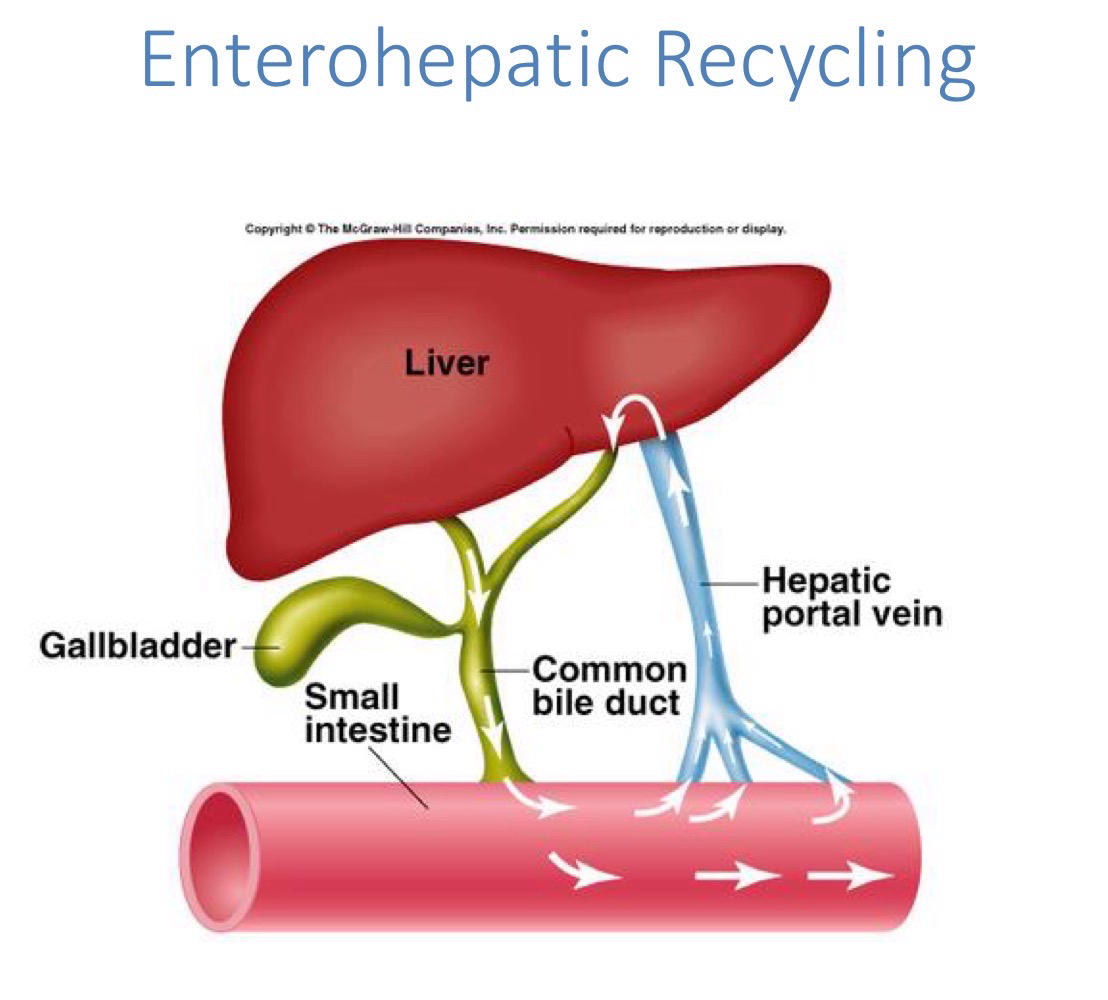
33
What is the pathway of enterohepatic recycling?
Liver → bile → intestine → portal blood → liver.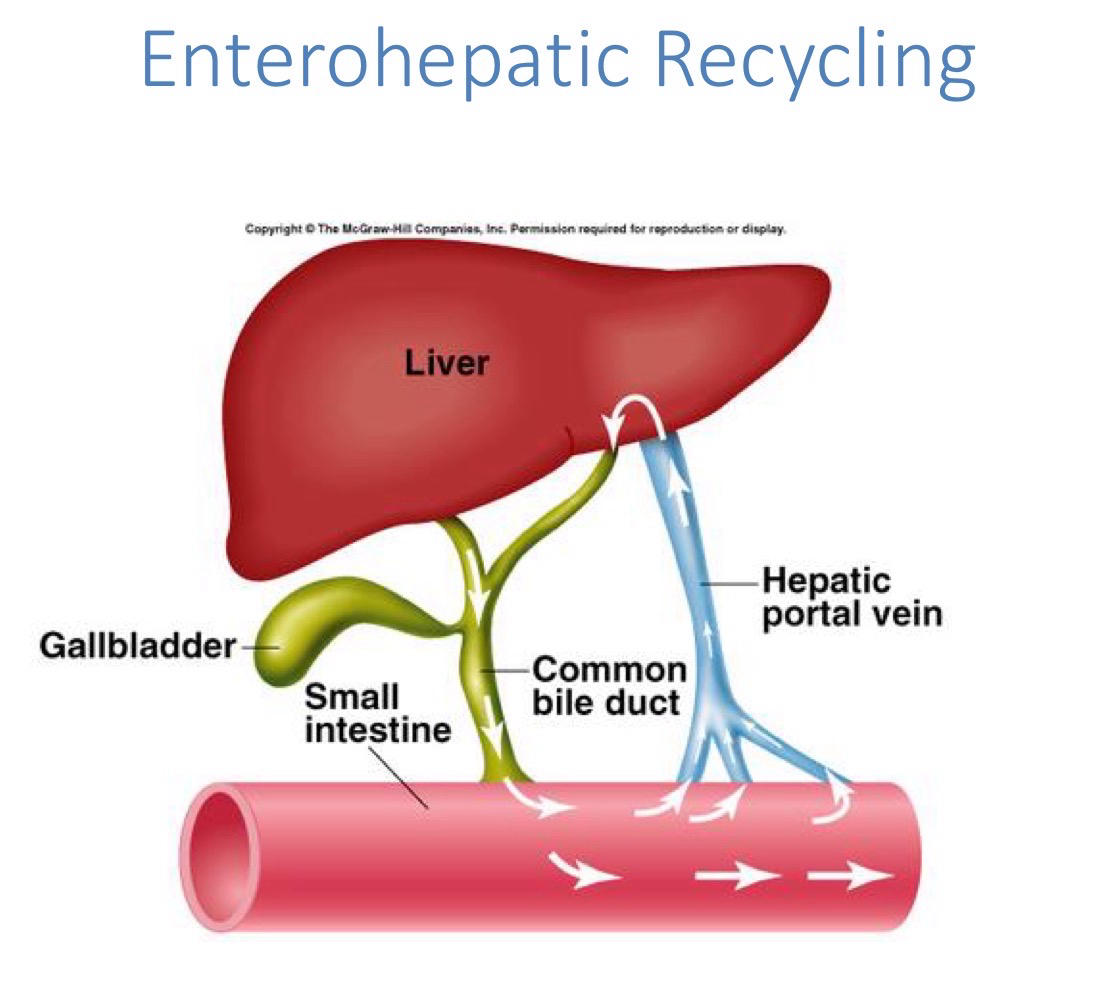
More Medicine & health flashcards
Eating DisordersMedicine & health · EnglishAveryLecture 2 - inflammationMedicine & health · EnglishkarebearPOCT: Blood Gas AnalyzersMedicine & health · EnglishChristyDiabetesMedicine & health · EnglishcathsimsBrachiumMedicine & health · EnglishEshaskeletal part 1Medicine & health · EnglishelijahInfectious Disease Medications and VaccinesMedicine & health · EnglishebradstreetDifusión Molecular en fluidos Medicine & health · SpanishGuilleW3: Antifungal/Gout C/N/B/IMedicine & health · EnglishVictorAufbau wirbelMedicine & health · GermanFinja(13) Tumorer i nervesystemetMedicine & health · DanishTobiasAcute Care: Pediatric Respiratory ConditionsMedicine & health · EnglishAddie
Study these decks in the app
Free on iPhone, Android, Mac and the web. Add any deck to your account in one tap.

