Lecture 2 - inflammation
Study these flashcardsFree · spaced repetition · iPhone, Android, Mac & web
All cards
1
What is the point of inflammation?
to protect the body
2
What happens when there is damage to the tissue? (steps)
Instantaneous dilation of blood vessels (vasodilation)
Active hyperemia
Increased hydrostatic pressure (EDEMA)
Slowdown of cirulation (congestion)
Hemodynamic changes: RBC rouleaux formation and margination of WBC
Active hyperemia
Increased hydrostatic pressure (EDEMA)
Slowdown of cirulation (congestion)
Hemodynamic changes: RBC rouleaux formation and margination of WBC
3
What makes blood vessels dilate?
arteriolar smooth muscles
4
what is hyperemia?
an excess of blood in the vessels supplying an organ or other part of the body.
5
What is congestion?
crowding of blood
6
What is hydrostatic pressure?
Pressure created by the heart and blood vessels (elastic fibers)
7
What is edema?
swelling caused by fluid buildup in body tissues.
8
What is responsible for controlling where the blood flows?
capillary sphincter
9
Where do the neutrophils attach to during margination?
Endothelial cells
10
What is the first WBC that comes to the site of injury?
neutrophils
11
What do endothelial cells express when the blood vessel is injured?
Endothelial cell adhesion molecule
12
What are the steps of margination of WBC and interaction with endothelium?
1. Margination of neutrophils
2. Adhesion of platelets
3. Pavementing of neutrophils
2. Adhesion of platelets
3. Pavementing of neutrophils
13
What happened after the pavementing of neutrophils?
Endothelial cells become more porous
14
What activates the myofibroblasts?
Chemicals produced by macrophages
15
What are myofibroblasts?
play an important role in normal tissue repair processes,
16
What 3 types of blasts produced when blood vessels are injured?
myofibroblasts
angioblasts
fibroblasts
angioblasts
fibroblasts
17
What are the two groups called that derive mediators of inflammation?
Plasma derived
Cell derived
Cell derived
18
What are group does the complement cascade (proteins) fall under?
Plasma derived
19
Which amine causes the endothelial cells to become porous?
Histamine
20
Where does histamine come from?
Basophils, platelets, and Mast cells
21
What is coagulation?
Blood clotting
22
Which organ produces compliment proteins?
liver
23
What is histamine?
biogenic amine: NH3
24
What INCREASES THE PREMEABILITY of the endothelial cells during injury?
Histamine
25
How long does histamine permeabililty affect last?
30 minutes ; SHORT ACTION "immediate transient reaction"
26
What inactivates histamine?
histaminase
27
What is bradykinin and what does it do?
a plasma protein; induces pain!!!
28
Does bradykinin come before or after histamine?
AFTER
29
Where does bradykinin come from?
KININOGEN
30
What activates kininogen -> bradykinin?
Kallikrein
31
what is kallikrein activated by?
Hageman factor (Factor XII) ~12
32
Kininogen is produce by _____
Pancreas
33
What are the outcomes for hagemen factor (FACTOR XII) when activated?
Bradykinin, plasmin, and fibrin
34
What is the complement system?
group of plasma proteins in our plasma in the inactive form
35
what can activate the complement?
CLASSIC PATHWAY
ALTERNATIVE PATHWAY
LECTIN PATHWAY
ALTERNATIVE PATHWAY
LECTIN PATHWAY
36
what is the classical pathway?
Ag-Ab -> C4+C2 -> C42 + fragements of C4 AND C2 -> C3 -> C3b +C3a -> C5 -> C5b + C5a -> C6 + C7 -> C567 -> C8 + C9 -> MAC
37
What is opsonin?
an antibody or other substance which binds to foreign microorganisms or cells making them more susceptible to phagocytosis.
38
Which plasma proteins can activate opsonin?
C3b + C3a
39
Which plasma proteins can activate anaphylatoxins?
C3b + C3a AND
C5b + C5a
C5b + C5a
40
What do anaphylatoxins do?
Continue with inflammatory responses like histamine release from Mast cells
41
Which plasma proteins activate nuetrophils attraction?
C567
42
What does C567 activate?
neutrophils,
leukotrienes ~smooth muscle contraction aka vasoconstriction
leukotrienes ~smooth muscle contraction aka vasoconstriction
43
What do inhalers do?
Inactivate leukotrienes
44
What is the end point of complement activation?
MAC - cell lysis
45
what are arachidonic acid derivatives?
Come from phospholipids via phospholipase
46
What are arachidonic acids futher metabolized as?
Lipoxygenase pathway
Cyclooxygenase pathway
Cyclooxygenase pathway
47
What does the lipoxygenase pathway produce?
Leukotrienes & lipoxins
48
What are leukotrienes?
bring more neutrophils; same thing as bradikinin and histamine
49
What do lipoxins do?
NEUTRALIZES leukotrienes!
50
What does the cyclooxygenase pathway produce?
thromboxane and prostaglandins
51
What do prostaglandins do?
inflammatory response
52
What does thromboxane do?
activates platelets
53
Which cytokine causes fever?
IL-1 & TNF
54
Is COX-1 OR COX-2 involved in inflammation?
COX-2
55
What inhibits the COX-2 pathway?
Aspirin
56
What is transudate?
when plasma gets into the space when the premeability of the vessel wall increases (increase of hydrostatic pressure)
57
What is exudate?
emigration of leukocytes. (aka infection)
58
which cells indirectly help during inflammation?
Mast cells
59
What is acute inflammation?
Fast and sudden (Ex: hepatitis B)
60
What is chronic inflammation?
Slow progressing (ex: TB)
61
What is the serous membrane?
a smooth tissue membrane of mesothelium lining the contents and inner walls of body cavities.
62
what is the serous of the heart called?
pericardial membrane
63
What is the fluid within the paricardial membrane?
Serous fluid aka percaridal fluid
64
What type of inflammation is this?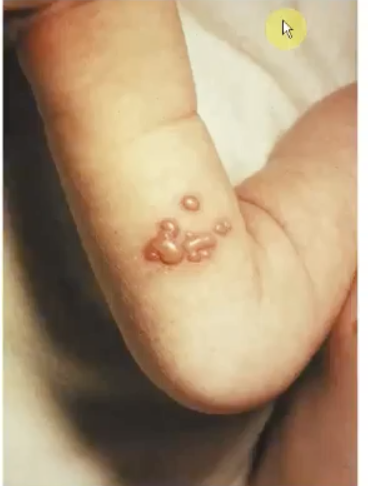
serous inflammation (can be seen in internal organs as well)
65
What type of inflammation is this?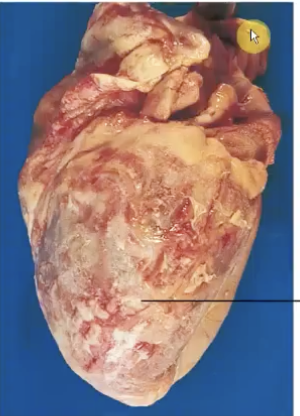
Fibrinous pericarditis
66
What type of inflammation is this?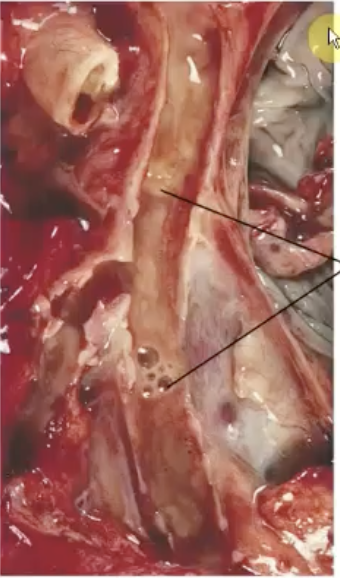
Purulent Tracheaobronchitism ~ inside blood vessel
67
what happens in purulent tracheobronchitis?
PUSS formation with fibrin ~ life threatening
68
What bacteria is associated with purulent tracheobronchitis?
Streptococcus and staphlococcus
69
What type of inflammation is this?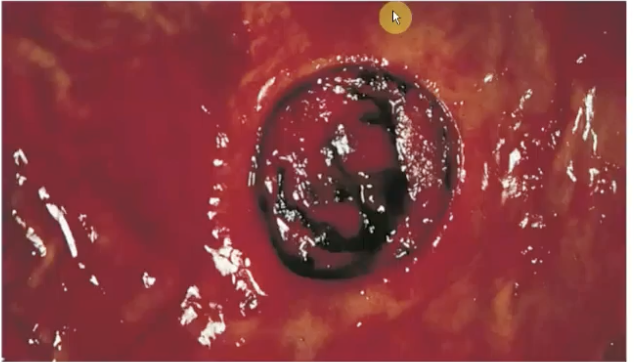
Peptic Ulcer
70
What type of inflammation is this?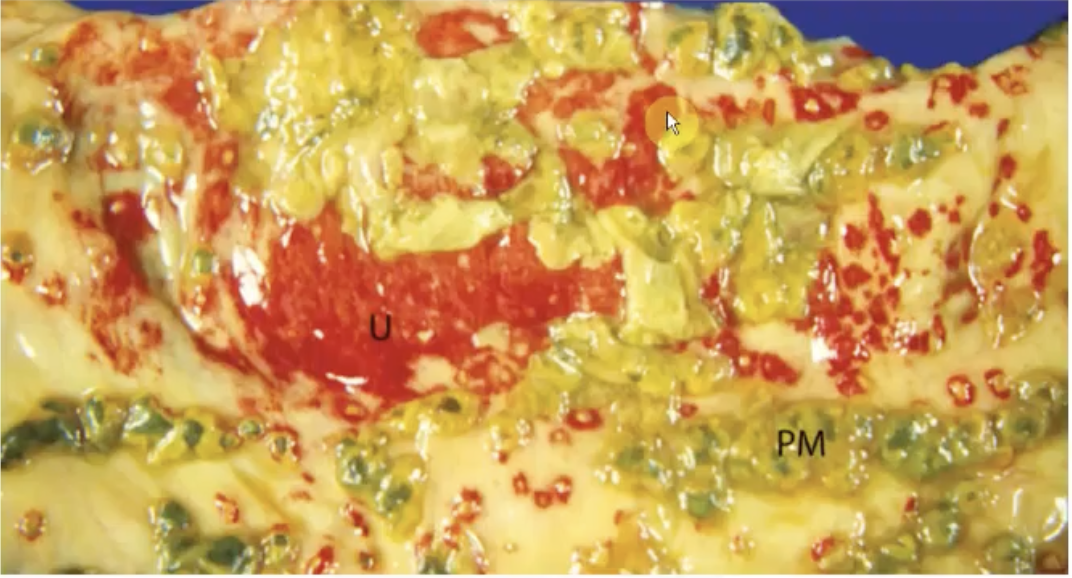
Pseudomembranous Inflammation
71
What happens in pseudomembranous inflammation?
purulent, fibrin, and ulcers all together.
Caused by Clostridium difficle (C. diff); hospital infections
Caused by Clostridium difficle (C. diff); hospital infections
72
What is granuloma?
contained inflammation
73
What does granuloma consist of?
Lymphocytes
Epithelioid cells (macrophages)
Multinucleated giant cells
Epithelioid cells (macrophages)
Multinucleated giant cells
74
Caseous necrosis in a granuloma indicates what?
TB
75
What is fibronectin?
glue; adhesive glycoprotein that is primarily involved in cell–adhesive interactions.
76
what is the most abundant protein in the blood?
ALBUMIN
77
What type of collagen also helps in the healing process?
Collagen type III
78
What are clinical symptoms that indicate inflammation?
Fever
Leukocytosis
Constitutional symptoms ~ depression, fatigue, weight loss
Leukocytosis
Constitutional symptoms ~ depression, fatigue, weight loss
79
What is the pathogenesis of fever?
1. Macrophages release cytokines (IL-1 , TNF)
2. Goes to the hypothalamus ~ temperature regulator
3. Increase body temperature above 37 degrees Celsius (bacteria don't like high temps)
2. Goes to the hypothalamus ~ temperature regulator
3. Increase body temperature above 37 degrees Celsius (bacteria don't like high temps)
80
What are nondividing postmitotic cells?
non-mitotic cells that have terminally differentiated, and are unable to complete mitosis. (EX: neurons)
81
What is primary intention incision?
WOUND HEALING (i.e. surgury incisions)
82
What is secondary intention?
a wound will be left open to heal by itself,
83
During wound healing, where do the myofibroblasts mostly reside?
Outline of the wound
84
What is this?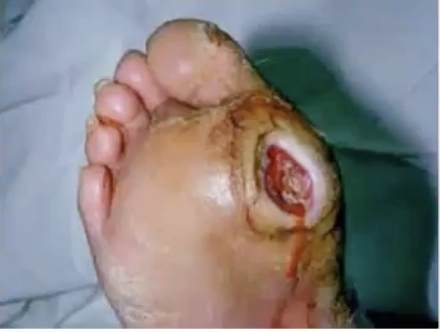
Diabetic foot ulcer
85
What is this?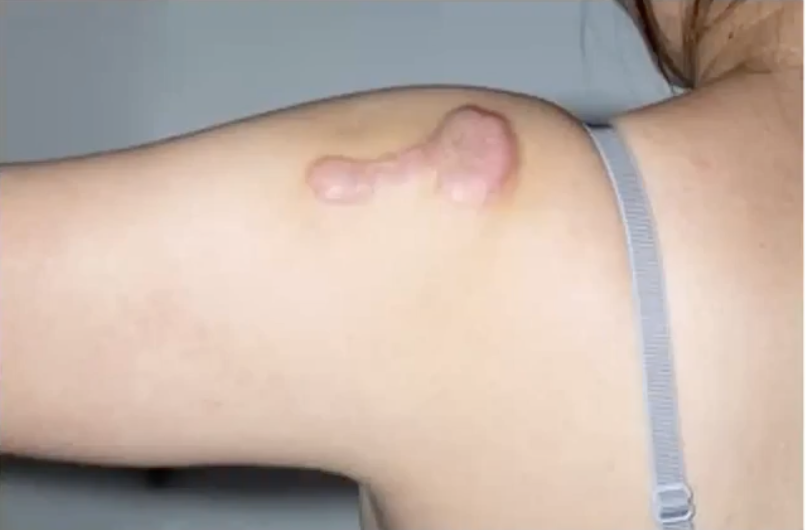
Keloid
86
What is a Keloid?
benign, dermal growths related to previous skin trauma or inflammation.