Human Vision and Eye Anatomy
Study these flashcardsFree · spaced repetition · iPhone, Android, Mac & web
All cards
1
What is the wavelengths humans can see
short to long, 400-700
2
What happens when we look at something on the level of the eye?
Light bounces off the object and reflect into the eye through the cornea, the pupil, and his the lens, the lens either stretches or contract, and reaches the fovea and goes into retina, to optic nerve and into brain
3
What does the cornea do
focus
4
How does focusing work?
bend light so we are able to focus it or point it into fovea
5
What is the fovea
center of vision and has highest visual acuity due to highest concentration of cones
6
What is the iris
the colored portion of the eye which is a muscle to contract and expand the pupil
7
Why does the pupil contract/expand?
to increase/decrease size of pupil to allow more or less light to hit the lens
8
What does the lens do?
The lens can stretch itself to become more flat or push itself together to bend light even which is underlined by ciliary muscles
9
What is an example of top down completion?
because we have a blindspot in both of our eyes due to the optic nerve, our brain fills in missing information
10
What is convergence
going from a lot to a little
11
What is lens accommodation
how much the ciliary muscles are pulling on the lens to focus on image.
12
What will happen to lens if we see something far away and seeing something close
far away
13
What is nearsightedness
aka myopia, cant see far due to issues with lensciliary muscles
14
What is farsightedness
aka hyperopia
15
Why does astigmatism occur
misshapen cornea
16
What causes cataracts
lens are clouded
17
What is glaucoma
blockage of drainage mechanisms within eye and filled with aqueous humor and vitreous humor
18
What is macular degeneration
most common cause of age related blindness, disgusting of region around the eye due to protein occlusion which kills of photoreceptors
19
What does tonically active mean
always leaking NT
20
What are photoreceptors
light sensing cells in back of reign that takes a photo and turns it into electrical signal to create vision
21
What are opsins
proteins that are responsive to light
22
What are photoreceptors release when looking at no light
glutamate
23
What happens to photoreceptors when they detect light
turn off constant depolarization and receive less NT
24
What are rod cells
shaped spirally to allow for more opsin receptor to allow for increased sensitivity to low levels of light, opsin regenerates slowly
25
What are cone cells
shaped like a comb and has high acuity for color, needs more intense stimuli to activate, very little convergence,opsin regenerates fast
26
What is scotopic vision
high sensitivity to light but low acuity
27
What is photopic vision
color, high acuity but low sensitivity
28
What is range fractionation
intensity into rods/cones
29
In our field of vision where is photopic and scotopic vision
our central visual field favors photopic, peripheral visual field for scotopic vision
30
What is photometer
a machine that measures the amount of light thats bouncing off an object
31
Explain how photoreceptors adapt
chemical inside opsin called il cis retinal turns into il trans retinal in response to light.
32
What needs to happen for a rod to send a signal?
The conversion of il cis retinal to il trans retinal
33
What is a saccade?
Movement of the eye
34
What is a micro saccade?
constant jiggle of the eye
35
What is a macro saccade?
Left or right movement of the eye.
36
What would happen if your saccades are paralyzed?
Wouldn't be able to see anything because photoreceptors would be exhausted as long as you're looking at a constant image.
37
What is edge detection?
our eyes perceive exaggerated edges.
38
What do horizontal cells do?
They serve as early processing units for the retina
39
What is lateral inhibition?
each pixel of your retina not only activates itself but inhibits its neighbors
40
What is trichomatic/color component theory?
result of the identification of our three different photoreceptor cones
41
What wavelengths do short cones respond to?
Peak response to 420nm, blue
42
What wavelengths do medium cones respond to?
Peak response to 525nm green
43
What wavelengths do long cones respond to?
Peak response to 570nm red
44
What happens that lead to colorblindness?
dysfunction or absence of cones
45
What leads to redreen colorblindness?
dysfunction of medium or long cones
46
What leads to blue/yellow colorblindness?
missing short cone
47
What is the opponent process theory?
short, medium, long cones are not independent of each other, they activate and inhibit each other
48
Example of opponent process theory?
Looking at short cone, it will send excitation to own ganglion cell and inhibit ganglion cells associated with medium and long cones
49
What do the ganglion cells do in respond to excitation explained by the opponent process theory?
ganglion cells are performing comparisons between the types of cones
50
What do retinal ganglion cells do?
cells that are bundled together and send their axons out of the eye via optic nerve aka the blind spot
51
What is the retino tectral pathway?
once a stimulus is received, goes to retina, to lateral geniculate nucleus of the thalamus, to v1 aka striate/calcarine cortex
52
What is the tectum and what does it contain?
contains the superior colliculus for vision and inferior colliculus for hearing
53
What does the superior colliculus of the tectum do?
Orient us to a sudden visual stimulus aka reflex
Where is most of the visual cortex located? Mostly in the medial portion of the occipital lobe
Where is most of the visual cortex located? Mostly in the medial portion of the occipital lobe
54
Why is the separation of different parts of the visual field important?
important for clinical applications because it can give us a clue on what's happening in the brain. Lesions at different points in this pathway cause very different deficits
55
What is it called if there is a lesion of v1
scotoma
What happens if there is a lesion in V1 for a temporary condition? Visual auras are due to a blind sport due to a higher level of deactivation in the visual pathway and impacts center of vision
What happens if there is a lesion in V1 for a temporary condition? Visual auras are due to a blind sport due to a higher level of deactivation in the visual pathway and impacts center of vision
56
What is completion
where the brain fills in the gap that made by the scotoma
57
What is scintillating scotoma
brain fills in gap with patterns, colors, flashes and stay in same part of the visual field
58
Pixels equal to
receptive fields
59
What is shape of a pixel
donut
60
What does it mean when cells have a center surround property?
they have surround and a center, like a donut, that interact together
61
Describe on center/off surround
strong output if stimulus is in center, by increasing the response to center stimulus but decrease responding to neighbor stimulus
62
Describe off center/on surround
strong output if nothing is in center, by decreasing the response to center stimulus but increase response to neighboring stimulus
63
What happens to to cone cell if light is detected?
Hypolarization of the cone where glutamate is decreased, stop inhibitory bipolar cell and the on center cell will depolarize and send more glutamate where the ganglion cell sends action potentials to the brain
64
explain whats going on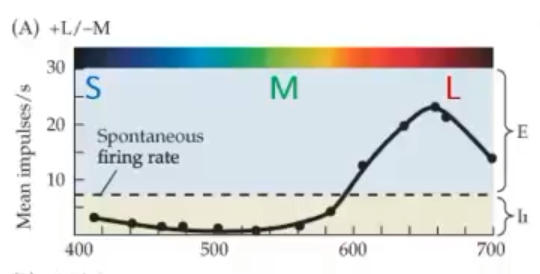
long cone recieves excitation from flong wavelength cones and recieve inhibition from medium wavelength cones saying something red and something not green
65
explain whats going on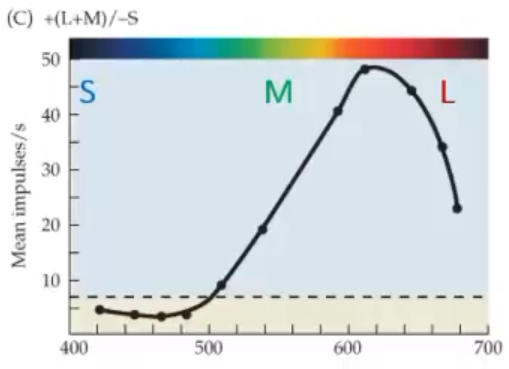
response in medium and long wavelength cones and inhibited by short wavelength
66
explain whats going on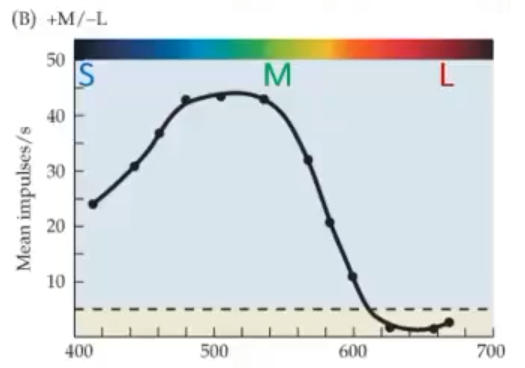
excitation recieve by medium wavelength cones and inhibited by long wavelength cones
67
explain whats going on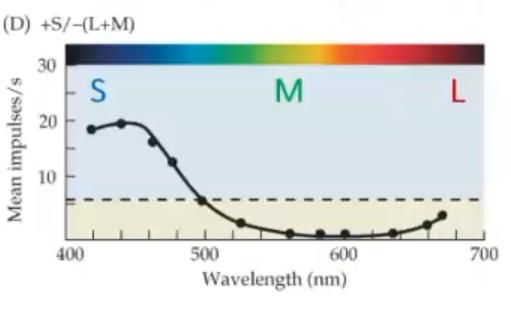
excitation of short wavelength cone and inhibited by both long and medium cones
68
what does damage of a correlate too and explain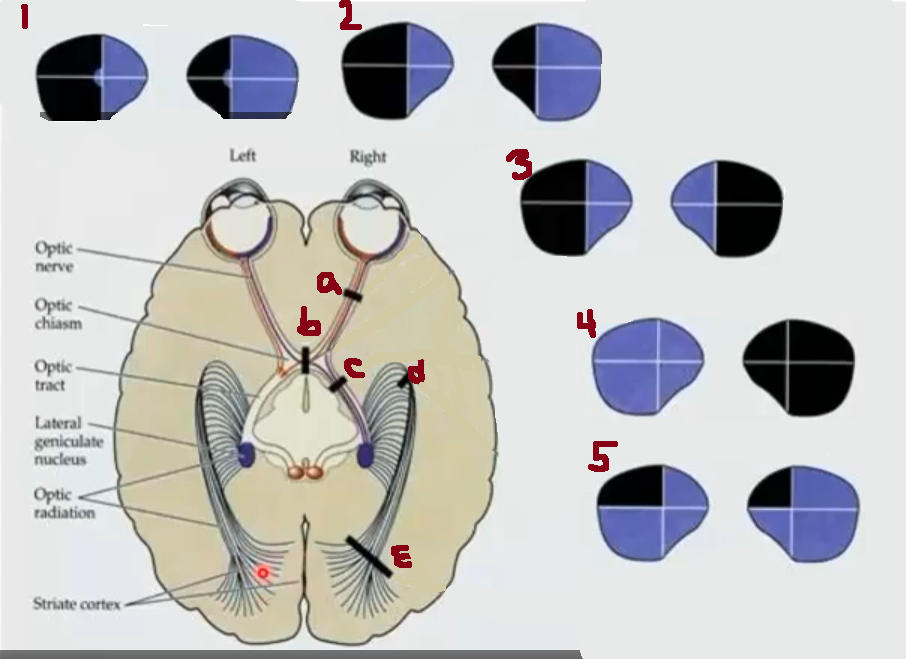
4, damage of the optic nerve results in no visual field
69
what does damage of b correlate too and explain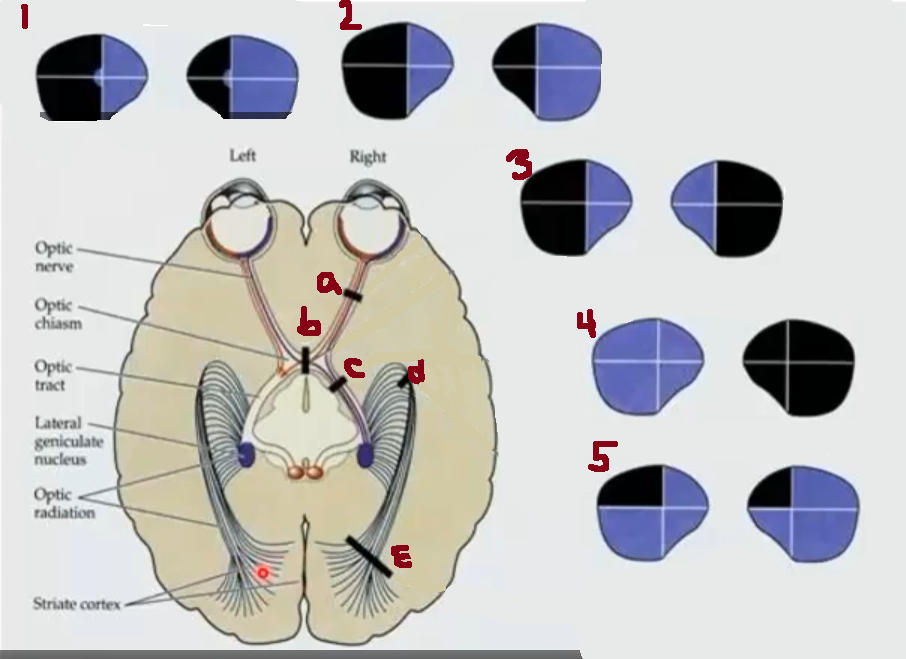
3, damage of optic chiasm results in loss of function in fibers that cross aka loss of peripheral vision
70
what does damage of c correlate too and explain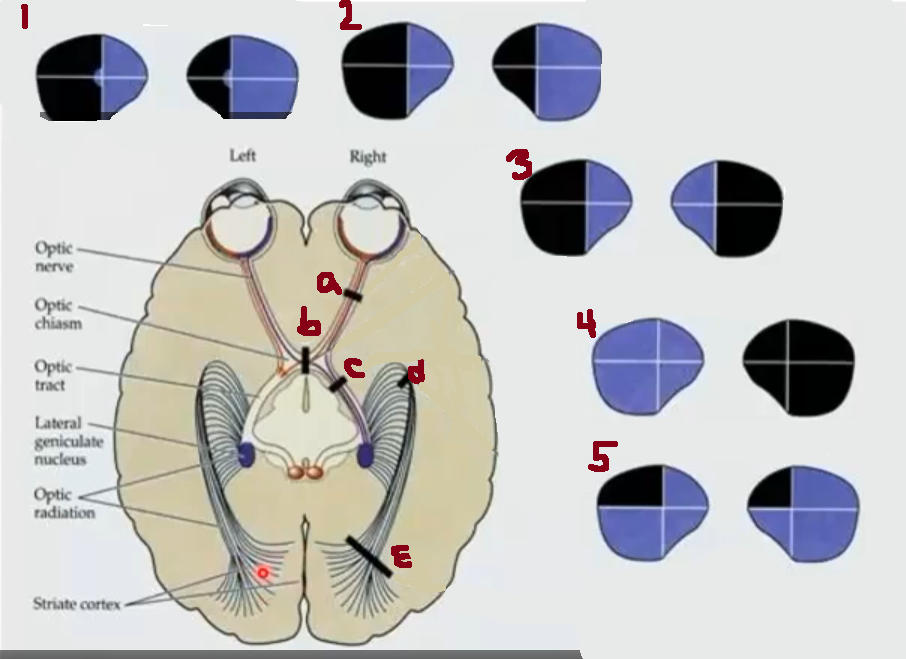
2, damage after optic chiasm will result in losing right visual field
71
what does damage of d correlate too and explain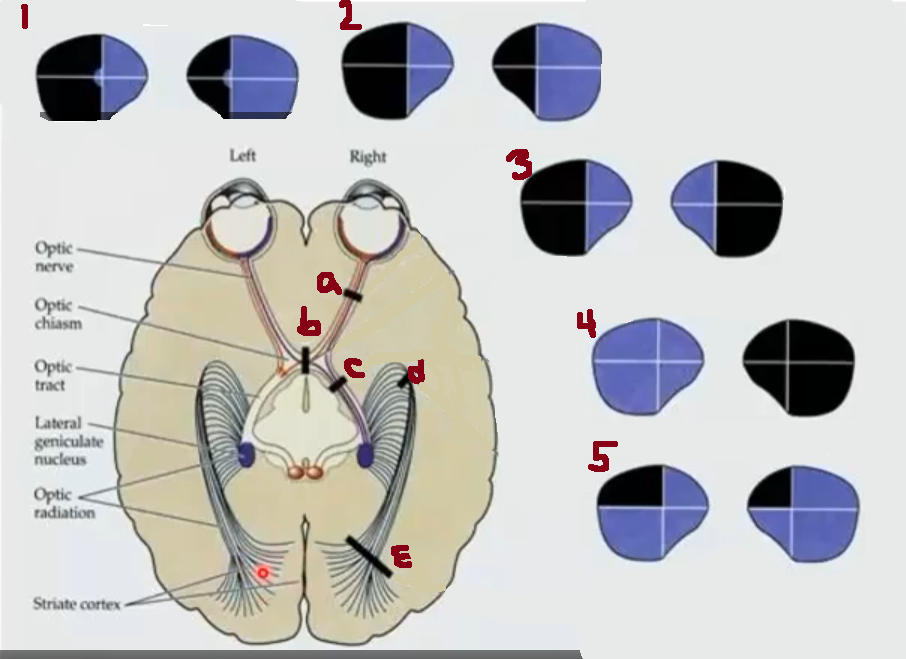
5, damage of a part of optic radiation (whiter matter tract that radiates from the thalamus to primary visual cortex, lose everything from upper right visual field
72
what does damage of e correlate too and explain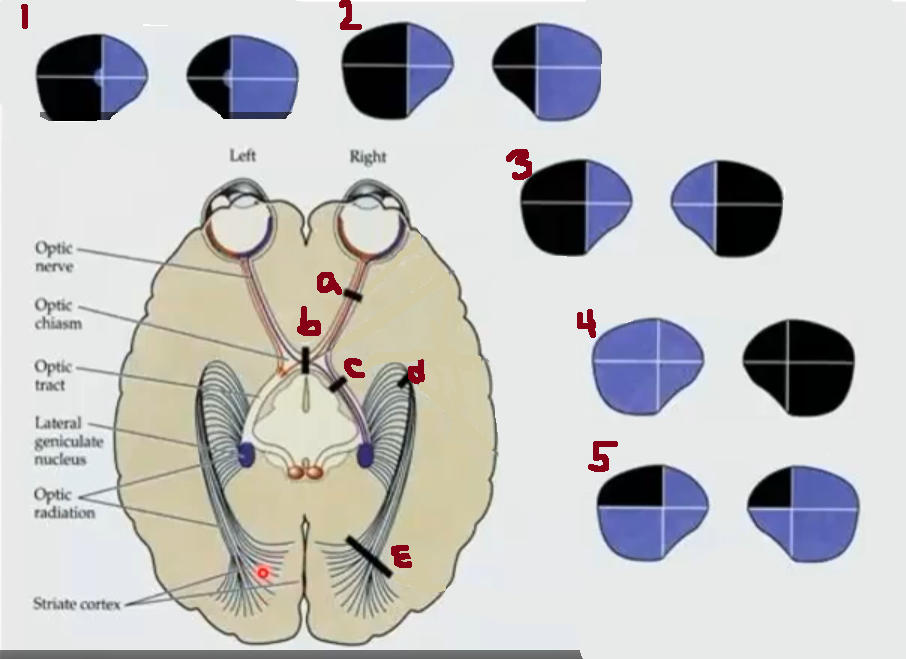
damage that results in loss of entire pathway but has something containing fovea sparing because some info from left hemisphereis going to cross over toward the back to make up for fovea
73
explain what is going on with grade resposne and ap response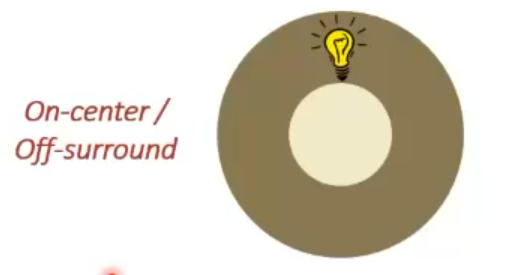
activation of surround will lead to hyperpolarization, and slower ap response
74
explain what is going on with grade resposne and ap response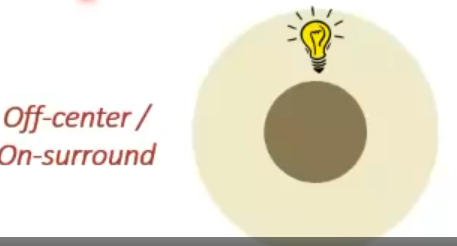
activation of surround will lead to depolarization and increased ap response
75
explain what is going on with grade resposne and ap response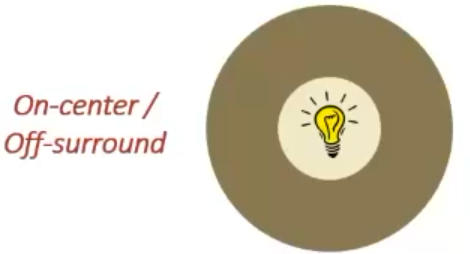
depolarize and lead to increase in ap response
76
no means
on
77
on means
off
78
explain what is going on with grade resposne and ap response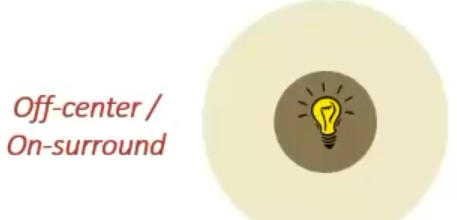
hyperpolarize because surrounding regions dont have any stimulation via horizoantal cells which will reduce ap response
79
explain what is going on with grade resposne and ap response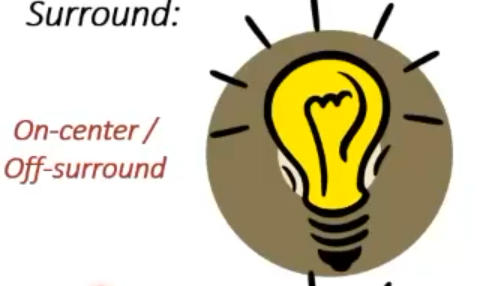
stimualtion of my on portion of the receptive field would increase membrane potential of the bipolar cell and decrease firing of ganglion cell of an oncenter/off surround, light stimulus in surround will hyperpolarize causing the bipolar cell to reduce firing firing frequency
80
explain what is going on with grade resposne and ap response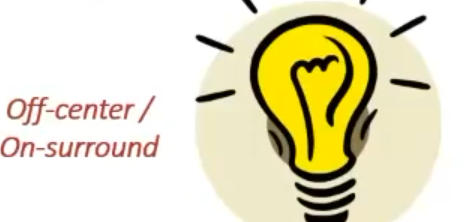
stimulation of my off position of the receptive field would hyperpolarize the bipolar cell and depolarize on the onsurround which will cancel itself out resulting in no change in bipolar cell in membrane potential or no change in ap frequency
81
explain cell a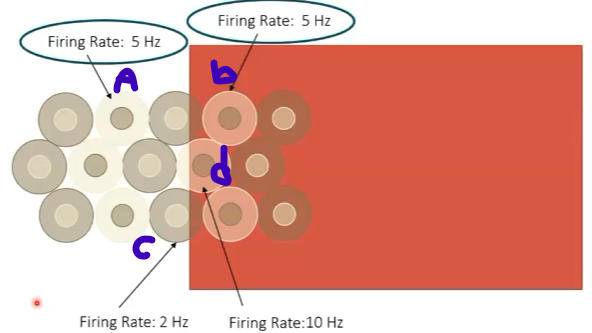
no change/detection due to everything being covered
82
explain cell b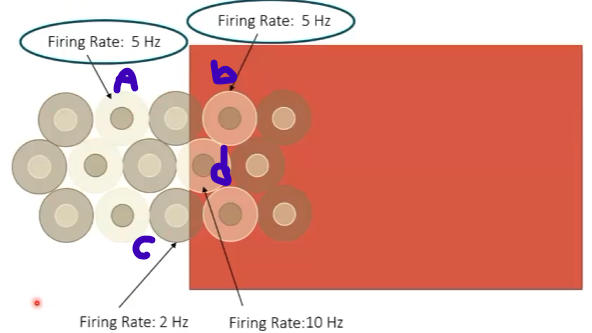
no change/detection due to everything being covered
83
explain cell c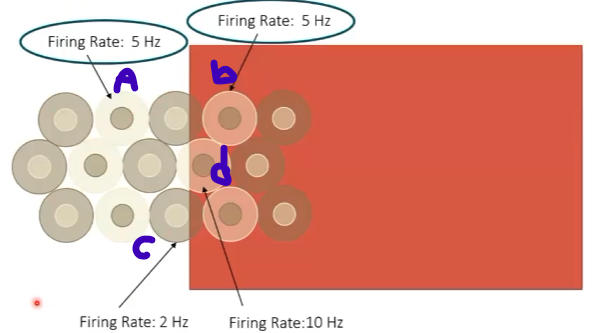
cell c will changfe firing rate to 2 hz because there is a stimulus in the off surround but no stimulus in on center
84
explain cell d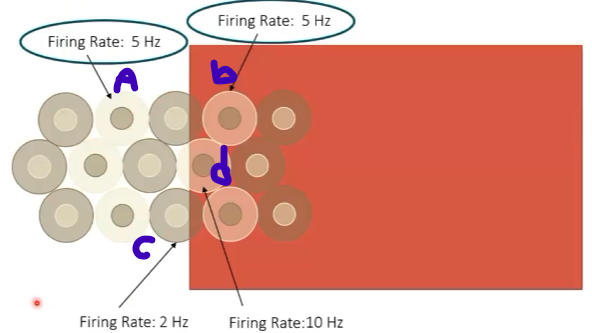
cell d will icnrease firing rate to 10 hz since all off center is stimulated and most of on surround is stimulated
85
what is a simple cortical cell and explain what it does
WILL RESPOND WHEN A LINE OF RGCS RECIEVES AN ON SIGNAL THAT IS SURROUNDED BY 2 LINES OF RHCS THAT RECIEVE AN OFF SIGNAL WHICH GIVES A BAR/EDGE
86
explain a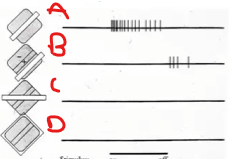
shining a bar onto retina will lead to increase in activity
87
explain b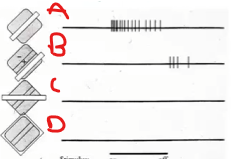
shine a bar of light below receptiv3e field then no increase inac tivity but has rebound effects
88
explain c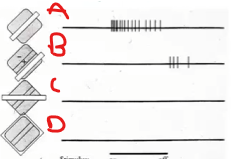
shining a bar of light horizontalling so its activating someof off and on cells will cancel so no activation
89
explain d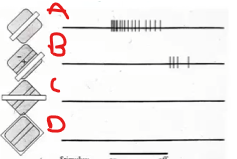
shine al ight so its only on the off section and on the on sections, cancels out and no stimulus
90
what are complex cortical cells: combonation of simple cells
91
explain a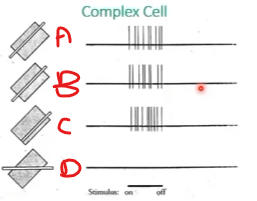
increasing in response
92
explain b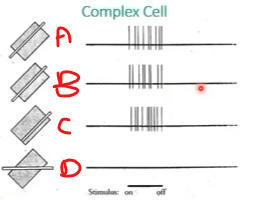
increasing in response
93
explain c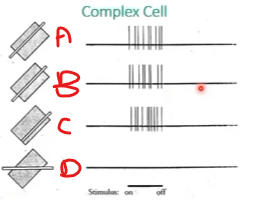
increasing in response
94
explain d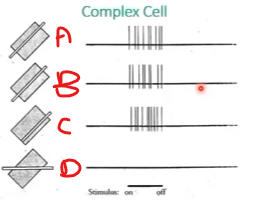
no activation
95
what is the contour illusion
we seee something because theres an implied outline
96
what is retinex theory
the ability to see an object as the same color despite changes in lighting
97
what is color constancy
idea that regardless of actula wavelength of light hitting your eye,m we percieve a color as constant for a particular object
98
what is the calcarine fissure
seprates dorsal and ventral occiptal lobe
99
what does v2 do
detects pattern and texture by comparing neighboring sort of pixels from v1 to determine what kinds of pattenrs are in those neighboring pixels
100
what dopes v4 do
percieve color not actual wavelength by recieving info from blobs
101
what happens if v4 is damaged
achromatopsia. lack of color vision usually in one side of vision
102
what does v5 do
percieves motion
103
damage of v5 results in what
akinetopsia, cant see constant fluid motion and cannot see the world when your eyes move
104
what is the dorsal stream
proceeds from occipital lobe up into parietal lobe. brain regions that are associated with body awareness, shape of object in terms of brightness/darkness, how deep/far away something is and how something is moving
105
damage of the dorsal stream results in what
can identify most objects but cant locate them in space or interact with them
106
what is the ventral pathway
path from v1 to temporal cortex associated with identifying objects by lining up shape with semantic memory
107
what happens if ventral pathway is damaged
cant tell what object is until they pick it up
108
what is agnosia
damage to a part of their visual pathway after it reaches the cortex that may lead to a lack of awareness
109
what is blindsight
unable tos ay we know something
110
what is prosopagnosia
impairment of fusiform gyrus resulting in an inability in facial recognition
111
what is pareidolia
tendency to percieve faces in non face objects
112
why do people who have damage to their dorsal pathway have trouble interacting with ojects and have ease with identifying most objects?
apart of thinking about an object or tool is thinking "how will I interact with that?" and they cannot do that
More Science flashcards
Allgemeiner Teil 1_Zellen Gewebe und allgemeiner Aufbau Science · GermanJenniferBIO 465W Quiz 2Science · EnglishBraedenKinesiologySciencejocyt9HA - what is adaptation?Science · EnglishAnaïsMCB Lec 9Science · EnglishLuckyWavesScience · EnglishesmeeFunctional GroupsScience · EnglishVampzieksConstanteScience · FrenchQuentinStrength of Materials and Seismology TermsScience · EnglishMPLEDental Embryology and Pulp BiologyScience · EnglishoozuFirst 20 Chemical ElementsScience · LatinLukeGeology MidtermScience · EnglishMolly
Study these decks in the app
Free on iPhone, Android, Mac and the web. Add any deck to your account in one tap.

