Pharmacokinetics & Pharmacodynamics
Study these flashcardsFree · spaced repetition · iPhone, Android, Mac & web
All cards
1
What does pharmacokinetics describe?
Drug movement through the body: absorption, distribution, metabolism, and excretion (ADME)
2
What does pharmacodynamics describe?
The biochemical and physiologic effects of a drug on the body
3
Why must ICU drug dosing be reassessed frequently?
PK variables can change rapidly and with high frequency during critical illness
4
What is the bioavailability of an IV medication?
100%; the entire dose reaches systemic circulation
5
Does IV administration guarantee adequate drug concentrations in tissues?
No. Hydrophilic drugs may penetrate poorly into meninges, pulmonary tissue, and bone
6
What injury can occur after norepinephrine extravasation?
Local vasoconstriction and tissue necrosis
7
Can enteral drug exposure increase as well as decrease in ICU patients?
Yes. Different medications can have increased or decreased bioavailability
8
Which non-IV routes bypass hepatic first-pass metabolism?
Subcutaneous and intramuscular administration
9
Why can subcutaneous or IM absorption change during shock?
Changes in perfusion alter delivery of drug into the blood
10
What is the primary PK goal of inhaled drug administration?
High pulmonary drug concentrations with reduced systemic exposure
11
What inhaled particle size best reaches all regions of the lungs?
1–5 micrometers
12
Are inhaled antibiotic efficacy data firmly established in ICU patients?
No. The chapter describes efficacy of this route as not well established
13
Why administer antibiotics intraventricularly for resistant meningitis?
To increase local drug concentrations and reduce systemic concentrations
14
What does bioavailability (F) measure?
The percentage of a dose that reaches the systemic circulation
15
How may shock affect gastrointestinal drug absorption?
Splanchnic hypoperfusion is thought to decrease absorption; direct studies are lacking
16
What bedside test has been investigated as a surrogate for GI drug absorption?
An oral acetaminophen test with subsequent serum concentrations
17
What effect may reduced skin and muscle perfusion have on SC or IM drugs?
It is thought to reduce absorption from these sites
18
Does intestinal atrophy consistently increase or decrease drug absorption?
Unknown; passive diffusion may increase while active transport may decrease
19
How common can GI dysmotility be in critically ill patients?
Reported incidence as high as 60%
20
How does delayed gastric emptying usually change acetaminophen absorption?
Delayed absorption and a reduced peak concentration
21
Name two common treatments for ICU GI dysmotility.
Metoclopramide and erythromycin
22
Is the effect of prokinetics on enteral drug absorption established in ICU patients?
No; it remains unclear
23
What is the general effect of intestinal P-glycoprotein on substrate absorption?
It reduces absorption of drug substrates
24
Which fluoroquinolone has reduced bioavailability with enteral nutrition (except its oral suspension)?
Ciprofloxacin
25
Which three commonly used drugs have reported reduced absorption with enteral nutrition?
Levothyroxine, phenytoin, and warfarin
26
What enteral-feeding hold interval is suggested for interacting drugs?
1–2 hours before and after drug administration; use the minimum interruption needed
27
Why should prolonged enteral-feed interruptions be avoided?
They may reduce nutrition support and increase administration workload and errors
28
What effect does increased gastric pH have on ketoconazole/itraconazole absorption?
Decreased absorption
29
Which cardiac medication has increased absorption with acid suppression in the chapter?
Digoxin (also nifedipine)
30
Why can a jejunostomy tube reduce oral iron absorption?
Iron is dissolved in the stomach and absorbed in the duodenum
31
Is tolerance of enteral feeding a reliable marker of drug absorption?
No. The chapter describes it as not an ideal marker
32
What does volume of distribution (Vd) relate?
The amount of drug in the body to its serum concentration
33
For an IV dose, what is the relationship between initial serum concentration and Vd?
$C = Dose/V_d$
34
For the same IV dose, what happens to initial serum concentration when Vd increases?
It decreases
35
Which drug type generally has increased Vd after large-volume resuscitation?
Hydrophilic drugs
36
How is Vd of lipophilic drugs generally affected by increased interstitial fluid?
It is often unchanged
37
Name three conditions that may increase interstitial fluid and hydrophilic-drug Vd.
Sepsis, ARDS, and AKI (also burns, HF, cirrhosis, surgery)
38
How did septic shock affect piperacillin subcutaneous tissue exposure in a cited study?
Reduced tissue concentrations versus healthy volunteers
39
Which plasma protein usually binds acidic drugs?
Albumin
40
Which plasma protein usually binds basic drugs?
Alpha-1 acid glycoprotein (AAG)
41
How does albumin generally change during physiologic stress?
It decreases (negative acute-phase reactant)
42
How does AAG generally change during physiologic stress?
It increases (positive acute-phase reactant)
43
What happens to the unbound fraction of an albumin-bound drug in hypoalbuminemia?
The unbound fraction (fu) increases
44
How can hypoalbuminemia affect Vd of an albumin-bound drug?
The Vd can increase as plasma free fraction rises
45
How can elevated AAG affect the Vd of an AAG-bound drug?
Increased binding decreases fu and Vd
46
What relationship does the chapter give for protein binding and Vd?
$V_d=(f_u/f_{ut})\times V_t+V_p$
47
Which antiepileptic had elevated free concentrations associated with hypoalbuminemia?
Valproate
48
Which form of a drug penetrates cell membranes more easily?
The nonionized form
49
Theoretically, how does acidemia affect Vd of a weak acid?
Increases Vd because more drug is nonionized; human evidence is lacking
50
Theoretically, how does acidemia affect Vd of a weak base?
Decreases Vd because more drug is ionized; human evidence is lacking
51
What is the most commonly reported ECMO-related PK change?
An increase in volume of distribution
52
Which two ECMO circuit components may sequester drugs?
Circuit tubing and membrane oxygenator
53
How can ECMO priming fluid affect drug distribution?
Its volume, type, and pH may increase drug Vd
54
How might drug requirements change as an ECMO circuit ages?
Binding sites may saturate, allowing requirements to return toward pre-ECMO doses
55
What does a higher logP indicate regarding ECMO circuit sequestration risk?
Greater lipophilicity and potentially higher sequestration risk
56
Which ICU drug pair has demonstrated ECMO circuit loss in ex vivo studies?
Fentanyl and midazolam
57
What monitoring did a pilot ECMO study recommend for β-lactams and aminoglycosides?
Therapeutic drug monitoring because PK target attainment was variable
58
What is the predominant organ for drug metabolism?
The liver
59
What change in insulin disposition contributes to hypoglycemia during AKI?
Decreased renal metabolism and lower insulin requirements
60
What three factors determine hepatic drug metabolism?
Hepatic blood flow, protein binding, and intrinsic enzyme activity
61
What is the basic hepatic clearance equation?
$CL_H = Q \times E$ (Q = hepatic blood flow, E = extraction ratio)
62
What equation relates extraction ratio to intrinsic clearance and hepatic flow?
$E=(f_u\times CL_{int})/(Q+f_u\times CL_{int})$
63
How is hepatic extraction ratio (E) classified as high?
Greater than 0.7
64
How is hepatic extraction ratio (E) classified as intermediate?
0.3–0.7
65
How is hepatic extraction ratio (E) classified as low?
Less than 0.3
66
Which variable primarily limits clearance of high-extraction hepatic drugs?
Hepatic blood flow (Q)
67
What simplified clearance equation applies to high-extraction hepatic drugs?
$CL_H = Q$
68
Which two drugs in the chapter are high-extraction and albumin-bound?
Morphine and propofol (other examples are in the chapter table)
69
Which high-extraction drug in the chapter binds AAG?
Lidocaine
70
What happens to total and unbound Css of a high-extraction drug when hepatic flow increases?
Both decrease
71
What happens to total and unbound Css of a high-extraction drug when hepatic flow decreases?
Both increase
72
For a high-extraction drug, what happens to total Css if protein-free fraction increases?
No change in total Css
73
For a high-extraction drug, what happens to unbound Css if protein-free fraction increases?
Unbound Css increases
74
Which hemodynamic state may increase hepatic clearance of high-extraction drugs?
Hyperdynamic sepsis with increased hepatic perfusion (theoretical in humans)
75
What shock state may increase exposure to high-extraction drugs?
Low-output shock with reduced hepatic blood flow
76
Why may positive-pressure ventilation reduce hepatic clearance?
Increased intrathoracic pressure may reduce venous return and cardiac output
77
Which two albumin-bound drugs in the chapter are LOW-extraction?
Phenytoin and warfarin
78
Which albumin-bound sedative in the chapter has an INTERMEDIATE extraction ratio?
Midazolam
79
Which variable primarily limits clearance of low-extraction hepatic drugs?
Intrinsic enzyme activity, together with unbound fraction
80
What simplified clearance equation applies to low-extraction hepatic drugs?
$CL_H = f_u \times CL_{int}$
81
Does altered hepatic blood flow directly affect Css of a low-extraction drug?
No; both total and unbound Css are unchanged in the model
82
What happens to total and unbound Css of a low-extraction drug when intrinsic clearance decreases?
Both increase
83
What happens to total Css of a low-extraction drug if free fraction increases?
Decreases
84
What happens to unbound Css of a low-extraction drug if free fraction increases?
No change in the model
85
How do CYP inhibitors usually affect concentrations of coadministered substrates?
They increase substrate concentrations
86
How do CYP inducers usually affect concentrations of coadministered substrates?
They decrease substrate concentrations
87
Which inflammatory mediators suppress CYP expression and activity?
IL-1, IL-6, and TNF-alpha
88
What effect can early sepsis have on intrinsic hepatic clearance?
Inflammatory cytokines may decrease CYP activity
89
What effect did mild hypothermia have on phenytoin metabolism?
Reduced metabolism with increased concentrations; protein binding was unchanged
90
What effect has worsening AKI been associated with for midazolam concentrations?
Increasing concentrations, possibly from impaired CYP3A activity
91
What determines clearance of intermediate-extraction drugs?
Hepatic blood flow, intrinsic clearance, and unbound fraction
92
During early traumatic brain injury, how may phenytoin hepatic clearance change?
It can increase during the first 7–14 days
93
Which phase II substrate had increased clearance in TBI and thermal injury?
Lorazepam
94
Which three processes govern urinary drug excretion?
Filtration, secretion, and reabsorption
95
What is augmented renal clearance (ARC)?
Increased renal drug elimination associated with increased renal blood flow/filtration
96
Which major conditions are associated with ARC in ICU patients?
Surgery, trauma, burns, and early sepsis
97
Name three common patient characteristics associated with ARC.
Younger age, trauma, and low serum creatinine
98
What may happen to renal elimination during the hyperdynamic burn phase?
Increased excretion of drugs such as vancomycin and aminoglycosides
99
In which direction can renal clearance change as early sepsis progresses to AKI?
From increased clearance to decreased clearance
100
What is the major dosing risk when renal excretion falls during AKI?
Drug accumulation and toxicity
101
Do the KDIGO AKI staging guidelines provide specific drug-dosing instructions?
No
102
Why might FDA renal-dose recommendations be imperfect for acute ICU kidney injury?
They are often based on chronic kidney disease populations
103
What should be monitored when individualizing drug doses during AKI?
Response, toxicity, and drug levels (when available), with reassessment
104
Which three equations for estimating kidney function does the chapter discuss?
Cockcroft–Gault, MDRD, and CKD-EPI
105
What is the Cockcroft–Gault equation for creatinine clearance?
$CrCl = [(140-age)\times weight]/(72\times SCr)$; multiply by 0.85 for females
106
What units does the Cockcroft–Gault equation use for weight and SCr?
Kilograms and mg/dL, respectively
107
Which kidney-function estimate is emphasized over MDRD by the National Kidney Foundation?
CKD-EPI
108
Which factors affect removal of a drug by intermittent hemodialysis?
Molecular size, Vd, protein binding, and filter membrane
109
Can intermittent HD remove all medications to the same degree?
No. Drug removal depends on drug and dialyzer characteristics
110
What is the most important CKRT parameter for drug removal in this chapter?
Effluent flow rate (Qeff)
111
How does increasing CKRT effluent flow affect solute clearance?
It increases solute clearance
112
In the chapter’s CKRT dose equation, what does SC stand for?
Sieving coefficient
113
What CKRT dose adjustment equation is presented in the chapter?
$Dose = Dose_n \times [CL_{nonrenal} + Q_{eff}\times SC]/CL_{norm}$
114
Which neuromuscular blockers had prolonged half-lives during biliary obstruction or cholestasis?
Pancuronium and vecuronium
115
What are the three major antibiotic PK/PD efficacy indexes?
Time above MIC, peak/MIC, and AUC/MIC
116
Which PK/PD index predicts β-lactam effectiveness?
Free-drug time above MIC (fT>MIC)
117
What ideal fT>MIC percentage is described for β-lactams?
100% (studied targets vary)
118
What fT>MIC cutoff is cited for carbapenem efficacy?
About 40%
119
What fT>MIC cutoff is cited for penicillin efficacy?
About 50%
120
What fT>MIC cutoff range is cited for cephalosporin efficacy?
About 50–75%
121
Why may prolonged or continuous β-lactam infusions improve PD target attainment?
They increase time above MIC
122
Have controlled trials consistently shown benefits from prolonged β-lactam infusion?
No. Prospective trial results are mixed
123
Which PK/PD index best characterizes aminoglycoside killing?
Peak concentration/MIC (Cmax/MIC)
124
What aminoglycoside peak/MIC ratio correlated with about 90% clinical response?
8–10
125
Why is extended-interval aminoglycoside dosing pharmacodynamically attractive?
It takes advantage of high peak concentrations
126
Which PK/PD index best predicts vancomycin efficacy?
AUC/MIC
127
What vancomycin AUC target range is recommended for efficacy and safety?
400–600 (AUC/MIC framework)
128
What vancomycin loading-dose range is recommended in the chapter?
20–35 mg/kg based on actual body weight
129
When may continuous-infusion vancomycin be considered?
When conventional dosing cannot achieve target AUC
130
What IV access concern accompanies continuous-infusion vancomycin?
Y-site incompatibilities with several common ICU medications
131
What fluoroquinolone peak/MIC ratio is cited in the chapter?
10 or greater
132
What ciprofloxacin AUC/MIC exposure was associated with clinical cure in a cited respiratory infection study?
125 for 24-hour AUC/MIC
133
Why are individualized fluoroquinolone PK/PD targets difficult to verify?
Routine serum drug concentrations are not available
134
What monitoring test is commonly used for the PD response to UFH infusion?
Activated partial thromboplastin time (aPTT)
135
How did septic shock affect dobutamine response in a cited study?
Reduced response compared with nonseptic patients and healthy volunteers
136
What are the two primary goals of therapeutic drug monitoring (TDM)?
Maximize efficacy and reduce toxicity
137
Which drugs are especially appropriate for TDM?
Drugs with a narrow therapeutic index
138
What is a practical barrier to widespread antimicrobial TDM?
Limited assays and timely results
139
What total phenytoin trough range is shown in the chapter?
10–20 mg/L
140
What unbound phenytoin trough range is shown?
1–2.5 mcg/mL
141
What total valproate trough range is shown?
50–100 mcg/mL
142
What caveat does the book give for the unbound valproate range?
Its optimal range remains undetermined
143
What carbamazepine trough range is shown?
4–12 mg/L
144
What phenobarbital trough range is shown?
10–40 mg/L
145
What digoxin trough sampling interval is shown?
8–24 hours after the dose
146
What vancomycin exposure range is shown in the TDM table?
AUC 400–600 mg·hour/L
147
What peak is listed for traditional gentamicin/tobramycin dosing?
8–10 mg/L
148
What trough is listed for traditional gentamicin/tobramycin dosing?
Less than 2 mg/L
149
What is the recommended trough goal for extended-interval aminoglycoside doses in the table?
Undetectable
150
How is the first-order elimination rate constant (ke) calculated from two concentrations?
$k_e = ln(C_1/C_2)/\Delta t$
151
What formula relates drug half-life to elimination rate constant?
$t_{1/2}=0.693/k_e$
152
How does the book back-extrapolate a postinfusion peak to the end of infusion?
$C_{max} = C_1 \times e^{k_e t}$
153
How does the book extrapolate a trough forward to the next dose?
$C_{min} = C_2 \times e^{-k_e t}$
154
What formula is given for a new dosing interval from desired peak and trough?
$\tau=\ln(C_{max,desired}/C_{min,desired})/k_e+t_{inf}$
155
What assumption is a drawback of using trough-based TDM alone?
That a PK measurement (e.g., trough) correlates with PD exposure (e.g., AUC/MIC)
156
Why might population-PK software misdose an ICU patient?
Models based on non-critically ill patients may misrepresent ICU PK
157
Which additional antimicrobial classes/drugs are recommended for TDM in a cited position paper?
β-lactams, linezolid, and voriconazole (in addition to aminoglycosides/vancomycin)
158
What do once-daily aminoglycoside dosing nomograms commonly determine?
The dosing interval, using sampling time and drug concentration
159
Why must Hartford-type nomograms be applied cautiously in ICU patients?
They were not developed in critically ill patients and may miss altered PK
160
What population-specific risk applies to insulin infusion protocols in AKI?
Higher hypoglycemia risk if protocols were developed without kidney impairment
161
High-extraction drug: ↑ hepatic blood flow. What happens to total and unbound Css?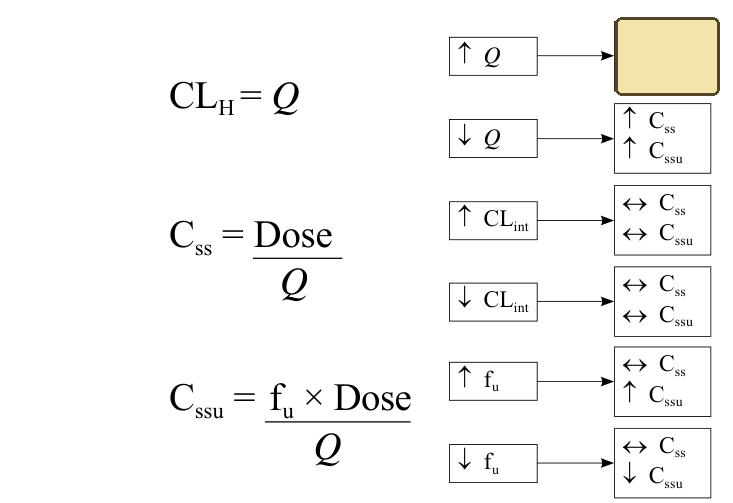
Both decrease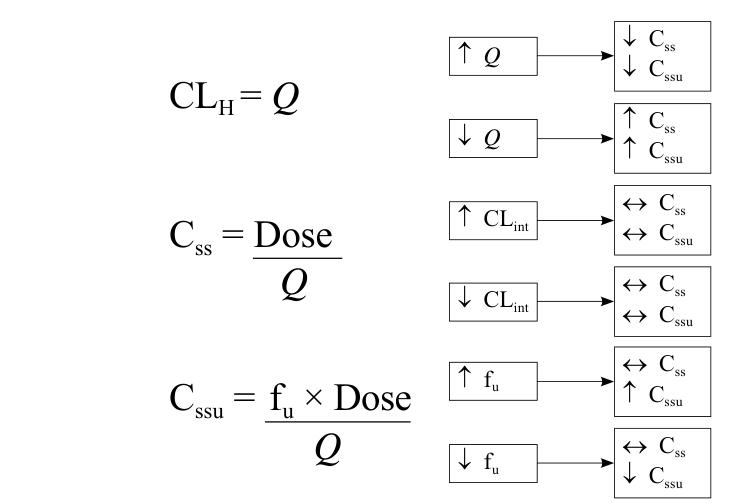
162
Low-extraction drug: ↑ free fraction. What happens to total and unbound Css?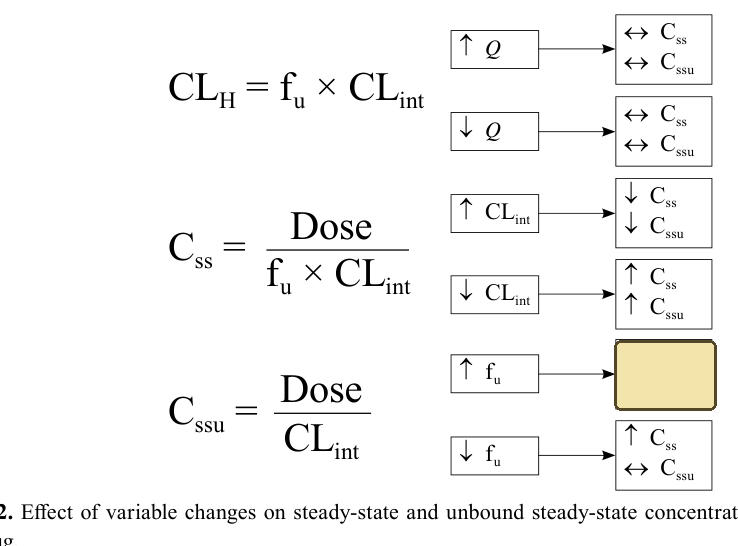
Total decreases; unbound unchanged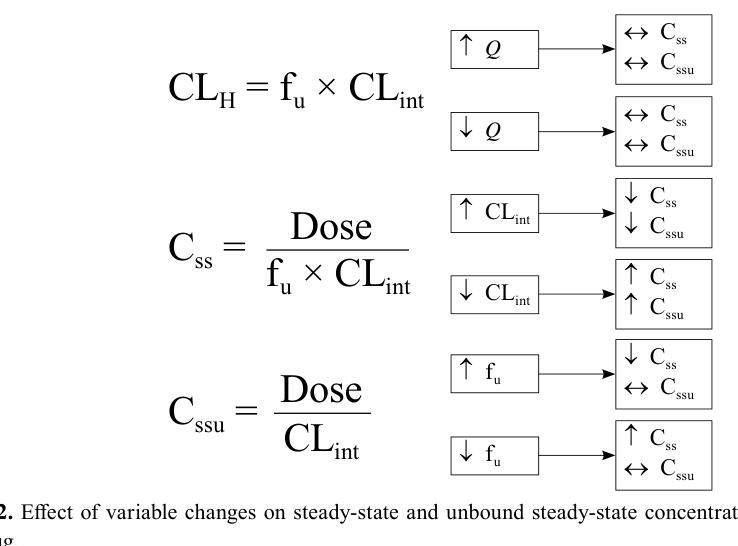
163
Phenytoin: recall the TOTAL and UNBOUND trough ranges.
Total 10–20 mg/L; unbound 1–2.5 mcg/mL
164
Carbamazepine: recall total and unbound trough ranges.
Total 4–12 mg/L; unbound 0.5–4 mcg/mL
165
Vancomycin: recall the target AUC range.
AUC 400–600 mg·hour/L
166
Gentamicin: recall the traditional peak and trough ranges.
Peak 8–10 mg/L; trough <2 mg/L
More Medicine & health flashcards
ingredients Medicine & health · EnglishashCirkulation Medicine & health · SwedishAlilproW2: Mental Disorders C/N/B/IMedicine & health · EnglishVictormuscle fibers Medicine & health · EnglishnewTkanka łączna - HistologiaMedicine & health · PolishLuvenDrug Classes and UsesMedicine & health · EnglishAveryHistology: Heart Anatomy and ValvesMedicine & health · EnglishSaraSkeletal SystemMedicine & health · EnglishEmelySensory Receptors and Transduction (Chapter 11)Medicine & health · EnglishKrisMedCardsLecture 7 — Infection, Virulence, and EpidemiologyMedicine & health · EnglishlaviniaPathology C6Medicine & health · EnglishImadNafazolina, oximetazolina, tolterodinaMedicine & health · SpanishLAURA
Study these decks in the app
Free on iPhone, Android, Mac and the web. Add any deck to your account in one tap.