ACG2071 Chapter 7 (Principles of Managerial Accounting)
Study these flashcardsFree · spaced repetition · iPhone, Android, Mac & web
All cards
1
Benchmarking
Benchmarking is the practice of comparing a company with its prior performance or with best practices from other companies.
2
Participative budget vs Preliminary budgets?
Participative Budget (Bottom-up): Individuals who are directly affected by the budgets are involved in the development of the budgets.
-This requires a lot of coordination and is usually is started to prepare months before the budget actually takes place
Preliminary budgets: High level bosses make the budgets themseleves and pretty much guess how much money to allocate.
-The upside is that it is really fast to do.
-This requires a lot of coordination and is usually is started to prepare months before the budget actually takes place
Preliminary budgets: High level bosses make the budgets themseleves and pretty much guess how much money to allocate.
-The upside is that it is really fast to do.
3
Budgetary Slack
When managers internally underestimate revenues or overestimate expenses.
They do this because
1. Many companies have financial incentives to be at or below the budget.
2. Stress reduction from having extra money or an emergency fund
They do this because
1. Many companies have financial incentives to be at or below the budget.
2. Stress reduction from having extra money or an emergency fund
4
Zero-based Budget
A budget technique that requires managers to justify all revenue and expenses for each new period.
You have to ignore the previous period's expenses and revenues.(PS: A common way for companies to make budgets is to use the revenues and expenses from the previous period and adjust.)
You have to ignore the previous period's expenses and revenues.(PS: A common way for companies to make budgets is to use the revenues and expenses from the previous period and adjust.)
5
Strategic Budgets
A strategic budget is a long-term financial plan used to coordinate the activities needed to achieve the long-term goals of the company.
-Strategic budgets often span three to 10 years.
-Because of their longevity, they often are not as detailed as budgets for shorter periods.
-Strategic budgets often span three to 10 years.
-Because of their longevity, they often are not as detailed as budgets for shorter periods.
6
Operational Budget
*Also, name one type of Operational Budget
*Also, name one type of Operational Budget
An operational budget is a short-term financial plan used to coordinate the activities needed to achieve the short-term goals of the company. Operational budgets are generally much more detailed than strategic budgets. Operational budgets are most often one year in length (generally encompassing the fiscal year) but may also span only a week, a month, or a quarter, depending on the company’s needs.
Continuous Budget: A continuous budget is a type of operational budget that involves continuously adding one additional month as each month goes by.
Continuous Budget: A continuous budget is a type of operational budget that involves continuously adding one additional month as each month goes by.
7
Static Budget vs Flexible Budget
Static Budget: A static budget is a budget prepared for only one level of sales volume.
Flexible Budget: A flexible budget is a budget prepared for various levels of sales volume.
EXAMPLE
Per Burger
-Sold at: \$6
-Costs: \$3
Expected to sell 1,000 Burgers
Actually Sold 1,200 Burgers
Static Budget:
Cost of expected 1,000 burgers: \$3,000
Cost of actual 1,200 burgers sold: \$3,840
You Overspent: \$840
Flexible Budget:
RECALCULATE as if we knew that we would sell 1,200 burgers.
1,200 burgers x \$3 cost per burger = \$3,600 Cost
Cost of actual 1,200 burgers sold: \$3,840
\$3,840 - \$3,600 = \$240
You Overspent: \$240
Flexible Budget: A flexible budget is a budget prepared for various levels of sales volume.
EXAMPLE
Per Burger
-Sold at: \$6
-Costs: \$3
Expected to sell 1,000 Burgers
Actually Sold 1,200 Burgers
Static Budget:
Cost of expected 1,000 burgers: \$3,000
Cost of actual 1,200 burgers sold: \$3,840
You Overspent: \$840
Flexible Budget:
RECALCULATE as if we knew that we would sell 1,200 burgers.
1,200 burgers x \$3 cost per burger = \$3,600 Cost
Cost of actual 1,200 burgers sold: \$3,840
\$3,840 - \$3,600 = \$240
You Overspent: \$240
8
"A set of budgeted financial statements and supporting schedules for the entire organization"
The image shows 3 different types of budgets
1. The operating Budget: (Shown in image)
2. The capital expenditure Budget: The budget presents the company's plan for purchasing property, plant and equipment, and other long term assets. (Capital Expenditure is the money companies use to buy long-term assets)
3. The financial Budget: Includes the cash budget and the budgeted financial statements
↓
*Cash Budget: The cash budget details how the business expects to go from the beginning cash balance to the desired ending cash balance and feeds into the budgeted financial statements.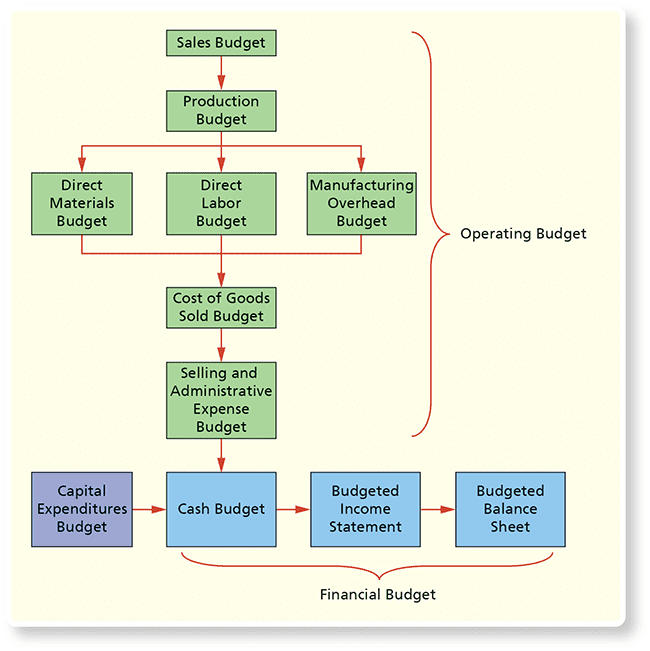
The master Budget for a MANUFACTURING company (The rest of the slides will explain each type of budget in the master budget)
"A set of budgeted financial statements and supporting schedules for the entire organization"
The image shows 3 different types of budgets
1. The operating Budget: (Shown in image)
2. The capital expenditure Budget: The budget presents the company's plan for purchasing property, plant and equipment, and other long term assets. (Capital Expenditure is the money companies use to buy long-term assets)
3. The financial Budget: Includes the cash budget and the budgeted financial statements
↓
*Cash Budget: The cash budget details how the business expects to go from the beginning cash balance to the desired ending cash balance and feeds into the budgeted financial statements.
9
The budget that estimated the amount of sales revenue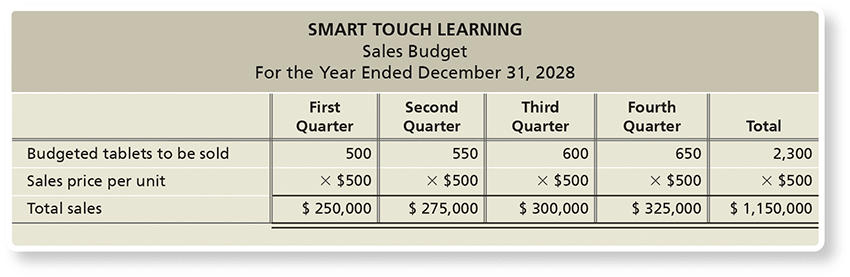
Sales Budget
The budget that estimated the amount of sales revenue
10
Production Budget (Slide 1/2)
What is the Production Budget? How to caluclate it?
What is the Production Budget? How to caluclate it?
The budget that determines the number of units to be produced to meet projected sales
To determine the amount to produce, look at image
*Also, companies don't want zero ending inventory, they want enough to begin next period.
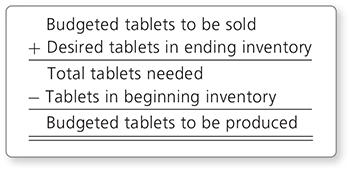
To determine the amount to produce, look at image
*Also, companies don't want zero ending inventory, they want enough to begin next period.
11
(Slide 2/2)Production Budget
What is the production budget financial statement, if
Smart Touch Learning desires to have an ending inventory each quarter equal to 20% of the next quarter’s EXPECTED sales.
What is the production budget financial statement, if
Smart Touch Learning desires to have an ending inventory each quarter equal to 20% of the next quarter’s EXPECTED sales.
*PS: So you don't get stumped understanding this, the first beginning inventory in the first quarter is just randomly chosen.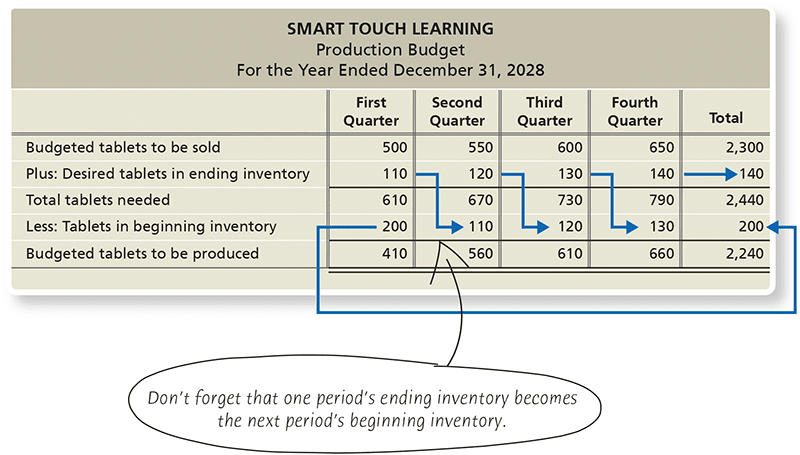
12
Direct Materials Budget
How to calculate the direct material budget?
(Slide 1/2)
How to calculate the direct material budget?
(Slide 1/2)
The direct materials budget estimates the amount of materials to purchase to meet the company’s production needs.
(So, its basically to clear up the beginning, its the amount of tablets you plan to produce x the amount of pounds of direct materials needed to make each tablet. Plus ending inventory )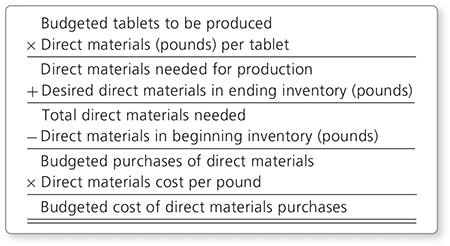
(So, its basically to clear up the beginning, its the amount of tablets you plan to produce x the amount of pounds of direct materials needed to make each tablet. Plus ending inventory )
13
Direct Materials Budget
What is the direct Material Budget Financial statement, if The company desires the ending balance in Raw Materials Inventory to be 40% of the next quarter’s budgeted direct materials needed for production
What is the direct Material Budget Financial statement, if The company desires the ending balance in Raw Materials Inventory to be 40% of the next quarter’s budgeted direct materials needed for production
Remember that just like before, the ending inventory at the total is he 4th quarter, and the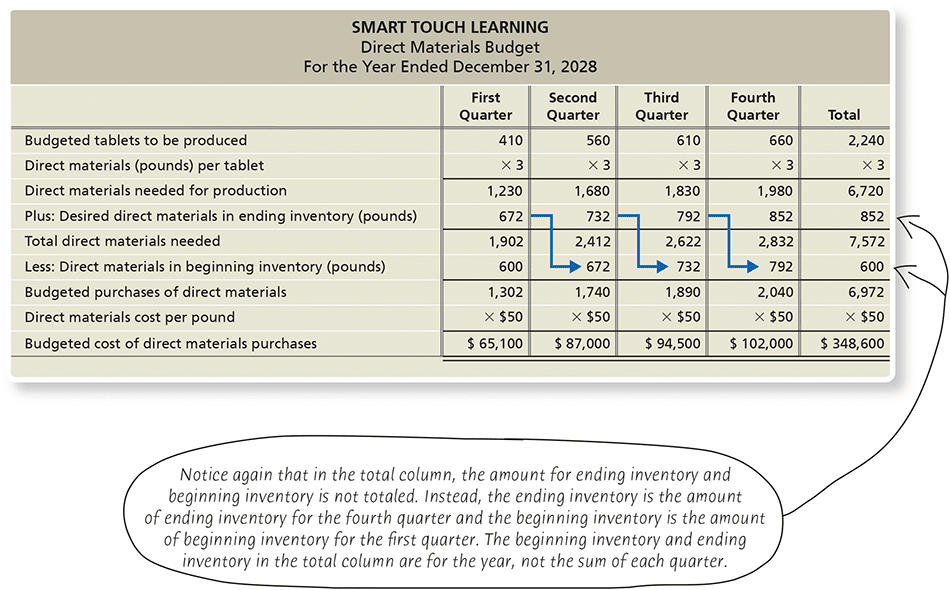
14
Direct Labor Budget
What is it?
What does the financial statement of it look like?
What is it?
What does the financial statement of it look like?
The direct labor budget estimates the direct labor hours and related cost needed to support the production budget.
Its easy to calculate: (Just the amount of tablets needed to produce x the amount of labor hours per tablet x the amount of \$ per labor hour = the amount you will need to budget for, for direct labor.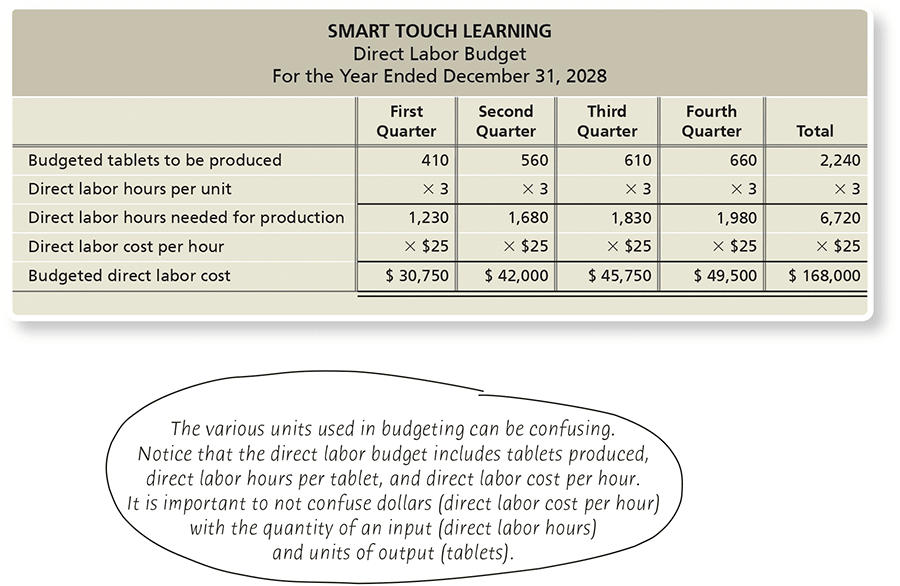
Its easy to calculate: (Just the amount of tablets needed to produce x the amount of labor hours per tablet x the amount of \$ per labor hour = the amount you will need to budget for, for direct labor.
15
Manufacturing Overhead Budget
1.What is it?
2. What is the financial staetment of it look like?
1.What is it?
2. What is the financial staetment of it look like?
1. It is both the fixed and variable costs of manufacturing overhead.
2. Variable Cost: \$20 Per tablet
Fixed Cost:
-\$12,000 per quarter for depreciation
-\$15,400 per quarter for other MOH stuff
Then, use the predetermined allocation rate (= Total estimated overhead costs / Total Estimated quantity of the overhead allocation base) to calculate the overhead cost of the indirect Manufacturing overhead (PS: Manufacturing overhead is ALWAYS INDIRECT!!! We are using the fixed and variable costs in this example to calculate the indirect MOH costs).
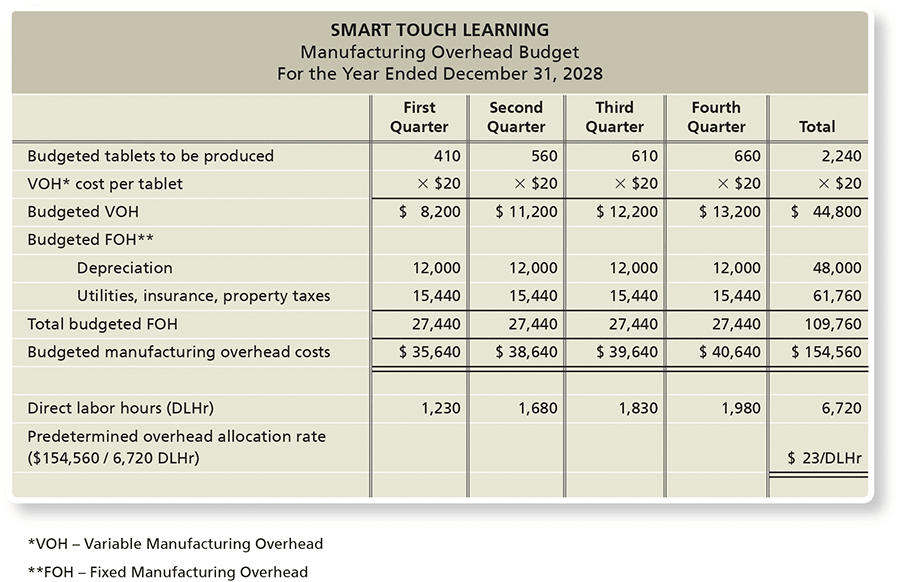
2. Variable Cost: \$20 Per tablet
Fixed Cost:
-\$12,000 per quarter for depreciation
-\$15,400 per quarter for other MOH stuff
Then, use the predetermined allocation rate (= Total estimated overhead costs / Total Estimated quantity of the overhead allocation base) to calculate the overhead cost of the indirect Manufacturing overhead (PS: Manufacturing overhead is ALWAYS INDIRECT!!! We are using the fixed and variable costs in this example to calculate the indirect MOH costs).
16
Cost of Goods Sold Budget
Pretty Self explanatory
Also, the 294pertabletcamefrom(150 Direct Materials + \$75 Direct Labor + \$69 Manufacturing Overhead).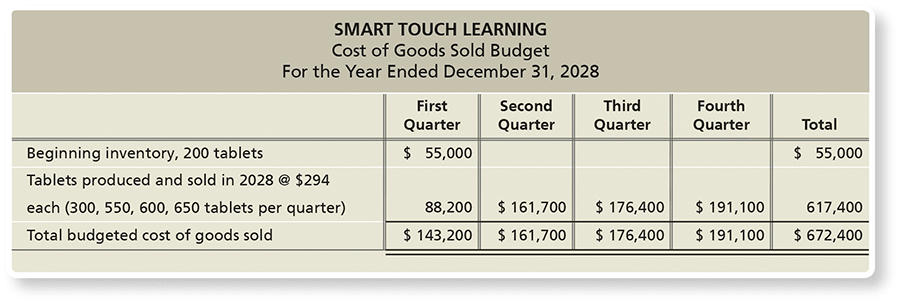
Also, the 294pertabletcamefrom(150 Direct Materials + \$75 Direct Labor + \$69 Manufacturing Overhead).
17
Selling and administrative budget
You literally just list out the different types of selling and administrative expenses and then just total them up.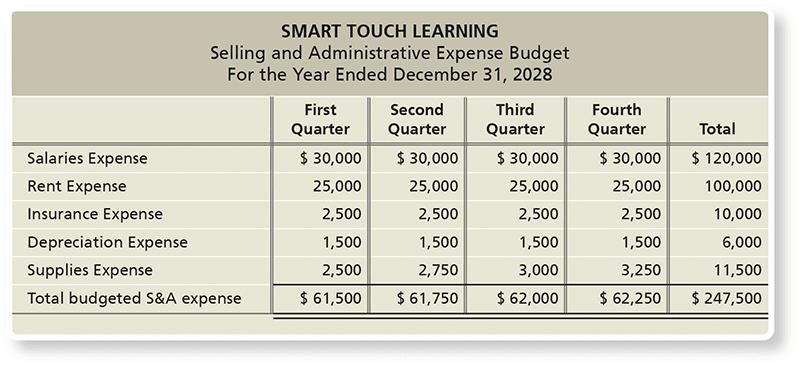
18
In the cash budget, if you have a rule of having a minimum cash balance of \$30,000, but you only have \$24,000, what do you do?
You finance (borrow) \$6,000.
19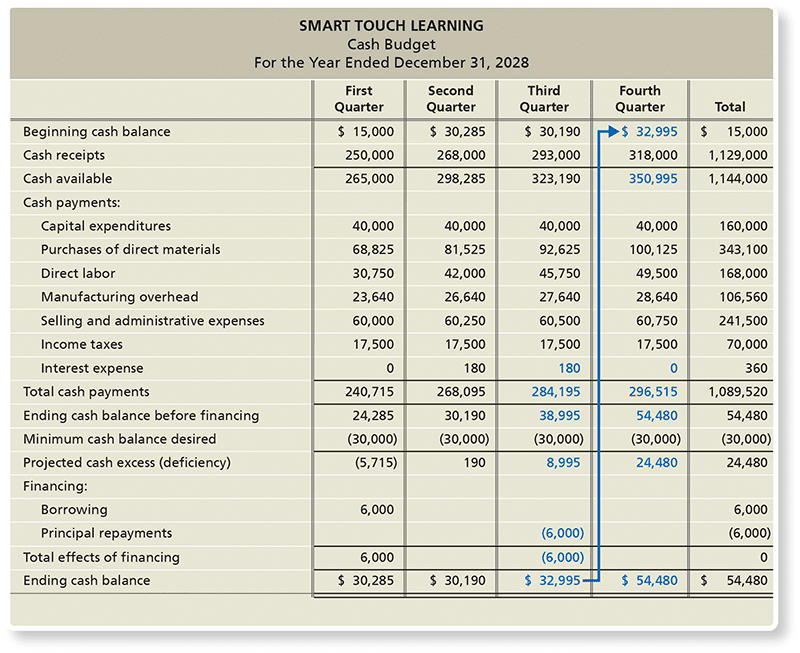
Cash Budget
What does the financial statement of it look like?
What does the financial statement of it look like?
20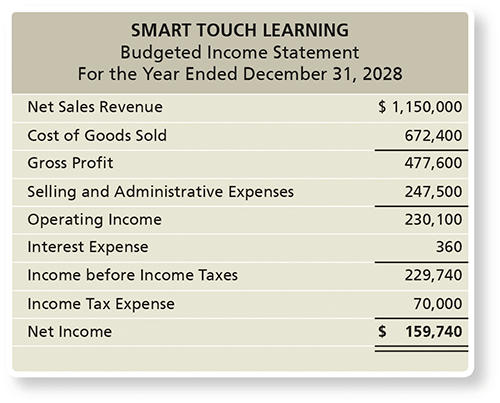
Budgeted Income Statement
What does that financial statement look like?
What does that financial statement look like?
21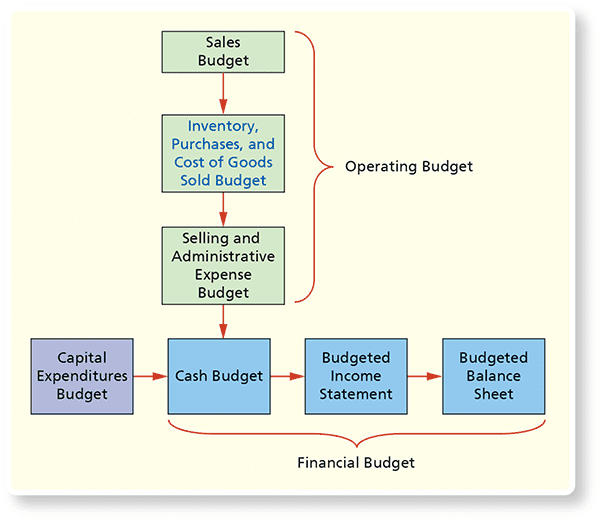
Master Budget - Merchandising Company
(Next couple of slides will explain each budget in this master budget)
(Next couple of slides will explain each budget in this master budget)
22
Sales Budget
(Merchandising Master Budget)
(Merchandising Master Budget)
Example: They think that 60% of there sales will be Cash sales, and the other 40% will be accounts receivable.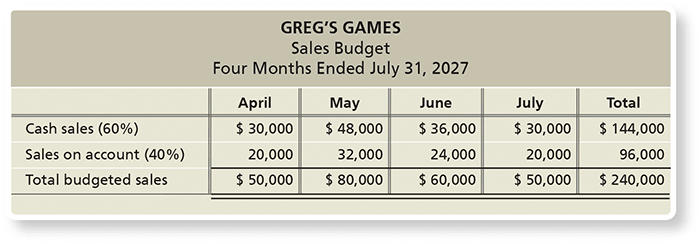
23
Inventory, Purchases, and Cost of Goods Sold Budget
(Merchandising Master Budget)
(Merchandising Master Budget)
Greg’s Games’ minimum merchandise inventory rule is as follows: Ending merchandise inventory should be equal to \$20,000 plus 80% of the next month’s cost of goods sold
(Also, remember, beginning inventory is part of first quarter and ending inventory is part of the fourth quarter, when totaling)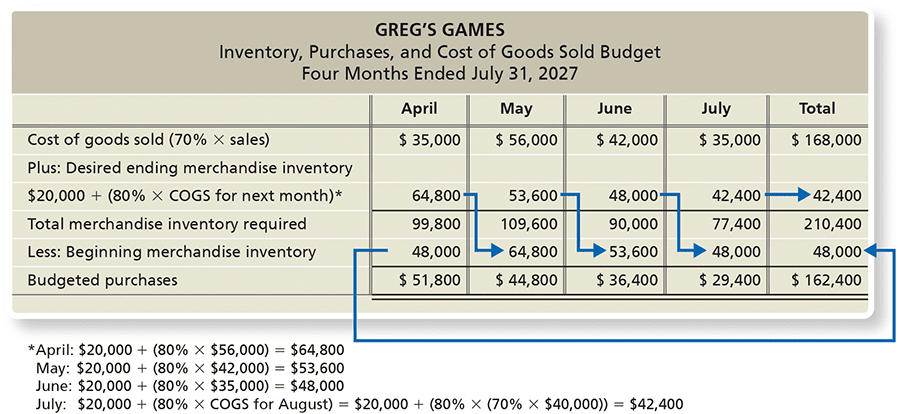
(Also, remember, beginning inventory is part of first quarter and ending inventory is part of the fourth quarter, when totaling)
24
Selling and Administrative Expense Budget
(Merchandising Master Budget)
(Merchandising Master Budget)
(easy), literally just list and total up variable costs (relating to Selling & administrative), then list and total up fixed costs (relating to Selling & administrative), then just add up both fixed and variable costs to get the Selling & Administrative Expense budget.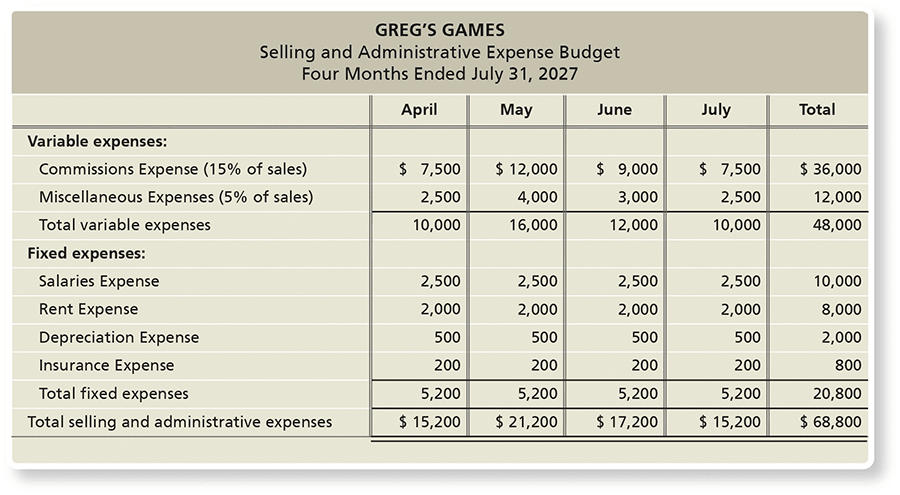
25
Cash expenditure Budget
(Merchandising Master Budget)
(Merchandising Master Budget)
Literaly just paymnets for long-term assets
26
Cash Budget
(Merchandising Master Budget)
(Merchandising Master Budget)
Seems to be the same as the cash budget for a manufacturing company.
Just Cash Receipts - Cash payments, and then you have a minimum ending balance amount that needs to be maintained. If your ending cash balance is too low, then you have to borrow the money.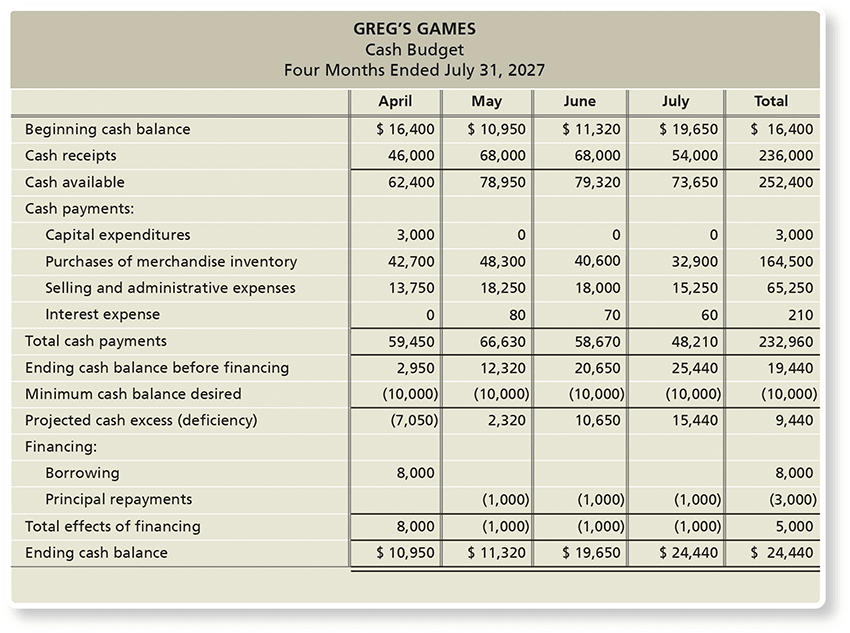
Just Cash Receipts - Cash payments, and then you have a minimum ending balance amount that needs to be maintained. If your ending cash balance is too low, then you have to borrow the money.
27
Budgeted Income Statement
(Merchandising Master Budget)
(Merchandising Master Budget)
Seems to be the same as manufacturing budgeted incoem statement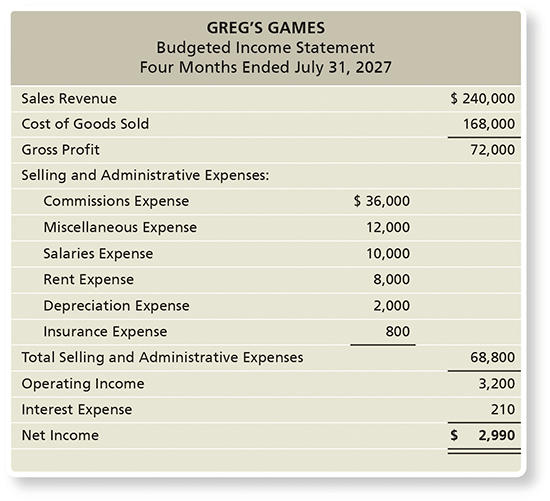
28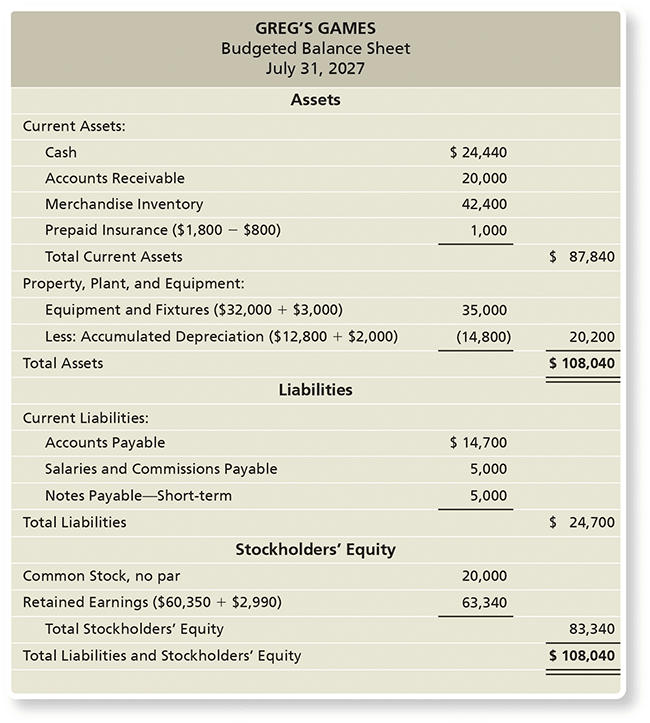
Budgeted Balacne Sheet
(Merchandising Master Budget)
(Merchandising Master Budget)
29
Which of the following is the cornerstone of the master budget?
A.
The selling and administrative expense budget
B.
The production budget
C.
The sales budget
D.
The budgeted balance sheet
A.
The selling and administrative expense budget
B.
The production budget
C.
The sales budget
D.
The budgeted balance sheet
The sales budget!!!
If you don't have sales, then you have no money to spend!
If you don't have sales, then you have no money to spend!
30
This means utilities is paid AFTER the month it is incurred.
So, they paid for january's utilities in february.
"800 per month, utilites paid in month after incurred"
-What does this mean?
-What does this mean?
This means utilities is paid AFTER the month it is incurred.
So, they paid for january's utilities in february.
More Business & economics flashcards
Internal Controls and Business ProcessesBusiness & economics · EnglishSarinaComp Exam 1Business & economics · EnglishLexieMGT 101Business & economics · EnglishKARISSAMineral Resources (2)Business & economics · EnglishNecole03Aggregate demandBusiness & economics · Englishan OutLearn studentDSP Module 1-4 -- Cumulative ExamBusiness & economics · EnglishZackJChapter 11 Vocab - Marketing ManagementBusiness & economics · Englishbevo612ECON Exam 1 FormulasBusiness & economics · EnglishJoshPrince 2Business & economics · EnglishEllaFinance and Accounting PracticeBusiness & economics · EnglishdTheme 2: Business Finance and OperationsBusiness & economics · EnglishDsoboE2 Project ManagementBusiness & economics · EnglishElla
All Business & economics decks
Study these decks in the app
Free on iPhone, Android, Mac and the web. Add any deck to your account in one tap.

