Year 1 Pure Mathematics
Study these flashcardsFree · spaced repetition · iPhone, Android, Mac & web
All cards
1
How do you decide which numbers to test when proving a number is prime?
Find the square root of the number, then test all the prime numbers up to its square root.
2
What is the rule for proving a number is prime?
To prove a number is prime, you only need to check whether it is divisible by the prime numbers up to its square root. If none divide exactly, the number is prime.
3
What does N mean?
Natural numbers (counting numbers). Natural numbers (counting numbers).
4
What does Z mean?
Integers (positive and negative whole numbers, including 0). E.g. −3, −2, −1, 0, 1, 2, 3, …
5
What does Z+ mean?
Positive integers (whole numbers greater than 0). E.g. 1, 2, 3, 4, … 0 is NOT included.
6
What does Z0+ mean?
Non-negative integers (positive whole numbers AND 0). E.g. 0, 1, 2, 3, 4, …
7
What does R mean?
Real numbers (all numbers on the number line, including integers, fractions, decimals and irrational numbers). E.g. −3, 0, ½, 2.5, square root 2, pi
8
What does Q mean?
Rational numbers (numbers that can be written as a fraction p/q, where p is an integer and q is a positive integer.
E.g. ½, −¾, 5, 0.25.
E.g. ½, −¾, 5, 0.25.
9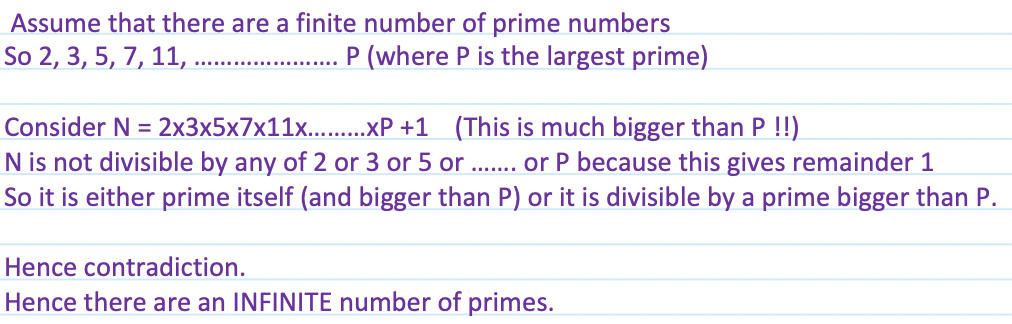
Prove that there are an infinite number of prime numbers.
10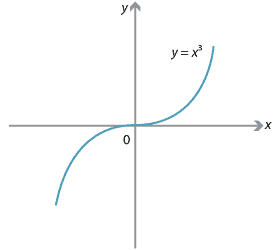
Sketch the graph of $y=x^3$.
11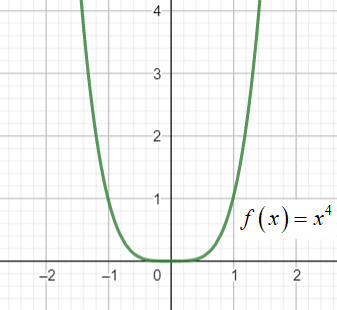
Sketch the graph of $y=x^4$.
12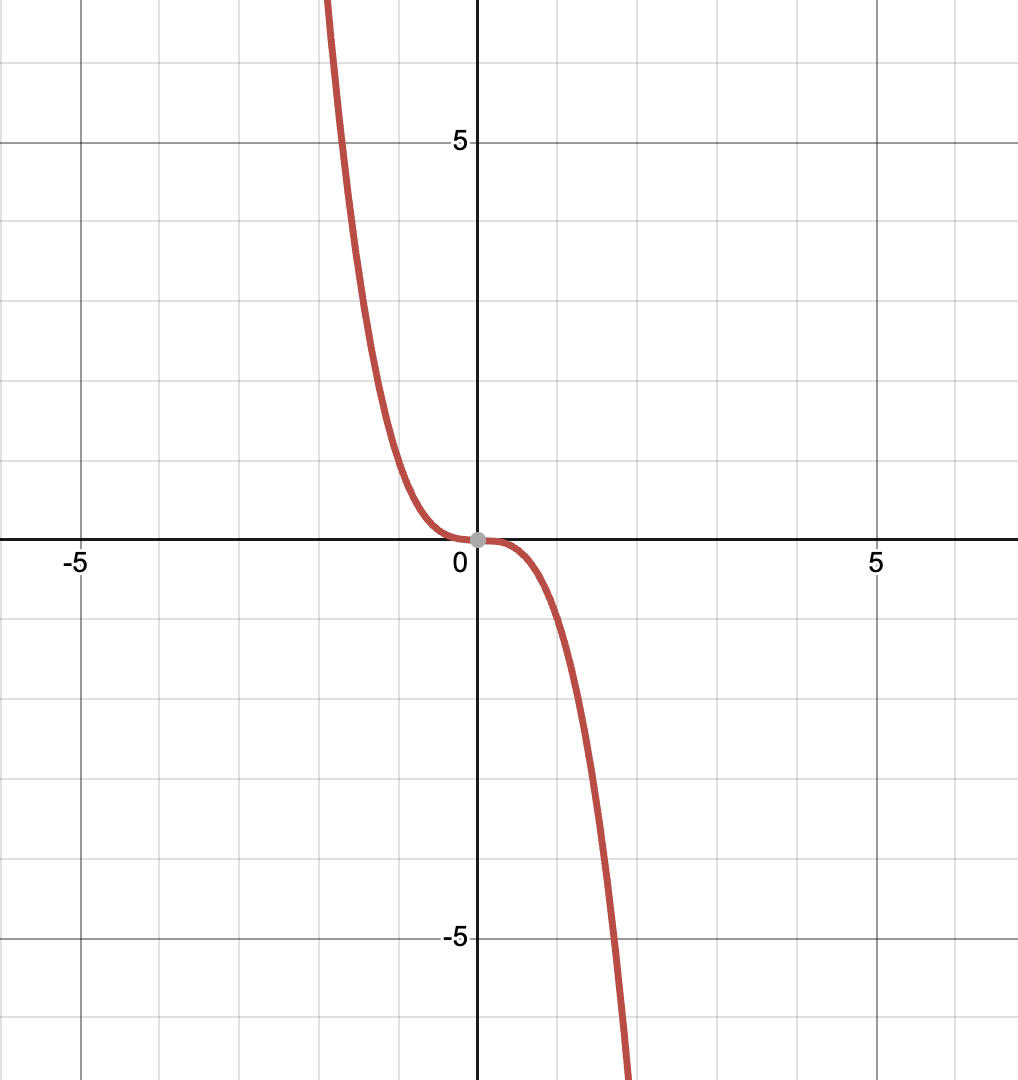
Sketch the graph of $y=-x^3$.
13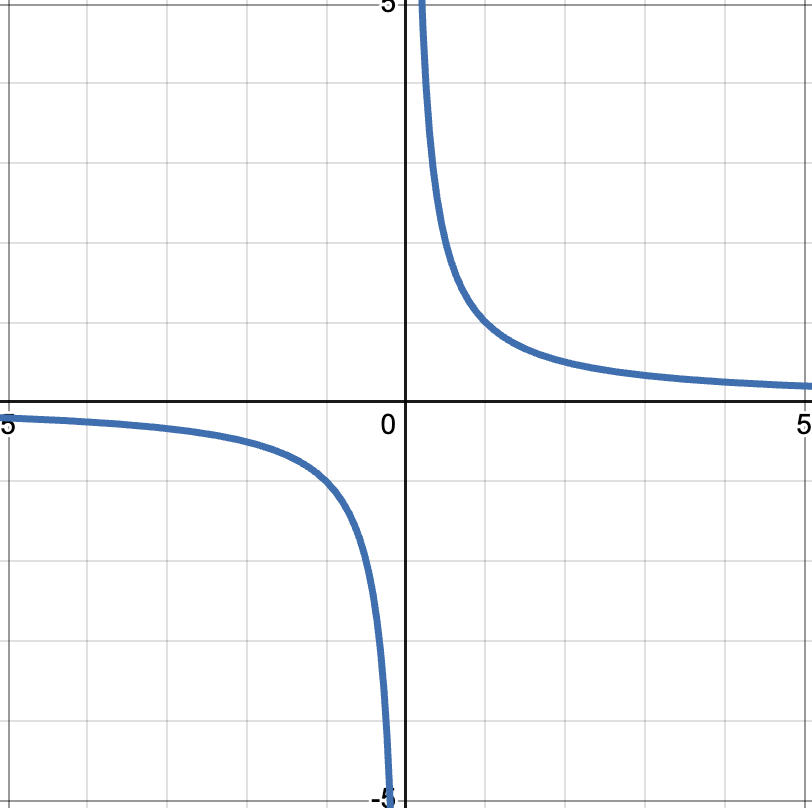
Sketch the graph of $y=\frac{1}{x}$.
14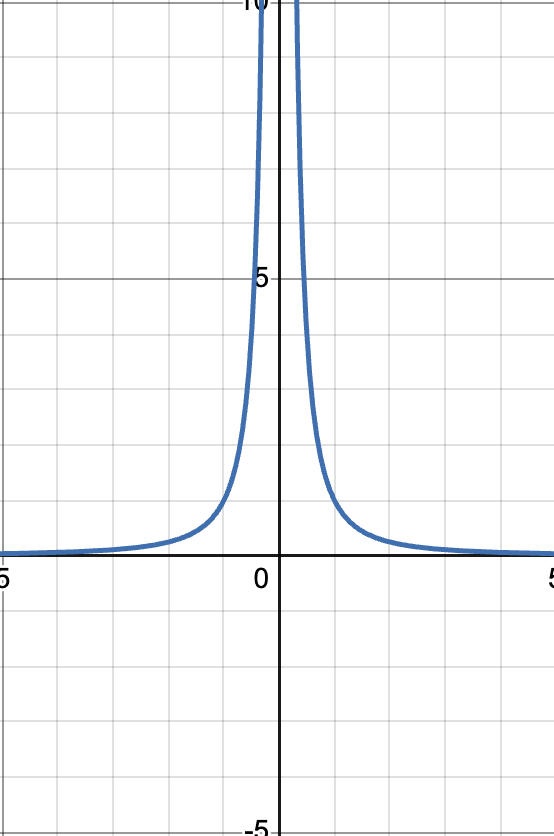
Sketch the graph of $y=\frac{1}{x^2}$.
15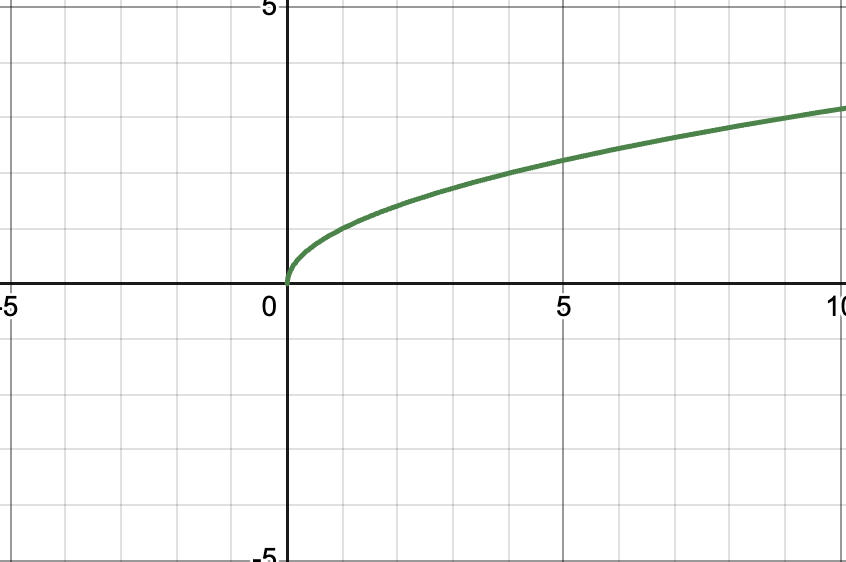
Sketch the graph of $y=\sqrt{x}$.
16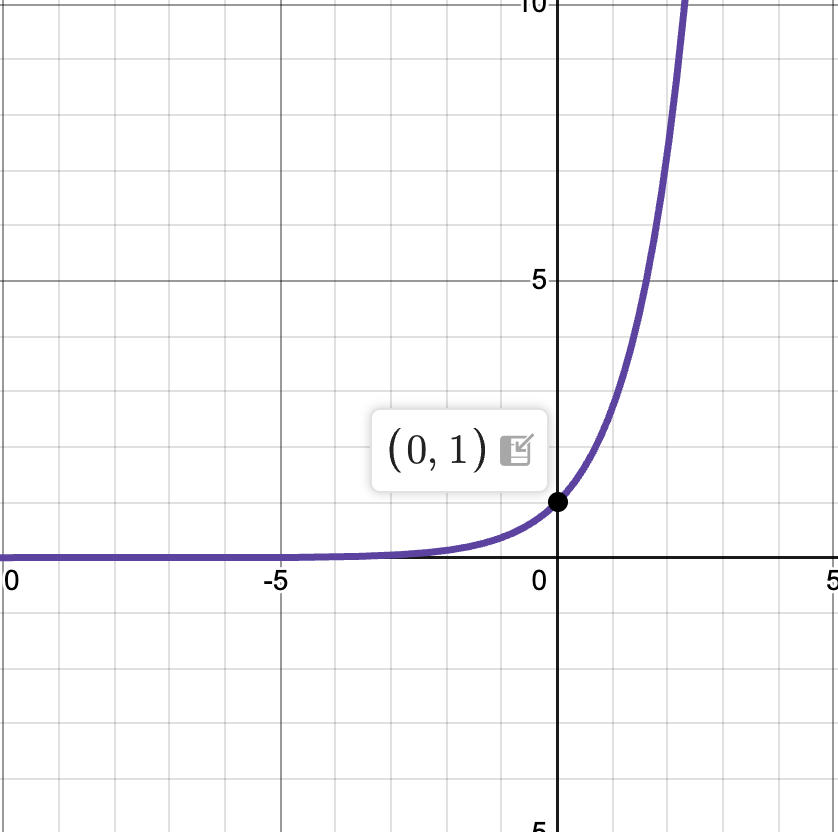
Sketch the graph of $y=e^x$.
17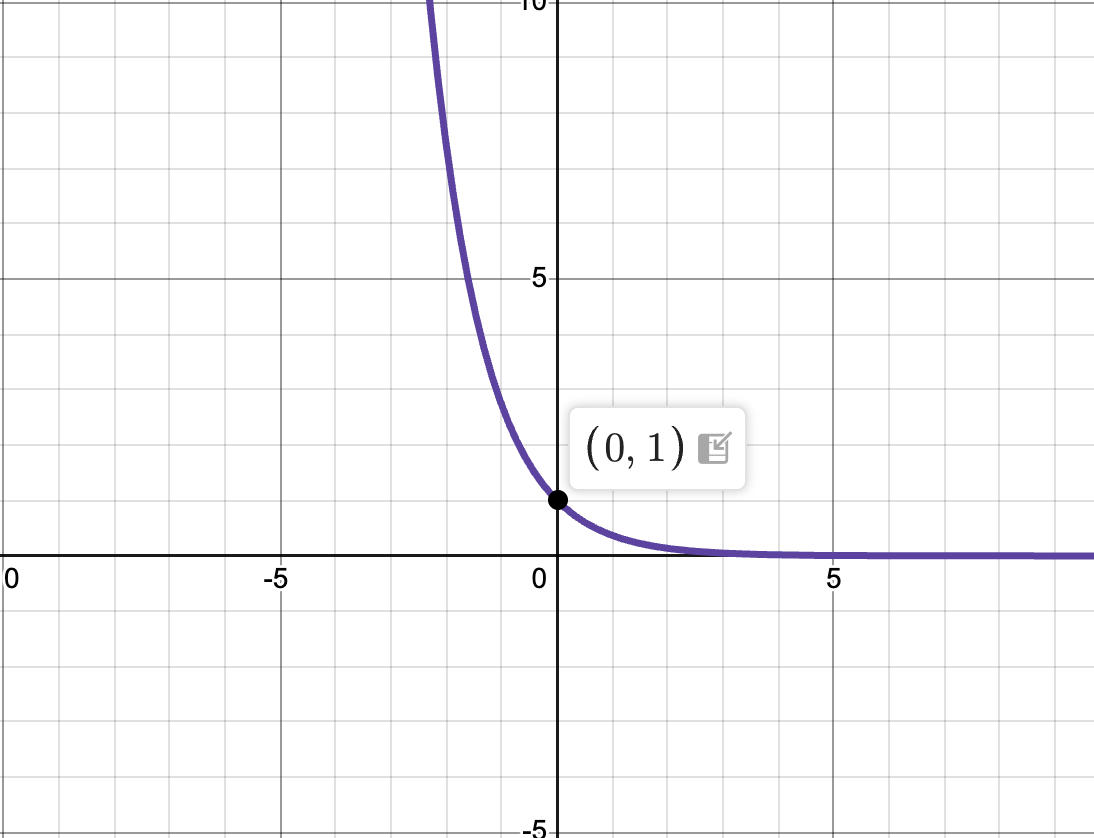
Sketch the graph of $y=e^{-x}$.
18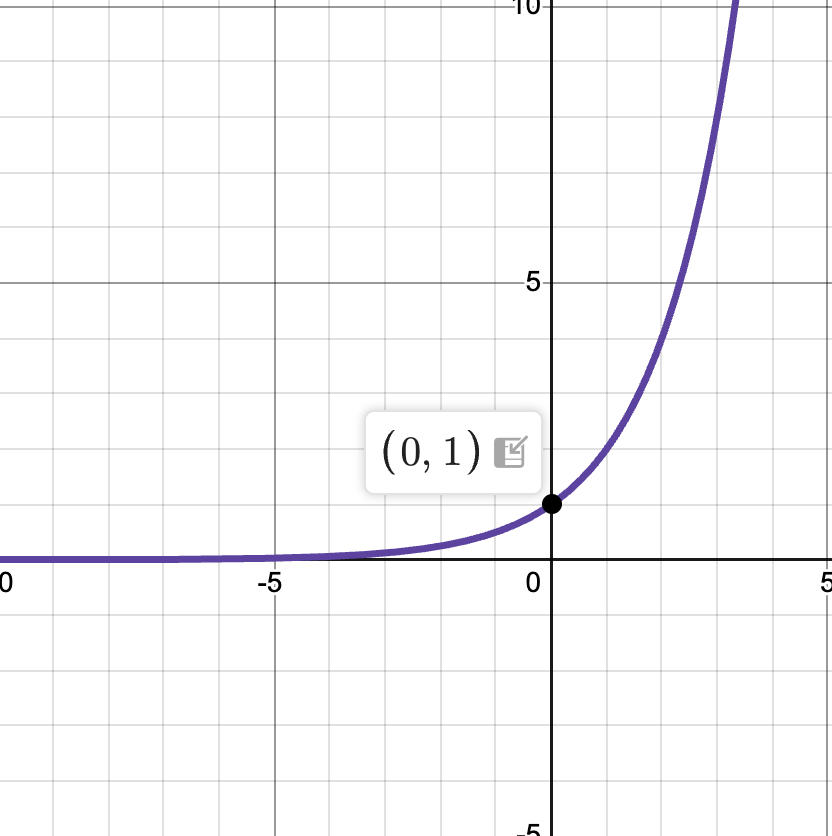
Sketch the graph of $y=2^x$.
19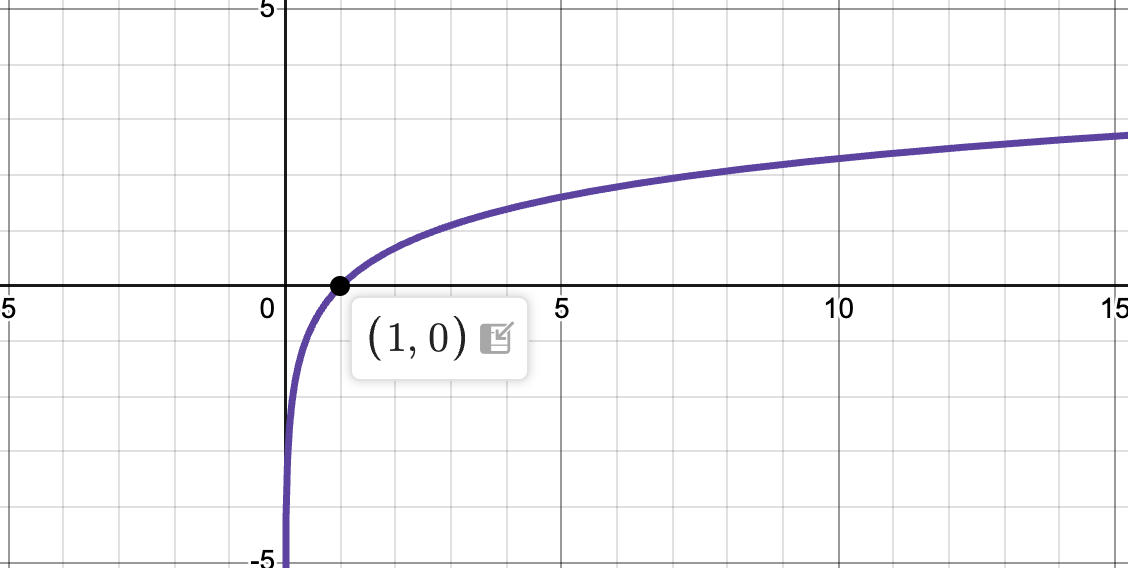
Sketch the graph of $y=\ln x$.
20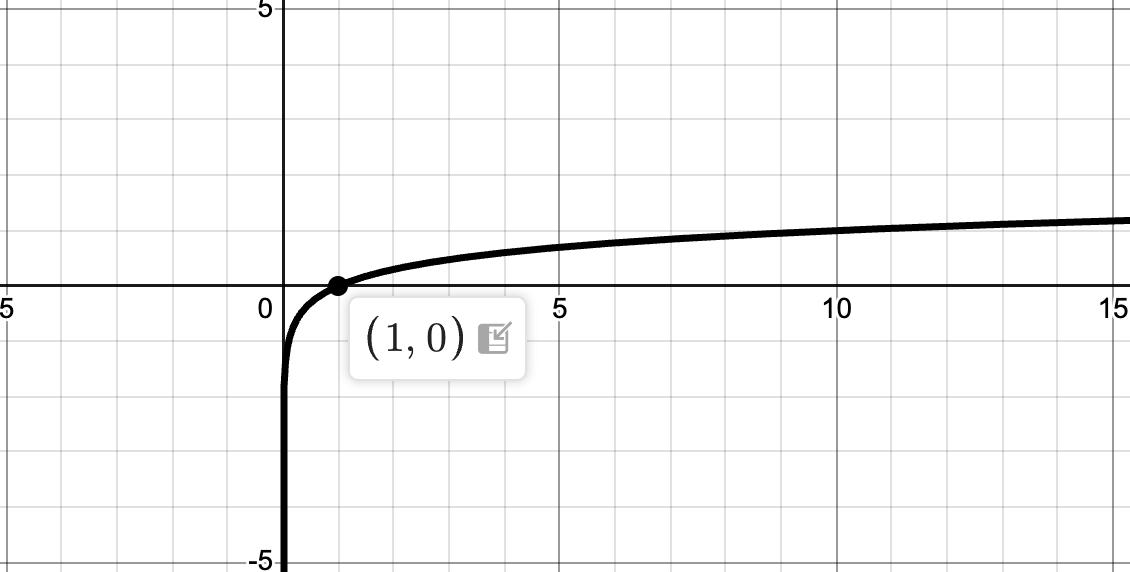
Sketch the graph of $y=\log_{10}x$.
21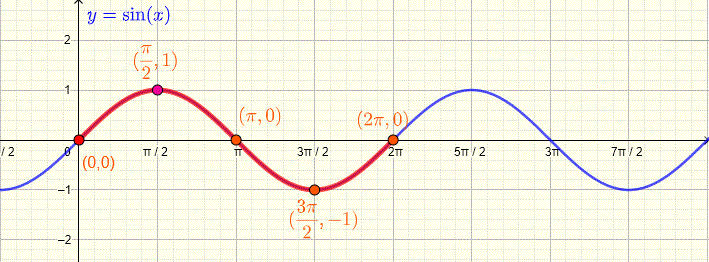
Sketch the graph of $y=\sin x$.
22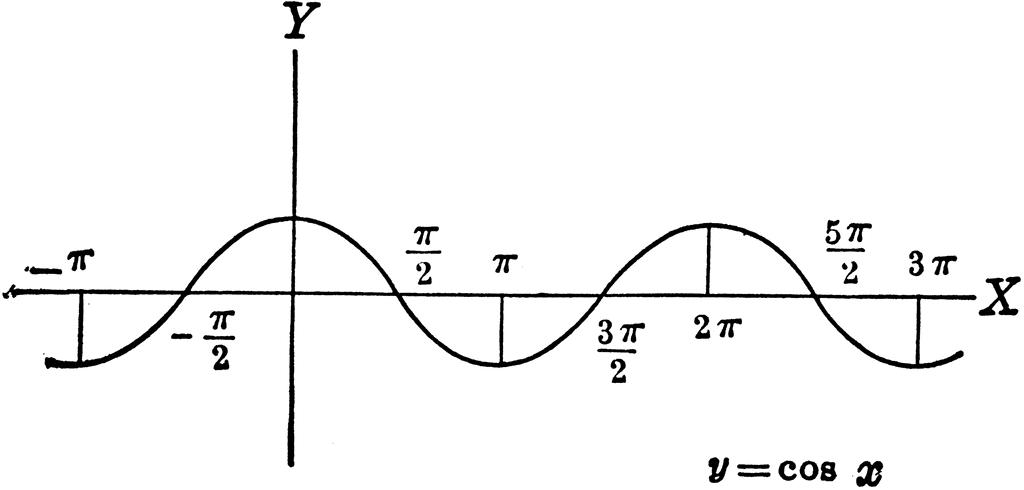
Sketch the graph of $y=\cos x$.
23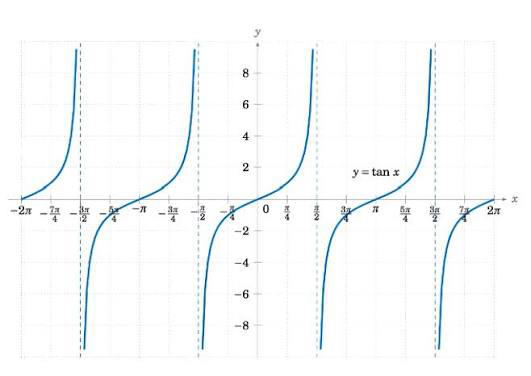
Sketch the graph of $y=\tan x$.
24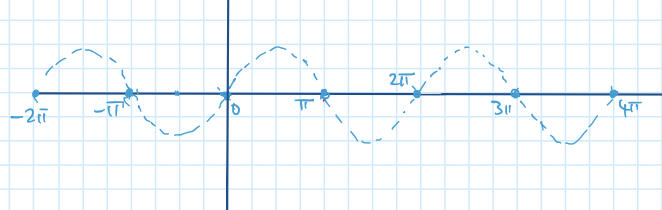
Sketch the graph of $y=\sec x$.
25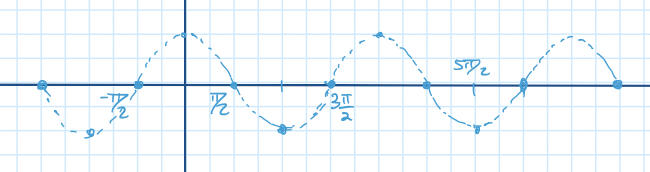
Sketch the graph of $y=\cosec x$.
26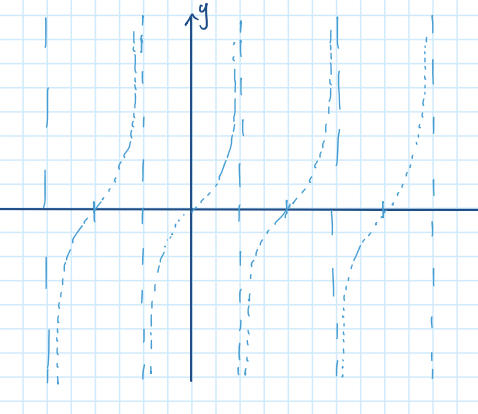
Sketch the graph of $y=\cot x$.
27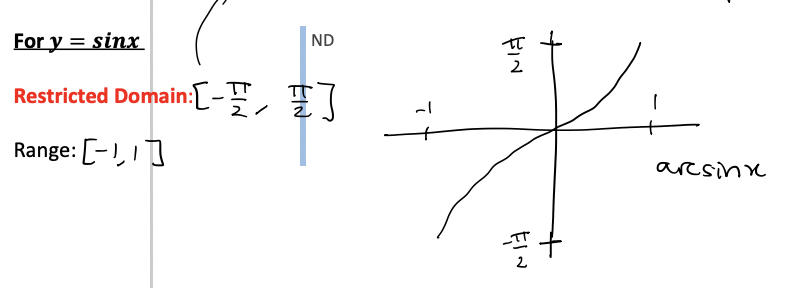
Sketch the graph of $y=\arcsin x$.
28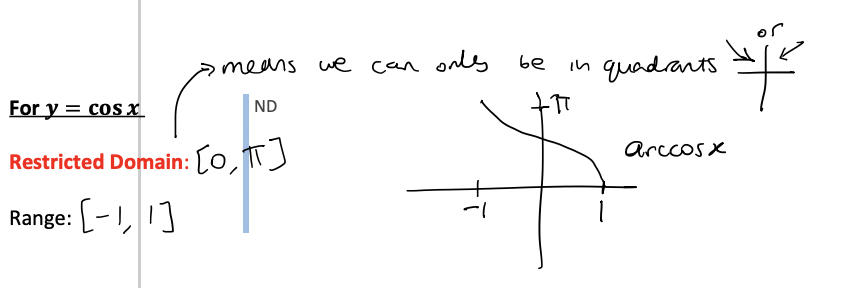
Sketch the graph of $y=\arccos x$.
29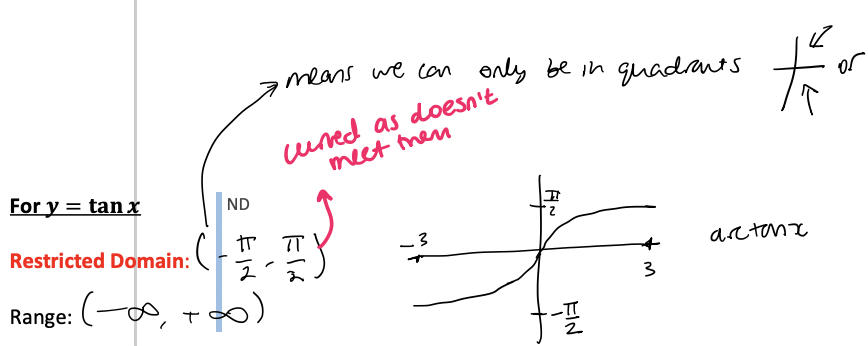
Sketch the graph of $y=\arctan x$.
30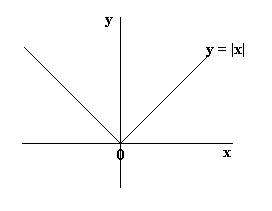
Sketch the graph of $y=|x|$.
31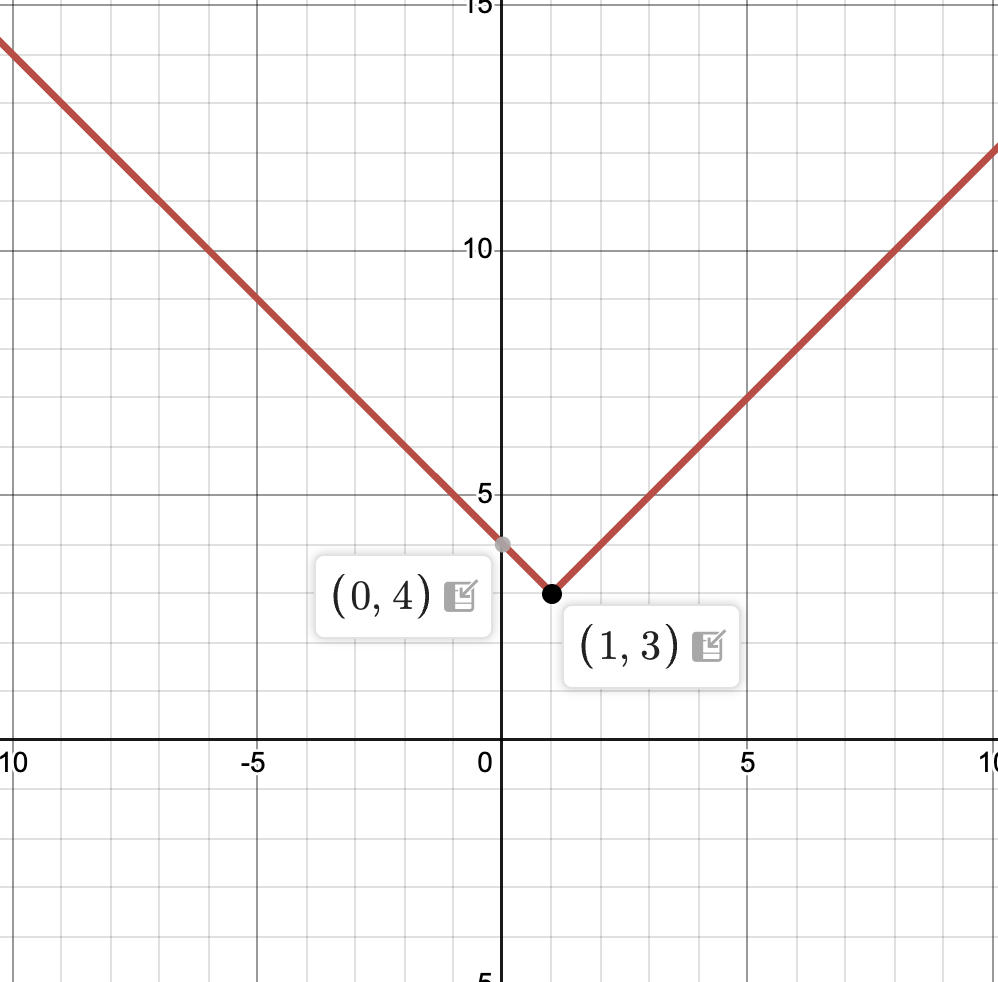
Sketch the graph of $y=\left|x-1\right|+3$.
32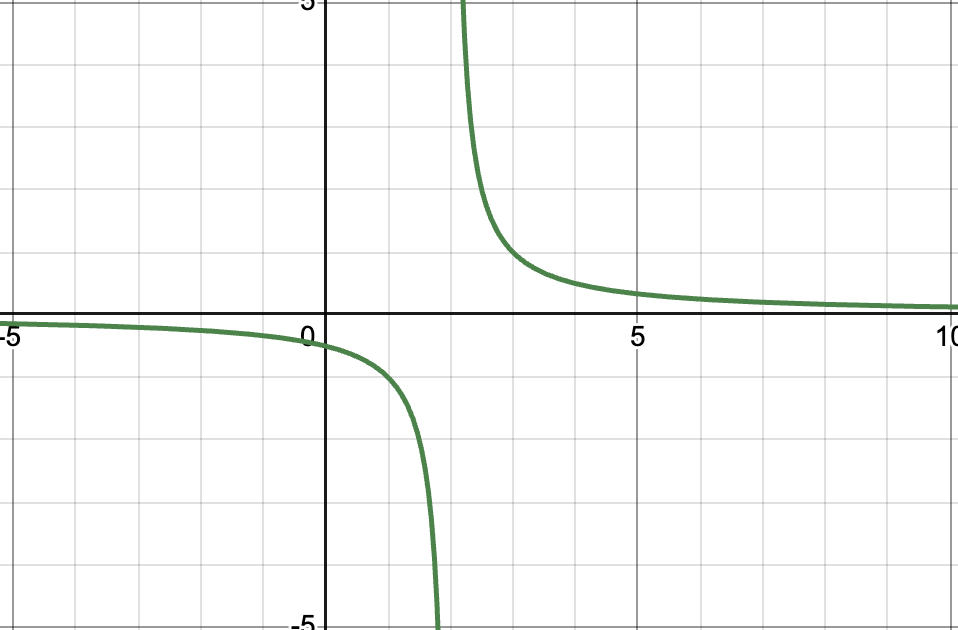
Sketch the graph of $y=\frac{1}{x-2}$.
33
Sketch the graph of $y=|x^2-4|$.
Keep everything above the x-axis unchanged. Reflect any part of the graph below the x-axis upwards.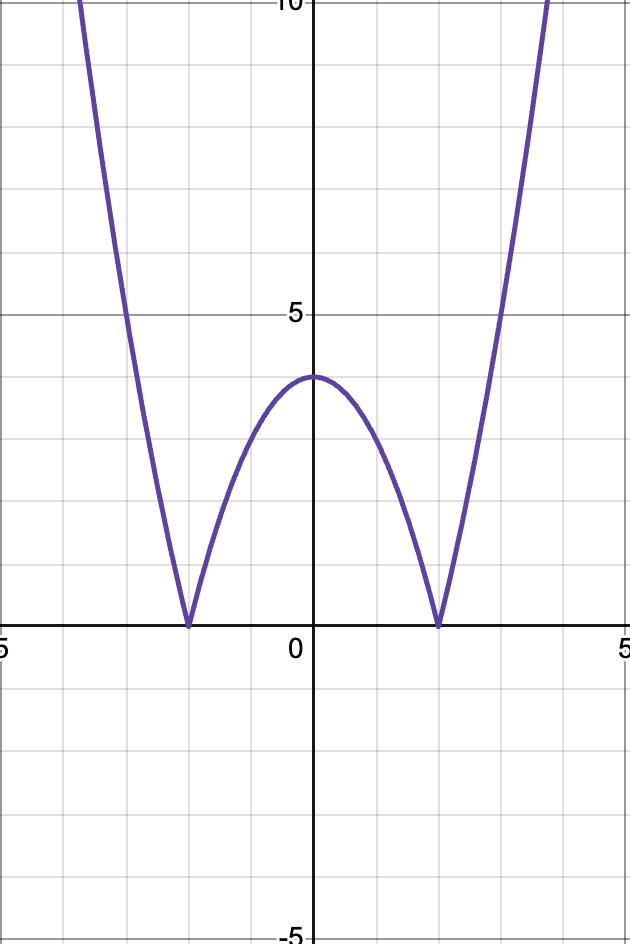
34
Sketch the graph of $y=(|x|-2)^2$.
Remove everything to the left of the y-axis, and reflect the right-hand side across the y-axis.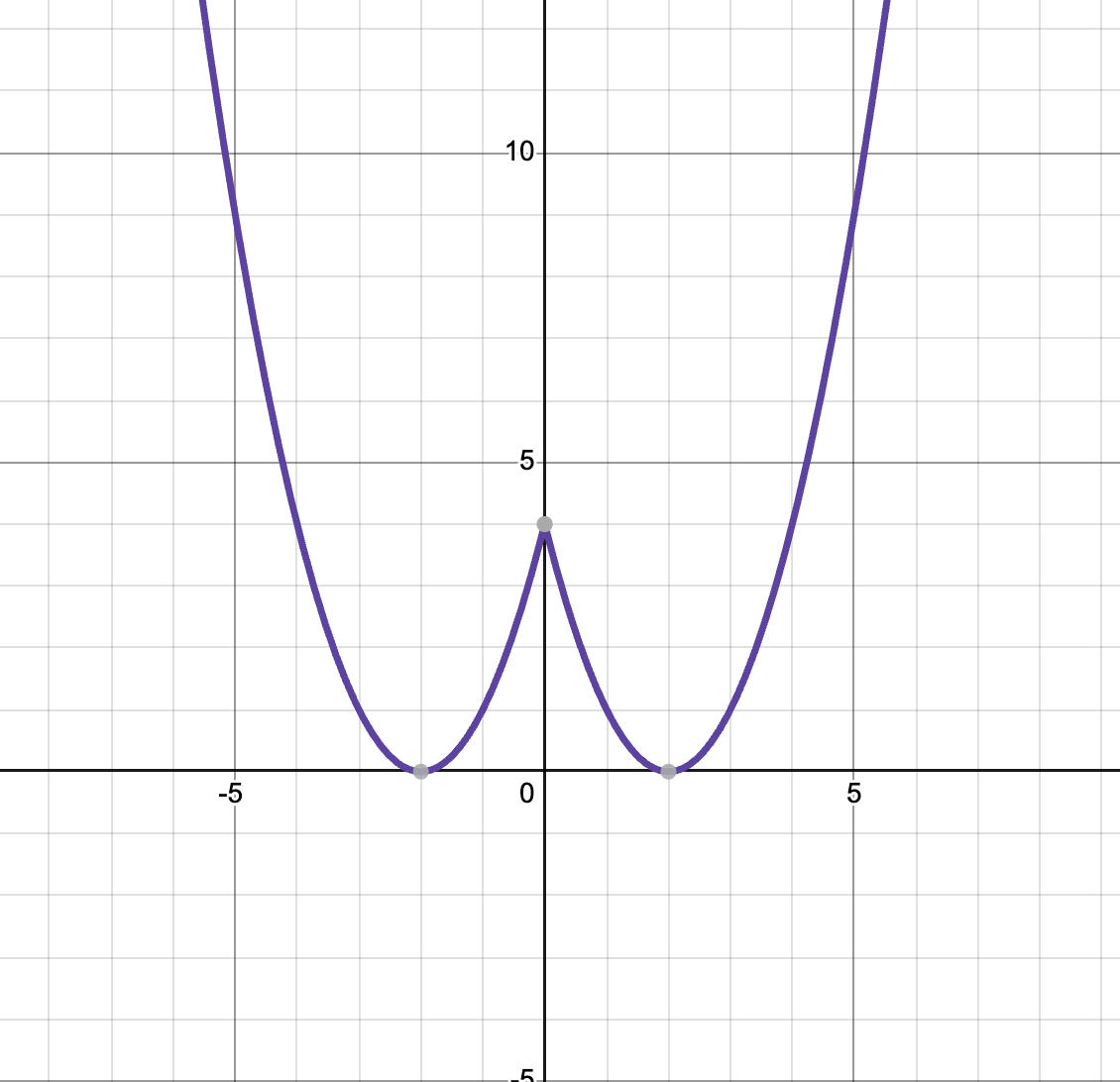
35
What is the formula for the volume of a sphere?
$V=\frac{4}{3}\pi r^3$
36
What is the formula for the surface area of a sphere?
$A=4\pi r^2$
37
What is the formula for the volume of a cylinder?
$V=\pi r^2h$
38
What is the formula for the total surface area of a closed cylinder?
$A=2\pi rh+2\pi r^2$
39
What is the formula for the volume of a cone?
$V=\frac{1}{3}\pi r^2h$
40
What is the formula for the volume of a pyramid?
$V=\frac{1}{3}\times\text{Base Area}\times h$
41
What is the formula for the volume of a pyramid with a triangular base?
$V=\frac{1}{3}\times\frac{1}{2}ab\times h$
42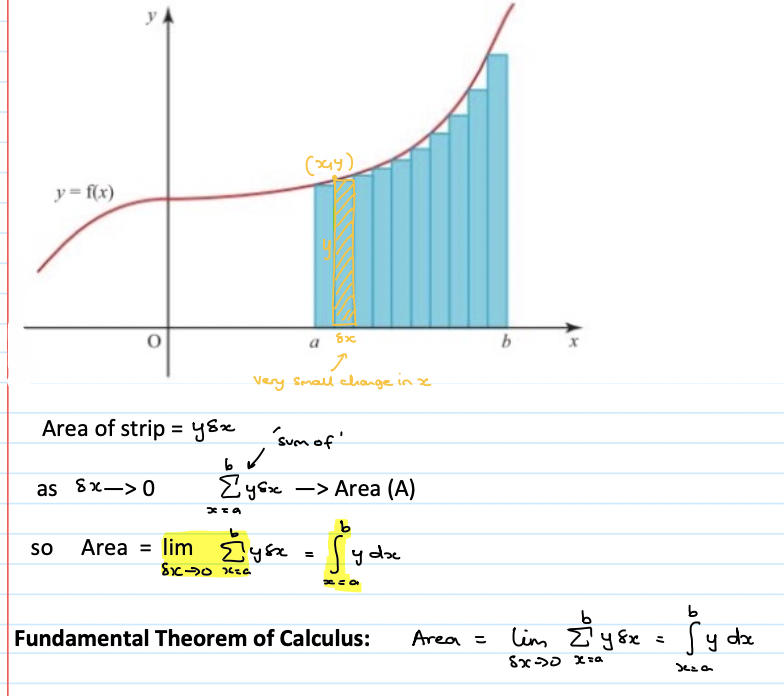
prove the fundamental theorem of calculus (area under a curve formula)
43
When do you use permutations vs combinations?
- Permutations: Order matters (arranging objects).
- Combinations: Order does NOT matter (selecting objects).
- Combinations: Order does NOT matter (selecting objects).
44
How do you calculate the number of ways to select people from different groups?
Calculate the combinations for each group, then multiply. eg. Choose 6 batters from 9, 4 bowlers from 8, and 1 wicket-keeper from 2. ${}^9C_6\times{}^8C_4\times{}^2C_1$
45
How do you convert a vector from component form into magnitude-direction (polar) form?
46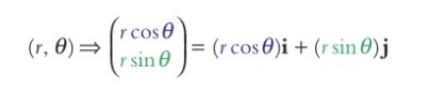
How do you convert a vector from magnitude-direction (polar) form into component form?
47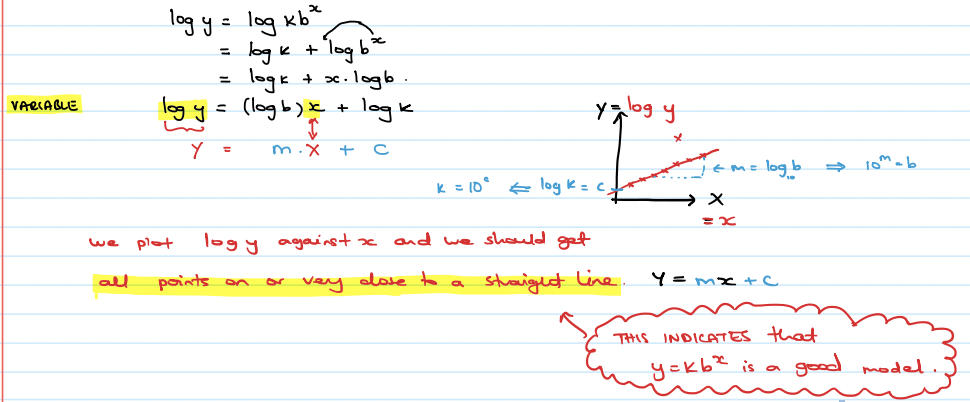
How do you linearise $y=kb^x$ using logarithms, and determine $k$ and $b$ from the straight-line graph?
48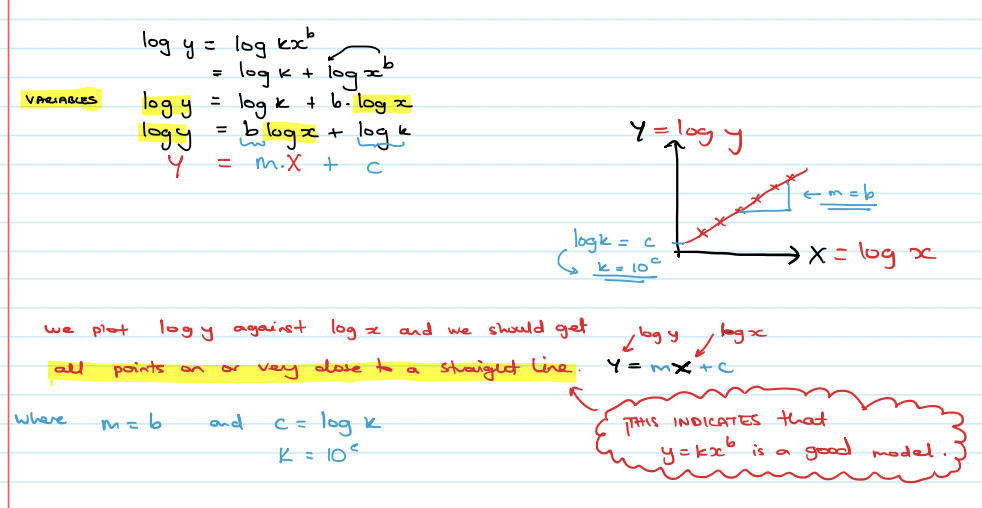
How do you linearise $y=kx^b$ using logarithms, and determine $k$ and $b$ from the straight-line graph?
49
What is the change of base formula for logarithms?
$\log_a b=\frac{\log_x b}{\log_x a}$
50
What is the formula for the arc length of a circle?
$s=r\theta$
51
What is the formula for the area of a sector of a circle?
$A=\frac{1}{2}r^2\theta$
52
How do you calculate the area of a minor segment of a circle?
Area of sector − Area of isosceles triangle = $A=\frac{1}{2}r^2(\theta-\sin\theta)$
53
When are the small-angle approximations valid to approximately 1% accuracy?
- $\sin\theta\approx\theta$: $|\theta|\lesssim0.2441$ radians
- $\tan\theta\approx\theta$: $|\theta|\lesssim0.1730$ radians
- $\cos\theta\approx1-\frac2$: $|\theta|\lesssim0.6620$ radians
- $\tan\theta\approx\theta$: $|\theta|\lesssim0.1730$ radians
- $\cos\theta\approx1-\frac2$: $|\theta|\lesssim0.6620$ radians
54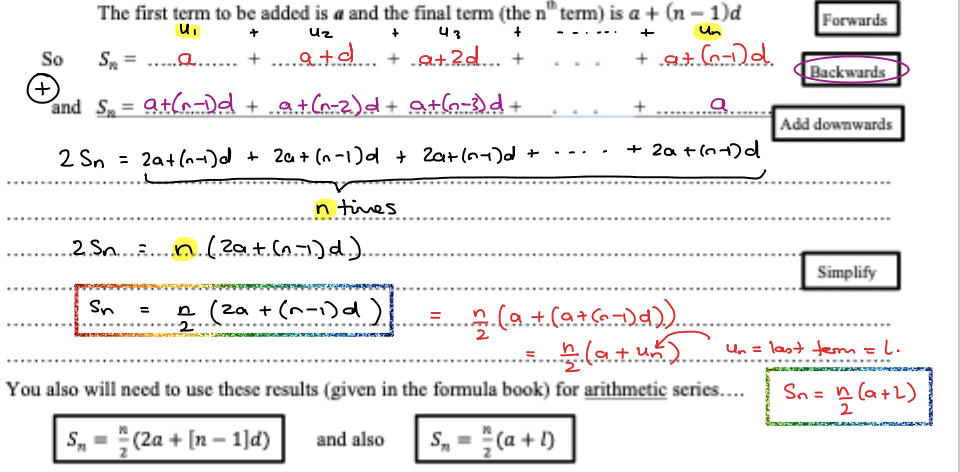
Prove the formula for the sum of an arithmetic sequence
55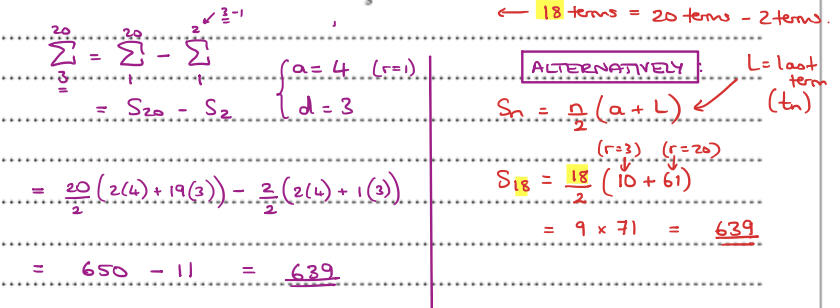
evaluate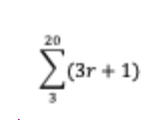
56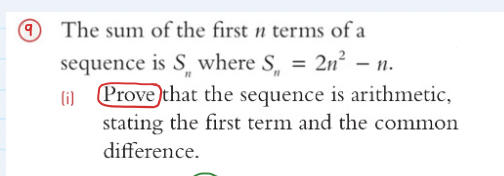
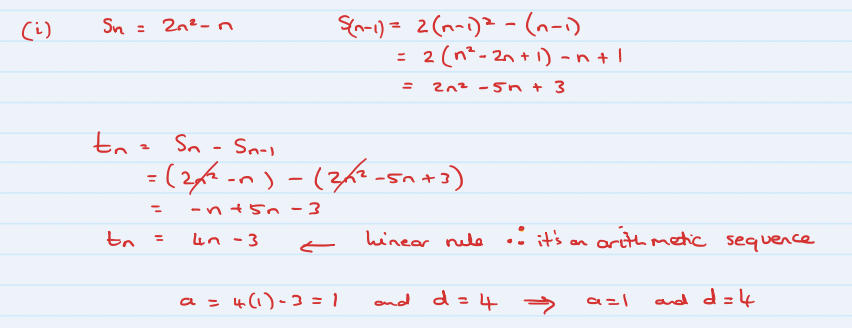
57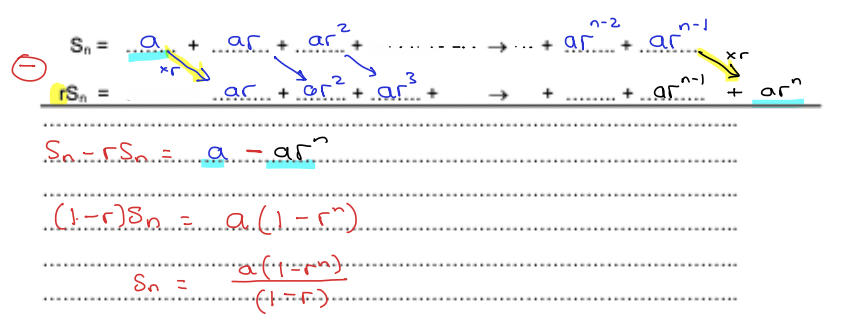
Prove the formula for the sum of a geometric sequence
58
What is the formula for the sum of the first $n$ terms of a geometric series when $r>1$?
$S_n=\frac{a(r^n-1)}{r-1}$
59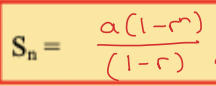
What is the formula for the sum of the first $n$ terms of a geometric series when $r<1$?
60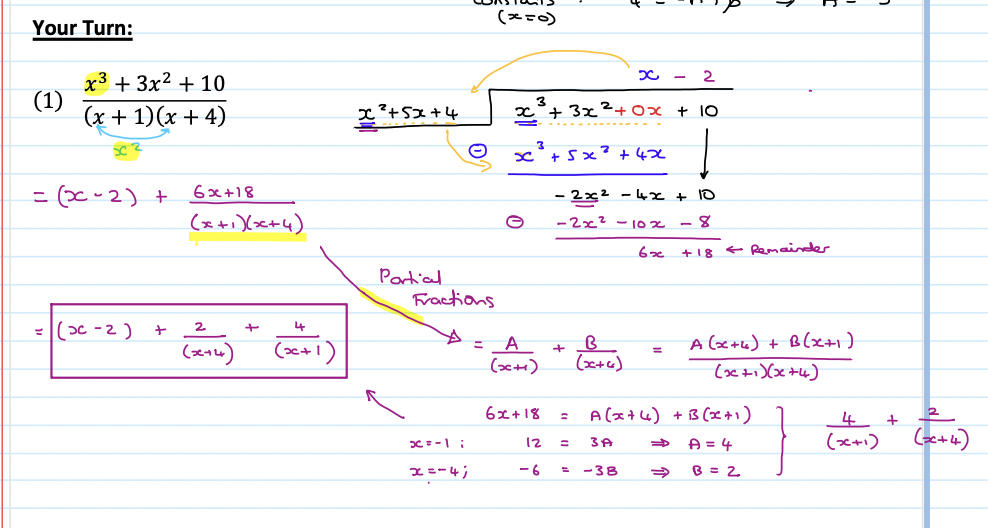
convert into partial fractions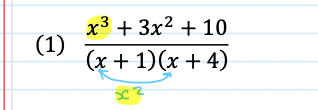
61
How do the degree and leading coefficient of a polynomial determine its end behaviour?
- Even + positive eg. x^4: Both ends UP.
- Even + negative eg. -x^4 : Both ends DOWN.
- Odd + positive: Left DOWN, right UP.
- Odd + negative: Left UP, right DOWN.
- Even + negative eg. -x^4 : Both ends DOWN.
- Odd + positive: Left DOWN, right UP.
- Odd + negative: Left UP, right DOWN.
62
What is the minimum number of turning points for even- and odd-degree polynomials?
- Even degree: Minimum 1 turning point.
- Odd degree: Minimum 0 turning points.
- Odd degree: Minimum 0 turning points.
63
How do you solve a modulus equation of the form $|A|=B$?
Split into two equations $A=B\quad\text{or}\quad A=-B$ then solve for both.
64
How do you solve a modulus inequality of the form $|A|>B$?
65
How do you solve a modulus inequality of the form $|A|<B$?
$A<-B\quad\text{or}\quad A>B$
66
How do you solve a modulus equation of the form $|A|=|B|$?
Either square both sides or write: $A=B\quad\text{or}\quad A=-B$
More Maths flashcards
Medical Unit Conversions and FormulasMaths · EnglishhikaruMotion and forcesMaths · EnglishesmeeCIMA FormulaMaths · EnglishEllaStatistical TestingMaths · EnglishHenzoC1 - C2 - C3 - C4 - C5Maths · FrenchQuentinMatrices and DeterminantsMaths · EnglishPascual,Espaces vectorielsMaths · FrenchLaraThéorèmes / Propositions / Propriétés / CorollairesMathsPiouSomma con lo zeroMaths · Italianan OutLearn studentFormularium - RendabiliteitMaths · DutchAurélieFormularium - SolvabiliteitMaths · DutchAurélieCalculations and FormulaeMaths · EnglishDsobo
Study these decks in the app
Free on iPhone, Android, Mac and the web. Add any deck to your account in one tap.

