Structure and growth of living organisms
Diese Karteikarten lernenKostenlos · Spaced Repetition · iPhone, Android, Mac & Web
Alle Karten
1
prokaryotes vs eukaryotes
prokaryotes are single celled organisms that lack the nucleous, eukaryotes are organisms with a nucleous
2
The cells of multicellular animals and
plants have several things in common: in each cell is a nucleus
where nucleic acids such as ___1___ are concentrated. In the
surrounding material, termed ____2____, there are organelles —
structures with particular functions, like ____3____, where
many of the reactions of respiration take place, and chloroplasts in
plants which are responsible for photosynthesis.
DNA, cytoplasm, mitochondria. The image is of a plant eukaryote cell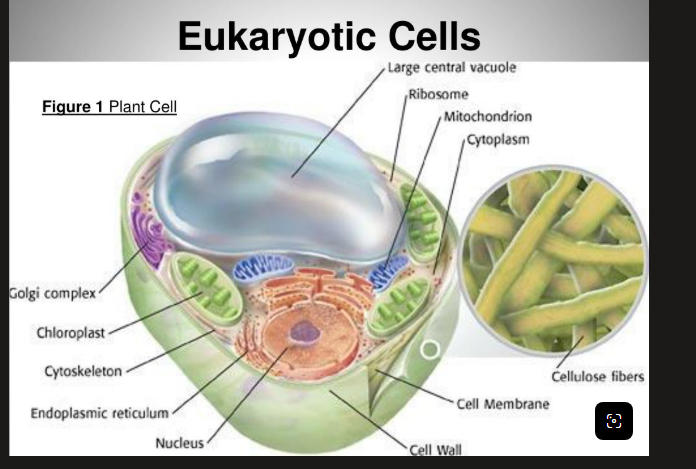
3
2 types of prokaryotes are
Bactertia and Archaea.
4
Theory on how the first eukaryote was evolved
It’s likely that the first eukaryote evolved from a member of the Archaea
which began to live in conjunction with bacteria in a cooperative relationship called symbiosis. Eventually the archaea engulfed the
bacteria. The included bacteria became organelles like mitochondria and chloroplasts in the cytoplasm of the resulting eukaryote.
which began to live in conjunction with bacteria in a cooperative relationship called symbiosis. Eventually the archaea engulfed the
bacteria. The included bacteria became organelles like mitochondria and chloroplasts in the cytoplasm of the resulting eukaryote.
5
Eukaryotes are divided into 2 sections
Unicellular eukaryotes also known as protists
and multicellular eukaryotes that include all the larger animals and plants that we as humans are familiar with
and multicellular eukaryotes that include all the larger animals and plants that we as humans are familiar with
6
How do unicellular eukaryotes reproduce. Explain in moderate detail
If it is through cell division, the genetic material gets copied from the nucleic acid and the copies are distributed to 2 parts of the dividing cell. Known as mitosis. If it is sexual reproduction 2 cells share half of their DNA each to form a new cell. (the cell division requried to split the DNA into 2 halves is called meiosis.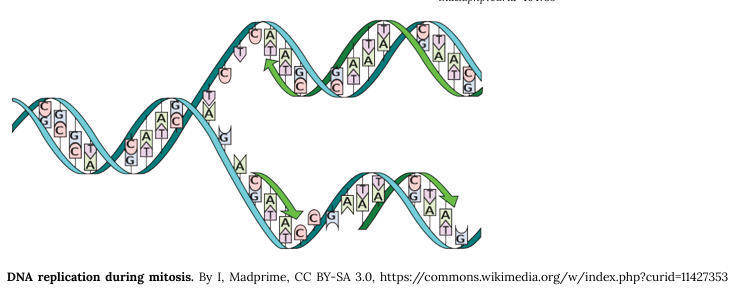
7
Amino acids are linked together in chains by carbon-nitrogen _______ bonds
peptide bonds
8
how are disulfide bonds important for protein structure and how are they formed
some amino acids contain sulfur, allowing the amino acids to bond with themselves. Thereby changing the shape of the protein. 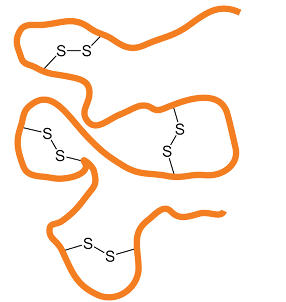
9
Are nucleic acids found in both prokaryotes and eukaryotes?
Yes, it is what allows prokaryotes to reproduce. Nucleic acids, as their name implies, are concentrated in the nuclei of eukaryotic cells, but they are found in prokaryotes too. Two
types of nucleic acid are important in the building of proteins and in reproduction of cells
types of nucleic acid are important in the building of proteins and in reproduction of cells
10
How DNA transcription and translation works in general
polymerase goes along and reads the DNA strand attaching a mRNA (messenger RNA) strand to it. And then from the nucleus this mRNA will go to the ribosome for translation. Then for every 3 mRNA letters, a codon gets formed where the amino acid for that codon will get binded with the next codon. Therby creating a protein chain.
11
More complex lipids molecules that involve the element
phosphorus (P), called phospholipids, have one end that repels
water (hydrophobic) but the other end of the molecule is polar,
and attracts water (hydrophilic). Phospholipids combine with
proteins to make ______– the thin layers of organic
molecules that enclose cells and organelles. The combination
of polar and non-polar materials helps to control the flow of
other substances in and out of cells.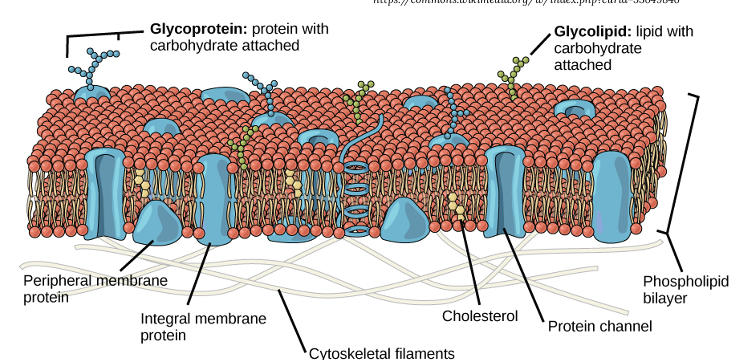
phosphorus (P), called phospholipids, have one end that repels
water (hydrophobic) but the other end of the molecule is polar,
and attracts water (hydrophilic). Phospholipids combine with
proteins to make ______– the thin layers of organic
molecules that enclose cells and organelles. The combination
of polar and non-polar materials helps to control the flow of
other substances in and out of cells.
membraines
12
How archaea were first recognizes as a distinct group from bacteria (with respect to lipids)
Their phospholipid molecules have a barnched strutured that is different from other organisms 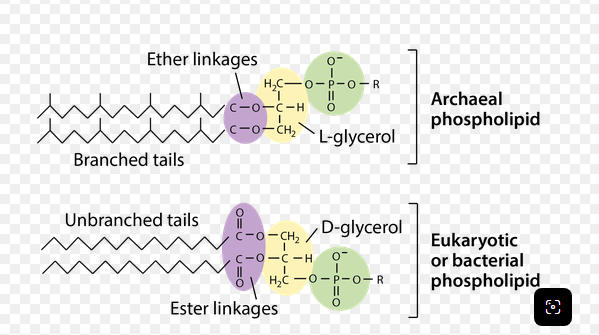
Mehr Karteikarten: Naturwissenschaften
Biology: Mitosis and Cellular RespirationNaturwissenschaften · EnglischKanav2.5 Biological Membranes ✓Naturwissenschaften · EnglischIzzyOrganic ChemistryNaturwissenschaften · EnglischRobertChemical Ions and ValencyNaturwissenschaften · LateinLydiaapes unit 2Naturwissenschaften · EnglischAMaqHESC CH INaturwissenschaften · EnglischChristopherBiology and Chemistry: Proteins, ATP, and EnthalpyNaturwissenschaften · EnglischDryLaundryModule 2: Coulombkracht en elektrisch veldNaturwissenschaften · NiederländischYaniSalts and solubilitiesNaturwissenschaften · EnglischAli_vxxxFood ProductionNaturwissenschaften · EnglischAli_vxxxCarbohydrates 2Naturwissenschaften · EnglischLogancommon acidsNaturwissenschaften · EnglischLydia
Alle Decks: Naturwissenschaften
Lerne diese Decks in der App
Kostenlos auf iPhone, Android, Mac und im Web. Füge jedes Deck mit einem Tipp zu deinem Konto hinzu.

