Hemostasis and Bleeding Disorders
Diese Karteikarten lernenKostenlos · Spaced Repetition · iPhone, Android, Mac & Web
Alle Karten
1
Which hemostatic components are defective in a primary hemostatic defect?
Platelet numbers, platelet function, vWF, or endothelium
2
Which component is defective in a secondary hemostatic defect?
Coagulation factors
3
What are the five parts of the initial assessment of a bleeding patient?
History, signalment, physical exam, screening tests, and differentiating primary vs. secondary disorder
4
What bleeding pattern suggests a primary hemostatic defect?
Pinpoint mucosal surface bleeding (petechiae, ecchymoses, epistaxis, melena), scleral hemorrhage
5
What are the four causes of a primary hemostatic defect?
Thrombocytopenia, thrombopathia (abnormal platelet function), vWD, vasculopathy (disorder)
6
What bleeding pattern suggests a secondary hemostatic defect?
High-volume bleeding: cavitary hemorrhage (hemoabdomen, hemothorax, hemoarthrosis) and large hematomas
7
What is hemarthrosis?
Bleeding into a joint
8
What disorders cause secondary hemostatic defects?
Coagulation cascade disorders
9
What are the three lab tests for primary hemostasis?
Platelet metrics, BMBT, vWF testing
10
What does a platelet count measure, and on what sample is it performed?
Platelet numbers, on EDTA anticoagulated blood
11
What is thrombocytopenia?
Decreased platelet count
12
What is thrombocytosis?
Increased platelet count
13
How does platelet clumping affect the platelet count?
Artifactually decreases it
14
How does platelet clumping affect MPV?
Artifactually increases it
15
What is pseudothrombocytopenia?
Falsely low platelet count due to platelet clumping
16
Which species commonly show platelet clumping?
Cats and horses
17
Which anticoagulant gives an accurate platelet count in cats and horses?
Citrate
18
Where are platelet clumps often found on a smear?
Along the feathered edge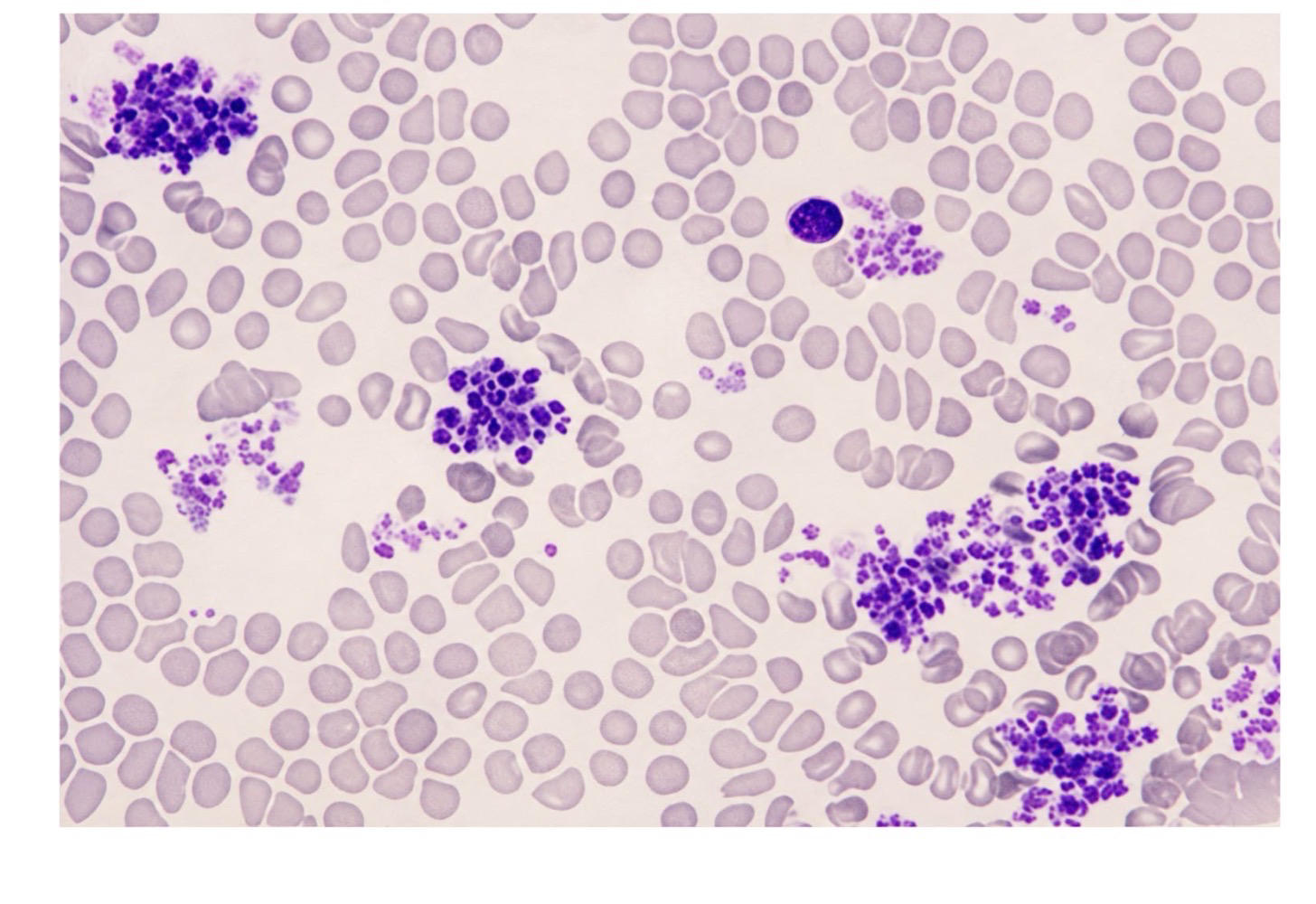
19
At what magnification is a platelet estimate performed?
1000x (oil immersion)
20
What is the platelet estimate formula?
Average PLTs x 20,000 = estimated platelet count
21
What is the estimated count if there are 7 platelets per 1000x field? 20,000 plt/ ul in a 20um
140,000 plt/µL
22
What is mean platelet volume (MPV)?
Average platelet size measured by hematology analyzer
23
What are macroplatelets?
Larger platelets seen on blood smear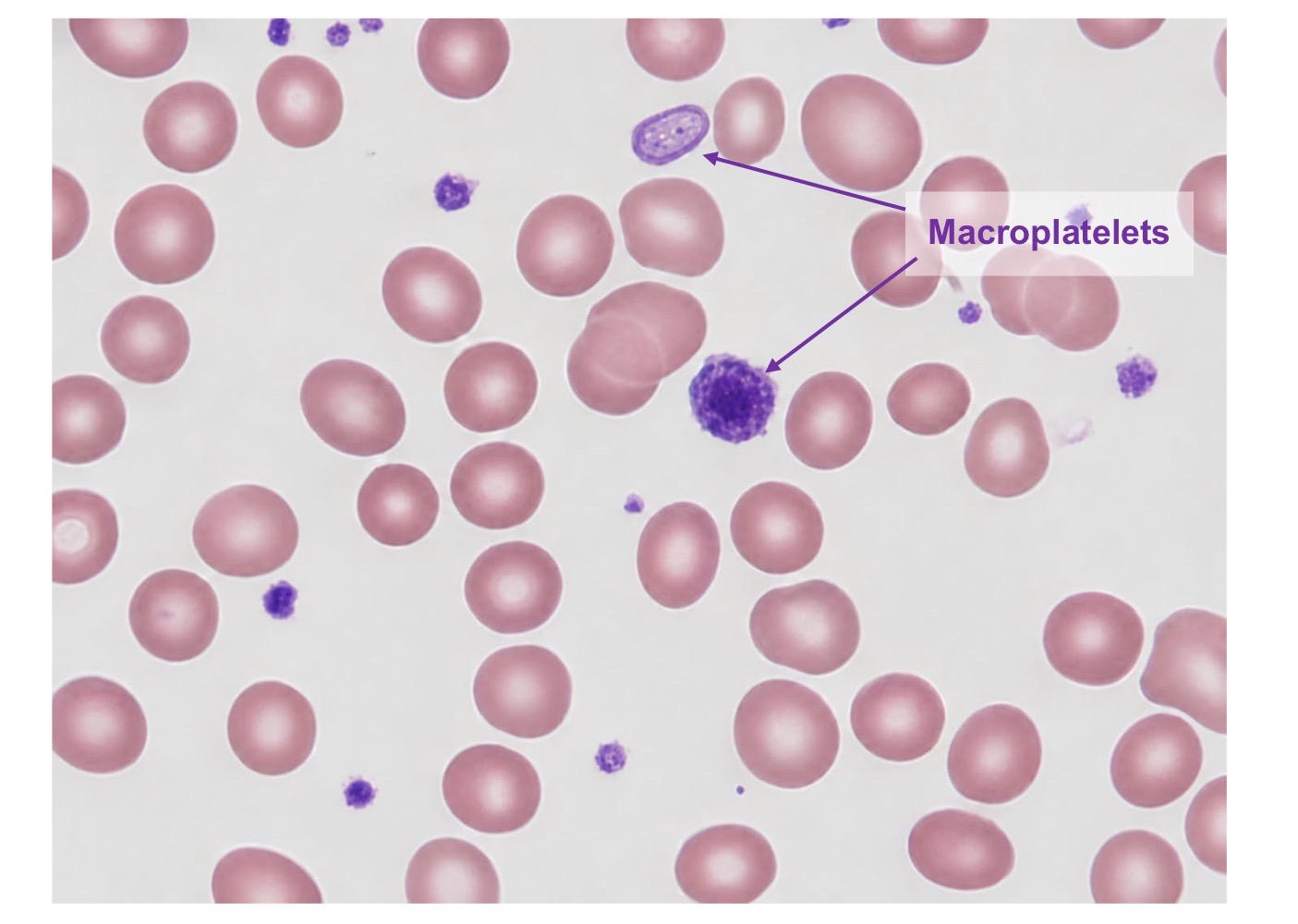
24
What does increased MPV in a thrombocytopenic patient indicate?
Regenerative thrombocytopenia
25
Why are younger platelets larger?
Large platelets indicate the marrow is making new platelets
26
What causes congenital macrothrombocytopenia?
Mutation in beta-tubulin 1 resulting in having low numbers of gigantic platelets
27
Which breed is most commonly affected by congenital macrothrombocytopenia?
Cavalier King Charles Spaniel
28
Does congenital macrothrombocytopenia cause bleeding?
No, large platelets compensate for the low count
29
What is plateletcrit (PCT)?
Proportion of whole blood occupied by platelets (like HCT for RBCs), represents platelet mass
30
What are PLT count and PCT in congenital macrothrombocytopenia?
Low PLT count, normal PCT
31
What does buccal mucosal bleeding time (BMBT) assess?
All aspects of primary hemostasis
“A small cut is made in the cheek (buccal mucosa) and you time how long it bleeds.”
“A small cut is made in the cheek (buccal mucosa) and you time how long it bleeds.”
32
What is the normal BMBT in most species?
<4 minutes
33
What does vWF:Ag measure?
Patient vWF amount vs. healthy dog pool by ELISA (% of normal)
“is the key test. It's an ELISA comparing the patient's vWF to a pooled healthy dog sample. The result is a % of normal”
“is the key test. It's an ELISA comparing the patient's vWF to a pooled healthy dog sample. The result is a % of normal”
34
What canine vWF:Ag range is normal?
What canine vWF:Ag range indicates vWD?
What vWF:Ag level puts a dog at risk of hemorrhage? EXAM
What canine vWF:Ag range indicates vWD?
What vWF:Ag level puts a dog at risk of hemorrhage? EXAM
70-180%
0-49%
<35%
0-49%
<35%
35
What is von Willebrand disease?
Problem with vWF quantity or functionality
“vWD is a problem with vWF quantity or function (remember vWF is what GPIb on platelets sticks to”
“vWD is a problem with vWF quantity or function (remember vWF is what GPIb on platelets sticks to”
36
What defines type I vWD?
Decreased (but present) vWF, most common
- Doberman pinchers
- Doberman pinchers
37
What defines type II vWD?
Inadequate vWF multimers, rare
“vWF is there but the long, active chains are missing“
“vWF is there but the long, active chains are missing“
38
What defines type III vWD?
Complete absence of vWF
- Scotty dogs
- Scotty dogs
39
What are the four mechanisms of thrombocytopenia?
Consumption, destruction, sequestration (holding them away), decreased production
40
What is increased platelet consumption?
Platelets used faster than they can be produced
41
What are causes of platelet consumption?
Severe trauma, vasculitis, DIC, sepsis, viper envenomation
42
What are causes of increased platelet destruction?
ITP (immune thrombocytopenia), tick-vector infections, neoplasia (hemophagocytic histiocytic sarcoma)
43
What is the most common cause of extreme thrombocytopenia (<50,000/µL) in dogs?
Immune thrombocytopenia (ITP)
44
What is platelet sequestration?
Platelets stored outside laminar blood flow
45
What are causes of platelet sequestration?
Splenic dilation (resting, anesthesia, neoplasia), hypothermia (platelets rest along vessel wall), pulmonary congestion (sepsis)
46
Does sequestration cause spontaneous hemorrhage?
Never; mild thrombocytopenia with normal MPV
47
What are causes of decreased platelet production?
Bone marrow disorders; Medications, infections, myelophthisis, leukemia, immune destruction of megakaryocytes
48
What is the MPV in decreased platelet production?
Normal, as marrow cannot make new platelets
49
Which mechanisms of thrombocytopenia can be regenerative (↑ MPV)?
Consumption and destruction
50
What platelet count causes spontaneous hemorrhage?
<20,000/µL
51
What platelet count causes excessive surgical bleeding?
<50,000/µL
52
What is thrombopathia? What is the most common type of thrombopathia?
1. Inherited or acquired platelet dysfunction
2. acquired
2. acquired
53
What are causes of acquired thrombopathia?
Aspirin, clopidogrel, uremic acids/ketoacids, hypergammaglobulinemia
54
What are the five major mechanisms of thrombocytosis?
Excitation (epinephrine response with splenic contraction), inflammation, drug-induced, iron deficiency anemia, neoplasia
“red is most common”
“red is most common”
55
Which drug commonly causes thrombocytosis?
Chronic corticosteroid therapy
56
Which species normally have 2-3x more platelets?
Ruminants and mice
Mehr Karteikarten: Medizin und Gesundheit
Drug Cards: Carisoprodol and Other MedicationsMedizin und Gesundheit · Englischkay24ALL powerpoint questions for pharm finalMedizin und Gesundheit · EnglischMatthewWeek One quizMedizin und Gesundheit · EnglischAlyssacirculatory system 2Medizin und Gesundheit · Englischbeaweek 2 104 MedlistMedizin und Gesundheit · EnglischkjUNIT 1 PATHFITMedizin und Gesundheit · EnglischTolentino,#4 - Classification SystemsMedizin und Gesundheit · EnglischagrawrockLecture 3 - Thrombophilia Medizin und Gesundheit · EnglischkarebearSkeletal Muscle Anatomy and PhysiologyMedizin und Gesundheit · EnglischLucieDental Radiology: CDT Codes and AnatomyMedizin und Gesundheit · EnglischEmmaSynovial Fluid and ArthrocentesisMedizin und Gesundheit · EnglischCHRISTYCalcium and Phosphate Metabolism Medizin und Gesundheit · Englischfaith
Alle Decks: Medizin und Gesundheit
Lerne diese Decks in der App
Kostenlos auf iPhone, Android, Mac und im Web. Füge jedes Deck mit einem Tipp zu deinem Konto hinzu.

