Veterinary Pharmacology Basics
Diese Karteikarten lernenKostenlos · Spaced Repetition · iPhone, Android, Mac & Web
Alle Karten
1
What is pharmacology?
The study of drug properties, actions, absorption, and fate in the body.
2
Why is species-specific drug behavior important?
Different species may process and respond to the same drug differently.
3
What interactions must veterinarians consider when prescribing drugs?
Drug-drug, drug-diet, and drug-environment interactions.
4
How does pharmacogenomic variation affect drug responses?
Genetic differences can alter drug metabolism or effects.
5
How does the FDA define a drug?
A substance intended to diagnose, prevent, treat, or mitigate disease or affect body structure or function.
6
What is a drug product?
A finished dosage form containing a drug substance, with or without other ingredients.
7
What is a pioneer (legend) drug?
An original drug with demonstrated safety and efficacy manufactured under GMP. FDA approved
8
What is a generic drug?
A drug bioequivalent to a brand-name drug and manufactured under GMP. FDA approved
9
The drug category that is not FDA-approved?
Compounded drugs
10
What 6 major factors are evaluated during veterinary drug approval?
Manufacturing, chemistry, animal safety, efficacy, food safety, and environmental considerations.
11
What is drug compounding?
Manipulating drugs to create a preparation that differs from the starting materials.
12
A 1000-lb horse needs 0.5 mg/lb of a 100 mg/mL drug. What volume is needed?
5 mL (500 mg divided by 100 mg/mL).
13
What is toxicology?
The study of poisons, their properties, biological effects, and treatment of poisoning.
14
What is toxicosis?
A disease state resulting from exposure to a toxicant; poisoning.
15
What is a toxicant?
Any agent capable of producing a harmful biological response.
16
What distinguishes a toxin from a toxicant?
A toxin originates from a living organism; a toxicant is any poisonous agent.
17
What fundamental toxicology principle did Paracelsus establish?
The dose determines whether a substance acts as a poison or remedy.
18
Why are pharmacology and toxicology closely related?
What is the main difference between pharmacology and toxicology? EXAM
What is the main difference between pharmacology and toxicology? EXAM
1. Both study chemical effects on organisms at different ends of the dose-response spectrum.
2. Pharmacology emphasizes beneficial effects; toxicology emphasizes harmful effects.
2. Pharmacology emphasizes beneficial effects; toxicology emphasizes harmful effects.
19
What is the lethal dose (LD)?
The lowest dose that causes death.
20
What is the LD50? EXAM
The dose that causes death in 50% of test animals during an observation period.
21
What is the ED50? EXAM
The dose producing a response in 50% of subjects or a 50% graded response.
Effective Dose at 50%.
Effective Dose at 50%.
22
How is the therapeutic index (TI) calculated?
Why is a higher therapeutic index generally preferred? EXAM
Why is a higher therapeutic index generally preferred? EXAM
“an estimate that characterizes the relative safety of a drug/chemcial”
1. TI = LD50 / ED50.
2. It indicates greater separation between effective and lethal doses.
1. TI = LD50 / ED50.
2. It indicates greater separation between effective and lethal doses.
23
What is the EC50?
The drug concentration required to produce 50% of the maximum effect.
24
What are two purposes of establishing a dose-response relationship?
Establish causality and identify the lowest dose producing a detectable effect.
25
What three assumptions underlie dose-response relationships?
Drug interaction at a site; site concentration determines response; site concentration relates to dose.
26
What is the threshold dose?
The lowest dose at which a given effect becomes detectable.
27
What generally happens to toxicity as dose increases?
The percentage of individuals with toxic effects increases, often approaching 100%.
28
If ED50 = 1 and TD50 = 5, what is the therapeutic index using TD50?
5; the median toxic dose is five times the median effective dose.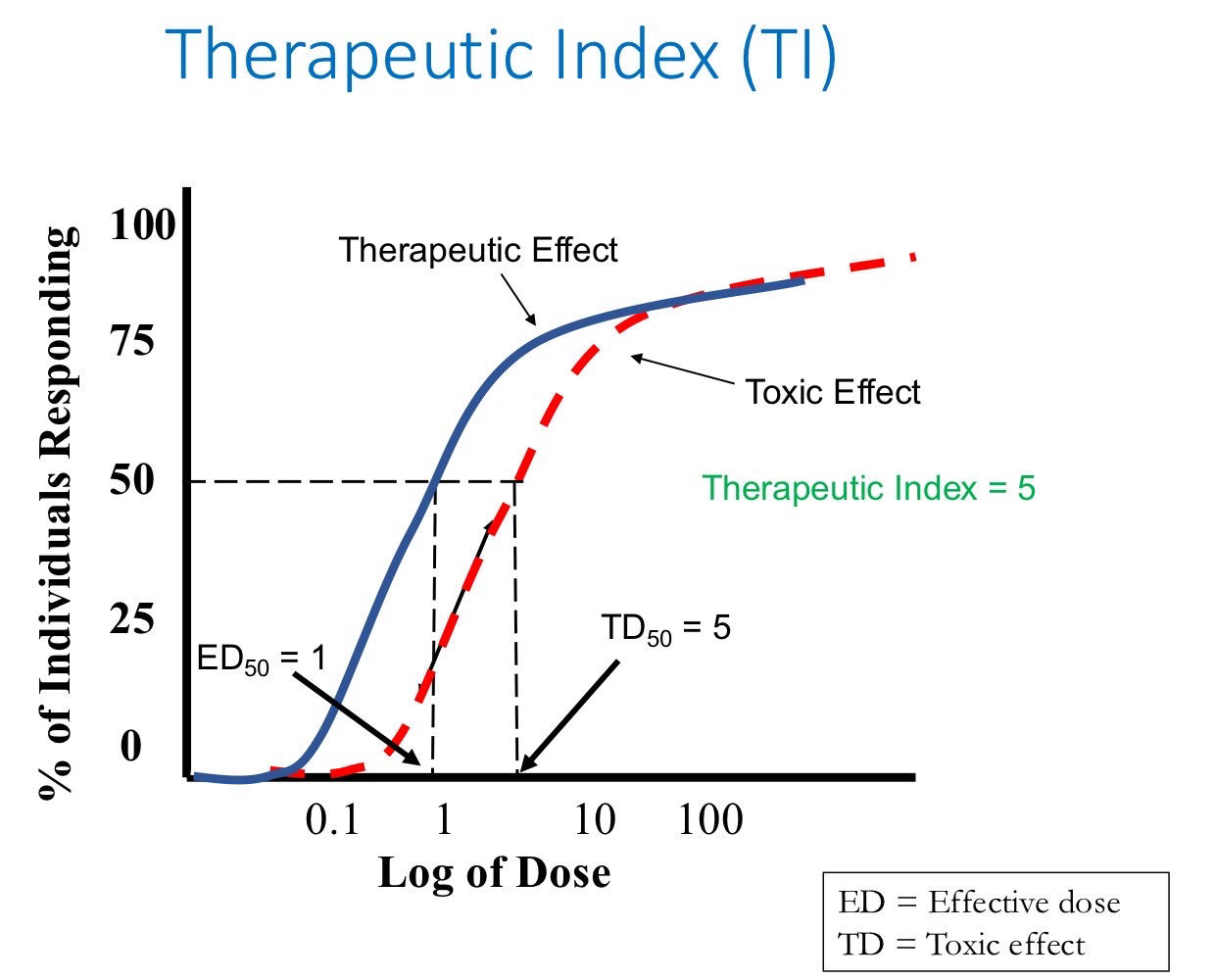
29
What is the therapeutic range or therapeutic window?
The blood concentration range likely to produce therapeutic effects.
30
What happens when drug concentrations fall below or rise above the therapeutic window?
Below may be subtherapeutic; above increases the risk of adverse effects.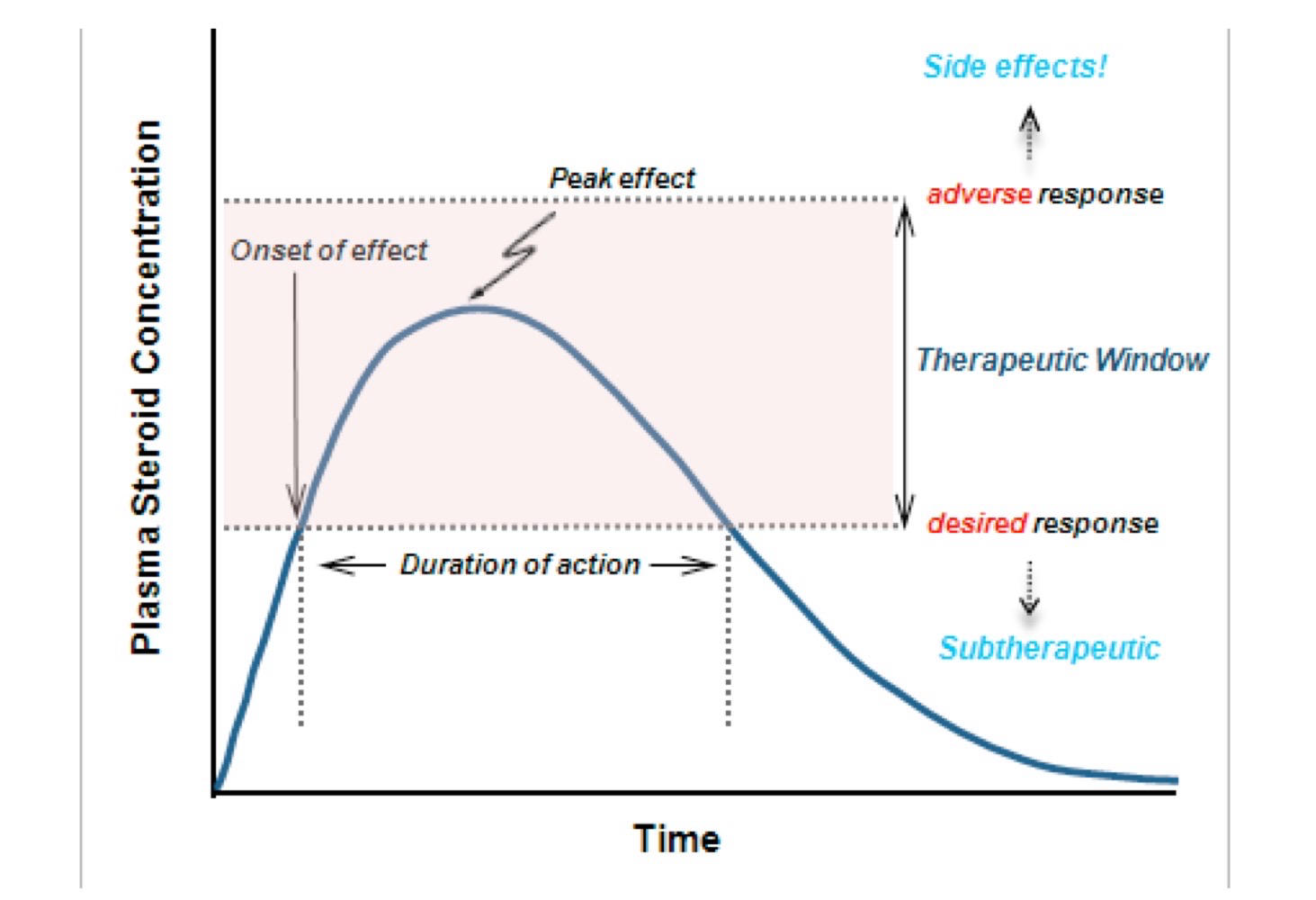
31
What is pharmacokinetics (PK)? EXAM
The effect of the body on a drug; how the drug moves through the body.
32
What four processes make up pharmacokinetics (ADME)?
Absorption, distribution, metabolism, and excretion.
33
What is pharmacodynamics (PD)? EXAM
The effect of a drug on the body, including desired and undesired outcomes.
34
How does pharmacokinetics influence pharmacodynamics? EXAM
PK determines the concentration reaching the target site, influencing the drug's effects.
35
Why is vomiting considered pharmacodynamic rather than pharmacokinetic? EXAM
Vomiting is a drug effect on the body, not drug absorption, distribution, metabolism, or excretion.
Mehr Karteikarten: Medizin und Gesundheit
Magnetic Resonance Spectroscopy (MRS) PrinciplesMedizin und Gesundheit · EnglischMollfemale reproduction Medizin und Gesundheit · EnglischnewSCAPULA in CLAVICULAMedizin und Gesundheit · EnglischemčutilaMedizin und Gesundheitemaksillar ateş ölçümüMedizin und Gesundheit · TürkischNurlymphoid rendszer Medizin und Gesundheit · UngarischRitike6- colonne pelvienneMedizin und Gesundheit · FranzösischOcéaneAntibiotics IMedizin und Gesundheit · EnglischcathsimsMedical Terminology: Color Word RootsMedizin und Gesundheit · EnglischMorgy52TissuesMedizin und Gesundheit · EnglischEliazarAnatomie de la face et des sinusMedizin und Gesundheit · FranzösischOcéaneHemostasis and Bleeding DisordersMedizin und Gesundheit · EnglischDaniela
Alle Decks: Medizin und Gesundheit
Lerne diese Decks in der App
Kostenlos auf iPhone, Android, Mac und im Web. Füge jedes Deck mit einem Tipp zu deinem Konto hinzu.

