ACG2071 Chapter 10 (Principles of Managerial Accounting)
Réviser ces flashcardsGratuit · répétition espacée · iPhone, Android, Mac et web
Toutes les cartes
1
"Relevant information is expected future data that differ among alternatives."
-No idea exactly what they mean by this.
Relevant Information
"Relevant information is expected future data that differ among alternatives."
-No idea exactly what they mean by this.
2
Relevant Costs/ Revenue
Costs / Revenues that are relevant to a certain decision
3
Sunk Costs
Sun Costs are costs that were incurred in the past and cannot be changed regardless of which future action is taken.
4
Differential Analysis
A method that looks at how operating income would differ under each decision; also leaves out irrelevant information
5
What are the 3 basic questions a company should ask it self when setting regular prices for products?
1. What is the company's target profit?
2. How much would customers actually pay for the product?
3. Is this company a price taker or price setter? (If the companies product is unique enough then it can be a price setter, however if it is not (such as most foods or wood) then it is not.)
2. How much would customers actually pay for the product?
3. Is this company a price taker or price setter? (If the companies product is unique enough then it can be a price setter, however if it is not (such as most foods or wood) then it is not.)
6
Target Pricing
1) You start with the amount customers would actually be willing to pay
2) You subtract the desired profit
3)Now you have the amount of target product cost that you have to aim for.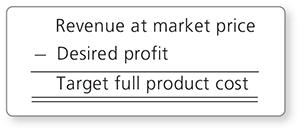
2) You subtract the desired profit
3)Now you have the amount of target product cost that you have to aim for.
7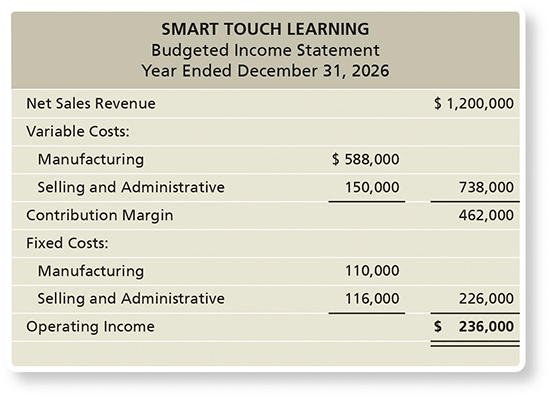
Budgeted Income Statement
8
Cost-Plus Pricing
1) Start with the full product cost
2) Add the desired profit
3) Now you have how much you should sell it for, to get your desired profit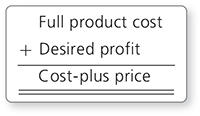
2) Add the desired profit
3) Now you have how much you should sell it for, to get your desired profit
9
When a company makes a special pricing decision occurs when a customer request a one-time order at a reduced sales price.
What are 3 things they should consider to before agreeing?
What are 3 things they should consider to before agreeing?
1) Does the company have excess capacity available to fill the order?
-If the company is already using all its existing manufacturing capacity and selling all units made at its regular sales price, it would not be as profitable to fill a special order at a reduced sales price.
2) Will the reduced sales price be high enough to cover the differential costs to fill the order?
-The special price must be greater than the variable costs of filling the order or the company will incur a loss on the deal. (In other words, the deal most produce a positive contribution margin)
3) Will the special order affect regular sales in the long run?
-Will regular customers find out about the special order and demand a lower price? Will the special order customer come back again and again, asking for the same reduced price?
-If the company is already using all its existing manufacturing capacity and selling all units made at its regular sales price, it would not be as profitable to fill a special order at a reduced sales price.
2) Will the reduced sales price be high enough to cover the differential costs to fill the order?
-The special price must be greater than the variable costs of filling the order or the company will incur a loss on the deal. (In other words, the deal most produce a positive contribution margin)
3) Will the special order affect regular sales in the long run?
-Will regular customers find out about the special order and demand a lower price? Will the special order customer come back again and again, asking for the same reduced price?
10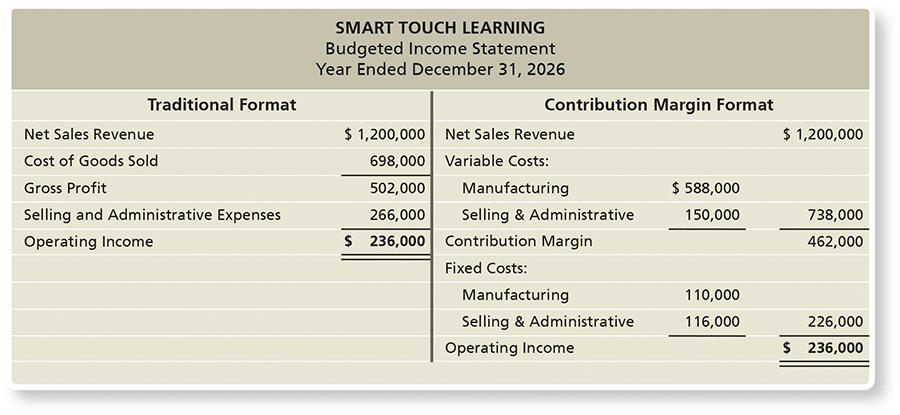
Budgeted Income Statement (Traditional on the left and Contribution margin on the righ)
11
Constraints
Restrict the production or sale of a product.
12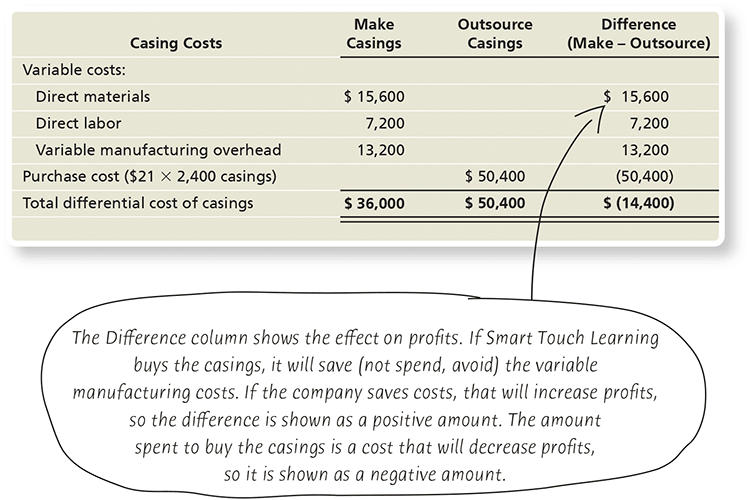
Differential Analysis Chart for whether a business should outsource or not for making "casings"
(Fixed Costs will not change for each decision)
(Fixed Costs will not change for each decision)
13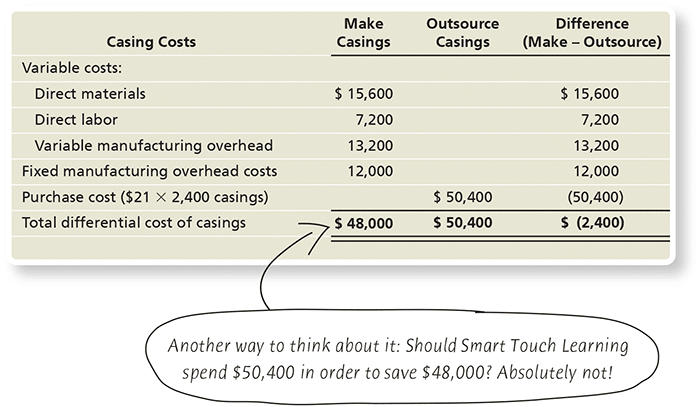
Differential Analysis Chart for whether a business should outsource or not for making "casings"
(Fixed Costs will change for each decision)
(Fixed Costs will change for each decision)
14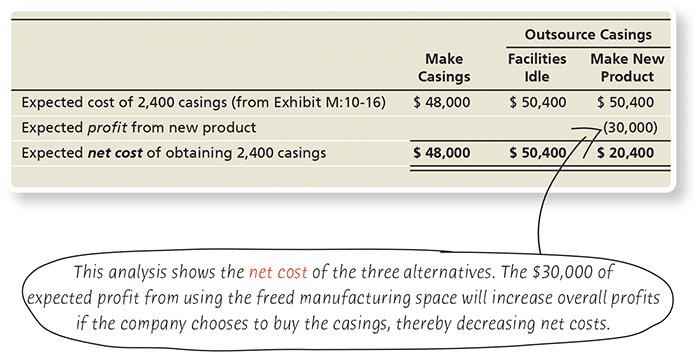
Smart Touch Learning’s managers must now consider three alternatives:
1. Use the facilities to make the casings.(Cost \$48,000)
2. Buy the casings (oursource) and leave facilities idle (Cost \$50,400)
3. Buy the casings and use facilities to make the new product (Cost \$50,400 but get \$30,000 from new product)
Make a chart to show which they should choose.
1. Use the facilities to make the casings.(Cost \$48,000)
2. Buy the casings (oursource) and leave facilities idle (Cost \$50,400)
3. Buy the casings and use facilities to make the new product (Cost \$50,400 but get \$30,000 from new product)
Make a chart to show which they should choose.
15
Joint Cost
A cost of a product that yields multiple products
-A tablet that has the special software downloaded vs a tablet that does not have the special software
-A tablet that has the special software downloaded vs a tablet that does not have the special software
16
In deciding which product lines to emphasize when a production constraint exists, the company should focus on the product line that has the highest
A.
profit per unit of product.
B.
contribution margin per unit of product.
C.
contribution margin ratio.
D.
contribution margin per unit of the constraint.
A.
profit per unit of product.
B.
contribution margin per unit of product.
C.
contribution margin ratio.
D.
contribution margin per unit of the constraint.
D.
contribution margin per unit of the constraint.
!!!!!!!!!!!!!
contribution margin per unit of the constraint.
!!!!!!!!!!!!!
Plus de flashcards : Économie et gestion
IAS 36 ImpairmentsÉconomie et gestion · AnglaisEllaConsumer welfare and protection Économie et gestion · AnglaisamongusTürsteuerung, Aufgaben ZGF, Streckenliste & ZughakengrenzlasÉconomie et gestion · AllemandJuliaBusiness in the real worldÉconomie et gestion · AnglaisesmeeHSC Human Resources Topic 4Économie et gestion · AnglaisAndyH4 marketingmodellenÉconomie et gestion · NéerlandaisDemiBMicro Unit 2Économie et gestion · AnglaisAvaFinal study guide chaps 4-6Économie et gestion · Anglaismattmc03Products and InnovationÉconomie et gestion · Anglaisrikishakennedydigestion Économie et gestion · FrançaisdassineArm en Rijk 1.1 VWO 4Économie et gestion · NéerlandaisKamillaChapter 3: ReceivablesÉconomie et gestion · AnglaisDion
Tous les decks : Économie et gestion
Révise ces decks dans l’app
Gratuit sur iPhone, Android, Mac et le web. Ajoute n’importe quel deck à ton compte en un tap.

