Aviation Instrument and Engine Knowledge 2
Réviser ces flashcardsGratuit · répétition espacée · iPhone, Android, Mac et web
Les 300 premières cartes sur 525
1
ARROW
Airworthiness certificate (never expires)
Registration Certificate (renewed every seven years)
Radio Station License (Required for international)
Operating Limitations (Found in the approved flight manual or Pilot's operating handbook)
Weight and balance data
Registration Certificate (renewed every seven years)
Radio Station License (Required for international)
Operating Limitations (Found in the approved flight manual or Pilot's operating handbook)
Weight and balance data
2
ASR approach
airport surveillance radar
3
How many degrees per hour on the clock?
30°
4
Max holding speed MHA-6000'
200 KIAS
5
Max Holding speed 6,001-14,000
230
6
Max holding speed 14,001 & above
265
7
What two things does MEA assure?
Obstacle clearance and acceptable navigational signal coverage
8
How far is VOR signal coverage assured at when flying at MOCA?
22nm
9
What is the standard glideslop of a 3-bar VASI?
3°
10
IFR Over FL240 requires
Approved DME or suitable RNAV
11
EFC
expect further clearance
12
What is the range when given a speed adjustment by atc
±10 knots
13
If no minimum altitude is prescribed, what is altitude and course requirements in non-mountainous terrain?
1,000', 4nm from course
14
If no minimum altitude is prescribed, what is altitude and course requirements in mountainous terrain?
2,000', 4nm from course
15
What does declaring "minium fuel" to ATC imply?
An advisory that indicates that an emergency situation is possible.
16
With no climb restriction, and within 1000' of assigned altitude, pilots should attempt to climb/descend at
500FPM or 1,500FPM
17
Acronym to remember non-precision approach types
VALORS
18
What do you read back when given IFR clearance during flight?
Altitude assignments, vectors, and any part requiring verification
19
Aircraft accident and incident reporting responsibilities.
NTSB Part 830
20
An abbreviated departure clearance needs at least
departure airport and route
21
Fuel required calculation for IFR
Fuel to distance + Alternate + 45 minutes
22
VALORS
VOR
ASR
Localizer (LOC / LDA/ SDF)
Old school (NDB/ADF)
RNAV
Surveilance
ASR
Localizer (LOC / LDA/ SDF)
Old school (NDB/ADF)
RNAV
Surveilance
23
What are the ground-based approach systems?
VOR & NDB
24
What are the Localizer based approach systems?
LOC (straight-in)
LDA & SDF (offset or wide)
LDA & SDF (offset or wide)
25
What are the Satellite based approach systems?
LPV, LP, LNAV, LNAV/VNAV
26
What are the precision approaches?
ILS
PAR
GLS
PAR
GLS
27
ILS
Instrument landing system
28
How does ILS work?
A VHF localizer provides lateral and vertical guidance
29
PAR
Precision Approach radar
30
How does PAR work?
A radar-based system where ATC uses two-way radio comms to talk the pilot down.
31
Alternate Minimums for precision approaches.
600' ceiling, 2SM
32
Alternate minimums for non-precision approach
800' ceiling, 2sm
33
Alternate minimums for no instrument approach
Descent and landing must be possible from the Minimum en route altitude (MEA) under basic VFR
34
1-2-3 Rule
Must file an alternate unless destiantion has an instrument approach AND:
Weather 1 hour before/after is at least
2,000' ceiling
3sm visbility
Weather 1 hour before/after is at least
2,000' ceiling
3sm visbility
35
What does a non-standard alternate minimum look like?
Black triangle with an "A" on the approach plate or in TPP.
36
GLS
GBAS Landing System
37
GBAS
Ground Based Augmentation System
38
How does GLS work?
Uses GPS systems to enhance the signals provided by ground equipment.
39
TLS
Transponder landing system
40
How does TLS work?
Provides ILS-like guiadnce using secondary radar/transponder signals.
41
What must be logged when doing a VOR check?
Date, place, bearing error, and signature
42
Mag Compass
Right + East
Right + East
Correct smooth
43
Mag Compass
Right + West
Right + West
Correct Smooth
44
Mag Compass
Right + South
Right + South
Right Faster
45
Mag Compass
Right + North
Right + North
Left
46
Mag Compass
Left + East
Left + East
Correct Smooth
47
Mag Compass
Left + West
Left + West
Correct Smooth
48
Mag Compass
Left + South
Left + South
Left faster
49
Mag Compass
Left + North
Left + North
Right
50
Mag Compass
Left (280°) + North (350°)
Left (280°) + North (350°)
slower rate
51
Mag Compass
Left/Right + East/West
Left/Right + East/West
Correct Smooth
52
What is LAHSO?
When a pilot is cleared to land and hold short of an intersecting runway or taxiway
53
Mode A transponder reports
Squawk only
54
Mode C Transponder reports
Squawk and pressure altitude in 100ft increments
55
Mode S transponder reports
Squaw address, ICAO 24-bit address, Pressure altitude at 25ft increments, tail number
56
Engine surging/sputtering
Switch tanks, full rich, fuel pump on
Carb heat
Test mags
Carb heat
Test mags
57
High Oil Temp + Low/No Oil Pressure
Outcome + Causes
Outcome + Causes
Outcome:
imminent engine failure, divert.
Causes:
Severe Oil loss
Oil pump failure
imminent engine failure, divert.
Causes:
Severe Oil loss
Oil pump failure
58
High Oil Temp + Normal Oil Pressure
Outcome and causes
Outcome and causes
Outcome:
Reduce power, reduce climb rate and enrich mixture. Monitor.
High ambient temp, slow airspeed, lean mixture
Reduce power, reduce climb rate and enrich mixture. Monitor.
High ambient temp, slow airspeed, lean mixture
59
Normal Oil Temp + Low Oil Pressure Outcome and causes
Outcome:
Expect failure, divert.
Causes:
Gasket failure, oil loss, oil pump failure, faulty gauge.
Expect failure, divert.
Causes:
Gasket failure, oil loss, oil pump failure, faulty gauge.
60
Normal Oil Temp + High oil pressure Outcome and Cause
Outcome:
Monitor. Engine failure unlikely. Divert.
Cause:
Stuck pressure release valve, line blockage, cold oil
Monitor. Engine failure unlikely. Divert.
Cause:
Stuck pressure release valve, line blockage, cold oil
61
A gradual decrease in RPMS w/ engine roughness likely cause:
Induction icing
62
Rough running engine, drop in RPM.
Possible icing, mag heat on
test Magneto failure, try grounding one at a time and run on the smoother one.
test Magneto failure, try grounding one at a time and run on the smoother one.
63
Power on stall entry speed
70kts
64
Power off stall entry speed
65kts
65
$V_{S0}$ speed
45
66
$V_S$ speed
50
67
$V_R$ Speed
60
68
$V_X$ speed
64
69
$V_Y$ Speed
76
70
$V_G$ speed
76
71
$V_{FE}$ speed
102
72
$V_{NO}$ Speed
125
73
$V_A$ at MGW
113
74
$V_{S0}$ 45
$V_S$ 50
$V_R$ 60
$V_X$ 64
$V_Y$ 76
$V_G$ 76
$V_{FE}$ 102
$V_{NO}$ 125
$V_{NE}$ 154
$V_A$ 113
Write out the V speeds
$V_{S0}$
$V_S$
$V_R$
$V_X$
$V_Y$
$V_G$
$V_{FE}$
$V_{NO}$
$V_{NE}$
$V_A$
$V_{S0}$
$V_S$
$V_R$
$V_X$
$V_Y$
$V_G$
$V_{FE}$
$V_{NO}$
$V_{NE}$
$V_A$
$V_{S0}$ 45
$V_S$ 50
$V_R$ 60
$V_X$ 64
$V_Y$ 76
$V_G$ 76
$V_{FE}$ 102
$V_{NO}$ 125
$V_{NE}$ 154
$V_A$ 113
75
White and green beacon
Lighted land airport
76
Lighted land airport beacon
White and green beacon
77
White/Yellow beacon
Seaport
78
Seaport beacon
White/Yellow beacon
79
White/White/Green beacon
Military
80
Military beacon
White/White/Green beacon
81
White/Yellow/Green Beacon
Heliport
82
Heliport beacon
White/Yellow/Green Beacon
83
What does IAU stand for?
Integrated Avionics Unit
84
Acronym to remember the 6 sigmet items
CAT SIT
85
CAT SIT
Cyclones
Ash (Volcanic)
Thunderstorms
Sand/Dust storms
Icing (Severe)
Turbulence (Severe)
Ash (Volcanic)
Thunderstorms
Sand/Dust storms
Icing (Severe)
Turbulence (Severe)
86
ABCD of engine failure
Airspeed
Best place to land
Checklists
Declare
Best place to land
Checklists
Declare
87
What is CFIT
Controlled flight into terrain
88
DECIDE
Detect
Estimate
Choose
Identify
Do
Evaluate
Estimate
Choose
Identify
Do
Evaluate
89
Types of NOTAMs
FDC
Type D
Type D
90
FDC NOTAM
Navigational equipment
91
D NOTAM
(Distant) airport environment
92
What does 5 1-1-1 mean?
5sm, 1000 above, 1000 below, 1sm horizontal
93
What is required to fly above 10,000ft
mode c transponder adsb out
94
What law for torque
Newtons 3rd law
95
Newton's 3rd law
For every action there is an equal and opposite reaction
96
For every action there is an equal and opposite reaction
Newton's 3rd law
97
Requirements for basicmed
Drivers license
Held a valid medical after July 14 2006
Physician Exam
Online course
Held a valid medical after July 14 2006
Physician Exam
Online course
98
Requirements to be a private pilot
Be at least 17
Pass knowledge and practical test
Speak English
Minimum 3rd class medical
Proper logbook endorsements
Flight time experience requirements
Pass knowledge and practical test
Speak English
Minimum 3rd class medical
Proper logbook endorsements
Flight time experience requirements
99
What is a VOR radial?
a line extending out from a VOR station
100
What is VOR bearing?
the course you fly towards a VIR station
101
What does WAAS stand for
wide area augmentation system
102
How often do you need to update the GPS database?
Every 28 days
103
Pilotage
Using landmarks to navigate
104
Dead Reckoning
Using a known position to find time and distance
105
RAIM
Receiver Autonomous Integrity Monitoring
106
How many satellites required to determine 3D location?
4
107
How many satellites for 2D position?
3
108
How many minimum satellites for RAIM
6
109
What does RAIM do?
It ensures GPS signal integrity
110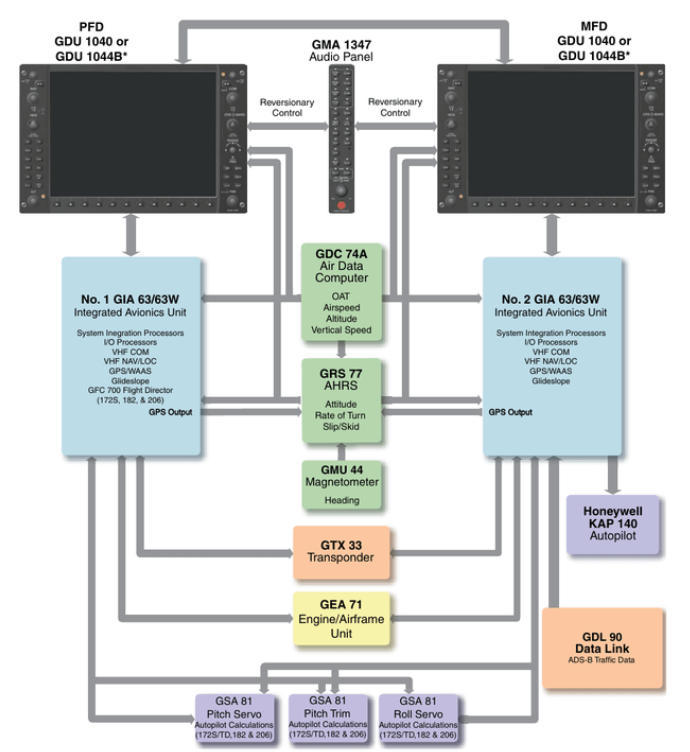
Draw the G1000 layout
111
How can you show the aircraft is airworthy?
DIE
112
Acronym for types of airspeed
ICE-T-G
113
Acronym to remember types of altitude
TAI-PD
114
TAI-PD
True Altitude
Absolutel Altitude
Indicated Altitude
Pressure Altitude
Density Altitude
Absolutel Altitude
Indicated Altitude
Pressure Altitude
Density Altitude
115
ICE-T-G
Indicated Airspeed
Calibrated Airspeed
Equivalent
True Airspeed
Groundspeed
Calibrated Airspeed
Equivalent
True Airspeed
Groundspeed
116
Indicated Airspeed
Airspeed off the instrument
117
Calibrated Airspeed
Airspeed corrected for instrument and positional errors
118
Equivalent airspeed
Airspeed adjusted for air compressibility
119
Groundspeed
movement of airplane relative to the ground
120
What is True Altitude?
vertical distance above sea level
121
What is Absolute Altitude?
Height Above the ground (AGL)
122
What is indicated altitude?
Altitude read off the altimeter
123
What is pressure altitude?
Height above the standard data plane when barometric pressure is set to 29.92
124
What is Density Altitude?
Pressure altitude corrected for non-standard temperature
125
Personal Minimums
5SM 10kts 4000' ceiling
126
What is the ratio of oxygen to nitrogen in the air?
78% Nitrogen 21% Oxygen 1% Other
127
Does the ratio of nitrogen and oxygen change with altitude?
No, only the density
128
How is an urgent PIREP coded?
UUA
129
What area does a TAF cover?
5nm from the airport
130
What is the acronym to remember the special use airspaces?
MCPRAWN
131
how can you find out if a restricted area is hot?
1-800-wx-brief
EFB
FAA SUA website
Contact Controlling agency
EFB
FAA SUA website
Contact Controlling agency
132
MCPRAWN
MOA
CFA
Prohibited
Restricted
Alert Area
Warning Area
National Security Area
CFA
Prohibited
Restricted
Alert Area
Warning Area
National Security Area
133
What at the two types of fatigue?
chronic and acute
134
What are the two types of stress?
chronic and acute
135
Airthworthiness DIE
Documents (ARROW)
Inspections (AV1ATES)
Equipment (A TOMATO FLAMES)
Inspections (AV1ATES)
Equipment (A TOMATO FLAMES)
136
What color is a temporary registration?
pink
137
How long is a temporary registration valid for?
12 months
138
Where can you find known atc delays?
NAS website
139
What should you look for in an alternate?
Fuel, maintenance facilities
140
What is wet sump?
When the oil is stored in the oil pan
141
What is dry sump?
When oil is stored outside the engine
142
What is a stable atmosphere?
The ability for it to resist vertical motion
143
What layer of the atmosphere do we fly in?
troposphere
144
What is the acronym to remember required inspections?
AV1ATES
145
Open door checklist
Airspeed 87
Close vents
open storm windows
latch side then top
Close vents
open storm windows
latch side then top
146
What 3 things cause compass oscillation?
aircraft acceleration, turbulence, magnetic dip
147
What is area of ambiguity?
When you are 90° abeam the selected radial, the to/from flag will fluctuate
148
piper archer glide ratio
9.5:1
149
What does the archer glide ratio mean?
For every 1,000 feet of altitude lost, the aircraft can travel forward about 9,500 feet
150
What type of aircraft don't require an ELT
Single seat, agricultural, gliders ballons etc
151
what is the significance of 14500 feet msl in the classification of airspace
Serves as the floor of the class E and ceiling for golf
152
Acronym to remember VOR limitations
CARL
153
CARL
Cone of confusion
Area of ambiguity
reverse sensing
line of sight
Area of ambiguity
reverse sensing
line of sight
154
When can you begin logging night flight time?
end of evening Civil twilight and beginning of morning Civil twilight
155
When should position lights be used?
From sunset to sunrise
156
For passenger night time currency, what times count?
an hour before sunrise and hour after sunset
157
How many miles wide is a Victor airway?
8 miles, 4 each side
158
What are 5 factors that can affect takeoff distance?
Heavy loads, high altitudes, high temperatures, runway coondition, engine wear
159
what are the basic advantages of an alternator over a generator
Better efficiency, smaller, lighter
160
At what RPM does the engine make 180hp?
2700
161
What do MELs apply to?
(my) Specific airplanes by tail number
162
Where is a KOEL found?
In the POH
163
Acronym for inop equipment decision making
MKART
164
MKART
MEL
KOEL
ADs
Regs
Type certificate data sheet
KOEL
ADs
Regs
Type certificate data sheet
165
What is the regulation for inop equipment?
91.213
166
91.213
inoperable equipment
167
What conditions are required to be considered a severe thunderstorm?
50 knot surface winds, 3/4 inch hail or tornadoes
168
Minimum safe altitude anywhere:
An altitude that allows for a landing should the engine fail without undue hazard
169
Minimum safe altitude over a congested area
1000ft above the highest obstacle, 2,000ft horizontal
170
Minimum safe altitude other than a congested area
500ft over the surface
If over open water: 500ft from any person, vessel, vehicle or structure
If over open water: 500ft from any person, vessel, vehicle or structure
171
Minimum oil
2 quarts
172
Maximum oil
8 quarts
173
School minimum oil
6 quarts
174
Oxygen requirements 12,500-14,000
More than 30 minutes, minimum flight crew must use supplemental
175
Oxygen requirements above 14,000
Oxygen required for required crew entire duration
176
Oxygen requirements above 15,000
All occupants must be supplied oxygen
177
Oxygen requirements
12,500-14,000: More than 30 minutes, required crew must use supplemental
14,000: Required crew must use continous supplemental oxygen
15,000: All occupants must be provided oxygen
14,000: Required crew must use continous supplemental oxygen
15,000: All occupants must be provided oxygen
178
Private pilot privileges
Can act as PIC within your privileges
PSCRIPT
Can fly at night
Can fly with pax
PSCRIPT
Can fly at night
Can fly with pax
179
Private pilot limitations
Can't fly for compensation or hire
Must pay pro rata
Can only fly VFR
Must pay pro rata
Can only fly VFR
180
What regulation has the medical chart?
61.23
181
How often do you need an exam for basicmed?
Every 48 months.
182
What happens when your first or second class expires?
It reverts to a third class
183
Category in respect to airmen certification
Broad, like airplane or rotorcraft
184
Class in respect to airmen
Specific design features, like single engine land
185
Type in respect to airmen
Specific models
186
Category in respect to aircraft certification
Normal, Utility, Acrobatic, Transport
187
Class in respect to aircraft certification
Airplane, rotorcraft, glider etc
188
Type in respect to aircraft certification
Specific aircraft models of similar designs
189
How long is a convective sigmet valid?
2 hours
190
How long is a standard sigmet valid for?
4 hours
191
What are the types of sigmets
Convective, standard, cyclonic, and volcanic ash.
192
What are the types of airmets
S (Widespread IFR)
T (Turbulence)
Z (Icing)
T (Turbulence)
Z (Icing)
193
What is a SIGMET?
an aviation weather advisory that alerts pilots to severe weather hazards that pose a danger to all aircraft.
194
What are the different conditions that warrant a sigmet? (6 items)
Cyclones
Ash (Volcanic)
Thunderstorms
Sand/Duststorms
Icing (Severe)
Turbulence (Severe)
Ash (Volcanic)
Thunderstorms
Sand/Duststorms
Icing (Severe)
Turbulence (Severe)
195
What are the requirements for a convective sigmet
severe thunderstorms, embedded thunderstorms, continous line of at least 60nm, wide area coverage of at least 40% of 3000 square miles
196
What are the types of occluded fronts?
Cold and warm
197
What conditions can you expect with a cold front occlusion?
A mix of both warm and cold front conditions
198
What conditions can you expect with a warm occlusion?
Typically the weather is more severe than the state weather in a cold front occlusion. Embedded thunderstorms, rain, and fog.
199
How long is the airworthiness certificate valid for?
Indefintely as long as the aircraft meets its approved type desgin and is in a condition for safe operation.
200
How long is an aircraft registration valid for?
Seven years
201
Where can the operating limitations be found?
Approved flight manual or POH
202
IMSAFE (91.17)
Illness
Medication
Stress
Alcohol
Fatigue
Emotion/eating
Medication
Stress
Alcohol
Fatigue
Emotion/eating
203
PAVE (Preflight general)
Pilot
Aircraft
enVironment
External Factors
Aircraft
enVironment
External Factors
204
Acronym for 91.17
IMSAFE
205
Required aircraft documents
Airworthiness certificate (never expires)
Registration Certificate (renewed every seven years)
Radio Station License (Required for international)
Operating Limitations (Found in the approved flight manual or Pilot's operating handbook)
Weight and balance data
Registration Certificate (renewed every seven years)
Radio Station License (Required for international)
Operating Limitations (Found in the approved flight manual or Pilot's operating handbook)
Weight and balance data
206
Required aircraft maintenance inspections
Annual inspection
VOR Check
100 hour inspection
Altimeter
Transponder
ELT
Static System
VOR Check
100 hour inspection
Altimeter
Transponder
ELT
Static System
207
AV1ATES
Annual Inspection: Every 12 calendar months (91.409) (Must be done by an A&P IA)
VOR Check: Every 30 days (required for IFR only) (91.171)
100 Hour inspection: Required if flying for hire (91.409)
Altimeter: Every 24 calendar months (91.411) (Required for IFR only)
Transponder: Every 24 calendar months (91.413)
ELT: Every 12 calendar months; battery replaced if used for more than 1 cumulative hour or if 50% of the usable battery life has expired (91.207)
Static System: 24 Calendar months (91.411)
208
How often is a VOR check required? (And reg)
Every 30 days. (91.171) (For IFR flight)
209
When is a 100 hour inspection required? (When and the Reg)
Required if flying for hire (91.409)
210
How often does the altimeter need to be inspected? (And reg)
Every 24 calendar months (91.411)
211
How often does the transponder need to be inspected? (and what is the reg)
Every 24 calendar months (91.413)
212
When does the ELT need to be inspected? (and reg)
Every 12 calendar months; battery replaced if used for more than 1 cumulative hour or if 50% of the usable battery life has expired (91.207)
213
Acronym for minimum required equipment for VFR flight.
A TOMATO FLAMES (91.205)
214
Minimum required equipment for VFR flight. 91.205
Altimeter
Tachometer (each engine)
Oil pressure indicator (each engine)
Manifold pressure gauge (each engine)
Airspeed Indicator
Temp gauge (each engine)
Oil temp gauge (each engine)
Fuel quantity gauge (each tank)
Landing gear position lights
Anti-collision lights (certified after 1996)
Magnetic direction indicator (compass)
ELT
Safety belts (certified after 1986)
215
A TOMATO FLAMES
Altimeter
Tachometer (each engine)
Oil pressure indicator (each engine)
Manifold pressure gauge (each engine)
Airspeed Indicator
Temp gauge (each engine)
Oil temp gauge (each engine)
Fuel quantity gauge (each tank)
Landing gear position lights
Anti-collision lights (certified after 1996)
Magnetic direction indicator (compass)
ELT
Safety belts
216
Minimum required equipment for VFR night
Same as VFR AND
Fuses (spare)
Landing light (if for hire)
Anti-collision lights
Position lights (nav lights)
Source of power (such as battery)
Fuses (spare)
Landing light (if for hire)
Anti-collision lights
Position lights (nav lights)
Source of power (such as battery)
217
Required pilot documents for PIC (61.3)
Pilot certificate
Photo ID
Medical Certificate
Radio operator permit (if outside US)
Photo ID
Medical Certificate
Radio operator permit (if outside US)
218
How long is an AIRMET valid for?
6 hours
219
How long is a SIGMET valid for?
4 hours
220
What is the standard lapse rate?
2c / 1000ft
221
Air is stable if....
the adiabatic lapse rate is greater than the ambient lapse rate
222
What are the types of fog?
Upslope
Precipitation
Advection
Ice
Radiation
Steam
Precipitation
Advection
Ice
Radiation
Steam
223
What is the acronym to remember the types of fog?
UPAIRS
224
What type of aileron does the Archer have?
Differential ailerons.
225
What do differiential ailerons do?
Deflects further upward than the downward one to counteract the yawing effect created by the downward aileron
226
What type of flaps does the Archer have?
Slotted flaps
227
What is the benefit of slotted flaps?
Better performance at slower speeds
228
What type of propeller does the archer have?
Sesinich fixed pitch
229
What type of engine does the archer have?
Lycoming O-360-A4M
Horizontally opposed
Air cooled
Normally aspirated
Direct drive
180 hp
Horizontally opposed
Air cooled
Normally aspirated
Direct drive
180 hp
230
What is the acronym to remember the engine in the Archer?
LHAND
231
What type of gear does the archer have?
Tricycle with differential hydraulic toe braking
232
How many gallons does each tank hold in the Archer at tabs?
17 gallons at tabs, 32 useable (both tanks)
233
How does the airspeed indicator work?
It compares the pressure between the pitot and the static port
234
What are the gyroscopic systems?
Heading indicator, attitude indicator, and turn coordinator
235
$V_{S0}$
Stall speed landing config (45 knots)
236
$V_{S1}$
Stall speed no flaps (50)
237
$V_X$
Best angle (64)
238
$V_Y$
Best rate (76)
239
$V_{FE}$
Maximum flap extension (102)
240
$V_A$
Maneuvering Speed (113)
241
$V_{NO}$
Max structural cruise (125)
242
$V_{NE}$
Never exceed (154)
243
What is the total useable fuel in the archer (Tabs and Full)?
32 gallons at tabs; 48 full
244
What conditions are associated with a warm front?
Steady rain, widespread clouds, poor visibility, stratifrom clouds, low ceilings
245
What is a warm front?
A warm front is when a warm air mass advances and replaces a colder body of air, covering the cold air and forcing it out below
246
What conditions are associated with a cold front?
thunderstorms, towering cumulus, precipitation
247
What is a stationary front?
A stationary front is when the forces of two air masses are relatively equal, causing them to not move.
248
What is an occluded front?
When a faster-moving cold front catches up to a warm front, forcing the warm air up.
249
What type of front is this?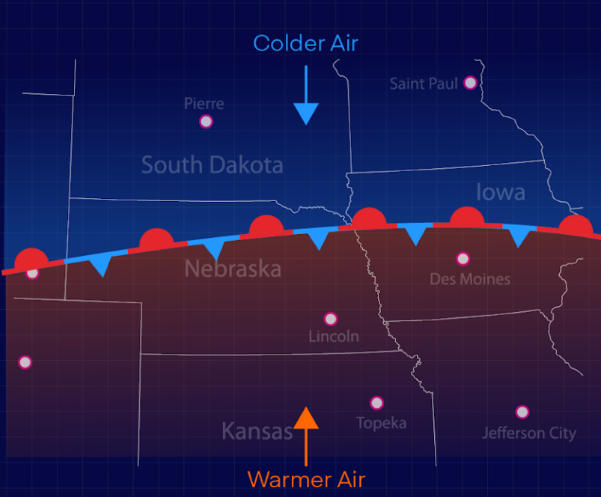
Stationary front
250
What type of front is this?
Occluded front
251
How does a high pressure system move?
Clockwise, outwards, and downwards
252
How does a low pressure system move?
Counter-clockwise, inwards, and upwards
253
What is a Sierra AIRMET mean?
Widespread IFR
254
What does a Tango AIRMET mean?
Turbulence
255
What does a Zulu AIRMET mean?
Icing
256
How does GUMPS apply to the Archer?
Gas
Undercarriage (N/A)
Mixture (Full rich)
Prop (N/A)
Switches (LDG Light and fuel pump on)
Undercarriage (N/A)
Mixture (Full rich)
Prop (N/A)
Switches (LDG Light and fuel pump on)
257
What altitude is used for ground reference maneuvers?
Between 600 and a 1000' AGL, or 1,200' MSL (TOP) ~1100' MSL
258
What speed do you enter for turns around a point?
Cruise speed (100-115)
259
How do you enter for turns around a point?
On a tailwind
260
How do you enter for S-Turns?
On a tailwind
261
What altitudes for performance maneuvers?
No lower than 1,500' AGL
(So ~1,800 MSL)
(So ~1,800 MSL)
262
What speed do you fully retract flaps at for recovery from slow flight/stalls?
76 knots
263
When do you retract the second notch of flaps while recovering?
Once there is a postive climb rate.
264
What speed do you descend at for power-off stall?
65 knots
265
What speed do you aim for for a power-on stall before applying full power?
70-75 knots
266
Engine fire during start procedure
Keep starter on
Mixture cut
Throttle open
turn off fuel pump and fuel selector
Mixture cut
Throttle open
turn off fuel pump and fuel selector
267
Engine failure during flight restart procedure
76 knots
switch tanks
mixture rich
carb heat on
fuel pump on
turn each mag on/off one at a time
switch tanks
mixture rich
carb heat on
fuel pump on
turn each mag on/off one at a time
268
Power off landing checklist
close throttle and mixture
turn off battery
turn off alternator
turn off mags
turn off fuel
Crack door open
turn off battery
turn off alternator
turn off mags
turn off fuel
Crack door open
269
Electrical fire checklist
Verify emerg battery armed
Master batt off
alternator off
vents open
cabin heat off
extinguish fire
Master batt off
alternator off
vents open
cabin heat off
extinguish fire
270
Emergency descent procedure
Throttle to idle
aim for 120 knots
bank 30-45 degrees
aim for 120 knots
bank 30-45 degrees
271
Spin recovery acronym
PARE
272
PARE
Power- idle
Ailerons- Neutal
Rudder opposite the turn
Elevator forward to break the stall, then back to level flight
Ailerons- Neutal
Rudder opposite the turn
Elevator forward to break the stall, then back to level flight
273
How do you slip?
bank into the wind, Full rudder opposite the wind
274
Forward slip speed
Over 80 knots
275
Class B airspace requirements (Entry, Equipment, Visibility)
ATC Clearance, two-way radio communications
Mode C transponder (while inside the veil)
3sm, Clear of clouds
Mode C transponder (while inside the veil)
3sm, Clear of clouds
276
Mode C Veil description
Surrounds most Class B airports within 30nm.
Mode C transponder required
Mode C transponder required
277
Class C airspace requirements (Entry, visibility, restrictions)
Establish and maintain two-way radio prior to entering, mode c transponder, adsb-out
3 miles visibility, 500 below, 1,000 above, 2000 horizontal
3 miles visibility, 500 below, 1,000 above, 2000 horizontal
278
Class D airspace requirements
Establish and maintain two-way radio communication
3-152
3-152
279
Short field rotate speed
55 knots
280
Climb out speed for short field
64 knots
281
Vy speed for short takeoff
76 knots
282
What is the standard temperature at sea level?
15C 59F
283
How far should a pilot stay away from a thunderstorm, and what are the risks of flying too close?
At least 20nm
hail, turbulence, lightning
hail, turbulence, lightning
284
Squawk 7700
General emergency
285
General emergency Squawk
Squawk 7700
286
Squawk 7600
Lost communications
287
Lost communications squawk
Squawk 7600
288
Squawk 7500
Hijacking
289
Hijacking squawk
Squawk 7500
290
What are the characteristics of an aft CG?
Unstable
Takeoff ground roll decreased
Stall speed decreases
Cruise speed increases
bad stall recovery characteristics
Takeoff ground roll decreased
Stall speed decreases
Cruise speed increases
bad stall recovery characteristics
291
What are the characteristics of a forward CG?
more stable
takeoff ground roll increased
stall speed increases
cruise speed decreases
takeoff ground roll increased
stall speed increases
cruise speed decreases
292
What are the four forces acting on a plane in flight?
Lift, thrust, drag, weight
293
What are the two types of drag?
Parasitic and Induced
294
What are the three types of parasitic drag?
Form drag
Skin friction
Interference
Skin friction
Interference
295
When is wake turbulence the worse? (conditions and event)
Heavy, clean, and slow
During takeoff
During takeoff
296
How do wing tip vortices move?
Downwards and outwards
297
What are the four left-turning tendencies?
P-factor
Gyroscopic precession
Torque
Spiraling slipstream
Gyroscopic precession
Torque
Spiraling slipstream
298
When are left-turning tendencies the most prominient?
During high angle of attacks and high power settings.
299
What causes P-factor?
The propeller's descending blade experiencing a greater angle of attack (bigger bite of air) than the ascending blade, causing more thrust on one side causing a yaw to the left
300
What is gyroscopic precession, and type of plane does it primarily affect?
As the air hits the top of the prop, due to Newton's law of motion, will be applied at a 90 degrees later, creating a yaw to the left.
Tailwheel
Tailwheel
225 cartes de plus dans OutLearn. Ouvrir le deck complet
Plus de flashcards
PSW vocab 3Langues · Japonais → AnglaisevansbDeadlock ManagementInformatique · Anglais—Griffith—Subject Matter JurisdictionDroit et politique · AnglaisSameng2Langues · Russe → Anglaisanya€2/2 Korean vocabulary quiz '의류 오염' - K->ELangues · Coréen → AnglaisEvelynLektion 6 Kapitel 2 DE-NLLangues · Néerlandais → AllemandSabrinaRevision: 2.1 Individuals, populations, communities and ecosystems: Part 2Sciences · AnglaisLeyGeology: Weathering and Chemical ReactionsSciences · AnglaisJadenBiology Core ConceptsSciences · AnglaisRidhPublic HealthAnglaiskay24Charts Pt.1AnglaisSamuelSCORE 7-9Médecine et santé · Anglaisyyl109
Révise ces decks dans l’app
Gratuit sur iPhone, Android, Mac et le web. Ajoute n’importe quel deck à ton compte en un tap.

