Medical Exam Final Review
Réviser ces flashcardsGratuit · répétition espacée · iPhone, Android, Mac et web
Les 300 premières cartes sur 1997
1
The five stages of grief per the Kubler-Ross model are , anger, bargaining, depression, and acceptance
The five stages of grief per the Kubler-Ross model are denial, anger, bargaining, depression, and acceptance
2
The five stages of grief per the Kubler-Ross model are denial, , bargaining, depression, and acceptance
The five stages of grief per the Kubler-Ross model are denial, anger, bargaining, depression, and acceptance
3
The five stages of grief per the Kubler-Ross model are denial, anger, , depression, and acceptance
The five stages of grief per the Kubler-Ross model are denial, anger, bargaining, depression, and acceptance
4
The five stages of grief per the Kubler-Ross model are denial, anger, bargaining, , and acceptance
The five stages of grief per the Kubler-Ross model are denial, anger, bargaining, depression, and acceptance
5
The five stages of grief per the Kubler-Ross model are denial, anger, bargaining, depression, and
The five stages of grief per the Kubler-Ross model are denial, anger, bargaining, depression, and acceptance
6
Ways to decrease confounding
During study design: Randomisation, Matching, Restriction
During analysis stage: stratification
Randomisation: used in cohort studies, random groups with similar distribution of known & unknown variables are created, and then exposure is assigned to one group...
So the groups differ only in assigned exposure..
Matching: used in case control studies.. cases and controls are matched so that there are least possible variables that may act as confounders
eg.age, race, social economic status of both controls and cases is kept same
Restriction: limiting study inclusion by setting criteria eg age, severity of disease
Analysis stage: Stratification analysis (alcohol, smoking and lung cancer example)
Unlike all other methods of controlling confounding(matching, stratified analysis) randomisation potentially controls known as well as unknown confounders.
one of the methods to assess the adequacy of randomisation is to look at the distribution of baseline characteristics in both groups
if they are similar one can assume that randomisation evenly distributed the confounders between the groups and at randomisation was successful
7
Microscopy of the ulcer base of a granuloma inguinale lesion shows intracellular .
Microscopy of the ulcer base of a granuloma inguinale lesion shows intracellular Donovan bodies.
8
Z value, how is it calculated, what is its significance... what is standard normal distribution ??
So a normal distribution with x̄=0; variance=1 is called standard normal distribution..
Z score indicates how many SD a given value is from the mean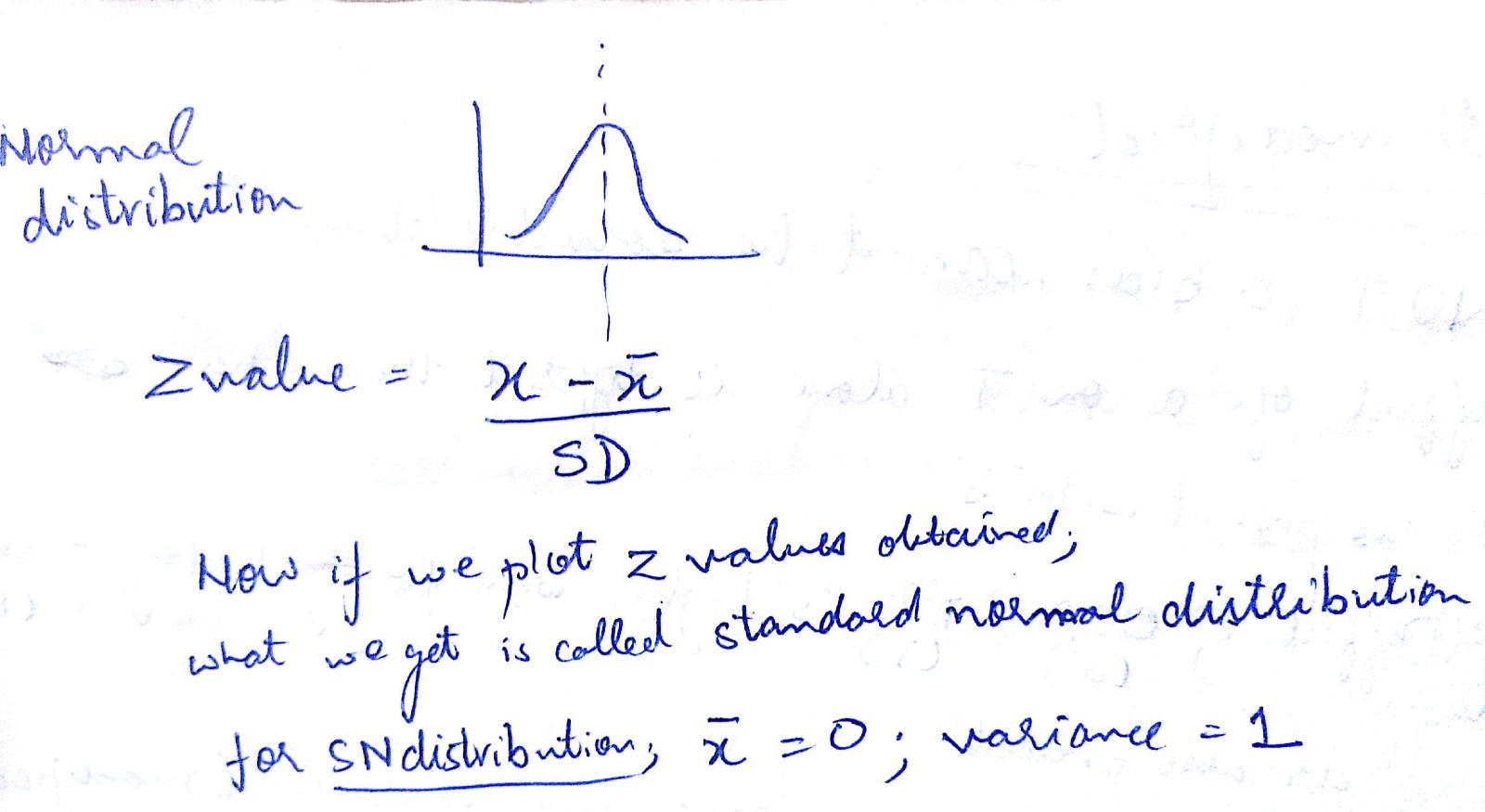
Z score indicates how many SD a given value is from the mean
9
What type of study uses subjects as their own controls?
What type of study uses subjects as their own controls?
Crossover studies
Crossover studies
10
disease prevention involves preventing a disease before it occurs
Primary disease prevention involves preventing a disease before it occurs
11
disease prevention involves early screening and managements of existing, asymptomatic disease
Secondary disease prevention involves early screening and managements of existing, asymptomatic disease
12
disease prevention involves early reduction in complications from disease
Tertiary disease prevention involves early reduction in complications from disease
13
disease prevention involves identifying patients at risk of unnecessary treatment
Quaternary disease prevention involves identifying patients at risk of unnecessary treatment
14
Immunizations are an example of disease prevention
Immunizations are an example of primary disease prevention
15
Mammograms are an example of disease prevention
Mammograms are an example of secondary disease prevention
16
Cardiac rehabilitation programs are an example of disease prevention
Cardiac rehabilitation programs are an example of tertiary disease prevention
17
The effect is also called the Observer-expectancy effect
The Pygmalion effect is also called the Observer-expectancy effect
18
The Pygmalion effect is also called the effect
The Pygmalion effect is also called the Observer-expectancy effect
19
Which study type is shown below?
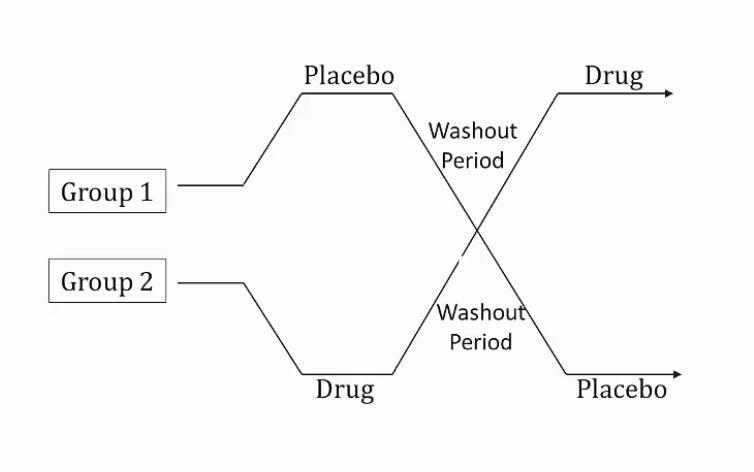
Which study type is shown below?
Crossover study
Crossover study
20
The following data has a skew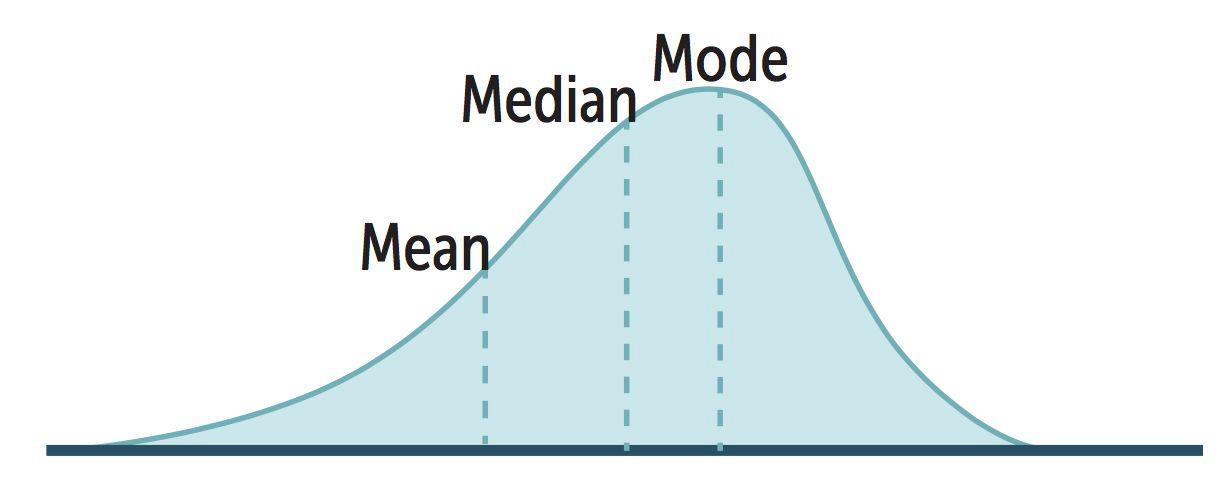
The following data has a negative skew
21
The following data has a skew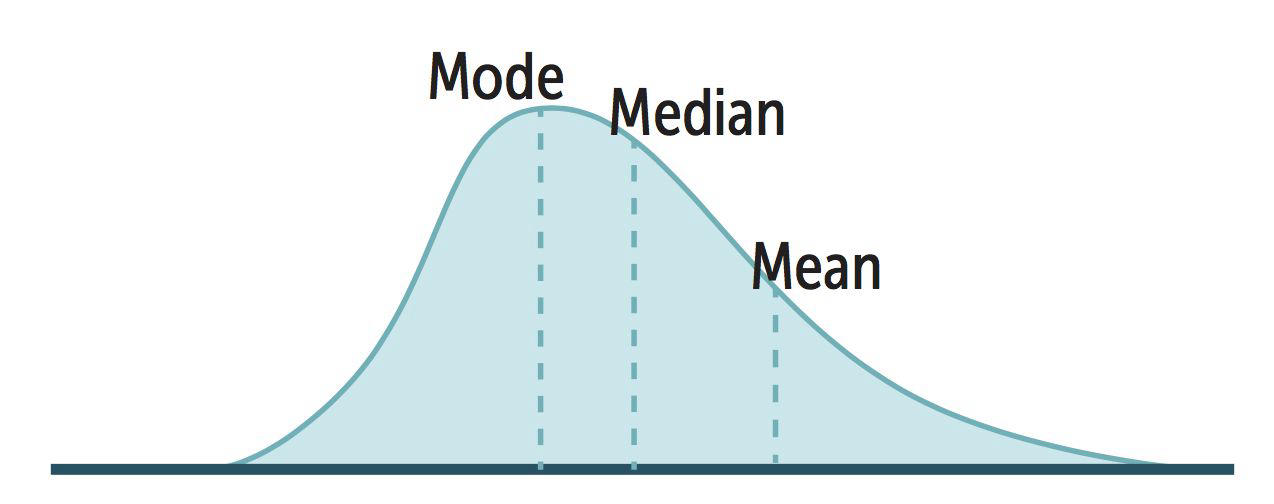
The following data has a positive skew
22
= (SD)2
Variance = (SD)2
23
Variance = ( )2
Variance = (SD)2
24
The checks the differences between means of 2 groups
Paired - same/comparable groups
Unpaired - different groups
Paired - same/comparable groups
Unpaired - different groups
The T-test checks the differences between means of 2 groups
Paired - same/comparable groups
Unpaired - different groups
Paired - same/comparable groups
Unpaired - different groups
25
The T-test checks the differences between
Paired - same/comparable groups
Unpaired - different groups
Paired - same/comparable groups
Unpaired - different groups
The T-test checks the differences between means of 2 groups
Paired - same/comparable groups
Unpaired - different groups
Paired - same/comparable groups
Unpaired - different groups
26
The T-test checks the differences between means of 2 groups
Paired - groups
Unpaired - groups
Paired - groups
Unpaired - groups
The T-test checks the differences between means of 2 groups
Paired - same/comparable groups
Unpaired - different groups
Paired - same/comparable groups
Unpaired - different groups
27
The checks the differences between means of 3 or more groups
The ANOVA checks the differences between means of 3 or more groups
28
The ANOVA checks the differences between
The ANOVA checks the differences between means of 3 or more groups
29
The checks the differences between 2 or more categorical outcomes
The Chi-square test (χ2) checks the differences between 2 or more categorical outcomes
30
The Chi-square test (χ2) checks the differences between
The Chi-square test (χ2) checks the differences between 2 or more categorical outcomes
31
What test compares two means of same group and evaluates if they are statistically different?
paired T-test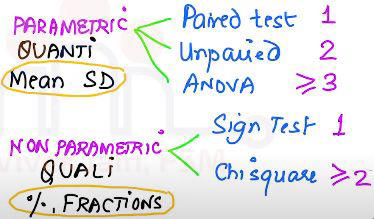
32
What analysis of variance compares more than 2 quantitative means?
ANOVA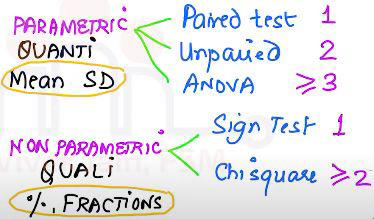
33
What test compares the difference between categorical variables?
Chi-square (χ2)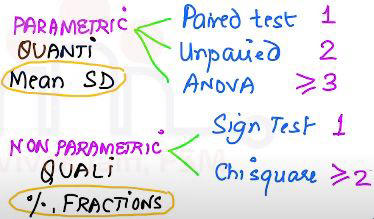
34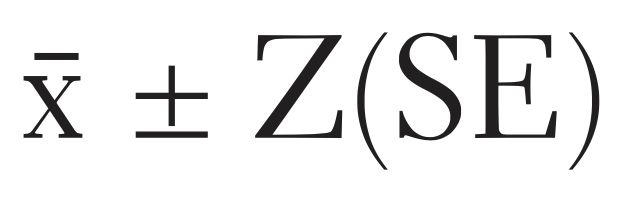
What is the formula for the confidence interval?
35
By age 12 months, an infant's weight should and height should increase by %
By age 12 months, an infant's weight should triple and height should increase by 50%
36
Which measure of central tendency has the highest value in a positively skewed data set?
Mean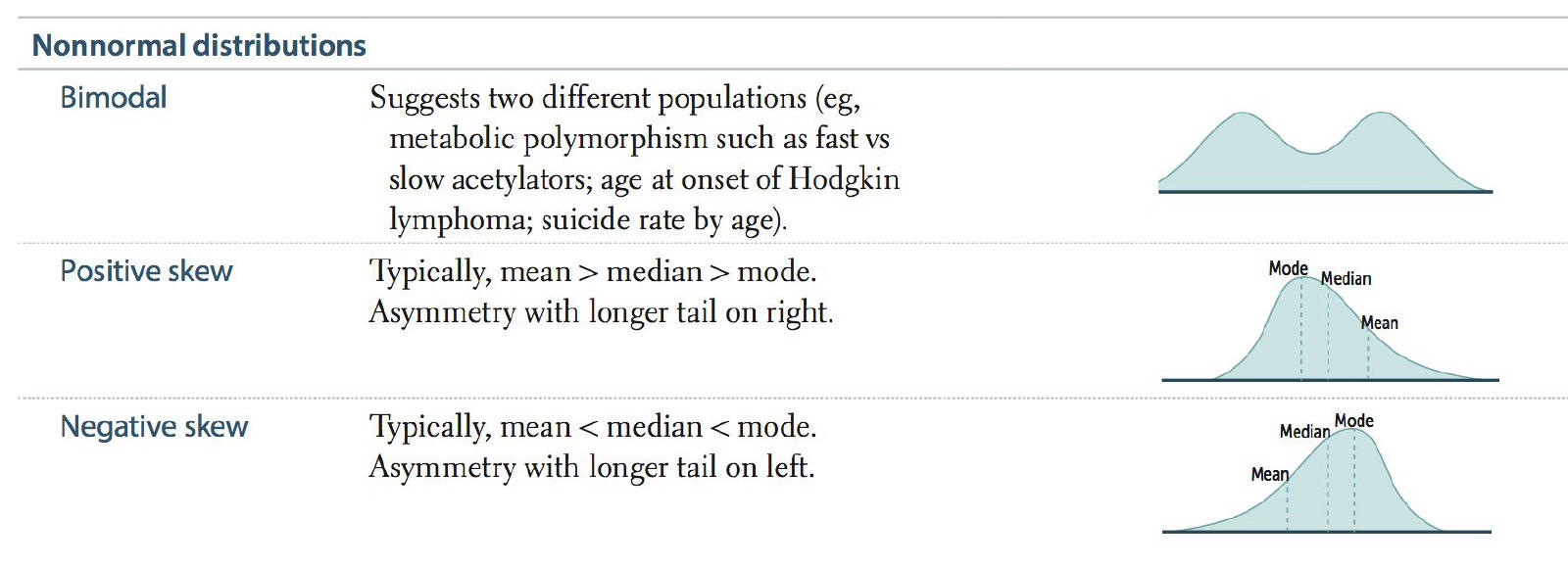
37
Which measure of central tendency has the lowest value in a positively skewed data set?
Mode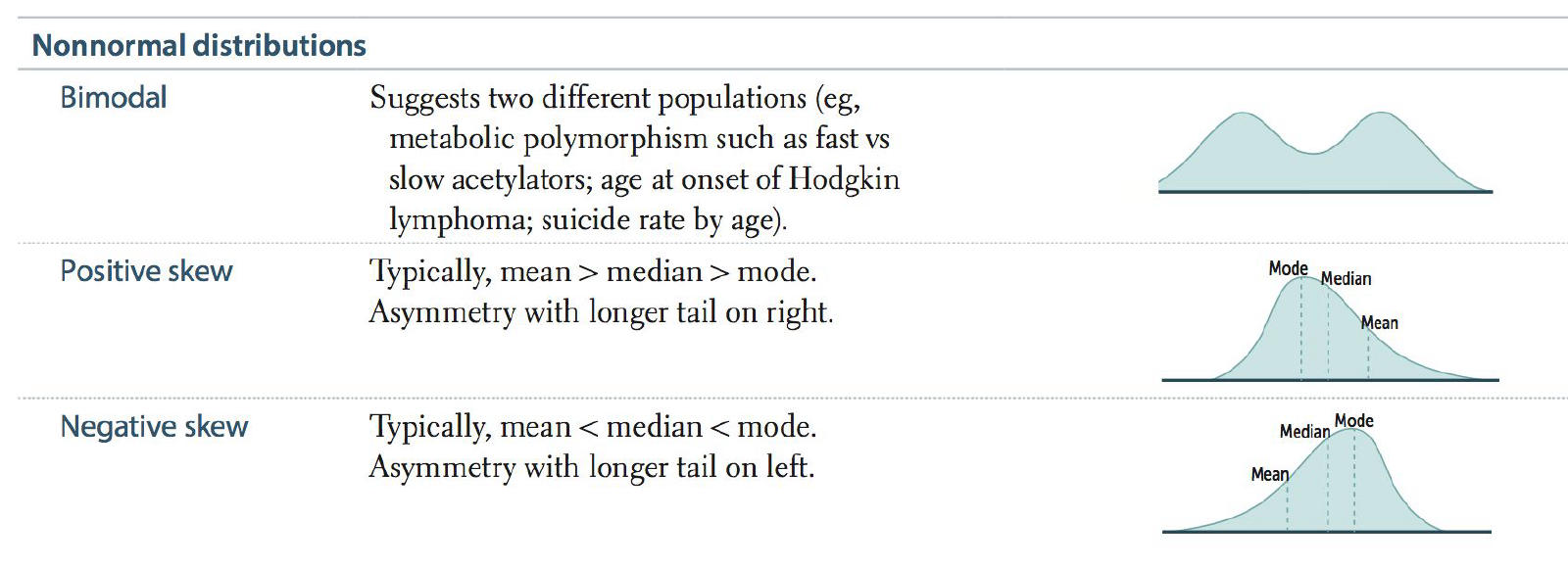
38
Which measure of central tendency has the lowest value in a negatively skewed data set?
Mean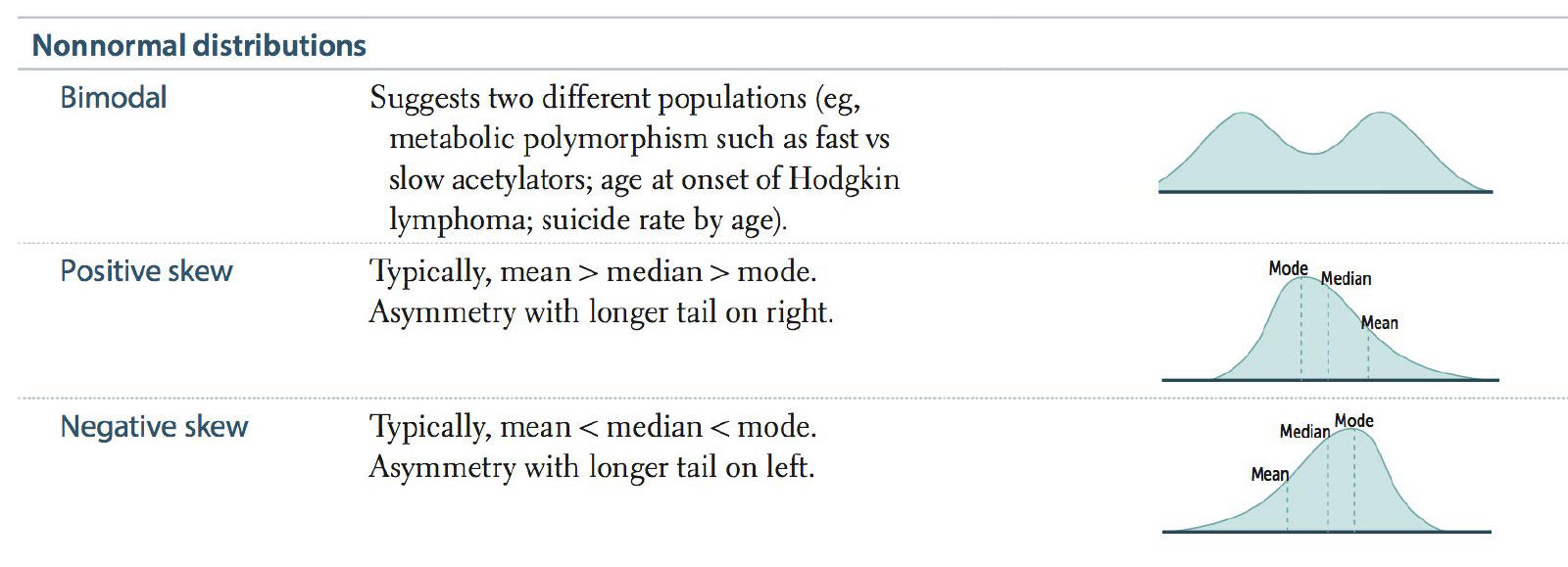
39
Which measure of central tendency has the highest value in a negatively skewed data set?
Mode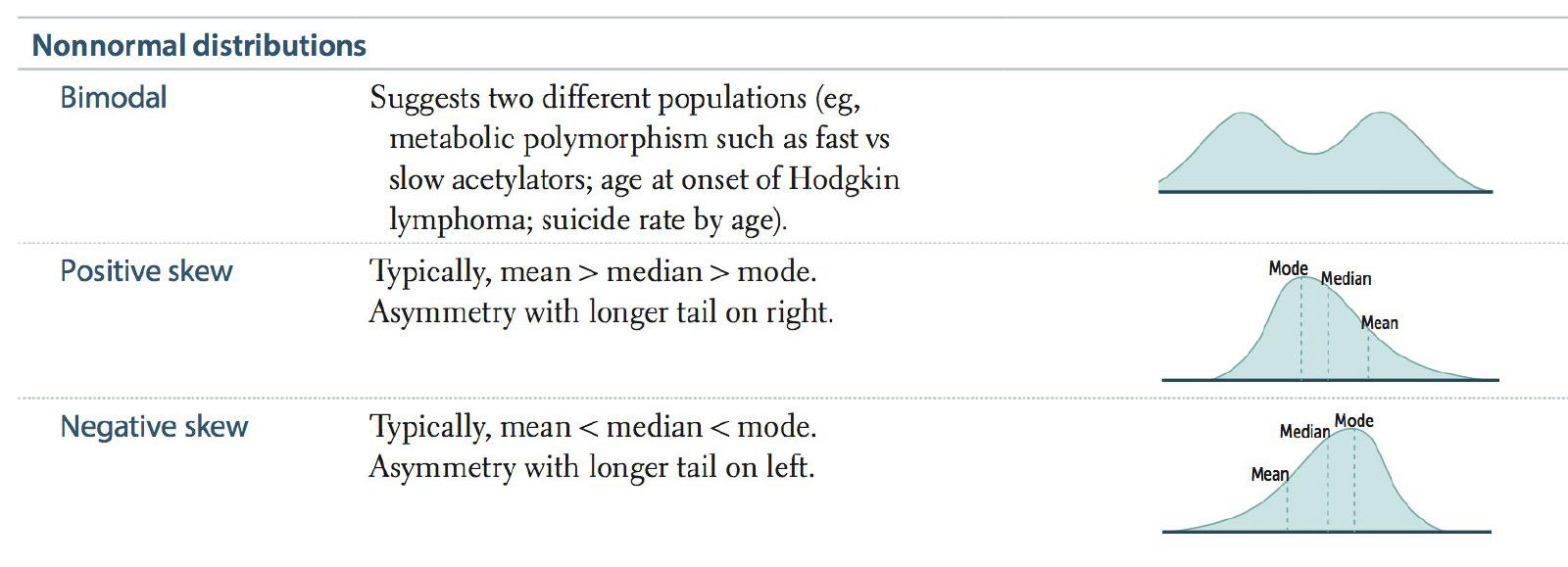
40
Standard deviation squared, equals which statistical value?
Variance
• Measure of dispersion in a data set
• Related to standard deviation
• Average degree to which each point differs from the mean
SD =
• Measure of dispersion in a data set
• Related to standard deviation
• Average degree to which each point differs from the mean
SD =
41
What is the value of Z in a 99% Confidence Interval?
2.58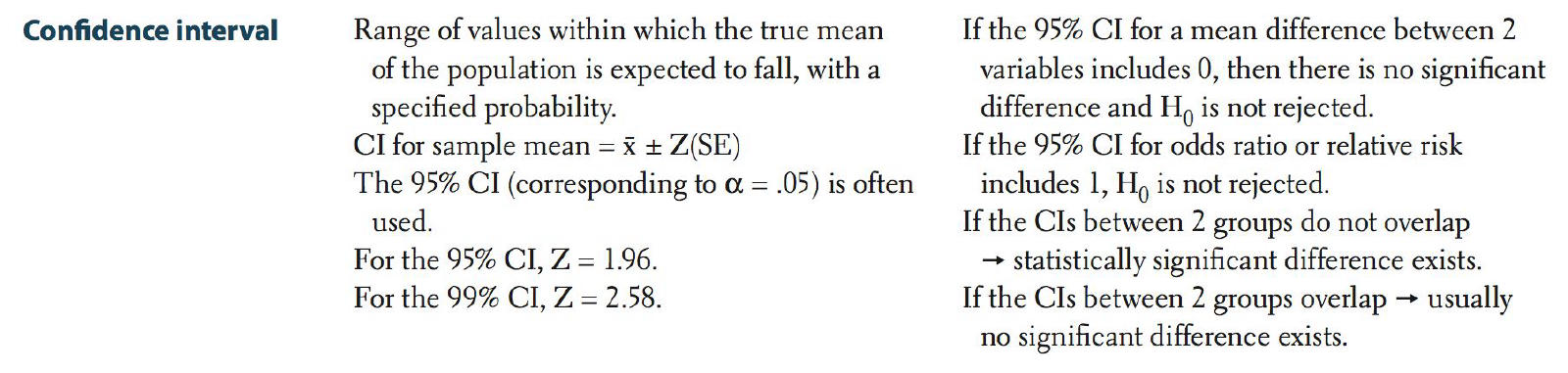
42
= the mean +/- (Z)(Standard Error)
Confidence Interval = the mean +/- (Z)(Standard Error)
43
Confidence Interval = the mean +/-
Confidence Interval = the mean +/- (Z)(Standard Error)
44
What is the X-axis in a ROC curve?
1-Specificity (FP rate)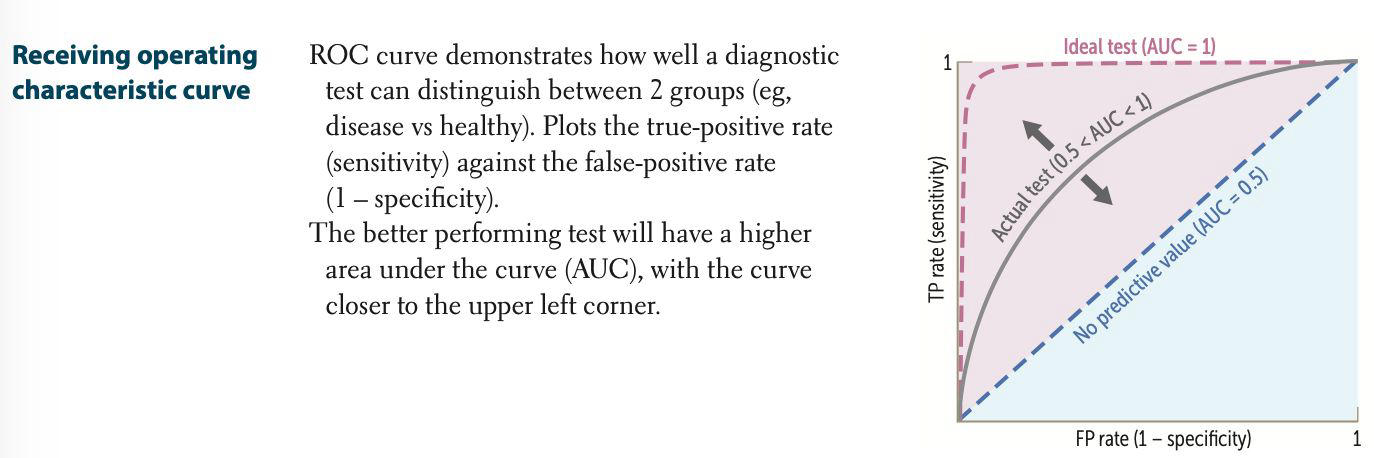
45
What is the Y-axis in a ROC curve?
Sensitivity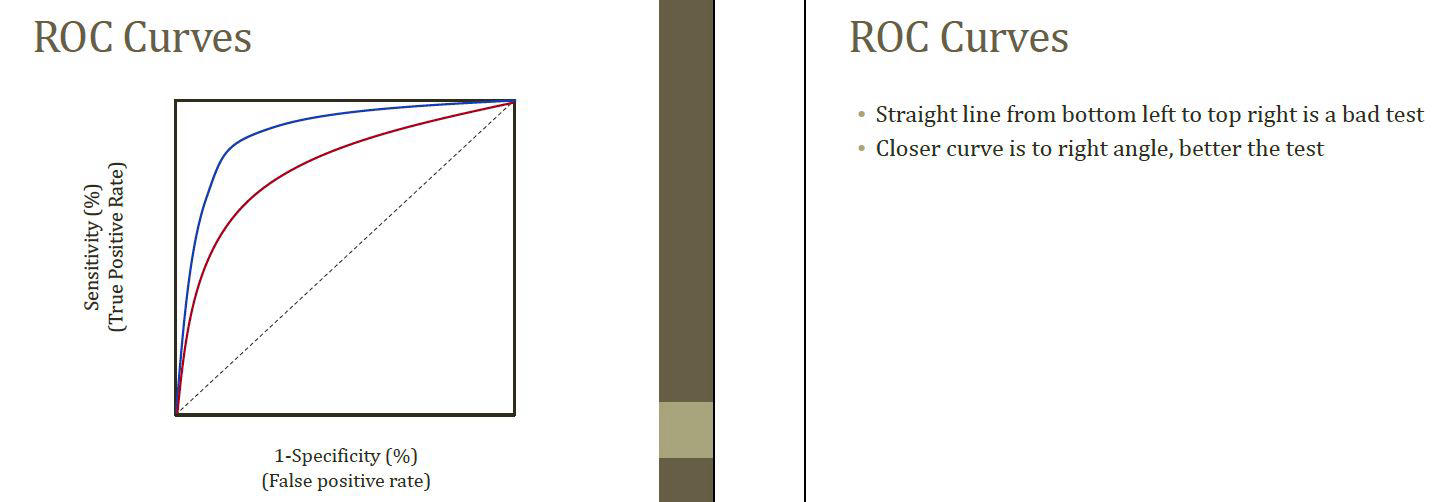
46
Pneumococcal vaccine(PCV13 vs PPSV23) schedule for adults with:
1) Sickle cell disease
2) Smoker
3) HIV
4) CLD
5) CKD
6) Chronic lung dz
7) Alcoholic
8) Diabetes
9) CSF leak
10) CHD
11) Cancer
1) Sickle cell disease
2) Smoker
3) HIV
4) CLD
5) CKD
6) Chronic lung dz
7) Alcoholic
8) Diabetes
9) CSF leak
10) CHD
11) Cancer
Pneumococcal Polysaccharide Vaccine(PPSV)
Pneumococcal Conjugate Vaccine(PCV)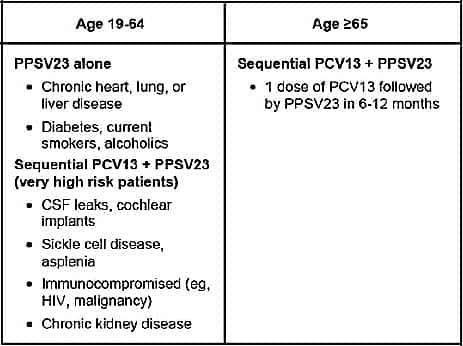
Pneumococcal Conjugate Vaccine(PCV)
47
A cohort study was conducted to assess the relationship between caffeine consumption and colon cancer in middle aged women. Study shows caffeine consumption decreases the risk of colon cancer. The fact that this study was conducted specifically in middle aged women raises most concerns regarding what?
generalizability or external validity
"How generalizable are the results of a study to other populations?"
Internal validity (validity as generally taught): "Are results obtained in this specific cohort valid?"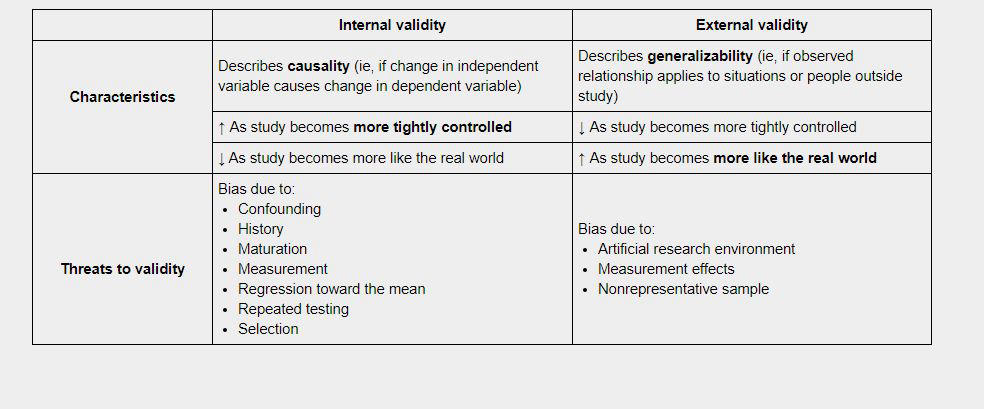
"How generalizable are the results of a study to other populations?"
Internal validity (validity as generally taught): "Are results obtained in this specific cohort valid?"
48
For a study patients are randomised to initial treatment with either a ß blocker , ACE inhibitor or a CCB and to 1 of 2 mean arterial BP goals (102-107mmHg or <92mmHg). This study is best classified as ?
Factorial design.
A factorial design involves 2 or more experimental interventions (eg assigning 1 of 3 drugs), each with 2 or more variables that are studied independently (eg different BP goals).
Compare with parallel study:
a parallel study randomizes one treatment to one group and different treatment to other group. There are usually no other variables measured such as two BP goals in this study.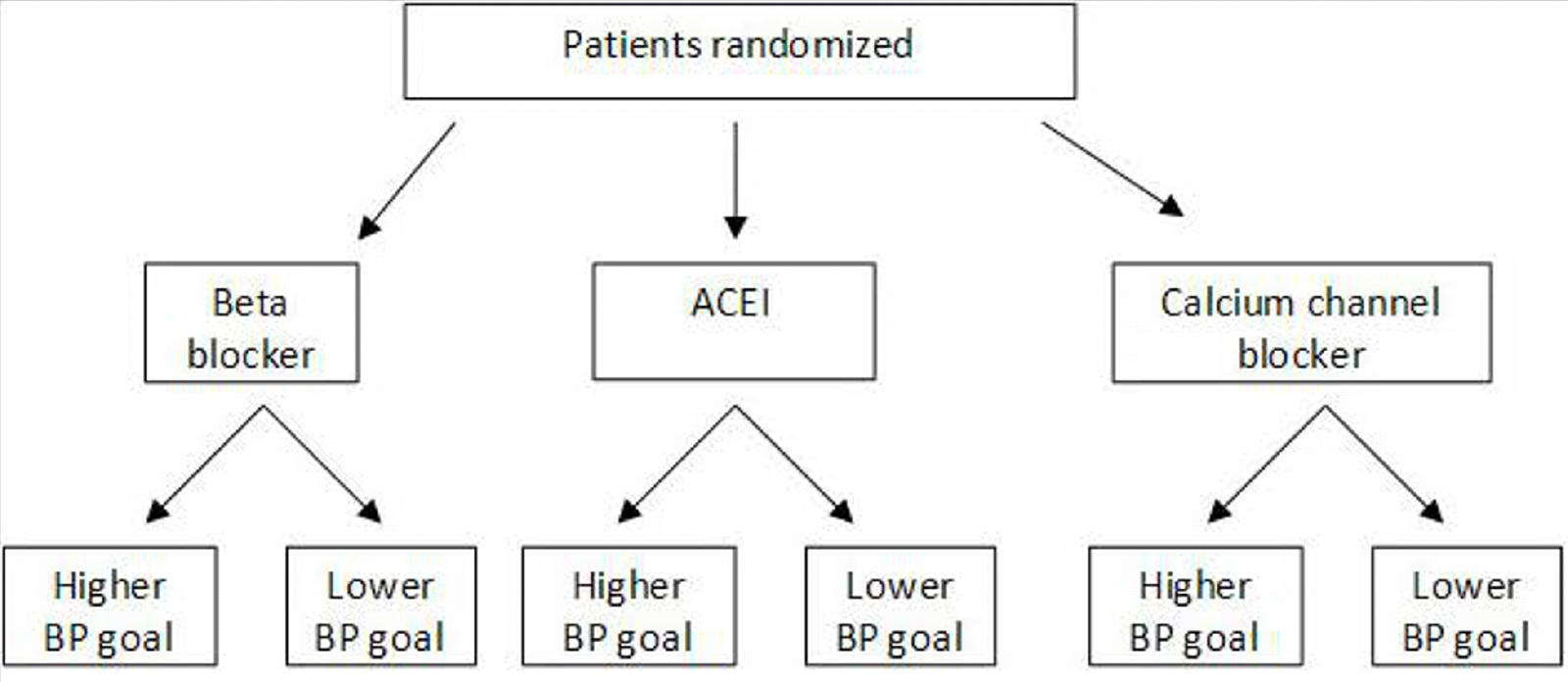
A factorial design involves 2 or more experimental interventions (eg assigning 1 of 3 drugs), each with 2 or more variables that are studied independently (eg different BP goals).
Compare with parallel study:
a parallel study randomizes one treatment to one group and different treatment to other group. There are usually no other variables measured such as two BP goals in this study.
49
How do the following values change when moving the cutoff point of a screening test from B to A?
Sensitivity:
Specificity:
PPV:
NPV: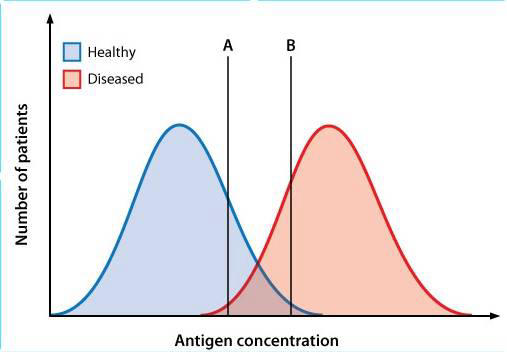
Sensitivity:
Specificity:
PPV:
NPV:
How do the following values change when moving the cutoff point of a screening test from B to A?
Sensitivity: increased
Specificity: decreased
PPV: decreased
NPV: increased
Sensitivity: increased
Specificity: decreased
PPV: decreased
NPV: increased
50
When raising the cutoff point for a disease, the and will increase.
When raising the cutoff point for a disease, the specificity and PPV will increase.
51
When raising the cutoff point for a disease, the specificity and PPV will .
When raising the cutoff point for a disease, the specificity and PPV will increase.
52
This funnel plot suggests what?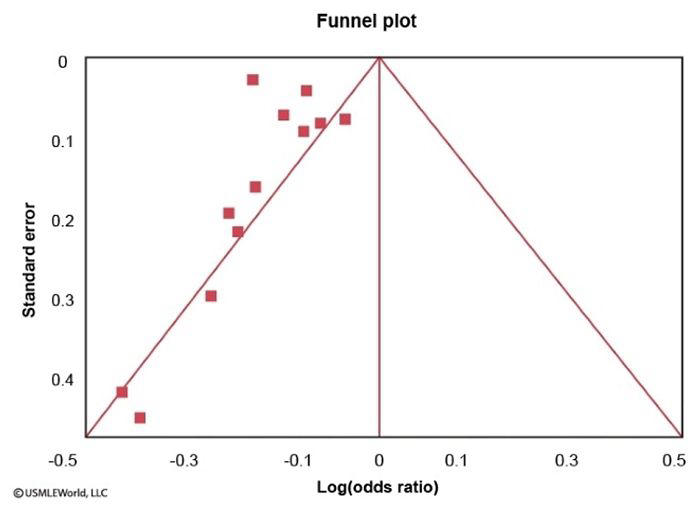
publication bias
This is used in meta-analysis
In funnel plot, a measure of sample size(eg standard error) is plotted on y-axis and some measure of effect (eg odds ratio) on x-axis.
Now we typically use log scale so that the plot is symmetrical.
Log1= 0
So the centre of this particular plot in question is Odds ratio of 1.
The bottom of the chart is scattered as the standard error is high due to low sample size.
At top, the values are closer to the actual value, with lower values far away.
Ideally, this plot should be symmetrical.
If not, it suggests that some studies (eg those with negative results, or ones with low sample number were not published. It could also mean that researches of meta-analysis did not do a thorough research of published material)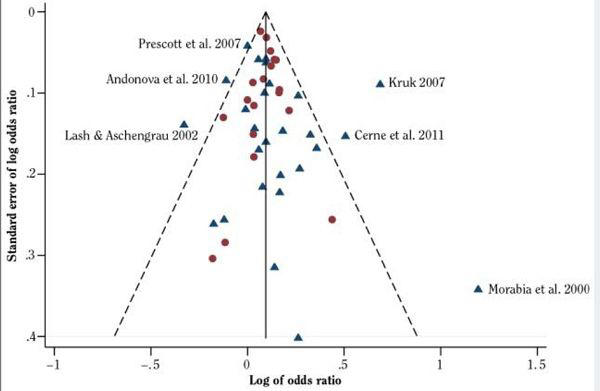
This is used in meta-analysis
In funnel plot, a measure of sample size(eg standard error) is plotted on y-axis and some measure of effect (eg odds ratio) on x-axis.
Now we typically use log scale so that the plot is symmetrical.
Log1= 0
So the centre of this particular plot in question is Odds ratio of 1.
The bottom of the chart is scattered as the standard error is high due to low sample size.
At top, the values are closer to the actual value, with lower values far away.
Ideally, this plot should be symmetrical.
If not, it suggests that some studies (eg those with negative results, or ones with low sample number were not published. It could also mean that researches of meta-analysis did not do a thorough research of published material)
53
The following are possible results of a non-invasive study showing control drug - test drug differences
Explain each of these outcomes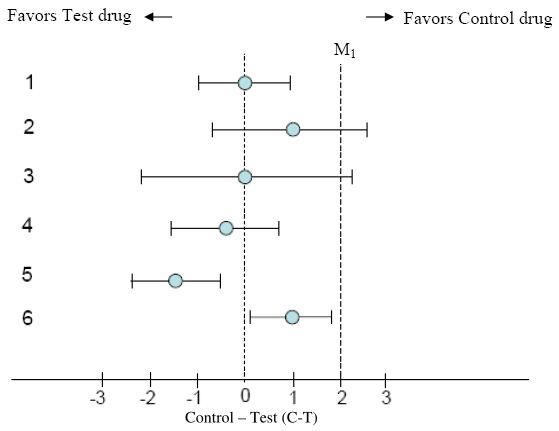
Explain each of these outcomes
This is a non inferiority study.
The blue central dot is called "point estimate"
Explanations:
1) Not inferior; not superior
2) "not non-inferior"; not superior
3) not-non inferior; not superior
4) non-inferior, not superior.
5) not inferior, superior.
6) non-inferior; inferior
Understanding the Figures and Their Correlation
The images you provided are explaining the outcomes of a non-inferiority trial comparing a test drug to a control drug. These trials aim to determine whether the test drug is not unacceptably worse than the control drug by a predefined margin (M1). Let’s break it down systematically.
---
1st Image: The Possible Outcomes
This image shows different point estimates (blue dots) with confidence intervals (CIs), and their placement relative to zero (no difference) and M1 (non-inferiority margin). Each of the six cases represents a possible outcome:
1. Not Inferior; Not Superior
The CI crosses 0 but remains within M1.
The test drug is neither inferior nor superior, meaning it has similar effectiveness to the control.
2. Not Non-Inferior; Not Superior
The CI extends beyond M1.
The test drug does not meet the non-inferiority criteria and cannot be considered superior.
3. Not Non-Inferior; Not Superior
The CI extends beyond M1.
Again, non-inferiority is not proven, and superiority is also not demonstrated.
4. Non-Inferior; Not Superior
The CI is entirely within M1.
The test drug is proven to be non-inferior but not better than the control drug.
5. Not Inferior; Superior
The CI is within M1 and does not cross 0.
The test drug is both non-inferior and superior.
6. Non-Inferior; Inferior
The CI is above 0 but still within M1.
The test drug meets non-inferiority criteria but is actually inferior to the control.
---
2nd and 3rd Images: Concept of Non-Inferiority Trials
The black squares in the second and third images represent point estimates, with horizontal lines as CIs.
The vertical red line at 0 represents no difference.
The blue dashed line represents the non-inferiority margin (M1).
Key concepts explained in these images:
1. Superiority Trials vs. Non-Inferiority Trials
A superiority trial aims to show that a test drug is better than a control drug.
A non-inferiority trial aims to show that the test drug is not significantly worse than the control drug.
2. Understanding Placement of Confidence Intervals
If the CI lies entirely to the right of M1, the test drug is non-inferior.
If the CI crosses M1, non-inferiority is not proven.
If the CI crosses 0, superiority is not demonstrated.
---
Correlation Between All Three Images
The first image provides possible statistical outcomes of a non-inferiority trial.
The second and third images explain the statistical logic behind non-inferiority trials using a different visual representation.
The key takeaway is that a non-inferiority margin (M1) must be considered first, and superiority is only assessed if non-inferiority is established.
Would you like me to go deeper into any specific part?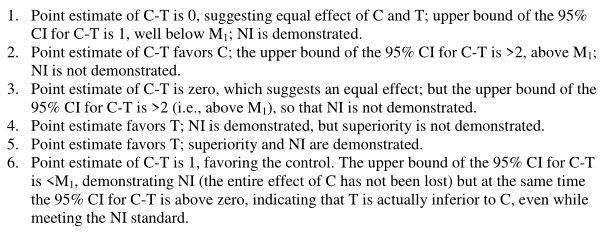
The blue central dot is called "point estimate"
Explanations:
1) Not inferior; not superior
2) "not non-inferior"; not superior
3) not-non inferior; not superior
4) non-inferior, not superior.
5) not inferior, superior.
6) non-inferior; inferior
Understanding the Figures and Their Correlation
The images you provided are explaining the outcomes of a non-inferiority trial comparing a test drug to a control drug. These trials aim to determine whether the test drug is not unacceptably worse than the control drug by a predefined margin (M1). Let’s break it down systematically.
---
1st Image: The Possible Outcomes
This image shows different point estimates (blue dots) with confidence intervals (CIs), and their placement relative to zero (no difference) and M1 (non-inferiority margin). Each of the six cases represents a possible outcome:
1. Not Inferior; Not Superior
The CI crosses 0 but remains within M1.
The test drug is neither inferior nor superior, meaning it has similar effectiveness to the control.
2. Not Non-Inferior; Not Superior
The CI extends beyond M1.
The test drug does not meet the non-inferiority criteria and cannot be considered superior.
3. Not Non-Inferior; Not Superior
The CI extends beyond M1.
Again, non-inferiority is not proven, and superiority is also not demonstrated.
4. Non-Inferior; Not Superior
The CI is entirely within M1.
The test drug is proven to be non-inferior but not better than the control drug.
5. Not Inferior; Superior
The CI is within M1 and does not cross 0.
The test drug is both non-inferior and superior.
6. Non-Inferior; Inferior
The CI is above 0 but still within M1.
The test drug meets non-inferiority criteria but is actually inferior to the control.
---
2nd and 3rd Images: Concept of Non-Inferiority Trials
The black squares in the second and third images represent point estimates, with horizontal lines as CIs.
The vertical red line at 0 represents no difference.
The blue dashed line represents the non-inferiority margin (M1).
Key concepts explained in these images:
1. Superiority Trials vs. Non-Inferiority Trials
A superiority trial aims to show that a test drug is better than a control drug.
A non-inferiority trial aims to show that the test drug is not significantly worse than the control drug.
2. Understanding Placement of Confidence Intervals
If the CI lies entirely to the right of M1, the test drug is non-inferior.
If the CI crosses M1, non-inferiority is not proven.
If the CI crosses 0, superiority is not demonstrated.
---
Correlation Between All Three Images
The first image provides possible statistical outcomes of a non-inferiority trial.
The second and third images explain the statistical logic behind non-inferiority trials using a different visual representation.
The key takeaway is that a non-inferiority margin (M1) must be considered first, and superiority is only assessed if non-inferiority is established.
Would you like me to go deeper into any specific part?
54
A study examined the role of humanized monoclonal antibody (mAb) that binds soluble forms of amyloid in treating alzheimer's disease. Patients were randomly assigned to a mAb injection or placebo group for 14 months. The outcome included changes in the cognitive performance assessed by different scores at week 72 compared to baseline. Higher scores indicate worse impairment. The following numbers were reported for patients with mild and moderate Alzheimer disease.
Is the effect of mAb different in mild versus moderate Alzheimer's disease?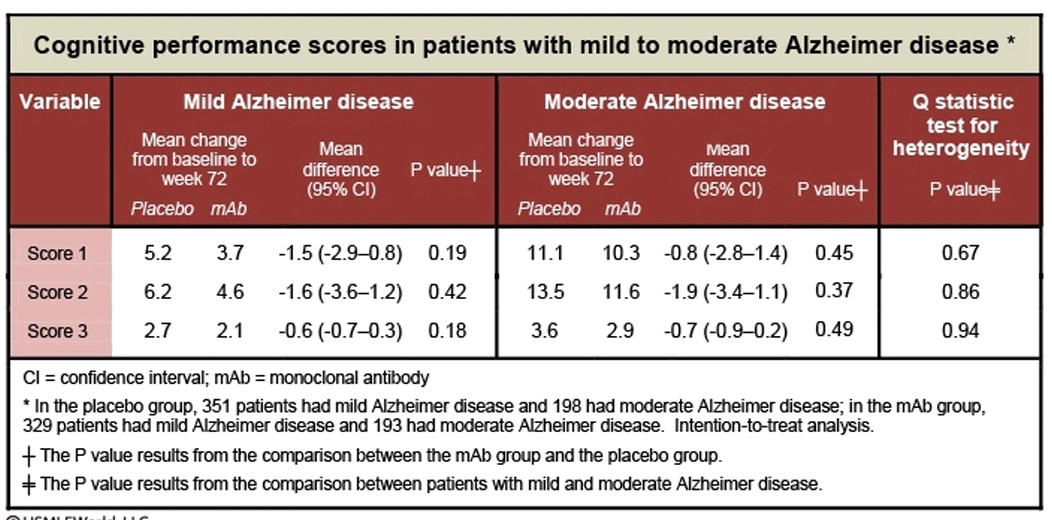
Is the effect of mAb different in mild versus moderate Alzheimer's disease?
No, there is no differential response to mAb therapy depending upon Alzheimer disease severity
Before presenting different studies in the same analysis you have to make sure that these studies are similar i.e there is no heterogeneity so that you are comparing apples with apples and not oranges. There are different tests to measure heterogeneity namely chi-square test and I²index.
Heterogeneity testing is particularly important when conducting a meta-analysis of several trials as it can provide insight about the combinability of multiple studies.
This question:
The 2 categories (mild vs moderate) were evaluated separately but presented in the same analysis, so chi squared test for heterogeneity helps to exclude differences between them
From chi-squared test, Q-statistic is calculated.
Ho: there is no difference in the two study groups(no heterogeneity)
H1: The two study groups are different
If we cannot reject the Ho, it means that the 2 studies are similar.
So, if Q statistic is >0.05, there is no difference b/w the 2 groups.
another company used heterogeneity test is I² index(derived from Q statistic).
I² index=0 means no heterogeneity
I² index 25%: low heterogeneity
I² index 50%: moderate
I² index 75%: high heterogeneity
55
The table shows impact of risk factors on DLBCL in HIV positive patients
The authors of the study have decided to conduct a follow-up analysis on their data.
They decided to stratify their results by CD4 count at the time of diagnosis. Among patients with CD4 counts below 200, RR of high cART is 0.52, p=0.01. However among patients with CD4 counts above 200, no relationship was found (RR=0.96, p=0.36).
What explains this?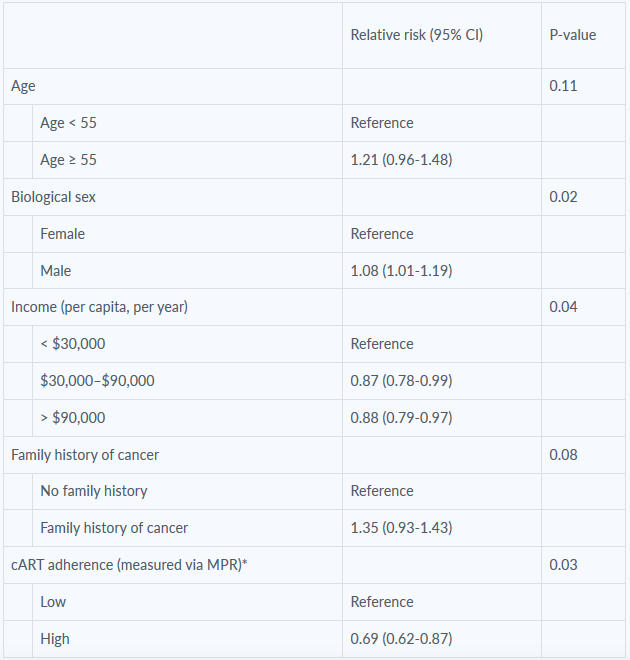
The authors of the study have decided to conduct a follow-up analysis on their data.
They decided to stratify their results by CD4 count at the time of diagnosis. Among patients with CD4 counts below 200, RR of high cART is 0.52, p=0.01. However among patients with CD4 counts above 200, no relationship was found (RR=0.96, p=0.36).
What explains this?
Effect modification
Stratification of the patients by CD4 count reveals that the relationship between ART adherence and DLBCL risk is present for CD4 count<200 but not CD4 count>200.
NOT confounding
If confounding was present, after stratification, the apparent relationship b/w ART adherence and DLBCL would disappear.
i.e RR of developing DLBCL would be same (equal to 1) in both CD4<200 and CD4>200.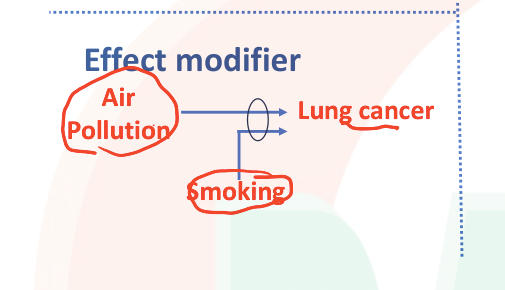
Stratification of the patients by CD4 count reveals that the relationship between ART adherence and DLBCL risk is present for CD4 count<200 but not CD4 count>200.
NOT confounding
If confounding was present, after stratification, the apparent relationship b/w ART adherence and DLBCL would disappear.
i.e RR of developing DLBCL would be same (equal to 1) in both CD4<200 and CD4>200.
56
The presence of makes Lowenstein Jenson medium a selective media by inhibiting other bacteria
The presence of malachite green makes Lowenstein Jenson medium a selective media by inhibiting other bacteria
57
Under RNTCP, A New case is defined as a TB patient who had:
• or • Taken ATT for < 1 month
• or • Taken ATT for < 1 month
Under RNTCP, A New case is defined as a TB patient who had:
• Never taken ATT previously or • Taken ATT for < 1 month
• Never taken ATT previously or • Taken ATT for < 1 month
58
Under RNTCP, A New case is defined as a TB patient who had:
• Never taken ATT previously or • Taken ATT for
• Never taken ATT previously or • Taken ATT for
Under RNTCP, A New case is defined as a TB patient who had:
• Never taken ATT previously or • Taken ATT for < 1 month
• Never taken ATT previously or • Taken ATT for < 1 month
59
Previously treated Case: Patients who have received or more of Anti TB drugs in the past
Previously treated Case: Patients who have received 1 month or more of Anti TB drugs in the past
60
TB: A TB patient who had completed course of treatment / declared cured and now presenting as microbiologically confirmed case
Recurrent TB: A TB patient who had completed course of treatment / declared cured and now presenting as microbiologically confirmed case
61
: Patients who had been treated for TB and their treatment failed at the end of most recent course of treatment
Treatment after failure: Patients who had been treated for TB and their treatment failed at the end of most recent course of treatment
62
Treatment after failure: Patients who had been treated for TB and their treatment at the end of most recent course of treatment
Treatment after failure: Patients who had been treated for TB and their treatment failed at the end of most recent course of treatment
63
As per the latest recommendation, the MOHFW has decided that all previously treated TB patients (earlier known as category II) will be initiated on regimen
As per the latest recommendation, the MOHFW has decided that all previously treated TB patients (earlier known as category II) will be initiated on standard first-line ATT regimen
64
Steroids maybe used in HIV -ve patients with TB and for 4 weeks
but not Pleural TB
but not Pleural TB
Steroids maybe used in HIV -ve patients with TB meningitis and pericarditis for 4 weeks
but not Pleural TB
but not Pleural TB
65
Steroids maybe used in HIV -ve patients with TB meningitis and pericarditis for weeks
but not Pleural TB
but not Pleural TB
Steroids maybe used in HIV -ve patients with TB meningitis and pericarditis for 4 weeks
but not Pleural TB
but not Pleural TB
66
Steroids maybe used in HIV -ve patients with TB meningitis and pericarditis for 4 weeks
but not TB
but not TB
Steroids maybe used in HIV -ve patients with TB meningitis and pericarditis for 4 weeks
but not Pleural TB
but not Pleural TB
67
The Index TB guidelines are for TB
The Index TB guidelines are for extra pulmonary TB
68
assay maybe used as an adjunct in the diagnosis of lymph node TB and TB meningitis.
X-pert MTB/RIF assay maybe used as an adjunct in the diagnosis of lymph node TB and TB meningitis.
69
X-pert MTB/RIF assay maybe used as an adjunct in the diagnosis of TB and TB .
X-pert MTB/RIF assay maybe used as an adjunct in the diagnosis of lymph node TB and TB meningitis.
70
The first of xerophthalmia is nyctalopia.
The first symptom of xerophthalmia is nyctalopia.
71
The first symptom of xerophthalmia is .
The first symptom of xerophthalmia is nyctalopia.
72
The first of xerophthalmia is conjunctival xerosis
The first sign of xerophthalmia is conjunctival xerosis
73
The first sign of xerophthalmia is
The first sign of xerophthalmia is conjunctival xerosis
74
The pathognomonic feature of xerophthalmia is the appearance of .
The pathognomonic feature of xerophthalmia is the appearance of Bitot's spots.
75
index is used to identify the importance of hookworm infestation as a public health problem in a community.
Chandlers index is used to identify the importance of hookworm infestation as a public health problem in a community.
76
Chandlers index is used to identify the importance of infestation as a public health problem in a community.
Chandlers index is used to identify the importance of hookworm infestation as a public health problem in a community.
77
Measures for cholera control:
• Early case detection
• Water control by of water
• Proper disposal of excreta
• Early case detection
• Water control by of water
• Proper disposal of excreta
Measures for cholera control:
• Early case detection
• Water control by chlorination of water
• Proper disposal of excreta
• Early case detection
• Water control by chlorination of water
• Proper disposal of excreta
78
Does likelihood ratio change with prevalence?
Does likelihood ratio change with prevalence?
No
No
79
A large likelihood ratio is strong evidence to rule the disease.
A small likelihood ratio is strong evidence to rule the disease.
A small likelihood ratio is strong evidence to rule the disease.
A large likelihood ratio is strong evidence to rule in the disease.
A small likelihood ratio is strong evidence to rule out the disease.
A small likelihood ratio is strong evidence to rule out the disease.
80
T/F?
Drug A is non-inferior compared to warfarin in preventing MI.
Drug A is superior compared to warfarin in preventing MI.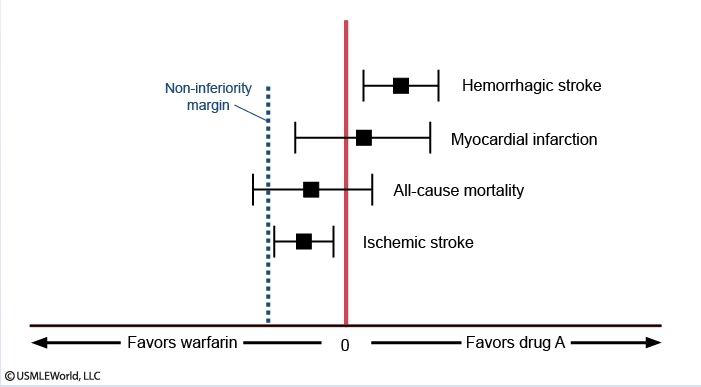
Drug A is non-inferior compared to warfarin in preventing MI.
Drug A is superior compared to warfarin in preventing MI.
T/F?
Drug A is non-inferior compared to warfarin in preventing MI. T
Drug A is superior compared to warfarin in preventing MI. F
Drug A is non-inferior compared to warfarin in preventing MI. T
Drug A is superior compared to warfarin in preventing MI. F
81
What selection bias occurs when a sample consisting of only working individuals is selected and is compared to the general population?
What selection bias occurs when a sample consisting of only working individuals is selected and is compared to the general population?
Healthy worker effect
Healthy worker effect
82
analysis refers to repeating primary analysis calculations in a study by modifying certain variables to determine whether such modifications affect the original results.
Sensitivity analysis refers to repeating primary analysis calculations in a study by modifying certain variables to determine whether such modifications affect the original results.
83
bias occurs when false results are produced by non-random sampling leading to differences in the study vs. target population.
Ascertainment (sampling) bias occurs when false results are produced by non-random sampling leading to differences in the study vs. target population.
84
A test has repeated values of 7, 8, 5,7, 8.
The actual value however is 15.
This test has
Precision :
Accuracy: Low
Validity: Low
Reliability: High
The actual value however is 15.
This test has
Precision :
Accuracy: Low
Validity: Low
Reliability: High
A test has repeated values of 7, 8, 5,7, 8.
The actual value however is 15.
This test has
Precision : High
Accuracy: Low
Validity: Low
Reliability: High
The actual value however is 15.
This test has
Precision : High
Accuracy: Low
Validity: Low
Reliability: High
85
A test has repeated values of 7, 8, 5,7, 8.
The actual value however is 15.
This test has
Precision : High
Accuracy:
Validity: Low
Reliability: High
The actual value however is 15.
This test has
Precision : High
Accuracy:
Validity: Low
Reliability: High
A test has repeated values of 7, 8, 5,7, 8.
The actual value however is 15.
This test has
Precision : High
Accuracy: Low
Validity: Low
Reliability: High
The actual value however is 15.
This test has
Precision : High
Accuracy: Low
Validity: Low
Reliability: High
86
A test has repeated values of 7, 8, 5,7, 8.
The actual value however is 15.
This test has
Precision : High
Accuracy: Low
Validity:
Reliability: High
The actual value however is 15.
This test has
Precision : High
Accuracy: Low
Validity:
Reliability: High
A test has repeated values of 7, 8, 5,7, 8.
The actual value however is 15.
This test has
Precision : High
Accuracy: Low
Validity: Low
Reliability: High
The actual value however is 15.
This test has
Precision : High
Accuracy: Low
Validity: Low
Reliability: High
87
A test has repeated values of 7, 8, 5,7, 8.
The actual value however is 15.
This test has
Precision : High
Accuracy: Low
Validity: Low
Reliability:
The actual value however is 15.
This test has
Precision : High
Accuracy: Low
Validity: Low
Reliability:
A test has repeated values of 7, 8, 5,7, 8.
The actual value however is 15.
This test has
Precision : High
Accuracy: Low
Validity: Low
Reliability: High
The actual value however is 15.
This test has
Precision : High
Accuracy: Low
Validity: Low
Reliability: High
88
Accuracy is aka
Accuracy is aka Validity
89
This test has
Precision :
Accuracy: High
Validity: High
Reliability: Low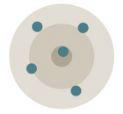
Precision :
Accuracy: High
Validity: High
Reliability: Low
This test has
Precision : Low
Accuracy: High
Validity: High
Reliability: Low
Precision : Low
Accuracy: High
Validity: High
Reliability: Low
90
This test has
Precision : Low
Accuracy:
Validity: High
Reliability: Low
Precision : Low
Accuracy:
Validity: High
Reliability: Low
This test has
Precision : Low
Accuracy: High
Validity: High
Reliability: Low
Precision : Low
Accuracy: High
Validity: High
Reliability: Low
91
This test has
Precision : Low
Accuracy: High
Validity:
Reliability: Low
Precision : Low
Accuracy: High
Validity:
Reliability: Low
This test has
Precision : Low
Accuracy: High
Validity: High
Reliability: Low
Precision : Low
Accuracy: High
Validity: High
Reliability: Low
92
This test has
Precision : Low
Accuracy: High
Validity: High
Reliability:
Precision : Low
Accuracy: High
Validity: High
Reliability:
This test has
Precision : Low
Accuracy: High
Validity: High
Reliability: Low
Precision : Low
Accuracy: High
Validity: High
Reliability: Low
93
Values within 1 standard deviation encapsulate % of all data
Values within 1 standard deviation encapsulate 68% of all data
94
Values within 2 standard deviations encapsulate % of all data
Values within 2 standard deviations encapsulate 95% of all data
95
Values within 3 standard deviations encapsulate % of all data
Values within 3 standard deviations encapsulate 99.7% of all data
96
Total people: 200Mean Hb: 10.5
Standard deviation: 0.5
Number of people below Hb of 9.5:
Standard deviation: 0.5
Number of people below Hb of 9.5:
Total people: 200Mean Hb: 10.5
Standard deviation: 0.5
Number of people below Hb of 9.5: 5
Standard deviation: 0.5
Number of people below Hb of 9.5: 5
97
Addition of kcalories/day is recommended in first trimester of pregnancy.
Addition of zero kcalories/day is recommended in first trimester of pregnancy.
98
Addition of kilocalories/day is recommended in second trimester of pregnancy.
Addition of 350 kilocalories/day is recommended in second trimester of pregnancy.
99
Addition of kilocalories/day is recommended in 3rd trimester of pregnancy.
Addition of 452 kilocalories/day is recommended in 3rd trimester of pregnancy.
100
Addition of kilocalories/day is recommended in first 6 months of lactation.
Addition of 600 kilocalories/day is recommended in first 6 months of lactation.
101
Addition of kilocalories/day is recommended from 6-12 months of lactation.
Addition of 520 kilocalories/day is recommended from 6-12 months of lactation.
102
Estimated Average Requirement for Sedentary Male <60yrs old is
Estimated Average Requirement for Sedentary Male <60yrs old is 2110
103
Estimated Average Requirement for Sedentary Female <60yrs old is
Estimated Average Requirement for Sedentary Female <60yrs old is 1660
104
Estimated Average Requirement for Sedentary Female >60yrs old is
Estimated Average Requirement for Sedentary Female >60yrs old is 1500
105
Estimated Average Requirement for Sedentary male >60yrs old is
Estimated Average Requirement for Sedentary male >60yrs old is 1700
106
Pregnancy test introduced by govt:
Pregnancy test introduced by govt: Nishchay
107
Duration of what kind of epidemic falls within one incubation period of a particular disease?
Duration of what kind of epidemic falls within one incubation period of a particular disease?
Point source, single exposure
Point source, single exposure
108
Contaminated well water in a village is an example of what type of epidemic?
Contaminated well water in a village is an example of what type of epidemic?
Point source, multiple exposure
Point source, multiple exposure
109
Food poisoning is an example of what type of epidemic?
Food poisoning is an example of what type of epidemic?
Point source, single exposure
Point source, single exposure
110
COVID is an example of what type of epidemic?
COVID is an example of what type of epidemic?
Propagated epidemic
Propagated epidemic
111
Biostastical definition of epidemic?
Biostastical definition of epidemic?
Cases= Mean number of cases + 2SD
Cases= Mean number of cases + 2SD
112
When do we call a disease endemic?
)
)
When do we call a disease endemic?
When it is always present in population (eg TB, measles, dengue, malaria etc)
When it is always present in population (eg TB, measles, dengue, malaria etc)
113
looks after1) Pregnant Women
2) Sick Infants
2) Sick Infants
Janani Shishu Suraksha Karyakram looks after1) Pregnant Women
2) Sick Infants
2) Sick Infants
114
Janani Shishu Suraksha Karyakram looks after1)
2) Sick Infants
2) Sick Infants
Janani Shishu Suraksha Karyakram looks after1) Pregnant Women
2) Sick Infants
2) Sick Infants
115
Janani Shishu Suraksha Karyakram looks after1) Pregnant Women
2)
2)
Janani Shishu Suraksha Karyakram looks after1) Pregnant Women
2) Sick Infants
2) Sick Infants
116
ensures quality antenatal care so that a pregnant women recieves at least 1 check up in her 2nd and 3rd trimester by a doctor in clinic on 9th day of every month
Pradhan Mantri Surakshit Matritva Abhiyaan (PMSMA) ensures quality antenatal care so that a pregnant women recieves at least 1 check up in her 2nd and 3rd trimester by a doctor in clinic on 9th day of every month
117
Pradhan Mantri Surakshit Matritva Abhiyaan (PMSMA) ensures quality antenatal care so that a pregnant women recieves at least check up in her 2nd and 3rd trimester by a doctor in clinic on 9th day of every month
Pradhan Mantri Surakshit Matritva Abhiyaan (PMSMA) ensures quality antenatal care so that a pregnant women recieves at least 1 check up in her 2nd and 3rd trimester by a doctor in clinic on 9th day of every month
118
Pradhan Mantri Surakshit Matritva Abhiyaan (PMSMA) ensures quality antenatal care so that a pregnant women recieves at least 1 check up in her and trimester by a doctor in clinic on 9th day of every month
Pradhan Mantri Surakshit Matritva Abhiyaan (PMSMA) ensures quality antenatal care so that a pregnant women recieves at least 1 check up in her 2nd and 3rd trimester by a doctor in clinic on 9th day of every month
119
Pradhan Mantri Surakshit Matritva Abhiyaan (PMSMA) ensures quality antenatal care so that a pregnant women recieves at least 1 check up in her 2nd and 3rd trimester by a doctor in clinic on day of every month
Pradhan Mantri Surakshit Matritva Abhiyaan (PMSMA) ensures quality antenatal care so that a pregnant women recieves at least 1 check up in her 2nd and 3rd trimester by a doctor in clinic on 9th day of every month
120
The initiative is for improving the quality of labour rooms and providing respectful maternity care.
The LaQshya initiative is for improving the quality of labour rooms and providing respectful maternity care.
121
Insulin syringe would be disposed in
Insulin syringe would be disposed in white container
122
Which of the following VVM suggests that the vaccine should be discarded?
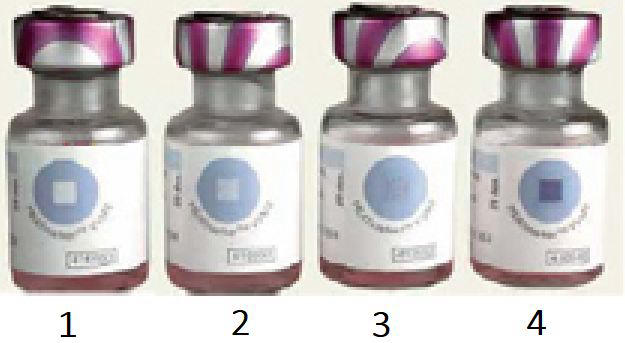
Which of the following VVM suggests that the vaccine should be discarded?
3, 4
3, 4
123
Doing pap smear screening in healthy women is an example of prevention
Doing pap smear screening in healthy women is an example of secondary prevention
124
Doing neonatal hypothyroidism screeing in newborn is an example of prevention
Doing neonatal hypothyroidism screeing in newborn is an example of secondary prevention
125
Doing prospective screening of COVID infection among international passengers at airport is an example of prevention
Doing prospective screening of COVID infection among international passengers at airport is an example of primary prevention
126
Diagnosis and treatment of disease comes under prevention.
Diagnosis and treatment of disease comes under secondary prevention.
127
Health promotion and specific protection against a disease comes under prevention
Health promotion and specific protection against a disease comes under primary prevention
128
All vaccines are examples of prevention
All vaccines are examples of primary prevention
129
BCG vaccine used for treatment of bladder cancer is an example of prevention
BCG vaccine used for treatment of bladder cancer is an example of secondary prevention
130
Disability limitation and rehabilitation for a disease is an example of prevention
Disability limitation and rehabilitation for a disease is an example of tertiary prevention
131
Mosquito nets are an example of prevention
Mosquito nets are an example of primary prevention
132
DDT sprays are an example of prevention
DDT sprays are an example of primary prevention
133
A primodial level of prevention for prevention of malaria would be to
A primodial level of prevention for prevention of malaria would be to eliminate breeding sites
134
Doctor advicing a patient to stop smoking is an example of prevention.
Doctor advicing a patient to stop smoking is an example of primary prevention.
135
Total students: 100,000Mean score: 628
SD: 18
How many students scored more than 664?
SD: 18
How many students scored more than 664?
Total students: 100,000Mean score: 628
SD: 18
How many students scored more than 664?
2500
SD: 18
How many students scored more than 664?
2500
136
In triage, what patients are assigned color "black"?
In triage, what patients are assigned color "black"?
dead/moribund(at point of death)
dead/moribund(at point of death)
137
In triage, what patients are assigned color "green"?
In triage, what patients are assigned color "green"?
Ambulatory patients(minor illness liike abrasions)
Ambulatory patients(minor illness liike abrasions)
138
In triage, what patients are assigned color "yellow"?
In triage, what patients are assigned color "yellow"?
Those who need resuscitation/surgery within 24hrs(eg isolated simple fracture)
Those who need resuscitation/surgery within 24hrs(eg isolated simple fracture)
139
In triage, what patients are assigned color "red"?
In triage, what patients are assigned color "red"?
Those who need IMMEDIATE resuscitation/surgery within 6hrs(eg massive hemorrhage/tension pneumothorax)
Those who need IMMEDIATE resuscitation/surgery within 6hrs(eg massive hemorrhage/tension pneumothorax)
140
In a train wreck, a passenger has suspected undisplaced fracture of the tibia.That triage color should be assigned to him?
In a train wreck, a passenger has suspected undisplaced fracture of the tibia.That triage color should be assigned to him?
Yellow
Yellow
141
Blood bags are to be disposed in bin
Blood bags are to be disposed in yellow bin
142
Working women with already 2 surviving children are entitled to a paid maternity leave of
Working women with already 2 surviving children are entitled to a paid maternity leave of 12wks
143
Working women with 1 surviving child is entitled to a paid maternity leave of wks
Working women with 1 surviving child is entitled to a paid maternity leave of 12-26wks
144
According to WHO, the quality of the drinking water is considered to be satisfactory if the presumptive coliform count is /100 mL
According to WHO, the quality of the drinking water is considered to be satisfactory if the presumptive coliform count is 0/100 mL
145
Stages of demographic cycle:
Stage1:
Stage2:
Stage3: Late Expanding
Stage4: Low stationary
Stage5: Declining
Stage1:
Stage2:
Stage3: Late Expanding
Stage4: Low stationary
Stage5: Declining
Stages of demographic cycle:
Stage1: High stationary
Stage2: Early Expanding
Stage3: Late Expanding
Stage4: Low stationary
Stage5: Declining
Stage1: High stationary
Stage2: Early Expanding
Stage3: Late Expanding
Stage4: Low stationary
Stage5: Declining
146
Stages of demographic cycle:
Stage1: High stationary
Stage2: Early Expanding
Stage3:
Stage4:
Stage5: Declining
Stage1: High stationary
Stage2: Early Expanding
Stage3:
Stage4:
Stage5: Declining
Stages of demographic cycle:
Stage1: High stationary
Stage2: Early Expanding
Stage3: Late Expanding
Stage4: Low stationary
Stage5: Declining
Stage1: High stationary
Stage2: Early Expanding
Stage3: Late Expanding
Stage4: Low stationary
Stage5: Declining
147
Stages of demographic cycle:
Stage1: High stationary
Stage2: Early Expanding
Stage3: Late Expanding
Stage4: Low stationary
Stage5:
Stage1: High stationary
Stage2: Early Expanding
Stage3: Late Expanding
Stage4: Low stationary
Stage5:
Stages of demographic cycle:
Stage1: High stationary
Stage2: Early Expanding
Stage3: Late Expanding
Stage4: Low stationary
Stage5: Declining
Stage1: High stationary
Stage2: Early Expanding
Stage3: Late Expanding
Stage4: Low stationary
Stage5: Declining
148
Which stage of demographic cycle is characterized by high birth rate and high death rate?
Which stage of demographic cycle is characterized by high birth rate and high death rate?
High stationary
High stationary
149
What is the name of the stage of demographic cycle that is characterized by high birth rate and low death rate?
What is the name of the stage of demographic cycle that is characterized by high birth rate and low death rate?
Early expanding stage(stage2)
Early expanding stage(stage2)
150
In the demographic cycle, which is the first stage when birth rate falls?
In the demographic cycle, which is the first stage when birth rate falls?
Late expanding stage(stage3)
Late expanding stage(stage3)
151
What is the stage of demographic cycle when death rate is more than birth rate/
What is the stage of demographic cycle when death rate is more than birth rate/
Stage 5(Declining stage)
Stage 5(Declining stage)
152
What is the stage of demographic cycle when there is maximum demographic gap?
What is the stage of demographic cycle when there is maximum demographic gap?
Late stage 2
Late stage 2
153
What is the stage of demographic cycle marked by the arrow?
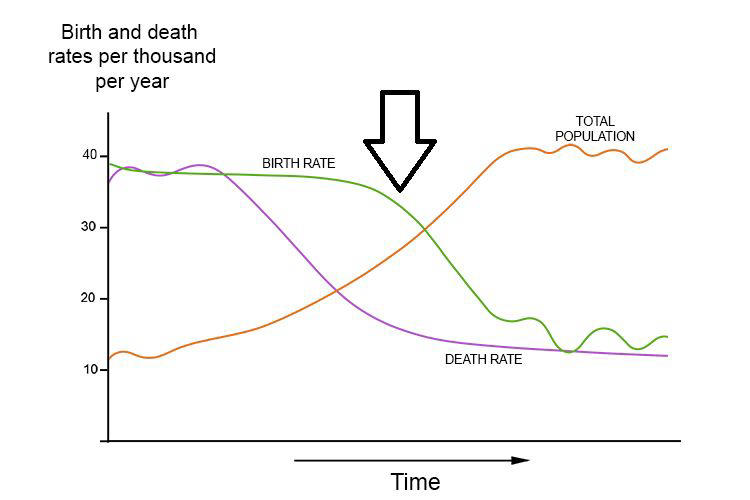
What is the stage of demographic cycle marked by the arrow?
Late expanding(Stage 3)
Late expanding(Stage 3)
154
During what phases of demographic cycle are the birth rate and death rates nearly equal?
Stage and Stage
Stage and Stage
During what phases of demographic cycle are the birth rate and death rates nearly equal?
Stage 1 and Stage 4
Stage 1 and Stage 4
155
At what phase of demographic cycle is India currently in?
At what phase of demographic cycle is India currently in?
Late expanding(Stage 3)
Late expanding(Stage 3)
156
Crude birth rate is defined as

Crude birth rate is defined as
157
Total number of children born to a female in her lifetime is called as
Total number of children born to a female in her lifetime is called as Total Fertility Rate.
158
Total number of girl children born to a female in her lifetime regrardless of the mortality of children is called as
Total number of girl children born to a female in her lifetime regrardless of the mortality of children is called as Gross Fertility Rate
159
Total number of girl children born to a female in her lifetime taking into account the of girl children is called as Net Reproductive Rate(NRR)
Total number of girl children born to a female in her lifetime taking into account the mortality of girl children is called as Net Reproductive Rate(NRR)
160
Total number of girl children born to a female in her lifetime taking into account the mortality of girl children is called as
Total number of girl children born to a female in her lifetime taking into account the mortality of girl children is called as Net Reproductive Rate(NRR)
161
What is the mathematical relationship between Total fertility and the Gross Reproductive rate?
What is the mathematical relationship between Total fertility and the Gross Reproductive rate?
Gross Reproductive rate = 1/2 Total fertility rate
Gross Reproductive rate = 1/2 Total fertility rate
162
Current total fertility rate of India is
Current total fertility rate of India is 2.2
163
Current NRR of India is
Current NRR of India is 1.1
164
Target total fertility rate of India(TFR) is by 2025
Target total fertility rate of India(TFR) is 2.1 by 2025
165
Target Net reproductive rate(NRR) is by 2025
Target Net reproductive rate(NRR) is 1 by 2025
166
Most important demographic fertility indicator is
Most important demographic fertility indicator is Net reproductive rate(NRR)
167
To achieve Net reproductive rate of 1, ideal couple protection rate should be %
To achieve Net reproductive rate of 1, ideal couple protection rate should be 60%
168
Economic dependency ratio(DR) is calculated as:

Economic dependency ratio(DR) is calculated as:
169
Lipofuscin is an pigment.
Lipofuscin is an endogenous pigment.
170
is an intracellular pigment which is a tell tale sign of free radical injury to the cell.
Lipofuscin is an intracellular pigment which is a tell tale sign of free radical injury to the cell.
171
Lipofuscin is an intracellular pigment which is a tell tale sign of to the cell.
Lipofuscin is an intracellular pigment which is a tell tale sign of free radical injury to the cell.
172
Lipofuscin predomiantly accumulates in
Lipofuscin predomiantly accumulates in lysosomes
173
A is place where children are kept under the care of a doctor/psychiatrist/other trained personnel
A remand home is place where children are kept under the care of a doctor/psychiatrist/other trained personnel
174
Boys over 16 years who are too difficult to be handled in a
certified school or have misbehaved there, are sent to a
.
certified school or have misbehaved there, are sent to a
.
Boys over 16 years who are too difficult to be handled in a
certified school or have misbehaved there, are sent to a
Borstal.
certified school or have misbehaved there, are sent to a
Borstal.
175
"A steady decline in cigarette sales over the past several decades is associated with the decline in incidence of ischemic heart disease during the same period "
What type of study can produce such results?
What type of study can produce such results?
"A steady decline in cigarette sales over the past several decades is associated with the decline in incidence of ischemic heart disease during the same period "
What type of study can produce such results?
Ecological study/Correlation study
What type of study can produce such results?
Ecological study/Correlation study
176
A researcher found positive correlation b/w the incidence of respiratory problems and the rising pollution in the district. He collected data from the hospital and pollution control board.Type of study?
A researcher found positive correlation b/w the incidence of respiratory problems and the rising pollution in the district. He collected data from the hospital and pollution control board.Type of study?
Ecological study aka correlation study
Ecological study aka correlation study
177
Prevalence of obesity and HTN was collected from 20 states and plotted on a scatter plot. It was seen as prevalance of obesity ↑, prevalance of htn also increases.Type of study?
Prevalence of obesity and HTN was collected from 20 states and plotted on a scatter plot. It was seen as prevalance of obesity ↑, prevalance of htn also increases.Type of study?
Ecological study aka correlation study
Ecological study aka correlation study
178
Identify the type of study:
100 Breast cancer patients are selected. Equal number of normal subjects are enrolled from the each subject's neighbourhood. Each group is asked about their exposure to substances like alcohol, marijuana, tobacco. It is concluded that alcohol is a potential risk factor.
What type of study is this?
100 Breast cancer patients are selected. Equal number of normal subjects are enrolled from the each subject's neighbourhood. Each group is asked about their exposure to substances like alcohol, marijuana, tobacco. It is concluded that alcohol is a potential risk factor.
What type of study is this?
Identify the type of study:
100 Breast cancer patients are selected. Equal number of normal subjects are enrolled from the each subject's neighbourhood. Each group is asked about their exposure to substances like alcohol, marijuana, tobacco. It is concluded that alcohol is a potential risk factor.
What type of study is this?
Case-Control study
179
Case-Control study is a study.
Case-Control study is a retrospective study.
180
risk factors can be studies in case control study at a time.
Multiple risk factors can be studies in case control study at a time.
181
"Patients with autism are almost 2.5 times more likely to have been exposed
to pesticides while in utero than people without autism"
What type of study can produce such a conclusion?
to pesticides while in utero than people without autism"
What type of study can produce such a conclusion?
"Patients with autism are almost 2.5 times more likely to have been exposed
to pesticides while in utero than people without autism"
What type of study can produce such a conclusion?
Case-Control Study
to pesticides while in utero than people without autism"
What type of study can produce such a conclusion?
Case-Control Study
182
ratio is calculated after a case-control study.
Odds ratio is calculated after a case-control study.
183
Odds ratio is calculated after a study.
Odds ratio is calculated after a case-control study.
184
Identify the type of study:
100 smokers and 100 non smokers with age group 35-50 are selected from a community.
They are followed up for 25years.
Subjects were studied for development of abdominal artery aneurysm and myocardial infarction.
It is concluded that smokers were 2.5 times more likely to develop AAA and 2.1 times more likely to develop MI.
Type of study?
Identify the type of study:
100 smokers and 100 non smokers with age group 35-50 are selected from a community.
They are followed up for 25years.
Subjects were studied for development of abdominal artery aneurysm and myocardial infarction.
It is concluded that smokers were 2.5 times more likely to develop AAA and 2.1 times more likely to develop MI.
Type of study?
Prospective cohort study
185
What study can compare incidences of disease in patients with risk factors of interest?
What study can compare incidences of disease in patients with risk factors of interest?
Cohort study
Cohort study
186
ratio is calculated from cohort study.
Relative risk ratio is calculated from cohort study.
187
250 medical students in a classroom are asked about their score in recent professional exam and the hours they spend on social media.It is concluded that less social media time is associated with better performance.
Type of study?
Type of study?
250 medical students in a classroom are asked about their score in recent professional exam and the hours they spend on social media.It is concluded that less social media time is associated with better performance.
Type of study?
Cross-sectional study
Type of study?
Cross-sectional study
188
What is the amino acid score?

What is the amino acid score?
189
Which index is the best indicator of the protein quality?
Which index is the best indicator of the protein quality?
Digestible indispensable amino acid score(DIAAS)
Digestible indispensable amino acid score(DIAAS)
190
What is Digestible indispensable amino acid score(DIAAS)?

What is Digestible indispensable amino acid score(DIAAS)?
191
In family planning, what is the definition of eligible couple.
In family planning, what is the definition of eligible couple.
Couple where age of female is b/w 15-49yrs
Couple where age of female is b/w 15-49yrs
192
What is couple protection rate?

What is couple protection rate?
193
What is effective couple protection rate?

What is effective couple protection rate?
194
What is the formula for pearl index?

What is the formula for pearl index?
195
is a measure of contraceptive failure.
Pearl index is a measure of contraceptive failure.
196
100 women use contraceptive "A" for 2 years each. 10 pregnancies occur. Calculate the pearl index:
100 women use contraceptive "A" for 2 years each. 10 pregnancies occur. Calculate the pearl index:
5 per hundred women years(HWY)
5 per hundred women years(HWY)
197
What are the units of pearl index?
What are the units of pearl index?
Hundred women years
Hundred women years
198
Which as a higher pearl index:
Which as a higher pearl index: tubectomy
199
Which plasmodium species has the longest incubation period?
Which plasmodium species has the longest incubation period?
P.malariae
P.malariae
200
Vitamin A supplementation doses which is given in NIS?
Vitamin A supplementation doses which is given in NIS?
1 lakh at 9months with measles vaccine. After this, 2 lakh units every 6 months till 5 years of age.
1 lakh at 9months with measles vaccine. After this, 2 lakh units every 6 months till 5 years of age.
201
Total dose of vitamin A in the routine immunization schedule is units
Total dose of vitamin A in the routine immunization schedule is 17 lakhs units
202
Treatment of 5month old child with signs of vitamin A deficiency.
Treatment of 5month old child with signs of vitamin A deficiency.
50,000 IUSame dose is repeated next day and on 14th day
50,000 IUSame dose is repeated next day and on 14th day
203
Treatment of 9month old child with signs of vitamin A deficiency.
Treatment of 9month old child with signs of vitamin A deficiency.
1lakh IU
Same dose is repeated next day and on 14th day
1lakh IU
Same dose is repeated next day and on 14th day
204
Treatment of 2yr old child with signs of vitamin A deficiency.
Treatment of 2yr old child with signs of vitamin A deficiency.
2 lakh IU
Same dose is repeated next day and on 14th day
2 lakh IU
Same dose is repeated next day and on 14th day
205
Attempt to commit suicide is defined under section of IPC
Attempt to commit suicide is defined under section 309 of IPC
206
The most sensitive index of recent transmission of malaria is
The most sensitive index of recent transmission of malaria is infant parasite rate
207
What is the minimum recommended content of iodine in salt at the production level?
What is the minimum recommended content of iodine in salt at the production level?
30ppm
30ppm
208
Birth rate is 40 and death rate if 35, then the current annual growth rate is %
Birth rate is 40 and death rate if 35, then the current annual growth rate is 0.5%
209
incidence (API)
In this scenario, API = 100 x 1000/100000
In this scenario, API = 100 x 1000/100000
Annual parasite incidence (API)
In this scenario, API = 100 x 1000/100000
In this scenario, API = 100 x 1000/100000
210
Annual parasite incidence (API)
In this scenario, API =
In this scenario, API =
Annual parasite incidence (API)
In this scenario, API = 100 x 1000/100000
In this scenario, API = 100 x 1000/100000
211
As per rule of halves for hypertension, what does "4" represent?
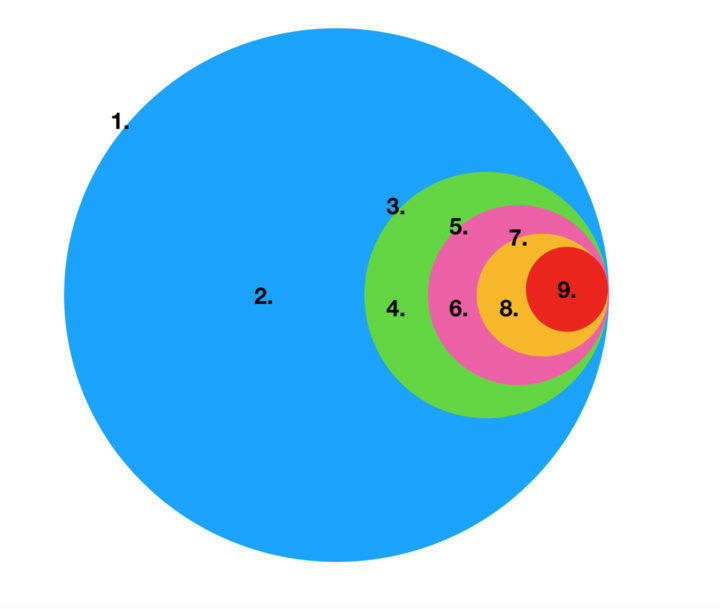
As per rule of halves for hypertension, what does "4" represent?
Undiagnosed hypertension
Undiagnosed hypertension
212
As per rule of halves for hypertension, what does "8" represent?
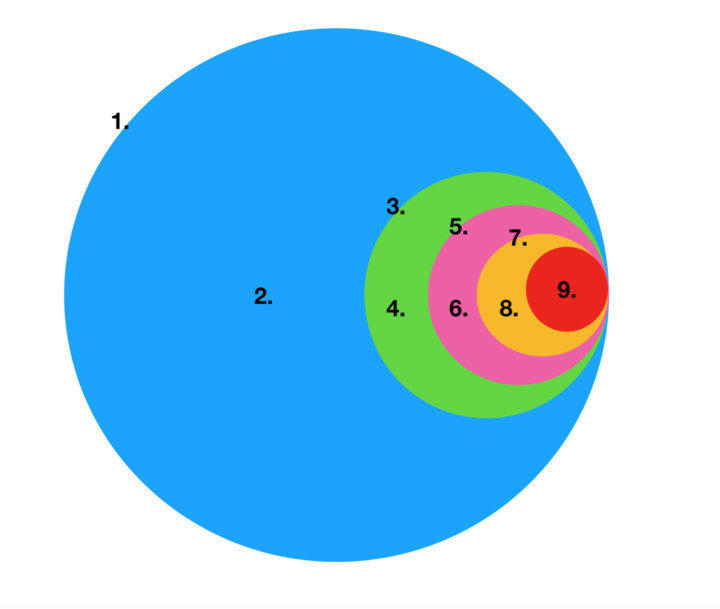
As per rule of halves for hypertension, what does "8" represent?
Inadequately treated patients
Inadequately treated patients
213
As per rule of halves for hypertension, what does "3" represent?
As per rule of halves for hypertension, what does "3" represent?
Hypertensive patients
Hypertensive patients
214
is the longest acting glucocorticoid.
Dexamethasone is the longest acting glucocorticoid.
215
What strain of poliovirus is not covered in bivalent OPV?
What strain of poliovirus is not covered in bivalent OPV?
Strain 2
Strain 2
216
These 7 vaccines were first included in Mission Indradhanush in October 2014 to represent 7 colors of the rainbow:
OPV
D
P
T
HepB
Measles
OPV
D
P
T
HepB
Measles
These 7 vaccines were first included in Mission Indradhanush in October 2014 to represent 7 colors of the rainbow:
BCG
OPV
D
P
T
HepB
Measles
BCG
OPV
D
P
T
HepB
Measles
217
These 7 vaccines were first included in Mission Indradhanush in October 2014 to represent 7 colors of the rainbow:
BCG
D
P
T
HepB
Measles
BCG
D
P
T
HepB
Measles
These 7 vaccines were first included in Mission Indradhanush in October 2014 to represent 7 colors of the rainbow:
BCG
OPV
D
P
T
HepB
Measles
BCG
OPV
D
P
T
HepB
Measles
218
These 7 vaccines were first included in Mission Indradhanush in October 2014 to represent 7 colors of the rainbow:
BCG
OPV
P
T
HepB
Measles
BCG
OPV
P
T
HepB
Measles
These 7 vaccines were first included in Mission Indradhanush in October 2014 to represent 7 colors of the rainbow:
BCG
OPV
D
P
T
HepB
Measles
BCG
OPV
D
P
T
HepB
Measles
219
These 7 vaccines were first included in Mission Indradhanush in October 2014 to represent 7 colors of the rainbow:
BCG
OPV
D
T
HepB
Measles
BCG
OPV
D
T
HepB
Measles
These 7 vaccines were first included in Mission Indradhanush in October 2014 to represent 7 colors of the rainbow:
BCG
OPV
D
P
T
HepB
Measles
BCG
OPV
D
P
T
HepB
Measles
220
These 7 vaccines were first included in Mission Indradhanush in October 2014 to represent 7 colors of the rainbow:
BCG
OPV
D
P
HepB
Measles
BCG
OPV
D
P
HepB
Measles
These 7 vaccines were first included in Mission Indradhanush in October 2014 to represent 7 colors of the rainbow:
BCG
OPV
D
P
T
HepB
Measles
BCG
OPV
D
P
T
HepB
Measles
221
These 7 vaccines were first included in Mission Indradhanush in October 2014 to represent 7 colors of the rainbow:
BCG
OPV
D
P
T
Measles
BCG
OPV
D
P
T
Measles
These 7 vaccines were first included in Mission Indradhanush in October 2014 to represent 7 colors of the rainbow:
BCG
OPV
D
P
T
HepB
Measles
BCG
OPV
D
P
T
HepB
Measles
222
These 7 vaccines were first included in Mission Indradhanush in October 2014 to represent 7 colors of the rainbow:
BCG
OPV
D
P
T
HepB
BCG
OPV
D
P
T
HepB
These 7 vaccines were first included in Mission Indradhanush in October 2014 to represent 7 colors of the rainbow:
BCG
OPV
D
P
T
HepB
Measles
BCG
OPV
D
P
T
HepB
Measles
223
index:
It is the percentage of houses and premises, in a limited well defined area, showing actual breeding of Aedes aegypti larvae. It is a house index
It is the percentage of houses and premises, in a limited well defined area, showing actual breeding of Aedes aegypti larvae. It is a house index
Aedes aegypti index:
It is the percentage of houses and premises, in a limited well defined area, showing actual breeding of Aedes aegypti larvae. It is a house index
It is the percentage of houses and premises, in a limited well defined area, showing actual breeding of Aedes aegypti larvae. It is a house index
224
Aedes aegypti index:
It is the percentage of houses and premises, in a limited well defined area, showing actual breeding of Aedes aegypti larvae. It is a index
It is the percentage of houses and premises, in a limited well defined area, showing actual breeding of Aedes aegypti larvae. It is a index
Aedes aegypti index:
It is the percentage of houses and premises, in a limited well defined area, showing actual breeding of Aedes aegypti larvae. It is a house index
It is the percentage of houses and premises, in a limited well defined area, showing actual breeding of Aedes aegypti larvae. It is a house index
225
In 2018, 5 vaccines were added to the existing 7 vaccines of Mission Indradhanush:
Rubella (as MR vaccine)
H.inflenzae(as pary of Pentavalent)
Pneumococcal pneumoniae
Japanese encephalitis
Rubella (as MR vaccine)
H.inflenzae(as pary of Pentavalent)
Pneumococcal pneumoniae
Japanese encephalitis
In 2018, 5 vaccines were added to the existing 7 vaccines of Mission Indradhanush:
Rotavirus
Rubella (as MR vaccine)
H.inflenzae(as pary of Pentavalent)
Pneumococcal pneumoniae
Japanese encephalitis
Rotavirus
Rubella (as MR vaccine)
H.inflenzae(as pary of Pentavalent)
Pneumococcal pneumoniae
Japanese encephalitis
226
In 2018, 5 vaccines were added to the existing 7 vaccines of Mission Indradhanush:
Rotavirus
H.inflenzae(as pary of Pentavalent)
Pneumococcal pneumoniae
Japanese encephalitis
Rotavirus
H.inflenzae(as pary of Pentavalent)
Pneumococcal pneumoniae
Japanese encephalitis
In 2018, 5 vaccines were added to the existing 7 vaccines of Mission Indradhanush:
Rotavirus
Rubella (as MR vaccine)
H.inflenzae(as pary of Pentavalent)
Pneumococcal pneumoniae
Japanese encephalitis
Rotavirus
Rubella (as MR vaccine)
H.inflenzae(as pary of Pentavalent)
Pneumococcal pneumoniae
Japanese encephalitis
227
In 2018, 5 vaccines were added to the existing 7 vaccines of Mission Indradhanush:
Rotavirus
Rubella (as MR vaccine)
Pneumococcal pneumoniae
Japanese encephalitis
Rotavirus
Rubella (as MR vaccine)
Pneumococcal pneumoniae
Japanese encephalitis
In 2018, 5 vaccines were added to the existing 7 vaccines of Mission Indradhanush:
Rotavirus
Rubella (as MR vaccine)
H.inflenzae(as pary of Pentavalent)
Pneumococcal pneumoniae
Japanese encephalitis
Rotavirus
Rubella (as MR vaccine)
H.inflenzae(as pary of Pentavalent)
Pneumococcal pneumoniae
Japanese encephalitis
228
In 2018, 5 vaccines were added to the existing 7 vaccines of Mission Indradhanush:
Rotavirus
Rubella (as MR vaccine)
H.inflenzae(as pary of Pentavalent)
Japanese encephalitis
Rotavirus
Rubella (as MR vaccine)
H.inflenzae(as pary of Pentavalent)
Japanese encephalitis
In 2018, 5 vaccines were added to the existing 7 vaccines of Mission Indradhanush:
Rotavirus
Rubella (as MR vaccine)
H.inflenzae(as pary of Pentavalent)
Pneumococcal pneumoniae
Japanese encephalitis
Rotavirus
Rubella (as MR vaccine)
H.inflenzae(as pary of Pentavalent)
Pneumococcal pneumoniae
Japanese encephalitis
229
In 2018, 5 vaccines were added to the existing 7 vaccines of Mission Indradhanush:
Rotavirus
Rubella (as MR vaccine)
H.inflenzae(as pary of Pentavalent)
Pneumococcal pneumoniae
Rotavirus
Rubella (as MR vaccine)
H.inflenzae(as pary of Pentavalent)
Pneumococcal pneumoniae
In 2018, 5 vaccines were added to the existing 7 vaccines of Mission Indradhanush:
Rotavirus
Rubella (as MR vaccine)
H.inflenzae(as pary of Pentavalent)
Pneumococcal pneumoniae
Japanese encephalitis
Rotavirus
Rubella (as MR vaccine)
H.inflenzae(as pary of Pentavalent)
Pneumococcal pneumoniae
Japanese encephalitis
230
In 2020, the government launched to reach to partially vaccinated and unvaccinated children with 12 vaccines
In 2020, the government launched Intensified Mission Indradhanush 2.0 to reach to partially vaccinated and unvaccinated children with 12 vaccines
231
In 2020, the government launched Intensified Mission Indradhanush 2.0 to reach to partially vaccinated and unvaccinated children with
In 2020, the government launched Intensified Mission Indradhanush 2.0 to reach to partially vaccinated and unvaccinated children with 12 vaccines
232
Under Mission Indradhanush, rounds of immunization are proposed to held for 7 days in each month.
Under Mission Indradhanush, 4 rounds of immunization are proposed to held for 7 days in each month.
233
Under Mission Indradhanush, 4 rounds of immunization are proposed to held for days in each month.
Under Mission Indradhanush, 4 rounds of immunization are proposed to held for 7 days in each month.
234
The universal immunization program provides protection against vaccine preventable diseases
The universal immunization program provides protection against 12 vaccine preventable diseases
235
Leishmaniasis:
1. leishmaniasis aka sore by L.tropica
2. Post kala azar dermal leishmaniasis - L.donovani
1. leishmaniasis aka sore by L.tropica
2. Post kala azar dermal leishmaniasis - L.donovani
Leishmaniasis:
1. Cutaneous leishmaniasis aka Oriental sore by L.tropica
2. Post kala azar dermal leishmaniasis - L.donovani
1. Cutaneous leishmaniasis aka Oriental sore by L.tropica
2. Post kala azar dermal leishmaniasis - L.donovani
236
Leishmaniasis:
1. Cutaneous leishmaniasis aka Oriental sore by L.
2. Post kala azar dermal leishmaniasis - L.
1. Cutaneous leishmaniasis aka Oriental sore by L.
2. Post kala azar dermal leishmaniasis - L.
Leishmaniasis:
1. Cutaneous leishmaniasis aka Oriental sore by L.tropica
2. Post kala azar dermal leishmaniasis - L.donovani
1. Cutaneous leishmaniasis aka Oriental sore by L.tropica
2. Post kala azar dermal leishmaniasis - L.donovani
237
Leishmaniasis:
1. Cutaneous leishmaniasis aka Oriental sore by L.tropica
2. leishmaniasis - L.donovani
1. Cutaneous leishmaniasis aka Oriental sore by L.tropica
2. leishmaniasis - L.donovani
Leishmaniasis:
1. Cutaneous leishmaniasis aka Oriental sore by L.tropica
2. Post kala azar dermal leishmaniasis - L.donovani
1. Cutaneous leishmaniasis aka Oriental sore by L.tropica
2. Post kala azar dermal leishmaniasis - L.donovani
238
Leishmaniasis:
Indian kala Azar: Reservoir -
Indian kala Azar: Reservoir -
Leishmaniasis:
Indian kala Azar: Reservoir - man
Indian kala Azar: Reservoir - man
239
index
It is the area under the 2 hour blood glucose response curve - following ingestion of a fixed portion of test carbs -
as a proportion of the Curve area of the standard(glucose or white bread)
It is the area under the 2 hour blood glucose response curve - following ingestion of a fixed portion of test carbs -
as a proportion of the Curve area of the standard(glucose or white bread)
Glycemic index
It is the area under the 2 hour blood glucose response curve - following ingestion of a fixed portion of test carbs -
as a proportion of the Curve area of the standard(glucose or white bread)
It is the area under the 2 hour blood glucose response curve - following ingestion of a fixed portion of test carbs -
as a proportion of the Curve area of the standard(glucose or white bread)
240
Glycemic index
It is the area under the hour curve - following ingestion of a fixed portion of test carbs -
as a proportion of the Curve area of the standard(glucose or white bread)
It is the area under the hour curve - following ingestion of a fixed portion of test carbs -
as a proportion of the Curve area of the standard(glucose or white bread)
Glycemic index
It is the area under the 2 hour blood glucose response curve - following ingestion of a fixed portion of test carbs -
as a proportion of the Curve area of the standard(glucose or white bread)
It is the area under the 2 hour blood glucose response curve - following ingestion of a fixed portion of test carbs -
as a proportion of the Curve area of the standard(glucose or white bread)
241
Glycemic index
It is the area under the 2 hour blood glucose response curve - following ingestion of a fixed portion of test -
as a proportion of the Curve area of the
It is the area under the 2 hour blood glucose response curve - following ingestion of a fixed portion of test -
as a proportion of the Curve area of the
Glycemic index
It is the area under the 2 hour blood glucose response curve - following ingestion of a fixed portion of test carbs -
as a proportion of the Curve area of the standard(glucose or white bread)
It is the area under the 2 hour blood glucose response curve - following ingestion of a fixed portion of test carbs -
as a proportion of the Curve area of the standard(glucose or white bread)
242
Neurolathyrism
• Vitamin prophylaxis may be given.
• Vitamin prophylaxis may be given.
Neurolathyrism
• Vitamin C prophylaxis may be given.
• Vitamin C prophylaxis may be given.
243
Measles show iceberg phenomenon.
Measles does NOT show iceberg phenomenon.
244
TB show iceberg phenomenon.
TB does show iceberg phenomenon.
245
Mental illness show iceberg phenomenon.
Mental illness does show iceberg phenomenon.
246
Austin Flint murmur is heard in patients with .
Austin Flint murmur is heard in patients with aortic regurgitation.
247
The indicators for body fat are:
• Body weight: For adults, some people calculate various other indicators such as:
1. Body mass index ( index): Weight (kg) / Square of height in metres
2. Ponderal index: (Weight x 100/Length3
3. Corpulence index: Actual weight /desirable weight.(Should not exceed 1.2)
• Body weight: For adults, some people calculate various other indicators such as:
1. Body mass index ( index): Weight (kg) / Square of height in metres
2. Ponderal index: (Weight x 100/Length3
3. Corpulence index: Actual weight /desirable weight.(Should not exceed 1.2)
The indicators for body fat are:
• Body weight: For adults, some people calculate various other indicators such as:
1. Body mass index (Quetelet's index): Weight (kg) / Square of height in metres
2. Ponderal index: (Weight x 100/Length3
3. Corpulence index: Actual weight /desirable weight.(Should not exceed 1.2)
• Body weight: For adults, some people calculate various other indicators such as:
1. Body mass index (Quetelet's index): Weight (kg) / Square of height in metres
2. Ponderal index: (Weight x 100/Length3
3. Corpulence index: Actual weight /desirable weight.(Should not exceed 1.2)
248
The indicators for body fat are:
• Body weight: For adults, some people calculate various other indicators such as:
1. Body mass index (Quetelet's index): Weight (kg) / Square of height in metres
2. index: (Weight x 100/Length3
3. Corpulence index: Actual weight /desirable weight.(Should not exceed )
• Body weight: For adults, some people calculate various other indicators such as:
1. Body mass index (Quetelet's index): Weight (kg) / Square of height in metres
2. index: (Weight x 100/Length3
3. Corpulence index: Actual weight /desirable weight.(Should not exceed )
The indicators for body fat are:
• Body weight: For adults, some people calculate various other indicators such as:
1. Body mass index (Quetelet's index): Weight (kg) / Square of height in metres
2. Ponderal index: (Weight x 100/Length3
3. Corpulence index: Actual weight /desirable weight.(Should not exceed 1.2)
• Body weight: For adults, some people calculate various other indicators such as:
1. Body mass index (Quetelet's index): Weight (kg) / Square of height in metres
2. Ponderal index: (Weight x 100/Length3
3. Corpulence index: Actual weight /desirable weight.(Should not exceed 1.2)
249
The indicators for body fat are:
• Body weight: For adults, some people calculate various other indicators such as:
1. Body mass index (Quetelet's index): Weight (kg) / Square of height in metres
2. Ponderal index: (
3. Corpulence index: Actual weight /desirable weight.(Should not exceed 1.2)
• Body weight: For adults, some people calculate various other indicators such as:
1. Body mass index (Quetelet's index): Weight (kg) / Square of height in metres
2. Ponderal index: (
3. Corpulence index: Actual weight /desirable weight.(Should not exceed 1.2)
The indicators for body fat are:
• Body weight: For adults, some people calculate various other indicators such as:
1. Body mass index (Quetelet's index): Weight (kg) / Square of height in metres
2. Ponderal index: (Weight x 100/Length3
3. Corpulence index: Actual weight /desirable weight.(Should not exceed 1.2)
• Body weight: For adults, some people calculate various other indicators such as:
1. Body mass index (Quetelet's index): Weight (kg) / Square of height in metres
2. Ponderal index: (Weight x 100/Length3
3. Corpulence index: Actual weight /desirable weight.(Should not exceed 1.2)
250
The indicators for body fat are:
• Body weight: For adults, some people calculate various other indicators such as:
1. Body mass index (Quetelet's index): Weight (kg) / Square of height in metres
2. Ponderal index: (Weight x 100/Length3
3. index: Actual weight /desirable weight.(Should not exceed 1.2)
• Body weight: For adults, some people calculate various other indicators such as:
1. Body mass index (Quetelet's index): Weight (kg) / Square of height in metres
2. Ponderal index: (Weight x 100/Length3
3. index: Actual weight /desirable weight.(Should not exceed 1.2)
The indicators for body fat are:
• Body weight: For adults, some people calculate various other indicators such as:
1. Body mass index (Quetelet's index): Weight (kg) / Square of height in metres
2. Ponderal index: (Weight x 100/Length3
3. Corpulence index: Actual weight /desirable weight.(Should not exceed 1.2)
• Body weight: For adults, some people calculate various other indicators such as:
1. Body mass index (Quetelet's index): Weight (kg) / Square of height in metres
2. Ponderal index: (Weight x 100/Length3
3. Corpulence index: Actual weight /desirable weight.(Should not exceed 1.2)
251
The indicators for body fat are:
• thickness: Four sites mid-triceps, biceps, subscapular and suprailiac regions.
↓
The sum of the measurements should be less than 40 mm in boys and 50 mm in girls
• thickness: Four sites mid-triceps, biceps, subscapular and suprailiac regions.
↓
The sum of the measurements should be less than 40 mm in boys and 50 mm in girls
The indicators for body fat are:
• Skinfold thickness: Four sites mid-triceps, biceps, subscapular and suprailiac regions.
↓
The sum of the measurements should be less than 40 mm in boys and 50 mm in girls
• Skinfold thickness: Four sites mid-triceps, biceps, subscapular and suprailiac regions.
↓
The sum of the measurements should be less than 40 mm in boys and 50 mm in girls
252
The indicators for body fat are:
• Skinfold thickness: Four sites , , and regions.
↓
The sum of the measurements should be less than 40 mm in boys and 50 mm in girls
• Skinfold thickness: Four sites , , and regions.
↓
The sum of the measurements should be less than 40 mm in boys and 50 mm in girls
The indicators for body fat are:
• Skinfold thickness: Four sites mid-triceps, biceps, subscapular and suprailiac regions.
↓
The sum of the measurements should be less than 40 mm in boys and 50 mm in girls
• Skinfold thickness: Four sites mid-triceps, biceps, subscapular and suprailiac regions.
↓
The sum of the measurements should be less than 40 mm in boys and 50 mm in girls
253
The indicators for body fat are:
• Skinfold thickness: Four sites mid-triceps, biceps, subscapular and suprailiac regions.
↓
The sum of the measurements should be less than mm in boys and mm in girls
• Skinfold thickness: Four sites mid-triceps, biceps, subscapular and suprailiac regions.
↓
The sum of the measurements should be less than mm in boys and mm in girls
The indicators for body fat are:
• Skinfold thickness: Four sites mid-triceps, biceps, subscapular and suprailiac regions.
↓
The sum of the measurements should be less than 40 mm in boys and 50 mm in girls
• Skinfold thickness: Four sites mid-triceps, biceps, subscapular and suprailiac regions.
↓
The sum of the measurements should be less than 40 mm in boys and 50 mm in girls
254
The phenomenon of persistence of the of blood pressure is described as tracking.
↓
This is helpful in identifying children and adolescents who are at risk of developing hypertension in their future.
↓
This is helpful in identifying children and adolescents who are at risk of developing hypertension in their future.
The phenomenon of persistence of the rank order of blood pressure is described as tracking.
↓
This is helpful in identifying children and adolescents who are at risk of developing hypertension in their future.
↓
This is helpful in identifying children and adolescents who are at risk of developing hypertension in their future.
255
The phenomenon of persistence of the rank order of blood pressure is described as .
↓
This is helpful in identifying children and adolescents who are at risk of developing hypertension in their future.
↓
This is helpful in identifying children and adolescents who are at risk of developing hypertension in their future.
The phenomenon of persistence of the rank order of blood pressure is described as tracking.
↓
This is helpful in identifying children and adolescents who are at risk of developing hypertension in their future.
↓
This is helpful in identifying children and adolescents who are at risk of developing hypertension in their future.
256
bias or prevalence-incidence bias:
It is due to the decreased survival of prevalent cases usually seen in fatal diseases
It is due to the decreased survival of prevalent cases usually seen in fatal diseases
Neyman's bias or prevalence-incidence bias:
It is due to the decreased survival of prevalent cases usually seen in fatal diseases
It is due to the decreased survival of prevalent cases usually seen in fatal diseases
257
Neyman's bias or bias:
It is due to the decreased survival of prevalent cases usually seen in fatal diseases
It is due to the decreased survival of prevalent cases usually seen in fatal diseases
Neyman's bias or prevalence-incidence bias:
It is due to the decreased survival of prevalent cases usually seen in fatal diseases
It is due to the decreased survival of prevalent cases usually seen in fatal diseases
258
Neyman's bias or prevalence-incidence bias:
It is due to the decreased survival of prevalent cases usually seen in diseases
It is due to the decreased survival of prevalent cases usually seen in diseases
Neyman's bias or prevalence-incidence bias:
It is due to the decreased survival of prevalent cases usually seen in fatal diseases
It is due to the decreased survival of prevalent cases usually seen in fatal diseases
259
Maximum source of linoleic acid is oil and safflower oil
Maximum source of linoleic acid is sunflower oil and safflower oil
260
Maximum source of linoleic acid is sunflower oil and oil
Maximum source of linoleic acid is sunflower oil and safflower oil
261
Meta-analysis:
Limitations
→ bias due to suppression of some important information leading to file drawer effect
Limitations
→ bias due to suppression of some important information leading to file drawer effect
Meta-analysis:
Limitations
→ Publication bias due to suppression of some important information leading to file drawer effect
Limitations
→ Publication bias due to suppression of some important information leading to file drawer effect
262
Meta-analysis:
Limitations
→ Publication bias due to suppression of some important information leading to effect
Limitations
→ Publication bias due to suppression of some important information leading to effect
Meta-analysis:
Limitations
→ Publication bias due to suppression of some important information leading to file drawer effect
Limitations
→ Publication bias due to suppression of some important information leading to file drawer effect
263
Malaria shows type of biological transmission.
Malaria shows cyclo-propagative type of biological transmission.
264
Paris green mainly kills only.
Paris green mainly kills anopheles larva only.
265
Plan:
• Ending Preventable Newborn Deaths to achieve "Single Digit NMR" by 2030, with all the states to individually achieve this target by 2035
• Ending Preventable Stillbirths to achieve "Single Digit SBR" by 2030, with all the states to individually achieve this target by 2035
• Ending Preventable Newborn Deaths to achieve "Single Digit NMR" by 2030, with all the states to individually achieve this target by 2035
• Ending Preventable Stillbirths to achieve "Single Digit SBR" by 2030, with all the states to individually achieve this target by 2035
India Newborn Action Plan:
• Ending Preventable Newborn Deaths to achieve "Single Digit NMR" by 2030, with all the states to individually achieve this target by 2035
• Ending Preventable Stillbirths to achieve "Single Digit SBR" by 2030, with all the states to individually achieve this target by 2035
• Ending Preventable Newborn Deaths to achieve "Single Digit NMR" by 2030, with all the states to individually achieve this target by 2035
• Ending Preventable Stillbirths to achieve "Single Digit SBR" by 2030, with all the states to individually achieve this target by 2035
266
India Newborn Action Plan:
• Ending Preventable Deaths to achieve "Single Digit NMR" by 2030, with all the states to individually achieve this target by 2035
• Ending Preventable to achieve "Single Digit SBR" by 2030, with all the states to individually achieve this target by 2035
• Ending Preventable Deaths to achieve "Single Digit NMR" by 2030, with all the states to individually achieve this target by 2035
• Ending Preventable to achieve "Single Digit SBR" by 2030, with all the states to individually achieve this target by 2035
India Newborn Action Plan:
• Ending Preventable Newborn Deaths to achieve "Single Digit NMR" by 2030, with all the states to individually achieve this target by 2035
• Ending Preventable Stillbirths to achieve "Single Digit SBR" by 2030, with all the states to individually achieve this target by 2035
• Ending Preventable Newborn Deaths to achieve "Single Digit NMR" by 2030, with all the states to individually achieve this target by 2035
• Ending Preventable Stillbirths to achieve "Single Digit SBR" by 2030, with all the states to individually achieve this target by 2035
267
India Newborn Action Plan:
• Ending Preventable Newborn Deaths to achieve " Digit NMR" by 2030, with all the states to individually achieve this target by 2035
• Ending Preventable Stillbirths to achieve " Digit SBR" by 2030, with all the states to individually achieve this target by 2035
• Ending Preventable Newborn Deaths to achieve " Digit NMR" by 2030, with all the states to individually achieve this target by 2035
• Ending Preventable Stillbirths to achieve " Digit SBR" by 2030, with all the states to individually achieve this target by 2035
India Newborn Action Plan:
• Ending Preventable Newborn Deaths to achieve "Single Digit NMR" by 2030, with all the states to individually achieve this target by 2035
• Ending Preventable Stillbirths to achieve "Single Digit SBR" by 2030, with all the states to individually achieve this target by 2035
• Ending Preventable Newborn Deaths to achieve "Single Digit NMR" by 2030, with all the states to individually achieve this target by 2035
• Ending Preventable Stillbirths to achieve "Single Digit SBR" by 2030, with all the states to individually achieve this target by 2035
268
The scheme was launched to combat child trafficking in India
The Ujjawala scheme was launched to combat child trafficking in India
269
The components of the scheme include:
1. Prevention of trafficking by awareness, vigilance, education
2. Rescue of children from place of exploitation
3. Rehabilitation of victims
4. Re-integration of victims into society
5. Repatriation of cross-border victims to their place of origin
1. Prevention of trafficking by awareness, vigilance, education
2. Rescue of children from place of exploitation
3. Rehabilitation of victims
4. Re-integration of victims into society
5. Repatriation of cross-border victims to their place of origin
The components of the Ujjawala scheme include:
1. Prevention of trafficking by awareness, vigilance, education
2. Rescue of children from place of exploitation
3. Rehabilitation of victims
4. Re-integration of victims into society
5. Repatriation of cross-border victims to their place of origin
1. Prevention of trafficking by awareness, vigilance, education
2. Rescue of children from place of exploitation
3. Rehabilitation of victims
4. Re-integration of victims into society
5. Repatriation of cross-border victims to their place of origin
270
The components of the Ujjawala scheme include:
1. of trafficking by awareness, vigilance, education
2. Rescue of children from place of exploitation
3. Rehabilitation of victims
4. Re-integration of victims into society
5. Repatriation of cross-border victims to their place of origin
1. of trafficking by awareness, vigilance, education
2. Rescue of children from place of exploitation
3. Rehabilitation of victims
4. Re-integration of victims into society
5. Repatriation of cross-border victims to their place of origin
The components of the Ujjawala scheme include:
1. Prevention of trafficking by awareness, vigilance, education
2. Rescue of children from place of exploitation
3. Rehabilitation of victims
4. Re-integration of victims into society
5. Repatriation of cross-border victims to their place of origin
1. Prevention of trafficking by awareness, vigilance, education
2. Rescue of children from place of exploitation
3. Rehabilitation of victims
4. Re-integration of victims into society
5. Repatriation of cross-border victims to their place of origin
271
The components of the Ujjawala scheme include:
1. Prevention of trafficking by awareness, vigilance, education
2. of children from place of exploitation
3. of victims
4. of victims into society
5. Repatriation of cross-border victims to their place of origin
1. Prevention of trafficking by awareness, vigilance, education
2. of children from place of exploitation
3. of victims
4. of victims into society
5. Repatriation of cross-border victims to their place of origin
The components of the Ujjawala scheme include:
1. Prevention of trafficking by awareness, vigilance, education
2. Rescue of children from place of exploitation
3. Rehabilitation of victims
4. Re-integration of victims into society
5. Repatriation of cross-border victims to their place of origin
1. Prevention of trafficking by awareness, vigilance, education
2. Rescue of children from place of exploitation
3. Rehabilitation of victims
4. Re-integration of victims into society
5. Repatriation of cross-border victims to their place of origin
272
The components of the Ujjawala scheme include:
1. Prevention of trafficking by awareness, vigilance, education
2. Rescue of children from place of exploitation
3. Rehabilitation of victims
4. Re-integration of victims into society
5. of cross-border victims to their place of origin
1. Prevention of trafficking by awareness, vigilance, education
2. Rescue of children from place of exploitation
3. Rehabilitation of victims
4. Re-integration of victims into society
5. of cross-border victims to their place of origin
The components of the Ujjawala scheme include:
1. Prevention of trafficking by awareness, vigilance, education
2. Rescue of children from place of exploitation
3. Rehabilitation of victims
4. Re-integration of victims into society
5. Repatriation of cross-border victims to their place of origin
1. Prevention of trafficking by awareness, vigilance, education
2. Rescue of children from place of exploitation
3. Rehabilitation of victims
4. Re-integration of victims into society
5. Repatriation of cross-border victims to their place of origin
273
"Clean care is safer care" guideline given by the WHO for
"Clean care is safer care" guideline given by the WHO for hand hygiene
274
How should blood contaminated bedding of patients be discarded?
How should blood contaminated bedding of patients be discarded?
Pretreatment with non-chlorinated chemical disinfection f\/b incineration
Pretreatment with non-chlorinated chemical disinfection f\/b incineration
275
How are blood stained dressings discarded?
How are blood stained dressings discarded?
Thrown in yellow bag→Incineration
Thrown in yellow bag→Incineration
276
Formula for sensitivity:
Formula for sensitivity:
TP/(TP+FN)
TP/(TP+FN)
277
Formula for specificity:
Formula for specificity:
TN/(TN+FP)
TN/(TN+FP)
278
Specificity is also called rate
Specificity is also called true negative rate
279
Formula for positive predictive value:
Formula for positive predictive value:
TP/(TP+FP)
TP/(TP+FP)
280
Formula for negative predictive value:
Formula for negative predictive value:
TN/(TN+FN)
TN/(TN+FN)
281
After getting positive biopsy for breast cancer, patient asks doctor "What is the chance that the test is correct?"
What property of the test(biopsy) does the patient want to know?
What property of the test(biopsy) does the patient want to know?
After getting positive biopsy for breast cancer, patient asks doctor "What is the chance that the test is correct?"
What property of the test(biopsy) does the patient want to know?
Positive predictive value
What property of the test(biopsy) does the patient want to know?
Positive predictive value
282
If prevalence of a disease increases, what happens to sensitivity of the test?
If prevalence of a disease increases, what happens to sensitivity of the test?
No change
No change
283
If prevalence of a disease increases, what happens to positive predictive value of the test?
If prevalence of a disease increases, what happens to positive predictive value of the test?
Increases
Increases
284
If prevalence of a disease increases, what happens to negative predictive value of the test?
If prevalence of a disease increases, what happens to negative predictive value of the test?
Decreases
Decreases
285
This is the symbol for 
This is the symbol for cytotoxic waste
286
This symbol is for 
This symbol is for Biohazard
287
This is the symbol of 
This is the symbol of Radiation
288
Typhoral vaccine schedule :
Typhoral vaccine schedule :1, 3, 5 days
289
Modified Kuppuswami Scale is used for families socio-economic status evaluation.
Modified Kuppuswami Scale is used for urban families socio-economic status evaluation.
290
3 components of Modified Kuppuswami scale are
Education of head of family
Occupation of head of family
Education of head of family
Occupation of head of family
3 components of Modified Kuppuswami scale are
Income of all family members
Education of head of family
Occupation of head of family
Income of all family members
Education of head of family
Occupation of head of family
291
3 components of Modified Kuppuswami scale are
Income of all family members
Occupation of head of family
Income of all family members
Occupation of head of family
3 components of Modified Kuppuswami scale are
Income of all family members
Education of head of family
Occupation of head of family
Income of all family members
Education of head of family
Occupation of head of family
292
3 components of Modified Kuppuswami scale are
Income of all family members
Education of head of family
Income of all family members
Education of head of family
3 components of Modified Kuppuswami scale are
Income of all family members
Education of head of family
Occupation of head of family
Income of all family members
Education of head of family
Occupation of head of family
293
Maximum score in Modified Kuppuswami scale is
Maximum score in Modified Kuppuswami scale is 29
294
According to Modified Kuppuswami Scale, the score for the upper family is
According to Modified Kuppuswami Scale, the score for the upper family is 26-29
295
According to Modified Kuppuswami Scale, the score for the socioeconomic group is 11-15
According to Modified Kuppuswami Scale, the score for the lower middle socioeconomic group is 11-15
296
According to Modified Kuppuswami Scale, the score for the lower middle socioeconomic group is
According to Modified Kuppuswami Scale, the score for the lower middle socioeconomic group is 11-15
297
According to Modified Kuppuswami Scale, the score for the socioeconomic group is 5-10
According to Modified Kuppuswami Scale, the score for the upper lower socioeconomic group is 5-10
298
According to Modified Kuppuswami Scale, the score for the upper lower socioeconomic group is
According to Modified Kuppuswami Scale, the score for the upper lower socioeconomic group is 5-10
299
What is the formula for confidence interval?
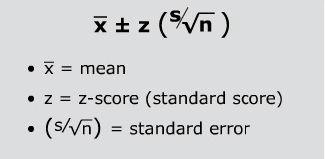
What is the formula for confidence interval?
300
How do you calculate standard error(SE)?
How do you calculate standard error(SE)?
SD/√n
SD/√n
1697 cartes de plus dans OutLearn. Ouvrir le deck complet
Plus de flashcards : Médecine et santé
LEUKEMIAMédecine et santé · AnglaiselleezeeeeAbdomenMédecine et santé · AnglaisSaraEssentials of Strength and Conditioning NSCA chapter 1Médecine et santé · AnglaisLuisChapter 2: The Human Body in Health and DiseaseMédecine et santé · AnglaisfortwinnyAdvanced Cardiac Life Support (ACLS)Médecine et santé · AnglaisRenInvestigation chromosomique (Caryotype et FISH)Médecine et santé · FrançaisOcéaneRespiratory Drug NamesMédecine et santé · AnglaisebradstreetAtrial flagellatesMédecine et santé · AnglaisMauLumbar special testsMédecine et santé · AnglaisAlexandraNose, Mouth, Throat HA Exam #2Médecine et santé · AnglaisMadiruth2Thyroid disordersMédecine et santé · AnglaisBarzoWeek 1 Google Docs QuestionsMédecine et santé · Anglaisjocyt9
Tous les decks : Médecine et santé
Révise ces decks dans l’app
Gratuit sur iPhone, Android, Mac et le web. Ajoute n’importe quel deck à ton compte en un tap.

