Unit 3.3 Respiration
Réviser ces flashcardsGratuit · répétition espacée · iPhone, Android, Mac et web
Toutes les cartes
1
What is respiration, and why is it catabolic?
A series of enzyme-controlled reactions that transfers energy from organic substrates to ATP; some energy is released as heat.
Larger organic molecules are broken down into smaller molecules.
Larger organic molecules are broken down into smaller molecules.
2
Why do cells need ATP?
ATP supplies immediate energy for processes such as active transport, muscle contraction, protein synthesis and cell division.
3
What is a respiratory substrate?
An organic molecule used in respiration to release energy, e.g. glucose, fatty acids, glycerol or amino acids.
4
How do aerobic respiration and anaerobic pathways differ?
It requires oxygen and completely oxidises glucose to CO₂ and H₂O.
They operate without oxygen and only partly break down glucose, producing lactate or ethanol + CO₂.
They operate without oxygen and only partly break down glucose, producing lactate or ethanol + CO₂.
5
Give the word and balanced equations for aerobic respiration.
Glucose + oxygen → carbon dioxide + water, with energy transferred to ATP and released as heat.
C₆H₁₂O₆ + 6O₂ → 6CO₂ + 6H₂O.
C₆H₁₂O₆ + 6O₂ → 6CO₂ + 6H₂O.
6
What is ATP, and what is it made of?
ATP = adenosine triphosphate, a nucleotide. It contains adenine + ribose + three phosphate groups. Adenine + ribose = adenosine.
7
How does ADP differ from ATP?
ADP has two phosphate groups; ATP has three.
8
How does ATP hydrolysis release usable energy?
ATP + H₂O → ADP + Pᵢ; removal of the terminal phosphate releases energy overall. ATPase catalyses the reaction.
9
How is ATP regenerated, and what does Pᵢ mean?
Energy drives ADP + Pᵢ → ATP. Adding phosphate is phosphorylation.
Inorganic phosphate.
Inorganic phosphate.
10
Why is ATP useful as an immediate energy source?
It releases energy rapidly in small usable quantities and can be regenerated quickly.
It is soluble, its reactions are enzyme-controlled, and it is continually made and used as a temporary energy store.
It is soluble, its reactions are enzyme-controlled, and it is continually made and used as a temporary energy store.
11
What is substrate-level phosphorylation, and where does it occur?
Enzyme-catalysed phosphate transfer from a phosphorylated intermediate to ADP, forming ATP independently of an electron transport chain.
In glycolysis and the Krebs cycle.
In glycolysis and the Krebs cycle.
12
What is oxidative phosphorylation?
ATP production using a proton gradient generated by electron transport; it occurs at the inner mitochondrial membrane.
13
Does substrate-level phosphorylation directly require oxygen?
No. However, the Krebs cycle depends indirectly on oxygen because its oxidised coenzymes must be regenerated.
14
Which cells contain mitochondria, and what is a mammalian exception?
In the cytoplasm of most eukaryotic cells; prokaryotes lack mitochondria.
Mature red blood cells.
Mature red blood cells.
15
How does mitochondrial abundance relate to cell activity?
Cells with high ATP demand, such as muscle cells, generally contain many mitochondria.
16
What is the role of the outer mitochondrial membrane?
It encloses the organelle and separates it from the cytoplasm.
17
How do the inner membrane and cristae support ATP production?
Electron carriers, proton pumps and ATP synthase.
Their folds increase the inner membrane's surface area for oxidative phosphorylation.
Their folds increase the inner membrane's surface area for oxidative phosphorylation.
18
How does the intermembrane space help establish a proton gradient?
The space between the outer and inner membranes; protons accumulate here during electron transport.
Its small volume allows proton concentration to rise as protons are pumped into it.
Its small volume allows proton concentration to rise as protons are pumped into it.
19
What is the mitochondrial matrix?
The internal compartment containing enzymes and coenzymes for the link reaction and most Krebs cycle reactions.
20
What are the roles of mitochondrial DNA and ribosomes?
It carries genes for some mitochondrial proteins and RNA; it is typically circular.
Synthesise some mitochondrial proteins.
Synthesise some mitochondrial proteins.
21
What are the stalked particles on the inner membrane?
ATP synthase complexes, with catalytic heads projecting into the matrix.
22
Where do the four main stages of respiration occur?
In the cytoplasm/cytosol.
In the mitochondrial matrix.
In the mitochondrial matrix; this is the location expected in the overview.
At the inner mitochondrial membrane/cristae.
In the mitochondrial matrix.
In the mitochondrial matrix; this is the location expected in the overview.
At the inner mitochondrial membrane/cristae.
23
What does glycolysis do to one glucose molecule?
Converts one 6C glucose into two 3C pyruvates.
24
Why is glycolysis described as anaerobic?
It does not directly require oxygen and occurs in both aerobic respiration and anaerobic pathways.
25
What are the two broad phases of glycolysis?
Phosphorylation, including splitting; then oxidation.
26
How and why is glucose phosphorylated at the start of glycolysis?
Two ATP, each becoming ADP.
Glucose → hexose phosphate → hexose bisphosphate.
It activates the molecule for subsequent reactions, including splitting.
Glucose → hexose phosphate → hexose bisphosphate.
It activates the molecule for subsequent reactions, including splitting.
27
What happens to the phosphorylated 6C compound?
It splits into two 3C triose phosphate molecules.
28
What happens to triose phosphate and NAD during oxidation?
Hydrogen is removed and accepted by NAD, forming reduced NAD; further reactions form pyruvate.
Triose phosphate is oxidised; NAD is reduced.
Triose phosphate is oxidised; NAD is reduced.
29
How is ATP made in glycolysis, and why is the net yield two?
Phosphate is transferred from phosphorylated organic intermediates to ADP by substrate-level phosphorylation.
Four ATP.
Four ATP made − two ATP used initially = two ATP gained overall.
Four ATP.
Four ATP made − two ATP used initially = two ATP gained overall.
30
What does glycolysis produce per glucose?
Per glucose: two pyruvates + two reduced NAD + two net ATP. No CO₂ is released and no reduced FAD is formed.
31
What carbon counts, ATP and NAD labels belong on a glycolysis diagram?
One 6C glucose → phosphorylated 6C compound → two 3C triose phosphates → two 3C pyruvates.
Two ATP used at the start; four ATP formed later; two NAD reduced.
Two ATP used at the start; four ATP formed later; two NAD reduced.
32
What happens to pyruvate when aerobic respiration can continue?
It enters the mitochondrion for the link reaction.
33
What happens to glycolytic reduced NAD aerobically, and why must NAD be regenerated?
Its reducing equivalents supply electrons for electron transport, regenerating oxidised NAD.
Glycolysis requires oxidised NAD to accept hydrogen; otherwise its limited supply runs out.
Glycolysis requires oxidised NAD to accept hydrogen; otherwise its limited supply runs out.
34
What happens to pyruvate when aerobic oxidation is insufficient?
It can be reduced to lactate, or converted to ethanol + CO₂, depending on the organism.
35
What three changes convert pyruvate into acetyl CoA?
One carbon atom leaves as CO₂, leaving a 2C fragment.
Hydrogen is accepted by NAD, forming reduced NAD.
The remaining 2C acetyl group combines with coenzyme A.
Hydrogen is accepted by NAD, forming reduced NAD.
The remaining 2C acetyl group combines with coenzyme A.
36
Why is the link reaction called oxidative decarboxylation, and which enzyme activities are involved?
Oxidation by hydrogen removal and removal of CO₂ occur.
Dehydrogenase and decarboxylase activities.
Dehydrogenase and decarboxylase activities.
37
What does coenzyme A carry, and what does “2C acetyl CoA” mean?
It carries the acetyl group into the Krebs cycle; it is a coenzyme, not an enzyme.
No. Two carbons refers to the acetyl group carried by coenzyme A.
No. Two carbons refers to the acetyl group carried by coenzyme A.
38
What is the simplified link-reaction equation?
Pyruvate + NAD + coenzyme A → acetyl coenzyme A + reduced NAD + CO₂.
39
Compare link-reaction products per pyruvate and per glucose.
Per pyruvate: one acetyl CoA + one reduced NAD + one CO₂; no direct ATP. Per glucose: double these products because glycolysis makes two pyruvates; still no direct ATP.
40
Where do the link-reaction products go?
Acetyl groups enter Krebs; reduced NAD supplies electrons for oxidative phosphorylation; CO₂ leaves the cell.
41
What is the Krebs cycle?
An enzyme-controlled cyclic pathway that oxidises acetyl groups, releasing CO₂ and producing reduced coenzymes and ATP.
42
How does an acetyl group enter Krebs? Include names and carbon numbers.
A 2C acetyl group combines with a 4C acceptor to form a 6C compound; coenzyme A is released and reused.
Oxaloacetate = 4C acceptor; citrate = 6C product. Carbon numbers are the priority in the overview.
Oxaloacetate = 4C acceptor; citrate = 6C product. Carbon numbers are the priority in the overview.
43
What carbon changes and CO₂ losses occur in Krebs?
6C → 5C → 4C. Each step releases one CO₂: two decarboxylations and two CO₂ per turn.
44
What does dehydrogenation produce during one Krebs turn?
Hydrogen is removed from intermediates and accepted by NAD or FAD. Four pairs are removed per turn, forming three reduced NAD + one reduced FAD.
45
How much ATP is made directly per turn?
One ATP equivalent by substrate-level phosphorylation.
46
Why must the 4C acceptor be regenerated?
So it can accept another acetyl group and the cycle can repeat.
47
Why are there two Krebs turns per glucose, and what do they produce?
One glucose produces two pyruvates, which give two acetyl groups.
Four CO₂ + six reduced NAD + two reduced FAD + two direct ATP equivalents.
Eight pairs.
Four CO₂ + six reduced NAD + two reduced FAD + two direct ATP equivalents.
Eight pairs.
48
Does Krebs use oxygen directly, and why does it depend on oxygen?
No. Oxygen is used directly at the end of electron transport.
Electron transport needs oxygen to reoxidise reduced NAD/FAD. Without oxidised coenzymes, dehydrogenation and the cycle stop.
Electron transport needs oxygen to reoxidise reduced NAD/FAD. Without oxidised coenzymes, dehydrogenation and the cycle stop.
49
What must a simplified Krebs diagram show?
2C + 4C → 6C → 5C → 4C; two CO₂ lost; acceptor regenerated; three NAD and one FAD reduced; one ATP formed per turn.
50
What do oxidation and reduction mean?
Loss of electrons; in respiration, often loss of hydrogen.
Gain of electrons; in respiration, often gain of hydrogen.
Gain of electrons; in respiration, often gain of hydrogen.
51
Distinguish dehydrogenation from decarboxylation.
Removal of hydrogen, catalysed by a dehydrogenase.
Removal of CO₂ from a molecule.
Removal of CO₂ from a molecule.
52
If a substrate loses hydrogen to NAD, what happens to each?
The substrate is oxidised; NAD is reduced.
53
What is a coenzyme?
An organic non-protein molecule that helps an enzyme, e.g. by transferring hydrogen, electrons or chemical groups.
54
Which stages reduce NAD, and which reduce FAD?
Glycolysis, the link reaction and the Krebs cycle.
The Krebs cycle.
The Krebs cycle.
55
How do NAD/FAD and coenzyme A differ in their roles?
NAD/FAD carry hydrogen/electrons; coenzyme A carries acetyl groups.
56
How are reduced NAD and reduced FAD written?
NADH, or NADH + H⁺ when the accompanying proton is shown; use the notation in the question.
FADH₂.
FADH₂.
57
What happens to coenzymes after electron donation, and why is recycling necessary?
They are oxidised again and can accept hydrogen in further reactions.
Their supply is limited; recycling allows respiration to continue.
Their supply is limited; recycling allows respiration to continue.
58
Where is the electron transport chain, and what supplies its electrons?
A sequence of electron carriers in the inner mitochondrial membrane.
Reduced NAD and reduced FAD.
Reduced NAD and reduced FAD.
59
How do carriers change as electrons move along the chain?
A carrier is reduced when it accepts electrons and oxidised when it passes them on.
60
How and in which direction are protons pumped?
Energy is released in stages and used to pump protons.
From the matrix into the intermembrane space.
Against the electrochemical gradient; it requires energy.
From the matrix into the intermembrane space.
Against the electrochemical gradient; it requires energy.
61
What gradient forms, and which side has more H⁺?
An electrochemical proton gradient: a difference in H⁺ concentration and electrical charge.
The intermembrane space.
The intermembrane space.
62
Why is the inner membrane's limited permeability to protons important?
It prevents unrestricted proton return and allows the gradient to be maintained.
63
How does chemiosmosis produce ATP?
H⁺ flows down its electrochemical gradient from the intermembrane space into the matrix through ATP synthase. This drives ADP + Pᵢ → ATP on the matrix side. Coupling proton flow to ATP formation is chemiosmosis.
64
Why is this called oxidative phosphorylation?
Oxidation of reduced coenzymes supplies energy that ultimately drives phosphorylation of ADP.
65
What is oxygen’s role, and how does water form?
It is the final electron acceptor.
Oxygen combines with electrons and H⁺ to form water.
½O₂ + 2e⁻ + 2H⁺ → H₂O; equivalently O₂ + 4e⁻ + 4H⁺ → 2H₂O.
Oxygen combines with electrons and H⁺ to form water.
½O₂ + 2e⁻ + 2H⁺ → H₂O; equivalently O₂ + 4e⁻ + 4H⁺ → 2H₂O.
66
How does oxygen reach respiring animal cells?
It diffuses from blood through tissue fluid into cells.
67
What happens to electron flow, proton pumping and ATP production without oxygen?
Electrons cannot be passed to the final acceptor, so carriers remain reduced and electron flow stops.
Pumping stops; the gradient dissipates; oxidative ATP synthesis stops.
Pumping stops; the gradient dissipates; oxidative ATP synthesis stops.
68
Why do link and Krebs stop without oxygen, while glycolysis may continue?
Reduced NAD/FAD cannot be reoxidised by electron transport, so oxidised coenzymes become unavailable.
Yes, if an anaerobic pathway regenerates NAD.
Yes, if an anaerobic pathway regenerates NAD.
69
Why does reduced FAD give less ATP than reduced NAD in the theoretical model?
Its electrons enter later, bypassing one proton-pumping stage, so less energy is used to establish the gradient.
70
What should an electron transport diagram show?
Matrix and intermembrane space; inner membrane; carriers; H⁺ pumped out and returning through ATP synthase; oxygen forming water; ATP formation.
71
How many reduced NAD and reduced FAD form in each stage per glucose?
Glycolysis 2 + link reaction 2 + Krebs 6 = 10.
Glycolysis 0 + link reaction 0 + Krebs 2 = 2.
Glycolysis 0 + link reaction 0 + Krebs 2 = 2.
72
What ATP yields per reduced NAD and FAD does the theoretical 38-ATP model use?
Three ATP through oxidative phosphorylation.
Two ATP through oxidative phosphorylation.
Two ATP through oxidative phosphorylation.
73
Calculate total oxidative ATP in the theoretical model.
Reduced NAD: 10 × 3 = 30 ATP. Reduced FAD: 2 × 2 = 4 ATP. Total oxidative ATP = 34 (theoretical model).
74
How do net direct ATP and oxidative ATP add up to 38?
Two from glycolysis + two from Krebs = four ATP.
34 oxidative + 4 net substrate-level = 38 ATP.
34 oxidative + 4 net substrate-level = 38 ATP.
75
What is the difference between net direct ATP and later oxidative ATP?
ATP made by substrate-level phosphorylation minus ATP used in that stage.
ATP made during oxidative phosphorylation using electrons from coenzymes produced in an earlier stage.
ATP made during oxidative phosphorylation using electrons from coenzymes produced in an earlier stage.
76
What is the corrected glycolysis row, and why is its attributed total eight?
Reduced FAD 0; reduced NAD 2; net direct ATP 2. Its reduced NAD supports 6 ATP later. Total attributed to glycolysis = 2 + 6 = 8 in the theoretical model.
77
What ATP is attributed to the link reaction per pyruvate and per glucose?
Reduced FAD 0; reduced NAD 2; direct ATP 0; later oxidative ATP 6; total attributable ATP 6.
No. Its two reduced NAD supply electrons for later oxidative phosphorylation.
Three later ATP from one reduced NAD; no direct ATP.
No. Its two reduced NAD supply electrons for later oxidative phosphorylation.
Three later ATP from one reduced NAD; no direct ATP.
78
What is the Krebs row per glucose, and how is its oxidative ATP calculated?
Reduced FAD 2; reduced NAD 6; direct ATP 2; later oxidative ATP 22; total attributable ATP 24.
(6 reduced NAD × 3) + (2 reduced FAD × 2) = 22.
(6 reduced NAD × 3) + (2 reduced FAD × 2) = 22.
79
What are the corrected totals for the ATP table?
Reduced FAD 2; reduced NAD 10; net direct ATP 4; later oxidative ATP 34; total ATP 38.
80
How much ATP is attributed to one Krebs turn in this model?
(3 × 3) + (1 × 2) + 1 direct = 12 ATP equivalents.
81
How much substrate-level ATP is made gross per glucose?
Six: four in glycolysis + two in Krebs. Subtract the initial two ATP used to give four net.
82
How do you scale ATP yields to five glucose molecules?
Multiply the per-glucose yield by the number of glucose molecules.
Aerobic: 5 × 38 = 190 ATP. Anaerobic: 5 × 2 = 10 ATP.
Aerobic: 5 × 38 = 190 ATP. Anaerobic: 5 × 2 = 10 ATP.
83
How many times greater is 38 ATP than 2 ATP?
38 ÷ 2 = 19 times.
84
Which stages release CO₂, and which uses oxygen directly?
The link reaction and Krebs; not glycolysis or electron transport.
Electron transport, where oxygen is the final electron acceptor.
Electron transport, where oxygen is the final electron acceptor.
85
Are NAD and FAD reduced in electron transport?
Their reduced forms are oxidised overall when they supply electrons; this regenerates NAD and FAD.
86
What three distinctions prevent ATP-counting errors?
Gross vs net; per turn vs per glucose; direct ATP vs ATP made later from reduced coenzymes.
87
What is the essential purpose of fermentation after glycolysis?
Regenerating NAD so glycolysis can continue.
88
How is lactate formed, and how does this regenerate NAD?
Pyruvate accepts hydrogen from reduced NAD and becomes lactate. Reduced NAD is oxidised to NAD, allowing glycolysis to continue. Pyruvate + reduced NAD → lactate + NAD.
89
What is the carbon balance for lactate fermentation, and is CO₂ released?
One 6C glucose → two 3C lactates.
No.
No.
90
What is the ATP yield of lactate fermentation, and where is it made?
Two net ATP per glucose, all made in glycolysis. Converting pyruvate to lactate makes no extra ATP.
91
Why is anaerobic ATP production useful in intense exercise but limited?
It provides ATP when demand exceeds the rate supported by oxygen delivery and oxidative phosphorylation.
Its yield per glucose is low; glucose is used rapidly and much chemical energy remains in lactate.
Its yield per glucose is low; glucose is used rapidly and much chemical energy remains in lactate.
92
How is pyruvate converted to ethanol, and how is NAD regenerated?
3C pyruvate → 2C ethanal + CO₂ (decarboxylation). Ethanal accepts hydrogen from reduced NAD: ethanal + reduced NAD → ethanol + NAD. The NAD returns to glycolysis.
93
Give the equation, products and ATP yield of ethanol fermentation.
C₆H₁₂O₆ → 2C₂H₅OH + 2CO₂.
Two ethanol + two CO₂ + two net ATP from glycolysis; two reduced NAD are reoxidised.
Two ethanol + two CO₂ + two net ATP from glycolysis; two reduced NAD are reoxidised.
94
What accepts hydrogen to regenerate NAD in the lactate and ethanol pathways?
Pyruvate in the lactate pathway; ethanal in the ethanol pathway.
95
How is NAD regenerated in aerobic respiration?
Reduced NAD supplies electrons for electron transport and becomes oxidised again.
96
How does the completeness of glucose oxidation compare?
Aerobic respiration: complete. Lactate and ethanol pathways: incomplete, so their products retain chemical energy.
97
How do starch and glycogen supply respiratory substrates?
Their breakdown supplies glucose or glucose-derived intermediates; both are α-glucose polymers.
98
What does sucrose hydrolysis produce, and how can fructose enter respiration?
Glucose + fructose.
It is converted to glycolytic intermediates; fructose and glucose are structural isomers.
It is converted to glycolytic intermediates; fructose and glucose are structural isomers.
99
Can humans digest cellulose with their own enzymes?
No; humans lack cellulase.
100
How do fatty acids enter respiration, and what determines acetyl CoA yield?
They are broken into 2C units carried as acetyl CoA into the Krebs cycle.
No; the number depends on chain length.
No; the number depends on chain length.
101
Why do lipids release more energy per gram than carbohydrates?
They are more reduced and contain proportionally more hydrogen, supplying more electrons for oxidative phosphorylation.
102
Why may glucose be useful during intense exercise?
It can support rapid ATP production and anaerobic glycolysis; fatty-acid oxidation depends on aerobic metabolism.
103
How are proteins prepared for respiration, including deamination?
They are hydrolysed to amino acids, which are deaminated, mainly in the liver.
Removal of the amino group from an amino acid, producing ammonia and a carbon skeleton/keto acid.
Removal of the amino group from an amino acid, producing ammonia and a carbon skeleton/keto acid.
104
How can the carbon skeleton of an amino acid enter respiration?
Through glycolysis, acetyl CoA or Krebs intermediates, depending on the amino acid.
105
What happens to ammonia in humans?
It is converted to less toxic urea in the liver; urea is carried to the kidneys and excreted in urine.
106
When might muscle protein be used as fuel, and what are the disadvantages?
During severe nutrient shortage/starvation.
Loss of functional muscle tissue and production of nitrogenous waste.
Loss of functional muscle tissue and production of nitrogenous waste.
107
What do shared metabolic pathways show?
Carbohydrates, lipids and proteins can feed into common pathways; intermediates can also be used in synthesis.
108
Which reactions build and break down proteins?
Condensation builds proteins; hydrolysis breaks them down.
109
Do reversible arrows in a metabolic overview mean every step is directly reversible?
No. Opposite directions can use different enzymes and different pathways.
110
How do you calculate energy from mass, and what does kJ g⁻¹ mean?
Energy = mass × energy value per gram; make units consistent.
Kilojoules per gram.
Kilojoules per gram.
111
Using the notes' supplied values of glucose 16, lipid 39 and protein 17 kJ g⁻¹, what does 2 g yield?
Glucose 32 kJ; lipid 78 kJ; protein 34 kJ. Treat these as supplied practice values rather than universal constants.
112
How is RQ calculated from gas measurements? Include conditions and units.
RQ = CO₂ produced ÷ O₂ consumed, using volumes or rates. Match time interval, volume units, temperature and pressure. RQ has no units because the units cancel.
113
How do you calculate RQ from an equation? Use glucose as an example.
Divide the CO₂ coefficient by the O₂ coefficient.
6 CO₂ ÷ 6 O₂ = 1.0.
6 CO₂ ÷ 6 O₂ = 1.0.
114
Why is fat's RQ below 1?
Fat contains proportionally less oxygen, so oxidation needs relatively more external O₂ than the CO₂ produced.
115
Given 2C₅₁H₉₈O₆ + 145O₂ → 102CO₂ + 98H₂O, what is RQ?
102 ÷ 145 ≈ 0.70. The equation is provided for application, not memorisation.
116
What is RQ if 14 cm³ CO₂ is produced and 20 cm³ O₂ consumed?
14 ÷ 20 = 0.70.
117
How do you convert dm³ to cm³?
Multiply by 1,000; 1 dm³ = 1,000 cm³.
118
Can you calculate a finite RQ if oxygen uptake is zero?
No; division by zero is undefined.
119
How do you find respiration rate and RQ from cumulative gas-volume graphs?
Gas-exchange rate = change in volume ÷ change in time, e.g. cm³ min⁻¹.
A faster gas-exchange rate.
Divide the corresponding CO₂-production gradient by the O₂-consumption gradient.
A faster gas-exchange rate.
Divide the corresponding CO₂-production gradient by the O₂-consumption gradient.
120
[Extra detail] What mitochondrial dimensions were quoted in the original slides?
About 1 µm diameter and 10 µm long; size varies. These are not fixed dimensions to memorise.
121
[Extra detail] What is another name for a triose phosphate in glycolysis?
Glyceraldehyde 3-phosphate.
122
[Extra detail] Is the splitting step of glycolysis accurately called hydrolysis?
No. It is an aldolase-catalysed cleavage; use 'splitting' in the overview.
123
[Extra detail] How is most CO₂ transported in human blood?
As hydrogencarbonate ions, before being released at the lungs; linked transport knowledge.
124
[Extra detail] What other names and historical detail do the notes give for Krebs?
Citric acid cycle; tricarboxylic acid cycle (TCA).
Sir Hans Krebs, 1937; historical background only.
Sir Hans Krebs, 1937; historical background only.
125
[Extra detail] What happens to citrate before the first oxidative decarboxylation?
It is rearranged to isocitrate; both contain six carbons.
126
[Extra detail] What is the first named oxidative decarboxylation, and what is oxoglutarate?
6C isocitrate → 5C α-ketoglutarate, releasing CO₂ and reducing NAD.
Oxoglutarate.
Oxoglutarate.
127
[Extra detail] What happens in the second oxidative decarboxylation?
5C α-ketoglutarate → a 4C succinyl group carried on CoA, releasing CO₂ and reducing NAD.
128
[Extra detail] Which named Krebs step produces ATP, and why is it called an ATP equivalent?
Succinyl coenzyme A → succinate; one ATP equivalent per turn.
Depending on the enzyme form, ATP or GTP is formed; GTP can transfer phosphate to ADP. Detailed mechanism is extra.
Depending on the enzyme form, ATP or GTP is formed; GTP can transfer phosphate to ADP. Detailed mechanism is extra.
129
[Extra detail] How can substrate-level phosphorylation occur although succinyl CoA is not a phosphate donor initially?
Energy from its conversion supports a transient phosphorylated intermediate; phosphate is relayed through the enzyme to ADP or GDP. It is not a one-step phosphate transfer from unmodified succinyl CoA.
130
[Extra detail] Which later Krebs conversions reduce FAD or NAD, and which adds water?
Succinate → fumarate, by dehydrogenation.
No; water is added in this step.
Malate → oxaloacetate, by dehydrogenation.
No; water is added in this step.
Malate → oxaloacetate, by dehydrogenation.
131
[Extra detail] Which Krebs intermediates have 6C, 5C or 4C skeletons, and why can several share a carbon count?
Their hydrogen/oxygen content and bonding differ; carbon number alone does not identify a molecule.
Citrate/isocitrate: 6C; α-ketoglutarate: 5C; succinyl group, succinate, fumarate, malate and oxaloacetate: 4C.
Citrate/isocitrate: 6C; α-ketoglutarate: 5C; succinyl group, succinate, fumarate, malate and oxaloacetate: 4C.
132
[Extra detail] What do the optional Krebs mnemonics in the notes mean?
Two CO₂-removal/NAD-reduction steps; ATP-equivalent production; FAD reduction; an intervening step; final NAD reduction.
Carbon counts of the detailed sequence including the succinyl group; optional mnemonic, not the essential overview.
Carbon counts of the detailed sequence including the succinyl group; optional mnemonic, not the essential overview.
133
[Extra detail] What do NAD and FAD stand for?
Nicotinamide adenine dinucleotide; flavin adenine dinucleotide.
134
[Extra detail] How do NAD and FAD compare structurally?
Adenine, ribose and two phosphate groups.
NAD contains nicotinamide and two ribose rings; FAD contains flavin, a ribose ring and a ribitol chain.
NAD contains nicotinamide and two ribose rings; FAD contains flavin, a ribose ring and a ribitol chain.
135
[Extra detail] What is the notes' shorthand for NAD reduction?
NAD⁺ + 2H → NADH + H⁺.
136
[Extra detail] Where do electrons enter the numbered chain, which complexes pump H⁺, and where is oxygen reduced?
NADH at complex I; electrons from succinate oxidation enter through complex II.
I, III and IV; II does not.
No. It is an alternative electron-entry route.
Complex IV.
I, III and IV; II does not.
No. It is an alternative electron-entry route.
Complex IV.
137
[Extra detail] How many protons are pumped per electron pair in the detailed model?
About 10 for NADH-linked entry and 6 for FAD-linked entry. Do not combine these figures mechanically with the older 3/2 ATP model.
138
[Extra detail] Is 'three protons per ATP' a universal exact value?
No; it is a simplified teaching value. Keep the principle of proton flow driving ATP synthesis.
139
[Extra detail] Why do notes sometimes say lactic acid and sometimes lactate?
Lactate predominates at physiological pH; 'lactic acid' is often used in school diagrams.
140
[Extra detail] What happens during recovery after exercise, including lactate use and extra oxygen demand?
It can be converted back to pyruvate and used metabolically; the liver can also use its carbon to remake glucose.
Extra oxygen taken in after exercise to support recovery, including metabolism of accumulated lactate and restoration of energy stores.
To supply oxygen for recovery processes.
Extra oxygen taken in after exercise to support recovery, including metabolism of accumulated lactate and restoration of energy stores.
To supply oxygen for recovery processes.
141
[Extra detail] Is lactate simply an unusable toxic waste?
No; it is a reusable metabolite. Avoid treating this as an explanation for all exercise fatigue.
142
[Extra detail] What is another name for ethanal, and what are the ethanal/ethanol formulae?
Ethanal = acetaldehyde, CH₃CHO; ethanol = CH₃CH₂OH.
143
[Extra detail] Where does the source's metabolic diagram show fructose entering?
Via hexose bisphosphate; actual routes vary with tissue, so do not treat this as universal.
144
[Extra detail] Why does tripalmitin release more energy per molecule than glucose?
It has many more oxidisable carbon and hydrogen atoms: C₅₁H₉₈O₆ versus C₆H₁₂O₆.
145
[Extra detail] Where does the carbon of completely oxidised glucose or lipid end up?
In CO₂.
146
In the tissue-biopsy example, what was measured?
Enzyme activities, oxygen consumption and ATP-production rates; the passage also describes immediate freezing of the sample.
147
Why supply different respiratory substrates to isolated mitochondria?
They enter at different points, helping identify which region of a pathway is impaired.
148
Why might skeletal muscle be sampled for mitochondrial investigations?
It has many mitochondria and is relatively accessible compared with some vital organs.
149
What can different substrate responses reveal about a mitochondrial defect, and what can they not establish?
A problem before α-ketoglutarate's entry point, e.g. pyruvate transport, the link reaction or early Krebs steps; later reactions still function.
No. It narrows down a region; more evidence is needed.
No. It narrows down a region; more evidence is needed.
150
What can accumulation of a metabolic intermediate suggest?
Its conversion to the next compound is restricted, possibly by an inhibited or defective enzyme.
151
Why might blood lactate rise when mitochondrial oxidation is impaired?
More reliance on glycolysis and pyruvate reduction to regenerate NAD.
152
In the notes’ insect-muscle example, how do routes A and B explain a 36-ATP yield?
In the supplied older model: NAD-linked route A gives 3 ATP per electron pair; FAD-linked route B gives 2. These labels belong only to that question.
Two glycolytic reduced NAD each support one fewer ATP: a loss of 2 ATP overall.
Two glycolytic reduced NAD each support one fewer ATP: a loss of 2 ATP overall.
153
Why does flight muscle have high ATP demand?
Repeated muscle contraction uses ATP.
154
Does glycolytic NADH freely cross the inner mitochondrial membrane?
No; shuttle pathways transfer reducing equivalents. Shuttle details are extra context.
155
In the ORIGINAL notes’ ATP-synthase diagram, what are W–Z and the proton-flow direction?
W outer membrane; X intermembrane space; Y inner membrane; Z matrix. These labels are copied from the notes and apply only to the original diagram, which is not reproduced in this deck.
X → Z: intermembrane space → matrix. ADP + Pᵢ → ATP.
X → Z: intermembrane space → matrix. ADP + Pᵢ → ATP.
156
In the ORIGINAL notes’ whole-cell diagram, what are labels A–F?
A triose phosphate; B pyruvate; C acetyl coenzyme A. Use only with the original labelled diagram.
D NAD\/reduced NAD; E CO₂; F O₂. The original diagram is needed to interpret D's direction.
D NAD\/reduced NAD; E CO₂; F O₂. The original diagram is needed to interpret D's direction.
157
What does the endosymbiosis passage propose, and how did both partners benefit?
Aerobic bacteria became established inside ancestral eukaryotic cells more than one billion years ago; the date is passage context.
More efficient aerobic ATP production.
Nutrients and protection; host glycolysis could provide pyruvate.
More efficient aerobic ATP production.
Nutrients and protection; host glycolysis could provide pyruvate.
158
What mitochondrial features support an endosymbiotic origin?
DNA, ribosomes and double-membrane organisation.
159
How do the products of triglyceride hydrolysis enter respiration?
Triglyceride hydrolysis produces glycerol + fatty acids. Glycerol → triose phosphate → glycolysis. Fatty acids → 2C units carried as acetyl CoA → Krebs.
160
Why is acetyl CoA a metabolic link?
It connects the breakdown of sugars, fats and some amino acids.
161
Why is actual ATP yield below the theoretical maximum?
Some H⁺ leaks back without passing through ATP synthase, dissipating gradient energy. Transporting metabolites also has an energetic cost; WJEC mentions pyruvate and ADP.
162
What actual ATP range does WJEC guidance give, and which model should you use in exams?
Around 30–32 per glucose; keep this separate from the theoretical 38-ATP accounting model.
Follow the question's stated model; do not mix older 3/2 ATP yields with modern estimates.
Follow the question's stated model; do not mix older 3/2 ATP yields with modern estimates.
163
Which WJEC term describes the combined concentration and charge difference?
Electrochemical gradient.
164
What does WJEC call the enzyme often labelled ATP synthase?
ATP synthetase; both refer to the ATP-producing enzyme here.
165
Compare proton gradients and ATP synthesis in mitochondria and chloroplasts.
Both mitochondrial and chloroplast membranes maintain proton gradients that drive ATP synthesis.
Mitochondria: accumulate in the intermembrane space, return to matrix. Chloroplasts: accumulate in thylakoid lumen, return to stroma.
Mitochondria: accumulate in the intermembrane space, return to matrix. Chloroplasts: accumulate in thylakoid lumen, return to stroma.
166
Which short specification phrase helps describe NAD/FAD's role?
They provide 'electrons and protons' for electron transport; explain how these support ATP production.
167
What does the specification mean by the 'energy budget' of respiration?
Accounting for ATP used and made under aerobic and anaerobic conditions.
168
Must you memorise names of electron carriers and proton pumps?
Unit 3.1 excludes their names from required recall; learn their functions. Numbered complexes remain in the extra-detail section only.
169
What yeast respiration investigation is specified, and what estimates its rate?
Investigating factors affecting the rate of respiration in yeast.
CO₂ production per unit time.
CO₂ production per unit time.
170
Outline WJEC’s syringe-and-bubble method.
Mix 5 cm³ yeast suspension with 10 cm³ sucrose solution in a 20 cm³ syringe; lay it in a water bath with its nozzle uppermost and hold it with a weight.
Allow about 2 minutes to equilibrate; once bubbles emerge regularly, count them for 1 minute.
Allow about 2 minutes to equilibrate; once bubbles emerge regularly, count them for 1 minute.
171
Why stir the yeast suspension before sampling it?
To distribute cells evenly, making samples more comparable.
172
Why equilibrate the mixture before measuring?
So its temperature reaches the chosen value.
173
In a temperature investigation, identify the independent, dependent and control variables.
Independent: temperature. Dependent: CO₂ production rate, estimated by bubbles per minute.
Yeast amount/concentration, sugar type/concentration/volume, pH, measurement duration and apparatus.
Yeast amount/concentration, sugar type/concentration/volume, pH, measurement duration and apparatus.
174
Why monitor temperature throughout the experiment?
Changes during measurement would alter enzyme activity and confound the comparison.
175
Why repeat each condition and calculate a mean?
To assess variation and reduce the effect of random error; examine anomalous results rather than automatically deleting them.
176
Why is bubble counting limited, and how could measurement improve?
Bubble volumes can differ; equal numbers need not mean equal gas volumes.
Collect and measure CO₂ volume over time with a suitable gas syringe or sensor, checking the apparatus for leaks.
Collect and measure CO₂ volume over time with a suitable gas syringe or sensor, checking the apparatus for leaks.
177
What should you do if the syringe nozzle becomes blocked?
Restart that replicate rather than use its count.
178
Why does respiration rate rise then fall as temperature increases?
Molecules have more kinetic energy; successful enzyme–substrate encounters occur more frequently.
Enzyme structure and active sites are disrupted by denaturation, reducing catalysis.
Enzyme structure and active sites are disrupted by denaturation, reducing catalysis.
179
How would you investigate sugar concentration instead?
Vary sugar concentration while keeping yeast, temperature, pH, total volume and timing constant; measure CO₂ rate.
180
What does a no-added-sugar control help show?
Baseline CO₂ production without supplied sugar; yeast may still use stored substrates.
181
How would you investigate pH?
Use buffers of different pH while controlling the other conditions and comparing CO₂ rates.
182
How should the temperature results be plotted?
Temperature on the x-axis; mean respiration-rate estimate on the y-axis, with units.
183
How is Q₁₀ calculated, and does a value near two prove accuracy?
Rate at (T + 10) °C ÷ rate at T °C; it describes the effect of a 10 °C rise over the chosen interval.
24 ÷ 12 = 2.
No. It can fit a common trend below the optimum, but accuracy requires independent assessment; Q₁₀ varies with conditions.
24 ÷ 12 = 2.
No. It can fit a common trend below the optimum, but accuracy requires independent assessment; Q₁₀ varies with conditions.
184
What precautions are relevant in this yeast practical?
Avoid hot-water burns, keep electrical handling dry, and prevent yeast/solutions contacting eyes; use eye protection and follow the school risk assessment.
185
Which practical links dehydrogenation to ATP studies in Unit 3.1?
Investigating dehydrogenase activity with artificial hydrogen acceptors such as methylene blue, DCPIP or tetrazolium compounds.
186
How does methylene blue reveal dehydrogenase activity?
It accepts hydrogen removed during respiration and changes colour on reduction.
Blue → colourless.
Blue → colourless.
187
What is the outline of WJEC's methylene-blue method?
Equilibrate 10 cm³ yeast suspension at 30 °C for 5 minutes; add 1 cm³ indicator, mix once and time the colour change in the water bath.
188
How can colour-change time be expressed as a relative rate?
Relative rate = 1/time; if time is in seconds, units are s⁻¹.
189
What must be controlled when comparing indicator-reduction times, including oxygen exposure?
Indicator amount/concentration, yeast amount, endpoint judgement and all conditions except the chosen independent variable.
Oxygen can reoxidise the indicator; mixing and exposure to air must be consistent.
Oxygen can reoxidise the indicator; mixing and exposure to air must be consistent.
190
What comparison could support the role of active enzymes?
Live yeast versus boiled, cooled yeast treated otherwise identically; heating denatures enzymes.
191
What safety precautions apply to redox indicators?
Avoid skin/eye contact and wear eye protection; follow the indicator-specific school risk assessment.
192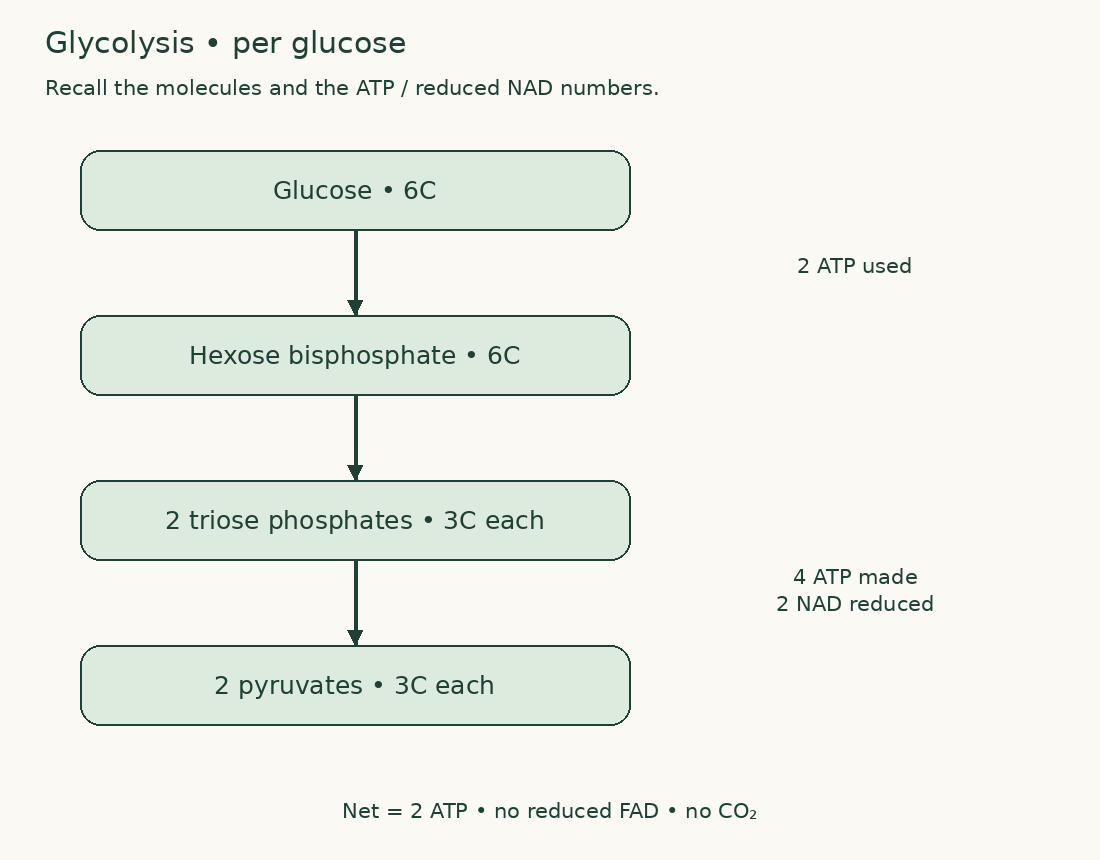
Complete the glycolysis diagram: molecules, carbon counts and ATP/NAD numbers.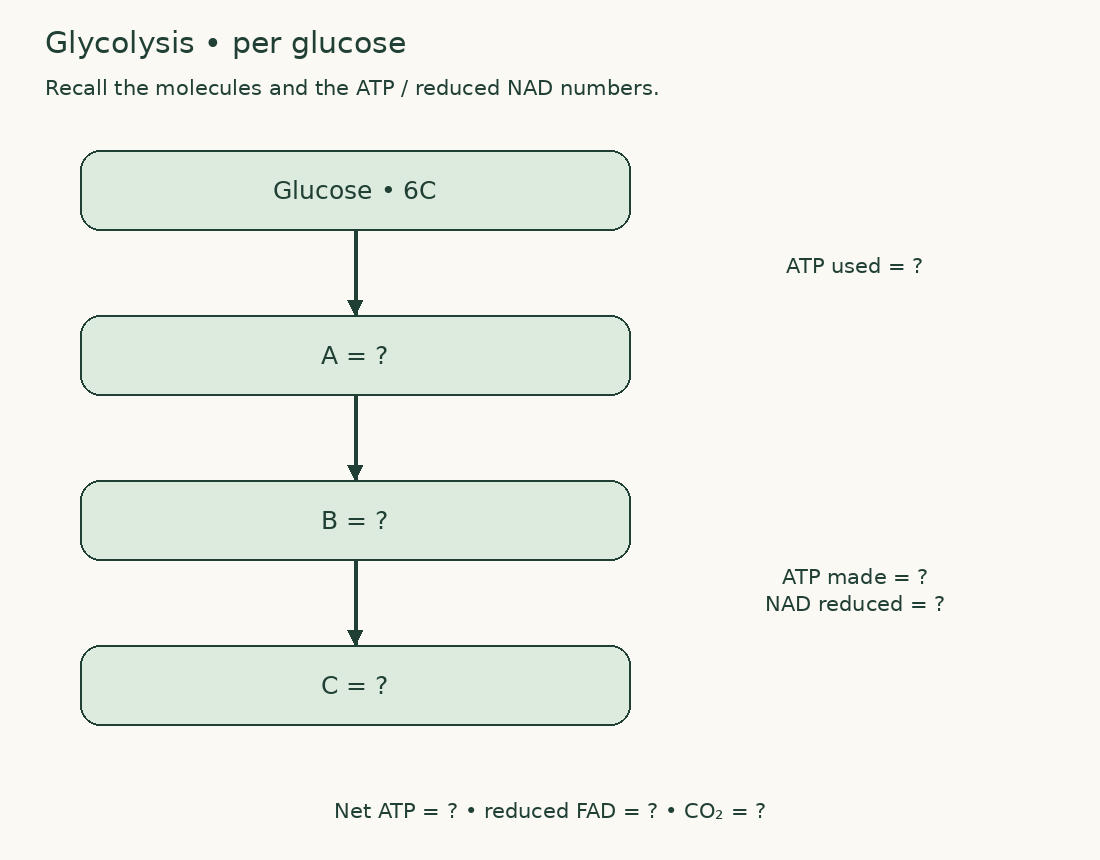
193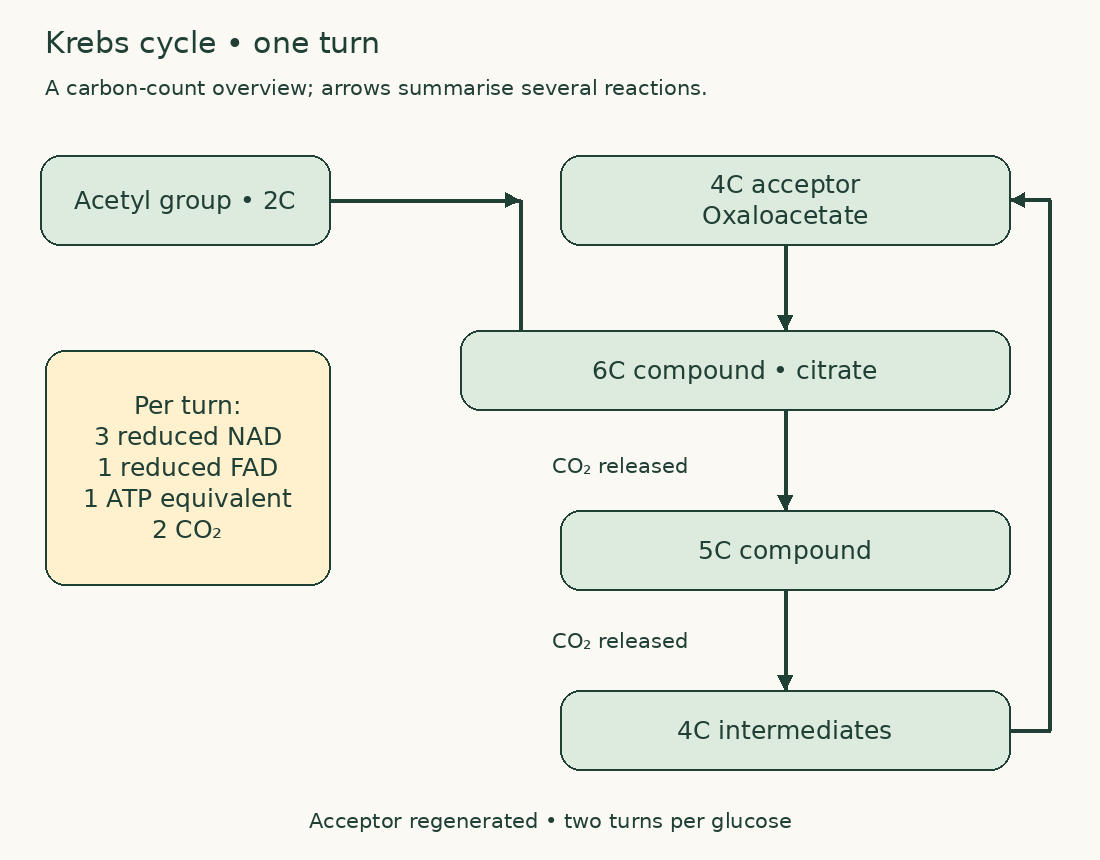
Complete the carbon counts, CO₂ losses and products of one Krebs turn.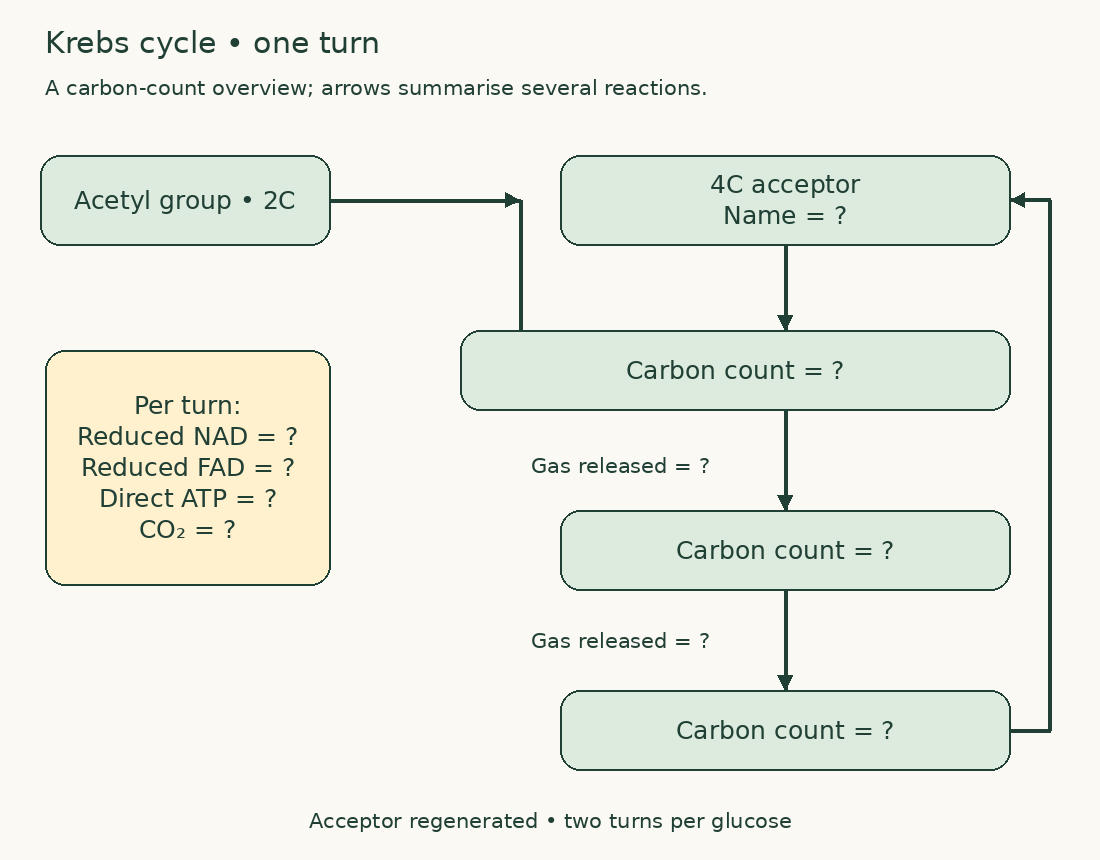
194
Identify A–D, the electron donors and oxygen’s role. Explain both H⁺ arrows.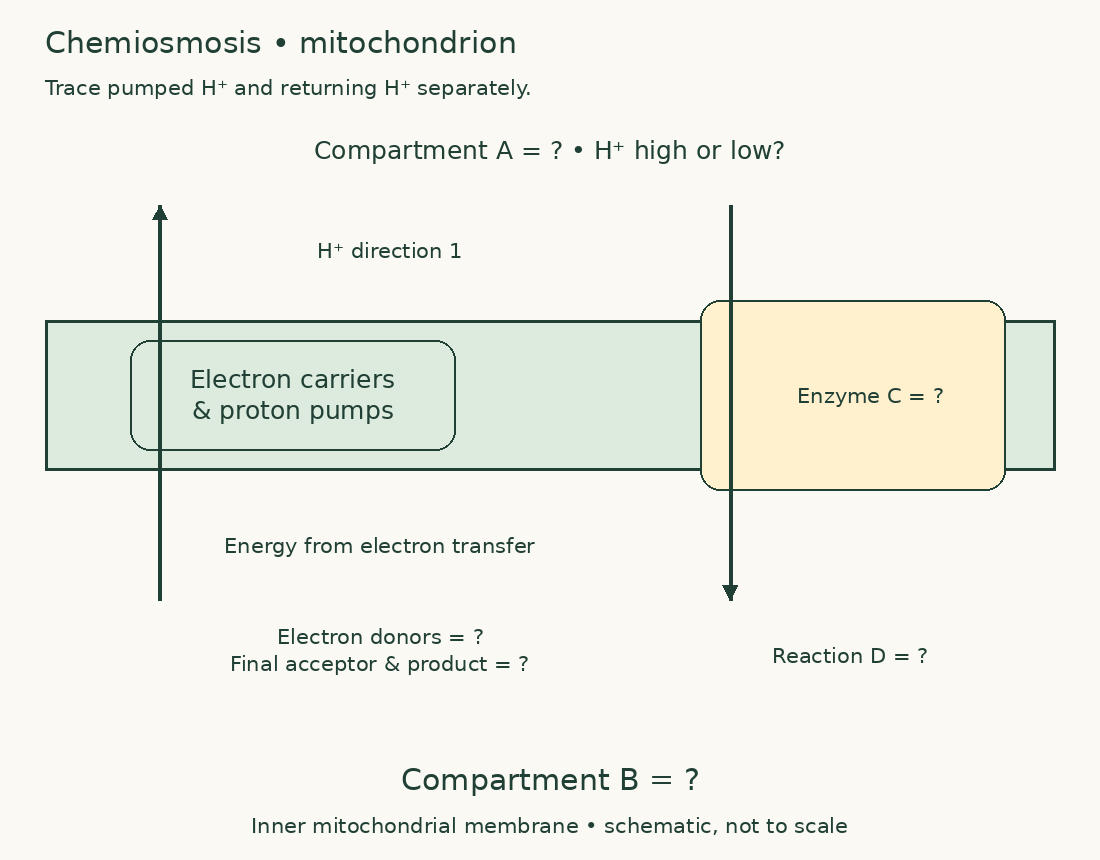
H⁺ is pumped from matrix to intermembrane space against its gradient. It returns through ATP synthase down the gradient, driving ATP formation. Oxygen is the final electron acceptor.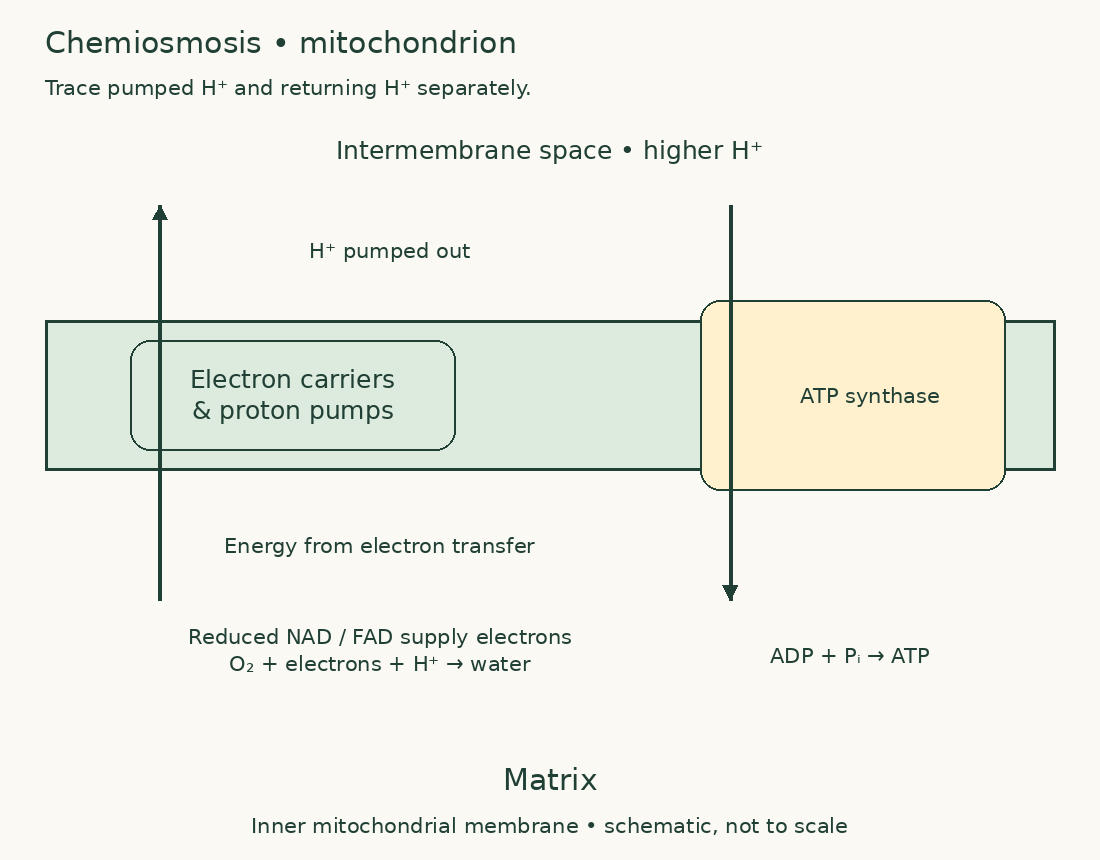
195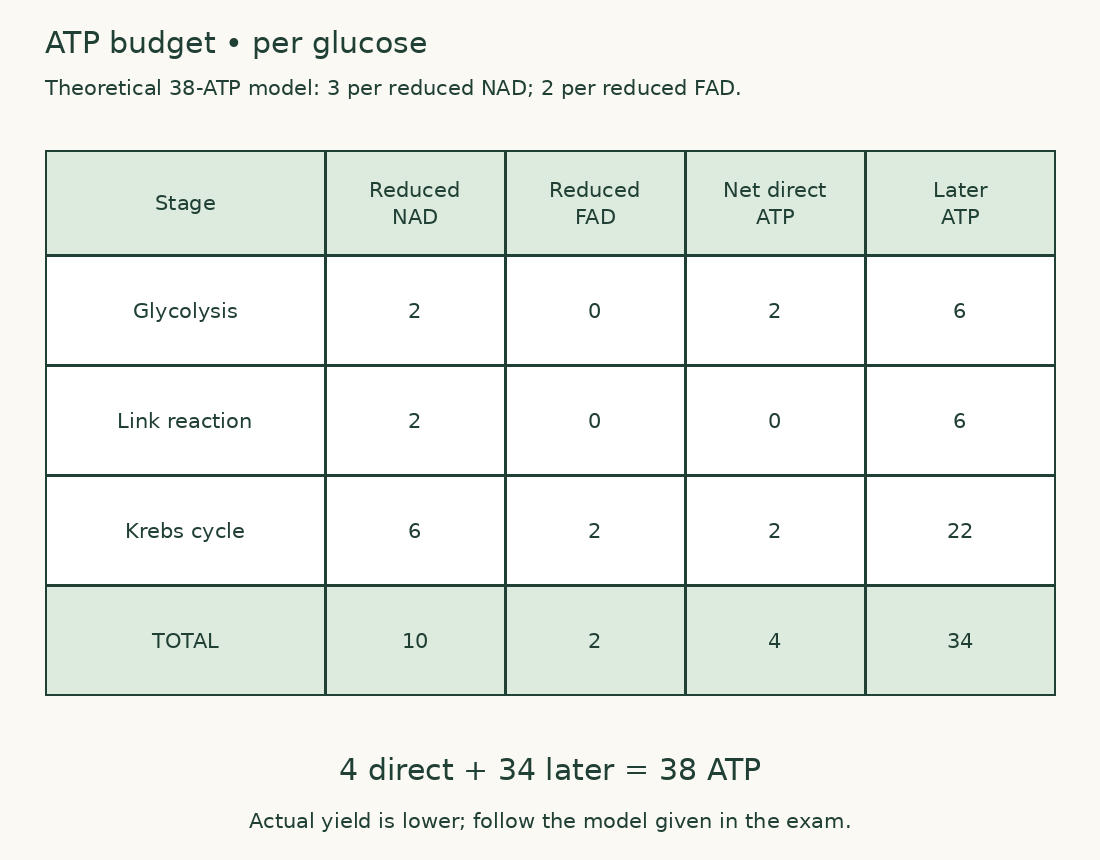
Complete this corrected ATP table using the theoretical 38-ATP model.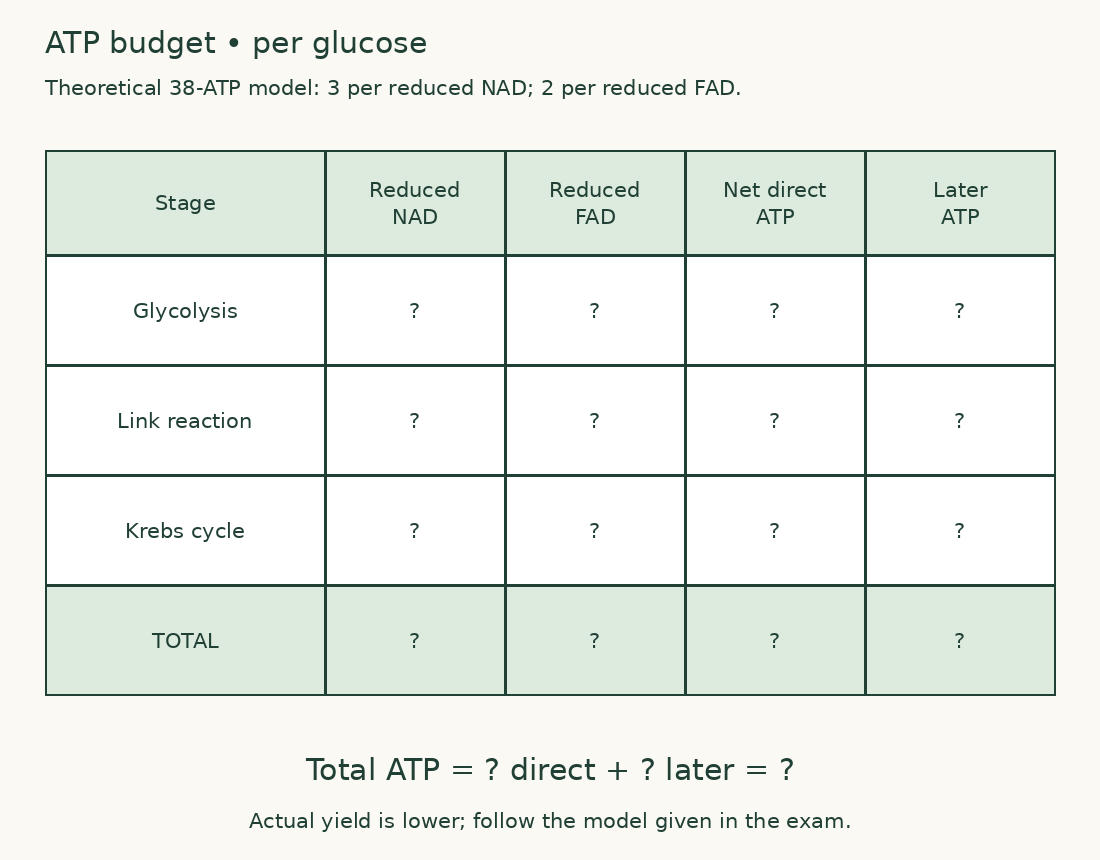
Plus de flashcards : Sciences
Polyatomic IonsSciences · AnglaisEmmyCell physSciences · AnglaisAmandaMicroscopy and Types of MicroscopesSciences · Anglaisgnourt7Astronomy: Universe, Solar System, and GravitySciences · AnglaisJackCell Biology: Transport and Membrane ProteinsSciences · AnglaisAngelinaPeriodic table Sciences · AnglaisZyeerTopics 9 & 10: Mitosis and MeiosisSciences · AnglaisAdam3: Electrified InterfaceSciences · AnglaisJackQuantum TheorySciences · AnglaisfrankieModule 8 Set 2 ASTSciences · AnglaisAdam3. Chromosomale Grundlagen der Vererbung und Rekombination Sciences · AllemandJenniferPractical #4 Amphibian taxonomy and identificationSciences · AnglaisEman
Révise ces decks dans l’app
Gratuit sur iPhone, Android, Mac et le web. Ajoute n’importe quel deck à ton compte en un tap.

