Pulmonary Function Testing (PFT)
Réviser ces flashcardsGratuit · répétition espacée · iPhone, Android, Mac et web
Toutes les cartes
1
The principal goal of pulmonary function testing is to:
A) establish the etiologic diagnosis without other evidence
B) replace clinical assessment and imaging
C) classify lung function as normal or abnormal and quantify impairment
D) identify only obstructive disease
A) establish the etiologic diagnosis without other evidence
B) replace clinical assessment and imaging
C) classify lung function as normal or abnormal and quantify impairment
D) identify only obstructive disease
2
According to the ATS, the most common cause of poor-quality PFT data is:
A) an inaccurate reference equation
B) a patient older than 65 years
C) an incompetent or unmotivated technologist
D) a disposable mouthpiece
A) an inaccurate reference equation
B) a patient older than 65 years
C) an incompetent or unmotivated technologist
D) a disposable mouthpiece
3
For a patient with suspected infectious, airborne disease, the technologist should wear:
A) a surgical mask
B) an N95 respirator
C) a face shield only
D) double gloves only
A) a surgical mask
B) an N95 respirator
C) a face shield only
D) double gloves only
4
Which statement about inline filters during PFT is correct?
A) They do not eliminate the need for regular cleaning and disinfection.
B) They eliminate all cross-contamination risk.
C) They replace the need for universal precautions.
D) They make mouthpiece disinfection optional.
A) They do not eliminate the need for regular cleaning and disinfection.
B) They eliminate all cross-contamination risk.
C) They replace the need for universal precautions.
D) They make mouthpiece disinfection optional.
5
Which person is specifically listed as an example of someone who may be screened with spirometry?
A) A healthy 20-year-old nonsmoker
B) A smoker older than 40 years
C) A patient with uncomplicated appendicitis
D) A patient receiving an annual eye examination
A) A healthy 20-year-old nonsmoker
B) A smoker older than 40 years
C) A patient with uncomplicated appendicitis
D) A patient receiving an annual eye examination
6
The daily volume calibration check for a spirometer should use a:
A) 1-L calibration syringe
B) 6-L calibration syringe
C) water manometer
D) 3-L calibration syringe
A) 1-L calibration syringe
B) 6-L calibration syringe
C) water manometer
D) 3-L calibration syringe
7
Which quality-control statements are correctly matched to the minimum interval?
I. Volume calibration check - daily
II. Leak check for a volume-sensing spirometer - daily
III. Volume linearity check - quarterly
IV. Flow linearity check - weekly
A) I and II only
B) II and III only
C) III and IV only
D) I, III, and IV only
I. Volume calibration check - daily
II. Leak check for a volume-sensing spirometer - daily
III. Volume linearity check - quarterly
IV. Flow linearity check - weekly
A) I and II only
B) II and III only
C) III and IV only
D) I, III, and IV only
8
When new spirometry software is installed, the quality-control program should include:
A) logging the installation date and testing a known subject
B) a quarterly volume-linearity test only
C) replacement of the flow sensor
D) a 15-minute nitrogen washout
A) logging the installation date and testing a known subject
B) a quarterly volume-linearity test only
C) replacement of the flow sensor
D) a 15-minute nitrogen washout
9
A spirometer should be able to measure volumes up to _____ and flows up to _____.
A) 6 L : 12 L/s
B) 8 L : 14 L/s
C) 10L : 16 L/s
D) 12 L : 20 L/s
A) 6 L : 12 L/s
B) 8 L : 14 L/s
C) 10L : 16 L/s
D) 12 L : 20 L/s
10
A 3-L syringe calibration is acceptable at +/-3.5%. Which recovered volume is within the acceptable source range?
A) 3.08 L
B) 2.86 L
C) 2.88 L
D) 3.12 L
A) 3.08 L
B) 2.86 L
C) 2.88 L
D) 3.12 L
11
The demographic measurement most important for determining lung size in predicted equations is:
A) body weight
B) resting heart rate
C) chest circumference
D) standing height
A) body weight
B) resting heart rate
C) chest circumference
D) standing height
12
Why should weight-based predicted reference equations generally not be used?
A) They do not account for bronchodilator use.
B) They require a body box measurement.
C) They overestimate predicted function in obesity and underestimate it in underweight patients.
D) They are valid only in children.
A) They do not account for bronchodilator use.
B) They require a body box measurement.
C) They overestimate predicted function in obesity and underestimate it in underweight patients.
D) They are valid only in children.
13
For a chair-bound patient or a patient with marked kyphoscoliosis, the preferred surrogate for standing height is:
A) fingertip-to-fingertip arm span
B) sitting height
C) ulnar length
D) weight adjusted for BMI
A) fingertip-to-fingertip arm span
B) sitting height
C) ulnar length
D) weight adjusted for BMI
14
Which medication-withholding statements are correct for optional pre-spirometry preparation?
I. Albuterol may be withheld for 4-6 hours.
II. Ipratropium may be withheld for 6 hours.
III. Formoterol may be withheld for 12 hours.
IV. Vilanterol may be withheld for 24 hours.
A) I and II only
B) II and III only
C) I, III, and IV only
D) I, II, III, and IV
I. Albuterol may be withheld for 4-6 hours.
II. Ipratropium may be withheld for 6 hours.
III. Formoterol may be withheld for 12 hours.
IV. Vilanterol may be withheld for 24 hours.
A) I and II only
B) II and III only
C) I, III, and IV only
D) I, II, III, and IV
15
Spirometry is generally recommended in the sitting position primarily to reduce the risk of:
A) hypoxemia
B) bronchospasm
C) syncope with a fall
D) nasal contamination
A) hypoxemia
B) bronchospasm
C) syncope with a fall
D) nasal contamination
16
BTPS reports lung volumes under which condition?
A) Barometric temperature and pressure standard
B) Body temperature and pressure saturated
C) Body temperature and pressure standardized
D) Breathing temperature and pressure stable
A) Barometric temperature and pressure standard
B) Body temperature and pressure saturated
C) Body temperature and pressure standardized
D) Breathing temperature and pressure stable
17
Which statements describe unacceptable FVC-maneuver features?
I. Cough in the first second
II. A leak
III. A 0.150-L difference between the two largest FEV1 values
IV. A Valsalva maneuver
A) I, II, and IV only
B) I and III only
C) II and III only
D) I, II, III, and IV
I. Cough in the first second
II. A leak
III. A 0.150-L difference between the two largest FEV1 values
IV. A Valsalva maneuver
A) I, II, and IV only
B) I and III only
C) II and III only
D) I, II, III, and IV
18
For FVC repeatability, the difference between the largest and next-largest FEV1 should be:
A) 0.100 L or less
B) 0.200 L or less
C) 0.250 L or less
D) 0.150 L or less
A) 0.100 L or less
B) 0.200 L or less
C) 0.250 L or less
D) 0.150 L or less
19
No more than how many FVC maneuvers should ordinarily be attempted?
A) 3
B) 8
C) 5
D) 6
A) 3
B) 8
C) 5
D) 6
20
For adults, a forced vital capacity maneuver requires rapid expiration for at least:
A) 3 seconds
B) 4 seconds
C) 6 seconds
D) 5 seconds
A) 3 seconds
B) 4 seconds
C) 6 seconds
D) 5 seconds
21
An FIVC greater than the preceding FVC most strongly suggests that the patient:
A) has fixed upper airway obstruction
B) coughed during early expiration
C) has a low total lung capacity
D) did not fully inhale before forced exhalation
A) has fixed upper airway obstruction
B) coughed during early expiration
C) has a low total lung capacity
D) did not fully inhale before forced exhalation
22
Excessive back-extrapolated volume should be suspected when it exceeds:
A) 100 mL or 3% of FVC
B) 150 mL or 5% of FVC
C) 125 mL or 4% of FVC
D) 200 mL or 10% of FVC
A) 100 mL or 3% of FVC
B) 150 mL or 5% of FVC
C) 125 mL or 4% of FVC
D) 200 mL or 10% of FVC
23
Which statements about excessive back-extrapolated volume (BEV) are correct?
I. It may occur when air escapes before forced expiration.
II. It can falsely elevate FEV1.
III. It is corrected by accepting a larger FIVC.
IV. The patient should be coached to exhale from the very top.
A) I and II only
B) II and III only
C) I, II, and IV only
D) I, II, III, and IV
I. It may occur when air escapes before forced expiration.
II. It can falsely elevate FEV1.
III. It is corrected by accepting a larger FIVC.
IV. The patient should be coached to exhale from the very top.
A) I and II only
B) II and III only
C) I, II, and IV only
D) I, II, III, and IV
24
A variable extrathoracic upper airway lesion usually causes the FEF50/FIF50 ratio to:
A) increase above its usual value of about 1.0
B) fall below 0.50
C) remain diagnostic only when FVC is low
D) equal the RV/TLC ratio
A) increase above its usual value of about 1.0
B) fall below 0.50
C) remain diagnostic only when FVC is low
D) equal the RV/TLC ratio
25
In a healthy adult, the usual FEV1/FVC ratio is approximately:
A) 0.50-0.60
B) 0.60-0.70
C) 0.75-0.85
D) 0.90-1.00
A) 0.50-0.60
B) 0.60-0.70
C) 0.75-0.85
D) 0.90-1.00
26
Airflow obstruction is defined spirometrically by an FEV1/FVC ratio:
A) below the lower limit of normal
B) below 80% predicted
C) below 0.70 at every age
D) above the upper limit of normal
A) below the lower limit of normal
B) below 80% predicted
C) below 0.70 at every age
D) above the upper limit of normal
27
FEV6 has been introduced primarily as an acceptable replacement for:
A) FEV1
B) MVV
C) TLC
D) FVC
A) FEV1
B) MVV
C) TLC
D) FVC
28
On a flow-volume loop, the horizontal axis displays _____ and the vertical axis displays _____.
A) time: volume
B) volume: flow
C) flow: volume
D) volume: time
A) time: volume
B) volume: flow
C) flow: volume
D) volume: time
29
On a conventional flow-volume loop, points above the baseline represent:
A) expiration
B) inspiration
C) dead space only
D) the breath-hold period
A) expiration
B) inspiration
C) dead space only
D) the breath-hold period
30
A concave downward expiratory limb, resembling an ocean wave, is most characteristic of:
A) normal spirometry
B) restrictive lung disease
C) an isolated low DLCO
D) obstructive airway disease
A) normal spirometry
B) restrictive lung disease
C) an isolated low DLCO
D) obstructive airway disease
31
The flow-volume loop in severe restrictive disease is most often described as resembling a:
A) flattened box
B) narrow upside-down ice cream cone
C) sail with broad base
D) large concave ocean wave
A) flattened box
B) narrow upside-down ice cream cone
C) sail with broad base
D) large concave ocean wave
32
Why may slow vital capacity be larger than FVC in airflow limitation?
A) SVC is measured only after bronchodilator use.
B) FVC excludes residual volume by definition.
C) Slow exhalation minimizes forced-expiratory air trapping.
D) SVC adds dead-space volume to the vital capacity.
A) SVC is measured only after bronchodilator use.
B) FVC excludes residual volume by definition.
C) Slow exhalation minimizes forced-expiratory air trapping.
D) SVC adds dead-space volume to the vital capacity.
33
During an SVC maneuver, at least how many relaxed tidal breaths should be recorded before maximal inspiration?
A) 2
B) 3
C) 4
D) 5
A) 2
B) 3
C) 4
D) 5
34
A decrease of at least 15% in supine SVC is consistent with:
A) respiratory muscle weakness
B) isolated emphysema
C) bronchodilator responsiveness
D)upper airway obstruction
A) respiratory muscle weakness
B) isolated emphysema
C) bronchodilator responsiveness
D)upper airway obstruction
35
Maximum voluntary ventilation is the largest volume moved during a:
A) 6-second interval
B) 10-second interval
C) 12-second interval
D) 30-second interval
A) 6-second interval
B) 10-second interval
C) 12-second interval
D) 30-second interval
36
During acceptable MVV testing, individual breath volumes should meet or exceed what fraction of the best FVC?
A) 25%
B) 50%
C) 75%
D) 90%
A) 25%
B) 50%
C) 75%
D) 90%
37
Which statements about MVV are correct?
I. The recommended breathing frequency is about 90 breaths/min.
II. Two acceptable efforts should be recorded.
III. Variability should not exceed 20%.
IV. An isolated low MVV can occur with vocal cord dysfunction.
A) I, II, III, and IV
B) I and II only
C) II and III only
D) I, III, and IV only
I. The recommended breathing frequency is about 90 breaths/min.
II. Two acceptable efforts should be recorded.
III. Variability should not exceed 20%.
IV. An isolated low MVV can occur with vocal cord dysfunction.
A) I, II, III, and IV
B) I and II only
C) II and III only
D) I, III, and IV only
38
A significant bronchodilator response is an increase in FEV1 or FVC of at least:
A) 10% and 150 mL
B) 12% and 200 mL
C) 15% and 250 mL
D) 20% and 400 mL
A) 10% and 150 mL
B) 12% and 200 mL
C) 15% and 250 mL
D) 20% and 400 mL
39
After albuterol is administered for bronchodilator testing, post-bronchodilator spirometry is generally repeated after:
A) 2-5 minutes
B) 10-15 minutes
C) 20-30 minutes
D) 45-60 minutes
A) 2-5 minutes
B) 10-15 minutes
C) 20-30 minutes
D) 45-60 minutes
40
An FEV1 between 35% and 50% predicted is categorized as:
A) mild
B) moderate
C) severe
D) very severe
A) mild
B) moderate
C) severe
D) very severe
41
The traditional lower limit of normal for key pulmonary function variables corresponds to approximately the:
A) 1st percentile
B) 5th percentile
C) 2.5th percentile
D) 10th percentile
A) 1st percentile
B) 5th percentile
C) 2.5th percentile
D) 10th percentile
42
A Z score of -1.64 corresponds most closely to the:
A) upper limit of normal
B) predicted mean
C) lower limit of normal
D) moderate impairment cutoff
A) upper limit of normal
B) predicted mean
C) lower limit of normal
D) moderate impairment cutoff
43
A Z score of +1.64 corresponds most closely to the:
A) upper limit of normal
B) lower limit of normal
C) predicted mean
D) obstruction threshold
A) upper limit of normal
B) lower limit of normal
C) predicted mean
D) obstruction threshold
44
Which statements correctly distinguish lung volumes from capacities?
I. A capacity consists of two or more lung volumes.
II. VC includes VT, IRV, and ERV.
III. FRC equals RV plus ERV.
IV. TLC is the volume in the lungs at maximal inspiration.
A) I and II only
B) II and III only
C) I, II, III, and IV
D) I, III, and IV only
I. A capacity consists of two or more lung volumes.
II. VC includes VT, IRV, and ERV.
III. FRC equals RV plus ERV.
IV. TLC is the volume in the lungs at maximal inspiration.
A) I and II only
B) II and III only
C) I, II, III, and IV
D) I, III, and IV only
45
Vital capacity includes which three component volumes?
A) VT, RV, and ERV
B) VT, IRV, and ERV
C) IRV, RV, and ERV
D) VT, IRV, and FRC
A) VT, RV, and ERV
B) VT, IRV, and ERV
C) IRV, RV, and ERV
D) VT, IRV, and FRC
46
Functional residual capacity equals:
A) RV + ERV
B) VT + IRV
C) IRV + ERV
D) RV + VT
A) RV + ERV
B) VT + IRV
C) IRV + ERV
D) RV + VT
47
Residual volume can be calculated from FRC and ERV by:
A) FRC + ERV
B) ERV - FRC
C) FRC - ERV
D) FRC / ERV
A) FRC + ERV
B) ERV - FRC
C) FRC - ERV
D) FRC / ERV
48
Which methods are used in PFT laboratories to measure FRC?
I. Nitrogen washout
II. Helium dilution
III. Body plethysmography
IV. Single-breath FEV1 maneuver
A) I and IV only
B) II and IV only
C) I, II, III, and IV
D) I, II, and III only
I. Nitrogen washout
II. Helium dilution
III. Body plethysmography
IV. Single-breath FEV1 maneuver
A) I and IV only
B) II and IV only
C) I, II, III, and IV
D) I, II, and III only
49
In nitrogen washout, the patient is switched from room air to:
A) 100% nitrogen
B) 100% oxygen
C) 50% oxygen and 50% helium
D) 10% carbon monoxide
A) 100% nitrogen
B) 100% oxygen
C) 50% oxygen and 50% helium
D) 10% carbon monoxide
50
A nitrogen washout is complete when exhaled nitrogen falls below 1.5% for:
A) one breath
B) two consecutive breaths
C) three consecutive breaths
D) five consecutive breaths
A) one breath
B) two consecutive breaths
C) three consecutive breaths
D) five consecutive breaths
51
During nitrogen washout, a rise in exhaled nitrogen concentration most strongly indicates:
A) improved ventilation distribution
B) normal end-test equilibration
C) excessive CO2 absorption
D) a leak with room-air contamination
A) improved ventilation distribution
B) normal end-test equilibration
C) excessive CO2 absorption
D) a leak with room-air contamination
52
Lung clearance index is the number of FRC turnovers needed to reduce tracer gas to:
A) 2.5% of initial concentration
B) 10% of initial concentration
C) 5% of initial concentration
D) 0.5% of initial concentration
A) 2.5% of initial concentration
B) 10% of initial concentration
C) 5% of initial concentration
D) 0.5% of initial concentration
53
At the start of a helium-dilution FRC test, the spirometer system contains approximately:
A) 0.5% helium
B) 10% helium
C) 50% helium
D) 79% helium
A) 0.5% helium
B) 10% helium
C) 50% helium
D) 79% helium
54
Helium dilution is classified as a:
A) open-circuit method
B) body-box method
C) closed-circuit method
D) single-breath method
A) open-circuit method
B) body-box method
C) closed-circuit method
D) single-breath method
55
Which circuit component pairing is correct in helium dilution?
A) Calcium sulfate absorbs CO2.
B) Sodium or barium hydroxide absorbs CO2.
C) Helium absorbs water vapor.
D) A pneumotach absorbs nitrogen.
A) Calcium sulfate absorbs CO2.
B) Sodium or barium hydroxide absorbs CO2.
C) Helium absorbs water vapor.
D) A pneumotach absorbs nitrogen.
56
A leak during helium dilution tends to produce a measured FRC that is:
A) falsely high
B) falsely low
C) unchanged
D) equal to TLC
A) falsely high
B) falsely low
C) unchanged
D) equal to TLC
57
The gas analyzers used for nitrogen washout or helium dilution should receive at least daily:
A) a one-point room-air check
B) a two-point calibration using zero and span gas
C) a biological-control check only
D) a body-box shutter calibration
A) a one-point room-air check
B) a two-point calibration using zero and span gas
C) a biological-control check only
D) a body-box shutter calibration
58
Which daily body plethysmograph checks are correctly identified?
I. Mouth pressure with a manometer
II. Mouth flow and volume with a 3-L syringe
III. Change in box pressure with the piston pump
IV. DLCO with a biological control
A) I, III, and IV only
B) II and IV only
C) I, II, and III only
D) I, II, III, and IV
I. Mouth pressure with a manometer
II. Mouth flow and volume with a 3-L syringe
III. Change in box pressure with the piston pump
IV. DLCO with a biological control
A) I, III, and IV only
B) II and IV only
C) I, II, and III only
D) I, II, III, and IV
59
Compared with gas-dilution methods, body plethysmography measures:
A) only residual volume
B) only inspiratory capacity
C) only alveoli that communicate rapidly
D) all thoracic gas spaces, including noncommunicating gas
A) only residual volume
B) only inspiratory capacity
C) only alveoli that communicate rapidly
D) all thoracic gas spaces, including noncommunicating gas
60
During body-box FRC measurement, the patient is asked to breathe gently at about:
A) one breath every 10 seconds
B) one breath per second
C) two breaths per minute
D) five breaths per second
A) one breath every 10 seconds
B) one breath per second
C) two breaths per minute
D) five breaths per second
61
In body plethysmography, emphysema with a large FRC produces a more _____ slope with a tangent near _____.
A) vertical; 1.0
B) vertical; 1.7
C) horizontal; 0.58
D) horizontal; 1.7
A) vertical; 1.0
B) vertical; 1.7
C) horizontal; 0.58
D) horizontal; 1.7
62
Which pattern supports restriction on static lung-volume testing?
A) TLC below the LLN
B) RV/TLC above the ULN
C) TLC above the ULN
D) ERV above the ULN
A) TLC below the LLN
B) RV/TLC above the ULN
C) TLC above the ULN
D) ERV above the ULN
63
An RV/TLC ratio above the ULN is most consistent with:
A) normal aging alone
B) isolated respiratory muscle weakness
C) improved alveolar diffusion
D) air trapping
A) normal aging alone
B) isolated respiratory muscle weakness
C) improved alveolar diffusion
D) air trapping
64
DLCO is expressed in customary units as:
A) L's
B) ml/min/mm Hg
C) cm H2O/L/s
D) mL/min
A) L's
B) ml/min/mm Hg
C) cm H2O/L/s
D) mL/min
65
The standard DLCO test gas contains approximately what concentration of carbon monoxide?
A) 0.03%
B) 0.1%
C) 0.3%
D) 3.0%
A) 0.03%
B) 0.1%
C) 0.3%
D) 3.0%
66
By the Jones-Meade method, diffusing time begins at _____ of inspiratory time and ends when _____ of the alveolar sample is collected.
A) one-half; one-third
B) the end; one-half
C) one-third; the entire sample
D) one-third; one-half
A) one-half; one-third
B) the end; one-half
C) one-third; the entire sample
D) one-third; one-half
67
To avoid dead-space contamination during DLCO testing, the first approximately _____ of exhaled gas is discarded.
A) 750-1000 mL
B) 100-250 mL
C) 1.5-2.0 L
D) 3.0 L
A) 750-1000 mL
B) 100-250 mL
C) 1.5-2.0 L
D) 3.0 L
68
Which DLCO finding is expected in polycythemia or when blood is present in the airways?
A) Low DLCO from reduced hemoglobin
B) High DLCO
C) Normal DLCO regardless of hemoglobin
D) Absent tracer-gas dilution
A) Low DLCO from reduced hemoglobin
B) High DLCO
C) Normal DLCO regardless of hemoglobin
D) Absent tracer-gas dilution
69
Which statements are appropriate DLCO pretest precautions?
I. Avoid smoking for at least 1 hour.
II. Avoid exercise before testing.
III. Remove supplemental oxygen for at least 10 minutes if possible.
IV. Correct for hemoglobin and carboxyhemoglobin when possible.
A) I, II, III, and IV
B) I and II only
C) II and III only
D) I, III, and IV only
I. Avoid smoking for at least 1 hour.
II. Avoid exercise before testing.
III. Remove supplemental oxygen for at least 10 minutes if possible.
IV. Correct for hemoglobin and carboxyhemoglobin when possible.
A) I, II, III, and IV
B) I and II only
C) II and III only
D) I, III, and IV only
70
Airways resistance is calculated as:
A) flow divided by pressure
B) volume divided by time
C) pressure divided by flow
D) lung volume divided by conductance
A) flow divided by pressure
B) volume divided by time
C) pressure divided by flow
D) lung volume divided by conductance
71
A 3-L calibration check yields 3.12 L at an appropriate flow. Which interpretation is best?
A) Accept it because it is within 5%.
B) Accept it because flow is more important than volume.
C) Repeat it next week because volume checks are weekly.
D) Reject it because it exceeds the 3.10-L upper tolerance.
A) Accept it because it is within 5%.
B) Accept it because flow is more important than volume.
C) Repeat it next week because volume checks are weekly.
D) Reject it because it exceeds the 3.10-L upper tolerance.
72
A daily calibration sequence using a 3-L syringe produces 2.99 L, 3.01 L, and 3.00 L at flows spanning 2-12 L/s. What is the best action?
A) Fail the device because three injections are required at the same flow.
B) Accept the calibration as meeting the daily volume-verification criterion.
C) Repeat after a 15-minute washout.
D) Use a different predicted equation.
A) Fail the device because three injections are required at the same flow.
B) Accept the calibration as meeting the daily volume-verification criterion.
C) Repeat after a 15-minute washout.
D) Use a different predicted equation.
73
Use the following three acceptable maneuvers: largest FVC 3.42 L; next-largest FVC 3.31 L; largest FEV1 2.88 L; next-largest FEV1 2.74 L. Which conclusion is correct?
A) Both FVC and FEV1 meet repeatability.
B) FVC is repeatable but FEV1 is not.
C) FEV1 is repeatable but FVC is not.
D) Neither FVC nor FEV1 meets repeatability.
A) Both FVC and FEV1 meet repeatability.
B) FVC is repeatable but FEV1 is not.
C) FEV1 is repeatable but FVC is not.
D) Neither FVC nor FEV1 meets repeatability.
74
A patient has low FEV1, low FVC, a normal FEV1/FVC ratio, and a TLC below the LLN. The most likely pattern is:
A) nonspecific pattern
B) restriction
C) isolated air trapping
D) normal lung function
A) nonspecific pattern
B) restriction
C) isolated air trapping
D) normal lung function
75
A patient has low FEV1 and FVC, a normal FEV1/FVC ratio, and a normal TLC. This is best classified as:
A) confirmed restriction
B) hyperinflation
C) isolated diffusion impairment
D) a nonspecific pattern
A) confirmed restriction
B) hyperinflation
C) isolated diffusion impairment
D) a nonspecific pattern
76
FRC is 3.2 L by helium dilution and 4.4 L by body plethysmography in a patient with emphysema. The 1.2-L difference most likely represents:
A) calibration drift in the body box
B) increased dead space
C) a falsely low RV/TLC
D) trapped noncommunicating gas
A) calibration drift in the body box
B) increased dead space
C) a falsely low RV/TLC
D) trapped noncommunicating gas
77
During nitrogen washout, exhaled nitrogen falls steadily but then abruptly increases after the patient opens the mouth briefly. What is the most likely explanation?
A) Room-air contamination from a leak
B) Bronchodilator effect
C) Normal terminal equilibration
D) Increased alveolar uptake of nitrogen
A) Room-air contamination from a leak
B) Bronchodilator effect
C) Normal terminal equilibration
D) Increased alveolar uptake of nitrogen
78
Two similar patients begin helium dilution at 10% helium. One equilibrates at 6% and the other at 8%. Which patient has the larger FRC?
A) The 6% patient
B) Both have the same FRC
C) The 8% patient
D) Neither result permits inference about FRC
A) The 6% patient
B) Both have the same FRC
C) The 8% patient
D) Neither result permits inference about FRC
79
A body-box tracing shows a slope with tangent 1.7. Compared with normal, this most strongly suggests:
A) large FRC from emphysema
B) small FRC from fibrosis
C) air trapping with high RV/TLC
D) a helium-dilution leak
A) large FRC from emphysema
B) small FRC from fibrosis
C) air trapping with high RV/TLC
D) a helium-dilution leak
80
During DLCO testing, VA is substantially lower than TLC measured by body plethysmography. Which explanation is most likely?
A) The patient has excellent gas distribution.
B) The tracer gas has diffused into blood.
C) The FVC maneuver proves fixed UAO.
D) Test gas was poorly distributed through the lungs.
A) The patient has excellent gas distribution.
B) The tracer gas has diffused into blood.
C) The FVC maneuver proves fixed UAO.
D) Test gas was poorly distributed through the lungs.
81
With BTPS correction off, a 3-L syringe DLCO simulation yields DLCO 1.1 mL/min/mm Hg and VA 3.0 L. What is the best conclusion?
A) The simulation is acceptable because VA is correct.
B) The DLCO simulator result fails the expected <-0.5 criterion.
C) The test shows severe diffusion impairment.
D) The biological-control check can be omitted.
A) The simulation is acceptable because VA is correct.
B) The DLCO simulator result fails the expected <-0.5 criterion.
C) The test shows severe diffusion impairment.
D) The biological-control check can be omitted.
82
A patient walks briskly immediately before DLCO measurement and the result is unexpectedly high. Which factor best explains this?
A) Recent exercise reduces VA.
B) Smoking increases carboxyhemoglobin and raises DLCO.
C) Supplemental oxygen increases CO uptake.
D) Increased cardiac output raises pulmonary blood flow and falsely elevates resting DLCO.
A) Recent exercise reduces VA.
B) Smoking increases carboxyhemoglobin and raises DLCO.
C) Supplemental oxygen increases CO uptake.
D) Increased cardiac output raises pulmonary blood flow and falsely elevates resting DLCO.
83
Baseline FEV1 is 3.00 L. After methacholine, FEV1 is 2.37 L. This result has reached the usual positive endpoint because it shows:
A) a 12% fall in FEV1
B) a 15% fall in FEV1
C) a 21% fall in FEV1
D) a 10% fall in FEV1
A) a 12% fall in FEV1
B) a 15% fall in FEV1
C) a 21% fall in FEV1
D) a 10% fall in FEV1
84
During mannitol challenge, FEV1 falls 13% from baseline and 11% from the preceding dose. How should the result be interpreted?
A) Positive because the between-dose fall is at least 10%.
B) Negative because the baseline fall is below 15%.
C) Indeterminate because only baseline change matters.
D) Positive only if the next dose causes another fall.
A) Positive because the between-dose fall is at least 10%.
B) Negative because the baseline fall is below 15%.
C) Indeterminate because only baseline change matters.
D) Positive only if the next dose causes another fall.
85
After high-intensity exercise challenge, FEV1 declines 12% from baseline. The appropriate interpretation is:
A) negative because 12% is less than 15%
B) equivocal because only a 20% fall is meaningful
C) positive exercise challenge
D) positive only if FVC also falls
A) negative because 12% is less than 15%
B) equivocal because only a 20% fall is meaningful
C) positive exercise challenge
D) positive only if FVC also falls
86
A single-breath nitrogen washout shows a steeper phase III slope and increased closing volume. This pattern indicates:
A) uniform ventilation distribution
B) poor inspiratory effort only
C) reduced pulmonary blood flow
D) increasingly heterogeneous ventilation from obstructive disease
A) uniform ventilation distribution
B) poor inspiratory effort only
C) reduced pulmonary blood flow
D) increasingly heterogeneous ventilation from obstructive disease
87
Raw is elevated when measured near RV, but sGaw is normal. Which interpretation is most likely?
A) The patient has fixed central airway obstruction.
B) The elevation in Raw is explained by the low lung volume at measurement.
C) The patient has reduced alveolar volume from fibrosis.
D) The body box has a mouth-pressure leak.
A) The patient has fixed central airway obstruction.
B) The elevation in Raw is explained by the low lung volume at measurement.
C) The patient has reduced alveolar volume from fibrosis.
D) The body box has a mouth-pressure leak.
88
PImax trials are -31, -34, -36, and -33 cm H2O, with technically acceptable efforts. Which value should be reported as the highest PImax?
A) -36 cm H2O
B) -31 cm H2O
C) -33 cm H2O
D) -34 cm H2O
A) -36 cm H2O
B) -31 cm H2O
C) -33 cm H2O
D) -34 cm H2O
89
An adult has FENO results of 18 ppb, 34 ppb, and 58 ppb on separate quality-assured measurements. Which value is in the high ATS category?
A) 18 ppb
B) 58 ppb
C) 34 ppb
D) All three are intermediate
A) 18 ppb
B) 58 ppb
C) 34 ppb
D) All three are intermediate
90
After 7 minutes of nitrogen washout, exhaled nitrogen remains 12% in a patient with severe airflow obstruction and no detected leak. What is the best explanation?
A) Excessive tracer-gas uptake by blood
B) Normal completion criterion
C) Inadequate washout from poorly communicating lung regions
D) A falsely low FRC from hyperinflation
A) Excessive tracer-gas uptake by blood
B) Normal completion criterion
C) Inadequate washout from poorly communicating lung regions
D) A falsely low FRC from hyperinflation
91
A patient coughs in the first second of each otherwise forceful FVC attempt. Which is the most defensible technologist action?
A) Coach and repeat the maneuver
A) Coach and repeat the maneuver
92
cough in the first second makes it unacceptable.
B) Report the best FEV1 because the cough does not affect the first second.
C) Average the three FEV1 values to minimize the cough effect.
D) Classify the tracing as restrictive if FVC is low.
B) Report the best FEV1 because the cough does not affect the first second.
C) Average the three FEV1 values to minimize the cough effect.
D) Classify the tracing as restrictive if FVC is low.
93
A patient with marked kyphosis has all spirometry values above 120% predicted when short standing height is entered. Which approach is most appropriate?
A) Use weight-based predicted values instead.
B) Lower the LLN to 80% predicted.
C) Interpret the test as hyperinflation without repeating demographics.
D) Re-estimate height with arm span and recalculate predicted values.
A) Use weight-based predicted values instead.
B) Lower the LLN to 80% predicted.
C) Interpret the test as hyperinflation without repeating demographics.
D) Re-estimate height with arm span and recalculate predicted values.
94
A patient has low TLC and needs distinction between chest-wall restriction and interstitial lung disease. Which test result is most useful?
A) Peak expiratory flow
B) FEV6 alone
C) DLCO
D) MVV alone
A) Peak expiratory flow
B) FEV6 alone
C) DLCO
D) MVV alone
95
A patient has episodic wheeze but normal spirometry while asymptomatic. With a reasonable pretest probability of asthma, which next test is most justifiable?
A) Repeat TLC by helium dilution only
B) Perform an appropriately prepared bronchial challenge test
C) Order a DLCO to provoke bronchospasm
D) Diagnose asthma solely from symptoms
A) Repeat TLC by helium dilution only
B) Perform an appropriately prepared bronchial challenge test
C) Order a DLCO to provoke bronchospasm
D) Diagnose asthma solely from symptoms
96
An adult has FENO 62 ppb, compatible symptoms, and no contraindication to testing. Which interpretation is most appropriate?
A) It supports asthma and likely corticosteroid responsiveness but should be integrated clinically.
B) It rules out asthma because the value is above 50 ppb.
C) It confirms asthma without considering other evidence.
D) It proves fixed upper airway obstruction.
A) It supports asthma and likely corticosteroid responsiveness but should be integrated clinically.
B) It rules out asthma because the value is above 50 ppb.
C) It confirms asthma without considering other evidence.
D) It proves fixed upper airway obstruction.
97
Spirometry shows low FVC and FEV1 with a normal FEV1/FVC ratio, but TLC is normal. Which report is best?
A) Confirmed restrictive ventilatory defect
B) Normal PFTs because TLC is normal
C) Severe obstruction due to air trapping
D) Nonspecific pattern; do not label restriction without low TLC
A) Confirmed restrictive ventilatory defect
B) Normal PFTs because TLC is normal
C) Severe obstruction due to air trapping
D) Nonspecific pattern; do not label restriction without low TLC
98
A patient with anemia has a low unadjusted DLCO. Which laboratory practice is most appropriate?
A) Ignore hemoglobin because DLCO is volume-corrected.
B) Adjust or interpret DLCO with hemoglobin information when possible.
C) Repeat immediately after exercise to improve perfusion.
D) Administer supplemental oxygen during testing.
A) Ignore hemoglobin because DLCO is volume-corrected.
B) Adjust or interpret DLCO with hemoglobin information when possible.
C) Repeat immediately after exercise to improve perfusion.
D) Administer supplemental oxygen during testing.
99
A patient has normal FVC and FEV1, MVV 65% predicted, and FEF50/FIF50 of 3.2. Which follow-up interpretation is most defensible?
A) Diagnose emphysema from the MVV alone.
B) Call the result normal because FVC is normal.
C) Confirm restriction by measuring FENO.
D) Evaluate for variable extrathoracic upper airway obstruction with repeatable maximal inspiratory loops.
A) Diagnose emphysema from the MVV alone.
B) Call the result normal because FVC is normal.
C) Confirm restriction by measuring FENO.
D) Evaluate for variable extrathoracic upper airway obstruction with repeatable maximal inspiratory loops.
100
Which PFT strategy best evaluates suspected diaphragm weakness?
A) Pre- and post-bronchodilator FEV1 only
B) Methacholine challenge plus FENO
C) PImax/PEmax with seated and supine SVC
D) Raw at a fixed lung volume only
A) Pre- and post-bronchodilator FEV1 only
B) Methacholine challenge plus FENO
C) PImax/PEmax with seated and supine SVC
D) Raw at a fixed lung volume only
101
For severe bullous emphysema, which FRC method is most appropriate when the goal is to include trapped, noncommunicating gas?
A) Body plethysmography
B) Nitrogen washout
C) Helium dilution
D) Single-breath DLCO
A) Body plethysmography
B) Nitrogen washout
C) Helium dilution
D) Single-breath DLCO
102
In a quality system, accuracy is the extent to which a measurement:
A) Approximates a known quantity.
B) Repeats with a small standard deviation.
C) Meets a verification range.
D) Has no random error.
A) Approximates a known quantity.
B) Repeats with a small standard deviation.
C) Meets a verification range.
D) Has no random error.
103
The coefficient of variation is calculated as:
A) Mean divided by standard deviation.
B) Standard deviation divided by mean.
C) Current calibration minus prior calibration.
D) Range divided by the median.
A) Mean divided by standard deviation.
B) Standard deviation divided by mean.
C) Current calibration minus prior calibration.
D) Range divided by the median.
104
Calibration verification primarily confirms that a device:
A) Has a qualified operator.
B) Produces the most precise result.
C) Is within the expected calibration range.
D) Has normally distributed control values.
A) Has a qualified operator.
B) Produces the most precise result.
C) Is within the expected calibration range.
D) Has normally distributed control values.
105
In a quality manual, the question "How does this happen in our pulmonary function laboratory?" identifies a:
A) Policy.
B) Procedure.
C) Quality indicator.
D) Process.
A) Policy.
B) Procedure.
C) Quality indicator.
D) Process.
106
For spirometry reporting, which statements are correct?
I. Select the largest acceptable FVC.
II. Select the largest acceptable FEV1.
III. Select instantaneous flows from the curve with the highest peak expiratory flow.
IV. Print all acceptable curves.
A) I, II, and IV only.
B) I and III only.
C) II, III, and IV only.
D) I, II, III, and IV.
I. Select the largest acceptable FVC.
II. Select the largest acceptable FEV1.
III. Select instantaneous flows from the curve with the highest peak expiratory flow.
IV. Print all acceptable curves.
A) I, II, and IV only.
B) I and III only.
C) II, III, and IV only.
D) I, II, III, and IV.
107
Which fluid is covered by standard precautions even when it is not visibly bloody?
A) Nasal secretions.
B) Pleural fluid.
C) Sweat.
D) Tears.
A) Nasal secretions.
B) Pleural fluid.
C) Sweat.
D) Tears.
108
The recommended solution for cleaning a blood spill is:
A) 1 part 5% sodium hypochlorite bleach to 1 part water.
B) 1 part 5% sodium hypochlorite bleach to 4 parts water.
C) 1 part 5% sodium hypochlorite bleach to 9 parts water.
D) 1 part 5% sodium hypochlorite bleach to 99 parts water.
A) 1 part 5% sodium hypochlorite bleach to 1 part water.
B) 1 part 5% sodium hypochlorite bleach to 4 parts water.
C) 1 part 5% sodium hypochlorite bleach to 9 parts water.
D) 1 part 5% sodium hypochlorite bleach to 99 parts water.
109
Which practices reduce cross-contamination during pulmonary function testing?
I. Use disposable mouthpieces and nose clips.
II. Change rebreathing tubing or valves after each test.
III. Reuse disposable flow sensors after disinfection.
IV. Calibrate with a bacterial filter in line when the filter is used for testing.
A) I and II only.
B) II and III only.
C) I, III, and IV only.
D) I, II, and IV only.
I. Use disposable mouthpieces and nose clips.
II. Change rebreathing tubing or valves after each test.
III. Reuse disposable flow sensors after disinfection.
IV. Calibrate with a bacterial filter in line when the filter is used for testing.
A) I and II only.
B) II and III only.
C) I, III, and IV only.
D) I, II, and IV only.
110
For consumables and critical supplies, which information should be documented?
I. Receipt date.
II. Lot number.
III. Expiration date.
IV. Acceptance-criteria result.
A) I, II, III, and IV.
B) I, II, and III only.
C) I, II, and IV only.
D) II, III, and IV only.
I. Receipt date.
II. Lot number.
III. Expiration date.
IV. Acceptance-criteria result.
A) I, II, III, and IV.
B) I, II, and III only.
C) I, II, and IV only.
D) II, III, and IV only.
111
Corrective maintenance is best defined as:
A) Scheduled service intended to prevent failure.
B) Unscheduled repair after equipment failure.
C) Qualification before equipment installation.
D) Calibration verification after each patient test.
A) Scheduled service intended to prevent failure.
B) Unscheduled repair after equipment failure.
C) Qualification before equipment installation.
D) Calibration verification after each patient test.
112
A quality-control plan must specify which pairing?
A) Billing codes and report layout.
B) Staffing ratio and reference equations.
C) Tolerance limits and corrective actions.
D) Waiting-room capacity and survey score.
A) Billing codes and report layout.
B) Staffing ratio and reference equations.
C) Tolerance limits and corrective actions.
D) Waiting-room capacity and survey score.
113
Which are mechanical quality-control tools?
I. Large-volume syringe.
II. DLCO simulator.
III. Isothermal lung analog.
IV. Healthy volunteer tested repeatedly.
A) I and IV only.
B) II and III only.
C) I, II, and IV only.
D) I, II, and III only.
I. Large-volume syringe.
II. DLCO simulator.
III. Isothermal lung analog.
IV. Healthy volunteer tested repeatedly.
A) I and IV only.
B) II and III only.
C) I, II, and IV only.
D) I, II, and III only.
114
A large-volume calibration syringe must be accurate to within:
A) +/-15 mL or +/-0.5% of stated volume.
B) +/-30 mL or +/-1.0% of stated volume.
C) +/-90 mL or +/-3.0% of stated volume.
D) +/-150 mL or +/-5.0% of stated volume.
A) +/-15 mL or +/-0.5% of stated volume.
B) +/-30 mL or +/-1.0% of stated volume.
C) +/-90 mL or +/-3.0% of stated volume.
D) +/-150 mL or +/-5.0% of stated volume.
115
The acceptable postcalibration display range for a 3-L injection is:
A) 2.85 to 3.15 L.
B) 2.91 to 3.09 L.
C) 2.95 to 3.05 L.
D) 2.97 to 3.03 L.
A) 2.85 to 3.15 L.
B) 2.91 to 3.09 L.
C) 2.95 to 3.05 L.
D) 2.97 to 3.03 L.
116
Which statements describe spirometry mechanical QC requirements?
I. Flow-sensing linearity is checked weekly.
II. Volume-displacement linearity is checked at least quarterly.
III. Flow checks include low, middle, and high flow rates.
IV. Back-pressure resistance is less than 1.5 cm H2O up to 14 L/s.
A) I and II only.
B) I, II, and III only.
C) II, III, and IV only.
D) I, II, III, and IV.
I. Flow-sensing linearity is checked weekly.
II. Volume-displacement linearity is checked at least quarterly.
III. Flow checks include low, middle, and high flow rates.
IV. Back-pressure resistance is less than 1.5 cm H2O up to 14 L/s.
A) I and II only.
B) I, II, and III only.
C) II, III, and IV only.
D) I, II, III, and IV.
117
The required flow range for spirometer checks is:
A) 0.1 to 5 L/s.
B) 0.5 to 8 L/s.
C) 1 to 12 L/s.
D) 0.5 to 12 L/s.
A) 0.1 to 5 L/s.
B) 0.5 to 8 L/s.
C) 1 to 12 L/s.
D) 0.5 to 12 L/s.
118
The daily leak check for a volume spirometer is performed at:
A) 3 cm H2O at about half capacity, with loss no more than 30 mL/min.
B) 3 L at full capacity, with loss no more than 90 mL/min.
C) 1.5 cm H2O at half capacity, with no allowable loss.
D) 10 cm H2O at half capacity, with loss no more than 15 mL/min.
A) 3 cm H2O at about half capacity, with loss no more than 30 mL/min.
B) 3 L at full capacity, with loss no more than 90 mL/min.
C) 1.5 cm H2O at half capacity, with no allowable loss.
D) 10 cm H2O at half capacity, with loss no more than 15 mL/min.
119
When an in-line bacterial filter is used, calibration and verification should be performed:
A) Before the filter is connected.
B) With the filter in place.
C) Only after patient testing.
D) Without the patient-test circuit.
A) Before the filter is connected.
B) With the filter in place.
C) Only after patient testing.
D) Without the patient-test circuit.
120
Which statements apply to calibration of flow-based spirometers?
I. Keep the calibration syringe under the same environmental conditions as the spirometer.
II. Update the temperature used by software when ambient temperature changes significantly.
III. Generate separate correction factors for inspiration and expiration when both are measured.
IV. Recognize that zero drift can falsely increase or decrease FVC.
A) I and II only.
B) II, III, and IV only.
C) I, II, III, and IV.
D) I, III, and IV only.
I. Keep the calibration syringe under the same environmental conditions as the spirometer.
II. Update the temperature used by software when ambient temperature changes significantly.
III. Generate separate correction factors for inspiration and expiration when both are measured.
IV. Recognize that zero drift can falsely increase or decrease FVC.
A) I and II only.
B) II, III, and IV only.
C) I, II, III, and IV.
D) I, III, and IV only.
121
During two-point calibration of a gas analyzer, the second known gas is used to:
A) Validate report formatting.
B) Remove moisture from the circuit.
C) Assign a reference equation.
D) Span or set the high end.
A) Validate report formatting.
B) Remove moisture from the circuit.
C) Assign a reference equation.
D) Span or set the high end.
122
DLCO analyzer linearity should be assessed:
A) Monthly.
B) Weekly.
C) Quarterly.
D) Annually.
A) Monthly.
B) Weekly.
C) Quarterly.
D) Annually.
123
Which DLCO analyzer criteria are correct?
I. Nonlinearity is 1.0% or less of full scale.
II. Drift is less than +/-0.5% of full scale over 30 seconds.
III. Rapid gas analyzer response time is 150 ms or less.
IV. DLCO analyzer linearity is assessed only quarterly.
A) I and II only.
B) I, II, and III only.
C) II, III, and IV only.
D) I and IV only.
I. Nonlinearity is 1.0% or less of full scale.
II. Drift is less than +/-0.5% of full scale over 30 seconds.
III. Rapid gas analyzer response time is 150 ms or less.
IV. DLCO analyzer linearity is assessed only quarterly.
A) I and II only.
B) I, II, and III only.
C) II, III, and IV only.
D) I and IV only.
124
A serial dilution of 100 mL helium with 900 mL air produces approximately:
A) 1% helium.
B) 5% helium.
C) 10% helium.
D) 20% helium.
A) 1% helium.
B) 5% helium.
C) 10% helium.
D) 20% helium.
125
In a 3-L syringe DLCO simulation with no diffusion, the expected DLCO is:
A) Near the lower limit of normal.
B) About one-half of the control value.
C) Equal to the tracer-gas concentration.
D) Near zero.
A) Near the lower limit of normal.
B) About one-half of the control value.
C) Equal to the tracer-gas concentration.
D) Near zero.
126
The target result for weekly syringe DLCO is:
A) Less than 0.5 mL CO/min/mm Hg or less than 0.166 mmol/min/kPa.
B) Less than 2 mL CO/min/mm Hg or less than 0.67 mmol/min/kPa.
C) Within 10% of the biologic-control mean.
D) At least 90% of the same-session SVC.
A) Less than 0.5 mL CO/min/mm Hg or less than 0.166 mmol/min/kPa.
B) Less than 2 mL CO/min/mm Hg or less than 0.67 mmol/min/kPa.
C) Within 10% of the biologic-control mean.
D) At least 90% of the same-session SVC.
127
Which statements are appropriate for weekly syringe DLCO checks?
I. Turn off BTPS correction if possible, or set temperature to 37°C and barometric pressure to 760 mm Hg.
II. Complete at least two separate DLCO maneuvers.
III. Use a 5-second breath hold.
IV. Evaluate both IVC and VA against the expected result.
A) I and II only.
B) I, II, and IV only.
C) II, III, and IV only.
D) I, II, III, and IV.
I. Turn off BTPS correction if possible, or set temperature to 37°C and barometric pressure to 760 mm Hg.
II. Complete at least two separate DLCO maneuvers.
III. Use a 5-second breath hold.
IV. Evaluate both IVC and VA against the expected result.
A) I and II only.
B) I, II, and IV only.
C) II, III, and IV only.
D) I, II, III, and IV.
128
A plethysmograph mouth-pressure transducer should accurately record pressures greater than:
A) +/-10 cm H2O at 2 Hz.
B) +/-25 cm H2O at 4 Hz.
C) +/-50 cm H2O at 8 Hz or more.
D) +/-100 cm H2O at 1 Hz.
A) +/-10 cm H2O at 2 Hz.
B) +/-25 cm H2O at 4 Hz.
C) +/-50 cm H2O at 8 Hz or more.
D) +/-100 cm H2O at 1 Hz.
129
A box-pressure transducer should be able to measure pressures as small as:
A) +/-1.0 cm H2O.
B) +/-0.5 cm H2O.
C) +/-0.3 cm H2O.
D) +/-0.2 cm H2O.
A) +/-1.0 cm H2O.
B) +/-0.5 cm H2O.
C) +/-0.3 cm H2O.
D) +/-0.2 cm H2O.
130
Which statements apply to isothermal lung-analog QC?
I. Squeeze the bulb 1 to 2 times per second with the assistant holding breath and the shutter closed.
II. Calculated VTG should equal known analog volume within 50 mL or +/-3%, whichever is greater.
III. A difference greater than 10% between VTG and gas-dilution FRC may indicate malfunction.
IV. Subtract PH2O from the expected VTG calculation.
A) I, II, and III only.
B) I and IV only.
C) II, III, and IV only.
D) I, II, III, and IV.
I. Squeeze the bulb 1 to 2 times per second with the assistant holding breath and the shutter closed.
II. Calculated VTG should equal known analog volume within 50 mL or +/-3%, whichever is greater.
III. A difference greater than 10% between VTG and gas-dilution FRC may indicate malfunction.
IV. Subtract PH2O from the expected VTG calculation.
A) I, II, and III only.
B) I and IV only.
C) II, III, and IV only.
D) I, II, III, and IV.
131
A biologic control is especially valuable because it:
A) Replaces all mechanical controls.
B) Evaluates the entire testing system.
C) Requires a patient test each day.
D) Can be used only for spirometry.
A) Replaces all mechanical controls.
B) Evaluates the entire testing system.
C) Requires a patient test each day.
D) Can be used only for spirometry.
132
For useful biologic-control statistics, the laboratory should record:
A) 5 measurement sets.
B) 10 measurement sets.
C) 20 measurement sets.
D) 30 measurement sets.
A) 5 measurement sets.
B) 10 measurement sets.
C) 20 measurement sets.
D) 30 measurement sets.
133
If a repeat biologic-control result is also more than 2 SD from the mean, the laboratory should:
A) Discard the result and use patient data instead.
B) Assume normal subject variation.
C) Recalibrate without checking for an error source.
D) Consider equipment or procedural error and use a second biologic control if needed.
A) Discard the result and use patient data instead.
B) Assume normal subject variation.
C) Recalibrate without checking for an error source.
D) Consider equipment or procedural error and use a second biologic control if needed.
134
Which statements match the biologic-control CV targets?
I. Global-study FVC CV is 4% or less.
II. Global-study DLCO CV is 8% or less.
III. Multisystem single-country FRCpleth CV is 5% or less.
IV. Multisystem single-country TLC CV is 3% or less.
A) I, II, and III only.
B) I and IV only.
C) II, III, and IV only.
D) I, II, III, and IV.
I. Global-study FVC CV is 4% or less.
II. Global-study DLCO CV is 8% or less.
III. Multisystem single-country FRCpleth CV is 5% or less.
IV. Multisystem single-country TLC CV is 3% or less.
A) I, II, and III only.
B) I and IV only.
C) II, III, and IV only.
D) I, II, III, and IV.
135
In a busy blood-gas laboratory, automated one-point calibration may be performed every:
A) 15 minutes.
B) 30 minutes.
C) 60 minutes.
D) 120 minutes.
A) 15 minutes.
B) 30 minutes.
C) 60 minutes.
D) 120 minutes.
136
In blood-gas calibration, the low gas or buffer is used to:
A) Increase sample temperature.
B) Set the high-end slope.
C) Zero or balance the electrode.
D) Determine patient hemoglobin.
A) Increase sample temperature.
B) Set the high-end slope.
C) Zero or balance the electrode.
D) Determine patient hemoglobin.
137
Automatic blood-gas calibration may mask systematic error when:
I. The calibration gas or buffer is contaminated.
II. The electrode has protein contamination.
III. The membrane is damaged.
IV. The electrolyte is depleted.
A) I and II only.
B) II and III only.
C) I, II, and III only.
D) I, II, III, and IV.
I. The calibration gas or buffer is contaminated.
II. The electrode has protein contamination.
III. The membrane is damaged.
IV. The electrolyte is depleted.
A) I and II only.
B) II and III only.
C) I, II, and III only.
D) I, II, III, and IV.
138
Which commercially prepared blood-gas control can have poor PO2 precision because its oxygen capacity is much lower than whole blood?
A) Aqueous control.
B) Fluorocarbon-based control.
C) Electronic control.
D) Heparinized whole-blood control.
A) Aqueous control.
B) Fluorocarbon-based control.
C) Electronic control.
D) Heparinized whole-blood control.
139
Before using a commercially prepared blood-gas control ampoule, it should be agitated for:
A) 2 to 5 seconds.
B) 10 to 15 seconds.
C) 30 to 45 seconds.
D) 60 seconds.
A) 2 to 5 seconds.
B) 10 to 15 seconds.
C) 30 to 45 seconds.
D) 60 seconds.
140
After a blood-gas control ampoule is opened, delayed aspiration causes:
A) PO2 and PCO2 to rise.
B) PO2 and PCO2 to fall.
C) PO2 to drift toward 150 mm Hg and PCO2 toward zero.
D) pH to become the only unstable value.
A) PO2 and PCO2 to rise.
B) PO2 and PCO2 to fall.
C) PO2 to drift toward 150 mm Hg and PCO2 toward zero.
D) pH to become the only unstable value.
141
Which multiple-rule pattern places a control process out of control?
A) One result beyond +/-2 SD.
B) One result at the mean.
C) Two results that alternate around the mean.
D) Ten consecutive results on the same side of the mean.
A) One result beyond +/-2 SD.
B) One result at the mean.
C) Two results that alternate around the mean.
D) Ten consecutive results on the same side of the mean.
142
Use the calibration data below. What does the log indicate?
A) The display is outside the postcalibration acceptance range.
B) The display meets the +/- 3% spirometer-error criterion.
C) Syringe accuracy alone proves the system is in control.
D) Only a correction-factor alert needs review.
A) The display is outside the postcalibration acceptance range.
B) The display meets the +/- 3% spirometer-error criterion.
C) Syringe accuracy alone proves the system is in control.
D) Only a correction-factor alert needs review.
143
Use the control history below. Which rule is met?
A) A single 1_2s warning only.
B) A 2_2s out-of-control pattern.
C) A 1_3s out-of-control pattern.
D) A 4_1s out-of-control pattern.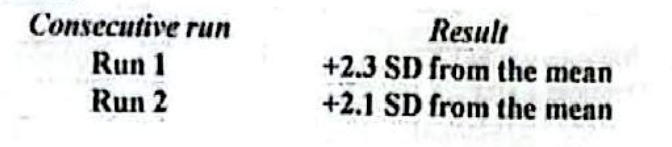
A) A single 1_2s warning only.
B) A 2_2s out-of-control pattern.
C) A 1_3s out-of-control pattern.
D) A 4_1s out-of-control pattern.
144
Use the DLCO analyzer data below. Which parameter fails its criterion?
A) Nonlinearity.
B) Rapid analyzer response.
C) Drift.
D) None of the parameters.
A) Nonlinearity.
B) Rapid analyzer response.
C) Drift.
D) None of the parameters.
145
A healthy biologic-control subject has the results below. What is the best interpretation?
A) The agreement is acceptable.
B) This proves normal obstructive gas trapping.
C) This is a routine calibration-verification result.
D) A possible plethysmograph malfunction should be investigated.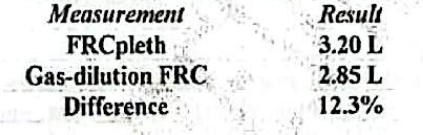
A) The agreement is acceptable.
B) This proves normal obstructive gas trapping.
C) This is a routine calibration-verification result.
D) A possible plethysmograph malfunction should be investigated.
146
Use the DLCO trial data below. Which change would make the pair meet the listed requirement?
A) Repeat after waiting at least 4 minutes.
B) Reduce breath hold to 5 seconds.
C) Lower inspiratory volume to 85% of SVC.
D) Increase the maximum number of trials to six.
A) Repeat after waiting at least 4 minutes.
B) Reduce breath hold to 5 seconds.
C) Lower inspiratory volume to 85% of SVC.
D) Increase the maximum number of trials to six.
147
Unacceptable blood-gas QC is found before patient testing. Which actions are most appropriate?
I. Verify the control level, assigned range, expiration, storage, handling, and absence of bubbles.
II. Adjust the analyzer immediately without checking the control material.
III. After corrective action, repeat required calibration when applicable and all required QC levels.
IV. Return the analyzer to patient testing before results meet acceptance criteria.
A) I and II only.
B) I and III only.
C) II and IV only.
D) I, III, and IV only.
I. Verify the control level, assigned range, expiration, storage, handling, and absence of bubbles.
II. Adjust the analyzer immediately without checking the control material.
III. After corrective action, repeat required calibration when applicable and all required QC levels.
IV. Return the analyzer to patient testing before results meet acceptance criteria.
A) I and II only.
B) I and III only.
C) II and IV only.
D) I, III, and IV only.
148
A PaO2 of 54 mm Hg conflicts with normal pulmonary function and SaO2 of 96%. PO2 controls show drift and an out-of-control pattern. What action is most justifiable?
A) Release the PaO2 with a disclaimer.
B) Redraw the patient specimen before reviewing QC.
C) Remove the analyzer, correct the PO2 electrode fault, recalibrate, repeat QC, and redraw.
D) Average the patient result with the previous value.
A) Release the PaO2 with a disclaimer.
B) Redraw the patient specimen before reviewing QC.
C) Remove the analyzer, correct the PO2 electrode fault, recalibrate, repeat QC, and redraw.
D) Average the patient result with the previous value.
149
A biologic-control DLCO is more than 3 SD low. DLCO simulation is also low, and measured CO is higher than expected. What is the best action?
A) Continue testing and adjust the expected result.
B) Repeat the biologic control next week.
C) Recalculate DLCO using VA only.
D) Replace the faulty gas analyzer before further patient testing.
A) Continue testing and adjust the expected result.
B) Repeat the biologic control next week.
C) Recalculate DLCO using VA only.
D) Replace the faulty gas analyzer before further patient testing.
150
Scheduled pretest QC fails while a patient is waiting. Which action best preserves the path of workflow and patient safety?
A) Remove the equipment from patient use until it is in control.
B) Perform the patient test, then rerun QC.
C) Issue only a preliminary report.
D) Use demographic correction to compensate.
A) Remove the equipment from patient use until it is in control.
B) Perform the patient test, then rerun QC.
C) Issue only a preliminary report.
D) Use demographic correction to compensate.
151
After an approved software upgrade to a spirometry system, what is the most defensible quality action?
A) Wait for patient-report errors before testing controls.
B) Reverify the system and repeat QC after the change.
C) Perform volume checks only at the next annual calibration.
D) Use previous biologic-control data without further checks.
A) Wait for patient-report errors before testing controls.
B) Reverify the system and repeat QC after the change.
C) Perform volume checks only at the next annual calibration.
D) Use previous biologic-control data without further checks.
Plus de flashcards : Médecine et santé
Cardio 3 Class/IndicationsMédecine et santé · Anglaisebradstreetbrain areas and functionsMédecine et santé · AnglaisalmondineATTRIBUTES OF PHARMACYMédecine et santé · AnglaischarmMicrobiology FinalMédecine et santé · Anglaiskara.roperOsteology CondensedMédecine et santé · AnglaistobiChapter 6 LAB - TissuesMédecine et santé · AnglaisnewSerous Fluid and MembranesMédecine et santé · AnglaiskarebearAcid Base DisordersMédecine et santé · AnglaisCoryEpitelios Médecine et santé · EspagnolLaritaMicosis subcutáneasMédecine et santé · EspagnolMajoDermMédecine et santé · AnglaisMadiCholeraMédecine et santé · AnglaisKatlynKE
Tous les decks : Médecine et santé
Révise ces decks dans l’app
Gratuit sur iPhone, Android, Mac et le web. Ajoute n’importe quel deck à ton compte en un tap.