ACG2021 Chapter 10 (Principles of Financial Accounting)
Diese Karteikarten lernenKostenlos · Spaced Repetition · iPhone, Android, Mac & Web
Alle Karten
1
Investor vs Investee
The investor is the one that bought the bond or stock from a corporation
The investee is the one that issued the bond or stock
The investee is the one that issued the bond or stock
2
Security
A security is a share or interest representing financial value.
3
Debt Security
Investment in notes or bonds payable issued by another company
4
Equity Security
An equity security is an investment in stock ownership in another company and sometimes pays cash dividends or issues stock dividends.
5
Two most common reasons for a company to invest
1. The company has short-term excess cash that they do not need for business operations and want to make the most of that cash
2. The company may invest for “certain business strategies”, such as buying stock of a vendor to strengthen their relationship with them.
2. The company may invest for “certain business strategies”, such as buying stock of a vendor to strengthen their relationship with them.
6
Short-term Investment vs Long-term Investment
Short-term investment: Investments in debt or equity securities that the investor intends to sell in one year or less.
Long-term investment: Are all investments that are not short-term. (So, the investor intends to no longer hold in over a year)
Long-term investment: Are all investments that are not short-term. (So, the investor intends to no longer hold in over a year)
7
Three types of Debt Securities
1. Trading Debt Investments: Are debt securities that investors intend to sell in the very near future - days, weeks, and only a few months - with the intent of generating a quick profit.
2. Held-to-Maturity (HTM) debt investments: Are debt securities that the investor intends to hold and has the ability to hold until it matures.
3. Available-for-sale (AFS) debt investments: Are all debt securities that are not trading debt investments or HTM debt investments. AFS debt investments are either reported as current assets (intend to no longer hold in a year or less) or as long-term assets (intend to no longer hold in over a year).
2. Held-to-Maturity (HTM) debt investments: Are debt securities that the investor intends to hold and has the ability to hold until it matures.
3. Available-for-sale (AFS) debt investments: Are all debt securities that are not trading debt investments or HTM debt investments. AFS debt investments are either reported as current assets (intend to no longer hold in a year or less) or as long-term assets (intend to no longer hold in over a year).
8
Three types of Equity Securities
-The classification is based on how much influence the investor has over the investee’s company
1. No Significant Influence Equity Investments: An equity investment in which the investor lacks the ability to participate in the decision of the investee’s company.
2. Significant Influence Equity Investments: An equity investment in which the investor has the ability to exert influence over operational and financial decisions of the investee company.
3. Controlling Interest Equity Investments: An equity investment in which the investor owns more than 50% of the investee’s stock.
1. No Significant Influence Equity Investments: An equity investment in which the investor lacks the ability to participate in the decision of the investee’s company.
2. Significant Influence Equity Investments: An equity investment in which the investor has the ability to exert influence over operational and financial decisions of the investee company.
3. Controlling Interest Equity Investments: An equity investment in which the investor owns more than 50% of the investee’s stock.
9
DEBT SECURITIES
DEBT SECURITIES
10
Journal Entry to buy a HTM debt investment
*Is the same for Trading Debt Investments & AFS debt investments, just a different account name.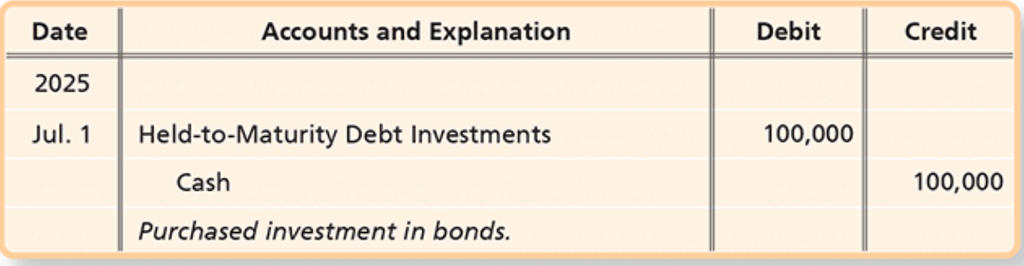
11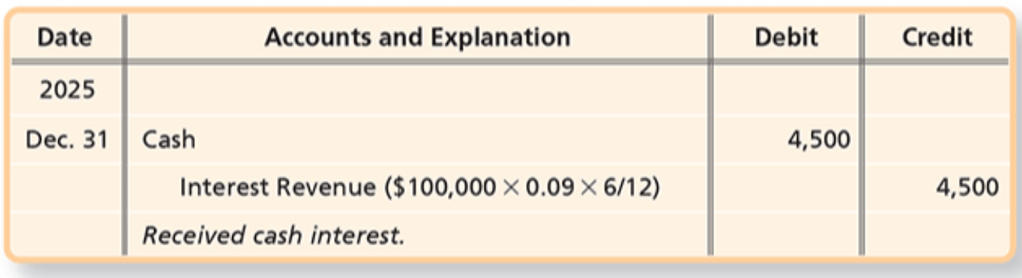
Journal Entry to record interest revenue from a bond?
12
Journal Entry when the HTM Bond reaches maturity
*Is the same for Trading Debt Investments & AFS debt investments, just a different account name.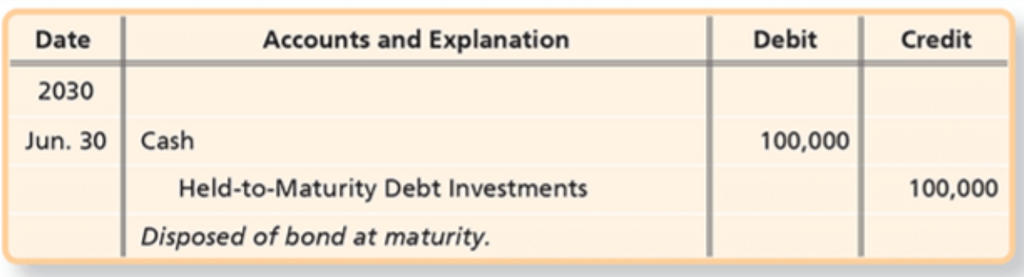
13
Next 4 slides are how to record debit securities
Next 4 slides are how to record debit securities
14
1. How to report Trading Debt Investments
At the end of each year, the company has to make an adjustment entry to report the fair value of the security. Fair value is the price the company would receive if the company were to sell their investment.
The adjustment entry is shown in the image. The ‘Unrealized Holding Loss - Trading’ is an expense. The ‘Fair Value Adjustment - Trading” is a contra-account to the Trading Securities asset (used on the balance sheet to report the fair value).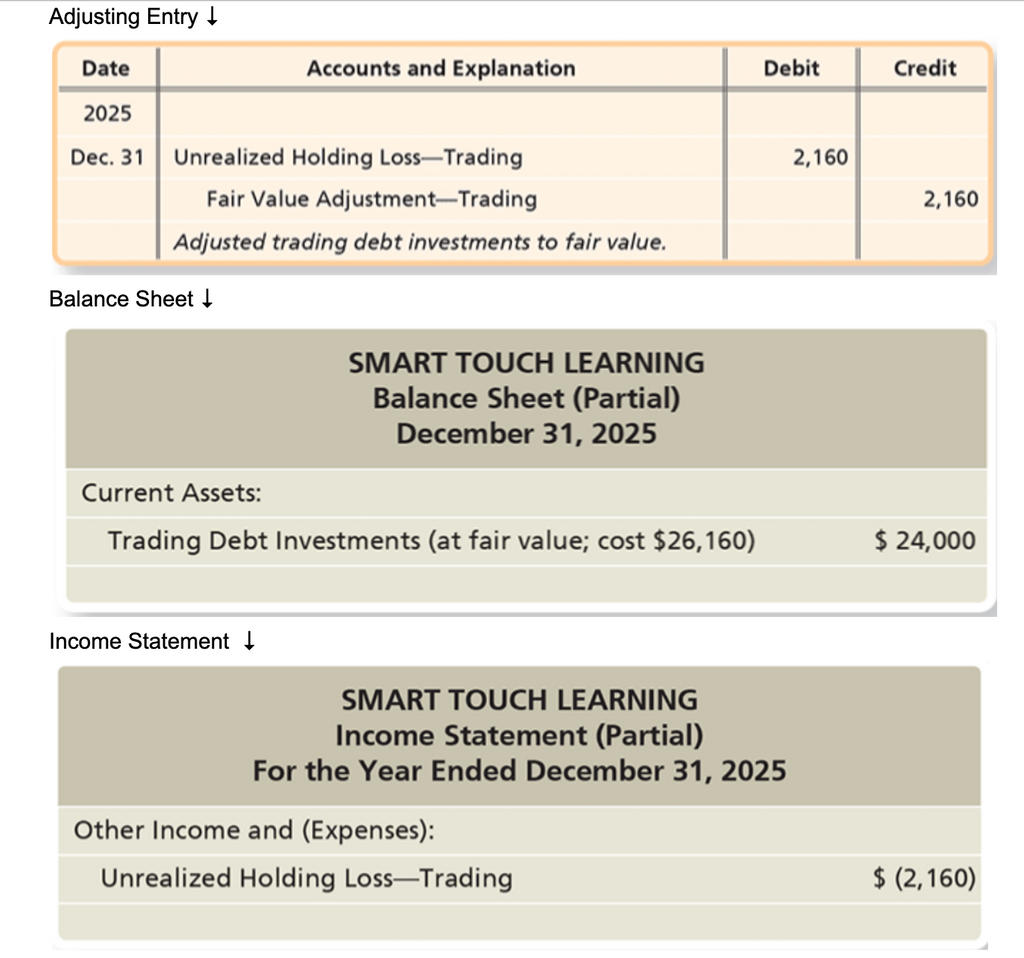
The adjustment entry is shown in the image. The ‘Unrealized Holding Loss - Trading’ is an expense. The ‘Fair Value Adjustment - Trading” is a contra-account to the Trading Securities asset (used on the balance sheet to report the fair value).
15
2. How to report Available-for-sale Debt Investments
-If the business intends to no longer hold in 1 year or less, then it's a current asset. Anything else is a long-term asset.
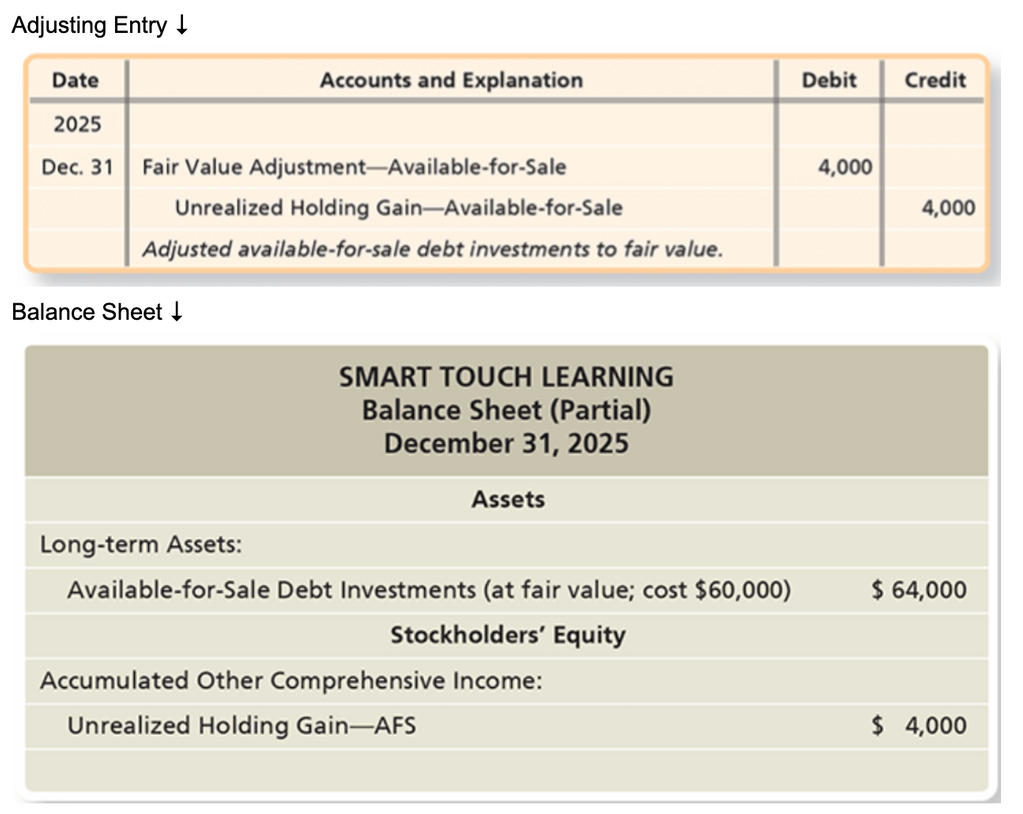
-At the end of each year, the company has to make an adjustment entry to report the fair value of the security. Fair value is the price the company would receive if the company were to sell their investment. (Just like Trading Debt Investments)
-The adjustment entry is shown in the image. This is the same as the Trading Debt Investment except that there is a gain so it's backwards. So, ‘Fair Value Adjustment
-Available for Sale” is a contra-asset account for AFS securities. "Unrealized Holding Gain - Available for sale” (however is different from trading in that it is not an revenue/expense) is an Equity account under ‘Other Comprehensive Income’.
(PS: Also, in the financial statements, you can see the contra-asset account be subtracted by the asset account to get the fair value for the balance sheet. Then, you can see the equity account under ‘Other Comprehensive income’)
-At the end of each year, the company has to make an adjustment entry to report the fair value of the security. Fair value is the price the company would receive if the company were to sell their investment. (Just like Trading Debt Investments)
-The adjustment entry is shown in the image. This is the same as the Trading Debt Investment except that there is a gain so it's backwards. So, ‘Fair Value Adjustment
-Available for Sale” is a contra-asset account for AFS securities. "Unrealized Holding Gain - Available for sale” (however is different from trading in that it is not an revenue/expense) is an Equity account under ‘Other Comprehensive Income’.
(PS: Also, in the financial statements, you can see the contra-asset account be subtracted by the asset account to get the fair value for the balance sheet. Then, you can see the equity account under ‘Other Comprehensive income’)
16
2a. How to report Available-for-sale Debt Investments
You also will use the ‘Unrealized Holding Gain/Loss - AFS’ account in a Comprehensive Income Statement, which is the company’s change in total stockholders’ equity from all sources other than the owner’s investments and dividends.
NEED TO KNOW
-Comprehensive Income includes
1. Unrealized holding gain/loss for AFS debt securities
2. Foreign Currency translation adjustment
3. Gain or losses from post retirement benefit plan
4. Deferred gains or losses from derivatives.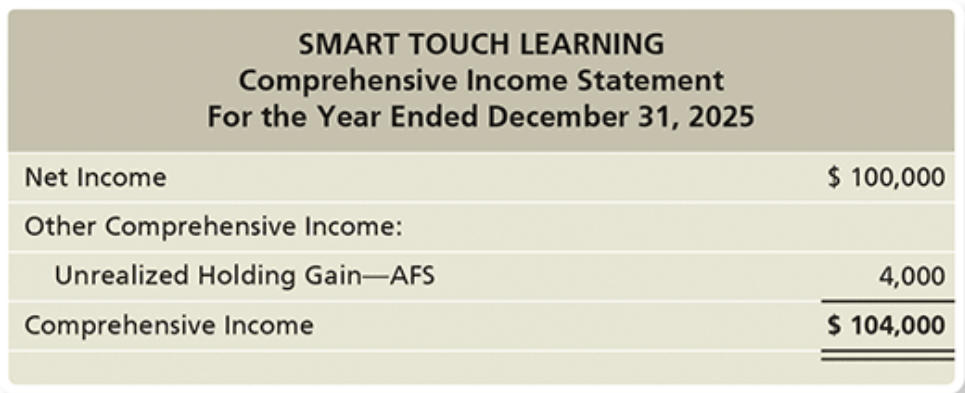
NEED TO KNOW
-Comprehensive Income includes
1. Unrealized holding gain/loss for AFS debt securities
2. Foreign Currency translation adjustment
3. Gain or losses from post retirement benefit plan
4. Deferred gains or losses from derivatives.
17
3. How to report HTM Debt Investments
-HTM Debt Investments are reported at amortized costs.
-Interest Revenue earned from the HTM debt investment is reported on the income statement in ‘Other Income and (Expense)’ Section.
(They don’t really explain it, just remember whats above)
-Interest Revenue earned from the HTM debt investment is reported on the income statement in ‘Other Income and (Expense)’ Section.
(They don’t really explain it, just remember whats above)
18
EQUITY SECURITIES
EQUITY SECURITIES
19
The next three slides are for Journal Entries for Equity Securities with no Influence.
(Also known as the Fair Value Method)
(Also known as the Fair Value Method)
The next three slides are for Journal Entries for Equity Securities with no Influence.
(Also known as the Fair Value Method)
(Also known as the Fair Value Method)
20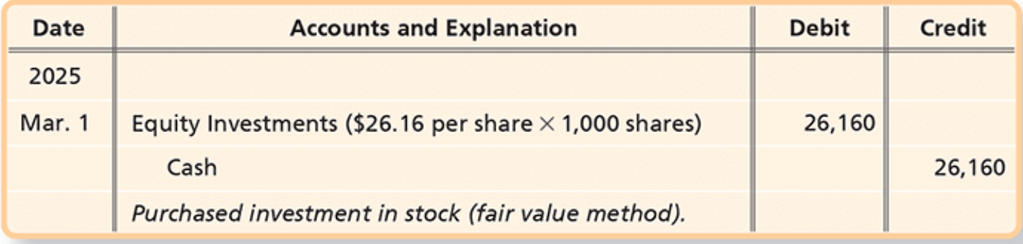
1. Journal Entry to buy Equity Securities (Fair Value)
21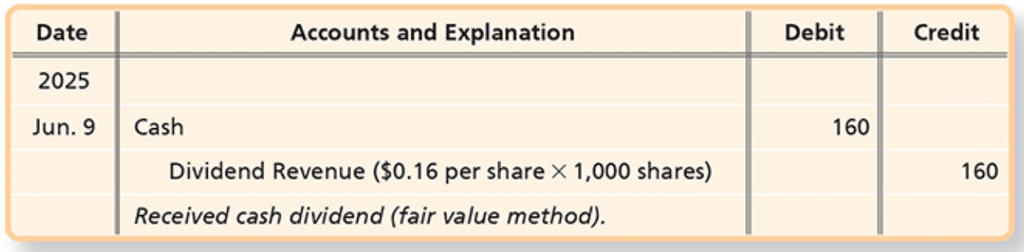
Journal Entry to receive dividend revenue from equity security (Fair Value)
22
3. Disposition (selling) part of the shares (with no influence of those shares)
ex)
Cash received for Stock: 25,000
Cost of Stock when bought: 20,928
ex)
Cash received for Stock: 25,000
Cost of Stock when bought: 20,928
*It could also be a “Loss on Disposal" and be debited since it is an expense.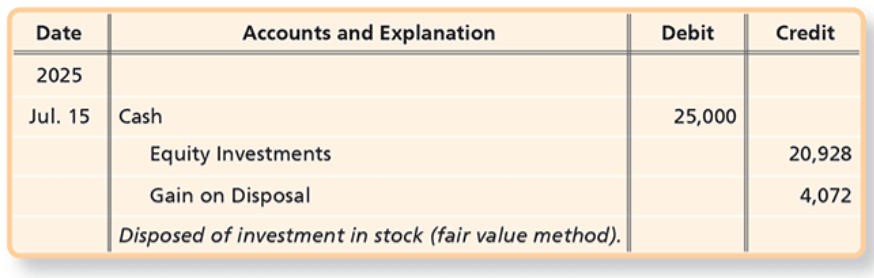
23
So, you increase / decrease the equity security.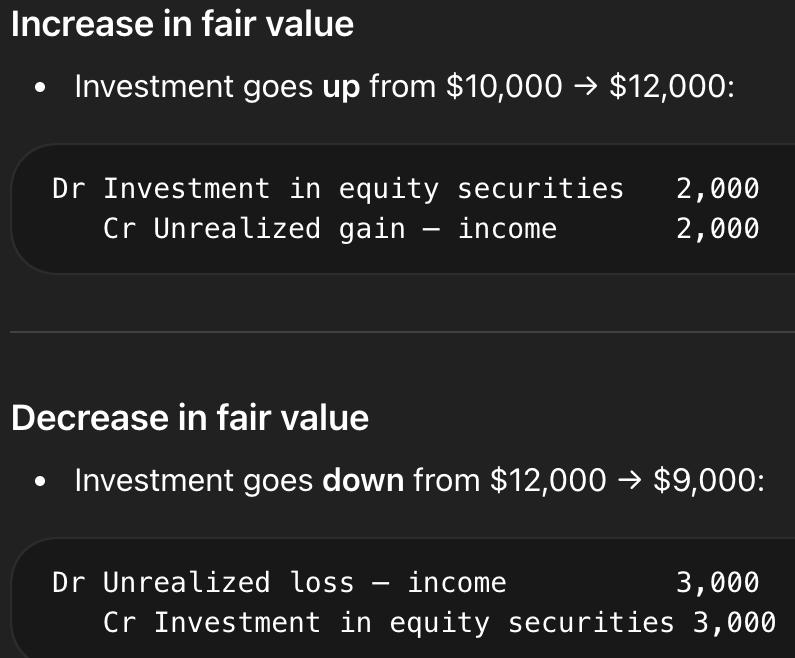
Adjusting shares to fair value
So, you increase / decrease the equity security.
24
The next four slides are for Journal Entries for Equity Securities with significant Influence (with 20% - 50% of the companies shares)
(Also known as the Equity Method)
(Also known as the Equity Method)
The next four slides are for Journal Entries for Equity Securities with significant Influence (with 20% - 50% of the companies shares)
(Also known as the Equity Method)
(Also known as the Equity Method)
25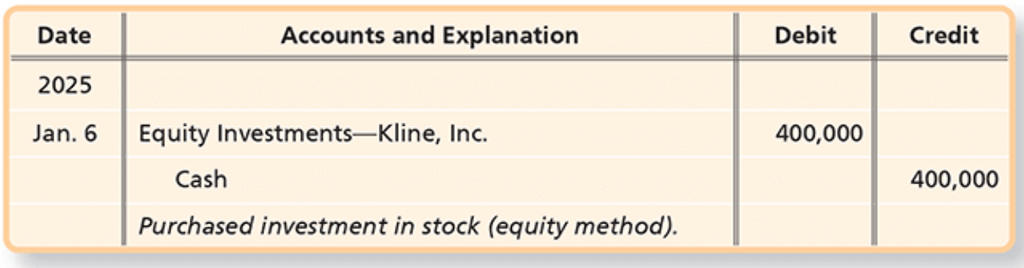
1. Journal Entry to buy Equity Securities (with significant Influence / Equity Method)
26
2a. Journal Entry to receive dividend revenue from equity security (with significant influence / Equity Method)
*PS: Unlike ‘no influence’, getting dividends decreases Equity Investments since part of the value of the company is taken out of the investee company and paid to you in cash.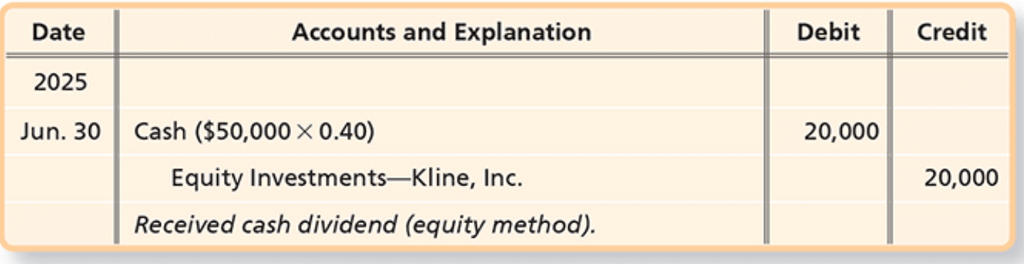
27
2b. Journal Entry to record investee income (Significant influence / Equity method)
*PS: The investor debits the Equity Investments account and credits Revenue from Investments when the investee reports income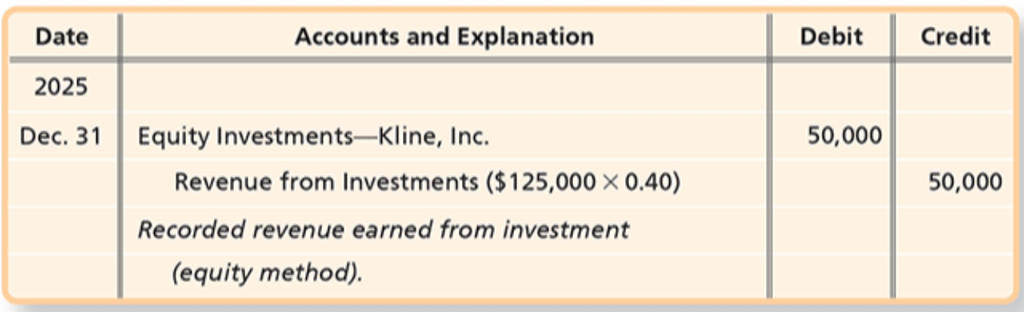
28
3. Disposition (selling) their shares (Equity Method / Significant Influence)
ex)
Received \$40,000 for shares
Book Value of 43,000
ALSO, what is a book value?
ex)
Received \$40,000 for shares
Book Value of 43,000
ALSO, what is a book value?
Book Value: Original Cost + your share of investee income - dividends received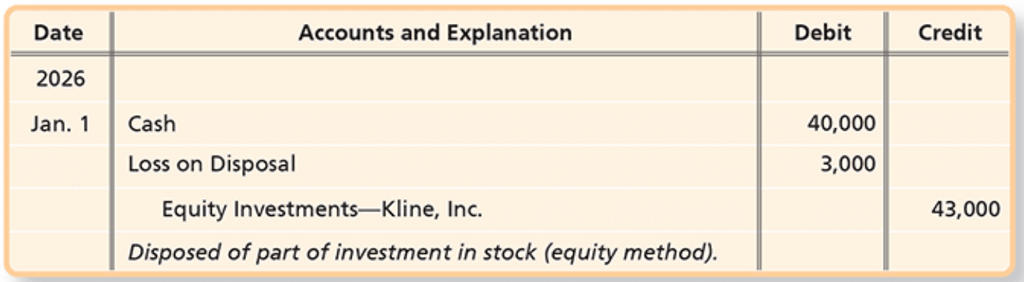
29
The next 5 slides are for Equity Securities when you control more than 50% of the company
The next 5 slides are for Equity Securities when you control more than 50% of the company
30
What method is used to record equity securities when you control more than 50% of the company.
Consolidation Method
31
Parent Company
The corporation that owns enough to control decisions in another company.
32
Subsidiary Company
A company that is controlled by another corporation
33
Consolidation Accounting
The way to combine the financial statements of two or more companies that have the same owners
34
Consolidated Statements
Combining the financial statements (such as income statement, balance sheet, etc) of the parent company with its controlling interest affiliation
PS: “Controlling Interest”: enough ownership to control decisions
PS: “Controlling Interest”: enough ownership to control decisions
35
Rate of Return of Total Assets
Rate of Return of Total Assets = (Net Income + Interest Expense) / Average Total Asset
A percentage that shows how much profit the company makes for every dollar of assets it owns.
(For every \$1.00 of total assets Pepsico owns, it earns \$0.102 in profit.
A percentage that shows how much profit the company makes for every dollar of assets it owns.
(For every \$1.00 of total assets Pepsico owns, it earns \$0.102 in profit.
Mehr Karteikarten: Wirtschaft
SHRMCP Exam 1Wirtschaft · EnglischLexieHealth Systems: Risk and ReimbursementWirtschaft · EnglischLoriCommerce: Consumer RightsWirtschaft · EnglischharleyModule 5: Financial Management P2Wirtschaft · EnglischAngelicMidterm Review Wirtschaft · EnglischKeeganBUSINESS PLAN 2Wirtschaft · EnglischKylaExam 1 Management 3335Wirtschaft · EnglischjujuOpenness in financial marketsWirtschaft · EnglischFathiaMIS Quiz 1Wirtschaft · EnglischLexieIFRS 16 LeasesWirtschaft · EnglischEllaFRL 3151: Money Markets and InstrumentsWirtschaft · EnglischJohnOperations Management Exam 1 ReviewWirtschaft · EnglischLexie
Lerne diese Decks in der App
Kostenlos auf iPhone, Android, Mac und im Web. Füge jedes Deck mit einem Tipp zu deinem Konto hinzu.

