Animal Nutrition and Essential Nutrients
Diese Karteikarten lernenKostenlos · Spaced Repetition · iPhone, Android, Mac & Web
Alle Karten
1
What is an essential nutrient?
A nutrient the animal cannot synthesize or cannot produce in sufficient amounts for optimal nutrition.
2
What is a conditionally essential nutrient?
A nutrient that becomes essential only under certain conditions. (vitamin d)
3
What are the three dietary sources of energy?
Carbohydrates, fats, and proteins.
4
What are the two essential fatty acids listed for most animals?
Linoleic acid (omega-6) and linolenic acid (omega-3).
5
What two major components make up food?
What two components make up dry matter?
What two components make up dry matter?
1. Moisture (water) and dry matter.
2. Ash (minerals) and organic matter.
2. Ash (minerals) and organic matter.
6
What nutrients make up organic matter?
Proteins, carbohydrates, lipids, vitamins, and other organic compounds.
7
What is proximate analysis?
A set of quantitative methods used to estimate macronutrient composition in feeds.
8
What five feed components are measured through proximate analysis?
Moisture, ash, crude fat, crude fiber, and crude protein.
9
How is moisture content determined during proximate analysis?
How is the amount of moisture calculated?
How is the amount of moisture calculated?
1. Drying a feed sample at 100–105°C until it reaches a constant weight.
2. Moisture = Wet feed weight − Dry feed weight.
2. Moisture = Wet feed weight − Dry feed weight.
10
What is a limitation of determining moisture by drying?
Volatile dietary components may evaporate along with water.
11
What is a limitation of ash analysis?
Some minerals, such as chloride, zinc, selenium, and iodine, can volatilize during heating.
12
Why can ether extraction overestimate true fat content?
It also extracts fat-soluble vitamins, chlorophyll, waxes, and other lipid-soluble compounds.
13
How is crude fiber calculated?
Crude fiber = Undissolved material weight (g) − Ash weight (g)
14
What is the major limitation of crude fiber analysis?
It does not measure soluble fiber; it consists of some cellulose and lignin
15
What method is used to determine crude protein?
Kjeldahl analysis, which measures nitrogen content.
16
How is crude protein calculated from nitrogen content?
Crude protein = Nitrogen × 6.25, assuming proteins contain approximately 16% nitrogen.
17
Why does Kjeldahl analysis potentially overestimate protein content?
It measures all nitrogen-containing compounds, including nonprotein nitrogen.
18
What is nitrogen-free extract (NFE)?
An estimated fraction representing carbohydrates other than crude fiber.
19
How is nitrogen-free extract calculated?
100% − moisture% − ash% − crude protein% − crude fat% − crude fiber% = %NFE
20
Why is NFE considered an estimate rather than a direct measurement?
It is calculated by subtraction rather than directly measuring carbohydrates.
21
What is the major limitation of NFE?
It does not directly measure the actual carbohydrate content of the diet.
22
What does "as-fed" nutrient concentration represent?
Nutrient concentration in food as consumed, including its water content.
23
What does dry matter (DM) nutrient concentration represent?
Nutrient concentration after excluding water from the food.
24
Why is dry matter comparison important when evaluating pet foods?
It removes moisture differences, allowing more accurate comparisons of nutrient concentrations.
25
How is dry matter percentage calculated? EXAM
DM% = 100% − Moisture%.
26
Why can wet food appear lower in protein than dry food despite having similar protein on a DM basis?
Wet food contains more water, diluting its as-fed nutrient percentages.
27
Diet A contains 12% moisture and 13% protein, while Diet B contains 74% moisture and 5% protein. Which has less protein on a DM basis?
Diet A; A = 14.8% protein DM, while B = 19.2% protein DM.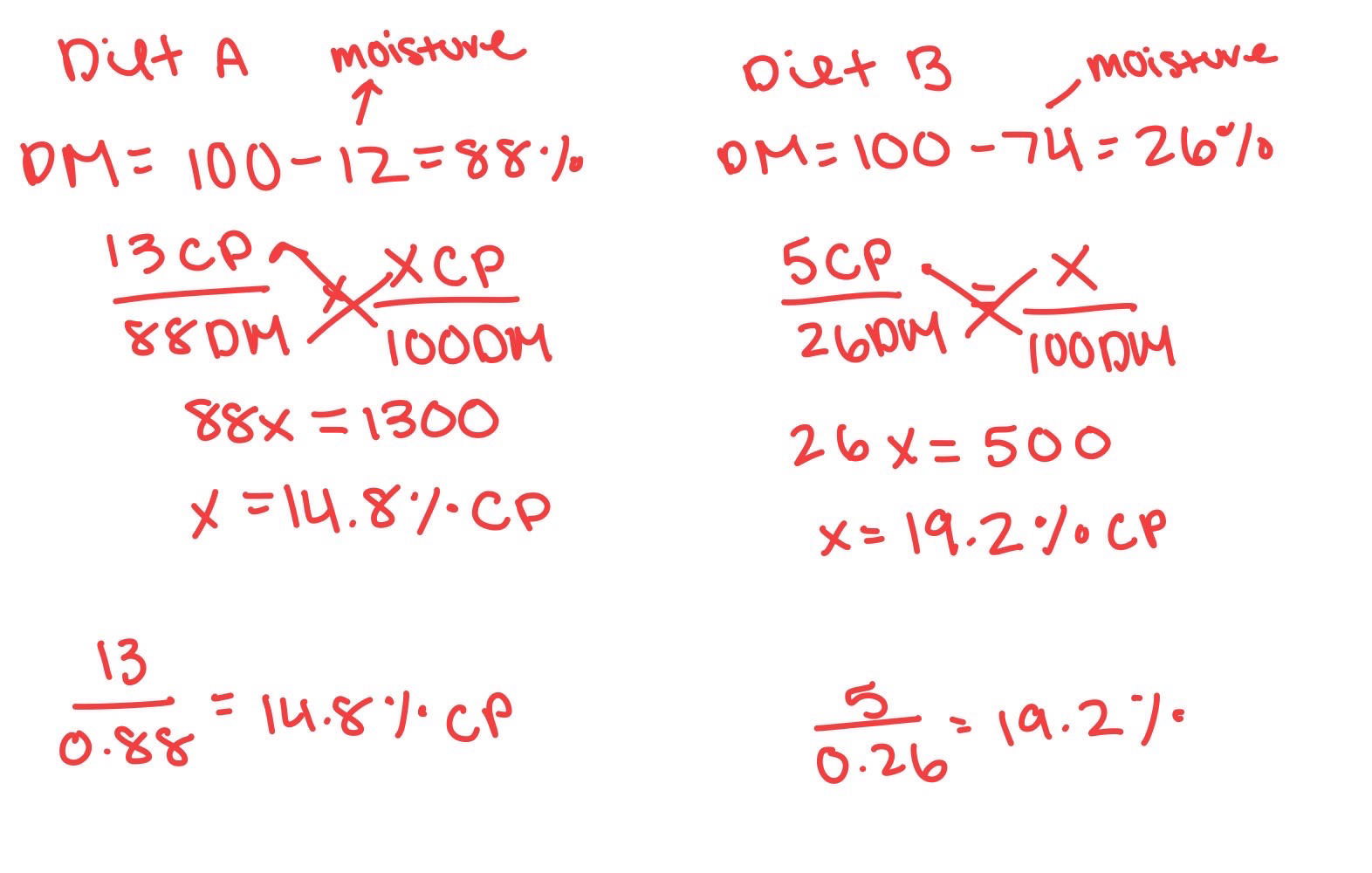
28
What does the rising portion of a nutrient-response curve represent?
The deficient range, where increasing nutrient intake improves the animal's response.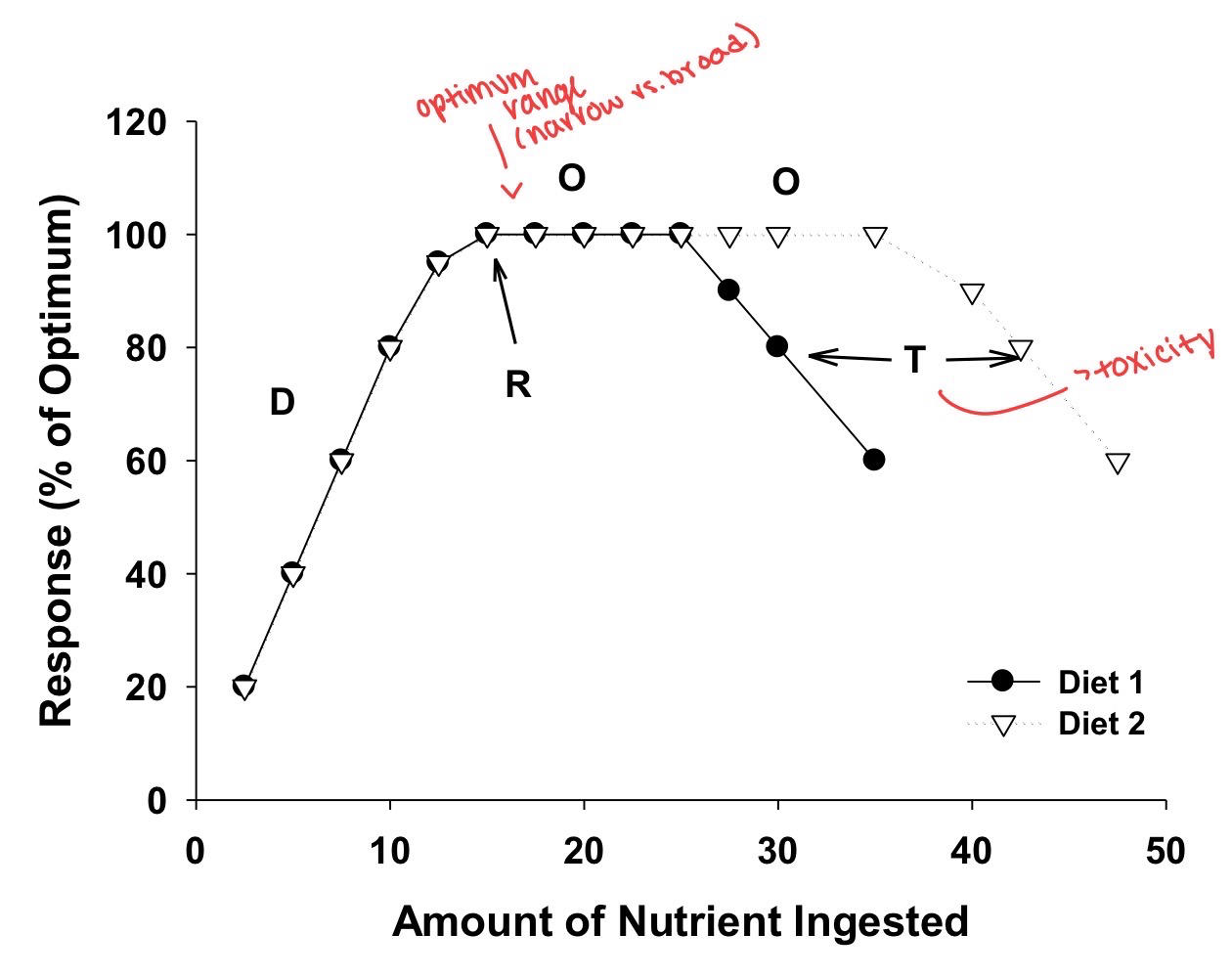
29
How is a nutrient requirement determined from a nutrient-response curve?
Identifying the intake where the response first reaches the optimum plateau.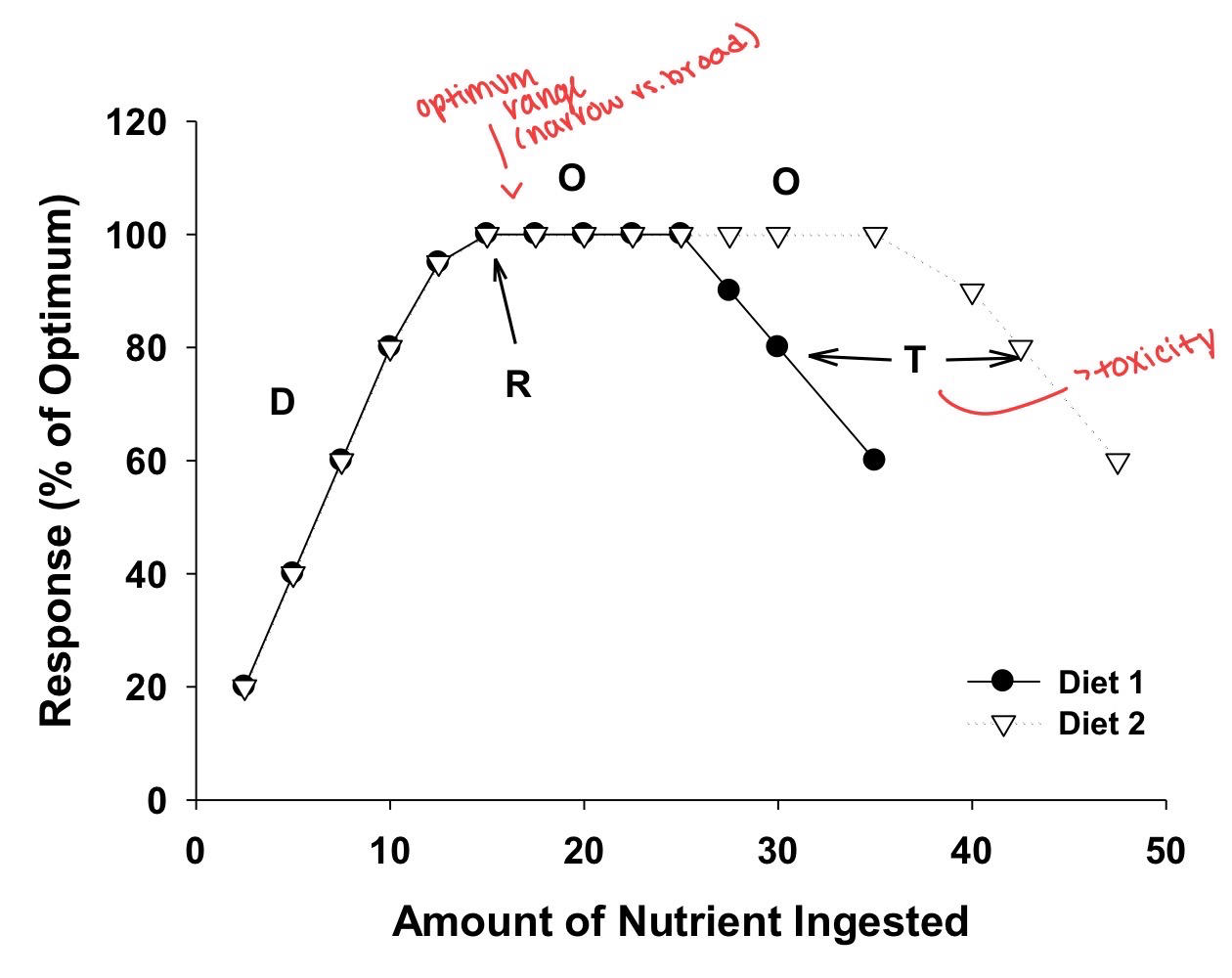
30
What happens when nutrient intake becomes excessive?
Toxicity may develop, causing the biological response to decline.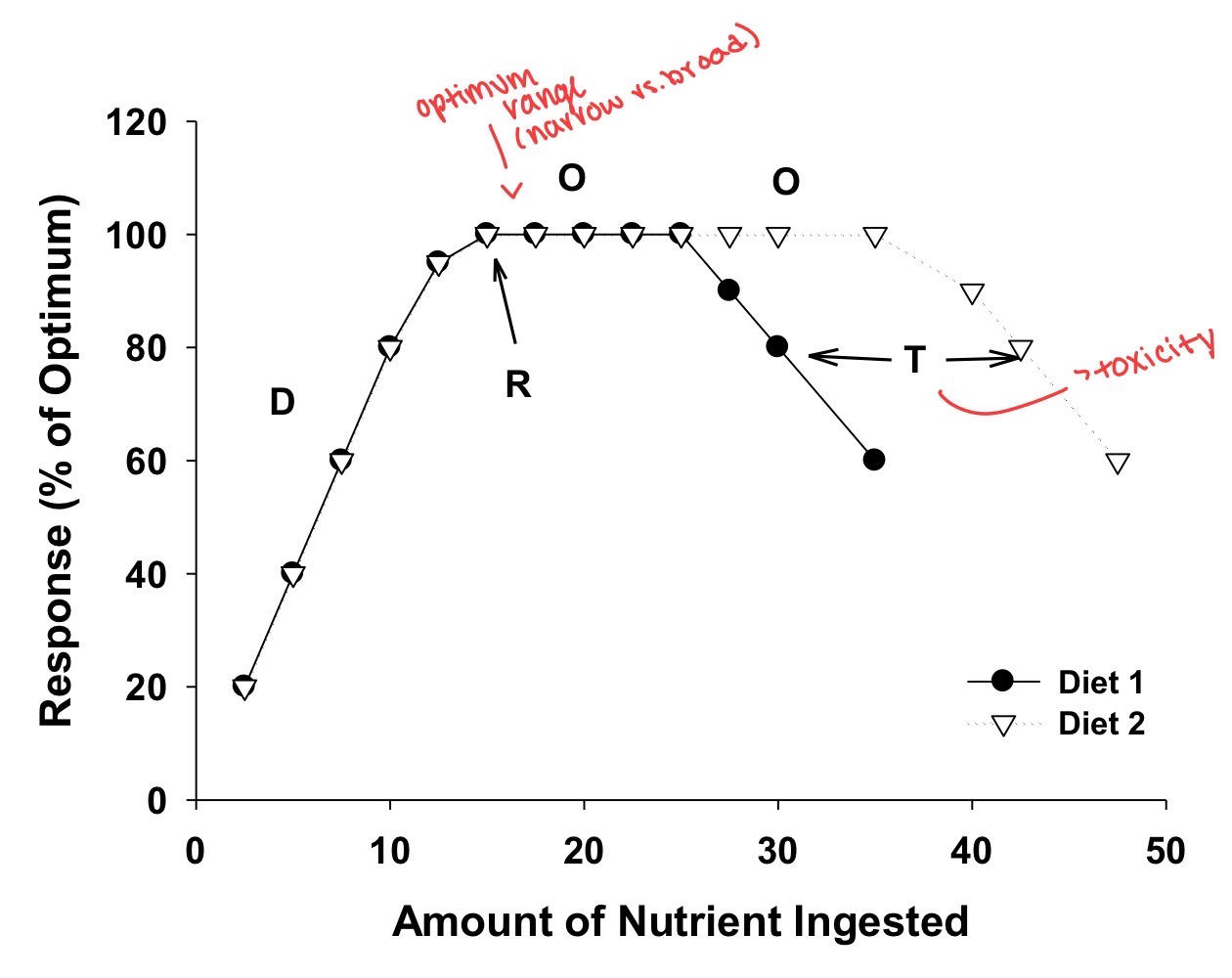
Mehr Karteikarten: Medizin und Gesundheit
Serous FluidMedizin und Gesundheit · EnglischJESSQTRANCommunity Health Nursing: Family AssessmentMedizin und Gesundheit · EnglischVanessaCH - HIV/AidsMedizin und Gesundheit · EnglischRobo3. Deshidratación de los alimentosMedizin und Gesundheit · SpanischEmilioCoordination and responseMedizin und Gesundheit · EnglischAli_vxxxSEDATIVES, hypnotics, & anxiolytics Medizin und Gesundheit · Englischeinem OutLearn-StudierendenGas Exchange systemsMedizin und Gesundheit · EnglischLoganStrep ThroatMedizin und Gesundheit · Englischcae4- la trachée + bronchesMedizin und Gesundheit · FranzösischOcéaneAntibiotics: Generic and Brand NamesMedizin und Gesundheit · Englischplane23Pharmacology and Clinical MedicineMedizin und Gesundheit · EnglischhikaruImmunology: Antibodies and ImmunoglobulinsMedizin und Gesundheit · EnglischJESSQTRAN
Alle Decks: Medizin und Gesundheit
Lerne diese Decks in der App
Kostenlos auf iPhone, Android, Mac und im Web. Füge jedes Deck mit einem Tipp zu deinem Konto hinzu.

