ACG2021 Chapter 7 (Principles of Financial Accounting)
Réviser ces flashcardsGratuit · répétition espacée · iPhone, Android, Mac et web
Toutes les cartes
1
Is an organization plan designed to accomplish
1.Safeguard assets: A company must protect its assets
2.Encourage employees to follow company policies
3.Promote Operational Efficiency: Businesses cannot afford to waste resources.
4.Ensure accurate and reliable accounting records
Internal Control
Is an organization plan designed to accomplish
1.Safeguard assets: A company must protect its assets
2.Encourage employees to follow company policies
3.Promote Operational Efficiency: Businesses cannot afford to waste resources.
4.Ensure accurate and reliable accounting records
2
Committee of Sponsoring Organizations (COSO)
A committee that provides thought leadership related to enterprise risk management, intercontrol and fraud protection.
3
Public Company
A company that sells its stock to the public.
4
Sarbanes-Oxley Act (SOX)
Requires companies to review internal control and take responsibility for accuracy and completeness of their financial reports.
This Bill includes
1.Public companies must issue an internal control report. An internal control report is a report by management describing its responsibility for and the adequacy of internal controls over financial reporting.
2.The Public Company Accounting Oversight Board (PCAOB) oversees the work of auditors of public companies.
3.Accounting firms are not allowed to audit a public company and also provide certain consulting services for the same client.
This Bill includes
1.Public companies must issue an internal control report. An internal control report is a report by management describing its responsibility for and the adequacy of internal controls over financial reporting.
2.The Public Company Accounting Oversight Board (PCAOB) oversees the work of auditors of public companies.
3.Accounting firms are not allowed to audit a public company and also provide certain consulting services for the same client.
5
Components of Internal Control
Control Procedures-are designed to ensure that the business’ goals are achieved.
Risk Assessment-A company must identify its risks. The higher the risks, the more controls a company must put in place to safeguard.
Information Systems-Decision makers need accurate information. The information can only be accessed through authorization.
Monitoring of controls-Companies hire auditors to monitor control.
Environment-This is the culture of the business. The CEO and CFO must behave honorably to set a good example for the company.
Risk Assessment-A company must identify its risks. The higher the risks, the more controls a company must put in place to safeguard.
Information Systems-Decision makers need accurate information. The information can only be accessed through authorization.
Monitoring of controls-Companies hire auditors to monitor control.
Environment-This is the culture of the business. The CEO and CFO must behave honorably to set a good example for the company.
6
Internal Auditor
An internal auditor is an employee of the business who ensures that the company’s employees are following company policies and that operations are running efficiently. Internal auditors also determine whether the company is following legal requirements for internal controls to safeguard assets.
7
External Auditor
An external auditor is an outside accountant who is completely independent of the business. External auditors evaluate the controls to ensure that the financial statements are presented fairly, in accordance with Generally Accepted Accounting Principles
8
Treasur
Person responsible for signing checks
9
The chief accounting officer is called _______.
The controller
10
Separation of Duties
-Dividing the responsibilities between two or more people to limit fraud and have more accurate accounting.
1. Separate operations from accounting: Accounting should be completely separate from the operating departments, such as production and sales. What would happen if sales personnel recorded the company’s revenue? Sales figures could be inflated, and then top managers would not know how much the company actually sold.
2. Separating the custody of assets from accounting. Accountants must not handle cash, and cashiers must not have access to the accounting records. If one employee has both duties, that employee could steal cash and conceal the theft in the accounting records.
1. Separate operations from accounting: Accounting should be completely separate from the operating departments, such as production and sales. What would happen if sales personnel recorded the company’s revenue? Sales figures could be inflated, and then top managers would not know how much the company actually sold.
2. Separating the custody of assets from accounting. Accountants must not handle cash, and cashiers must not have access to the accounting records. If one employee has both duties, that employee could steal cash and conceal the theft in the accounting records.
11
Do usually companies get checked by an internal auditor or an external auditor?
Both, to ensure accuracy.
12
Encryption
Rearranging plain-text messages by a mathematical process-the primary method of achieving security in e-commerce.
13
Only lets certain people inside the network. Can include things such as passwords, pin codes, and signatures.
Fire Wall
Only lets certain people inside the network. Can include things such as passwords, pin codes, and signatures.
14
Collusion
Two or more people working together to circumvent internal controls and defraud a company
15
Cash Recipet
A cash receipt is a document confirming payment for goods or services made with physical currency
16
Step 1: The mailroom employee opens all mail and sends checks to the treasurer and remittance advice (which is optional) to the accounting department. (The remittance advice is an optional attachment to a check that explains the reason the check is sent)
Step 2: The treasurer gets the cashier to deposit the check into the bank. The cashier then gets back a deposit receipt.
Step 3: The accounting department (or book keepers) use the remittance advice to record journal entries.
Step 4: As a final control, the controller compared the bank deposit from the treasurer to the debit in cash.
*Another method of this to accept cash or checks via mail is the “lock box system”.This is when customers send their checks directly to a post office the bank controllers and quickly deposits it into the company's bank account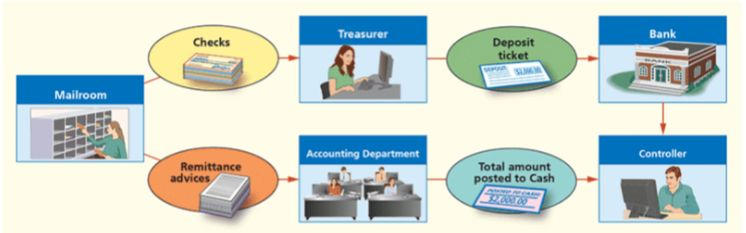
How do companies receive checks sent by mail?
Step 1: The mailroom employee opens all mail and sends checks to the treasurer and remittance advice (which is optional) to the accounting department. (The remittance advice is an optional attachment to a check that explains the reason the check is sent)
Step 2: The treasurer gets the cashier to deposit the check into the bank. The cashier then gets back a deposit receipt.
Step 3: The accounting department (or book keepers) use the remittance advice to record journal entries.
Step 4: As a final control, the controller compared the bank deposit from the treasurer to the debit in cash.
*Another method of this to accept cash or checks via mail is the “lock box system”.This is when customers send their checks directly to a post office the bank controllers and quickly deposits it into the company's bank account
17
How do companies make cash payments via checks.
Step 1: Smart Touch Learning sends a purchase order to the electronics manufacturer that contains the quantity and type of goods needed.
Step 2: The electronics manufacturer ships the inventory and sends an invoice back to Smart Touch Learning.
Step 3: Smart Touch Learning receives the inventory and prepares a receiving report.
Step 4: After approving all documents, Smart Touch Learning sends a check to the electronics manufacturer.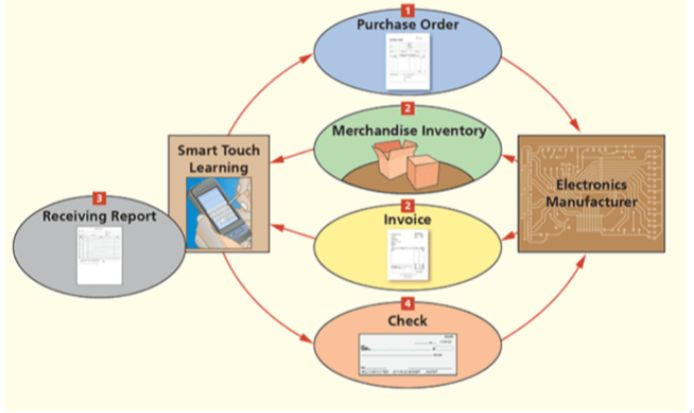
Step 2: The electronics manufacturer ships the inventory and sends an invoice back to Smart Touch Learning.
Step 3: Smart Touch Learning receives the inventory and prepares a receiving report.
Step 4: After approving all documents, Smart Touch Learning sends a check to the electronics manufacturer.
18
1.It received the goods ordered.
2. It is paying only for the goods received and authorized.
3. It is paying the correct amount.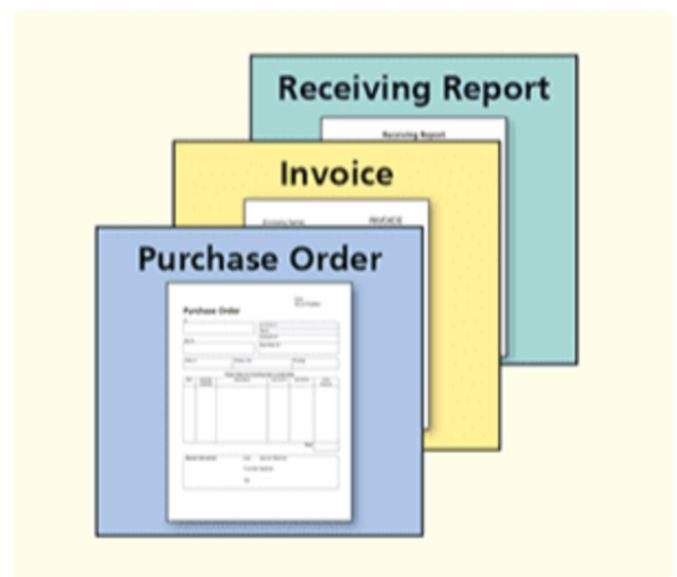
What documents does a controller or treasurer need to see to sign the check to pay for goods.
1.It received the goods ordered.
2. It is paying only for the goods received and authorized.
3. It is paying the correct amount.
19
A procedure that compresses the payment approval process into a single step by comparing the receiving report to the purchase order.
Evaluated receipts settlement (ERS)
A procedure that compresses the payment approval process into a single step by comparing the receiving report to the purchase order.
20
Electronic Data Interchange (EDI)
When the realtor's inventory gets low, the realtor’s computer program automatically submits a purchase order to the supplier. The supplier then ships the inventory and sends over an invoice. The manager approved the invoice and then an electronic fund transfer (EFT) sends the realtor’s payment to the supplier.
21
Petty Cash
A fund containing a small amount of cash for minor payments
22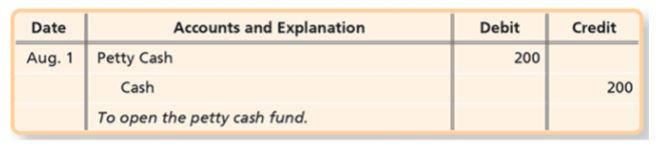
How to open a petty cash fund in a journal entry?
23
Custodian
Safeguards client assets
24
Petty Cash Ticket
(PS: ANyTHING about petty cash was NOT tested since it was IRRELEVANT in real life accoridng to my teacher)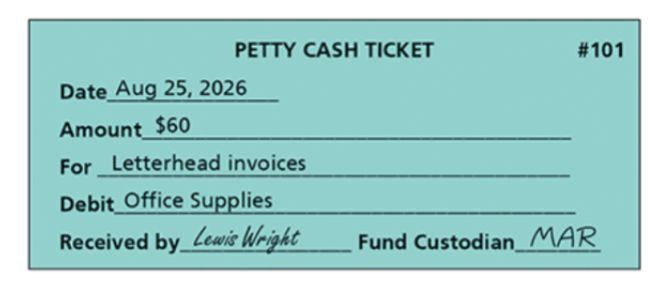
Whenever petty cash is taken, the custodian prepares a
Petty Cash Ticket
(PS: ANyTHING about petty cash was NOT tested since it was IRRELEVANT in real life accoridng to my teacher)
25
A physical box that stores the petty cash and the petty cash tickets
Fund Box
A physical box that stores the petty cash and the petty cash tickets
26
Imprest System
A way to account for petty cash by see that, at any time,
Cash ( as in physical cash being used for petty cash) + Petty cash ticket = total amount allocated to the petty cash fund
Cash ( as in physical cash being used for petty cash) + Petty cash ticket = total amount allocated to the petty cash fund
27
If the petty cash is more than expected to less than expected (maybe someone lost it), where is it recorded?
Cash Short & Over
Debit: If cash is less than expected (expense)
Credit: IF cash is more than expected (revenue)
*This account is closed into the income summary accounting.
Debit: If cash is less than expected (expense)
Credit: IF cash is more than expected (revenue)
*This account is closed into the income summary accounting.
28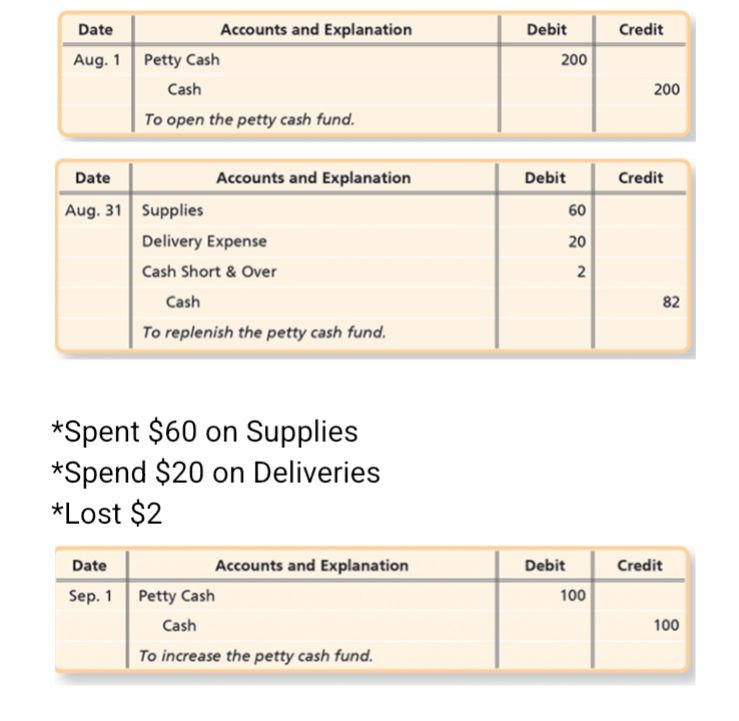
Journal Entry of
1.opening a Petty Cash account
2. recording the spending of the petty cash and replenishing the petty cash fund to the same amount.
3.Adding in \$100 more dollars into petty cash to get it to \$300
1.opening a Petty Cash account
2. recording the spending of the petty cash and replenishing the petty cash fund to the same amount.
3.Adding in \$100 more dollars into petty cash to get it to \$300
29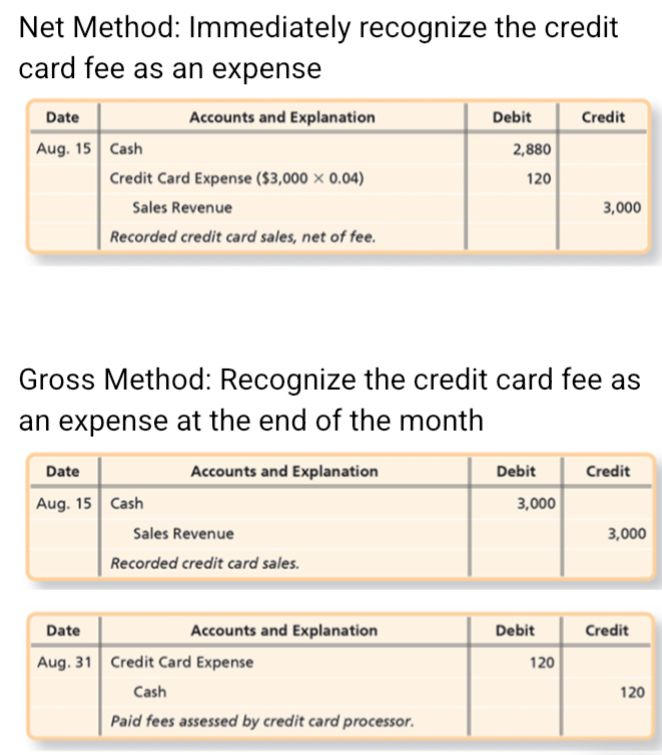
How to record (create journal entries) for sales where customers use a credit card. Do it for the net method and the gross Method
30
Signature Card
A form you fill out when opening a bank account. It lists the people that are allowed to use and withdraw money from the account, and gives a list of their signatures. If you write and sign a check, the bank checks your signature against the card.
31
Deposit Ticket
A form you fill out when putting money into a bank, which shows the amount of the deposit.
32
Check
A document that instructs a bank to pay a designated person a specific amount of money
33
What are the three parities of a check?
1.Bank 2.Maker: The party who issues the check
3.Payee: The party to which is being paid
3.Payee: The party to which is being paid
34
Routing Number vs Accounting number
Routing Number: a 9-digit number that identify the bank upon which the payment is drawn
Accounting Number: A number that identifies the account upon which the payment is drawn.
Accounting Number: A number that identifies the account upon which the payment is drawn.
35
Bank Statement
A document from the bank that Reports the activity of customer accounts
36
Canceled Checks
A check that has already been paid. Mainly used to record keeping of payment.
37
Electronic Fund Transfer (EFT)
A system that transfers cash by electronic communication rather than paper documents
38
Bank reconciliation
-A bank reconciliation compares and explains the differences between the cash on the companies books and cash according to bank records. Explanation ↓There are two ways a business records its cash
1. The cash account in the company's general ledger.
2. The bank statement (Shows cash being paid and received through the companies bank account)
But, sometimes there are timing differences.
Timing Differences: Differences arise between the balance on the bank statement and the balance of the company's books, because of a time lag in recording transactions.
*To obtain accurate cash records, the company must update its cash account after the company receives the bank statement. The Bank reconciliation is used to help with this process.
1. The cash account in the company's general ledger.
2. The bank statement (Shows cash being paid and received through the companies bank account)
But, sometimes there are timing differences.
Timing Differences: Differences arise between the balance on the bank statement and the balance of the company's books, because of a time lag in recording transactions.
*To obtain accurate cash records, the company must update its cash account after the company receives the bank statement. The Bank reconciliation is used to help with this process.
39
Should the person doing bank reconciliation have other cash duties?
NO! They could steal cash and manipulate reconciliation.
40
The bank side contains items not yet recorded by the bank but recorded by the company, or errors made by the bank.
1. Deposit in Transit: A deposit you already gave to the bank, but they have not processed it yet, but it has already been recorded in the books.
2. Outstanding Checks: A check you wrote that has not yet been paid for by the bank, but you already recorded the payment in the books. THIS DOES NOT INCOUFE CHECKS YOU RECEIVE, ONLY ONES YOU GIVE!!!!
3. Bank Errors:
How to prepare the Bank side of the bank reconciliation
The bank side contains items not yet recorded by the bank but recorded by the company, or errors made by the bank.
1. Deposit in Transit: A deposit you already gave to the bank, but they have not processed it yet, but it has already been recorded in the books.
2. Outstanding Checks: A check you wrote that has not yet been paid for by the bank, but you already recorded the payment in the books. THIS DOES NOT INCOUFE CHECKS YOU RECEIVE, ONLY ONES YOU GIVE!!!!
3. Bank Errors:
41
How to prepare the Book side of the bank reconciliation
The book side contains items not yet recorded by the company on its books but that have been recorded by the bank, or errors made by the company.
1. Bank Collections: Money the bank has received, but the company has not yet recorded it.
2. Electronic Fund Transfers: Money received or paid by the bank through EFT that has not yet been recorded in the books.
3. Service Charge: A cash payment to the bank for banking fees, which is not recorded as an expense yet in the books (ex, Gross Method for credit card sales)
4. Interest revenue and Checking Account: Interest added by the bank from the money being in the bank account for a long enough time, but has not yet been recorded in the books.
5. Nonsufficient Funds (NSF) Checks: Checks the company receives (NOT CHECKS YOU GIVE, ONLY RECEIVE) that turn out to be worthless. The cash has already been recorded on the books though, so that's a mistake.6.Book Error
1. Bank Collections: Money the bank has received, but the company has not yet recorded it.
2. Electronic Fund Transfers: Money received or paid by the bank through EFT that has not yet been recorded in the books.
3. Service Charge: A cash payment to the bank for banking fees, which is not recorded as an expense yet in the books (ex, Gross Method for credit card sales)
4. Interest revenue and Checking Account: Interest added by the bank from the money being in the bank account for a long enough time, but has not yet been recorded in the books.
5. Nonsufficient Funds (NSF) Checks: Checks the company receives (NOT CHECKS YOU GIVE, ONLY RECEIVE) that turn out to be worthless. The cash has already been recorded on the books though, so that's a mistake.6.Book Error
42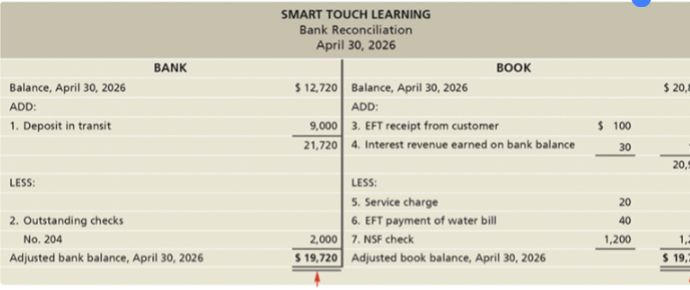
What does a Bank reconciliation look like?
43
-Determines the companies ability to meet short-term obligations
Cash Ratio = (Cash + Cash Equivalent) / Total Current liabilities
Cash Equivalent: A highly liquid investment that can be converted to cash in three months or less.
Current Liability: A debt that a business must pay within one year.
*A cash ratio to high (above 1.0) is concerning because that cash could be used to generate profit.
*A cash ratio below 1.0 is ideal, however, if it gets too low then that can signify they don’t have enough money to pay off their short-term debt.
Cash Ratio
-Determines the companies ability to meet short-term obligations
Cash Ratio = (Cash + Cash Equivalent) / Total Current liabilities
Cash Equivalent: A highly liquid investment that can be converted to cash in three months or less.
Current Liability: A debt that a business must pay within one year.
*A cash ratio to high (above 1.0) is concerning because that cash could be used to generate profit.
*A cash ratio below 1.0 is ideal, however, if it gets too low then that can signify they don’t have enough money to pay off their short-term debt.
44
Credit memorandums
Bank account increased
45
Debit Memorandums
Bank account decreased
Plus de flashcards : Économie et gestion
EconomicsÉconomie et gestion · AnglaisSarahBusiness Igcse Marketing Économie et gestion · AnglaisTasvikaChapter 19 - Liquidating DistributionsÉconomie et gestion · AnglaiswowiepowYear 2 Economics Key TermsÉconomie et gestion · AnglaisluluFacilities Layout and Location PlanningÉconomie et gestion · AnglaisPsalmsFederal Taxation (C239)Économie et gestion · AnglaisdTransportationÉconomie et gestion · AnglaisBUENAFLOR,ACC Chapter 2Économie et gestion · AnglaisTaylorFinanceÉconomie et gestion · Anglais17AICE Business Unit 4: OperationsÉconomie et gestion · AnglaisAkshayF2 Analysis of financial perfromance and positionÉconomie et gestion · AnglaisEllaExam 3 ReviewÉconomie et gestion · Anglaiswowiepow
Tous les decks : Économie et gestion
Révise ces decks dans l’app
Gratuit sur iPhone, Android, Mac et le web. Ajoute n’importe quel deck à ton compte en un tap.

