ACG2021 Chapter 9 (Principles of Financial Accounting)
Réviser ces flashcardsGratuit · répétition espacée · iPhone, Android, Mac et web
Toutes les cartes
1
Property, plant, and equipment (PP&E) are long-lived, tangible assets used in the operations of a business. Examples include land, buildings, equipment, furniture, and automobiles.
-These assets MUST be used in the operations of a business. If it is just a, for example, vacant ware house, than that is an investment!
-Business must allocate the cost of the plant asset over its useful life to follow the matching principle, except land since that does not depreciate.
Property, plant, and equipment (PP&E)
Property, plant, and equipment (PP&E) are long-lived, tangible assets used in the operations of a business. Examples include land, buildings, equipment, furniture, and automobiles.
-These assets MUST be used in the operations of a business. If it is just a, for example, vacant ware house, than that is an investment!
-Business must allocate the cost of the plant asset over its useful life to follow the matching principle, except land since that does not depreciate.
2
That an acquired assets and services should be recorded at their actual cost (known as historical cost) and not fair value (The fair value is the market value, which is how much would get back to being sold).
So, if you buy land for \$20,000, in the next year you think the land is worth \$25,000, you will still record the land as \$20,000 (The amount you paid for it).
Cost principle
That an acquired assets and services should be recorded at their actual cost (known as historical cost) and not fair value (The fair value is the market value, which is how much would get back to being sold).
So, if you buy land for \$20,000, in the next year you think the land is worth \$25,000, you will still record the land as \$20,000 (The amount you paid for it).
3
1. What is the difference between the asset ‘Land’ versus the asset ‘Land Improvements?
2. What costs are associated with both?
3. Journal Entries for both?
2. What costs are associated with both?
3. Journal Entries for both?
-Difference
‘Land’ asset account does not need to be depreciated while the ‘Land Improvement" asset account DOES.
-Costs associated with each account.
Land Account
-Purchase Price
-Brokerage Commissions
-Survey and Legal Fees
-Deliquent Property Taxes
-Tax assessed to transfer the ownership (title) of the land
-Cost of clearing the land and removing unwanted buildings
Land Improvements (These ARE NOT included with ‘Land’ account)
-Fencing-Paving
-Sprikler Systems
-Lighting
-Signs
-Anything else you PUT on it
.-Journal Entries
‘Land Account’
-Land is debited
-The part of ‘Land’ that is borrowed is in Notes payable, while the amount that is taken from Cash is put in Cash.
‘Land Improvements’
-Simple; Land Improvements (PPE asset) is debited and cash is credit.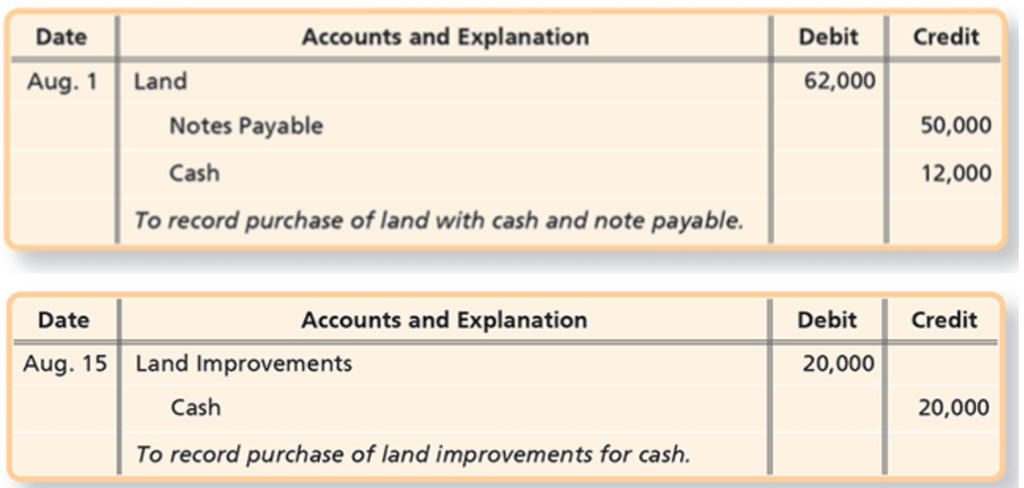
‘Land’ asset account does not need to be depreciated while the ‘Land Improvement" asset account DOES.
-Costs associated with each account.
Land Account
-Purchase Price
-Brokerage Commissions
-Survey and Legal Fees
-Deliquent Property Taxes
-Tax assessed to transfer the ownership (title) of the land
-Cost of clearing the land and removing unwanted buildings
Land Improvements (These ARE NOT included with ‘Land’ account)
-Fencing-Paving
-Sprikler Systems
-Lighting
-Signs
-Anything else you PUT on it
.-Journal Entries
‘Land Account’
-Land is debited
-The part of ‘Land’ that is borrowed is in Notes payable, while the amount that is taken from Cash is put in Cash.
‘Land Improvements’
-Simple; Land Improvements (PPE asset) is debited and cash is credit.
4
The company "Capitalized" the cost of land by \$62,000. What does this mean?
This means that the company increased the account of ‘Land’ by \$62,000.
“Capitalized” means to record the acquisition of an asset by increasing its account.
*This would only include all items paid for the asset to perform its intended function. After that, all other expenses related to the item are not considered to be "Capitalized" .
“Capitalized” means to record the acquisition of an asset by increasing its account.
*This would only include all items paid for the asset to perform its intended function. After that, all other expenses related to the item are not considered to be "Capitalized" .
5
What is included in the PPE asset account “Building’?
1.Contrusting a Building
-Materials
-Acritecual Charges
-Building Permits
-Contracter Charges
2. Purchasing an existing Building
-Purchase Price
-Cost to Renovate
-Materials
-Acritecual Charges
-Building Permits
-Contracter Charges
2. Purchasing an existing Building
-Purchase Price
-Cost to Renovate
6
What costs are included in the PPE asset account of ‘Machinery and Equipment’?
The cost of an Equipment account only includes costs associated with the Equipment before it is used. After the asset is up and running, all other costs after (such as maintenance and repairs) are NOT included.
Specific Costs included (Don’t need to memorize; just examples for context)
-Purchase Price
-Transportation Costs
-Insurance while on transit
-Sales tax and other taxes
-Installation Costs
-Testing Cost (Prior to use of asset)
Specific Costs included (Don’t need to memorize; just examples for context)
-Purchase Price
-Transportation Costs
-Insurance while on transit
-Sales tax and other taxes
-Installation Costs
-Testing Cost (Prior to use of asset)
7
A company has a lump-sum purchase of a building and land for \$100,000. How would you record this purchase in a journal entry
For accounting purposes, we must identify the cost of each asset purchased. We can do that with the Relative-Fair value method, shown below.
Step 1: Find the Fair value (market-Value) of each asset.mIn this case, the building is worth \$90,000, while the land is worth \$30,000. There is a total fair value of \$120,000.
Step 2: Find the Relative Fair value, or the percentage of the assets fair value to the total fair value.
-The land makes up 25% of the total fair value
-The building makes up about 75% of the total fair value
Step 3: Use those same percentages to find the historical cost of each asset
-Historical total cost = 100,000
-Land Historical Cost: \$25,000
-Building Historical Cost: \$75,000
THEN, Just do the journal entry.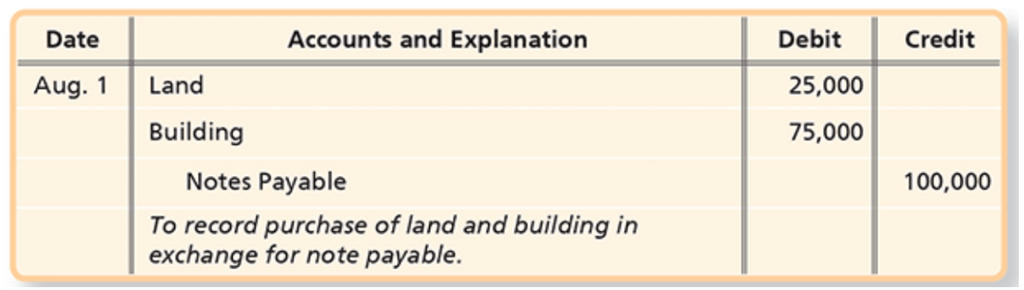
Step 1: Find the Fair value (market-Value) of each asset.mIn this case, the building is worth \$90,000, while the land is worth \$30,000. There is a total fair value of \$120,000.
Step 2: Find the Relative Fair value, or the percentage of the assets fair value to the total fair value.
-The land makes up 25% of the total fair value
-The building makes up about 75% of the total fair value
Step 3: Use those same percentages to find the historical cost of each asset
-Historical total cost = 100,000
-Land Historical Cost: \$25,000
-Building Historical Cost: \$75,000
THEN, Just do the journal entry.
8
How do accountants divide spending on Plant assets
Accountants divide the spending of plant assets into two categories.
1. Capital Expenditures: It is a debit to an asset account because it extends the assets useful life. (also, capital expenditures also include all costs needed to get the machine up and running)
ex)Extraordinary repair: A repair to an asset that greatly increases the assets useful life, such as fully replacing the engine of a truck.
2. Revenue Expenditures: Are debited to expense accounts. These expenses do NOT extend the assets useful life.
ex) Oil change, car wash, replace windshield.
1. Capital Expenditures: It is a debit to an asset account because it extends the assets useful life. (also, capital expenditures also include all costs needed to get the machine up and running)
ex)Extraordinary repair: A repair to an asset that greatly increases the assets useful life, such as fully replacing the engine of a truck.
2. Revenue Expenditures: Are debited to expense accounts. These expenses do NOT extend the assets useful life.
ex) Oil change, car wash, replace windshield.
9
What does it mean if an asset becomes ‘obsolete’?
An asset is considered obsolete when a newer asset can perform its job more efficiently. The most common example is computers.
10
1. Capitalized Cost: All items paid for the asset to perform its intended function.
2. Estimated Useful Life: How long the company expects to use the asset.
3. Estimated Residual Value: The asset’s expected value at the end of its estimated useful life.
What are the three main factors in determining depreciation of a plant asset?
1. Capitalized Cost: All items paid for the asset to perform its intended function.
2. Estimated Useful Life: How long the company expects to use the asset.
3. Estimated Residual Value: The asset’s expected value at the end of its estimated useful life.
11
What is depreciable cost?
Depreciable Cost = Cost - Estimated Residual Value
12
What is the BOOK VALUE!!!! (IMPORTANT!)
Book Value: Current value of an asset
Book Value = Cost - Accumulated Depreciation
Book Value = Cost - Accumulated Depreciation
13
1. What are the main Depreciation Methods
2. What is the journal entry for depreciation?
2. What is the journal entry for depreciation?
1. Straight-line Method
2. Accelerated Depreciation Method
3. Units-of-production Method
*The next three slides are for each of these methods.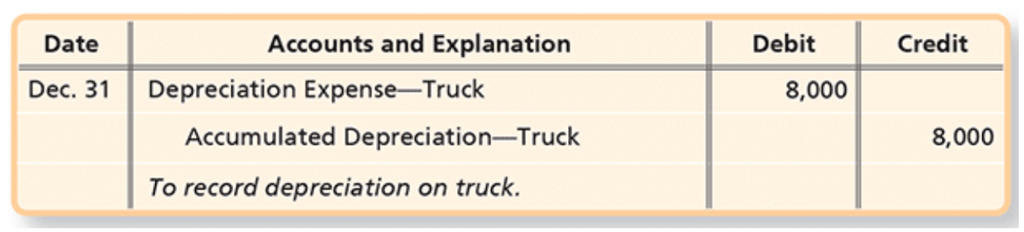
2. Accelerated Depreciation Method
3. Units-of-production Method
*The next three slides are for each of these methods.
14
Straight-Line Method
*PS: You multiply your result by (Number of months / 12 months) if you only used it part of the year.
ex)8,000 (6/12) = \$5,000 this year.

ex)8,000 (6/12) = \$5,000 this year.
15
Accelerated Depreciation Method
This method is when depreciation calculates more of the assets cost near the start of the assets life and less at the end of its useful life.
The main Accelerated depreciation method is the Double-declining-balance Method.
Step 1: Get the Straight-Line Rate, which is the 1 divided by the useful life.
SL Rate = 1 / (Useful Life)
ex)
SL Rate = 1/5 = 20%
Step 2: Multiple the Straight-Line Rate by 2.
ex)
20% x 2 = 40%
Step 3: Multiple the book value each year by 40%.
*The Book value = Cost - the amount of depreciation that has been accumulated.
The main Accelerated depreciation method is the Double-declining-balance Method.
Step 1: Get the Straight-Line Rate, which is the 1 divided by the useful life.
SL Rate = 1 / (Useful Life)
ex)
SL Rate = 1/5 = 20%
Step 2: Multiple the Straight-Line Rate by 2.
ex)
20% x 2 = 40%
Step 3: Multiple the book value each year by 40%.
*The Book value = Cost - the amount of depreciation that has been accumulated.
16
Units-of-production Method
This method depreciation by units rather than by years.
Below, the truck only used 20,000 miles that year.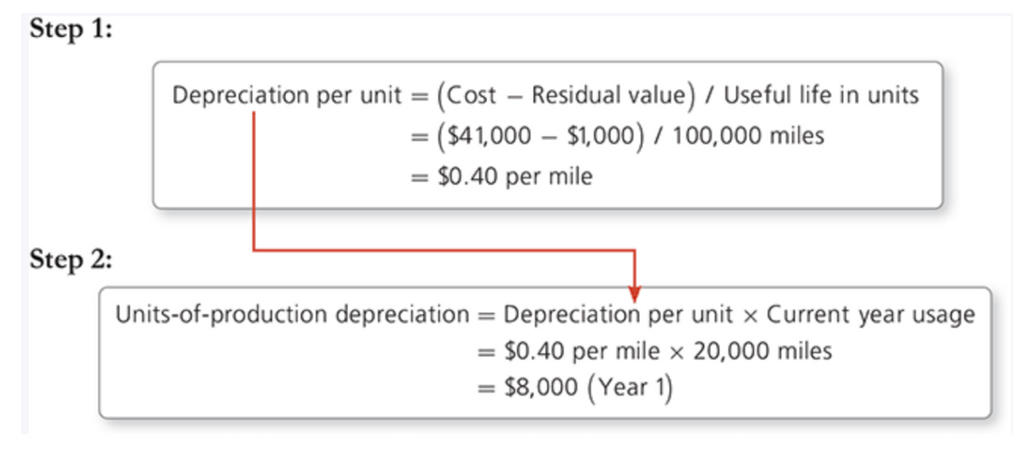
Below, the truck only used 20,000 miles that year.
17
What depreciation method is used for tax purposes rather than for your books?
The IRS requires companies to use a specific depreciation method for tax purposes. This method is called the ‘Modified Accelerated Cost Recovery System (MACRS)’.
ex) In the MACRS, office furniture has a 7-year useful life. Even if your book depreciation is different, such as 5 years.
*This does NOT follow GAAP! Businesses are required to calculate depreciation in both ways.
ex) In the MACRS, office furniture has a 7-year useful life. Even if your book depreciation is different, such as 5 years.
*This does NOT follow GAAP! Businesses are required to calculate depreciation in both ways.
18
What happens if there is a change in estimated useful life or residual value?
GAAP requires them to recalculate depreciation for the year the change was made and in future periods.
*Past depreciations do NOT need to be recalculated.
ALSO!!!
When recalculating the new depreciation, use REMAKING USEFUL LIFE.
Depreciation = (cost - residual value) / REMANINGING USEFUL LIFE
*Past depreciations do NOT need to be recalculated.
ALSO!!!
When recalculating the new depreciation, use REMAKING USEFUL LIFE.
Depreciation = (cost - residual value) / REMANINGING USEFUL LIFE
19
What happens when you get rid of an PPE asset?
You have 3 options
1. Discard the Plant Asset
2. Sell the Asset
3. Exchange the Plant Asset for another plant asset.
*Next three slides will explain each
"
1. Bring the depreciation up to date.
2. Remove the old, disposed-of asset and associated accumulated depreciation from the books.
3. Record the value of any cash received (or paid) in the disposal of the asset.
4. Finally, determine the amount of any gain or loss. Gain or loss is determined by comparing the cash received and the fair value of any other assets received with the book value of the asset disposed of.
"
1. Discard the Plant Asset
2. Sell the Asset
3. Exchange the Plant Asset for another plant asset.
*Next three slides will explain each
"
1. Bring the depreciation up to date.
2. Remove the old, disposed-of asset and associated accumulated depreciation from the books.
3. Record the value of any cash received (or paid) in the disposal of the asset.
4. Finally, determine the amount of any gain or loss. Gain or loss is determined by comparing the cash received and the fair value of any other assets received with the book value of the asset disposed of.
"
20
1. How to discard a plant asset
Step 1: Bring the depreciation up to date
-Lets say on July 1st, you decide to dispose of an asset. From Jan 1 to July 1st, there is depreciation that needs to be accounted for. Calculate and journalize how you would do any depreciation.
Step 2: Remove the old asset account and accumulated depreciation contra account with journal entry.
Step 3: Record any cash received or paid in the disposal of the asset.
Step 4: Finally determine the amount of gains or loss. Gains or losses are determined by comparing the cash received (or given) by the book value.
Ex)
-Equipment: 10,000
-Accumulated Depreciation: 8,500
-Threw away (Did not sell)
-Cost \$200 to throw away
Journal Entry
Dr Loss on Disposal of Equipment 1,700
Dr Accumulated Depreciation 8,500
__Cr Equipment 10,000
__Cr Cash 200
-Lets say on July 1st, you decide to dispose of an asset. From Jan 1 to July 1st, there is depreciation that needs to be accounted for. Calculate and journalize how you would do any depreciation.
Step 2: Remove the old asset account and accumulated depreciation contra account with journal entry.
Step 3: Record any cash received or paid in the disposal of the asset.
Step 4: Finally determine the amount of gains or loss. Gains or losses are determined by comparing the cash received (or given) by the book value.
Ex)
-Equipment: 10,000
-Accumulated Depreciation: 8,500
-Threw away (Did not sell)
-Cost \$200 to throw away
Journal Entry
Dr Loss on Disposal of Equipment 1,700
Dr Accumulated Depreciation 8,500
__Cr Equipment 10,000
__Cr Cash 200
21
2.
Journal Entry for
Equipment: \$10,000
Accumulated Depreciation: \$8,500
Sold for \$4,000
Journal Entry for
Equipment: \$10,000
Accumulated Depreciation: \$8,500
Sold for \$4,000
PS: Gain is credited since it is revnue
and
Loss is debited since it is an expense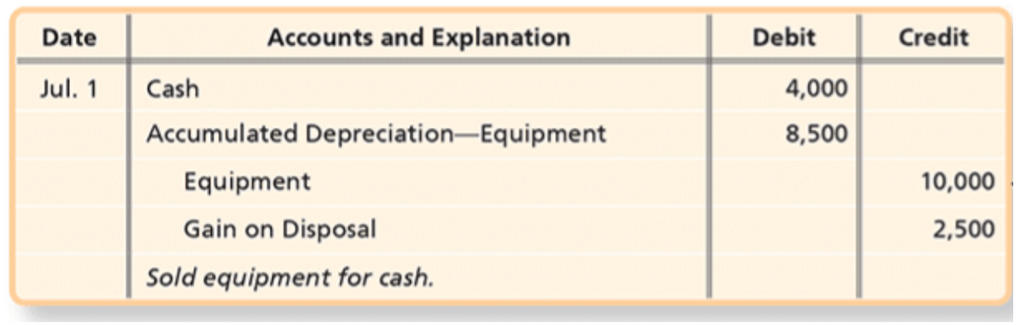
and
Loss is debited since it is an expense
22
3. Exchange Plant Asset for Another Plant Asset
Gain: When the book value + Cash > New Plant Asset fair value
Loss: When the Book Value + Cash < New Plant Asset Fair Value
*next two slides are scenarios of both
Loss: When the Book Value + Cash < New Plant Asset Fair Value
*next two slides are scenarios of both
23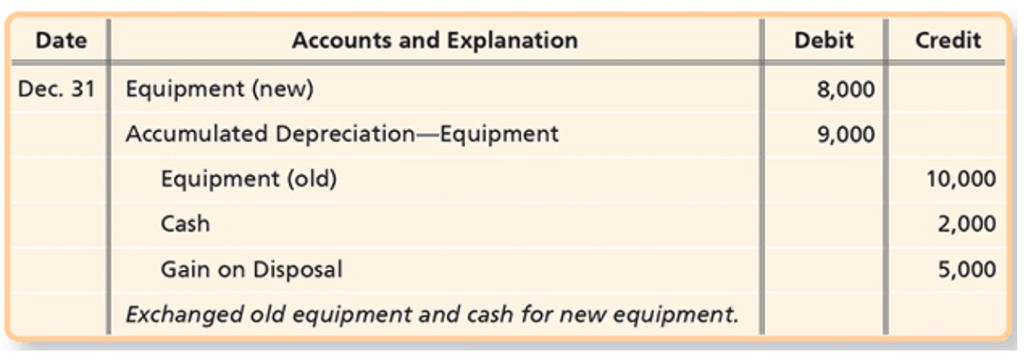
3a
How to journalize a gain during an exchange of a plant asset for another plant asset
-The old equipment capitalization Cost: \$10,000
-Old Equipment Current Book Value: \$1,000
-Also gave \$2,000 for new equipment
-New Equipment Fair Value: \$8,000
How to journalize a gain during an exchange of a plant asset for another plant asset
-The old equipment capitalization Cost: \$10,000
-Old Equipment Current Book Value: \$1,000
-Also gave \$2,000 for new equipment
-New Equipment Fair Value: \$8,000
24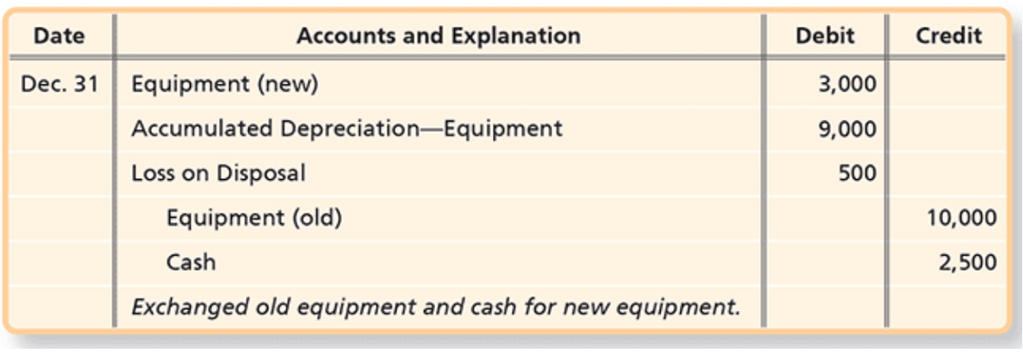
3b
How to journalize a loss during an exchange of a plant asset from another plant asset
-The old equipment capitalization Cost: \$10,000
-Old Equipment Current Book Value: \$1,000
-Also gave \$2,500 for new equipment
-New Equipment Fair Value: \$3,000
How to journalize a loss during an exchange of a plant asset from another plant asset
-The old equipment capitalization Cost: \$10,000
-Old Equipment Current Book Value: \$1,000
-Also gave \$2,500 for new equipment
-New Equipment Fair Value: \$3,000
25
What method of depreciation is used for natural resources?
Units-of-production method
Because, for oil per say, you would calculate the value by the amount of barrels you use. Its literally tied to how much of it you use.
Because, for oil per say, you would calculate the value by the amount of barrels you use. Its literally tied to how much of it you use.
26
Intangible Assets
Intangible assets are assets that have no physical form. Instead, these assets convey special rights from patents, copyrights, trademarks, and other creative works.
27
Definite Life Intangible Assets
-Amortization: The process by which a business spreads the allocation of the intangible’s assets costs over its useful life.
ex) Journal Entry shown
Indefinite Life Intangible Asset
-They are tested for impairment annually. Impairment is a permanent decline in an assets value.
!!!! INDEFINITE INTAGBLE ASSETS ARE ONLY RECORDED IF THEY DECREASE IN VALUE. IF THEY INCREASE, THEN DO NOTHING!!!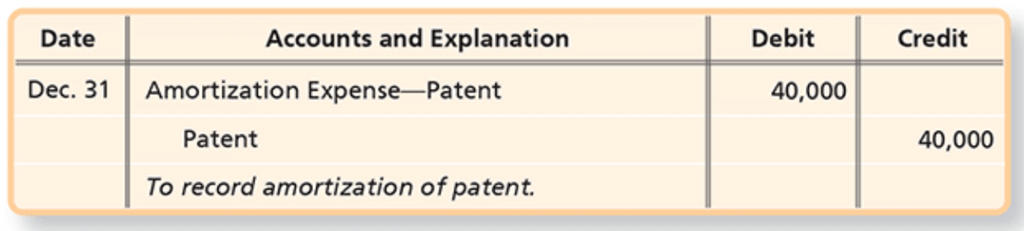
Accounting for Depreciation for Intangible Assets
Definite Life Intangible Assets
-Amortization: The process by which a business spreads the allocation of the intangible’s assets costs over its useful life.
ex) Journal Entry shown
Indefinite Life Intangible Asset
-They are tested for impairment annually. Impairment is a permanent decline in an assets value.
!!!! INDEFINITE INTAGBLE ASSETS ARE ONLY RECORDED IF THEY DECREASE IN VALUE. IF THEY INCREASE, THEN DO NOTHING!!!
28
What is ‘Good Will’
When a company buys another company over its fair value of its net assets (assets minus liabilities), that extra paid is called ‘Good Will’
This is recorded as an intangible asset that is indefinite.
*Next Slide will ask about a Journal entry on Good Will.
This is recorded as an intangible asset that is indefinite.
*Next Slide will ask about a Journal entry on Good Will.
29
Company A buys Company B for \$10 Million
Company B Assets: 9 million
Company B Liabilities: 1 million
Whats the journal Entry?
Company B Assets: 9 million
Company B Liabilities: 1 million
Whats the journal Entry?
Assets - liabilities = 8 million = Company Worth
Company A paid 10 million, which leaves 2 million for Good will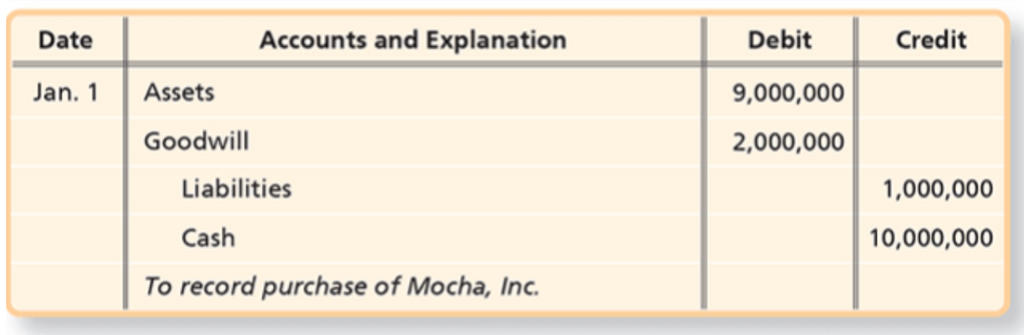
Company A paid 10 million, which leaves 2 million for Good will
30
Asset Turn Over Ratio
Asset Turn Over Ratio = Net Sales Revenue / Average Total Assets
ex) If a companies ratio is 0.86,
Then, that tells us that the company makes \$0.86 for every \$1 spent on assets.A higher ratio is better.
ex) If a companies ratio is 0.86,
Then, that tells us that the company makes \$0.86 for every \$1 spent on assets.A higher ratio is better.
31
Is Good Will based on the book value of the comapanies assets or the fair balue.
THE FAIR VALUE!!!!
Specifically the Net Fair Value of the assets
('Net' meaning Assets - Liabilities)
Specifically the Net Fair Value of the assets
('Net' meaning Assets - Liabilities)
32
Explain when to record depreciation when an asset is bought
If the asset was bought before or on the 15th of the month, then you record yhat month for depreciation
If the asset was bought after15th, then DONT record that months depreciation .
If the asset was bought after15th, then DONT record that months depreciation .
33
Is training employees for using an equipment typically debited the asset equipment of an expense?
Its typically treated as an expense for some reason.
Plus de flashcards : Économie et gestion
Wage and Price SettingÉconomie et gestion · AnglaisrikishakennedyP2 The Modern Business EnvironmentÉconomie et gestion · AnglaisEllaChapter One: Personal Finance Basics and the Time Value of MoneyÉconomie et gestion · AnglaisLexiAccountingÉconomie et gestion · AnglaisdevinaEconomics 101 Lecture 1-4Économie et gestion · AnglaisVincentSpanish Job Vocabulary 3Économie et gestion · EspagnolYueranBusiness Ethics and Corporate CultureÉconomie et gestion · AnglaisevanManagement Theories (Taylor, Fayol, Weber, Mayo)Économie et gestion · AnglaisSANGALLAHealthcare FinancingÉconomie et gestion · Anglaiskay24Key TermsÉconomie et gestion · AnglaisJonathanChapter 14 Vocab - Supply ChainÉconomie et gestion · Anglaisbevo612GFCÉconomie et gestion · AnglaisFathia
Tous les decks : Économie et gestion
Révise ces decks dans l’app
Gratuit sur iPhone, Android, Mac et le web. Ajoute n’importe quel deck à ton compte en un tap.

