ACG2071 Chapter 3 (Principles of Managerial Accounting)
Réviser ces flashcardsGratuit · répétition espacée · iPhone, Android, Mac et web
Toutes les cartes
1
One of a series of steps in manufacturing production; usually assoiated with larger quanities
processes
One of a series of steps in manufacturing production; usually assoiated with larger quanities
2
Equivalent Units of Production (EUP)
Used to measure the direct material, direct labor, and the manufacturing overhead on partially completed units, and expresses in fully completed units.
ex)
10,000 units at the end of the period are a work-in-progress. They are 100% complete as to Direct Material Cost. They are 25% complete for conversion costs (direct labor & manufacturing overhead)
10,000 units x 100% complete = 10,000 EUP for Direct Materials
10,000 units x 25% complete = 2,500 EUP for Conversion Cost
ex)
10,000 units at the end of the period are a work-in-progress. They are 100% complete as to Direct Material Cost. They are 25% complete for conversion costs (direct labor & manufacturing overhead)
10,000 units x 100% complete = 10,000 EUP for Direct Materials
10,000 units x 25% complete = 2,500 EUP for Conversion Cost
3
In a
what does each of these words mean?
"To account":
"Accounted for"
what does each of these words mean?
"To account":
"Accounted for"
"To account": Includes the amount in process at te beginning of the period + the amount added during the period
"Accounted for": You have shown where every unit is - no missing units. (every unit is either still in ending Work in Process or has been completed and transferred out.)
"Accounted for": You have shown where every unit is - no missing units. (every unit is either still in ending Work in Process or has been completed and transferred out.)
4
Costs Pool
An accumulation of individual costs
5
Transaction 1—Purchased Materials
*Accounts Payable could also be Cash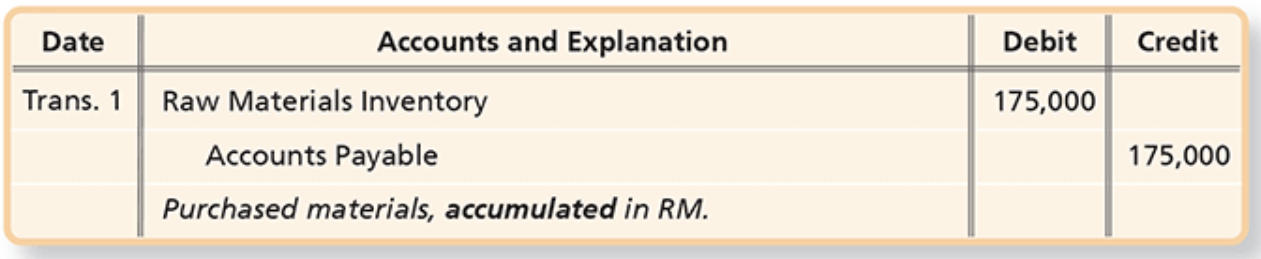
6
Transaction 2—Used Materials to make products
"During July, direct materials were assigned to the two production departments: \$130,200 to the Assembly Department and \$19,000 to the Cutting Department; \$2,000 in indirect materials was accumulated in Manufacturing Overhead."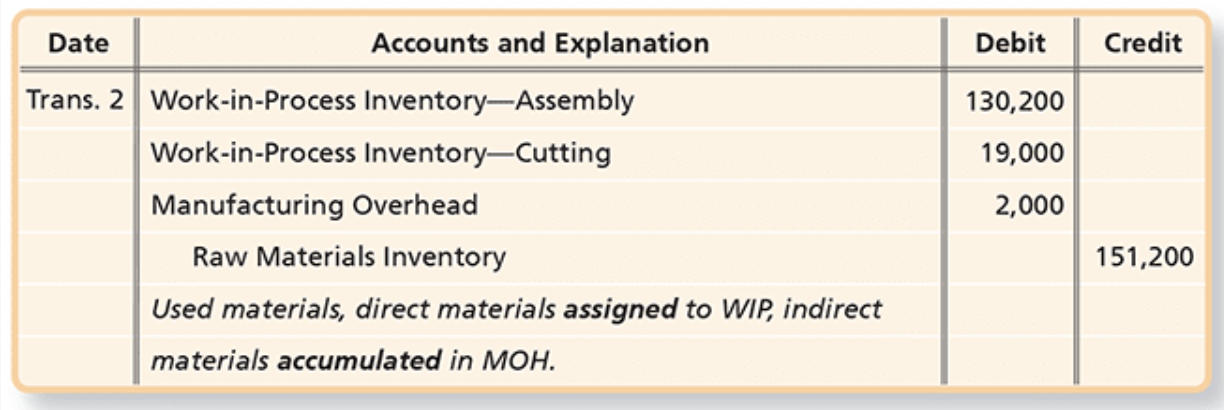
7
Transaction 3—Incurred Labor Costs
"During the month, Puzzle Me assigned \$22,090 in direct labor costs to the Assembly Department and \$3,840 in direct labor costs to the Cutting Department. \$1,500 in indirect labor costs were accumulated in Manufacturing Overhead."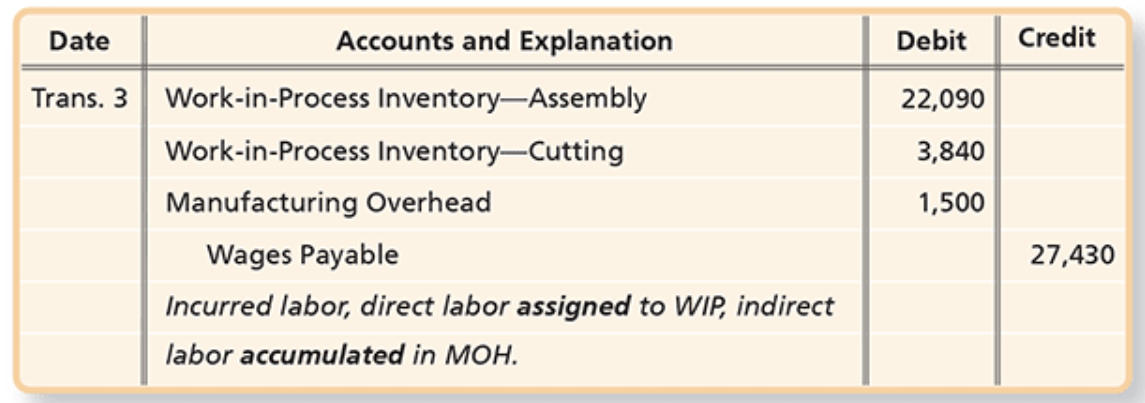
8
Transaction 4—Incurred Actual Overhead Costs
"Puzzle Me incurred \$30,000 in machinery depreciation and \$19,000 in indirect costs that were paid in cash, which included rent and utilities. These costs are accumulated in the Manufacturing Overhead account."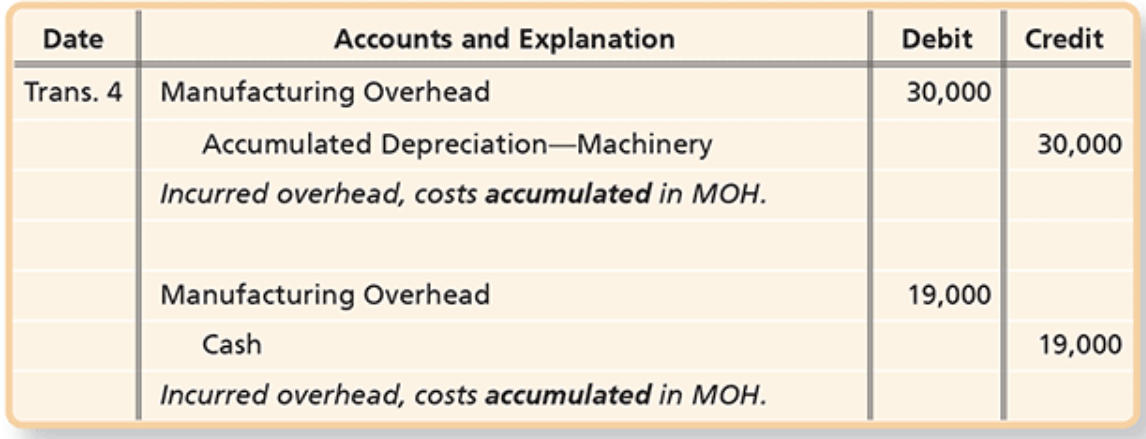
9
Transaction 5—Allocated Overhead
*This is during the period (So, for example, it would be done every week or month based on the amount of machine hours worked those updates). This transaction is shown in the image. This is based on the the Actual Amount of Allocation Base Used (ex, actual machine hours) x predetermined Overhead rate
*After the period ends, they determine if it is over or under allocated.
Underallocated (debit balance in MO)
Dr COGS:
Cr. Manufacturing Overhead
Overallocated (credit balance in MO)
Dr Manufacturing Overhead
Cr. COGS: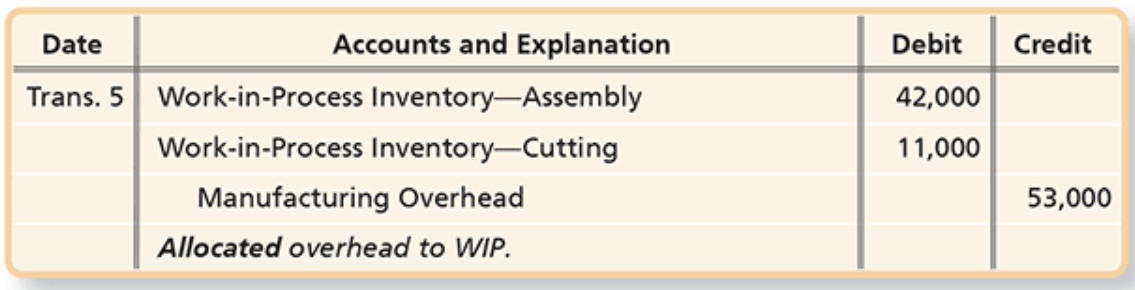
*After the period ends, they determine if it is over or under allocated.
Underallocated (debit balance in MO)
Dr COGS:
Cr. Manufacturing Overhead
Overallocated (credit balance in MO)
Dr Manufacturing Overhead
Cr. COGS:
10
Transaction 6—Transferred Costs from the Assembly Department to the Cutting Department
*This department process flow changes depending on the company/process. So, going from Assembly -> Cutting is just what this business does. I could be Mixing -> Baking -> Designing for a cake.
So, this happens when one department goes into another.
So, this happens when one department goes into another.
11
Transaction 7— When you finish making a job or completing a job (Book states: "Transferred Costs from the Cutting Department to Finished Goods Inventory")
*Should make perfect sense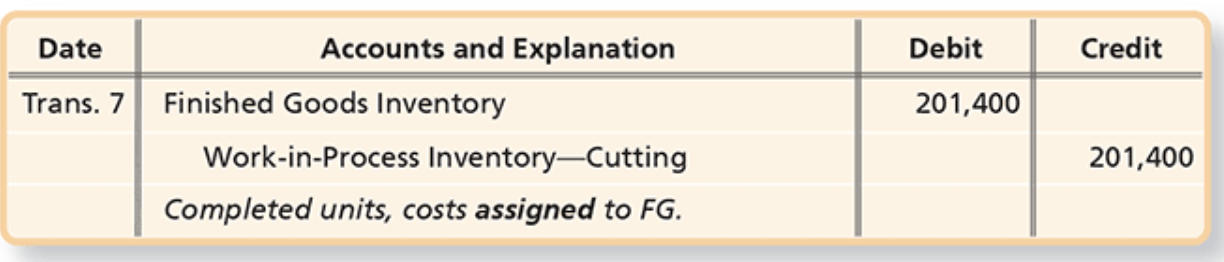
12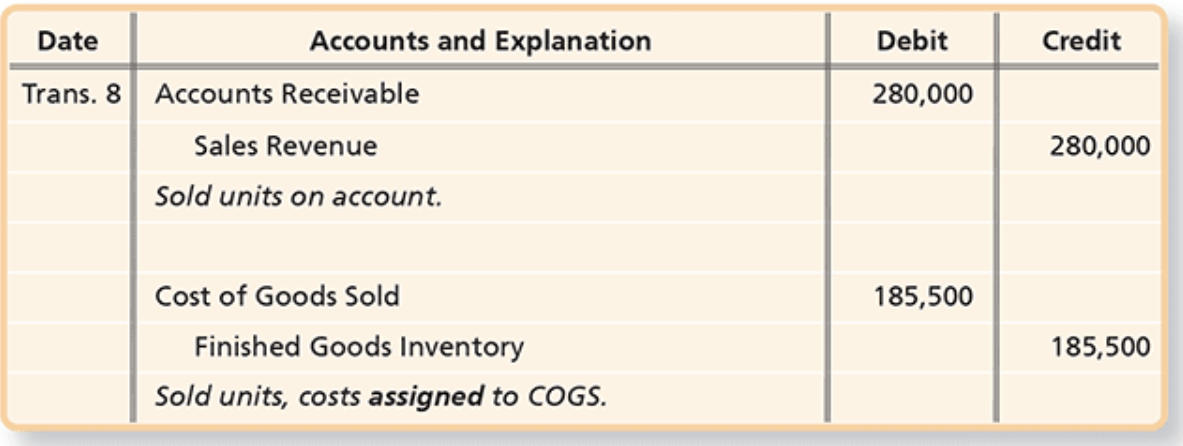
Transaction 8— Sell the product (Book States: Sold Puzzles and Transferred Costs from Finished Goods Inventory to Cost of Goods Sold)
13
Transaction 9—Adjusted Manufacturing Overhead
Underallocated (debit balance in MO)
Dr COGS:
Cr. Manufacturing Overhead
Overallocated (credit balance in MO)
Dr Manufacturing Overhead
Cr. COGS:
Dr COGS:
Cr. Manufacturing Overhead
Overallocated (credit balance in MO)
Dr Manufacturing Overhead
Cr. COGS:
14
Step 1:Find
Units completed and transferred out: 1,550
Ending WIP (Units still in process): 130
Step 2: Add them together
Equivalent units (DM) = 1,550 + 130 = 1,680 units
Step 3: Find total Direct Material Cost for the period
-which is \$3,900
Step 4:Cost per EU = 1,680/3,900 = \$2.3214
Anwser: \$2.32 per equivalent Unit
Block Company uses the weighted-average method in its process costing system. The Packaging Department started the month with 270 units in process, started 1,410 units, and had 130 units in process at the end of the period. All materials are added at the beginning of the process, and conversion costs are incurred uniformly. The units in process at the end of the month are 30% complete with respect to conversion costs. During the month 1,550 units were completed and transferred out.
Direct Materials
\$500 (Beginning Work-in-Process)
\$3,400 (Added This Month)
\$3,900 (Beginning Work-in-Process Direct Materials + Added This Month Direct Materials)
Conversion Costs
\$550 (Beginning Work-in-Process)
\$5,540 (Added This Month)
\$6,090 (Total) (Beginning Work-in-Process Conversion Costs + Added This Month Conversion Costs)
Total
\$1,050 (Beginning Work-in-Process Direct Materials + Beginning Work-in-Process Conversion Costs)
\$8,940 (Added This Month Direct Materials + Added This Month Conversion Costs)
\$9,990 (Total Direct Materials + Total Conversion Costs)
The cost per equivalent unit for direct materials is?????
Direct Materials
\$500 (Beginning Work-in-Process)
\$3,400 (Added This Month)
\$3,900 (Beginning Work-in-Process Direct Materials + Added This Month Direct Materials)
Conversion Costs
\$550 (Beginning Work-in-Process)
\$5,540 (Added This Month)
\$6,090 (Total) (Beginning Work-in-Process Conversion Costs + Added This Month Conversion Costs)
Total
\$1,050 (Beginning Work-in-Process Direct Materials + Beginning Work-in-Process Conversion Costs)
\$8,940 (Added This Month Direct Materials + Added This Month Conversion Costs)
\$9,990 (Total Direct Materials + Total Conversion Costs)
The cost per equivalent unit for direct materials is?????
Step 1:Find
Units completed and transferred out: 1,550
Ending WIP (Units still in process): 130
Step 2: Add them together
Equivalent units (DM) = 1,550 + 130 = 1,680 units
Step 3: Find total Direct Material Cost for the period
-which is \$3,900
Step 4:Cost per EU = 1,680/3,900 = \$2.3214
Anwser: \$2.32 per equivalent Unit
15
The Assembly Department had 4,600
units of beginning inventory in September, and 6,500
units were transferred to it from the Cutting Department. The Assembly Department completed 3,100
units during the month and transferred them to the Packaging Department.
Determine the total number of units to account for by the Assembly Department.
units of beginning inventory in September, and 6,500
units were transferred to it from the Cutting Department. The Assembly Department completed 3,100
units during the month and transferred them to the Packaging Department.
Determine the total number of units to account for by the Assembly Department.
"To account for": : Includes the amount in process at te beginning of the period + the amount added during the period
4,600 + 6,500 = 11,100
4,600 + 6,500 = 11,100
16
Which characteristic is the same in both job order costing systems and process costing systems?
A.
Types of product costs
B.
Method of record keeping
C.
Flow of costs through the accounts
D.
Number of Work-in-Process Inventory accounts
A.
Types of product costs
B.
Method of record keeping
C.
Flow of costs through the accounts
D.
Number of Work-in-Process Inventory accounts
THE ANWSER IS C
THEY BOTH HAVE
Raw Materials→Work in Process→Finished Goods→Cost of Goods Sold
THEY BOTH HAVE
Raw Materials→Work in Process→Finished Goods→Cost of Goods Sold
Plus de flashcards : Économie et gestion
Supply and DemandÉconomie et gestion · Anglaisrikishakennedyquick reviewÉconomie et gestion · AnglaisDariusFinancial Planning 1.01Économie et gestion · AnglaisABusiness Structures: Ltd, PLC and Sole TraderÉconomie et gestion · AnglaisdevinaHuman Resource Management: Careers and PayÉconomie et gestion · AnglaiscolleenHSC Operations Topic 1Économie et gestion · AnglaisAndyFood Quality Assurance PrelimÉconomie et gestion · AnglaisKrizEnvironmental EconÉconomie et gestion · AnglaisMrsRicchioStrategic LeadershipÉconomie et gestion · AnglaisrikishakennedyBusiness Structures: Ltd, PLC and Sole TraderÉconomie et gestion · AnglaisdevinaChapter 1 Vocab - Global BusinessÉconomie et gestion · Anglaisbevo612Chapter 13 Strategy,Structure,InnovationÉconomie et gestion · Anglaisbevo612
Tous les decks : Économie et gestion
Révise ces decks dans l’app
Gratuit sur iPhone, Android, Mac et le web. Ajoute n’importe quel deck à ton compte en un tap.

