ACG2071 Chapter 9 (Principles of Managerial Accounting)
Réviser ces flashcardsGratuit · répétition espacée · iPhone, Android, Mac et web
Toutes les cartes
1
Centralized companies
Decentralized companies
Decentralized companies
Centralized companies: A company in which decisions are made my top executives. Small companies are most often centralized due to the small scope of their operations.
Decentralized companies: Decentralized companies split their operations into different segments, such as departments or divisions. This is for when companies get too large.
Decentralized companies: Decentralized companies split their operations into different segments, such as departments or divisions. This is for when companies get too large.
2
Advantages of Decentralized companies:
1. Frees top management time.
2. Supports use of expert knowledge. Decentralization allows top management to hire the expertise each business segment needs to excel in its own specific operations.
3. Improves customer relations. Segment managers focus on just one segment of the company. Therefore, they can maintain closer contact with important customers than can upper management.
4. Provides training. Decentralization also provides segment managers with the training and experience necessary to become effective top managers.
5. Improves motivation and retention. Empowering segment managers to make decisions increases managers’ motivation and retention. This improves job performance and satisfaction.(BRUHHH)
Disadvantages of Decentralized companies:
1. Duplication of costs. For example, each business segment may hire its own payroll department and purchase its own payroll software. Companies can often avoid such duplications by providing centralized services
2. Problems achieving goal congruence. Goal congruence occurs when segment managers’ goals align with top management’s goals.
Advantages of Decentralized companies
Disadvantages of Decentralized companies
Disadvantages of Decentralized companies
Advantages of Decentralized companies:
1. Frees top management time.
2. Supports use of expert knowledge. Decentralization allows top management to hire the expertise each business segment needs to excel in its own specific operations.
3. Improves customer relations. Segment managers focus on just one segment of the company. Therefore, they can maintain closer contact with important customers than can upper management.
4. Provides training. Decentralization also provides segment managers with the training and experience necessary to become effective top managers.
5. Improves motivation and retention. Empowering segment managers to make decisions increases managers’ motivation and retention. This improves job performance and satisfaction.(BRUHHH)
Disadvantages of Decentralized companies:
1. Duplication of costs. For example, each business segment may hire its own payroll department and purchase its own payroll software. Companies can often avoid such duplications by providing centralized services
2. Problems achieving goal congruence. Goal congruence occurs when segment managers’ goals align with top management’s goals.
3
A responsibility Center
A responsibility center is a part of the organization for which a manager has decision-making authority and accountability for the results of those decisions.
4
Responsibility accounting system
A system for evaluating the performance of each responsibility center and its manager.
5
What are the four types of responsibility centers?
1. Cost Center: The manager is only responsible for controlling costs.
-"Comparing actual costs to budget costs"
2. Revenue Center: The manager is only responsible for generating revenues
-"Compares actual revenues to budgeted revenues"
3. Profit Center: The manager is responsible for profit by being responsible for generating revenues and controlling costs.
-"Compares actual revenues and costs to budgeted revenues and costs"
4. Investment Center: The manager is responsible for generating profits and efficiently managing the center’s invested capital.
-"Compares actual profits to budgeted profits and measures returns on investments"
-"Comparing actual costs to budget costs"
2. Revenue Center: The manager is only responsible for generating revenues
-"Compares actual revenues to budgeted revenues"
3. Profit Center: The manager is responsible for profit by being responsible for generating revenues and controlling costs.
-"Compares actual revenues and costs to budgeted revenues and costs"
4. Investment Center: The manager is responsible for generating profits and efficiently managing the center’s invested capital.
-"Compares actual profits to budgeted profits and measures returns on investments"
6
How do the four types of responsibility centers relate to each other.
The investment center is on top, then profit center, then under the profit center is cost and revenue centers.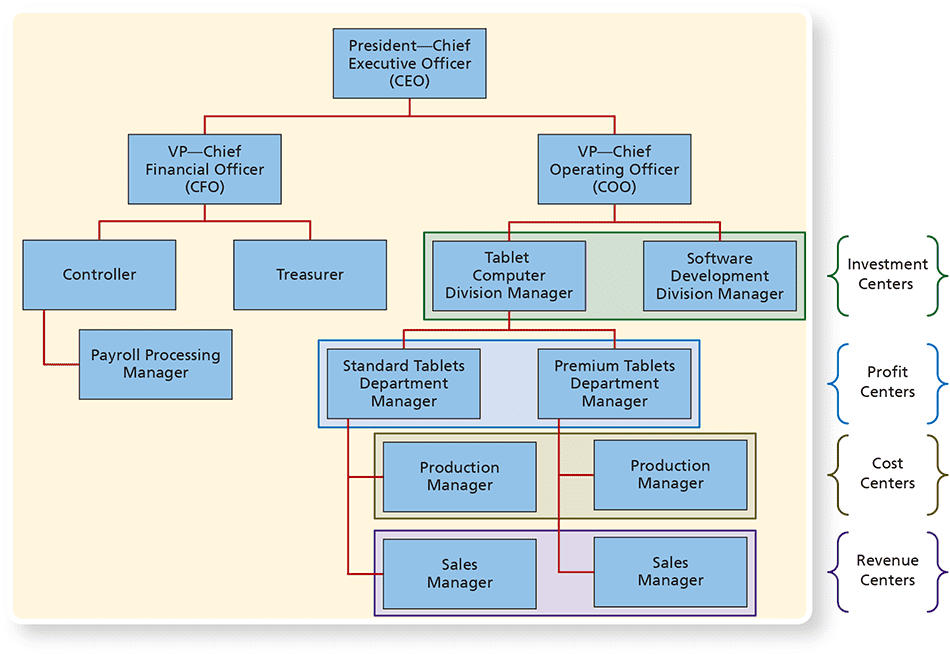
7
Performance Evaluation System
A system that provides top management with a framework for maintaining control over the entire organization.
8
1. Lag indicator vs Lead Indicator
2. Also, which indicator is shown in a "Financial Performance Evaluation System"
2. Also, which indicator is shown in a "Financial Performance Evaluation System"
1.
Lag Indicator: A performance measure that indicates past performance
Lead Indicators: A performance measure that forecasts future performance.
2. The Lag indicator is shown in a "Financial Performance Evaluation System". This is one of the Limitations of it.
Lag Indicator: A performance measure that indicates past performance
Lead Indicators: A performance measure that forecasts future performance.
2. The Lag indicator is shown in a "Financial Performance Evaluation System". This is one of the Limitations of it.
9
1. Operational Performance Measure: This measures the nonfinancial aspects of a company, specifically to "evaluate a firm’s performance on the basis of effectiveness and efficiency to ensure all segments of the business are working together to achieve the company’s goals"
2. In a 'Financial Performance Measure", it may measure lower costs, but would not measure lower quality and lower customer satisfaction, and therefore is a limitation. To overcome this limitation, you must also use the 'Operational Performance Measure'.
3. Lead indicators are related to "Operational Performance Measure"
1. Operational Performance Measure.
2. How does this relate to the 'Financial Performance Measure"
3. Which type of indicator is related to "Operational Performance Measure"
2. How does this relate to the 'Financial Performance Measure"
3. Which type of indicator is related to "Operational Performance Measure"
1. Operational Performance Measure: This measures the nonfinancial aspects of a company, specifically to "evaluate a firm’s performance on the basis of effectiveness and efficiency to ensure all segments of the business are working together to achieve the company’s goals"
2. In a 'Financial Performance Measure", it may measure lower costs, but would not measure lower quality and lower customer satisfaction, and therefore is a limitation. To overcome this limitation, you must also use the 'Operational Performance Measure'.
3. Lead indicators are related to "Operational Performance Measure"
10
Balances Score Card
The balanced scorecard is a performance evaluation system that requires management to consider both financial performance measures (lag indicators) and operational performance measures (lead indicators) when judging the performance of a company and its subunits.
They view a company from 4 different lenses
1. Financial perspective: This shows how well the company is performing financially, such as profits, revenue, and cost control.
2. Customer perspective: This measures how satisfied customers are and how well the company meets their needs.
3. Internal business perspective:This looks at how efficiently the company’s internal processes are running to deliver products or services.
4.Learning and growth perspective: This focuses on how the company improves through employee skills, training, and innovation.
They view a company from 4 different lenses
1. Financial perspective: This shows how well the company is performing financially, such as profits, revenue, and cost control.
2. Customer perspective: This measures how satisfied customers are and how well the company meets their needs.
3. Internal business perspective:This looks at how efficiently the company’s internal processes are running to deliver products or services.
4.Learning and growth perspective: This focuses on how the company improves through employee skills, training, and innovation.
11
Key Performance Indicators (KPI's)
A summary of performance measurements that help managers assess whether they the company is achieving its goals.
12
Responsibility Report
Responsibility reports are performance reports that capture the financial performance of cost, revenue, and profit centers with a focus on responsibility and control.
"Responsibility and control": meaning that the focus is only on what the manager has responsibility over and has control over. "It is not logical to evaluate a manager on items he or she cannot control or is not responsible for."
"Responsibility and control": meaning that the focus is only on what the manager has responsibility over and has control over. "It is not logical to evaluate a manager on items he or she cannot control or is not responsible for."
13
Controllable Costs
"A controllable cost is one that managers have the power to influence by their decisions."
14
Cost Centers Performance Report
Cost Centers Responsibility Report
Cost Centers Responsibility Report
"Cost center responsibility reports typically focus on the flexible budget variance—the difference between actual costs and the flexible budget costs.
- Recall that a flexible budget uses standard (budgeted) costs at the actual level of activity. Therefore, the flexible budget variance highlights the differences caused by changes in cost, not by changes in sales or production volume."
Items included in the performance report, but not the responsibility report
1. Salaries—The department manager does not control his or her own salary. report.
2. Payroll Benefits—Costs such as health insurance are determined at a higher level and are not controlled by the department manager.
3. Equipment Depreciation—The department manager does not have the authority to make investment decisions and, therefore, is not held responsible for the cost.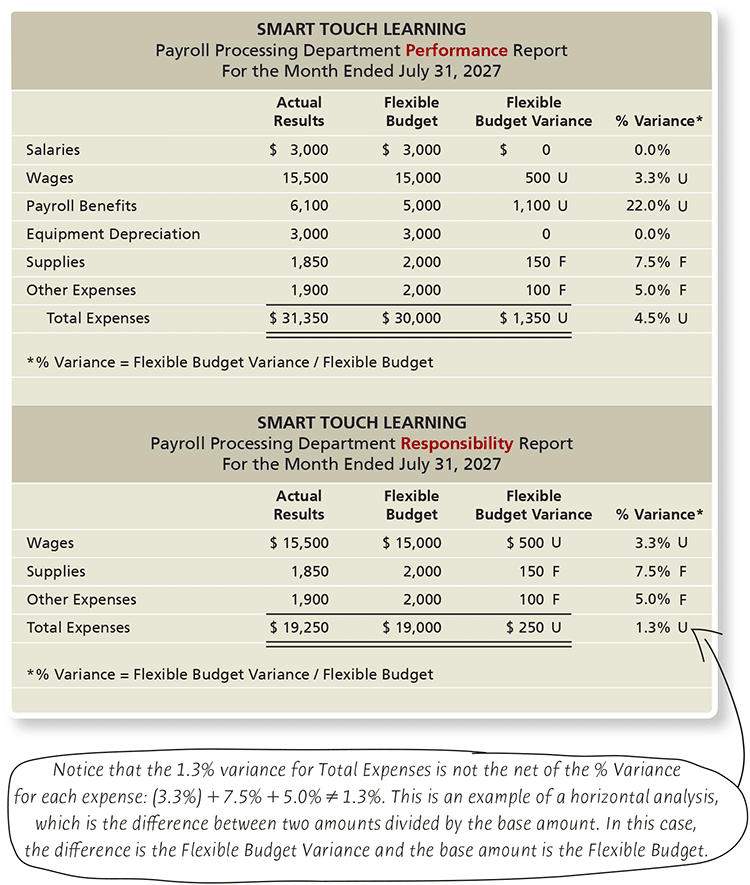
- Recall that a flexible budget uses standard (budgeted) costs at the actual level of activity. Therefore, the flexible budget variance highlights the differences caused by changes in cost, not by changes in sales or production volume."
Items included in the performance report, but not the responsibility report
1. Salaries—The department manager does not control his or her own salary. report.
2. Payroll Benefits—Costs such as health insurance are determined at a higher level and are not controlled by the department manager.
3. Equipment Depreciation—The department manager does not have the authority to make investment decisions and, therefore, is not held responsible for the cost.
15
Revenue Center Responsibility Report
*(for simplicity, the exhibit shows volume and revenue for only one item).
Flexible Budget Variance (in this case): Actual Revenue − Flexible Budget Revenue based on actual sales volume
Sales Volume Variance: Actual Volume of Sales - Planned Volume of Sales
-So, just the two main things that affect revenues, the price per item sold, and how many items were sold.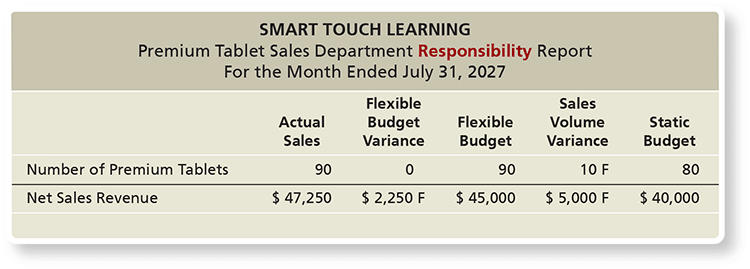
Flexible Budget Variance (in this case): Actual Revenue − Flexible Budget Revenue based on actual sales volume
Sales Volume Variance: Actual Volume of Sales - Planned Volume of Sales
-So, just the two main things that affect revenues, the price per item sold, and how many items were sold.
16
Profit Centers
!!!!PS: Flexible Budget Variance = Actaul results - felxible budget results!!!!
This is NOT just Actual revenues/costs - Flexible budget revenues/costs. !!!
Anyway,
The Traceable Fixed Expenses is in the performance report, but NOT in the Responsibility Report since managers cannot control fixed costs.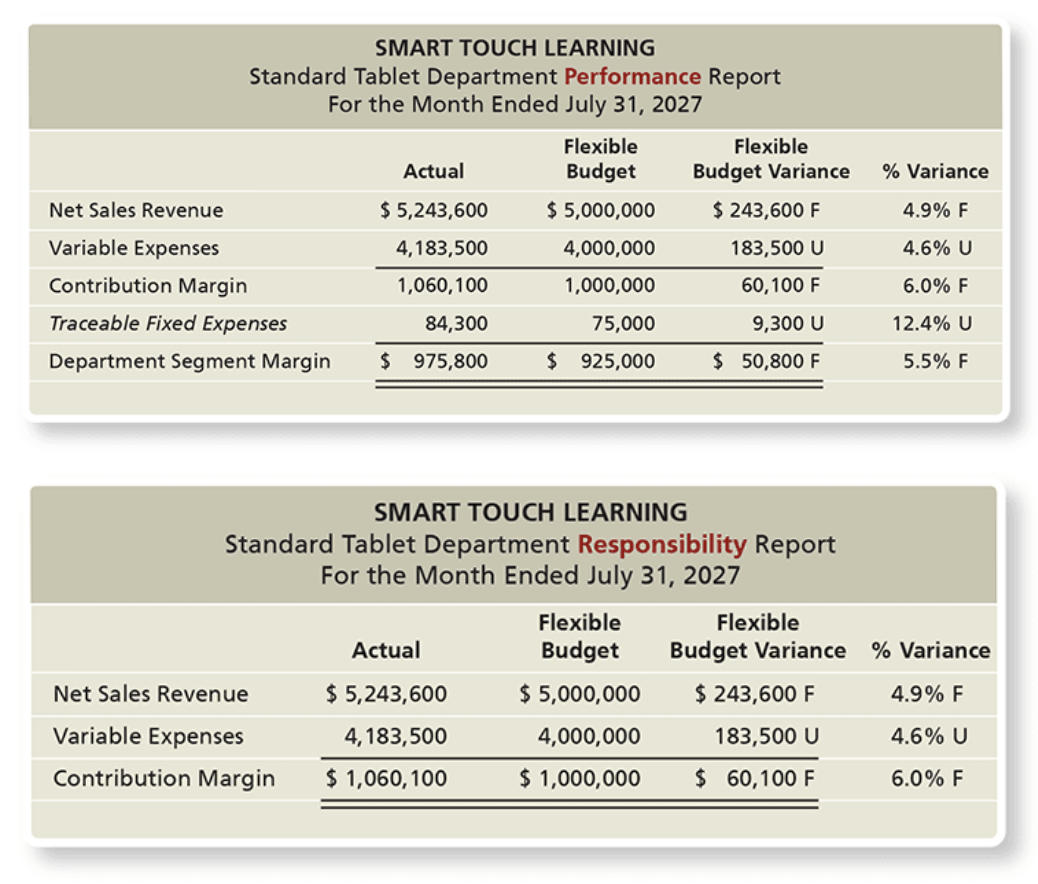
This is NOT just Actual revenues/costs - Flexible budget revenues/costs. !!!
Anyway,
The Traceable Fixed Expenses is in the performance report, but NOT in the Responsibility Report since managers cannot control fixed costs.
17
ROI
*Very Common KPI
How much operating income generated per each dollar of assets.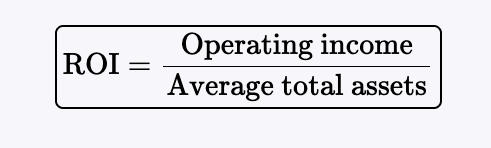
How much operating income generated per each dollar of assets.
18
What is the expanded ROI equation?
First Part: This represents the Profit Margin Ratio which shows how much operational income is earned per \$1.00 of sales. (Ex, if the profit margin ratio is 0.19/1, then they earn \$0.19 of operational income for every \$1.00 of sales)
Second Part: This represents the Asset Turnover Ratio which shows how much revenue is produced per \$1.00 of average total assets. (Ex, if the asset turnover ratio is 3, then they earned \$3.000 of revenue for every \$1.00 of average total assets)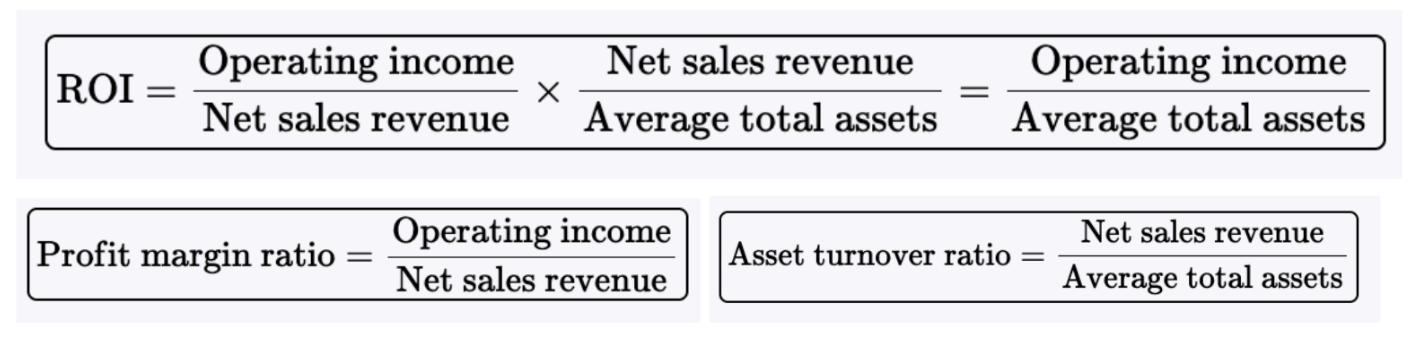
Second Part: This represents the Asset Turnover Ratio which shows how much revenue is produced per \$1.00 of average total assets. (Ex, if the asset turnover ratio is 3, then they earned \$3.000 of revenue for every \$1.00 of average total assets)
19
Residual Income
*PS: Target rate of return is calculated for you. You will learn to calculate it when your in your finance class.
20
Which is generally more goal congruent, Residual income or ROI?
Because some managers would not want to take profitable investments since their ROI would decrease due to the fact that the amount of revenue produced per dollar of assets would decrease.
Residual Income on the other hand encourages to just accept projects that increase overall profit.
So, if the top managers want to encourage divisions to buy new machinery that will be profitable, but not as profitable per dollar invested as the division's current operations.
-If performance was based on ROI, some divisions will not want to buy it since it decrease there ROI. This can cause clashing.
-If performance was based on RI, all divisions will be fine with buying it since it is profitable.
Residual Income on the other hand encourages to just accept projects that increase overall profit.
So, if the top managers want to encourage divisions to buy new machinery that will be profitable, but not as profitable per dollar invested as the division's current operations.
-If performance was based on ROI, some divisions will not want to buy it since it decrease there ROI. This can cause clashing.
-If performance was based on RI, all divisions will be fine with buying it since it is profitable.
21
Nonproductive assets and ROI
Non-productive assets are assets that aren't making any money yet. An example is a store chain buying land and construction in which they are building a new store. Including this in ROI would have a decreased ROI, therefore some companies will choose not to include them.
22
What is Gross Book Value and Net Book Value, and how does it relate to ROI?
Companies have to choose whether to measure assets using Gross Book Value (historical cost of asset) and Net Book Value (historical cost of asset minus depreciation).
Net Book value is easy to use since you can pull it right out of the balance sheet/
However, ROI and RI gets large over time, but because of depreciation, not because of improved operations.
Therefore, if performance is based on ROi or RI, if net book value is used in them, then managers are incentives to use old outdated equipment.
Therefore, to create goal congruence, some companies prefer to use gross book value when calculating RO and RI.
Net Book value is easy to use since you can pull it right out of the balance sheet/
However, ROI and RI gets large over time, but because of depreciation, not because of improved operations.
Therefore, if performance is based on ROi or RI, if net book value is used in them, then managers are incentives to use old outdated equipment.
Therefore, to create goal congruence, some companies prefer to use gross book value when calculating RO and RI.
23
Downsides of performance evaluations that are short-term
Managers will prioritize business decisions that made money short-term, even if they do not align with the companies interest long-term.
24
Transfer Price
The transfer price is the transaction amount of one unit of goods when the transaction occurs between divisions within the same company.
For example, if division was "selling" or transferring engines to another division, then:
-Transfer price has to be below market price (since if it was higher than market price, the division would just buy it on the market) but higher than variable costs (since it "would make contribution margin negative: sales price - variable cost").
That is the negotiated range for the transfer price.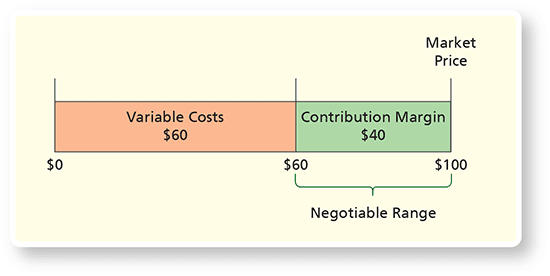
For example, if division was "selling" or transferring engines to another division, then:
-Transfer price has to be below market price (since if it was higher than market price, the division would just buy it on the market) but higher than variable costs (since it "would make contribution margin negative: sales price - variable cost").
That is the negotiated range for the transfer price.
25
1. What if the division can (obviously) sell to both an external customer and the other internal division, AND they are at full production capacity?
2. What if the division is below production capacity?
(What would the transfer price look like for both of these?)
2. What if the division is below production capacity?
(What would the transfer price look like for both of these?)
1. The transfer price should be a "market-based transfer price" meaning the:
transfer price = market price
Also, since they are at full production capacity, there is an opportunity cost to sell to either a external customer or a internal division.
2.
However, if they were not at full production capacity, then they could just manufacture another product for the internal division, since the external demand through there normal selling operations did NOT fill there production capacity. (Even though they could technically find someone to sell to, that is NOT through the normal selling means and would require further outreach which is not worth it for them)
So,
The transfer price should ba a "cost-based" transfer price, meaning:
-they consider the cost of the goods when determining the price.
transfer price = market price
Also, since they are at full production capacity, there is an opportunity cost to sell to either a external customer or a internal division.
2.
However, if they were not at full production capacity, then they could just manufacture another product for the internal division, since the external demand through there normal selling operations did NOT fill there production capacity. (Even though they could technically find someone to sell to, that is NOT through the normal selling means and would require further outreach which is not worth it for them)
So,
The transfer price should ba a "cost-based" transfer price, meaning:
-they consider the cost of the goods when determining the price.
26
Profit Margin
Operating Income / Net Sales Revenue
Plus de flashcards : Économie et gestion
E1 corporate governance & ethicsÉconomie et gestion · AnglaisellaLabour Markets & UnemploymentÉconomie et gestion · AnglaisrikishakennedyGr 11 Hfst 2 - Korporatiewe Sosiale VerantwoordelikheidÉconomie et gestion · NéerlandaisSnipperkasIAS 2 InventoriesÉconomie et gestion · AnglaisEllaIFRS 5 Assets held for sale and discontinued operationsÉconomie et gestion · AnglaisEllaEconomics Unit 3 AOS 1Économie et gestion · AnglaisRex.Business Structures: Sole ProprietorshipÉconomie et gestion · AnglaisSuveerBA 11: Introduction to Management and MarketingÉconomie et gestion · AnglaisJanineBusiness ActivityÉconomie et gestion · AnglaisHriteshECON Exam 2Économie et gestion · AnglaisJosh4 Role of the Marketing PlanÉconomie et gestion · AnglaisJohnTQM FINALSÉconomie et gestion · AnglaisSofia
Tous les decks : Économie et gestion
Révise ces decks dans l’app
Gratuit sur iPhone, Android, Mac et le web. Ajoute n’importe quel deck à ton compte en un tap.

