Pharmacokinetics and Drug Elimination
Réviser ces flashcardsGratuit · répétition espacée · iPhone, Android, Mac et web
Toutes les cartes
1
What is first-order drug elimination?
A constant fraction of the drug is eliminated per unit time; most drugs follow this pattern.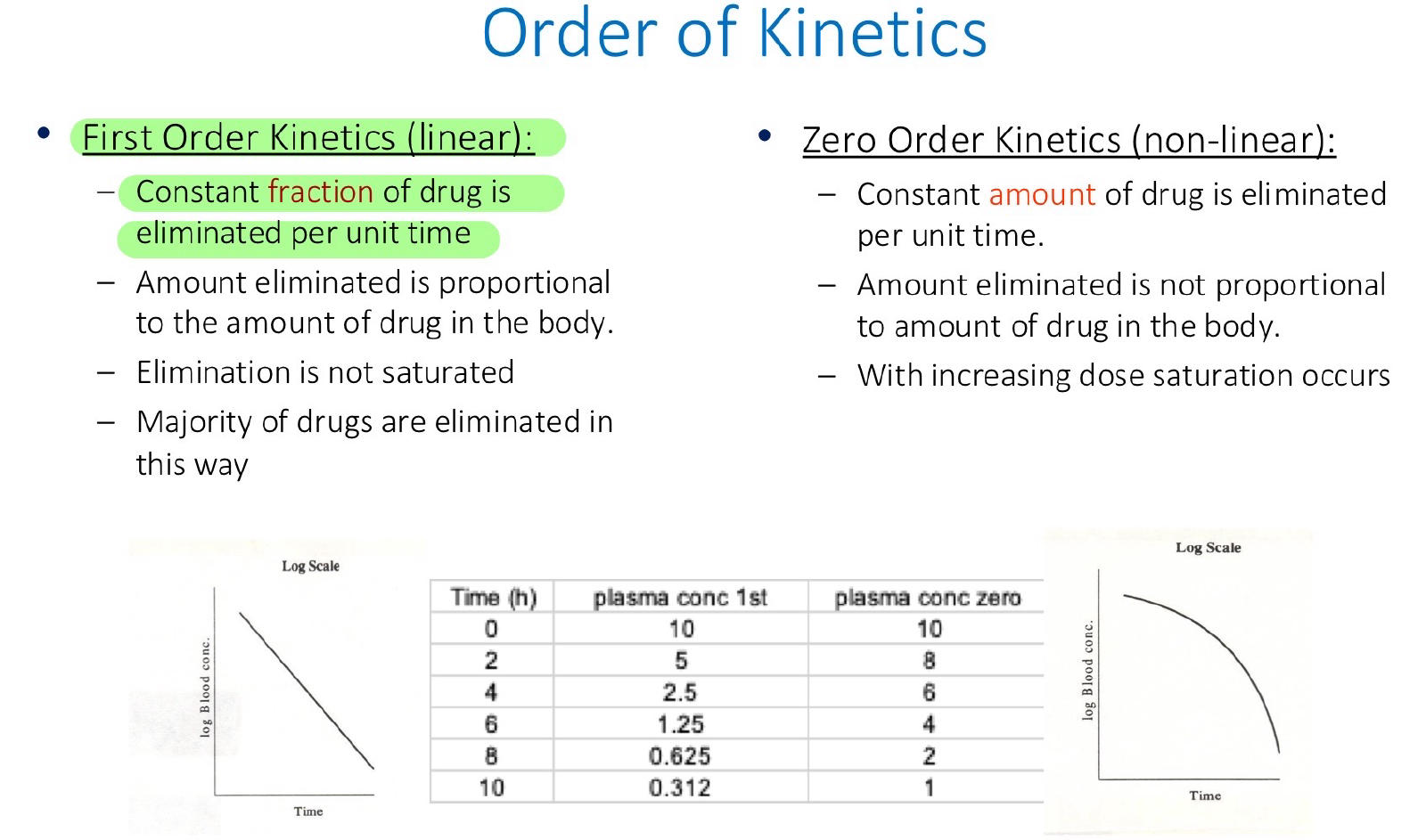
2
What is zero-order drug elimination?
A constant amount of drug is eliminated per unit time, often due to saturation.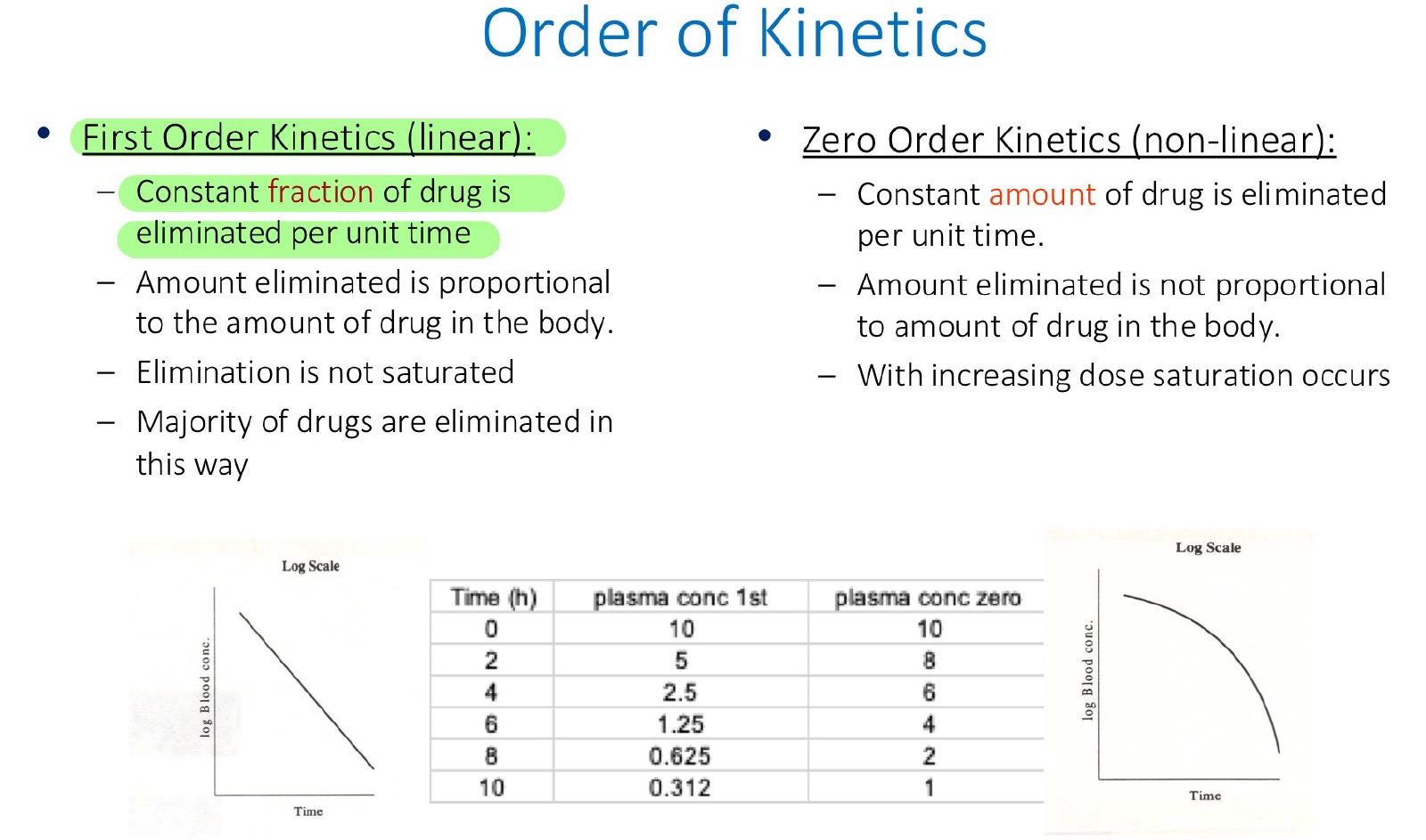
3
What is the major difference between first-order and zero-order elimination?
First-order eliminates a constant percentage; zero-order eliminates a constant amount.
4
A drug concentration is 2,000 ng/mL with first-order elimination. What remains after one half-life?
1,000 ng/mL. 50%
5
What is AUC?
Area under the concentration-time curve; measures total systemic drug exposure.
6
What is volume of distribution (Vd)?
The apparent volume in which a drug is distributed throughout the body.
7
Which pharmacokinetic parameter primarily determines a loading dose?
Volume of distribution (Vd).
8
What is clearance (CL)?
The volume of plasma completely cleared of drug per unit time.
9
What is the elimination rate constant (Kel)?
The fraction of drug eliminated per unit time.
10
What is elimination half-life (t½)? Drug eliminated/no longer has an effect after how many half lives? EXAM
1. The time required for plasma drug concentration to decrease by 50%.
2. Drug eliminated/no longer has an effect after 5 half lives
11
How does an increased Vd affect elimination half-life if clearance stays constant?
Half-life increases because the drug distributes into a larger apparent volume.
12
How does decreased clearance affect elimination half-life if Vd stays constant?
Half-life increases because the drug is eliminated more slowly.
13
What clinical factors influence a drug's dosage regimen?
Patient condition, adherence, and concurrently administered medications.
14
What three major components make up a dosing regimen?
Route of administration, dose, and dosing interval.
15
Why do neonatal foals often require higher mg/kg doses of aminoglycosides than adult horses?
Foals have more total body and extracellular water, increasing Vd for water-soluble drugs.
16
What is steady state?
The condition where the average rate of drug administration equals the average rate of elimination.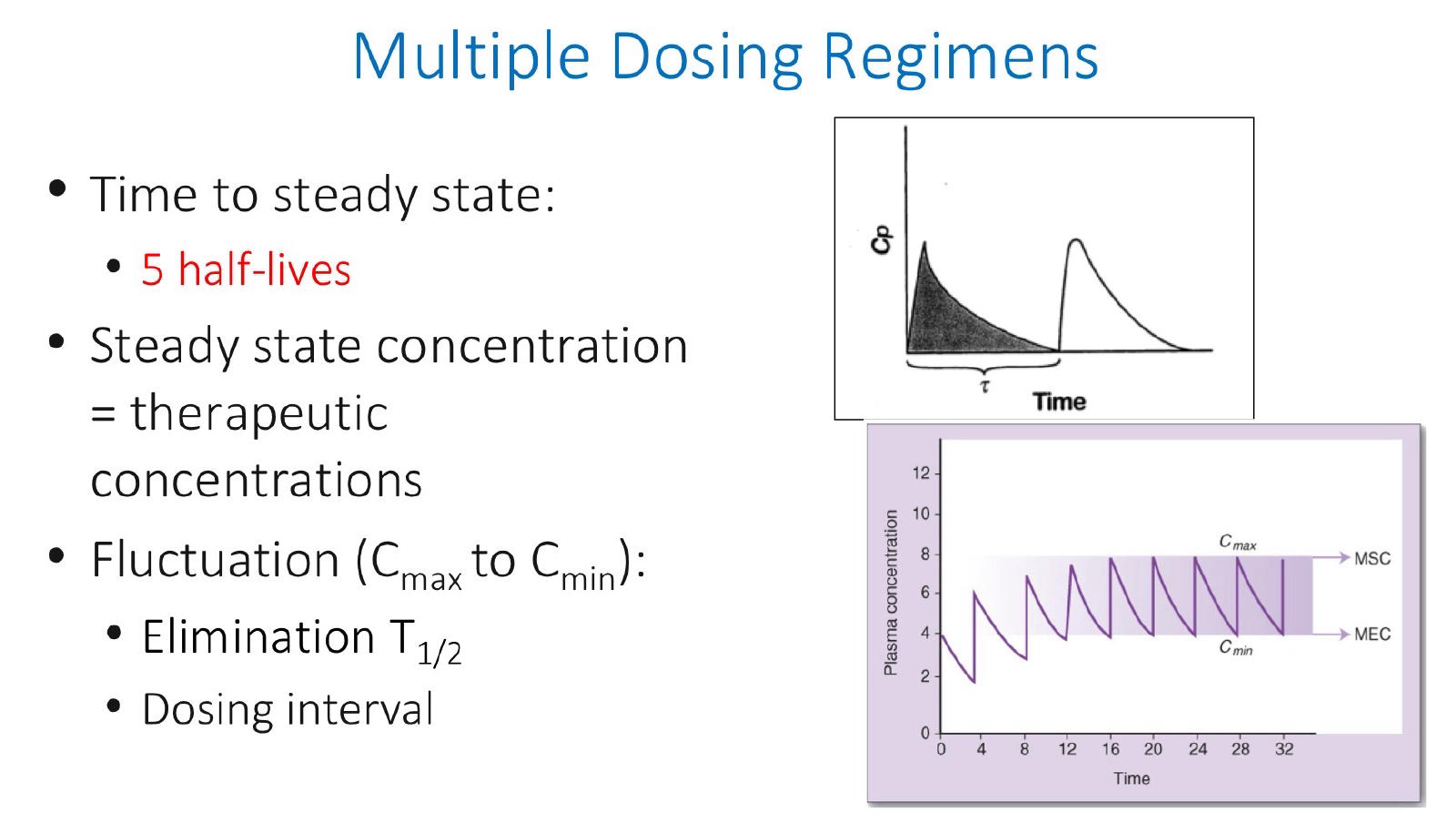
17
How many half-lives are required to reach approximately 97% of steady state? EXAM
Five half-lives.
18
What is drug accumulation?
The buildup of drug in the body when repeated doses are given before previous doses are fully eliminated.
19
What two factors primarily determine fluctuations between Cmax and Cmin?
Elimination half-life and dosing interval.
20
How does shortening the dosing interval relative to half-life affect accumulation?
Accumulation increases because less drug is eliminated between doses.
21
How does a loading dose help when a drug takes a long time to reach steady state?
It achieves the target therapeutic concentration immediately rather than waiting for gradual accumulation.
22
A drug has a half-life of 48 hours. Approximately how long until steady state?
10 days (5 × 48 hours = 240 hours).
23
What is the purpose of a maintenance dose?
To replace eliminated drug and maintain therapeutic concentrations during repeated dosing.
24
Which pharmacokinetic parameter primarily determines maintenance dose? EXAM
Clearance (CL).
25
What is the formula for maintenance dose? EXAM
MD = (Target concentration × CL × Dosing interval)/F.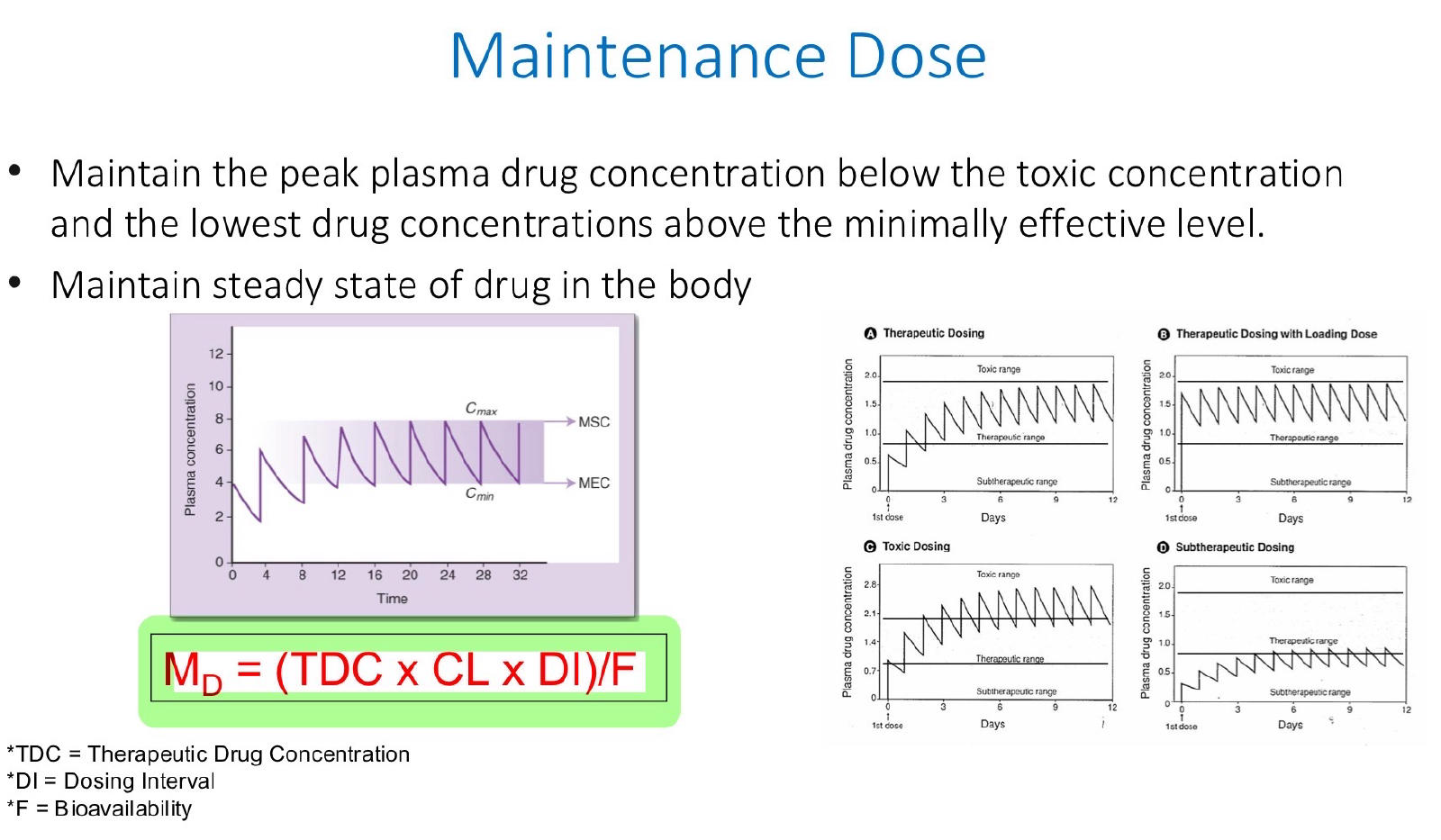
26
In the phenobarbital example, what maintenance dose maintains a target of 20 µg/mL?
Approximately 1.5 mg/kg every 12 hours.
27
What determines the appropriate dosing interval?
Elimination half-life and acceptable fluctuations between peak and trough concentrations.
28
Which drugs may have dosing intervals longer than their elimination half-lives?
Drugs with large therapeutic indices, drugs accumulated in tissue/with active metabolites
29
Which drugs commonly require dosing intervals shorter than their half-lives?
Drugs with narrow therapeutic indices
30
When is a loading dose warranted?
When therapeutic drug concentrations must be achieved rapidly, especially for drugs with long half-lives.
31
What is the formula for a loading dose? EXAM
LD = (Target concentration × Vd)/F.
32
In the lecture's phenobarbital example, what IV loading dose produces approximately 20 µg/mL? Vd is 715ml/kg
14 mg/kg IV.
33
What is the purpose of a constant-rate infusion (CRI)?
To maintain a target concentration
34
How should dosing be adjusted when Vd or clearance changes?
Increased Vd may require a larger loading dose; decreased CL generally requires a lower maintenance dose or longer interval
Plus de flashcards : Médecine et santé
Hemostasis and Coagulation TestingMédecine et santé · AnglaisDanielaNausea and Vomiting Médecine et santé · AnglaisfaithlisseMédecine et santé · FrançaisOcéaneArteriosclerosis/ Atherosclerosis Médecine et santé · AnglaisBrittanyTetanusMédecine et santé · AnglaisKatlynKEUnit 1 - Circulatory SystemMédecine et santé · AnglaisAnantBlood Culture Médecine et santé · Anglaisun étudiant OutLearnBlood and Hematology ReviewMédecine et santé · AnglaisRobynPsychology: Brain Regions and Emotional ResponsesMédecine et santé · AnglaisAnnieChapter 7 - Femur and Pelvic Girdle - Workbook Self-TestMédecine et santé · AnglaisZToxicologyMédecine et santé · AnglaisMadiMedical Terminology Glossary: Adnexa to AnasarcaMédecine et santé · AnglaisRangoMango
Tous les decks : Médecine et santé
Révise ces decks dans l’app
Gratuit sur iPhone, Android, Mac et le web. Ajoute n’importe quel deck à ton compte en un tap.

