Immunodeficiency and Immunosuppression
Réviser ces flashcardsGratuit · répétition espacée · iPhone, Android, Mac et web
Toutes les cartes
1
What is immunosuppression?
A state in which immune system activation is reduced.
2
What is immunodeficiency?
An inherited or acquired disorder where part of the immune system is missing or does not function properly.
3
What are common clinical signs of immunodeficiency?
Severe, chronic, or recurrent infections.
4
Why can immunodeficient animals develop infections from normally harmless microbes?
Their immune system cannot adequately control commensal or opportunistic organisms.
5
How can immunodeficiency increase cancer risk?
Reduced immune surveillance allows abnormal cells to survive and proliferate.
6
How can immunodeficiency affect vaccine responses?
Animals may fail to develop protective immunity and may be susceptible to disease.
7
How might immunodeficiency affect organ transplant rejection?
Reduced immune responses may decrease rejection of transplanted tissue.
8
Which neonatal animal would likely survive longer: one without innate immunity or one without adaptive immunity?
The animal without adaptive immunity, because innate defenses provide immediate protection.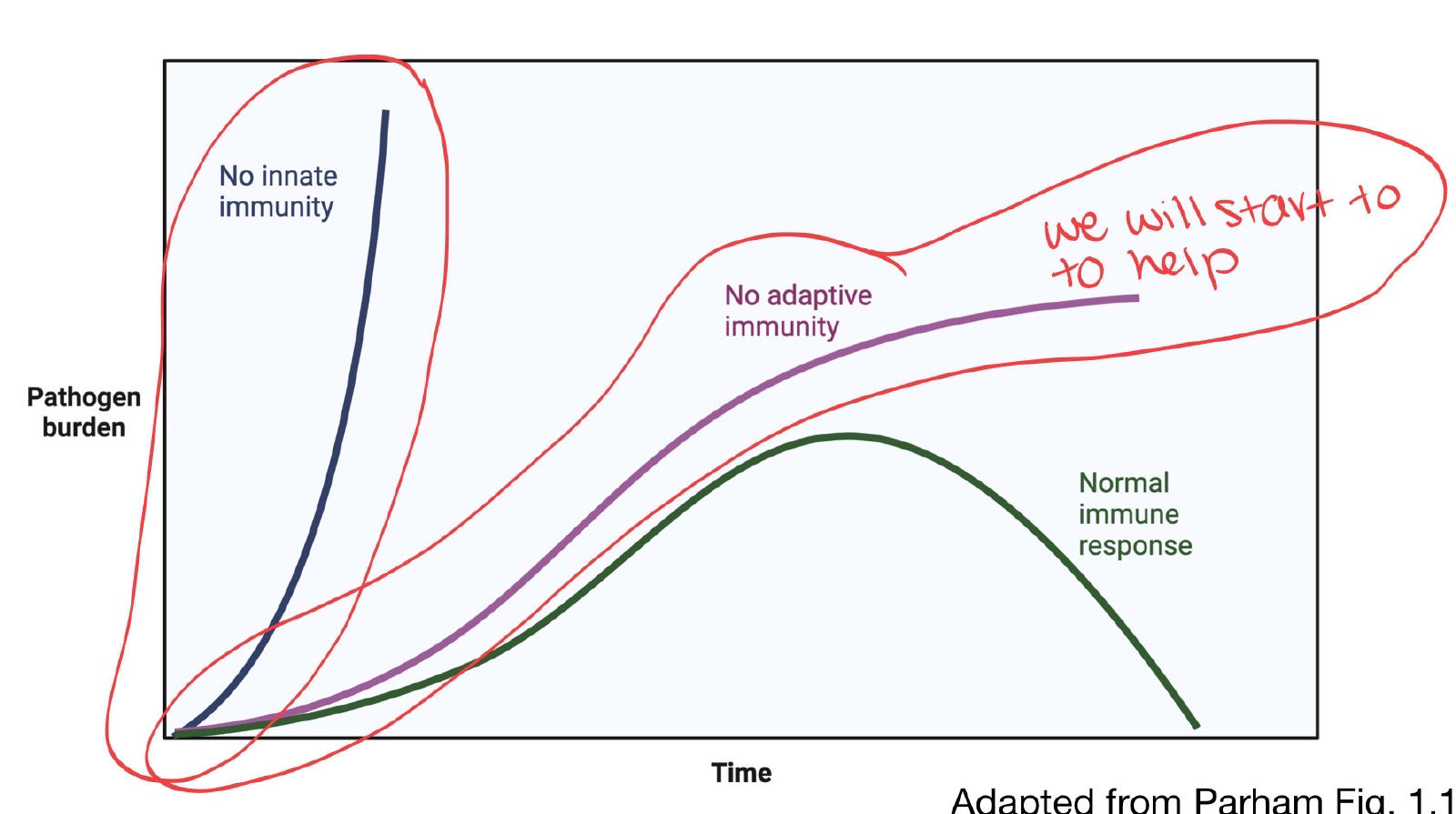
9
What are the two major classifications of immunodeficiency?
Primary and secondary.
10
What is primary immunodeficiency?
An inherited genetic defect affecting immune system development or function.
11
What is secondary immunodeficiency?
An acquired defect in immune function caused by disease or environmental factors.
12
Which type of immunodeficiency is more common?
Secondary immunodeficiency.
13
When do primary immunodeficiencies typically become apparent?
Early in life, often after maternal antibodies decline.
14
Can primary immunodeficiencies affect both innate and adaptive immunity?
Yes; defects can involve individual components or entire immune branches.
15
What are examples of primary immunodeficiencies affecting individual immune components?
Barrier defects, C3 deficiency, and IgA deficiency.
16
What types of immune cells can be affected by primary immunodeficiencies?
Neutrophils, B cells, T cells, or both B and T cells.
17
What is leukocyte adhesion deficiency (LAD)?
A genetic defect that prevents leukocytes from properly adhering to and migrating through blood vessel walls.
18
How does LAD affect neutrophil recruitment?
Neutrophils cannot properly leave the bloodstream to reach infected tissues.
19
What types of infections would be expected in an animal with LAD?
Recurrent bacterial infections due to impaired neutrophil recruitment.
20
What CBC finding might occur in an animal with LAD?
Marked neutrophilia because neutrophils remain in circulation.
21
What is severe combined immunodeficiency (SCID)?
A genetic disorder causing defective function of both B-cell and T-cell immunity.
22
Which animal species have documented SCID?
Humans, dogs, pigs, horses, and mice.
23
Why can SCID cause defective antibody responses?
B cells may develop abnormally or lack functional helper T-cell support.
24
What genetic defects can cause SCID?
Mutations affecting DNA-dependent protein kinase or recombination-activating genes.
25
Why can defective V(D)J recombination cause SCID?
B and T cells cannot properly generate functional antigen receptors.
26
At what age do clinical signs of SCID commonly appear?
Around 2–3 months, when maternal antibodies decline.
27
What CBC abnormality is commonly associated with SCID? What happens to lymphoid tissues in animals with SCID?
1. Persistent lymphopenia.
2. They may be poorly developed or undergo atrophy.
2. They may be poorly developed or undergo atrophy.
28
What histologic findings may suggest SCID?
Markedly decreased lymphocytes in lymph nodes and thymus.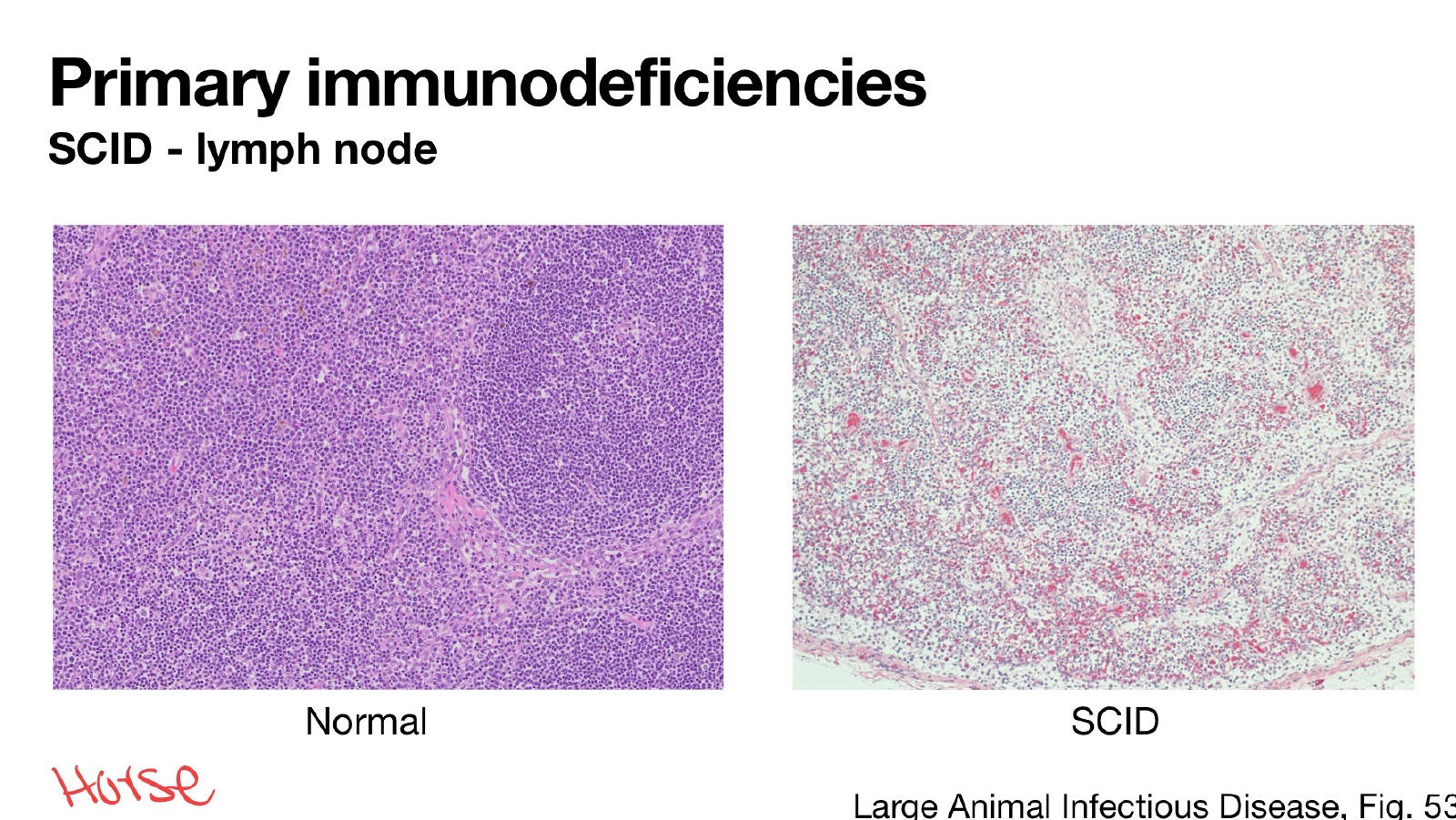
29
Can secondary immunodeficiency be temporary?
Yes; it may be transient or permanent (not germline encoded)
30
What infectious diseases can cause secondary immunodeficiency?
- FIV, FeLV, canine parvovirus, feline panleukopenia, and canine distemper.
- failure of passive transfer
- failure of passive transfer
31
What noninfectious conditions can cause secondary immunodeficiency? (professor said vv broad)
Malnutrition, stress, aging, toxins, and endocrine disease.
32
Which cats are commonly affected by FIV? Which immune cells are primarily targeted by FIV?
- Adult outdoor cats, especially those involved in fighting.
- CD4+ T cells.
- CD4+ T cells.
33
Why can FIV remain subclinical for long periods?
The virus integrates into the cat's genome and can remain latent.
34
How can chronic FIV infection increase cancer risk?
Defective NK-cell proliferation and function can reduce tumor surveillance.
35
What can happen during end-stage FIV infection?
Severe T-cell loss causes profound immunodeficiency.
36
Which 4 cells are preferentially infected by canine parvovirus and feline panleukopenia virus?
1. Rapidly dividing cells in intestinal crypts
2. Lymphoid tissues
3. Bone marrow
4. Thymus.
2. Lymphoid tissues
3. Bone marrow
4. Thymus.
37
What leukocyte abnormalities can occur with parvovirus or panleukopenia infection?
Severe lymphopenia and neutropenia.
38
Why are puppies with parvovirus susceptible to secondary bacterial infections?
Intestinal barrier damage and leukocyte depletion impair bacterial defense.
39
What is failure of passive transfer (FPT)?
Inadequate acquisition of maternal antibodies by a newborn.
40
Which domestic species receive essentially no maternal immunoglobulins across the placenta?
Horses, ruminants, and pigs.
41
Approximately how much maternal immunoglobulin transfer occurs before birth in dogs and cats?
About 10%.
42
What is colostrum?
The first milk after birth, rich in maternal antibodies such as IgG and IgA.
43
Why is colostrum especially important for newborn foals and calves?
They receive essentially no antibodies through the placenta and depend on colostrum for passive immunity.
44
What are two possible causes of failure of passive transfer?
Inadequate colostrum intake or poor intestinal absorption.
45
What can be measured to evaluate failure of passive transfer?
Neonatal serum IgG concentration and colostrum
46
What is a major consequence of failure of passive transfer?
Increased susceptibility to severe infections and septicemia.
47
How do maternal antibodies change as a young animal ages?
Maternal antibody concentrations decrease while the animal's own antibody production increases.
48
Why is there a vulnerable period as maternal antibodies decline?
Maternal protection may fall before the animal produces enough antibodies independently.
49
A 3-month-old Dachshund has recurrent bacterial infections due to an inherited neutrophil defect. What type of immunodeficiency is present?
Primary immunodeficiency.
50
Would a puppy with an isolated neutrophil deficiency necessarily be equally susceptible to viral infections?
No; neutrophils are especially important for bacterial defense.
51
A calf develops severe Mannheimia haemolytica pneumonia after BVDV infection. What type of immunodeficiency contributed?
Secondary immunodeficiency caused by viral damage to immune cells.
52
Why can BVDV infection predispose cattle to severe bacterial pneumonia?
BVDV impairs immune cell function, reducing the animal's ability to control secondary bacterial infections.
Plus de flashcards : Médecine et santé
Medical and Veterinary AbbreviationsMédecine et santé · AnglaiskayY8 Biology Combined TopicsMédecine et santé · Anglaissheep87654Cranial NervesMédecine et santé · AnglaisEshaMyocardial InfarctionMédecine et santé · AnglaisAvery5- sys. génital masculinMédecine et santé · FrançaisOcéanela composition du sang Médecine et santé · FrançaisClaraInsulinsMédecine et santé · AnglaisLukeTuberculosis (TB)Médecine et santé · AnglaisKatlynKEMedical Mnemonics: DepressionMédecine et santé · AnglaisEricThorax Study GuideMédecine et santé · AnglaisKrisMedCardsKidney Anatomy and FunctionMédecine et santé · AnglaisTaylorPediatric Infectious DiseasesMédecine et santé · AnglaisAvery
Tous les decks : Médecine et santé
Révise ces decks dans l’app
Gratuit sur iPhone, Android, Mac et le web. Ajoute n’importe quel deck à ton compte en un tap.

