Nervous System Anatomy and Physiology
Réviser ces flashcardsGratuit · répétition espacée · iPhone, Android, Mac et web
Toutes les cartes
1
there are pairs of cranial nerves and pairs of spinal nerves
there are 12 pairs of cranial nerves and 31 pairs of spinal nerves
2
neurons that have a single axon and a single dendrite are:
bipolar.
3
the motor (efferent) division of the peripheral nervous system....
transmits impulses from the CNS to skeletal muscle
4
the central nervous system includes the
brain and spinal cord
5
what glial cell must be bypassed to target neurons deep within the brain?
astrocyte
6
saltatory conduction of an action potential means that
an action potential is conducted from one node of ranvier to the next
7
a lesion in the cerebellum could lead to:
disturbed fine motor control, tremors when reaching for objects, normal tension in skeletal muscle
8
injury to the thalamus would
affect sensory projection to the cerebral cortex
9
what is the site for processing information?
the central nervous system
10
the sensory (afferent) division of the peripheral nervous system:
conveys action potentials to the CNS
11
what supportive cells in the CNS produce CSF that backs up the subarachnoid space?
ependymal cells
12
what is the input part of the neuron?
dendrites
13
the thickest meninge is the:
dura mater
14
the cerebral aqueduct connects the
third and fourth ventricle
15
an eating disorder with intense thirst and varying body temperatures would indicate disfunction of the:
hypothalamus
16
the junction of a neuron with another cell is a
synapse
17
how many cervical spinal nerves do we have?
8
18
where does the spinal cord begin?
foramen magnum
19
what protects neurons from toxic subtances in blood?
blood brain barrier
20
what structure has distal portion that runs to form presynaptic terminal?
axon
21
what surrounds individual axons and their schwann cells?
endoneurium
22
in the cross sectional view of a spinal cord, where is the grey matter and white matter?
grey matter on inside
white matter on outside
white matter on outside
23
during a spinal tap, CSF is obtained from what location?
subarachnoid space
24
what space is found between the vertebral wall and the dura matter that is used for injecting anesthesia during childbirth?
epidural space
25
where does the spinal cord end?
$L_1 & L_2\$
26
which area is being damaged in a patient presents with hesitant and disoriented speech?
broca's area
27
amputees feel pain in amputated limbs, what it called?
phantom pain/phantom limb
28
what is the middle, thin, spider like meninge?
arachnoid mater
29
what is the purpose of the cerebral gyri?
increase surface area of cortex
30
what is the part of the brain that connects the medulla to the midbrain?
pons
31
from which area are neurotransmitters released?
presynaptic terminal
32
what brain area serves as the major control center for the autonomic nervous system?
hypothalamus
33
if 5 action potentials arrive at the synapse at the same time, what would this result in?
temporal summation
34
what is a hyperpolarized post synaptic membrane known as?
IPSP
35
what is the neuron within the CNS that carries action potential to another
inter neuron / association neuron
36
patients are diagnosed with hydrocephaly, what is done if left untreated?
pressure on brain
37
what happens as Na+ ions enter the plasma membrane?
depolarization or the cell becomes more positive
38
during what perior is the cell NOT sensitive to further stimulation?
absolute refractory period
39
what type of neuroglial cell provides support to the PNS?
satellite cells
40
what is the function of acetylcholinesterase?
breaking down acetylcholine in the synaptic cleft
41
what happens if there is rapid destruction of neurotransmitters in the synaptic cleft?
no action potential
42
what is white matter composed of?
myelinated axons
43
patient has been hospitalized with flu that increases membrane permeability to ______, what state are the cells in?
hyperpolarized
44
what is the site for processing information
central nervous system
45
CSF is formed by what tissue and where?
ependymal cells, choroid plexus, in ventricles
46
what is the large C shaped white matter that connects the hemispheres?
corpus callosum
47
what are the lobes of the cerebrum?
fronta, occipital, temporal, insula, parietal
48
what do we call gray matter on the outer surface of the cerebrum?
cerebral cortex
49
what is the order of brainstem to spinal cord?
midbrain
pons
medulla oblongata
pons
medulla oblongata
50
what do we call the stalk that connects the hypothalamus to the pituitary gland?
infundibulum
51
the white matter of the cerebellum forms what branching network?
arbor vitae
52
what is the function of the cerebellum?
coordination
53
a lesion in what part of the brain would lead to increased heart rate & elevated blood pressure?
medulla oblongata
54
what portion of brainstem is continuous to the spinal cord?
medulla oblongata
55
what would happen if there is damage to the brain stem?
death, it's fatal
56
what is the blood temperature thermostat?
hypothalamus
57
when two presynaptic join to meet one postsynaptic terminal, what kind of pathway is formed?
convergent pathway
58
multiple EPSPs and IPSPs to one single postsynaptic terminal. what determines if there is an action potential or not?
the number of IPSPs and EPSPs
59
novacain decreases sodium permeability in sensory neurons. what will this do?
block sensory input to the CNS
60
IPSPs result from what?
influx of chloride (Cl-)
outflow of potassium(K+) ions
outflow of potassium(K+) ions
61
what happens in an EPSP?
local depolarization
62
what ion is needed for neurotransmitter release?
calcium (Ca2+)
63
what does the absolute refractory period assure?
that repolarization is complete
64
a stimulus either does an action potential or doesn't. what is this called?
all or none principle
65
in order to have an action potential what should occur?
threshold is reached
66
multiple sclerosis is a condition where myelin sheaths in the CNS are destroyed, what neuroglial cells are damaged?
oligodendrocytes
67
what are gaps in the myelin sheaths?
nodes of ranvier
68
what division of the CNS transmits signals from the CNS to skeletal muscle?
somatic (efferent) division
69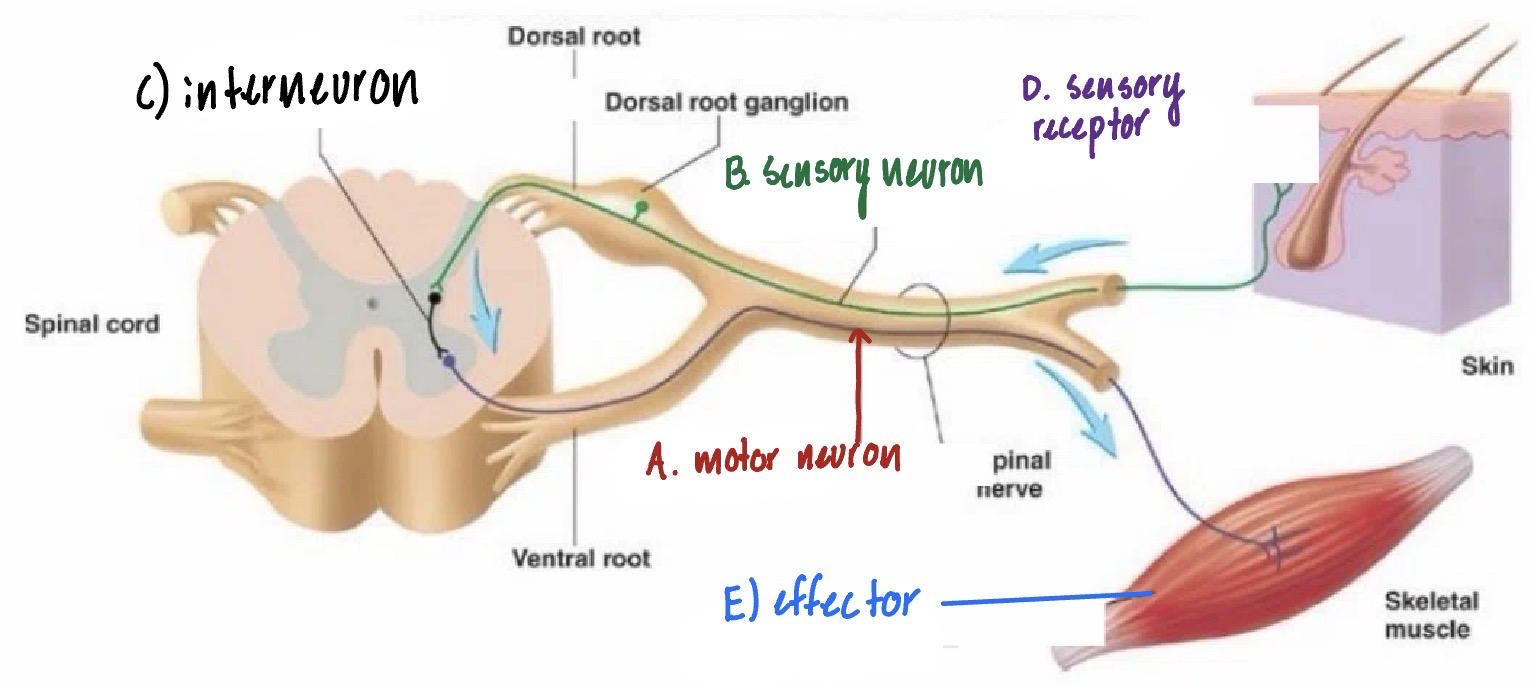
Occultation d’image : retrouve les étiquettes masquées
70
Occultation d’image : retrouve les étiquettes masquées
71
Occultation d’image : retrouve les étiquettes masquées
72
Occultation d’image : retrouve les étiquettes masquées
73
Occultation d’image : retrouve les étiquettes masquées
Plus de flashcards : Médecine et santé
Neurobiology UMBMédecine et santé · AnglaisCPharmacology C7Médecine et santé · AnglaisImadSeizure PharmacologyMédecine et santé · AnglaisCoryingredients Médecine et santé · Anglaisashlumbar kahootMédecine et santé · AnglaisAlexandratroubles de la personnalité les soinsMédecine et santé · FrançaisClaraSalmonellosisMédecine et santé · AnglaiscaeChoroby neurodegeneracyjne cz.1 WSTĘPMédecine et santé · PolonaisczyzowCardiology and Peripheral Artery DiseaseMédecine et santé · AnglaiscathsimsBio 201 practical 2Médecine et santé · AnglaisyourSkeletal SystemMédecine et santé · AnglaisEmelyRespiratory System (Chapter 22)Médecine et santé · Anglaiscae
Tous les decks : Médecine et santé
Révise ces decks dans l’app
Gratuit sur iPhone, Android, Mac et le web. Ajoute n’importe quel deck à ton compte en un tap.

