PNP 1 Management Exam #2
Study these flashcardsFree · spaced repetition · iPhone, Android, Mac & web
First 300 of 476 cards
1
Newborn Period Age
First 28 days of extrauterine life
2
Healthy People 2020 Objectives for the Newborn Period
-Improve maternal health and pregnancy outcomes
-Reduce disability rates in infants
-Improve the health and well-being of women, newborns and families in the U.S.
-Reduce disability rates in infants
-Improve the health and well-being of women, newborns and families in the U.S.
3
Focus of Public Health for Pregnant Women and Newborns
-Reducing health of pregnant women
-Reducing birth defect rates
-Decreasing newborn deaths
-Addressing maternal and newborn death risk factors
-Increasing breastfeeding rates
-Obtain recommended universal screening panel (RUSP) for state mandated diseases
-Reducing the proportion of children with a metabolic disorder who experience developemental delay
-Increase the percentage of healthy full-term newborns who are placed to sleep on back
-Reducing birth defect rates
-Decreasing newborn deaths
-Addressing maternal and newborn death risk factors
-Increasing breastfeeding rates
-Obtain recommended universal screening panel (RUSP) for state mandated diseases
-Reducing the proportion of children with a metabolic disorder who experience developemental delay
-Increase the percentage of healthy full-term newborns who are placed to sleep on back
4
Preventative Services for Newborns
-Prenatal screening for Rh(D) incompatibility, HIV, Hep B, Syphilis, Chlamydia, and Gonorrhea
-Promote breastfeeding
-Screening neonates for sickle hemoglobinopathies to identify newborns who may benefit from antibiotic prophylaxis to prevent sepsis
-Screening for congenital hypothyroidism for all newbowns within the first 4 days of life
-Screeening for phenylketonuria (PKU) for all newborns before discharge from the nursery. Newborns who are tested before they are 24 hours old should receive a repeat screening test by 2 weeks old
-Topical ocular prophylaxis of all newborns to prevent ophthalmia neonatorum
-Screening for developmental hip dysplasia
-Promote breastfeeding
-Screening neonates for sickle hemoglobinopathies to identify newborns who may benefit from antibiotic prophylaxis to prevent sepsis
-Screening for congenital hypothyroidism for all newbowns within the first 4 days of life
-Screeening for phenylketonuria (PKU) for all newborns before discharge from the nursery. Newborns who are tested before they are 24 hours old should receive a repeat screening test by 2 weeks old
-Topical ocular prophylaxis of all newborns to prevent ophthalmia neonatorum
-Screening for developmental hip dysplasia
5
Function of the Placenta
-Provides metabolic functions for the fetus
-Oxygenated blood from the placenta arrives to the fetus through the umbilical vein
-Oxygenated blood from the placenta arrives to the fetus through the umbilical vein
6
Heart Function in Utero
-High fetal pulmonary vascular pressure
-Blood is shunted from the right to the left side of the fetus' heart through the foramen ovale
-Or to the systemic ciculation through the ductus arteriosus
-Blood is shunted from the right to the left side of the fetus' heart through the foramen ovale
-Or to the systemic ciculation through the ductus arteriosus
7
Physiologic Changes at Birth
-Once the cord is clamped, the newborn simultaneously begins to breathe and the high pulmonary vascular pressure drops
-Allows blood to flow to the lungs for oxygenation
-Foramen ovale and ductus arterious are no longer needed and close
-GI tract begins to absorb nutrients and excreting waste
-Renal system excreates waste and mantains a chemical balance
-Liver metabolizes and excretes toxins
-Immune system begins protecting against pathogens
-Allows blood to flow to the lungs for oxygenation
-Foramen ovale and ductus arterious are no longer needed and close
-GI tract begins to absorb nutrients and excreting waste
-Renal system excreates waste and mantains a chemical balance
-Liver metabolizes and excretes toxins
-Immune system begins protecting against pathogens
8
First Period of Reactivity
Sympathetic system changes:
-Tachycardia
-Rapid respirations
-Transient rales
-Grunting
-Flaring and retractions
-Falling body temperature
-Hypertonus
-Alertness
Paraympathetic system changes:
-Initiation of bowel sounds
-Production of oral mucus
-Tachycardia
-Rapid respirations
-Transient rales
-Grunting
-Flaring and retractions
-Falling body temperature
-Hypertonus
-Alertness
Paraympathetic system changes:
-Initiation of bowel sounds
-Production of oral mucus
9
Second Period of Reactivity
-Begins after an interval of sleep
-Oral mucus production
-Heart rate becomes more labile
-Newborn becomes more responsive to endogenous and exogenous stimuli
-Meconium is passed
-Oral mucus production
-Heart rate becomes more labile
-Newborn becomes more responsive to endogenous and exogenous stimuli
-Meconium is passed
10
Assessment of the Neonate: History
-Past maternal history
-Past obstertic history:
Number of previous pregnancies (number of born alive and stillborn)
Number of elective or spontaneous abortions
Number of preterm and term deliveries
C-section and indications for them
Health status of living children (if deceased, age and cause of death)
-Family history
-3 generation pedigree: focus on genetic conditions, congential defects/diseases, intellectual disability, or other diseases/conditions (HTN, hyperlipidemia, heart disease or familial cancers)
Age and health status of living relatives
Causes of death of family members
-Past obstertic history:
Number of previous pregnancies (number of born alive and stillborn)
Number of elective or spontaneous abortions
Number of preterm and term deliveries
C-section and indications for them
Health status of living children (if deceased, age and cause of death)
-Family history
-3 generation pedigree: focus on genetic conditions, congential defects/diseases, intellectual disability, or other diseases/conditions (HTN, hyperlipidemia, heart disease or familial cancers)
Age and health status of living relatives
Causes of death of family members
11
Assessment of the Neonate: History Continued
-Obstertric history
Current maternal health, including depression or other mental health conditions
Maternal age
Prenatal care (duration of)
Medications used during preganancy (prescrioption, OTC, and natural health products)
Use of preganancy-enhancing drugs or technology
Infections (group B strep) and illnesses during pregnancy
Alcohol, tobacco, and other drugs used during preganancy
Environmental exposures to heavy metals (mercury or lead) or bacteria (Listeria)
HTN or glucose intolerance
Duration of labor, duration of ruptured membranes, analgesia, anesthesia, presentation and route of delivery, use of forceps or vaccum assit
Polyhyramnios (exessive fluid) or oligohydramnios (reduced fluid)
Stained meconium or foul-smelling amniotic fluid
Fever
Current maternal health, including depression or other mental health conditions
Maternal age
Prenatal care (duration of)
Medications used during preganancy (prescrioption, OTC, and natural health products)
Use of preganancy-enhancing drugs or technology
Infections (group B strep) and illnesses during pregnancy
Alcohol, tobacco, and other drugs used during preganancy
Environmental exposures to heavy metals (mercury or lead) or bacteria (Listeria)
HTN or glucose intolerance
Duration of labor, duration of ruptured membranes, analgesia, anesthesia, presentation and route of delivery, use of forceps or vaccum assit
Polyhyramnios (exessive fluid) or oligohydramnios (reduced fluid)
Stained meconium or foul-smelling amniotic fluid
Fever
12
Assessment of the Neonate: History Continued
-Social history
Emotional stressors during preganancy (homelessness or partner abuse)
Unplanned or unwanted pregnancy
Financial and emotional support
Dietary restrictions (vegan)
Educational background of parents
Partner's anticipated involvement in childrearing
Ages of other children in the home
Emotional stressors during preganancy (homelessness or partner abuse)
Unplanned or unwanted pregnancy
Financial and emotional support
Dietary restrictions (vegan)
Educational background of parents
Partner's anticipated involvement in childrearing
Ages of other children in the home
13
Perinatal History
**Important**
-Maternal age, gravida, para
-Maternal Blood group & Rh factor
-Historic duration of pregnancy (# weeks) (make sure it matches up)
-Prenatal conditions/complications
-Intrapartal Complications
-Medications used during labor (mag=sleepy baby)
-Maternal age, gravida, para
-Maternal Blood group & Rh factor
-Historic duration of pregnancy (# weeks) (make sure it matches up)
-Prenatal conditions/complications
-Intrapartal Complications
-Medications used during labor (mag=sleepy baby)
14
Perinatal History
-Delivery anesthesia
-Delivery date & time
-Type of delivery & rationale
-Hours of ROM before delivery (prolonged = spesis risk)
-Length of Labor (>24hr & <6 hrs-fetal stress because lungs aren't being squeezed out)
-GBS status
-Birth weight
-APGAR score
-Delivery date & time
-Type of delivery & rationale
-Hours of ROM before delivery (prolonged = spesis risk)
-Length of Labor (>24hr & <6 hrs-fetal stress because lungs aren't being squeezed out)
-GBS status
-Birth weight
-APGAR score
15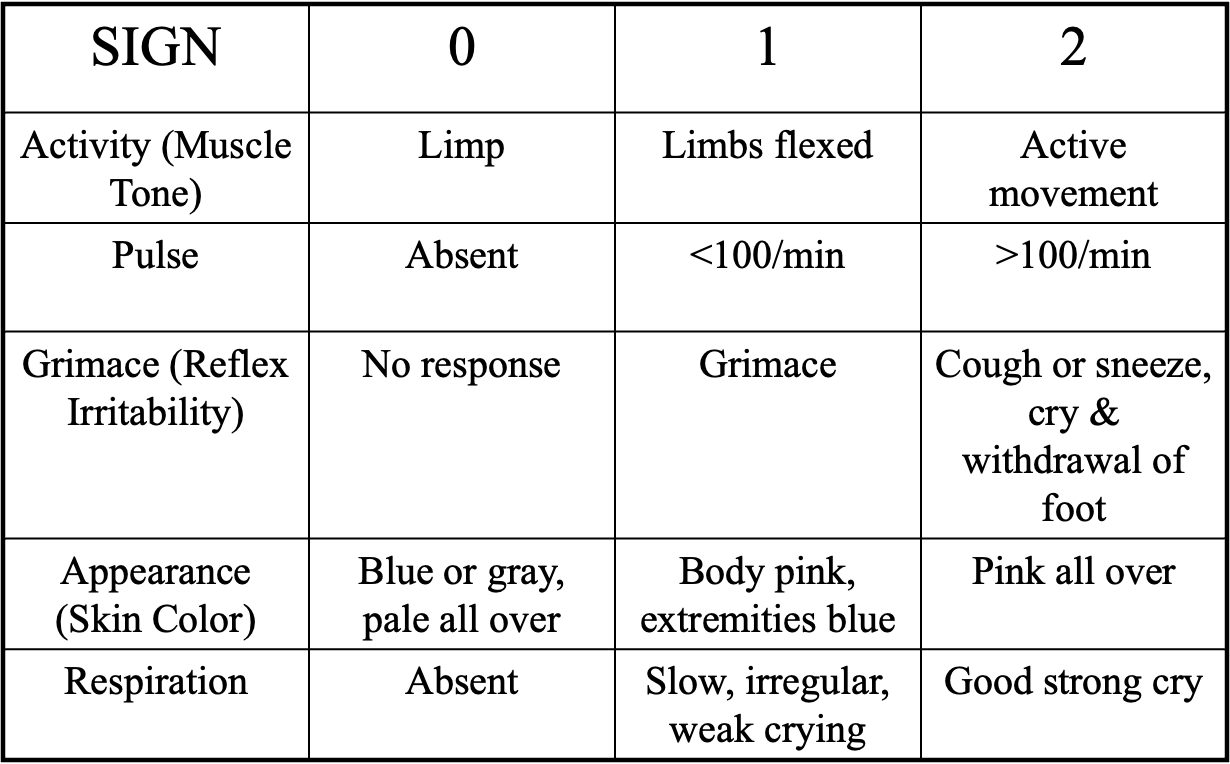
APGAR Score
16
APGAR Score TImining
-1 minute
-5 minutes
-5 minutes
17
APGAR Score 8 to 10
-Healthy infant
-Vigorous, pink and crying
-Requires only warming, drying and gental stimulation
-Occasionally requires oxygen for a short period
-Vigorous, pink and crying
-Requires only warming, drying and gental stimulation
-Occasionally requires oxygen for a short period
18
APGAR Score 5 to 7
-Moderately depressed infant
-NICU
-Cyanotic
-Slow, irregular respirations
-Good muscle tone and reflexes
-NICU
-Cyanotic
-Slow, irregular respirations
-Good muscle tone and reflexes
19
APGAR Score 4 or Less
-Severely depressed infant
-NICU
-Limp, pale or blue
-Apneic, slow heart rate
-Maximal resucitative efforts with bag and mask, chest compressions, IV volume expansion and drug therapy
-NICU
-Limp, pale or blue
-Apneic, slow heart rate
-Maximal resucitative efforts with bag and mask, chest compressions, IV volume expansion and drug therapy
20
APGAR Indications
-5-minute APGAR score is an indication of how well the resuscitation efforts have succeeded
-Caution must be used when using APGAR score to predict long-term mortality and developmental outcomes
-Useful in determinging long-term health outcomes only when combined with other factors such as:
Fetal status
Umbilical cord or scalp blood pH
Evidence of organ injury
Seizures
-Caution must be used when using APGAR score to predict long-term mortality and developmental outcomes
-Useful in determinging long-term health outcomes only when combined with other factors such as:
Fetal status
Umbilical cord or scalp blood pH
Evidence of organ injury
Seizures
21
Gestational Age Assessment
-Term (39-42 weeks)
-Pre-term (<39weeks)
-Post-term (>42weeks)
-Pre-term (<39weeks)
-Post-term (>42weeks)
22
When is the Maturational Assessment Done?
-Within 2 hours
-Based on physical exam to confirm maternal estimated dates
-Based on physical exam to confirm maternal estimated dates
23
Appropriate for Gestational Age (AGA)
10th to 90th percentiles
24
Small for Gestational Age
-<10 percentile
-Head may be microcephalic
-Head circumference: <5th percentile
-Head circumference is the first to usually show catch up growth followed by weight and then length
-Head may be microcephalic
-Head circumference: <5th percentile
-Head circumference is the first to usually show catch up growth followed by weight and then length
25
Symmetric Growth Restrictions
Due to intrinsic fetal conditions:
-Chromosomal abnormalities
-Chromosomal abnormalities
26
Asymmetric Growth Restrictions
-Due to impaired placental perfussion
-Nutrient deprivation during fetal development
-Nutrient deprivation during fetal development
27
Intrauterine Growth Restriction (IUGR)
-Restricted fetal weight, length or head circumference due to pathophysiologic process in utero
-Not necessarily SGA because IUGR infant may be below expected weight but not below 10th percentile for age
-Not necessarily SGA because IUGR infant may be below expected weight but not below 10th percentile for age
28
Maternal Risk Factors for IUGR
-HTN
-DM (poorly controlled)
-Autoimmune disease
-Cardiac or respiratory disease
-Maternal infection
-DM (poorly controlled)
-Autoimmune disease
-Cardiac or respiratory disease
-Maternal infection
29
Placental Risk Factors for IUGR
-Abnormal cord insertion or cord abnormalities
-Abnormal placentation
-Placental abruption
-Abnormal placentation
-Placental abruption
30
Fetal Risk Factors for IUGR
-Multiple gestations
-Chromosomal abnormalities
-Fetal infection
-Chromosomal abnormalities
-Fetal infection
31
Large for Gestational Age (LGA)
->90th percentile
-May be a result from fetal factors (genetic or chromosomal) or maternal factors (obesity or DM)
-May be a result from fetal factors (genetic or chromosomal) or maternal factors (obesity or DM)
32
Risk of LGA Newborns
-Birth trauma
-Neonatal asphyxia
-Hypoglycemia
-Polycythemia
-Hyperbiliruminemia
-Neonatal asphyxia
-Hypoglycemia
-Polycythemia
-Hyperbiliruminemia
33
Low Birth Weight (LBW)
Weight below 2500g
34
Very Low Birth Weight (VLBW)
Weight below 1500g
35
Extremely Low Birth Weight (ELBW)
Weight below 1000g
36
Low Birth Weight (LBW) and Very Low Birth Weight (VLBW) Maternal Risk Factors
-Maternal age less than 16 or greater than 35 years of age
-Race and ethnicity
-Materanl chronic health conditions
-Maternal medications
-Nutritional status
-Environmental toxins or occupational chemical toxins
-Access to prenatal care
-Race and ethnicity
-Materanl chronic health conditions
-Maternal medications
-Nutritional status
-Environmental toxins or occupational chemical toxins
-Access to prenatal care
37
Low Birth Weight (LBW) and Very Low Birth Weight (VLBW) Maternal Substance Abuse
-Alcoholism
-Tobacco use
-Illicit drug use
-OTC drug use
-Tobacco use
-Illicit drug use
-OTC drug use
38
Assessment of Growth Parameters
-Measurements normally include: weight, length, and occipitofrontal head circumference (OFC)
-Abdominal and chest circumference is not typically included unless there is clinical concern
-Abdominal and chest circumference is not typically included unless there is clinical concern
39
Length Measurement
Measured as heel to crown with infant lying on a flat surface
40
Head Circumference Measurement
-Measured with tape just above the brow line to the occipital prominence
-Transient head molding or overlapping of the cranial bones may impact this measurement
-Transient head molding or overlapping of the cranial bones may impact this measurement
41
Weight Measurement
-Obtained using a standardized scale
-Unclothed or standadized measurement of diaper
-Newborns can lose 10% of their birth weight in the first 72 hours due to contraction of the extracellular space
-Unclothed or standadized measurement of diaper
-Newborns can lose 10% of their birth weight in the first 72 hours due to contraction of the extracellular space
42
When do you use the WHO Growth Record
Infants and up to 2 years of age
43
Normal OFC Measurement
-32-38 cm
-Head approaches half the total body length
-Head approaches half the total body length
44
Normal Length Measurement
44-55 cm
45
Normal Weight Measurement
2500-3900 g
46
Normal Chest Circumference Measurement
-30-36 cm
-1-3 cm less than OFC
-1-3 cm less than OFC
47
Normal Abdominal Circumference Measurement
-32 to 36 weeks gestation = to OFC
-After 36 weeks gestation, >OFC
-After 36 weeks gestation, >OFC
48
Temperature Considerations for the Newborn
-Heat loss of a newborn is 4x of an adult
-Avoid cool drafty environments
-Towel dry the newborn after brith to prevent evaporative heat loss and place skin to skin with mother is newborn is stable
-Use a radiant warmer and wrap in warm blanket and cover the head to reduce heat loss
-Avoid cool drafty environments
-Towel dry the newborn after brith to prevent evaporative heat loss and place skin to skin with mother is newborn is stable
-Use a radiant warmer and wrap in warm blanket and cover the head to reduce heat loss
49
Lungs Physical Examination
-Squeezing action on the chest during a vaginal delivery assists in the expulsion of amniotic fluid from the lungs
-Further expulsion of amnuotic fluid from the lungs happens during the first few deep breaths
-C-section does not give the squeezing action, so increased respiratory effort and adequate bulb suction is necessary
-Bronchovesicular aor bronchial breath sounds are normal at birth
-Fine crackles are also normal during the first few hours of life
-Further expulsion of amnuotic fluid from the lungs happens during the first few deep breaths
-C-section does not give the squeezing action, so increased respiratory effort and adequate bulb suction is necessary
-Bronchovesicular aor bronchial breath sounds are normal at birth
-Fine crackles are also normal during the first few hours of life
50
How Many Veins and Arteries are in the Umbilical Cord
-2 arteries
-1 vein
-1 vein
51
Single Umbilical Artery (SUA)
Associated with congenital anomalies (cardiac and renal)
52
Delayed Cord Clamping
-30 to 60 seconds following birth
-Improved iron stores to prevent anemia
-In preterm newborns: decreased the risk of intracerebral hemorrhage and necrotizing enterocolitis
-Decreased blood cord volume available for banking if families are interested in this
-Improved iron stores to prevent anemia
-In preterm newborns: decreased the risk of intracerebral hemorrhage and necrotizing enterocolitis
-Decreased blood cord volume available for banking if families are interested in this
53
Physical Examination Techniques
-Well-lit room
-Done while the infant is calm
-Ensure you have warm hands and equipment
-Weighed on appropriate calibrated scale
-Length is on a firm surface
-Percussion and transillumination can be used to assess certain organs (percussion for liver) (transillumination for hydrocele)
-Done while the infant is calm
-Ensure you have warm hands and equipment
-Weighed on appropriate calibrated scale
-Length is on a firm surface
-Percussion and transillumination can be used to assess certain organs (percussion for liver) (transillumination for hydrocele)
54
Assessment Order for the Newborn
-Inspection
-Auscultation
-Palpation
-Auscultation
-Palpation
55
Approach to Physical Examination in the Newborn
-Begin the exam in the least disruptive manner
-Should be done in a systemic approach to ensure no areas are missed
-Should be done in a systemic approach to ensure no areas are missed
56
Assessment by Observation
-Overall size, shape, & symmetry
-Activity State:
Quiet sleep
Active sleep
Drowsy
Alert
Fussy
Crying
-Posture, tone
-Skin color, signs of trauma
-Activity State:
Quiet sleep
Active sleep
Drowsy
Alert
Fussy
Crying
-Posture, tone
-Skin color, signs of trauma
57
Assessment by Observation Continued
-Respiratory effort (the more signs the more concerning)
Grunting
Nasal flaring
Retractions
Respiratory Rate
-Jitteriness (some small jitters are normal)
No abnormal gaze or eye movements
Stimulus sensitive
Predominant motion is tremor-not clonic jerking
Grunting
Nasal flaring
Retractions
Respiratory Rate
-Jitteriness (some small jitters are normal)
No abnormal gaze or eye movements
Stimulus sensitive
Predominant motion is tremor-not clonic jerking
58
Recommended Universal Screening Panel (RUSP)
-All states in the US require newborn screenings
-Screens for a variety of genetic, metabolic disorders and selected congenital abnormalities
-Done at 24 hours or before discharge
-If done before 24 hours, rescreening should be done by 14 days years old
-Screens for a variety of genetic, metabolic disorders and selected congenital abnormalities
-Done at 24 hours or before discharge
-If done before 24 hours, rescreening should be done by 14 days years old
59
Hearing Screening
-Recommended by 1 month old
-Newborns born at a low birth weight, rubella or other infections, malformation, trauma, asphyxia, prematurity, NICU stay, or antibiotics have a higher risk of hearing problems
-Otoacoustic emissions (OAE) or auditory brainstem response (ABS)
-Newborns born at a low birth weight, rubella or other infections, malformation, trauma, asphyxia, prematurity, NICU stay, or antibiotics have a higher risk of hearing problems
-Otoacoustic emissions (OAE) or auditory brainstem response (ABS)
60
Initial Care of the Newborn
-Antibiotic eye ointment: prophylaxis for ophthalmia neonatorum
-Vitamin K injection: prevention of classic and late onset hemorrhagic disease
-Vitamin K injection: prevention of classic and late onset hemorrhagic disease
61
Umbilical Cord Anticipatory Guidance
-Bright Futures guidelines recommend leaving the cord to air dry and placing the diaper below the cord until it separates.
-Alcohol is not recommended
-Cord separation can take up to 10 to 14 days, after which a slight bloody discharge may follow for another one to two days
-Babies should not be submerged for bath time until the cord falls off, until that time they should be sponge bathed
-Avoid bellybands or coins placed on the naval to prevent or decrease umbilical hernias due to the risk of infection
**If a foul-smelling discharge or rapidly expanding erythema is noticed around the umbilicus, parents should be educated to bring back the baby immediately to be evaluated for possible sepsis**
-Alcohol is not recommended
-Cord separation can take up to 10 to 14 days, after which a slight bloody discharge may follow for another one to two days
-Babies should not be submerged for bath time until the cord falls off, until that time they should be sponge bathed
-Avoid bellybands or coins placed on the naval to prevent or decrease umbilical hernias due to the risk of infection
**If a foul-smelling discharge or rapidly expanding erythema is noticed around the umbilicus, parents should be educated to bring back the baby immediately to be evaluated for possible sepsis**
62
Granuloma
-Scar tissue around the umbilical cord
-Silver nitrate treatment
-Silver nitrate treatment
63
Omphalitis
CONCERNING
-Infection of the umbilical cord
-Discharge and erythema
-Infection of the umbilical cord
-Discharge and erythema
64
Male Anticipatory Guidance
-No evidence for routine circumcision but that the benefits of the procedure outweigh the risks
-Decision is up to the parents
The skin normally adheres to the penis and cannot be retracted at birth but will gradually loosen as the baby grows
-Parents should be instructed never to force the foreskin back
-Decision is up to the parents
The skin normally adheres to the penis and cannot be retracted at birth but will gradually loosen as the baby grows
-Parents should be instructed never to force the foreskin back
65
Circumcision Care
-If the baby is circumcised, the penis should be cleaned every day with cotton balls dipped in tap water and then followed by the placement of a small amount of petroleum jelly to the tip of the penis.
-This should be done for the first two to three days after the circumcision to prevent the penis from sticking to the diaper.
-Some parents also prefer to rub a small amount of petroleum jelly onto the inside of the diaper, facing the penis, which is fine.
-Both methods accomplish the same purpose, which is to allow for healing without causing further injury from the diaper. In the past, providers recommended that the penis be cleaned with soap and water but that is no longer recommended.
-This should be done for the first two to three days after the circumcision to prevent the penis from sticking to the diaper.
-Some parents also prefer to rub a small amount of petroleum jelly onto the inside of the diaper, facing the penis, which is fine.
-Both methods accomplish the same purpose, which is to allow for healing without causing further injury from the diaper. In the past, providers recommended that the penis be cleaned with soap and water but that is no longer recommended.
66
Contraindications to Circumcision
-Epi- or hydrospadias
-Ambiguous genitalia
-Familial bleeding disorders
-Exstrophy of the bladder
-Illness
-Ambiguous genitalia
-Familial bleeding disorders
-Exstrophy of the bladder
-Illness
67
Bathing, Oils and Powder Anticipatory Guidance
-Do not require daily baths
-Use gentle cleansing agents
-Oils and lotions clog the skin pores and powders are a risk for lung inhalation.
-If moisturizers are needed for dry skin, brands that are highly recommended and appropriate for parents to use are Keri, Eucerin, Aveeno, and Cetaphil
-Use gentle cleansing agents
-Oils and lotions clog the skin pores and powders are a risk for lung inhalation.
-If moisturizers are needed for dry skin, brands that are highly recommended and appropriate for parents to use are Keri, Eucerin, Aveeno, and Cetaphil
68
Guidelines for 48-72 Hour Follow-Up
-Review delivery and discharge summary for any follow-up needs
-Assess the newborn's heneral health, weight, hydration, and jaundice
-Identify any new problems
-Review feedings, stoolin, urination and consider lactation consultation if needed
-Assess quality of bonding
-Reinforce maternal and family education
-Review outstanding lab data
-Perform or repeat neonatal screen or other tests (bilirubin) if indicated
-Develop plan for healthcare maintenance, including emergency care, preventative care, immunizations and periodic screenings
-Evaluate mother for postpartum depression
-Refer to WIC if appropriate
-Assess the newborn's heneral health, weight, hydration, and jaundice
-Identify any new problems
-Review feedings, stoolin, urination and consider lactation consultation if needed
-Assess quality of bonding
-Reinforce maternal and family education
-Review outstanding lab data
-Perform or repeat neonatal screen or other tests (bilirubin) if indicated
-Develop plan for healthcare maintenance, including emergency care, preventative care, immunizations and periodic screenings
-Evaluate mother for postpartum depression
-Refer to WIC if appropriate
69
Newborn Skin
-An immature infant's skin is thinner, friable and perable, and more easily disrupted
-Typically covered in vernix (cheesy-white odorless protective sebaceous secretion)
-Skin pigmentation varies with ethnic origin
-Typically covered in vernix (cheesy-white odorless protective sebaceous secretion)
-Skin pigmentation varies with ethnic origin
70
Most Reliable Color Indicator in the Newbown
Mucous membranes and tongue
71
Acrocyanosis
NORMAL
-Bluish coloration of extremities that is present up to 24 hours
-Related to increased peripheral vascular resistance & results in sluggish circulation to hands & feet
-Make baby warmer and rewrap baby
-Bluish coloration of extremities that is present up to 24 hours
-Related to increased peripheral vascular resistance & results in sluggish circulation to hands & feet
-Make baby warmer and rewrap baby
72
Central Cyanosis
CONCERNING
-Evident when less than 5g percent of desaturated hemoglobin is present
-Associated with etiologies such as cardiac or pulmonary disease, infection, metabolic and neurologic conditions, and hematologic issues (anemia or polycythemia)
-Evident when less than 5g percent of desaturated hemoglobin is present
-Associated with etiologies such as cardiac or pulmonary disease, infection, metabolic and neurologic conditions, and hematologic issues (anemia or polycythemia)
73
Pallor
-Pale or ashen appearance
-Due to poor perfusion, acidosis or anemia
-Due to poor perfusion, acidosis or anemia
74
Plethora
-Ruddy appearance
-May indicate polycythemia
-May indicate polycythemia
75
Cyanosis
-Can be misleading
-Evident when there is 3-5g of desaturated hemaglobin
-Present in polycythemic infants with normal oxygen whereas its presence wtih anemia requires substantial hypoxemia and low oxygen content in the blood
-Evident when there is 3-5g of desaturated hemaglobin
-Present in polycythemic infants with normal oxygen whereas its presence wtih anemia requires substantial hypoxemia and low oxygen content in the blood
76
Ecchymoses
-Bruises
-Evident over head and buttocks
-Usually associated to assistive devices such as forceps for delivery
-Evident over head and buttocks
-Usually associated to assistive devices such as forceps for delivery
77
Stawberry Mark (nevus vasculosus)
NORMAL
-Type of hemangioma
-75% occur in the head
-May appear 1-2 months after birth & grow
-Usually stops growing by 8 months
-Most disappear by 7 years
-Treatment only if very large, location subjective to repeated trauma & bleeding, or growth after 8 months
-Type of hemangioma
-75% occur in the head
-May appear 1-2 months after birth & grow
-Usually stops growing by 8 months
-Most disappear by 7 years
-Treatment only if very large, location subjective to repeated trauma & bleeding, or growth after 8 months
78
Cavernous Hemangioma
-With strawberry mark
-Increases in size from 6-12 months and then shrinks with age
-Current treatments include laser therapy, high-dose steroids, & radiation
-Send to dermatology because of risk of compression on airway
-Increases in size from 6-12 months and then shrinks with age
-Current treatments include laser therapy, high-dose steroids, & radiation
-Send to dermatology because of risk of compression on airway
79
Cutis Marmorate
NORMAL
-Lacy, red or blue vascular pattern appearing over most of the body surface
-Associated with low temperatures disappears when the newborn is warmed
-Persistence occurs with Downs and trisomy 18 syndromes
-Lacy, red or blue vascular pattern appearing over most of the body surface
-Associated with low temperatures disappears when the newborn is warmed
-Persistence occurs with Downs and trisomy 18 syndromes
80
Erythema Toxicum
NORMAL
-Papular rash with possible vesicles-white halo around each lesion
-Commonly on trunk & diaper area
-“Flea bites”
-Transient
-Appears around day 1
-Disappears around day 7-10
-Eosinophils in smear from papule confirms diagnosis
-Papular rash with possible vesicles-white halo around each lesion
-Commonly on trunk & diaper area
-“Flea bites”
-Transient
-Appears around day 1
-Disappears around day 7-10
-Eosinophils in smear from papule confirms diagnosis
81
Miliaria Rubra
NORMAL
-Clear, thin vesicles seen primarily over forehead, neck, or groin in the creases
-Result of obstructed sweat glands in humid environments
-Clear, thin vesicles seen primarily over forehead, neck, or groin in the creases
-Result of obstructed sweat glands in humid environments
82
Nevus Simplex or Nevus Flameus
NORMAL
-Stork Bite
-Flat localized reddened areas common on upper eyelid, back of neck, occiput
-Darker when crying
-Capillary dilation
**Disappears when blanched**
-Usually fades by end of first year
-Stork Bite
-Flat localized reddened areas common on upper eyelid, back of neck, occiput
-Darker when crying
-Capillary dilation
**Disappears when blanched**
-Usually fades by end of first year
83
Port Wine Stain
-Nevus Flammeus
-Newly formed capillaries
-Does not resolve spontaneously
**Does not blanch with pressure**
-High-Fluence Modified Pulsed Dye Laser Photocoagulation With Dynamic Cooling most effective current treatment
-Can be associated with Weber Syndrome (neuro and eye complications)
-Newly formed capillaries
-Does not resolve spontaneously
**Does not blanch with pressure**
-High-Fluence Modified Pulsed Dye Laser Photocoagulation With Dynamic Cooling most effective current treatment
-Can be associated with Weber Syndrome (neuro and eye complications)
84
Transient Neonatal Pustular Melanosis
NORMAL
-Vesicles that rupture easily leaving a halo of white scales
-Common sites: trunk, limbs, palms and soles
-Rarely lasts more than 2-3 days but can persist for 3 months
-Vesicles that rupture easily leaving a halo of white scales
-Common sites: trunk, limbs, palms and soles
-Rarely lasts more than 2-3 days but can persist for 3 months
85
Milia
NORMAL
-Firm, pearly, white papules
-Disappear within the first few weeks of life
-Educate parents on not popping due to scarring and infection
-Firm, pearly, white papules
-Disappear within the first few weeks of life
-Educate parents on not popping due to scarring and infection
86
Mongolian Spot
NORMAL
-Irregular bruise-like spots
-Usually over buttocks & sacrum but can be more generalized
-Prevalent among African American, Asian, & some Europeans
-Usually fades in early school years
-Important to distinguish from abuse!
-Irregular bruise-like spots
-Usually over buttocks & sacrum but can be more generalized
-Prevalent among African American, Asian, & some Europeans
-Usually fades in early school years
-Important to distinguish from abuse!
87
Harlequin Color Change
NORMAL
-Division of the body skin coloring from forehead to pubis into red and pale halves
-Occurs between days 2 to 5 but could be up to 3 weeks
-Transient and no treatment is indicated
-Division of the body skin coloring from forehead to pubis into red and pale halves
-Occurs between days 2 to 5 but could be up to 3 weeks
-Transient and no treatment is indicated
88
Nevus Sebaceous
-Yellowish, hairless smooth plaque on head and neck
-In adulthood they are complicated by basal cell carcinoma
-In adulthood they are complicated by basal cell carcinoma
89
Herpes Simplex Virus (HSV)
CONCERNING
-Grouped vesicles on an erythematous base
-Diagnostics: Direct fluorescent antibody (DFA) or early enzyme-linked immunosorbent assays (ELISAs) detection of HSV antigens
-Management: Acyclovir
-Grouped vesicles on an erythematous base
-Diagnostics: Direct fluorescent antibody (DFA) or early enzyme-linked immunosorbent assays (ELISAs) detection of HSV antigens
-Management: Acyclovir
90
Jaundice
-Newborns have high RBC volume
-Bilirubin is a product of RBC hemolysis
-Bilirubin is a yellow-red pigment, causing skin discoloration
-Broken down & excreted by the liver
-Newborn liver is immature & not as effective in excreting bilirubin
-Bilirubin is a product of RBC hemolysis
-Bilirubin is a yellow-red pigment, causing skin discoloration
-Broken down & excreted by the liver
-Newborn liver is immature & not as effective in excreting bilirubin
91
When Does Jaundice Become Apparent
-When serum bilirubin levels exceed 5 to 7 mg/dL
-Serum levels cannot be estimated by clinical examination
-Serum levels cannot be estimated by clinical examination
92
Causes of Jaundice
-Increased hemolysis
-Polycythemia
-Delayed cord clamping
Delayed rate of conjugation
-Abnormalities of excretion or absorption
-Polycythemia
-Delayed cord clamping
Delayed rate of conjugation
-Abnormalities of excretion or absorption
93
Risk Factors for Developing Hyperbilirubinemia
-Hemolytic disease, anemia
-Inborn errors of metabolism
-Prematurity (35 to 36 weeks)
-Significant bruising or cephalohematoma
-Exclusive breastfeeding with significant weight loss or difficulty feeding
-Inborn errors of metabolism
-Prematurity (35 to 36 weeks)
-Significant bruising or cephalohematoma
-Exclusive breastfeeding with significant weight loss or difficulty feeding
94
Risk Factors for Developing Hyperbilirubinemia Continued
-Jaundice that develops within the first 24 hours
-The total bilirubin increasesn more than 5 mg/dL/24 hours, is more than 12.5 mg/dL before 48 hours old or the direct bilirubin exceeds 2 mg/dL
-Ethinic or geographic origin associated with hemolytic anemia (African or Mediterranean)
-Hepatobiliary disease
-Previous siblin requiring phototherapy
-The total bilirubin increasesn more than 5 mg/dL/24 hours, is more than 12.5 mg/dL before 48 hours old or the direct bilirubin exceeds 2 mg/dL
-Ethinic or geographic origin associated with hemolytic anemia (African or Mediterranean)
-Hepatobiliary disease
-Previous siblin requiring phototherapy
95
Complications of Jaundice
-Blood brain barrier is set at 5 days of life, if bilirubin is too high befiore then, it can get to the brain
-Bilirubin level of 25 to 30 mg/dL puts a newborn at risk and requires a blood transfusion
-Kernicterus (Bilirubin Encephalopathy):
Sensorineural hearing impairment
Cerebral Palsy
Ataxia
Seizures
Death
-Bilirubin level of 25 to 30 mg/dL puts a newborn at risk and requires a blood transfusion
-Kernicterus (Bilirubin Encephalopathy):
Sensorineural hearing impairment
Cerebral Palsy
Ataxia
Seizures
Death
96
Types of Jaundice
-Physiologic (affects 50-75% of all newborns)
-Pathologic
-Breast-Milk
-Breastfeeding
-Pathologic
-Breast-Milk
-Breastfeeding
97
Physiologic Jaundice Bilirubin Levels
-Rises from 1 to 3 mg/dL to 5 to 6 mg/dL on the third day of life
-Declines to an adult level (<1.3 to 1.5 mg/dL) by day 10 to 12
-Declines to an adult level (<1.3 to 1.5 mg/dL) by day 10 to 12
98
Physiologic Jaundice Signs
Skin & whites of eyes look yellow
99
Physiologic Jaundice Onset
3 days
100
Physiologic Jaundice Duration
10-12 days
101
Physiologic Jaundice Cause
-Breakdown of excess RBC
-Immature newborn liver
-Immature newborn liver
102
Physiologic Jaundice Treatment
-Breastfeed at least 8-12 times a day
-Check bilirubin level PRN
-Indirect sunlight
-Check bilirubin level PRN
-Indirect sunlight
103
Pathologic Jaundice Signs
-Skin & sclera yellow
-Lethargy
-Poor feeds
-Lethargy
-Poor feeds
104
Pathologic Jaundice Onset
-24 hours
-Huge red flag
-Huge red flag
105
Pathologic Jaundice Duration
-Rises quickly until treatment initiated-resolves with phototherapy
-Longer than 10-14 days
-Longer than 10-14 days
106
Pathologic Jaundice Cause
-Blood incompatibility
-Liver disease
-Liver disease
107
Pathologic Jaundice Treatment
-Medical evaluation
-Breastfeed or may need formula supplementation
-Phototherapy
-Blood transfusion
-Breastfeed or may need formula supplementation
-Phototherapy
-Blood transfusion
108
Breast-Milk Jaundice Signs
-Skin & sclera yellow
-Baby is:
Active
Alert
Nursing 8 times per day
Gaining weight
4 stools/day
-Baby is:
Active
Alert
Nursing 8 times per day
Gaining weight
4 stools/day
109
Breast-Milk Jaundice Onset
-Early onset: 2 to 4 days
-Late onset: 7 days
-Late onset: 7 days
110
Breast-Milk Jaundice Duration
-Peaks at 10 to 14 days
-Can remain elevated for 16 weeks
-Can remain elevated for 16 weeks
111
Breast-Milk Jaundice Cause
-Unknown
-Can be related to mother's milk
-Can be related to mother's milk
112
Breast-Milk Jaundice Treatment
-Breastfeed at least 8-10 X’s/day
-Check bilirubin level regularly
-If level continues to rise after 14 days: phototherapy, rotate breast & formula, interrupt breastfeeding for 24hr
-Check bilirubin level regularly
-If level continues to rise after 14 days: phototherapy, rotate breast & formula, interrupt breastfeeding for 24hr
113
Breastfeeding Jaundice Signs
-Skin & sclera yellow
-Baby is:
Sleepy
Nursing < 8 times/day
Losing weight
Passing <4 stools/day
-Baby is:
Sleepy
Nursing < 8 times/day
Losing weight
Passing <4 stools/day
114
Breastfeeding Jaundice Onset
3 to 5 days
115
Breastfeeding Jaundice Duration
-Peaks at 3 to 5 days
-May continue to rise if baby continues to nurse poorly
-May continue to rise if baby continues to nurse poorly
116
Breastfeeding Jaundice Cause
-<8 nursings/day
-Mother-led feeding
-Poor breastmilk production, release or transfer
-Mother-led feeding
-Poor breastmilk production, release or transfer
117
Breastfeeding Jaundice Treatment
-Increase frequency or breastfeedings
-Baby-led feedings
-Look for signs of milk production, release and transfer
-Supplement if necessary
-Baby-led feedings
-Look for signs of milk production, release and transfer
-Supplement if necessary
118
Jaundice Physical Examination
-Assess for jaundice in the first 24 hours
-Usually the face is impacted first, followed by the shoulders, chest, and abdomen
-Crude estimate of bilirubin level can be used to determine if a total serum bilirubin or transcutaneous bilirubin is necessary:
Face: 5 mg/dL
Mid-abdomen: 15 mg/dL
Soles: 20 mg/dL
-Petechiae, brusing, hepatosplenomegaly or signs of infections
-Lethargy, hypotonia, poor feedings, and loss of Moro reflex are signs of kernicterus
-Later signs of kerniterus are
-Usually the face is impacted first, followed by the shoulders, chest, and abdomen
-Crude estimate of bilirubin level can be used to determine if a total serum bilirubin or transcutaneous bilirubin is necessary:
Face: 5 mg/dL
Mid-abdomen: 15 mg/dL
Soles: 20 mg/dL
-Petechiae, brusing, hepatosplenomegaly or signs of infections
-Lethargy, hypotonia, poor feedings, and loss of Moro reflex are signs of kernicterus
-Later signs of kerniterus are
119
Signs of Kerniterus
-Lethargy
-Hypotonia
-Loss of Moro reflex
-Late signs:
Diminished tendon reflexes
Respiratory distress
Failure to suck
Opisthotonos
Bulging fontanalle
Twitching of face or limbs
Seizures
High pitched cry
-Hypotonia
-Loss of Moro reflex
-Late signs:
Diminished tendon reflexes
Respiratory distress
Failure to suck
Opisthotonos
Bulging fontanalle
Twitching of face or limbs
Seizures
High pitched cry
120
Coombs Test
Blood test performed on newborns to check for maternal antibodies that may be attacking the baby's red blood cells (RBCs)
121
Diagnostic Studies for Jaundice
-TcB (one-time mandatory screening before discharge)
-TSB (indirect or direct)
-Coombs test
-Venous ABO, Rh, blood type, isoimmune antibodies of the mother
-Hemoglobin
-Hematocrit
-Reticulocyte count
-TSB (indirect or direct)
-Coombs test
-Venous ABO, Rh, blood type, isoimmune antibodies of the mother
-Hemoglobin
-Hematocrit
-Reticulocyte count
122
When Should a TSB Level (Indirect and Direct) be Drawn
1. A TcB more than 70% of the recommended for phototherapy initiation
2. A TcB above the 75th percentile on the Bhutani nomogram
3. A TcB greater than 13 mg/dl at hospital followup
4. Currently under phototherapy
2. A TcB above the 75th percentile on the Bhutani nomogram
3. A TcB greater than 13 mg/dl at hospital followup
4. Currently under phototherapy
123
Unconjugated ("indirect") Bilirubin
-This is the bilirubin created from red blood cell breakdown
-It then travels in the blood to the liver
-It then travels in the blood to the liver
124
Conjugated ("direct") Bilirubin
-This is the bilirubin once it reaches the liver and undergoes a chemical change
-It moves to the intestines before being removed through your stool
-It moves to the intestines before being removed through your stool
125
What Causes Elevated Indirect Bilirubin with Normal H&H, Reticulocyte Count, and Negative Coombs Test
-Physiologic Jaundice
-Breastfeeding Jaundice
-Congenital familial nonhemolytic jaundice
-Breastfeeding Jaundice
-Congenital familial nonhemolytic jaundice
126
What Causes Elevated Indirect Bilirubin with Decreased H&H, Increased Reticulocyte Count, and Positive Coombs Test
-Isoimmunization (ABO or Rh incompatibility)
-Abnormal red blood cell shape
-Red blood cell enzyme abnormalities
-Abnormal red blood cell shape
-Red blood cell enzyme abnormalities
127
What Causes Elevated Indirect and Direct Bilirubin with Normal H&H, Reticulocyte Count, and Negative Coombs Test
-Hepatitis
-Metabolic abnormalities
-Biliary atresia
-Cholesdochal cyst
-GI or pancreatic obstruction
-Sepsis
-Drugs
-Metabolic abnormalities
-Biliary atresia
-Cholesdochal cyst
-GI or pancreatic obstruction
-Sepsis
-Drugs
128
Prevention of Hyperbilirubinemia and Bilirubin Encephalopathy
-Breastfeeding promotion and support
-Udentification hyperbilirubinemia risk factors
-Early and focused follow-up based on the risk assessment and treatment when necessary
-Udentification hyperbilirubinemia risk factors
-Early and focused follow-up based on the risk assessment and treatment when necessary
129
Management of Hyperbilirubinemia
-Promoting breastfeeding (8-12 times/day)
-Discourage the use of routine water or dextrose water supplementation
-In a healthy newborn (>35 weeks), treatment course is determined by physical findings, bilirubin level according to age and risk designation
-Phototherapy
-Rebound bilirubin testing (not required in full-term newborns with physiologic jaundice)
-Discourage the use of routine water or dextrose water supplementation
-In a healthy newborn (>35 weeks), treatment course is determined by physical findings, bilirubin level according to age and risk designation
-Phototherapy
-Rebound bilirubin testing (not required in full-term newborns with physiologic jaundice)
130
What Type of Jaundice Does Phototherapy Treat
-Indirect bilirubin
-Contraindicated in elevated direct bilirubin
-Contraindicated in elevated direct bilirubin
131
When Can Home Phototherapy Be Done
-TSB levels of 2 to 3 mg/dL
-Newborns without risk factors
-Newborns without risk factors
132
Phototherapy Considerations
-Dressed in only a diaper
-Temperature monitoring
-Increased fluid intake
-Avoid oral drugs due to decreased absorption
-Temperature monitoring
-Increased fluid intake
-Avoid oral drugs due to decreased absorption
133
Types of Phototherapy
-Bililights
-Biliblanket (fiberoptic pad)
-Bilibed
-Biliblanket (fiberoptic pad)
-Bilibed
134
Bililight
-Overhead lights placed close to the newborn
-Requires eyepatches (remove at intervals to prevent corneal abrasion)
-Requires eyepatches (remove at intervals to prevent corneal abrasion)
135
Biliblanket
-Fiberoptic pad
-Allows ongoing interaction between mother and newborn
-Pad is placed under clothing
-Allows ongoing interaction between mother and newborn
-Pad is placed under clothing
136
Bilibed
Bed with lights and baby is lying on back
137
SUID (sudden unexpected infant death)
-Sudden unexpected death in infants
-Suffication
-Asphyxia
-Entrapment
-Infection
-Ingestions
-Metabolic disease
-Trauma
-Suffication
-Asphyxia
-Entrapment
-Infection
-Ingestions
-Metabolic disease
-Trauma
138
SIDS (sudden infant death syndrome)
-Subcategory of SUIDs
-Infant deaths that are unexplained after a thorough case investigation including autopsy, a scene investigation and clinical history
-Infant deaths that are unexplained after a thorough case investigation including autopsy, a scene investigation and clinical history
139
Protective Factors for Infant Sleep
-Sleep in the same room but not same bed for 6 months
-Pacifiers
-Parental avoidance of illicit drugs, alcohol and smoking
-Supine position
-Avoiding bumper pads
-Pacifiers
-Parental avoidance of illicit drugs, alcohol and smoking
-Supine position
-Avoiding bumper pads
140
What Age is SIDS Most Prevalent
-Before 6 months
-Peak between 1 and 4 months
-Peak between 1 and 4 months
141
BRUE
-Brief, resolved, unexplained events
-Occurs in infants less than 1 year od age
-Witnessed brief event where the child returns to baseline and has a normal history and physical examination
-<1 minute but usually <20 to 30 seconds
-Occurs in infants less than 1 year od age
-Witnessed brief event where the child returns to baseline and has a normal history and physical examination
-<1 minute but usually <20 to 30 seconds
142
3 Main Pathophysiological Mechanisms Associated to SIDS
-Decreased arousal
-Asphyxia
-Rebreathing
-Thermal stress
-Asphyxia
-Rebreathing
-Thermal stress
143
Factors Associated with SIDS
-Previous BRUE
-Poverty
-Lack of prenatal care
-Low birth weight
-SGA
-Preterm birth
-Young maternal age
-High parity
-Maternal smoking and drug use
-Co-sleeping
-Restrictive clothing
-Hyperthermia
-Respiratory obstruction
-Poverty
-Lack of prenatal care
-Low birth weight
-SGA
-Preterm birth
-Young maternal age
-High parity
-Maternal smoking and drug use
-Co-sleeping
-Restrictive clothing
-Hyperthermia
-Respiratory obstruction
144
SIDS Physical Examination
-No signs of injury (nonaccidental trauma must be ruled out)
-Frothy blood tinged secretions in mouth and nares
-Intrathoracic petechiae on autopsy
-Retention of periadrenal brown fat on autopsy
-Frothy blood tinged secretions in mouth and nares
-Intrathoracic petechiae on autopsy
-Retention of periadrenal brown fat on autopsy
145
Management and Prevention of SIDS
-Obtain a thourough history
-Reassure family it was not their fault
-Offer support and counsel to the family
-Supply names of support groups
-Provide follow-up for at least 1 year
-Assist surviving siblings
-The use of home monitoring has not been shown to reduce SIDS (their use is discouraged)
-Reassure family it was not their fault
-Offer support and counsel to the family
-Supply names of support groups
-Provide follow-up for at least 1 year
-Assist surviving siblings
-The use of home monitoring has not been shown to reduce SIDS (their use is discouraged)
146
Head Assessment
-Note size, shape, symmetry and general appearance
-Look for signs of trauma (forceps hematomas)
-Palpate sutures (normal for some overriding)
-Palpate fontanels (VERY IMPORTANT) (check location, number and size)
-Note normal and abdnormal deviations
-Head is usually 2cm larger than chest diameter (catches up at 1 year old)
-Look for signs of trauma (forceps hematomas)
-Palpate sutures (normal for some overriding)
-Palpate fontanels (VERY IMPORTANT) (check location, number and size)
-Note normal and abdnormal deviations
-Head is usually 2cm larger than chest diameter (catches up at 1 year old)
147
Anterior Fontanel
-Junction of sagittal & coronal suture
-Diamond-shaped 1-4cm
-Closes at 9-18 months
-Pulsates
-Diamond-shaped 1-4cm
-Closes at 9-18 months
-Pulsates
148
Posterior Fontanel
-Junction of lambdoidal & sagittal sutures
-Triangular, fingertip
-Closes by 3 months of age
-Can be normal not to palpate at birth because of molding
-Triangular, fingertip
-Closes by 3 months of age
-Can be normal not to palpate at birth because of molding
149
Third Fontanel
CONCERNING
-Between anterior & posterior fontanels along sagittal suture
-Varies in size
-May be associated with congenital anomalies
-Between anterior & posterior fontanels along sagittal suture
-Varies in size
-May be associated with congenital anomalies
150
Abnormal Fontanel Findings
-Larger fontanels can be seen in hypothyroidism
-Bulging, full, or tense fontanel may be associated with increased ICP from hydrocephalus, birth injury, bleeding, or infection
-Bulging, full, or tense fontanel may be associated with increased ICP from hydrocephalus, birth injury, bleeding, or infection
151
Microcephaly
CONCERNING
-FOC less than 2 standard deviations below the mean for age and gender
-FOC <3rd percentile for gestational age
-Indicator of failure of brain development
-Delayed developmental milestones-not able to detect at birth
-Treatment supportive-geared toward management of deficits
-Refer to neurology for diagnosis
-FOC less than 2 standard deviations below the mean for age and gender
-FOC <3rd percentile for gestational age
-Indicator of failure of brain development
-Delayed developmental milestones-not able to detect at birth
-Treatment supportive-geared toward management of deficits
-Refer to neurology for diagnosis
152
Macrocephaly
-FOC greater than 2 standard deviations above the mean for age and gender
-Can be associated with pediatric chromosomal and developmental conditions
-Can be associated with pediatric chromosomal and developmental conditions
153
Hydrocephalus
-Excess CSF in ventricles of brain due to a decrease in reabsorption or overproduction
-Rapidly increasing FOC
-Causes: tumor, hemorrhage, infection, congenital malformation
-Rapidly increasing FOC
-Causes: tumor, hemorrhage, infection, congenital malformation
154
Hydrocephalus Clinical Findings
-Full and bulging fontanels
-Large head with widened sutures
-Irritability
-Vomiting
-Anorexia
-Large head with widened sutures
-Irritability
-Vomiting
-Anorexia
155
Why is vomiting concerning in a baby?
-Head can expand due to no sutures
-But if head is swelled to the point of vomiting then it is concerning
-But if head is swelled to the point of vomiting then it is concerning
156
Subgaleal Hemorrhage
-Cause of external cranial swelling
-Represents venous bleeding between the aponeurosis and ther periosteum
-Can increase in size over the first hours to days of life
-Associated with mechanically assisted deliveries, due to external shearing forces
-Represents venous bleeding between the aponeurosis and ther periosteum
-Can increase in size over the first hours to days of life
-Associated with mechanically assisted deliveries, due to external shearing forces
157
Subgaleal Hemorrhage Physical Examination
-Large boggy, shifting collection of fluid
-Extends over cranial surface to neck and behind ears
-Hypovolemia if the fluid develops quickly and is large
-Hyperbilirubinema
-Extends over cranial surface to neck and behind ears
-Hypovolemia if the fluid develops quickly and is large
-Hyperbilirubinema
158
When Do Cranial Bones Fuse
-Adolescents
-Typically approximated and not fully fused as a newborn
-Allows overlapping during a vaginal delivery
-Typically approximated and not fully fused as a newborn
-Allows overlapping during a vaginal delivery
159
Cranial Molding
-After vaginal delivery, most neonates have some molding
-Result of pressure exerted during the birth process
-More pronounced in 1st-born babies & those engaged for an extended period of time
-Overriding suture lines
-Suture lines should be displaceable
-Distortion usually disappears within 1-5 days after birth
-Failure of normal expansion can indicate microcephaly or craniostenosis
-Result of pressure exerted during the birth process
-More pronounced in 1st-born babies & those engaged for an extended period of time
-Overriding suture lines
-Suture lines should be displaceable
-Distortion usually disappears within 1-5 days after birth
-Failure of normal expansion can indicate microcephaly or craniostenosis
160
Caput Succedaneum
NORMAL
-Scalp edema caused by pressure during delivery
-Resolves within 5-7 days
-Parental reassurance
-Scalp edema caused by pressure during delivery
-Resolves within 5-7 days
-Parental reassurance
161
Caput Succedaneum Clinical Findings
Crosses suture lines
-Parietal regions of the scalp
-Immediately seen at birth
-May have pitting edema
-Does NOT increase in size after birth
-Parietal regions of the scalp
-Immediately seen at birth
-May have pitting edema
-Does NOT increase in size after birth
162
Caput Succedaneum Management
-No treatment necessary
-Monitor for jaundice if there is bruising
-Monitor for jaundice if there is bruising
163
Cephalohematoma
NORMAL
-Deep collection of blood in the subperiosteal area of the scalp
-From a traumatic delivery
-Resolution may take months
-Deep collection of blood in the subperiosteal area of the scalp
-From a traumatic delivery
-Resolution may take months
164
Cephalohematoma Clinical Findings
-May not be present at birth, but appear within 24 hours
Does NOT cross suture lines
-Usually unilateral, may be bilateral
-15-20% associated with fractured skull
Does NOT cross suture lines
-Usually unilateral, may be bilateral
-15-20% associated with fractured skull
165
Cephalohematoma Management
-No treatment
-Calcification of the hematoma can occur: bony prominence may require months to resolve
-Monitor for jaundice
-Calcification of the hematoma can occur: bony prominence may require months to resolve
-Monitor for jaundice
166
Craniotabes
NORMAL
-Thinning of skull bones
-Ping-pong ball sensation when examiner presses scalp, usually parietal bone
-Differentiate between softness along suture lines
-Higher incidence with prematurity
-If multiple areas, may indicate syphilis or calcium deficiency: Becomes concerning at this point
-Look for hydrocephalus
-Thinning of skull bones
-Ping-pong ball sensation when examiner presses scalp, usually parietal bone
-Differentiate between softness along suture lines
-Higher incidence with prematurity
-If multiple areas, may indicate syphilis or calcium deficiency: Becomes concerning at this point
-Look for hydrocephalus
167
Craniostenosis/Craniosynostenosis
CONCERNING
-Premature fusion of skull sutures
-Look for absent fontanels
-Normal brain growth inhibited
-Usually develops in utero
-20% associated with genetic syndrome
-Surgery usually performed at 4-7 months
-Refer to neuro
-Premature fusion of skull sutures
-Look for absent fontanels
-Normal brain growth inhibited
-Usually develops in utero
-20% associated with genetic syndrome
-Surgery usually performed at 4-7 months
-Refer to neuro
168
Hair Whorls/Spiral
-The result of brain growth
-Absence of, more than 2, or abnormal placement may indicate abnormal brain growth/development
-Absence of, more than 2, or abnormal placement may indicate abnormal brain growth/development
169
Eye Considerations
-Observe symmetry, spacing, & size
-Assess PERRLA
-Tears may not be produced until 2 months of age
-Iris is dark until 3-6 months of age when eye color may change, can change as late as 12 months
-Uncoordinated eye movements are common until 3-4 months
-Red reflex indicates intact lens and no retinoblastoma
-Can see 8-12 inches after unmedicated delivery
-Do NOT try to force eyes open-hold infant under arms & gently sway or turn
-Assess PERRLA
-Tears may not be produced until 2 months of age
-Iris is dark until 3-6 months of age when eye color may change, can change as late as 12 months
-Uncoordinated eye movements are common until 3-4 months
-Red reflex indicates intact lens and no retinoblastoma
-Can see 8-12 inches after unmedicated delivery
-Do NOT try to force eyes open-hold infant under arms & gently sway or turn
170
Subconjunctival Hemorrhage
NORMAL
-Result of pressure on fetal head during delivery
-Will usually resolve within 10 days
-No pathological significance even when extensive
-Result of pressure on fetal head during delivery
-Will usually resolve within 10 days
-No pathological significance even when extensive
171
Congenital Cataracts
CONCERNING
-Abnormal pupillary reflex
-Usually a history of maternal prenatal infection, drug exposure, or hypocalcemia
-Treatment is surgical removal of the lens
-Outcome depends on type of cataract
-Abnormal pupillary reflex
-Usually a history of maternal prenatal infection, drug exposure, or hypocalcemia
-Treatment is surgical removal of the lens
-Outcome depends on type of cataract
172
Hypotelorism
Narrow eye set
173
Hyperterolism
Wide set eyes
174
Ear Considerations
-Observe symmetry
-Observe auricle development
-Measure eye to ear alignment
-Palpate cartilage
-Assess ear recoil
-Visualization of ear drums usually impossible-check patency of ear canals
-Newborn hearing screen mandated by law in TX
-Blinks in response to loud noise
-Observe auricle development
-Measure eye to ear alignment
-Palpate cartilage
-Assess ear recoil
-Visualization of ear drums usually impossible-check patency of ear canals
-Newborn hearing screen mandated by law in TX
-Blinks in response to loud noise
175
Preauricular Skin Tags
NORMAL
-More reassuring if ear structure is normal
-May be associated with renal anomaly
-Renal ultrasound NOT routinely recommended unless multi-system concern
-More reassuring if ear structure is normal
-May be associated with renal anomaly
-Renal ultrasound NOT routinely recommended unless multi-system concern
176
Malformed or Malpositioned Ears
CONCERNING
-May be associated with:
Renal anomolies
Chromosomal anomolies
Congenital anomolies
-May be associated with:
Renal anomolies
Chromosomal anomolies
Congenital anomolies
177
Periauricle Sinue Tracts and Pits
-Result from imperfect fusion of the tubercles of the first and second branchial arches during gestational development
-Familial
-More common in females
-Commonly associated with ear and face anomolies as well as hearing loss
-Need to confirm newborn hearing evaluation
-Familial
-More common in females
-Commonly associated with ear and face anomolies as well as hearing loss
-Need to confirm newborn hearing evaluation
178
Neonatal Teeth
-Come in before the first month of life
-Usually lower incisors
-Removal recommended because usually loose & pose risk of aspiration (not always indicated)
-Refer to pedi dentist
-No root system associated
-Usually lower incisors
-Removal recommended because usually loose & pose risk of aspiration (not always indicated)
-Refer to pedi dentist
-No root system associated
179
Epsteins Pearls
-Oral counterpart of facial milia
-Occurs on midline of palate or alveolar ridges
~60% of neonates
-“Shed” within a few weeks
-Occurs on midline of palate or alveolar ridges
~60% of neonates
-“Shed” within a few weeks
180
Mucocele
-Small, circumscribed, compressible lesion of the oral mucosa
-Thought to be the result of trauma which leads to rupture of salivary glands
-May rupture and discharge for several months
-Observe for signs of infection
-Thought to be the result of trauma which leads to rupture of salivary glands
-May rupture and discharge for several months
-Observe for signs of infection
181
Cleft Lip
-May be observed unilaterally or bilaterally
-If unilateral it is usually on the left side
-Bilateral cleft lip is usually associated with cleft palate
-If unilateral it is usually on the left side
-Bilateral cleft lip is usually associated with cleft palate
182
Ankyloglossia
-Tongue-tied
-When the sublingual frenulum is attached to the anterior portion or tip of the tongue
-When the sublingual frenulum is attached to the anterior portion or tip of the tongue
183
Torticollis
-Asymmetrical shortening of the sternocleidomastoid muscle that results in preferential turning of the head to one side
-Limitation of full range of motion or a head tilt
-Refer for physical therapy
-Limitation of full range of motion or a head tilt
-Refer for physical therapy
184
Webbing or Redundant Skin
-Associated with:
Turner’s Syndrome
Noonan’s
Down Syndrome
Turner’s Syndrome
Noonan’s
Down Syndrome
185
Fractured Clavicle
-Asymptomatic: detected as a lump over clavicle 7-10 days following delivery
-Symptomatic: Exam reveals decreased or absent movement of arm, discoloration over fracture site, crepitus, tenderness, irregularity along clavicle
-Don't brace, just handle the baby gentle
-Symptomatic: Exam reveals decreased or absent movement of arm, discoloration over fracture site, crepitus, tenderness, irregularity along clavicle
-Don't brace, just handle the baby gentle
186
Facial Nerve Palsy
CONCERNING
-Trauma causes hemorrhage & edema into nerve sheath
-Usually presents 1st 2 days after birth
-Usually does not improve, but does not increase in severity
-Trauma causes hemorrhage & edema into nerve sheath
-Usually presents 1st 2 days after birth
-Usually does not improve, but does not increase in severity
187
Facial Nerve Palsy Clinical Findings
-Persistently open eye on affected side
-Suck with drooling
-Mouth drawn to normal side during crying
-Suck with drooling
-Mouth drawn to normal side during crying
188
Potter Facies
-Result of oligohydramnios in utero
-Lack of normal kidneys-leads to inadequate production of amniotic fluid
-Associated with: CV, neuro, GI, MSK, & genetic anomalies
-Lack of normal kidneys-leads to inadequate production of amniotic fluid
-Associated with: CV, neuro, GI, MSK, & genetic anomalies
189
Potter Facies Clinical Findings
-Flattened facies
-Malformed ears
-Contraction deformity of limbs
-Malformed ears
-Contraction deformity of limbs
190
Brachial Plexus Injury
-Stretch or traction injury
-80% Erb’s Palsy:
C5-C6: shoulder & arm
-Klumpke:
C8-T1, wrist & hand
-Refer to ortho, treatment with PT & splints
-Will have some degree of disability in life
-80% Erb’s Palsy:
C5-C6: shoulder & arm
-Klumpke:
C8-T1, wrist & hand
-Refer to ortho, treatment with PT & splints
-Will have some degree of disability in life
191
Brachial Plexus Injury Clinical Findings
-Limp hand and wrist
-Absent grasp reflex
-Moro reflex absent or incomplete on affected side
-Absent grasp reflex
-Moro reflex absent or incomplete on affected side
192
Polydactyly
-Varies from skin tag to extra formed finger
-1:300 Black
-1:3000 White
-Possible surgical removal when infant is older
-Removed for cosmetic reasons
-1:300 Black
-1:3000 White
-Possible surgical removal when infant is older
-Removed for cosmetic reasons
193
Syndactyly
-Fingers fused by skin & sometimes bone
-1:2200 live births
-Surgical separation deferred 3-5 years
-1:2200 live births
-Surgical separation deferred 3-5 years
194
Hip Dysplasia Assessment
-Barlow Maneuver: adducting the hip and dislocating
-Ortolani Maneuver: reducing the dislocation by abducting the hip creating a "click"
-Ortolani Maneuver: reducing the dislocation by abducting the hip creating a "click"
195
Urine and Kidneys in the Newborn
-First 2 days of life 15-60ml/24hr
-3-10 days of life 100-300ml/24hr
-3-10 days of life 100-300ml/24hr
196
How long does meconium last?
-24-48 hours
-Concerned if longer because it could indicate a meconium ileus
-Concerned if longer because it could indicate a meconium ileus
197
Gastroschisis
CONCERNING
Defect in the abdominal wall to the right of the umbilical cord with the intestinal contents herniated through this defect, unprotected by a sac
-Apply protective gauze with cellophane to maintain warmth
-1:10-20,000 births
Defect in the abdominal wall to the right of the umbilical cord with the intestinal contents herniated through this defect, unprotected by a sac
-Apply protective gauze with cellophane to maintain warmth
-1:10-20,000 births
198
Omphalocele
CONCERNING
-Herniation of abdominal viscera into the umbilical cord with the umbilical arteries & veins inserting into the apex of the defect
-1:5000 births
-EMERGENCY-immediate surgical repair is indicated to prevent drying if sac has ruptured
-Herniation of abdominal viscera into the umbilical cord with the umbilical arteries & veins inserting into the apex of the defect
-1:5000 births
-EMERGENCY-immediate surgical repair is indicated to prevent drying if sac has ruptured
199
Umbilical Hernia
-Weakness or imperfect closure of the umbilical ring
-Avoid taping coins & belly bands-contributes to infection and incarceration
-Give AG about observation for incarceration
-Surgical referral only necessary for incarceration or if persists >5-7 years
-Avoid taping coins & belly bands-contributes to infection and incarceration
-Give AG about observation for incarceration
-Surgical referral only necessary for incarceration or if persists >5-7 years
200
Imperforated Anus
CONCERNING
-Lack of rectal opening
-Endoscopic exam & ultrasound to indicate degree of malformation
-Immediate surgical repair with or without colostomy
-Lack of rectal opening
-Endoscopic exam & ultrasound to indicate degree of malformation
-Immediate surgical repair with or without colostomy
201
Trunk and Spine Considerations
-Infant should be held in prone position with head in midline
-Check end of coccyx for pilonidal sinus or dimple
-Hair tuft means probable connection to the spinal canal
-Check with sacral ultrasound
-Check end of coccyx for pilonidal sinus or dimple
-Hair tuft means probable connection to the spinal canal
-Check with sacral ultrasound
202
Myelomeningocele
CONCERNING
-Neural tube defect
-75% cases occur in lumbosacral regions
-Mortality 10-15%
-70% normal intelligence
-Neural tube defect
-75% cases occur in lumbosacral regions
-Mortality 10-15%
-70% normal intelligence
203
Myelomeningocele Clinical Findings
-Absence of DTR
-Flaccid paralysis of lower extremities
-Lack of response to touch & pain
-Constant urinary dribbling
-Flaccid paralysis of lower extremities
-Lack of response to touch & pain
-Constant urinary dribbling
204
Sacral Sinus
If you can see in the bottom of that dimple, you need an ultrasound to make sure that there is no connection to the spinal canal
205
Chest: Heart and Lungs Considerations
-Observe symmetry of movement
-Auscultate lungs
Respiration rate & rhythm
-Auscultate heart
Note location & intensity of PMI (normally at LSB 3rd-4th ICS)
Assess rate while infant is quiet
Assess capillary refill
Palpate femoral & brachial pulses
-Murmurs are noted for loudness, quality, location, & timing
-Auscultate lungs
Respiration rate & rhythm
-Auscultate heart
Note location & intensity of PMI (normally at LSB 3rd-4th ICS)
Assess rate while infant is quiet
Assess capillary refill
Palpate femoral & brachial pulses
-Murmurs are noted for loudness, quality, location, & timing
206
Breast Hypertrophy
NORMAL
-Usually appears by day 3 of life
-Can appear after 1-2 weeks
-May discharge a milk-like substance (witch’s milk)
-Usually disappears by one month
-Due to withdrawal from maternal hormones
-Not normal later in life (infancy)
-Usually appears by day 3 of life
-Can appear after 1-2 weeks
-May discharge a milk-like substance (witch’s milk)
-Usually disappears by one month
-Due to withdrawal from maternal hormones
-Not normal later in life (infancy)
207
Pectus Excavatum
-Inverted sternum
-Only concerning if there is compression on the heart and lungs
-Only concerning if there is compression on the heart and lungs
208
Pectus Carinatum
-Protruding sternum
-Associated with marfan syndrome and congenital heart disease
-Associated with marfan syndrome and congenital heart disease
209
Supernumerary Nipples
More than 2 nipples
210
Marfan Syndrome
-Autosomal-dominant
-Connective tissue disorder
-Cystic medial necrosis of aorta
-Joint laxity
-Subluxation of ocular lens
-Arm span exceeds height
-Connective tissue disorder
-Cystic medial necrosis of aorta
-Joint laxity
-Subluxation of ocular lens
-Arm span exceeds height
211
Female Genitalia Considerations
-Vaginal skin tags-hypertrophied tissue
-Ecchymosis & edema of labia common in breech deliveries
-Observe for patency of vaginal opening
-Hypertrophy of labia minora has no clinical significance-usually related to gestational age
-Fingertip space between vagina & anus in term infants
-Normal vaginal discharge-white &/or bloody starting 2-3 days after birth
-Ecchymosis & edema of labia common in breech deliveries
-Observe for patency of vaginal opening
-Hypertrophy of labia minora has no clinical significance-usually related to gestational age
-Fingertip space between vagina & anus in term infants
-Normal vaginal discharge-white &/or bloody starting 2-3 days after birth
212
Male Genitalia
-Normal length of penis is 3.1-3.9cm from pubic bone to tip of glans
-Recent circumcised penis should be inspected for bleeding, incision site infection, & edema
-Micropenis: (>2sd below mean length or width for age using standard charts) associated with neonatal hypoglycemia, cryptorchidism, persistent jaundice, or cleft lip/palate strongly suggests hypopituitarism
-Recent circumcised penis should be inspected for bleeding, incision site infection, & edema
-Micropenis: (>2sd below mean length or width for age using standard charts) associated with neonatal hypoglycemia, cryptorchidism, persistent jaundice, or cleft lip/palate strongly suggests hypopituitarism
213
Ambiguous Genitalia
-Hypertrophy of clitoris
-Palpable gonad
-Anterior displacement of urinary meatus
-Inseparably fused labia
-Abnormal openings or dimplings on perineum
-Decreased spacing between vagina & anus
-2 or more findings increase probability of gender ambiguity
-Palpable gonad
-Anterior displacement of urinary meatus
-Inseparably fused labia
-Abnormal openings or dimplings on perineum
-Decreased spacing between vagina & anus
-2 or more findings increase probability of gender ambiguity
214
Hydrospadias
CONCERNING
-Urethral meatus appears anywhere between the ventral glans & perineum
-NEVER do circumcision: extra skin is used during repair
-Surgery is usually done between 12-36 months, depending on severity
-Urethral meatus appears anywhere between the ventral glans & perineum
-NEVER do circumcision: extra skin is used during repair
-Surgery is usually done between 12-36 months, depending on severity
215
Chordee
Curvature of penis
216
Inguinal Hernia
CONCERNING
-Displacement of intestines into scrotal sac
-Nontransilluminating
-May auscultate bowel sounds
-Sometimes reducible
-Surgical consult indicated
-Displacement of intestines into scrotal sac
-Nontransilluminating
-May auscultate bowel sounds
-Sometimes reducible
-Surgical consult indicated
217
Testicular Torsion
CONCERNING
-Twisting of testis on its spermatic cord
-Can occur in utero
-Usually unilateral
-Presents with nontender or mildly tender, mass with reddish to bluish coloring of scrotal skin
-No transillumination
-Surgical emergency
-Twisting of testis on its spermatic cord
-Can occur in utero
-Usually unilateral
-Presents with nontender or mildly tender, mass with reddish to bluish coloring of scrotal skin
-No transillumination
-Surgical emergency
218
Hydrocele
-Fluid collection in testicular sac
-Transilluminates (bright red)
-Non-tender
-Can be transient
-Unilateral or bilateral
-Usually resolves by 12 months
-Transilluminates (bright red)
-Non-tender
-Can be transient
-Unilateral or bilateral
-Usually resolves by 12 months
219
Cryptorchidism
-One or both testes not completely descended into scrotal sac
-Inguinal hernias common
-Risk of infertility & malignancy if untreated
-Orchiopexy at 1-2 yrs
-Inguinal hernias common
-Risk of infertility & malignancy if untreated
-Orchiopexy at 1-2 yrs
220
New Ballard Score
-Observe:
Posture
Square window test
Arm recoil
Popliteal angle
Scarf sign
Heal to ear
Posture
Square window test
Arm recoil
Popliteal angle
Scarf sign
Heal to ear
221
Moro Reflex
-“Startle Reflex”
-Extension & abduction of arms followed by flexion & adduction
-May or may not cry
-Incomplete at 28 weeks
-Complete by 37 weeks
-Gone by 3-6 months
-Extension & abduction of arms followed by flexion & adduction
-May or may not cry
-Incomplete at 28 weeks
-Complete by 37 weeks
-Gone by 3-6 months
222
Grasping Reflex
-Palmar Grasp
-Fingers close immediately when object placed in hand
-Starts at 28 weeks
-Gone by 2 months
-Fingers close immediately when object placed in hand
-Starts at 28 weeks
-Gone by 2 months
223
Stepping Reflex
-Hold infant upright & touch foot to flat surface
-Ranges from minimal weight-bearing to several brisk steps with plantar stimulation
-Present at 37 weeks
-Gone by 2-4 months
-Ranges from minimal weight-bearing to several brisk steps with plantar stimulation
-Present at 37 weeks
-Gone by 2-4 months
224
Sucking Reflex
-Baby automatically sucks when soft palate, lip, mouth, cheek, or chin is stimulated
-Survival reflex
-Gone by 4-6 months
-Survival reflex
-Gone by 4-6 months
225
Rooting Reflex
-When cheek is stroked, baby will turn in direction of stimulus, mouth open & ready to suckle
-Gone by 4 months
-Gone by 4 months
226
Normal Heart Rate of the Newborn
-80-180 beats/min
-70-80 during sleep
-120-160 awake
-70-80 during sleep
-120-160 awake
227
Normal Respiratory Rate of the Newborn
30-60 breaths/min
228
Normal Blood Pressure of the Newborn
-Systolic: 57-69
-Diastolic: 44-52
-Diastolic: 44-52
229
Early Hospital Discharge for Newborn Criteria
-No ongoing issues
-Term
-Stable vital signs for 12 hours before discharge (Temp: 97.7-99.3, HR: 100-190, RR: <60)
-Passage of urine and at least one stool
-2 successful feedings
-Normal physical exam
-Vitamin K administration and no signs of bleeding
-Baseline bilirubin and no signs of jaundice
-Evaluation and monitoring for sepsis
-Newborn lab data completed
-Term
-Stable vital signs for 12 hours before discharge (Temp: 97.7-99.3, HR: 100-190, RR: <60)
-Passage of urine and at least one stool
-2 successful feedings
-Normal physical exam
-Vitamin K administration and no signs of bleeding
-Baseline bilirubin and no signs of jaundice
-Evaluation and monitoring for sepsis
-Newborn lab data completed
230
Early Hospital Discharge for Newborn Criteria Continued
-Hep B administered
-Mother has received tetanus toxoid, reduced diphtheria, pertussis and influenza
-Social support identified
-Social situation adequate
-Appropriate medical home identified with follow up care planned
-Mother knowledgeable in the care of the newborn
-Mother has received tetanus toxoid, reduced diphtheria, pertussis and influenza
-Social support identified
-Social situation adequate
-Appropriate medical home identified with follow up care planned
-Mother knowledgeable in the care of the newborn
231
ACE
-Adverse Childhood Experiences
-Dose related response
-Dose related response
232
10 Adversities That Cause ACE's
1. Physical abuse
2. Emotional abuse
3. Sexual abuse
4. Physical neglect
5. Emotional neglect
6. Caregiver mental illness
7. Caregiver separation
8. Maternal abuse
9. Incarceration of a caregiver
10. Substance abuse by a caregiver
2. Emotional abuse
3. Sexual abuse
4. Physical neglect
5. Emotional neglect
6. Caregiver mental illness
7. Caregiver separation
8. Maternal abuse
9. Incarceration of a caregiver
10. Substance abuse by a caregiver
233
Physical Illnesses Related to ACE's
-Cardiovascular disease
-Autoimmune conditions
-Chronic lung illnesses
-Headaches
-Obesity
-Smoking
-Generalized poor health
-Early death
-Cancer
-Diabetes
-SIDs
-Autoimmune conditions
-Chronic lung illnesses
-Headaches
-Obesity
-Smoking
-Generalized poor health
-Early death
-Cancer
-Diabetes
-SIDs
234
Brain Structural Changes From ACE's
-Hyperactivation of the amygdala
-Loss of neural connections in the hippocampus
-Overactivity of the orbitofronal cortex
-Impared critical thinking capabilities
-Loss of neural connections in the hippocampus
-Overactivity of the orbitofronal cortex
-Impared critical thinking capabilities
235
Psychological Illnesses Related to ACE's
-Depression
-Anxiety
-ADHD
-Austism
-Binge exploiting behaviors
-PTSD
-Increased risk taking
-Violent behaviors
-Suicide attempts
-Drug and alcoholism
-Anxiety
-ADHD
-Austism
-Binge exploiting behaviors
-PTSD
-Increased risk taking
-Violent behaviors
-Suicide attempts
-Drug and alcoholism
236
3 Types of Stress
1. Positive
2. Tolerable
3. Toxic
2. Tolerable
3. Toxic
237
Allostatic Load
Accumulation of toxic stress then leads to physical and psychological abnormalities due to maladaption of the stress cascade system
238
Positive Stress
-Necessary and important for development
-Stimulates fight or flight
-Trains their bodies to self-adjust through negative feedback systems
-Short-lived
-Stimulates fight or flight
-Trains their bodies to self-adjust through negative feedback systems
-Short-lived
239
Tolerable Stress
-Unavoidable circumstances where allostatic load is increased and altered over a slightly longer period of time
-As long as there is positive supportive relationships, stress does not alter brain development
-As long as there is positive supportive relationships, stress does not alter brain development
240
Toxic Stress
-Occurs when there is not supportive relationship with tolerable stress
-Occurs when there is prolonged allostatic load, leading to an imabalance of the NEI system and causing a surge of the sympathetic nervous system
-Fight or flight all the time
-Negative health outcomes
-Occurs when there is prolonged allostatic load, leading to an imabalance of the NEI system and causing a surge of the sympathetic nervous system
-Fight or flight all the time
-Negative health outcomes
241
What does toxic stress do to hormones?
-Dysregulation of hormones
-Constant release of:
Epinephrine
Norepinephrine
Cortisol (fat build up, immune system dysregulation, and weight gain)
Increased cytokine response
-Constant release of:
Epinephrine
Norepinephrine
Cortisol (fat build up, immune system dysregulation, and weight gain)
Increased cytokine response
242
Weight of the Infant
-Gains 5-7 ounces weekly during the first 6 months
-By 6 months, weight doubles
-By 1 year, weight triples
-By 6 months, weight doubles
-By 1 year, weight triples
243
Infant Mortality
-Leading causes:
Congenital malformations
Low birth weight
Prematurity
Maternal delivery complications
Sudden infant death syndrome (SIDS)
Unintentional injuries
-Of these five leading causes, four declined, but deaths due to unintentional injuries increased by 11%.
-Highest incidence in Non-Hispanic African Americans
Congenital malformations
Low birth weight
Prematurity
Maternal delivery complications
Sudden infant death syndrome (SIDS)
Unintentional injuries
-Of these five leading causes, four declined, but deaths due to unintentional injuries increased by 11%.
-Highest incidence in Non-Hispanic African Americans
244
Pediatric Primary Care Considerations
-Primary care levels
Primary care: is generalist care
Secondary care: requires specialized expertise
Tertiary care: requires both specialized expertise and equipment
Quaternary care: requires highly specialized expertise and highly unusual or specialized equipment
-More person than disease centered care
-Primary interface between the child/family and the health system
-Emphasis is on health promotion and protection, disease and/or/disability prevention
-First contact point
Primary care: is generalist care
Secondary care: requires specialized expertise
Tertiary care: requires both specialized expertise and equipment
Quaternary care: requires highly specialized expertise and highly unusual or specialized equipment
-More person than disease centered care
-Primary interface between the child/family and the health system
-Emphasis is on health promotion and protection, disease and/or/disability prevention
-First contact point
245
Pediatric Bright Futures Key Themes
-Healthy development
-Family support
-Mental health and emotional well-being
-Nutritional health
-Physical activity
-Healthy weight
-Family support
-Mental health and emotional well-being
-Nutritional health
-Physical activity
-Healthy weight
246
Pediatric Bright Futures Key Themes Continued
-Promoting lifelong health for families and communities
-Oral health
-Healthy adolescent development
-Safety and injury prevention
-Promoting the healthy and safe use of social media
-Children and youth with special health needs
-Oral health
-Healthy adolescent development
-Safety and injury prevention
-Promoting the healthy and safe use of social media
-Children and youth with special health needs
247
Primary Prevention
-Efforts that keep disease processes from becoming established
-Health Promotion
-Specific Protection
-Health Promotion
-Specific Protection
248
Secondary Prevention
-Early diagnosis and prompt treatment
-Efforts that interrupt the disease process
-Efforts that interrupt the disease process
249
Tertiary Care
-Limit the physical and social consequences of symptomatic disease
-Improve survival and/or quality of life
-Disability limitation and 2) rehabilitation
-Improve survival and/or quality of life
-Disability limitation and 2) rehabilitation
250
1 Month: Physical Developement
-Gains 5-7oz per week for the first 6 months
-Grows 1cm per month for the first 6 months
-Primitive reflexes present
-Obligate nose breather
-Grows 1cm per month for the first 6 months
-Primitive reflexes present
-Obligate nose breather
251
1 Month: Gross Motor
-Turns head from side to side when prone
-Lifts head briefly when prone
-Marked head lag
-Hips are downward and limp when held standing
-Lifts head briefly when prone
-Marked head lag
-Hips are downward and limp when held standing
252
1 Month: Fine Motor
-Hands mostly closed with non-directional hand swipes
-Strong grasp reflex
-Clenches when in contact with rattle, necklace and hair
-Strong grasp reflex
-Clenches when in contact with rattle, necklace and hair
253
1 Month: Language Development
-Shows anger, sadness and joy
-Makes sound while eating
-Makes sound while eating
254
1 Month: Sensory Developement
-Fixates eyes on object
-Quiets to voices
-Quiets to voices
255
1 Month: Socialization Development
-Intently watches faces when talked to
-Fixes on colors
-Calms when spoken to
-Fixes on colors
-Calms when spoken to
256
2 Month: Physical Development
-Posterior fontanel closes
-Crawling reflex disappears
-Crawling reflex disappears
257
2 Month: Gross Motor
-Decreasing head lag
-Lifts head and chest while prone
-Holds head upright but forward whle sitting
-Lifts head and chest while prone
-Holds head upright but forward whle sitting
258
2 Month: Fine Motor
-Hands frequently open
-Fading grasp reflex
-Fading grasp reflex
259
2 Month: Language Developement
-Vocalizes more than crying
-Coos vocalizes to familiar voice
-Coos vocalizes to familiar voice
260
2 Month: Sensory Developement
-Follows toy side to side when supine
-Searches for sounds
-Turns head to sounds
-Searches for sounds
-Turns head to sounds
261
2 Month: Socialization Development
-Has social smile
-More awake during the day
-More awake during the day
262
3 Month: Physical Development
All primitive reflexes fading
263
3 Month: Gross Motor
-Holds head erect when sitting but bobs
-Body symmetric when prone
-Begins to bear weight when standing
-Body symmetric when prone
-Begins to bear weight when standing
264
3 Month: Fine Motor
-Holds rattle, but will not reach for it
-Absent grasp reflex
-Hands kept loosely open
-Pulls at blankets and clothes
-Absent grasp reflex
-Hands kept loosely open
-Pulls at blankets and clothes
265
3 Month: Language Development
-Squeals to show pleasure
-Coos
-Begins babblings
-Vocalization when smiling and spoken to
-Coos
-Begins babblings
-Vocalization when smiling and spoken to
266
3 Month: Sensory Development
-Looks at mirrors, pictures of faces, shaoes and colors
-Follows object 180 degrees
-Turns head to locate sound
-Follows object 180 degrees
-Turns head to locate sound
267
3 Month: Socialization Development
-Shows interest in surroundings
-Stops crying when parents enter the room
-Recognize familiar objects and faces
-Begins to be aware of strange stimuli or situations
-Stops crying when parents enter the room
-Recognize familiar objects and faces
-Begins to be aware of strange stimuli or situations
268
4 Month: Physical Developement
-Begins drooling
-Moro and tonic neck reflexes disappeared
-Moro and tonic neck reflexes disappeared
269
4 Month: Gross Motor
-Begins to roll prone to supine
-No head lag when pulled to sit
-Balances head well in sitting position
-Sits upright if propped
-No head lag when pulled to sit
-Balances head well in sitting position
-Sits upright if propped
270
4 Month: Fine Motor
-Plays with own hands
-Reaches for items
-Grasps rattle, but cannot pick it up
-Mouths most objects
-Reaches for items
-Grasps rattle, but cannot pick it up
-Mouths most objects
271
4 Month: Language Developement
-Vocalizations show mood
-Laugh out loud
-Make b, g, h, n, and p sounds
-Laugh out loud
-Make b, g, h, n, and p sounds
272
4 Month: Sensory Developement
-Begins eye-hand control
-Focuses on objects farther away from face (0.5in)
-Focuses on objects farther away from face (0.5in)
273
4 Month: Socialization Developement-
-Enjoys interacting with others
-Fusses for attention
-Anticipates feedings when sees bottle or mother
-Prefers certain toys
-Fusses for attention
-Anticipates feedings when sees bottle or mother
-Prefers certain toys
274
5 Month: Physical Developement
-Birth weight doubles by the end of the month
275
5 Month: Gross Motor
-Rolls supine to prone
-Inserts toes to mouth when supine
-Sits well with support
-Inserts toes to mouth when supine
-Sits well with support
276
5 Month: Fine Motor
-Uses palmar geap to pull objects to mouth
-Holds one cube
-Plays with toes
-Holds one cube
-Plays with toes
277
5 Month: Language Developement
-Squeals in delight
-Begins to coo
-Vocalizes anger when objects taken away
-Begins to coo
-Vocalizes anger when objects taken away
278
5 Month: Sensory Developement
-Visually follows dropped objects
-Localizes sound made below ear
-Localizes sound made below ear
279
5 Month: Socialization Developement
-Recognizes family members
-Smiles at mirror image
-Pats bottle or breast with hands
-Rapid mood swings
-Discovers body parts
-Plays enthusiastically
-Smiles at mirror image
-Pats bottle or breast with hands
-Rapid mood swings
-Discovers body parts
-Plays enthusiastically
280
6 Month: Physical Developement
-Birth weight doubles
-Growth rate declines (3-5 ounces/week)
-Height increased
-Chewing and biting begins
-Growth rate declines (3-5 ounces/week)
-Height increased
-Chewing and biting begins
281
6 Month: Gross Motor
-Rolls from supine to prone
-Sits in high chair with back straight
-Bears weight on legs when supported
-Sits in high chair with back straight
-Bears weight on legs when supported
282
6 Month: Fine Motor
-Grasps and manipulates small objects
-Bang small objects
-Releases one object when offered another
-Grasps feet and pulls to mouth
-Holds bottle if bottle feeding
-Bang small objects
-Releases one object when offered another
-Grasps feet and pulls to mouth
-Holds bottle if bottle feeding
283
6 Month: Language Developement
-Begins to initiate sounds
-Has 1 syllale utterances
-Vocalizes to toys and mirror image
-Face brightens to own sounds
-Has 1 syllale utterances
-Vocalizes to toys and mirror image
-Face brightens to own sounds
284
6 Month: Sensory Developement
-Adjusts posture to see an object
-Localizes sound made above ear
-Localizes sound made above ear
285
6 Month: Socialization Developement
-Recognizes parents
-Fears strangers
-Extends arms to be picked up
-Imitates sticking out tongue or coughing
-Definite likes and dislikes
-Searches briefly for dropped objects
-Fears strangers
-Extends arms to be picked up
-Imitates sticking out tongue or coughing
-Definite likes and dislikes
-Searches briefly for dropped objects
286
7 Month: Gross Motor
-Lifts head off surface when supine
-Sits erect momentarily then leans forward to tripop position
-Bounces when held standing
-Sits erect momentarily then leans forward to tripop position
-Bounces when held standing
287
7 Month: Fine Motor
-Grasps witb one hand
-Holds 2 objects
-Bangs objects on table
-Transfers objects from one hand to the other
-Rakes objects
-Holds 2 objects
-Bangs objects on table
-Transfers objects from one hand to the other
-Rakes objects
288
7 Month: Language Developement
-Vocalizes four distinct vowels
-Combines vowel sounds wtih constantants to produce syllables without meaning (baba and dada)
-Combines vowel sounds wtih constantants to produce syllables without meaning (baba and dada)
289
7 Month: Sensory Developement
-Respons to own name
-Turns head to localize sound
-Has definite taste preferences
-Gaze fixates on small objects
-Turns head to localize sound
-Has definite taste preferences
-Gaze fixates on small objects
290
7 Month: Socialization Developement
-Imitates simple acts and noises
-Attracts attention by coughing or snorting
-Increasing stranger anciety
-Worries when parent disappears from sight
-Plays peek-a-boo
-Refuses foods by keeping lips closed
-Bites with frustration
-Attracts attention by coughing or snorting
-Increasing stranger anciety
-Worries when parent disappears from sight
-Plays peek-a-boo
-Refuses foods by keeping lips closed
-Bites with frustration
291
8 Month: Physical Developement
-Starts regular bladder and bowel patterns
-Parachute reflex emerges (extending arms to break a fall)
-Parachute reflex emerges (extending arms to break a fall)
292
8 Month: Gross Motor
-Sits steadily unsupported for short periods of time
-May stand holding onto furniture
-Adjusts position to reach an object
-May stand holding onto furniture
-Adjusts position to reach an object
293
8 Month: Fine Motor
-Develops pincer grasp
-Begins the dropping game
-Shakes rattle to
-Holds 2 cubes while looking at a third
-Reaches for out of reach objects
-Begins the dropping game
-Shakes rattle to
-Holds 2 cubes while looking at a third
-Reaches for out of reach objects
294
8 Month: Language Developement
-Listens subjectively to familiar words
-Consonant sounds including t and w
-Begins to have vocalizations with emphasis on emotion
-Consonant sounds including t and w
-Begins to have vocalizations with emphasis on emotion
295
8 Month: Socialization Developement
-Increased anxiety when paren is unseen
-Increased stranger anxiety
-Understands the word "no"
-Dislikes dressing or diaper change
-Increased stranger anxiety
-Understands the word "no"
-Dislikes dressing or diaper change
296
9 Month: Physical Developement
Pincer grasp refines
297
9 Month: Gross Motor
-Steadily sits for up to 10 minutes
-Pulls to stand when holds onto furniture
-Crawls
-Pulls to stand when holds onto furniture
-Crawls
298
9 Month: Fine Motor
-Hand dominance emerges
-Refines pincer grasp
-Compares cubes by bringing them together
-Grasps a third cube
-Refines pincer grasp
-Compares cubes by bringing them together
-Grasps a third cube
299
9 Month: Language Developement
-Comprehends "no"
-Responds to simple verbal commands
-Responds to simple verbal commands
300
9 Month: Sensory Developement
Localizes sound by turning head
176 more cards in OutLearn. Open the full deck