PNP Management 1 Exam #3
Study these flashcardsFree · spaced repetition · iPhone, Android, Mac & web
First 300 of 328 cards
1
Middle Childhood Age Range
6 to 9 years old
2
Late Childhood Age Range
10 to 12 years old
3
Middle Childhood Developemental Assessment
-Gain 5 to 7 lbs per year
-Gain 2 inches per year
-Need for privacy since body image becomes a thing
-Full brain size at 12 years old (frontal lobe is last to develop)
-Objective growth measurements and trends is the most accurate way to assess for appropriate growth (include BMI)
-Need to assess genitals (Tanner staging or puberty)
-Visual acuity is at 20/20 by 6 to 7 years old
-Gain 2 inches per year
-Need for privacy since body image becomes a thing
-Full brain size at 12 years old (frontal lobe is last to develop)
-Objective growth measurements and trends is the most accurate way to assess for appropriate growth (include BMI)
-Need to assess genitals (Tanner staging or puberty)
-Visual acuity is at 20/20 by 6 to 7 years old
4
Middle Childhood Health Promotion: Strength and Motor Coordination
-Encourage participation in exercise. Children in middle childhood should have some form of daily exercise. This is becoming more of a problem in the pediatric population.
-Provide fun family activities requiring cognitive/social skills.
-Include children’s friends in family activities.
-Support healthful activities.
-Provide fun family activities requiring cognitive/social skills.
-Include children’s friends in family activities.
-Support healthful activities.
5
Middle Childhood Health Promotion: Strength and Motor Coordination Continued
-Encourage hobbies, fitness, and increasing motor skills. It is important to remind parents that physical growth and development follow individual trajectories and there is much variation among children during this period.
-Help prevent overscheduling.
-Limit screen time to less than two hours per day—no television in the bedroom.
-Let the child “own” the activity—it should be fun.
-Help prevent overscheduling.
-Limit screen time to less than two hours per day—no television in the bedroom.
-Let the child “own” the activity—it should be fun.
6
Middle Childhood History: Strength and Motor
-Reviewing participation in physical activities can show concerns for gross motor
-Fine motor concerns arise because kids are learning to write
-If there is concerns, an Individualized Education Plan (IEP) or 504 should be made for PT and OT (needs to be done annually)
-Fine motor concerns arise because kids are learning to write
-If there is concerns, an Individualized Education Plan (IEP) or 504 should be made for PT and OT (needs to be done annually)
7
Middle Childhood Physical Examination: Strength and Motor
-Full 14 point preparticipation musculoskeletal examination should be done prior to sports participation
-Having children write and draw during the visit can evaluate fine motor
-Concerns about balance, coordination, strength and mobility should be investigated depending on attention, school performance, and overall developmental function
-Having children write and draw during the visit can evaluate fine motor
-Concerns about balance, coordination, strength and mobility should be investigated depending on attention, school performance, and overall developmental function
8
Middle Childhood Anticipatory Guidance: Strength and Motor
-Encourage participation in daily exercise
-Limit screen time to <2hr/day
-Provide opportunities to be active that are fun, involve the family and require cognitive or social skills
-Encourage healthful hobbies and activities fostering fitness and increased motor skills
-Encourage activies that require training, commitment, and effort
-Avoid factors that decrease childs motivation to be active (overscheduling or activies that require competition over enjoyment)
-Limit screen time to <2hr/day
-Provide opportunities to be active that are fun, involve the family and require cognitive or social skills
-Encourage healthful hobbies and activities fostering fitness and increased motor skills
-Encourage activies that require training, commitment, and effort
-Avoid factors that decrease childs motivation to be active (overscheduling or activies that require competition over enjoyment)
9
Middle Childhood Health Promotion: Nutrition
-Attention to nutrition is critical at this stage of development because 35% of school-age children are overweight or obese
-Children are more independent when choosing foods, so it is important to stress the selection of nutritious foods
-If allowed to always choose their own foods, their diets may consist mainly of high-fat snacks with deficiencies in iron and vitamin C, which contributes to obesity
-Children are more independent when choosing foods, so it is important to stress the selection of nutritious foods
-If allowed to always choose their own foods, their diets may consist mainly of high-fat snacks with deficiencies in iron and vitamin C, which contributes to obesity
10
Middle Childhood Health Promotion: Nutrition Continued
Parents still play a role in:
-Ensuring three nutritious meals and two nutritious snacks per day
-Understanding that food jags are still common
-Establishing a routine of at least one meal daily with the family
-Monitoring food choices and teaching the importance of healthy foods
-Encouraging participation in planning, shopping for, and preparing food
-Modeling healthy food behaviors
-Ensuring three nutritious meals and two nutritious snacks per day
-Understanding that food jags are still common
-Establishing a routine of at least one meal daily with the family
-Monitoring food choices and teaching the importance of healthy foods
-Encouraging participation in planning, shopping for, and preparing food
-Modeling healthy food behaviors
11
Middle Childhood Health Promotion: Self-Care
-Self-care still needs supervision in this age group and the best way for parents to encourage good habits is to model healthy behaviors
-Parents should closely monitor digital and social media use and use security tools to prevent instant messaging from strangers
-Children under the age of 13 years should not use social media
-Use parental controls on devices to limit access and provide opportunities to ask questions about sexuality, drugs, alcohol, and tobacco use
-Do not allow electronic devices to be used at night in the bedroom, restrict only to daytime use to ensure adequate sleep, and give choices where you can while still maintaining healthy boundaries
-In times when screen time is consistently exceeding recommended parameters, a gradual time of weaning is recommended
-Parents should closely monitor digital and social media use and use security tools to prevent instant messaging from strangers
-Children under the age of 13 years should not use social media
-Use parental controls on devices to limit access and provide opportunities to ask questions about sexuality, drugs, alcohol, and tobacco use
-Do not allow electronic devices to be used at night in the bedroom, restrict only to daytime use to ensure adequate sleep, and give choices where you can while still maintaining healthy boundaries
-In times when screen time is consistently exceeding recommended parameters, a gradual time of weaning is recommended
12
What Age Do You Obtain a Fasting Lipoprotein Analysis?
9 to 11 years old
13
Middle Childhood Health Promotion: Safety
-Unintentional injuries are common
-Child temperament plays a role in risk-taking behaviors (boys are more likely)
-Teach “survival skills,” including name, phone, address, 911 and use, and require safety equipment such as helmets
-Sometimes it is good to establish a code word that only the parents or caregivers and the child know
-If the child is in a situation where they need to be picked up right away, they can call their parents and just say the code word without needing to reveal details, making the parents aware that the situation is one where they need to take immediate action
-Child temperament plays a role in risk-taking behaviors (boys are more likely)
-Teach “survival skills,” including name, phone, address, 911 and use, and require safety equipment such as helmets
-Sometimes it is good to establish a code word that only the parents or caregivers and the child know
-If the child is in a situation where they need to be picked up right away, they can call their parents and just say the code word without needing to reveal details, making the parents aware that the situation is one where they need to take immediate action
14
Middle Childhood Health Promotion: Safety Continued
-Parents should also teach children how to swim and to use sunscreen
-Parents should eliminate firearms from the home or ensure they are unloaded and locked in a cabinet, with ammunition in a different location, with the key accessible only to the parent
-Know the child’s whereabouts after school and know their friends
-Internet safety
-Parents should eliminate firearms from the home or ensure they are unloaded and locked in a cabinet, with ammunition in a different location, with the key accessible only to the parent
-Know the child’s whereabouts after school and know their friends
-Internet safety
15
Car Seat Safety Guidelines
-Booster
-All children whose weight or height exceeds the forward-facing limit for their car safety seat should use a belt-positioning booster seat until the vehicle seat belt fits properly, typically when they have reached 4 feet 9 inches in height and 8 to 12 years of age
-All children younger than 13 years should ride in the back seat
-All children whose weight or height exceeds the forward-facing limit for their car safety seat should use a belt-positioning booster seat until the vehicle seat belt fits properly, typically when they have reached 4 feet 9 inches in height and 8 to 12 years of age
-All children younger than 13 years should ride in the back seat
16
Middle Childhood Health Promotion: Communication and Language
-Reading to school-age children is still critical while also supporting them reading aloud to others (this will continue to aid in communication and language development)
-At this stage, they can begin to keep journals and write letters
-Expressive language is fully intelligible
-Learnig multiple languages has a positive influence on cognitive development
-Langauage delays are linked with motor coordination, behavior and psychiatric comorbidities (ADHD)
-8 to 9 year olds understand jokes and meanings of words
-10 to 12 year olds begin to understand metaphors
-At this stage, they can begin to keep journals and write letters
-Expressive language is fully intelligible
-Learnig multiple languages has a positive influence on cognitive development
-Langauage delays are linked with motor coordination, behavior and psychiatric comorbidities (ADHD)
-8 to 9 year olds understand jokes and meanings of words
-10 to 12 year olds begin to understand metaphors
17
Middle Childhood History: Communication and Language
-School performance is a good indicator of language skills
-IEP or 504 needs to be uploaded if language delays were identified
-If there is a new concern, the concern needs to be explored (detailed history of hearing or related issues such as ear infections)
-IEP or 504 needs to be uploaded if language delays were identified
-If there is a new concern, the concern needs to be explored (detailed history of hearing or related issues such as ear infections)
18
Middle Childhood Physical Examination: Communication and Language
Pay attention to the childs articulation, vocab, sentence structure and grammar throughout the visit
19
Middle Childhood Anticipatory Guidance: Communication and Language
-Role model by reading and writing
-Encourage child to make notes, keep a journal and write letters
-Talk with and actively listen to child
-Play word games
-Enroll in extracurricular activities that engage the child in communication
-Never punish by removing books or writing materials
-Limit screen time to <2 hrs/day with no TV in the bedroom
-Encourage child to make notes, keep a journal and write letters
-Talk with and actively listen to child
-Play word games
-Enroll in extracurricular activities that engage the child in communication
-Never punish by removing books or writing materials
-Limit screen time to <2 hrs/day with no TV in the bedroom
20
What is the most common developmental delay in Middle Childhood?
Speech/language disorders
21
Why do speech and language delays need to be addressed early?
Can cause beahvioral issues and ADHD
22
Middle Childhood Health Promotion: Social and Emotional Growth
-Clear rules and expectations
-They need to be able to express their feelings in an appropriate manner while at the same time learn to manage anger and obtain impulse control.
-Do not have the cognitive maturity to cope with all situations, so emphasis needs to be placed on good decision-making when faced with challenges.
-Children this age come up against many stressors such as violence, bullying, divorce, substance abuse within the family, early responsibilities, and a lack of support in school.
-This is where the role of the primary care provider is of utmost importance to educate and guide the patient and family as they navigate this period of life.
-They need to be able to express their feelings in an appropriate manner while at the same time learn to manage anger and obtain impulse control.
-Do not have the cognitive maturity to cope with all situations, so emphasis needs to be placed on good decision-making when faced with challenges.
-Children this age come up against many stressors such as violence, bullying, divorce, substance abuse within the family, early responsibilities, and a lack of support in school.
-This is where the role of the primary care provider is of utmost importance to educate and guide the patient and family as they navigate this period of life.
23
Middle Childhood Health Promotion: Social and Emotional Growth
-Develop best friends
-Talk and dress like their peers
-Develop a concern for others
-Talk and dress like their peers
-Develop a concern for others
24
Most Common Mental Health Diagnosis in Middle Childhood
-Anxiety
-It often presents as psychosomatic complaints such as headaches, stomachaches, nausea, vomiting, tics, tremors, sweating, and other aches and pains or emotional disturbances including school phobias
-It often presents as psychosomatic complaints such as headaches, stomachaches, nausea, vomiting, tics, tremors, sweating, and other aches and pains or emotional disturbances including school phobias
25
What Behavior Requires Attention in Middle Childhood
-Nervous behaviors and tics
-Careful differential of developmental-behavioral screening should keep an open lens for consideration of anxiety, depression, ADHD, and other mental health complaints
-Careful differential of developmental-behavioral screening should keep an open lens for consideration of anxiety, depression, ADHD, and other mental health complaints
26
Middle Childhood History: Social and Emotional Growth
-Ask the child to name one or more friends
-Ask what they do at recess
-Ask them to name an adult asside from caregivers that they trust
-Ask what they do at recess
-Ask them to name an adult asside from caregivers that they trust
27
Middle Childhood Physical Examination: Social and Emotional Growth
Difficult to accurately assess this due to them being outside of their natural environment
28
Middle Childhood Anticipatory Guidance: Social Growth
-Encourage families to establish traditions and special family activities (birthdays or weekend activities)
-Make clear rules and expectations (apply consistently)
-Teach respect for authority and help children learn to communicate with adults
-Play and work together as a family to teach them how to work as a team (chores together)
-Practice conflict resolution
-Make clear rules and expectations (apply consistently)
-Teach respect for authority and help children learn to communicate with adults
-Play and work together as a family to teach them how to work as a team (chores together)
-Practice conflict resolution
29
Middle Childhood Anticipatory Guidance: Social Growth Continued
-Provide opportunities for the child to create friendships
-Teach social cues
-Discuss family values and rules, explain differences they may face away from home
-Provide opportunities for appropriate behavior when values are challenged (say no, my mom wont let me do that)
-Monitor communication activities on social networking sites
-Teach social cues
-Discuss family values and rules, explain differences they may face away from home
-Provide opportunities for appropriate behavior when values are challenged (say no, my mom wont let me do that)
-Monitor communication activities on social networking sites
30
Middle Childhood Anticipatory Guidance: Emotional Growth
-Provide positive expressions of love, concerns and pride to promote self esteem
-Help child identify and appropriately express emotions
-Provide family fantasy play to deal with emotions
-Help child with decision-making and accepting consequences of actions
-Help child identify and appropriately express emotions
-Provide family fantasy play to deal with emotions
-Help child with decision-making and accepting consequences of actions
31
Middle Childhood Anticipatory Guidance: Emotional Growth Continued
-Help child learn delayed gratification
-Ehance goal setting and motivation
-Provide opportunities to experiment with appropriate healthy behaviors (new hair styles or temporary tattoos
-Discuss emerging sexuality and sexual behaviors
-Ehance goal setting and motivation
-Provide opportunities to experiment with appropriate healthy behaviors (new hair styles or temporary tattoos
-Discuss emerging sexuality and sexual behaviors
32
What is the earliest school age psychosocial milestone?
When children learn to separate easily from their families which allows them to go to school
33
Middle Childhood Health Promotion: Cognitive Development
-Transitions to concrete operational abilities
-Egocentrism and magical thinking fades
-School success fosters sense of competence
-Egocentrism and magical thinking fades
-School success fosters sense of competence
34
Middle Childhood History: Cognitive Development
-Childs performance compared to that of their peers is a good indication of abilities
-Learning difficulties arise
-IEP or 504 Plan needs to be current from within the past year
-For any new onset of problems, a hearing and vision test should be done
-Learning difficulties arise
-IEP or 504 Plan needs to be current from within the past year
-For any new onset of problems, a hearing and vision test should be done
35
Middle Childhood Physical Examination: Cognitive Development
-Detailed learning evaluations are more accurate than clinical judgement
-If concernd arise, referral to an educational psychologist or learning specialist is warranted
-If concernd arise, referral to an educational psychologist or learning specialist is warranted
36
Middle Childhood Anticipatory Guidance: Cognitive Development
-Stimulate thinking by comparisons and differenes
-Discuss variables in objects or situation
-Provide opportunities to gain knowledge through reading, outings, classes and family discussion
-Engage in experiences with other languages and cultures
-Establish regular homework patterns
-Discuss variables in objects or situation
-Provide opportunities to gain knowledge through reading, outings, classes and family discussion
-Engage in experiences with other languages and cultures
-Establish regular homework patterns
37
Middle Childhood Anticipatory Guidance: Cognitive Development Continued
-Provide help early in school if problems arise (IED or 504 Plan)
-Stay involved with school assignments and evaluate progress to support childs work
-Encourage problem solving efforts
-Provide more complex opportunities at home (planning or cooking meals, managing a budget)
-Stay involved with school assignments and evaluate progress to support childs work
-Encourage problem solving efforts
-Provide more complex opportunities at home (planning or cooking meals, managing a budget)
38
Middle Childhood Sleep Considerations
-8 to 14 hours of sleep with no naps is typical
-Night terrors or sleep walking may arise
-Encourage uninteruppted sleep and calming bedtime routines
-Night terrors or sleep walking may arise
-Encourage uninteruppted sleep and calming bedtime routines
39
School Adjustment Considerations
-School entrance is based on chronological age rather than developmental age
-Process for determining school readiness for school and preparing for the transition begins in early childhood
-Process for determining school readiness for school and preparing for the transition begins in early childhood
40
School Adjustment History
-Ask the child about school (likes/dislikes, comfort)
-Assess caregivers feelings about their childs school
-Inquire about family activites, sibling school experience or traumatic events
-Investigate any stressors that might compromise school attendance/success
-Assess caregivers feelings about their childs school
-Inquire about family activites, sibling school experience or traumatic events
-Investigate any stressors that might compromise school attendance/success
41
School Adjustment Physical Examination
-Neurologic function, including sensory, cognitive and language abilities
-Affect and behavior (anxiety or depression)
-Affect and behavior (anxiety or depression)
42
School Adjustment Diagnostic Studies
-Pediatric Symptom Checklist
-Screening results should be used with history, observation, family situation and previous experiences
-Screening results should be used with history, observation, family situation and previous experiences
43
School Adjustment Management
-Encourage caregivers to visit the school and speak with teachers
-Urge children to share details from their daily school routines
-Help caregivers deal with their own stressors of separation from their child
-Provide caregivers with community and schop; resources to acess and meet the developemental needs of their child
-Be an advocate for caregivers and children with special needs
-Reassure caregivers that difficulty with adjusment is not a reflection of parenting
-Monitor the childs progress throughout the year
-Urge children to share details from their daily school routines
-Help caregivers deal with their own stressors of separation from their child
-Provide caregivers with community and schop; resources to acess and meet the developemental needs of their child
-Be an advocate for caregivers and children with special needs
-Reassure caregivers that difficulty with adjusment is not a reflection of parenting
-Monitor the childs progress throughout the year
44
Common Fine Motor Learning Challenges in Middle Childhood
-Dyspraxia
a neurodevelopmental condition that affects motor skills and coordination
-Dysgraphia
when one's writing skills are below those expected given a person's age measured through intelligence and age-appropriate education
a neurodevelopmental condition that affects motor skills and coordination
-Dysgraphia
when one's writing skills are below those expected given a person's age measured through intelligence and age-appropriate education
45
Common Cogntitive Learning Challenges in Middle Childhood
-Dyscalculia
difficulty with math
-Auditory or visual processing disorder
-Intellectual disability
difficulty with math
-Auditory or visual processing disorder
-Intellectual disability
46
Common Communication Learning Challenges in Middle Childhood
-Dyslexia
a learning disability that affects a person's ability to process information, particularly when it comes to reading and writing
-Dysphasia
a language disorder that makes it difficult to understand and produce language
a learning disability that affects a person's ability to process information, particularly when it comes to reading and writing
-Dysphasia
a language disorder that makes it difficult to understand and produce language
47
Common Socio-Emotional Learning Challenges in Middle Childhood
-Social communication disorder
-Autism
-Autism
48
Learning Challenges History
-Provides the most information
-Vision and hearing abilities
-Progress, interest and success in school (any changes to grades)
-Changes noted by caregivers or teachers in vocab, language, logical reasoning, or the ability to problem-solve
-Hyper or hypo sensitivity to sensory stimuli
-Reports of frequent fidgeting or inability to meet age appropriate expectations for seated activities
-Concerns with peer interactions
-Identification of learning problems by school
-Request results of any educational testing done
-Vision and hearing abilities
-Progress, interest and success in school (any changes to grades)
-Changes noted by caregivers or teachers in vocab, language, logical reasoning, or the ability to problem-solve
-Hyper or hypo sensitivity to sensory stimuli
-Reports of frequent fidgeting or inability to meet age appropriate expectations for seated activities
-Concerns with peer interactions
-Identification of learning problems by school
-Request results of any educational testing done
49
Learning Challenges History
-Medical History:
Prenatal history
Recurrent or chronic medical conditions
Medications
Syndromes
Vision and hearing problems
History of accidents (concussions or TBI)
-Developmental History
Achievement or regression of developmental milestones (especially language)
Daily routines
Tempermant
Preferred play
Repetitive behaviors
Prenatal history
Recurrent or chronic medical conditions
Medications
Syndromes
Vision and hearing problems
History of accidents (concussions or TBI)
-Developmental History
Achievement or regression of developmental milestones (especially language)
Daily routines
Tempermant
Preferred play
Repetitive behaviors
50
Learning Challenges History
-Family History
Family history of diffculties in school or school dropout
Learning diffculties
ADHD
Genetic disorders
Substance abuse
-Family Social History
Problem solving and decision making skills
Financial resources
Fmaily stressors
Substance abuse
Homelessness
Violence
Criminial behavior
Family history of diffculties in school or school dropout
Learning diffculties
ADHD
Genetic disorders
Substance abuse
-Family Social History
Problem solving and decision making skills
Financial resources
Fmaily stressors
Substance abuse
Homelessness
Violence
Criminial behavior
51
Learning Challenges Physical Examination
-General appearance
-Ability to follow commands
-Eye exam (nystagmus or strabismus)
-Neuromuscular function (sensation, mobility, tone and strength)
-Fine motor skills (writing and drawing)
-Mental status (cognitive, sensory and language abilities)
-Ability to follow commands
-Eye exam (nystagmus or strabismus)
-Neuromuscular function (sensation, mobility, tone and strength)
-Fine motor skills (writing and drawing)
-Mental status (cognitive, sensory and language abilities)
52
Learning Challenges Diagnostic Screening
-Formal diagnosis of learning challenges is done outside of the primary care setting
-Audiometry and visual acuity assessment
-Psychosocial screening for emotional or behavioral conditions
-Screening for OSA
-Audiometry and visual acuity assessment
-Psychosocial screening for emotional or behavioral conditions
-Screening for OSA
53
Learning Challenges Management
-Primary role of the PNP is support, consultation and resource provision for caregivers
-Encourage caregivers to pursue early diagnostic evaluation
-Encourage caregivers to pursue early diagnostic evaluation
54
Diagnostic Criteria for School Refusal
-Severe diffculty attentding school or refusal to attend school
-Severe emotional upset when attempting to go to school
-Absence of significant antisocial behaviors
-Staying home with the caregivers knowledge
-Severe emotional upset when attempting to go to school
-Absence of significant antisocial behaviors
-Staying home with the caregivers knowledge
55
Physical Complaints Associated with School Refusal
-Stomachaches
-Headaches
-Dizziness
-Fatigue
-Symptoms usually improve as the day progresses and often disappears on the weekend
-Headaches
-Dizziness
-Fatigue
-Symptoms usually improve as the day progresses and often disappears on the weekend
56
School Refusal History
-Patterns of somatic complaints
-School environment and evidence of bullying or academic failure
-Socialization away from others
-Child self-concept and self esteem
-Patterns of isolation and withdrawn behaviors
-School environment and evidence of bullying or academic failure
-Socialization away from others
-Child self-concept and self esteem
-Patterns of isolation and withdrawn behaviors
57
School Refusal History Continued
-Caregivers feelings about childs school attendance
-Other symptoms of anxiety
-Recent or anticipated loss or separation of caregivers
-History of traumatic event
Significant home responsibilities
Social determinants of health
-Other symptoms of anxiety
-Recent or anticipated loss or separation of caregivers
-History of traumatic event
Significant home responsibilities
Social determinants of health
58
School Refusal Diagnostic Screening
-Purpose is to uncover underlying psychopathology or contributing psychologic conditions
-Labs or diagnostic testing is rarely needed
-Pediatric Symptom Checklist
-Patient Health Questionnaire
Screen for Child Anxiety-Related Disorders
-Labs or diagnostic testing is rarely needed
-Pediatric Symptom Checklist
-Patient Health Questionnaire
Screen for Child Anxiety-Related Disorders
59
School Refusal Management
-Successful when behavioral measures are combined with supportive counseling of caregivers
-Mild cases can be managed in the primary care office
-Evaluate symptoms and rule out any organic causes
-Address environmental factors (bullying or home stress)
-Severe presentation should be referred to a mental health specialist and receive CBT
-Once there is a plan in place and environmental contributors are addressed, the child is encouraged to return to school
-Mild cases can be managed in the primary care office
-Evaluate symptoms and rule out any organic causes
-Address environmental factors (bullying or home stress)
-Severe presentation should be referred to a mental health specialist and receive CBT
-Once there is a plan in place and environmental contributors are addressed, the child is encouraged to return to school
60
School Refusal Management Key Elements
-Support caregivers through a balance of validation of their concerns and encouragement to return the child to school as soon as possible
-Collaborate with the school to intervene on any environmental factors
-Engage with social services if needed to assess the home situation
-Provide referrals as need for child or family counseling
-Notify CPS in the case of suspected abuse
-Collaborate with the school to intervene on any environmental factors
-Engage with social services if needed to assess the home situation
-Provide referrals as need for child or family counseling
-Notify CPS in the case of suspected abuse
61
Criteria for Mental Health Referral
-Symptoms are severe or do not improve within two weeks
-Out of school for at least two months
-Symptoms of depression, panic, or psychosis
-Parent or caregiver inability to cooperate with the plan
-Out of school for at least two months
-Symptoms of depression, panic, or psychosis
-Parent or caregiver inability to cooperate with the plan
62
Caregivers Evaluation of Developmental Status (CEDS)
-Birth to 8 years old
-Elicits caregiver concersn for their childs langeuage, motor, self-help, language, behavioral and socioemotional abilities
-Elicits caregiver concersn for their childs langeuage, motor, self-help, language, behavioral and socioemotional abilities
63
Pediatric Symptom Checklist (PSC)
-Children 4 to 16 years old
-Generalized cognitive, emotional and behavioral problems
-Generalized cognitive, emotional and behavioral problems
64
Patient Health Questionnaire (PSQ)
-12 years and up
-Depression and suicidality
-Depression and suicidality
65
Screen for Child Anxiety-Related Disorders (SCARED)
-Children 8 to 18 years old
-Childhood anxiety disorders
-Childhood anxiety disorders
66
NICHQ Vanderbilt Assessment Scale
-Children 6 to 12 years old
-Caregiver and teacher evaluation of inattention, hyperactivity, conduct disorders, and anxiety or depression
-Caregiver and teacher evaluation of inattention, hyperactivity, conduct disorders, and anxiety or depression
67
Topics for Preventative Health Visits in Middle Childhood
-Transisitons and progress in school and extracurricular activities
-Peer and family relationships
-Coping skills and problem solving away from home
-Food choices, eating practices and body image
-Oral hygiene
-Physical and sedentary activities
-Sleep and hygiene
-Home and community safety
-Internet and social media practices
-Sexual development, gender identity and sexuality
-Peer and family relationships
-Coping skills and problem solving away from home
-Food choices, eating practices and body image
-Oral hygiene
-Physical and sedentary activities
-Sleep and hygiene
-Home and community safety
-Internet and social media practices
-Sexual development, gender identity and sexuality
68
Common Physical Conditions in Middle Childhood
-Allergic rhinitis
-Asthma
-Constipation/encopresis
-Eczema
-Enuresis
-Obesity
-Scoliosis
-Asthma
-Constipation/encopresis
-Eczema
-Enuresis
-Obesity
-Scoliosis
69
Red Flags For School-Aged Children
-High-risk behaviors
-Chronic illness
-Accidents and/or injuries
-Vision and/or hearing problems
-Change in school performance
-Change in language
-Socialization or antisocial behavior
-Family circumstances
-Chronic illness
-Accidents and/or injuries
-Vision and/or hearing problems
-Change in school performance
-Change in language
-Socialization or antisocial behavior
-Family circumstances
70
Developmental Red Flags Psychosocial And Emotional Skill: 6 Years Old
-Problems with peer relationships
-Latchkey: Stays home alone
-Unable to state special quality about self
-Flat affect, depression, withdrawn
-Cruelty to animals, friends
-Interest in fire
-Latchkey: Stays home alone
-Unable to state special quality about self
-Flat affect, depression, withdrawn
-Cruelty to animals, friends
-Interest in fire
71
Developmental Red Flags Cognitive And Visual Abilities: 6 Years Old
-School problems with grades, behavior, interest in school
-Unable to sit still in class
-Unable to give age
-Watching television and play video games more
-Unable to name interests
-Unable to sit still in class
-Unable to give age
-Watching television and play video games more
-Unable to name interests
72
Developmental Red Flags Language And Hearing: 6 Years Old
Language partially unintelligible
73
Developmental Red Flags Fine Motor: 6 Years Old
-Unable to copy “+”
-Picture of self includes less than eight parts
-Picture of self includes less than eight parts
74
Developmental Red Flags Gross Motor: 6 Years Old
Unable to catch a ball
75
Developmental Red Flags Psychosocial And Emotional Skill: 8 Years Old
-Lack of hobbies
-Lack of best friend
-Cruelty to animals, friends
-Interest in fires or fire setting
-Flat affect, depression, withdrawn
-Defiant attitude
-Lack of best friend
-Cruelty to animals, friends
-Interest in fires or fire setting
-Flat affect, depression, withdrawn
-Defiant attitude
76
Developmental Red Flags Cognitive And Visual Abilities: 8 Years Old
-Unable to state days of the week
-Unable to add and subtract
-Unable to identify right and left
-Unable to add and subtract
-Unable to identify right and left
77
Developmental Red Flags Language And Hearing: 8 Years Old
-Unable to read simple phrases
-Unable to relate simple story
-Unable to relate simple story
78
Developmental Red Flags Fine Motor: 8 Years Old
-Unable to copy a diamond and square
-Unable to print name
-Unable to tie shoes
-Picture of self includes less than 12 to 16 parts
-Unable to print name
-Unable to tie shoes
-Picture of self includes less than 12 to 16 parts
79
Developmental Red Flags Gross Motor: 8 Years Old
-Unable to walk a straight line
-Poor coordination, endurance, strength
-Poor coordination, endurance, strength
80
Developmental Red Flags Psychosocial And Emotional Skill: 10 Years Old
-Lack of team sports or extracurricular activities at school
-Lacks understanding of rules
-Poor peer influence, interest in gangs
-Cruelty to animals, friends
-Interest in fires or fire setting
-Flat affect, depression, withdrawn
-Lacks understanding of rules
-Poor peer influence, interest in gangs
-Cruelty to animals, friends
-Interest in fires or fire setting
-Flat affect, depression, withdrawn
81
Developmental Red Flags Cognitive And Visual Abilities: 10 Years Old
Lack of operational thinking: cause and effect, relationships of whole and parts, non-egocentric thinking
82
Developmental Red Flags Language And Hearing: 10 Years Old
Problems with reading and math
83
Developmental Red Flags Fine Motor: 10 Years Old
Difficulty holding pencil with penmanship or cursive writing
84
Developmental Red Flags Gross Motor: 10 Years Old
Problems throwing or catching
85
Developmental Red Flags Psychosocial And Emotional Skill: 12 Years Old
-Risk-taking behaviors: smoking, alcohol, sex; inappropriate for age sexual behavior
-Cruelty to animals, friends
-Interest in fires or fire setting
-Flat affect, depression, withdrawn
-Defiant, rebellious attitude
-Cruelty to animals, friends
-Interest in fires or fire setting
-Flat affect, depression, withdrawn
-Defiant, rebellious attitude
86
Developmental Red Flags Cognitive And Visual Abilities: 12 Years Old
-Difficulty with school work
-Lack of organizational skills for homework
-Lack of organizational skills for homework
87
Developmental Red Flags Language And Hearing: 12 Years Old
-Problems understanding, following through with verbal instructions
-Problems with reading comprehension
-Problems with reading comprehension
88
Developmental Red Flags Fine Motor: 12 Years Old
Problems getting written homework done because of difficulties holding pencil or doing paper-and-pencil tasks
89
Developmental Red Flags Gross Motor: 12 Years Old
Unable to list strengths and physical things they like to do
90
Most Common Behavioral/Mental Health Diagnosis in Childhood
-ADHD
-Learning disabilities
-Autism
-Oppositional defiant disorder
-Conduct
-Anxiety
-Tourette's Syndrome
-Learning disabilities
-Autism
-Oppositional defiant disorder
-Conduct
-Anxiety
-Tourette's Syndrome
91
First Line Therapy for Mental Health Treatment in Middle Childhood
Should always be behavior modification
92
Physical Activity Recommendations
-Children and adolescents (ages 5 to 17 years) should participate in at least 60 minutes of moderate to vigorous physical activity daily (does not need to be continous)
-Physical activity should include each of the following on 3 or more days a week
Aerobic activity for cardiovascular and respiratory fitness
Resistance activites for muscle strengthening
Weight loading for bone strengthening
-Intensity level of physical activity for one individual differs when compared to others based on their fitness level
-Physical activity should include each of the following on 3 or more days a week
Aerobic activity for cardiovascular and respiratory fitness
Resistance activites for muscle strengthening
Weight loading for bone strengthening
-Intensity level of physical activity for one individual differs when compared to others based on their fitness level
93
Examples of Moderate Activity
-Brisk walking
-Dancing
-Household chores
-Dancing
-Household chores
94
Examples of Vigorous Activity
-Running
-Fast cycling
-Swimming
-Soccer
-Fast cycling
-Swimming
-Soccer
95
Positive Impact of Exercise
-Bone health
-Cardiorespiratory fitness
-Increasing lean mss
-Decreasing body fat
-Reducing symptoms of depression
-Improving the individual’s cognitive skills and ability to concentrate
-Cardiorespiratory fitness
-Increasing lean mss
-Decreasing body fat
-Reducing symptoms of depression
-Improving the individual’s cognitive skills and ability to concentrate
96
Negative Impact of Inactivity
-Greater risk for developing:
cardiovascular disease
cancer
diabetes
-Increases healthcare cost
cardiovascular disease
cancer
diabetes
-Increases healthcare cost
97
Barriers for Physical Activity
-Increasing urbanization
-Poverty
-High crime rates
-Lack of safe recreational areas
-High traffic density
-Overcrowding
-Poor air quality
-Poverty
-High crime rates
-Lack of safe recreational areas
-High traffic density
-Overcrowding
-Poor air quality
98
Who is the key player for increasing physical activity?
-Schools
-Suggestions for increased physical activity:
Enhancing PE programs
Providing classrom break activity breaks
Before and afterschool sessions
-Suggestions for increased physical activity:
Enhancing PE programs
Providing classrom break activity breaks
Before and afterschool sessions
99
Health Benefits of Physical Activity: Asthma
-Aerobic activity improves individuals exercise capacity
-Reduces airway inflammation
-Asthma should not prevent a child from participating in sports
-Proper asthma action plan needs to be in place (inhaler or decreasing exercise in the cold)
-Reduces airway inflammation
-Asthma should not prevent a child from participating in sports
-Proper asthma action plan needs to be in place (inhaler or decreasing exercise in the cold)
100
Health Benefits of Physical Activity: Hypertension
Reduces BP and increases physical fitness
101
Health Benefits of Physical Activity: Metabolic Syndrome and Type 2 Diabetes
-Aerobic exercise can improve:
Glycemic regulation
Improves lipid profiles (HDL and LDL)
-Physical inactivity increases the risk for metabolic syndrome, Type 2 diabetes and cardiovascular disease in adults and is related to increased levels of metabolic syndrome risk factors in children and adolescents
Glycemic regulation
Improves lipid profiles (HDL and LDL)
-Physical inactivity increases the risk for metabolic syndrome, Type 2 diabetes and cardiovascular disease in adults and is related to increased levels of metabolic syndrome risk factors in children and adolescents
102
Health Benefits of Physical Activity: Obesity
-Lower body fat and improved health outcomes
-Decreases risk of sedentary lifestyle
-Decreases risk of sedentary lifestyle
103
Contributing Factors for Inactivity with Children with Special Needs
-Physical limitations related to the diagnosis
-Oberprotective instincts of the caregivers
-Lack of opportunities in the school or community setting
-Lack of transportation
-Non-universal sports and playground equipment
-Lack of understanding of how to integrate the child
-Limitations with social skills
-Oberprotective instincts of the caregivers
-Lack of opportunities in the school or community setting
-Lack of transportation
-Non-universal sports and playground equipment
-Lack of understanding of how to integrate the child
-Limitations with social skills
104
Atlantoaxial Instability
-Low tone and looser ligaments
-Places a child at greater risk for compression of the spinal cord causing nerve damage
-Children with Down Syndrome are hat high risk
-Places a child at greater risk for compression of the spinal cord causing nerve damage
-Children with Down Syndrome are hat high risk
105
Atlantoaxial Instability Diagnosis
-Xray of the neck in a neutral position with forward flexion of the cervical spine
-Should be assessed during annual visits and preparticipation physicals
-Should be assessed during annual visits and preparticipation physicals
106
Atlantoaxial Instability Symptoms
-Neck pain
-Localized neurologic pain
-Weakness (upper extremities)
-Numbness
-Spacity (unusual tightness in certain muscles)
-Change in muscle tone
-Gait difficulties
-Hyperreflexia
-Change in bwoel or bladder funtion
-New fixed head tilt
-Localized neurologic pain
-Weakness (upper extremities)
-Numbness
-Spacity (unusual tightness in certain muscles)
-Change in muscle tone
-Gait difficulties
-Hyperreflexia
-Change in bwoel or bladder funtion
-New fixed head tilt
107
Sports Contraindicated for Atlantoaxial Instability
-Gymnastics
-Diving
-Butterfly stroke in swimming
-Diving start in swimming
-High jump
-Pentathlon
-Soccer
-Alpine skiing
-Equestrian
-Squat lift
-Judo
-Snowboarding
-Diving
-Butterfly stroke in swimming
-Diving start in swimming
-High jump
-Pentathlon
-Soccer
-Alpine skiing
-Equestrian
-Squat lift
-Judo
-Snowboarding
108
Sports Contraindicated for Atlantoaxial Instability Continued
-May engage in most of the noncontact sports
-Parents have the ability to decide if they can perform
-Parents have the ability to decide if they can perform
109
Atlantoaxial Instability X-Ray Abnormality
-If abnormalities are present on x-ray, referral to a neurosurgeon or orthopedic surgeon should be made for treatment
-Clearance for Special Olympics requires an additional thourough neuologic examination by a qualified physican
-Waiver must be signed for participation
-Clearance for Special Olympics requires an additional thourough neuologic examination by a qualified physican
-Waiver must be signed for participation
110
Unstructured Play
-From early childhood, it builds creativity and dexterity
-Has decreased in childs lives since a more structured goal oriented play has taken over
-Has decreased in childs lives since a more structured goal oriented play has taken over
111
Benefits of Organized Sports
-Developing physical skills
-Creating friendships
-Learning to work as a team
-Following rules and faireness
-Improving self esteem
-Creating friendships
-Learning to work as a team
-Following rules and faireness
-Improving self esteem
112
Correlation of Participation in Sports and Injuries
-Participating in a variety of sports decreases the risk of injuries
-Increased risk of injury if only specializing in one sport
-Increased risk of injury if only specializing in one sport
113
When can a child specialize in 1 sport
-Should wait until after puberty
-Minimizes injury risk
-Will have better cognitive, physical, social, emotional and motor skills to support their specialize training
-Minimizes injury risk
-Will have better cognitive, physical, social, emotional and motor skills to support their specialize training
114
Guidance for Clinicians on Sports Specialization
-Discuss what goals the youth has and confirm that these are their own goals and are safe and realistic
-Recommending a total of 3 months off over a year (in 1 month increments)
-1-2 days off a week to decrease injury risk
-Recommending a total of 3 months off over a year (in 1 month increments)
-1-2 days off a week to decrease injury risk
115
Strength Training
-Resistance training
-Allows strength building as they exert force against reisistance
-Used for:
enhance performance in a particular sport
increase stamina
component of rehabilitation after some injuries
enhance muscle mass for appearance
-Allows strength building as they exert force against reisistance
-Used for:
enhance performance in a particular sport
increase stamina
component of rehabilitation after some injuries
enhance muscle mass for appearance
116
Strength Training Continued
-Low weight and high reps
-Supervision of:
ability to listen and follow directions
existing motor skills and muscle strength
technical proficiency in combo with age and psychosocal maturity
-Supervision of:
ability to listen and follow directions
existing motor skills and muscle strength
technical proficiency in combo with age and psychosocal maturity
117
Strength Training Injuries
-Spine (growth plates, discs, spondylolysis)
-Shoulder stress fracture
-Muscle strains
-Shoulder stress fracture
-Muscle strains
118
Safe Practices for Strength Training for Young Athletes
-Should not engage in power lifting, body building and maximal lifts until they reach physical and skeletal maturity
-Integrate aerobic condititioning
-Include 10-15 minutes of warm up and cool down
-Progress from no load to incrementally adding load
-Gradually increase weights by 10% per week
-2 to 3 sets of high reps (8-15) 2 to 3 times per week and for a minimum of 8 weeks in duration
-Integrate aerobic condititioning
-Include 10-15 minutes of warm up and cool down
-Progress from no load to incrementally adding load
-Gradually increase weights by 10% per week
-2 to 3 sets of high reps (8-15) 2 to 3 times per week and for a minimum of 8 weeks in duration
119
Safe Practices for Strength Training for Young Athletes Continued
-Focus on all major muscle groups including the core
-Stop lifting is pain occurs
-Use instructors or personal trainers who are certified in pediatrics
-Learn and use proper techniques
-Adjust weight machines according to height
-Educate on the dangers of using performance enhancing drugs
-Stop lifting is pain occurs
-Use instructors or personal trainers who are certified in pediatrics
-Learn and use proper techniques
-Adjust weight machines according to height
-Educate on the dangers of using performance enhancing drugs
120
Benefits of Strength Training
-Improved cardiovascular fitness
-Strength
-Flexibility
-Bone mineral density
-Blood lipid profile
-Mental health
-Weight management (increases lean mass)
-Reduce BP
-Strength
-Flexibility
-Bone mineral density
-Blood lipid profile
-Mental health
-Weight management (increases lean mass)
-Reduce BP
121
Strength Training Restrictions
-Severe or uncontrolled hypertension
-Seizure disorders
-Prior history of childhood concers treated with chemotherapy
-Complex congential heart disease
-Should obtain clearance by the specialist involved with their care
-Seizure disorders
-Prior history of childhood concers treated with chemotherapy
-Complex congential heart disease
-Should obtain clearance by the specialist involved with their care
122
Preseason Conditioning
-Readiness can be addressed from developmental readiness and preseason conditioned readiness
-Prepares the CNS to react quicly to musclar stretchening and shortening
-Decreases overuse injuries
-Helps:
strengthening bones
facilitates weight control
improves balance and coordination
adds muscle mass
improves performance
decreases amount of time needed for rehab if injured
-Prepares the CNS to react quicly to musclar stretchening and shortening
-Decreases overuse injuries
-Helps:
strengthening bones
facilitates weight control
improves balance and coordination
adds muscle mass
improves performance
decreases amount of time needed for rehab if injured
123
Muscle Soreness Prevention Strategies
-Warm up body with a mix of static and dynamic stretching
-Start with lighter weights and fewer repetitions
-Start with lighter weights and fewer repetitions
124
Strains and Sprains Prevention Strategies
-Participate in a preseason conditioning program
-Tape site of previous injury
-Warm up body temperature before stretching
-Maintain playing surfaces
-Use proper footwear
-Limit practice time
-Tape site of previous injury
-Warm up body temperature before stretching
-Maintain playing surfaces
-Use proper footwear
-Limit practice time
125
Fractures Prevention Strategies
-Do strength-conditioning exercises
-Use proper techniques
-Take safety precautions
-Use protective gear
-Use proper techniques
-Take safety precautions
-Use protective gear
126
Stress Fractures Prevention Strategies
-Use soft running and playing surfaces
-Use proper footgear
-Do strengthening exercises
-Stop activity when pain occurs
-Use proper footgear
-Do strengthening exercises
-Stop activity when pain occurs
127
Lacerations Prevention Strategies
Protective gear
128
Shin Splints Prevention Strategies
-Confirm proper body mechanics
-Do not increase duration, frequency or intensity too quickly
-Promote bone strength and density (increase calcium and vitamin D)
-Use soft playing surfaces
-Use proper footwear
-Rest when shin splits are present
-Do not increase duration, frequency or intensity too quickly
-Promote bone strength and density (increase calcium and vitamin D)
-Use soft playing surfaces
-Use proper footwear
-Rest when shin splits are present
129
Plantar Facsiitis Prevention Strategies
-Use proper footwear
-Stretch calf and achilles tendon
-Do ice massage after event
-Correct biomechanical errors
-Limit hills and speed work
-Use soft surfaces for running
-Stretch calf and achilles tendon
-Do ice massage after event
-Correct biomechanical errors
-Limit hills and speed work
-Use soft surfaces for running
130
Blisters Prevention Strategies
-Wear socks
-Wear properly fitted shoes
-Use powder, vaseline and anti friction products
-Wear properly fitted shoes
-Use powder, vaseline and anti friction products
131
Head and Neck Injury Prevention Strategies
-Have appropriate supervision and coaching that teaches proper skills (tackling)
-Adhere to safety rules of the game
-Strengthen neck muscles
-Use proper equipment
-Follow concussion guidelines
-Adhere to safety rules of the game
-Strengthen neck muscles
-Use proper equipment
-Follow concussion guidelines
132
Eye Trauma Prevention Strategies
Safety goggles
133
What is the leading cause of death and disability for high school and college athletes?
Heat related illness
134
When can heat stroke come on?
Within 10 to 15 minutes
135
External Factors for Heat Related Illness
-High heat stress
-High humidity that reduces the efficacy of sweating in releasing body heat
-Lack of wind or air movement
-Individual exercise intensity (>75% VO2 max)
-Duration (>1 hour)
-Decreased planning or awareness of the risk
-Delayed management of early heat illness
-Decreased or lack of access to fluids and shade
-High humidity that reduces the efficacy of sweating in releasing body heat
-Lack of wind or air movement
-Individual exercise intensity (>75% VO2 max)
-Duration (>1 hour)
-Decreased planning or awareness of the risk
-Delayed management of early heat illness
-Decreased or lack of access to fluids and shade
136
Internal Factors for Heat Related Illness
-Obesity
-Recent febrile illness
-Sickle Cell
-Sweat glan dysfunction
-Uncontrolled DM
-HTN
-Cardiovascular disease
-CF
-Recent concussion with residual CNS dysfunction
-History of malignant hyperthermia
-Recent febrile illness
-Sickle Cell
-Sweat glan dysfunction
-Uncontrolled DM
-HTN
-Cardiovascular disease
-CF
-Recent concussion with residual CNS dysfunction
-History of malignant hyperthermia
137
Heat Related Illness and Related Medications
-Stimulants (amphetamines, ephedra, thyroid agonists, methylphenidate, alpha agonists)
-Anticholinergics
-Antihistamines
-Benzodiazepines
-Alcohol
-Laxatives
-Tricyclic antidepressiants
-Antipsychotics
-Illicit drugs ( cocaine, heroin, lysergic acid diethylamino)
-Certain cardiovascular drugs (beta blockers, calcium channel blockers, diuretics)
-Anticholinergics
-Antihistamines
-Benzodiazepines
-Alcohol
-Laxatives
-Tricyclic antidepressiants
-Antipsychotics
-Illicit drugs ( cocaine, heroin, lysergic acid diethylamino)
-Certain cardiovascular drugs (beta blockers, calcium channel blockers, diuretics)
138
Fluid Intake Recommendations
-Children 9 to 12 years old:
Replace with 3 to 8 ounces ever 20 minutes
-Adolescents:
32 to 48 ounces every hour
-Water for activies <1 hour
-Sports drink for activites >1 hour
Replace with 3 to 8 ounces ever 20 minutes
-Adolescents:
32 to 48 ounces every hour
-Water for activies <1 hour
-Sports drink for activites >1 hour
139
Is "being thirsty" a reliable sign for dehydration?
-No
-Late indicator
-Monitor urine color
-Late indicator
-Monitor urine color
140
Energy Deficit Consequences
-Short stature
-Delayed puberty
-Menstrual irregularity
-Loss of muscle mass
-Increased risk for injury
-Decreased sports performance
-Delayed puberty
-Menstrual irregularity
-Loss of muscle mass
-Increased risk for injury
-Decreased sports performance
141
When should nutritional supplementation be used?
-In select medical conditions with known nutritional deficiencies
-Examples:
iron
calcium
vitamin D
-Examples:
iron
calcium
vitamin D
142
Macronutrients and Exercise
-Short term and high intensity activites use carbohydrates (glucose)
-Longer duration activities use carbohydrates, fats and proteins
-Carbohydrates should make up 45% to 65% of total calorie intake
-Need 3 to 4 g/kg body weight of solid carbs, 3 to 4 hours prior to exercise
-Need 1 g/kg of body weight of liquid carbs just before activities
-Carbohydrate intake is important 30 minutes to 6 hours after exercise
-Longer duration activities use carbohydrates, fats and proteins
-Carbohydrates should make up 45% to 65% of total calorie intake
-Need 3 to 4 g/kg body weight of solid carbs, 3 to 4 hours prior to exercise
-Need 1 g/kg of body weight of liquid carbs just before activities
-Carbohydrate intake is important 30 minutes to 6 hours after exercise
143
Protein and Exercise
-Should make up 10% to 30% of total calorie intake
-Athletes need higher protein intake (1.4 to 1.7 g/protein/kg) compared to those that are not physically active
-Excessive protein intake may lead to inadequate amounts of carbs and fats
-Excess protein is stored as fat and increases the risk of hypercalciuria with calcium loss and dehydration
-Athletes need higher protein intake (1.4 to 1.7 g/protein/kg) compared to those that are not physically active
-Excessive protein intake may lead to inadequate amounts of carbs and fats
-Excess protein is stored as fat and increases the risk of hypercalciuria with calcium loss and dehydration
144
Fats and Exercise
Shoukd make up 25% to 35% of calorie intake
145
Energy Drink Concerns
-Excess sugar
-Increased calories
-Obesity
-Dental caries
-Tachycardia
-Insomnia
-Anxiety
-Increased bone demineralization (caffeine interfering with calcium absorption)
-When consumed with alcohol, it can cause the stimulating effect while being intoxicated
-Increased calories
-Obesity
-Dental caries
-Tachycardia
-Insomnia
-Anxiety
-Increased bone demineralization (caffeine interfering with calcium absorption)
-When consumed with alcohol, it can cause the stimulating effect while being intoxicated
146
Ergogenic Drugs
Any illegal and illicit substance used to enhance athletic performance, nutritional muslce-building or sports supplements
147
Ergogenic Drug Side Effects
-Rapid changes in body build
-Behavioral, emotional or psychological changes
-Increased acne
-Needle marks in buttocks or thigh
-Elevated BP
-Elevated cholesterol
-Blood clotting and liver problems
-Mood swings
-Reduced sperm production
-Behavioral, emotional or psychological changes
-Increased acne
-Needle marks in buttocks or thigh
-Elevated BP
-Elevated cholesterol
-Blood clotting and liver problems
-Mood swings
-Reduced sperm production
148
Ergogenic Drug Side Effects Continued
-Males
enlarged breasts
male pattern baldness
shrinking of testicles
-Females
smaller breasts
deepening of the voice
exess body hair growth
enlarged breasts
male pattern baldness
shrinking of testicles
-Females
smaller breasts
deepening of the voice
exess body hair growth
149
Primary Objectives of Preparticiation Sports Physical Examination
1) screen for conditions that may be life-threatening or disabling
2) screen for conditions that may predispose to injury or illness.
2) screen for conditions that may predispose to injury or illness.
150
Secondary Objectives of Preparticiation Sports Physical Examination
1) determine general health
2) serve as an entry point to the healthcare system for adolescents
3) provide an opportunity to initiate discussion on health-related topics
2) serve as an entry point to the healthcare system for adolescents
3) provide an opportunity to initiate discussion on health-related topics
151
When should a PPE be completed?
-Ideal timing is 4-6 weeks (book) or 6-8 weeks (announcement) prior to the start of the competitive season
-Allows time for adequate evaluation of presenting complaints, risk mitigation, and pre-conditioning
-PPE should be a completely distinct visit from the well-child exam and conducted at a separate visit
-The American Academy of Pediatrics is firmly opposed to sports physicals performed in group settings
-Allows time for adequate evaluation of presenting complaints, risk mitigation, and pre-conditioning
-PPE should be a completely distinct visit from the well-child exam and conducted at a separate visit
-The American Academy of Pediatrics is firmly opposed to sports physicals performed in group settings
152
Types of Clearance Based on PPE
-Unconditional clearance
-Cleared with recommendation for follow up
-Not cleared until further evaluation, treatment or rehabilitation
-Not cleared for any sport or level of participation in competitive sports
-Cleared with recommendation for follow up
-Not cleared until further evaluation, treatment or rehabilitation
-Not cleared for any sport or level of participation in competitive sports
153
Clearance Education for Families
-Even if the examination appears "normal", SCDs are rare
-Safety and conditioning are imperitive for prevention
-Injury is the most common cause of morbidity and mortality in sports other than medical causes
-Safety and conditioning are imperitive for prevention
-Injury is the most common cause of morbidity and mortality in sports other than medical causes
154
What to do if provider and family disagree with PPE results?
Provider needs to obtain the athletes, parents or guardians signed informed consernt statement acknowledging understanding of the advice and potential dangers of participation and releasing the provider and organization from liability
155
Preparticipation Physical Examination: History
-The particular sports activity planned, the extent or participation, level of competition and training schedule
-Coaching and supervision
-Hazardous playing and field conditions
-Injury prevention strategies
-Preparticipation conditioning
-Nutritional changes
-Risk behaviors (illicit drugs, sexual history, performance enhancing drugs, e-cigs)
-Family involvement
-Strategies to maintain schoolwork
-Coaching and supervision
-Hazardous playing and field conditions
-Injury prevention strategies
-Preparticipation conditioning
-Nutritional changes
-Risk behaviors (illicit drugs, sexual history, performance enhancing drugs, e-cigs)
-Family involvement
-Strategies to maintain schoolwork
156
Preparticipation Physical Examination: Health History
-Thorough past medical and family history
-Prior surgeries
-Previous trauma (notably head injuries)
-Family history of cardiac problems
-Specific cardiovascular disease questions
-Prior heat-intolerance episodes
-Asthma
-Loss of function or absence of any paired organs (kidneys, eyes)
-Prior surgeries
-Previous trauma (notably head injuries)
-Family history of cardiac problems
-Specific cardiovascular disease questions
-Prior heat-intolerance episodes
-Asthma
-Loss of function or absence of any paired organs (kidneys, eyes)
157
Preparticipation Physical Examination: Health History Continued
-Infectious mononucleosis (IM)
-Skin infections
-Anatomic abnormalities (Downs or Marfan syndrome)
-Obesity
-Medications, including supplements
-Immunization status
-Nutritional history
-History of sickle cell
-Menstral history
-Skin infections
-Anatomic abnormalities (Downs or Marfan syndrome)
-Obesity
-Medications, including supplements
-Immunization status
-Nutritional history
-History of sickle cell
-Menstral history
158
Preparticipation Physical Examination: Physical Examination
-Key Elements:
vital signs (HR, BP, height and weight)
vision and hearing screening
cardiovascular
musculoskeletal (90-second screening)
neurologic
genital (males)
general appearance
respiratory
abdominal
genitouinary
skin
vital signs (HR, BP, height and weight)
vision and hearing screening
cardiovascular
musculoskeletal (90-second screening)
neurologic
genital (males)
general appearance
respiratory
abdominal
genitouinary
skin
159
Preparticipation Physical Examination: Height/Weight and BMI
-Establish baseline
-Monitor for:
eating disorders
steroid use
obesity
-Monitor for:
eating disorders
steroid use
obesity
160
Preparticipation Physical Examination: Blood Pressure and Pulse
Assess in context of participant’s age, height, and sex
161
Preparticipation Physical Examination: General Appearance
-Excessive height and excessive long bone growth
-Arachanodactyly
-Arm span greater than height
-Pectus excavatum
-All signs of Marfan syndrome
-Arachanodactyly
-Arm span greater than height
-Pectus excavatum
-All signs of Marfan syndrome
162
Preparticipation Physical Examination: Eyes
-Important to detect vision defects
-One of the eyes should have greater than 20/40 corrected vision
-Absence of one eye can limit sport choices
-Marfan syndrome: lens subluxation, severe myopia, renal detachments, and strabismus
-One of the eyes should have greater than 20/40 corrected vision
-Absence of one eye can limit sport choices
-Marfan syndrome: lens subluxation, severe myopia, renal detachments, and strabismus
163
Preparticipation Physical Examination: Respiratory
-Observe for accessory muscle use or prolonged expiration and auscultate for wheezing
-EIB requires testing for diagnosis
-EIB requires testing for diagnosis
164
Preparticipation Physical Examination: Abdominal
-Assess for masses, tenderness, or organomeglay (liver, spleen and kidneys)
-In females:
assess for any pain, elargement over hypogastric area or pelvis that may indicate gynecologic problems or preganancy
-In females:
assess for any pain, elargement over hypogastric area or pelvis that may indicate gynecologic problems or preganancy
165
Preparticipation Physical Examination: Genitourinary
-Hernias and varioceles do not preclude sports participation
-Check for single, undescended testicle or masses
-Check for single, undescended testicle or masses
166
SMR Level and Sports
-Reflects muscle and spine maturity
-Important in contact sports participation and weight and strength training
-Risk of participation in high contact sports decreases although athletic injury remains a concern
-Important in contact sports participation and weight and strength training
-Risk of participation in high contact sports decreases although athletic injury remains a concern
167
Preparticipation Physical Examination: Skin
-Evidence of:
molluscum contagiosum
herpes simplex
impetigo
lesions suggestive of MRSA
tinea corpois
scabies
-Evidence of these would temporarily prohibit participation where skin-to-skin contact occurs
molluscum contagiosum
herpes simplex
impetigo
lesions suggestive of MRSA
tinea corpois
scabies
-Evidence of these would temporarily prohibit participation where skin-to-skin contact occurs
168
Preparticipation Physical Examination: Neurologic
-Gross motor assessment with attention to equality of strength (important with history of recurrent stingers or burners and head injury)
-90 second exam is usually sufficient
-90 second exam is usually sufficient
169
90 Second Musculoskeletal Screening Key Elements
-Focuses on alignment, flexibility and proprioception
-Effective measures of abnormalities and injury sequelae
-12 activities
-Effective measures of abnormalities and injury sequelae
-12 activities
170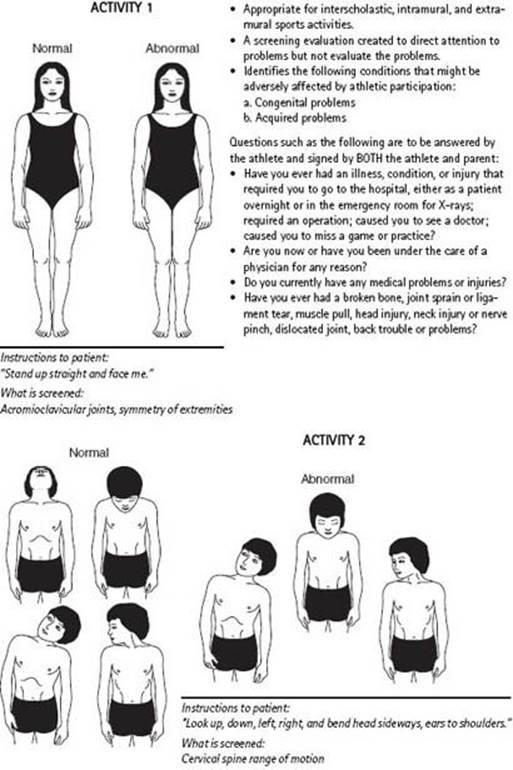
90 Second Musculoskeletal Screening
171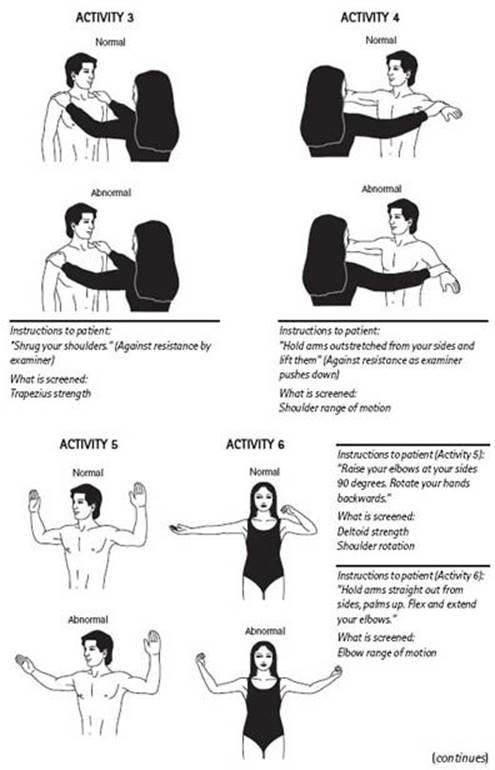
90 Second Musculoskeletal Screening
172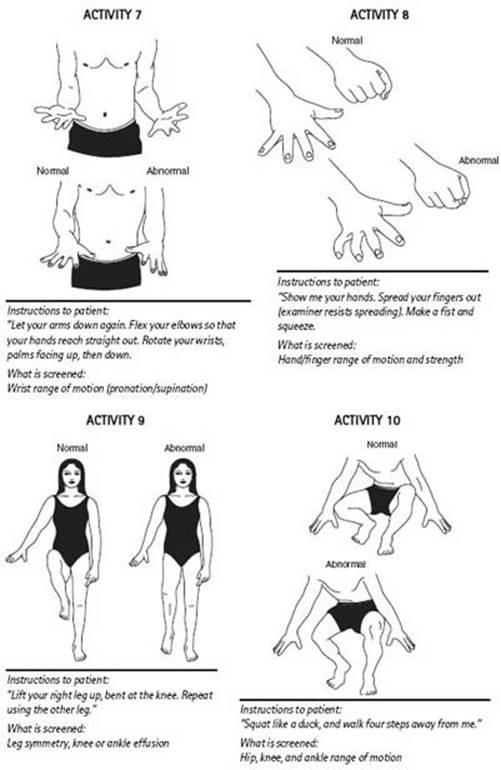
90 Second Musculoskeletal Screening
173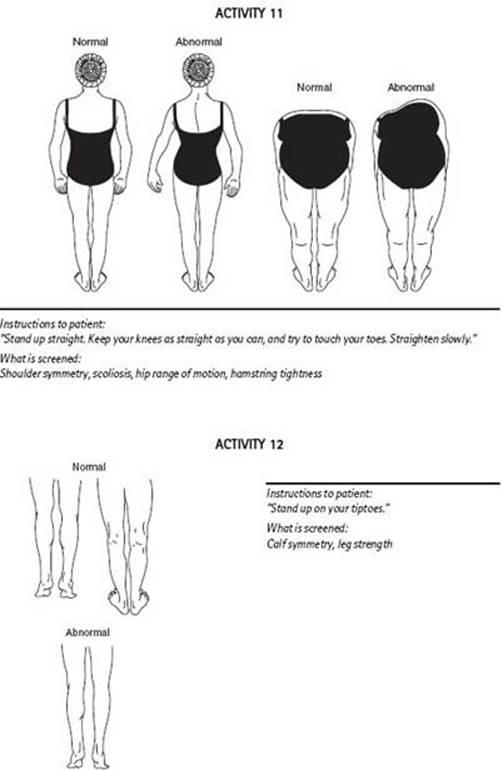
90 Second Musculoskeletal Screening
174
Preparticipation Physical Examination: Cardiovascular Personal History
-Chest pain/discomfort/tightness/pressure related to exertion
-Unexplained syncope/near syncope
-Excessive exertional and unexplained dyspnea/fatigue or palpitations associated with exercise
-Prior recognition of a heart murmur
-Elevated systemic blood pressure
-Prior restriction from participation in sports
-Prior testing for the heart
-Unexplained syncope/near syncope
-Excessive exertional and unexplained dyspnea/fatigue or palpitations associated with exercise
-Prior recognition of a heart murmur
-Elevated systemic blood pressure
-Prior restriction from participation in sports
-Prior testing for the heart
175
Preparticipation Physical Examination: Cardiovascular Family History
-Premature death before age of 50 attributable to heart disease in one or more relatives
-Disability from heart disease in a close relative <50 years of age
-Hypertrophic or dilated cardiopathy, long QT syndrome, or other ion channelpathies
-Marfan syndrome
-Clinically significant arrhythmias
-Specific knowledge of certain cardiac conditions in family members
-Disability from heart disease in a close relative <50 years of age
-Hypertrophic or dilated cardiopathy, long QT syndrome, or other ion channelpathies
-Marfan syndrome
-Clinically significant arrhythmias
-Specific knowledge of certain cardiac conditions in family members
176
Preparticipation Physical Examination: Cardiovascular Physical Examination
-Heart murmur
should be done with the patient in both supine and standing positions (or with the Valsava maneuver)
specifically to identify murmurs of dynatic left ventricular outflow tract obstruction
-Femoral pulses to exclude aortic coarctation
-Physical stigmata of Marfan syndrome
-Brachial artery blood pressure (sitting position, perferably taken from both arms)
should be done with the patient in both supine and standing positions (or with the Valsava maneuver)
specifically to identify murmurs of dynatic left ventricular outflow tract obstruction
-Femoral pulses to exclude aortic coarctation
-Physical stigmata of Marfan syndrome
-Brachial artery blood pressure (sitting position, perferably taken from both arms)
177
Initial Screening Method for Cardiac Conditions in PPE
-12-lead ECG
-Echocardiogram
-Echocardiogram
178
Concerning Cardiac Murmur
-Systolic murmur >grade 3
-Murmur that disrupts normal heart sounds
-Radiation of the murmur
-Wide or fixed splitting of S2
-Murmur heard during diastole
-Murmur that increases in intensity with different positions or maneuver
-All should be further evaluated prior to clearance for sports participation
-Murmur that disrupts normal heart sounds
-Radiation of the murmur
-Wide or fixed splitting of S2
-Murmur heard during diastole
-Murmur that increases in intensity with different positions or maneuver
-All should be further evaluated prior to clearance for sports participation
179
Preparticipation Physical Examination: Diagnostic Studies
-ECG, echocardiogram or exercise stress tests are not recommended as a requirement for all PPEs
-Urinalysis is not recommended
-H&H:
adolescnt females with heavy menstrual cycles
history of iron deficiency anemia
history of iron supplementation or medications that could affect blood count
-Urinalysis is not recommended
-H&H:
adolescnt females with heavy menstrual cycles
history of iron deficiency anemia
history of iron supplementation or medications that could affect blood count
180
Preparticipation Physical Examination: Diagnostic Studies Continued
-HIV
-Sickle cell testing
-Lipid or cholesterol
overweight or obese patients
personal history of elevated lipid or cholesterol
positive cardiovascular risk factors
-Sickle cell testing
-Lipid or cholesterol
overweight or obese patients
personal history of elevated lipid or cholesterol
positive cardiovascular risk factors
181
Recommendations for the Care of the Athlete with Type 1 Diabetes
-Adjustment to blood testing schedule or insulin dosing
-Athlete should frequently test and record blood sugars (before, during, and after training)
-Follow insulin dosing schedule but be prepared for adjustments depending on level of physical activity
-Avoid insulin to the limb that is most active in the exercise
-Plan snacks accordingly
-Pack extra testing supplies
-Wear a medical alert bracelet
-Have diabetes action plan available
-Take control and put diabetes first
-Educate coaches and teammates about diagnosis
-Athlete should frequently test and record blood sugars (before, during, and after training)
-Follow insulin dosing schedule but be prepared for adjustments depending on level of physical activity
-Avoid insulin to the limb that is most active in the exercise
-Plan snacks accordingly
-Pack extra testing supplies
-Wear a medical alert bracelet
-Have diabetes action plan available
-Take control and put diabetes first
-Educate coaches and teammates about diagnosis
182
When can athletes with hypertension participate in sports?
-Hypertension and cardiovascular risk has been evaluated
-Stage 2 hypertension with treatment has lowered blood pressure
-Stage 2 hypertension with treatment has lowered blood pressure
183
What should preparticipation clearance for seizures be based on?
-Type and frequency of seizures
-Antiepileptic medication compliance
-Presence of any comorbid conditions
-Antiepileptic medication compliance
-Presence of any comorbid conditions
184
Anticonvulsant Medication Side Effects
-Could impair performance or put the individual at risk
-Cognitive or behavioral changes
-Diplopia
-Dizziness
-General fatigue
-Sedation
-Ataxia
-Tremors
-Decreased bone density
-Cognitive or behavioral changes
-Diplopia
-Dizziness
-General fatigue
-Sedation
-Ataxia
-Tremors
-Decreased bone density
185
Poorly Controlled Seziures and Sports Participation
-Individualized assessment, discussion and medical decisions are needed
-Should be excluded from contact, limited-contact or collision category activities
-Contact sports does not provoke seizures, but head injury is a concern
-Should be excluded from contact, limited-contact or collision category activities
-Contact sports does not provoke seizures, but head injury is a concern
186
Precautions for Sickle Cell Trait and Sports
-Setting their own pace
-Performing gradual acclimatization to heat, humidity, and altitude
-Resting as needed
-Decreaing entension exertional activities to short bursts of less than 2 to 3 minutes
-Being aware and stopping activities if symptoms occur
-Not participating while sill
-Staying well hydrated at all times
-Performing gradual acclimatization to heat, humidity, and altitude
-Resting as needed
-Decreaing entension exertional activities to short bursts of less than 2 to 3 minutes
-Being aware and stopping activities if symptoms occur
-Not participating while sill
-Staying well hydrated at all times
187
Precautions for Infectious Mononucleosis and Sports
-Clinical manifestations
fever
pharyngitis
lymphadentitis
splenomegaly (most concerning clinical issue for an athlete)
-Risk of splenic rupture in contact or collision sport and sports that increase intraabdominal pressure (Valsava)
-
fever
pharyngitis
lymphadentitis
splenomegaly (most concerning clinical issue for an athlete)
-Risk of splenic rupture in contact or collision sport and sports that increase intraabdominal pressure (Valsava)
-
188
Return to Play Decision for Infectious Mononucleosis
-Routine imaging is not recommended because of the variance in a normal spleen size
-Advise the athlete to avoid any form of exertion for 2 to 3 weeks after onset of symptoms
-May return to light noncontact sports 3 weeks after if afebrile and symptom free
-Full return to play is based on a case by case basis
-Generally safe 4 weeks after symptom onset
-If a sport involves increased intraabdominal pressure, a longer recovery time is suggested
-Advise the athlete to avoid any form of exertion for 2 to 3 weeks after onset of symptoms
-May return to light noncontact sports 3 weeks after if afebrile and symptom free
-Full return to play is based on a case by case basis
-Generally safe 4 weeks after symptom onset
-If a sport involves increased intraabdominal pressure, a longer recovery time is suggested
189
Return-To-Play Guidelines: Tinea Corporis
190
Return-To-Play Guidelines: Tinea Corporis
-72 hours on topical fungicide
-Extensive or active lesions lead to disqualification
-Lesions must be covered with either bio-occlusive or gas-permeable dressing followed by underwrap and stretch tape
-Extensive or active lesions lead to disqualification
-Lesions must be covered with either bio-occlusive or gas-permeable dressing followed by underwrap and stretch tape
191
Return-To-Play Guidelines: Tinea Capitis
2 weeks of systemic antifungal therapy
192
Return-To-Play Guidelines: Herpes Simplex Virus (Primary)
-Free of systemic symptoms of viral infection, fever and malaise
-No new lesions in 72 hours
-No moist lesions (all lesions covered with a firm, adherent crust)
-120 hours on systemic antiviral therapy
-Active lesions cannot be covered to allow participation
-No new lesions in 72 hours
-No moist lesions (all lesions covered with a firm, adherent crust)
-120 hours on systemic antiviral therapy
-Active lesions cannot be covered to allow participation
193
Return-To-Play Guidelines: Herpes Simplex (Recurrent)
-No moist lesions (all lesions covered with a firm, adherent crust)
-120 hours on systemic antiviral therapy
-Active lesions cannot be covered to allow participation
-120 hours on systemic antiviral therapy
-Active lesions cannot be covered to allow participation
194
Return-To-Play Guidelines: Impetigo, Cellulitis, Staph, MRSA
-Lesions must be curetted or removed
-Lesions must be covered with gas-permeable dressing followed by underwrap and stretch tape
-Lesions must be covered with gas-permeable dressing followed by underwrap and stretch tape
195
Return-To-Play Guidelines: Scabies
Negative microscopic skin prep before returning to practice
196
What systems need to be evaluated before diagnosis of exercise-induced dyspnea?
-Cardiac (increase in cardiac output)
-Respiratory (increase in ventilation)
-Respiratory (increase in ventilation)
197
Exercise-Induced Dyspnea Diagnosis
-History
-Examination
-Spirometry
-Cardiopulmonary exercise testing
-Examination
-Spirometry
-Cardiopulmonary exercise testing
198
Sports Associated with Sudden Cardiac Death
-Basketball (highest)
-Soccer
-Football
-Soccer
-Football
199
Causes of Sudden Cardiac Death
-Hypertrophic cardiomyopathy (most common)
-Anomalous origin of a coronary artery (most common)
-Anabolic steroids
-Commotio cordis
-Exercise-induced bronchospasm
-Premature coronary artery disease
-Anomalous origin of a coronary artery (most common)
-Anabolic steroids
-Commotio cordis
-Exercise-induced bronchospasm
-Premature coronary artery disease
200
Reported Symptoms Before Sudden Cardiac Death
-Can be asymptomatic
-Chest pain
-Shortness of breath
-Pre-syncope or syncope
-Palpitations
-Decreased abiloty to perform at previous level
-Chest pain
-Shortness of breath
-Pre-syncope or syncope
-Palpitations
-Decreased abiloty to perform at previous level
201
Sudden Cardiac Death Screening
-Use of ECG's as a universal screening can lead to false positives or false negatives
-Full cardiac work up is needed if symptoms are present during an activity (cardiac imaging, exercise testing and electrophysiological evaluation)
-If patient is at higher risk based on the 14-element questionaire, then ECG and electrocardiogram should be done
-Full cardiac work up is needed if symptoms are present during an activity (cardiac imaging, exercise testing and electrophysiological evaluation)
-If patient is at higher risk based on the 14-element questionaire, then ECG and electrocardiogram should be done
202
Absence of Paired Organ Consideration
-Quality and function of the organ
-Probability of injury to that organ by particpation in the sport
-Protective equipment available and its effectiveness
-A signed letter of understanding and waiver from the parent and student is needed
-Probability of injury to that organ by particpation in the sport
-Protective equipment available and its effectiveness
-A signed letter of understanding and waiver from the parent and student is needed
203
Apophysitis
-Happens from skeletal imaturity
-From repetitive irritation, inflammation and microtrauma at the growth plate
-May be present as a persistent or worsening pain symptom after a specific history of injury or with gradual onset of pain without specific injury
-Can lead to an avulsion fracture
-From repetitive irritation, inflammation and microtrauma at the growth plate
-May be present as a persistent or worsening pain symptom after a specific history of injury or with gradual onset of pain without specific injury
-Can lead to an avulsion fracture
204
Neck Injury Consideration in Sports
-If a neck injury occurs, the athlete should have a complete neck evaluation done
-Needs to demonstrate full range of motion and adequate strength in neck flexion and entension and symmetric strength during lateral flexion along with absence of neurological symtoms
-If symtpoms are present:
cervical radiographs that include flexion-extenstion views should be performed
-Needs to demonstrate full range of motion and adequate strength in neck flexion and entension and symmetric strength during lateral flexion along with absence of neurological symtoms
-If symtpoms are present:
cervical radiographs that include flexion-extenstion views should be performed
205
Concussion Return To Sport Strategy Steps
1. Symptom limited activity
2. Light aerobic exercise
3. Sport-specific exercise
4. Non-contact training drills
5. Full-contact practice
6. Return to pkay
2. Light aerobic exercise
3. Sport-specific exercise
4. Non-contact training drills
5. Full-contact practice
6. Return to pkay
206
Symptom Limited Activity
-Daily activities that do not provoke symptoms
-High school aged and younger youth should not return to sports until they have successfully returned to academics
-Goal: gradual reintroduction of work/school activities
-High school aged and younger youth should not return to sports until they have successfully returned to academics
-Goal: gradual reintroduction of work/school activities
207
Light Aerobic Exercise
-Walking or stationary cycling at slow to medium pace
-No resistance training
-Goal: Increase heart rate
-No resistance training
-Goal: Increase heart rate
208
Sport-Specific Exercise
-Running or skating drills
-No head impact activities
-Goal: add movement
-No head impact activities
-Goal: add movement
209
Non-Contact Training Drills
-Harder training drills (passing drills)
-May start progressive resistance training
-Goal: exercise, coordination and increased thinking
-May start progressive resistance training
-Goal: exercise, coordination and increased thinking
210
Full-Contact Practice
-Following medical clearance, participation in normal training activities
-Goal: restore confidence and assess functional skills by coaching staff
-Goal: restore confidence and assess functional skills by coaching staff
211
Return To Play
Normal game play
212
Initial Concussion Rest
-24 to 48 hours long before strategy can be started
-Both physical and cognitive rest
-Both physical and cognitive rest
213
How long should each step in the concussion strategy be?
24 hours
214
Retrun-To-Sport Strategy Concussion Considerations
-If any symptoms worsen during exercise, the athlete should go back to the previous step
-If symptoms are persistent (over 1 month) the athlete should be referred to a health care provider who is an expert in the management of concussion
-If the adolescent has 2 to 3 concussions without LOC or 1 to 2 concussions with LOC then there needs to be further evaluation
-If symptoms are persistent (over 1 month) the athlete should be referred to a health care provider who is an expert in the management of concussion
-If the adolescent has 2 to 3 concussions without LOC or 1 to 2 concussions with LOC then there needs to be further evaluation
215
The Female Athlete Triad
1. Low energy availability with or without a disordered eating pattern
2. Menstrual dysfunction (amenorrhea or oligomenorrhea)
3. Low bone mineral density (osteopenia or osteoporosis)
2. Menstrual dysfunction (amenorrhea or oligomenorrhea)
3. Low bone mineral density (osteopenia or osteoporosis)
216
Sports Associated with The Female Athlete Triad
-Distance running
-Gymnastics
-Dance/dance team
-Figure skating
-Cheerleading
-Wrestling
-Light weight rowing
-Pole vaulting
-Gymnastics
-Dance/dance team
-Figure skating
-Cheerleading
-Wrestling
-Light weight rowing
-Pole vaulting
217
Goal of Treatment for The Female Athlete Triad
-Increase energy and decrease energy expenditure
-Therapy, participation and return to play is based on risk categories
-Calcium and vitamin D
-Therapy, participation and return to play is based on risk categories
-Calcium and vitamin D
218
Preventive Counseling for Sports
-Nutritional energy needs for sports
-Importance of bone mineralization
-Bone health throughout life
-Importance of physical activity
-Calcium and vitamin D
-Education for female athletes and families on the triad
-Importance of bone mineralization
-Bone health throughout life
-Importance of physical activity
-Calcium and vitamin D
-Education for female athletes and families on the triad
219
Screening Questions for Female Athlete Triad
-Menstrual History
have you had a menstrual period?
what was your age when you had your first period?
when was your last period?
how often do you have your periods?
how many menstrual periods have you had in the last year?
-Medications
are you taking hormones (estrogen, progesterone, birth control pills)?
have you had a menstrual period?
what was your age when you had your first period?
when was your last period?
how often do you have your periods?
how many menstrual periods have you had in the last year?
-Medications
are you taking hormones (estrogen, progesterone, birth control pills)?
220
Screening Questions for Female Athelte Triad Continued
-Weight
are you concerned about your weight or body compositions?
are you trying to or has anyone recommended that you lose or gain weight?
are you on a diet or do you avoid certain foods or food groups
have you done anything to try and control your weight (purging, binging, fasting)?
have you ever had an eating disorder?
-Musculoskeletal
have you ever had a stress fracture
have you been told that you have low bone density
are you concerned about your weight or body compositions?
are you trying to or has anyone recommended that you lose or gain weight?
are you on a diet or do you avoid certain foods or food groups
have you done anything to try and control your weight (purging, binging, fasting)?
have you ever had an eating disorder?
-Musculoskeletal
have you ever had a stress fracture
have you been told that you have low bone density
221
The Female Athlete Triad: Recommendations for the Clinician
-Screen for all elements of the triad at the PPE and at annual physicals
-If one comonent of the triad exists, screen for others
-If an eating disorder is suspected, refer to a nutrition professional and a mental health professional for screening/treatment
-Diagnosis of amenorrhea: exclude functional hypothalamic amenorrhea
-Screen for bone mineral density after a stress or low-impact fracture, 6 months of amenorrhea or oligomenorrhea or as part of assessment for disrodered eating patterns
-If one comonent of the triad exists, screen for others
-If an eating disorder is suspected, refer to a nutrition professional and a mental health professional for screening/treatment
-Diagnosis of amenorrhea: exclude functional hypothalamic amenorrhea
-Screen for bone mineral density after a stress or low-impact fracture, 6 months of amenorrhea or oligomenorrhea or as part of assessment for disrodered eating patterns
222
Objectives in Human Trafficking
-Objective is not to force or coerce the patient into disclosure
-It is not the PNP's job to “rescue” the patient.
-Provide a safe environment
-Respond to immediate care needs in an evidence-based, trauma-informed, and culturally responsive way
-Identify potential risks
-Connect the patient to appropriate services
-It is not the PNP's job to “rescue” the patient.
-Provide a safe environment
-Respond to immediate care needs in an evidence-based, trauma-informed, and culturally responsive way
-Identify potential risks
-Connect the patient to appropriate services
223
Greatest Risk Factors for Human Trafficking
-Teens
-Runaways
-Sexual abuse
-Runaways
-Sexual abuse
224
Labor Trafficking Vulnerability
-Poverty
-Recent immigration
-Hunger
-Limited english
-Lack of personal safety
-Learning disabilities
-Developemental delay
-Homelessness
-Recent immigration
-Hunger
-Limited english
-Lack of personal safety
-Learning disabilities
-Developemental delay
-Homelessness
225
Sex Trafficking Vulnerability
-Isolation/emotional distress
-Family dysfunction
-Substance abuse
-Mental illness
-Childhood sexual abuse
-Promotion of sexual exploitation by family members or peers
-Lack of social support
-Foster care
-Family dysfunction
-Substance abuse
-Mental illness
-Childhood sexual abuse
-Promotion of sexual exploitation by family members or peers
-Lack of social support
-Foster care
226
Labor Trafficking Red Flags
-Inappropriate clothing for weather
-Injuries do not explain history
-Being employed during the day without a school-work permit
-Living with exployer or having employer listed as childs caregiver
-Failing school performances due to long work hours
-Inability to produce personal identification
-No insurance information
-Want quickest less expensive treatment
-Injuries do not explain history
-Being employed during the day without a school-work permit
-Living with exployer or having employer listed as childs caregiver
-Failing school performances due to long work hours
-Inability to produce personal identification
-No insurance information
-Want quickest less expensive treatment
227
Labor Trafficking Environmental Factors
-Questionable employment
-Dependence on co-worker to answer all questions
-Abusive relationships
-Lack of transportation
-Lack of cultural understanding
-Delayed medical care with advanced disease stage
-Dependence on co-worker to answer all questions
-Abusive relationships
-Lack of transportation
-Lack of cultural understanding
-Delayed medical care with advanced disease stage
228
Human Trafficking Recruitment
-"Triple T"
-Target
traffickers seek out vulnerable children
-Trick (manipulate)
traffickers break down a child's natural resistance and suspicion
then reveal true intent of relationship
-Traumatize
childbecomes a victim; becomes and feels trapped and powerless
this "trauma bond" is extremely diffcult to break
-Target
traffickers seek out vulnerable children
-Trick (manipulate)
traffickers break down a child's natural resistance and suspicion
then reveal true intent of relationship
-Traumatize
childbecomes a victim; becomes and feels trapped and powerless
this "trauma bond" is extremely diffcult to break
229
Where does recruitment take place for human trafficking?
Social media
230
Injury Prevention 2 Principles
-The most effective way to get children to adopt safety measures and health protection behaviors is for the parents to model them
-When an injury occurs, it is the role of the PNP in primary care to determine what is within their scope of practice to triage and manage and what needs to be referred
routinely (in your primary care practice)
urgently (expedited appointment in your primary care practice or parent transport to the emergency room)
emergently (calling 911 or ambulance transfer)
-When an injury occurs, it is the role of the PNP in primary care to determine what is within their scope of practice to triage and manage and what needs to be referred
routinely (in your primary care practice)
urgently (expedited appointment in your primary care practice or parent transport to the emergency room)
emergently (calling 911 or ambulance transfer)
231
Mechanism of Injury Death: Infant
1. Accidental suffocation
2. Motor vehicle crashes
3. Drowning
2. Motor vehicle crashes
3. Drowning
232
Injury Prevention Anticipatory Guidance: Infants
-Back to sleep in parents room but not in parents bed
-Review car seat safety guidelines, instruct parent/caregiver not to drive under the influence
-Review car seat safety guidelines, instruct parent/caregiver not to drive under the influence
233
Mechanism of Injury Death: Ages 1 to 4
1. Drowning
2. Falls
3. Motor vehicle crashes
2. Falls
3. Motor vehicle crashes
234
Injury Prevention Anticipatory Guidance: Ages 1 to 4
-Constant supervision around water pools (touch supervision)
-Personal flotation devices (life jacket not floaties)
-Swim lessons beginning by age 4
-Adequate fencing around pools
-Do not leave toys in pool that could tempt child
-Do not leave child unattended near or inside of a vehicle
-Personal flotation devices (life jacket not floaties)
-Swim lessons beginning by age 4
-Adequate fencing around pools
-Do not leave toys in pool that could tempt child
-Do not leave child unattended near or inside of a vehicle
235
Mechanism of Injury Death: Ages 5 to 12
1. Motor vehicle crash
2. Drowning
3. Fire and burns
2. Drowning
3. Fire and burns
236
Injury Prevention Anticipatory Guidance: Ages 5 to 12
-Review car seat safety guidelines at every well child visit
-Consistent use of seatbelts
-Swim lessons
-Adult supervision around water
-If on boat or water craft, wear Coast Guard approved life jacket
-Functioning smoke alarms in the house
-Consistent use of seatbelts
-Swim lessons
-Adult supervision around water
-If on boat or water craft, wear Coast Guard approved life jacket
-Functioning smoke alarms in the house
237
Mechanism of Injury Death: Ages 13 to 19
-Motor vehicle crash
-Poisoning
-Drowning
-Poisoning
-Drowning
238
Injury Prevention Anticipatory Guidance: Ages 13 to 19
-Prevent distracted driving
-Consistent seatbelt use
-Home free of firearms
-If a firearm is in the home, it must be stored unloaded and locked with ammunition stored separately
-Consistent seatbelt use
-Home free of firearms
-If a firearm is in the home, it must be stored unloaded and locked with ammunition stored separately
239
Rear-Facing Car Seat
-Birth until age 2 to 4
-Buckle children in a rear-facing car seat until they reach the max weight or height limit of their car seat
-Keep child rear-facing as long as possible
-Buckle children in a rear-facing car seat until they reach the max weight or height limit of their car seat
-Keep child rear-facing as long as possible
240
Forward-Facing Car Seat
-After outgrowing rear-facing seat until at least age 5
-When children outgrow their rear-facing car seat, they should be buckled in a foward-facing car seat until they reach the max weight or height limit of their car seat
-When children outgrow their rear-facing car seat, they should be buckled in a foward-facing car seat until they reach the max weight or height limit of their car seat
241
Booster Seat
-After outgrowing forward-facing seat and until seat belts fit properly
-Once children outgrow their forward-facing seat, they should be buckled in a booster seat until seat belts fits properly
-Proper seat belt fit usually occurs when children are 4 feet 9 inches tall and age 9 to 12
-Once children outgrow their forward-facing seat, they should be buckled in a booster seat until seat belts fits properly
-Proper seat belt fit usually occurs when children are 4 feet 9 inches tall and age 9 to 12
242
Seat Belt
-Once seat belts fit properly without a booster seat
-Children no longer need to use a booster seat once seat belts fit them properly
-Seat belts fit properly when the lap belt lays across the upper thighs (not the stomach) and the shoulder belt lays across the chest (not the neck)
-Children no longer need to use a booster seat once seat belts fit them properly
-Seat belts fit properly when the lap belt lays across the upper thighs (not the stomach) and the shoulder belt lays across the chest (not the neck)
243
What age should a child be in the backseat?
12 and younger
244
Carseat Considerations
-Carseat should not move more than 1 inch once intalled
-Chest buckle should be armpit level
-Should not be able to pinch straps at shoulder
-Chest buckle should be armpit level
-Should not be able to pinch straps at shoulder
245
Adolescent Driving Injury Prevention
-Graduation driving laws can decrease death and injury
limiting nighttime driving
limiting passangers
setting minimum age at 18 for full license
-parents need to add safety rules by creating a driving agreement
-Technology needs to be out into "driving mode" so that they are not able to use it while driving
-Adults should model good driving behaviors
limiting nighttime driving
limiting passangers
setting minimum age at 18 for full license
-parents need to add safety rules by creating a driving agreement
-Technology needs to be out into "driving mode" so that they are not able to use it while driving
-Adults should model good driving behaviors
246
Falls Injury Prevention
-Always watch children on playground equipment
-Ensure there is sufficient padding (grass does not absorb fall energy well)
-Place skid pads under carpets and rugs
-Place stair gates
-Be cautious about leaving furniture and items that can be easily moved to allow a young child to reach areas by climbing
-Use window guards for open windows above ground level
-Always use bicycle hekments when using wheeled toys and bicycles
-Ensure there is sufficient padding (grass does not absorb fall energy well)
-Place skid pads under carpets and rugs
-Place stair gates
-Be cautious about leaving furniture and items that can be easily moved to allow a young child to reach areas by climbing
-Use window guards for open windows above ground level
-Always use bicycle hekments when using wheeled toys and bicycles
247
Fire/Burns Injury Prevention
-Usually casued by scalding liquids in infancy and early childhood while flames cause most burns in older children
-Install and maintain smoke detectors in the home on every floor and where people sleep
-Keep the hot water thermostate at 120 degrees
-Turn pot handles away from the stove edge
-Never leave cooking food on the stove or hot food unattended
-Careate and practice a family fire escape plan
-Be careful leaving hot mugs and bowls within reach
-Use table runners and tablecloths with caution
-Place barriers in front of open fireplaces or heating stoves to limit access to young children
-Install and maintain smoke detectors in the home on every floor and where people sleep
-Keep the hot water thermostate at 120 degrees
-Turn pot handles away from the stove edge
-Never leave cooking food on the stove or hot food unattended
-Careate and practice a family fire escape plan
-Be careful leaving hot mugs and bowls within reach
-Use table runners and tablecloths with caution
-Place barriers in front of open fireplaces or heating stoves to limit access to young children
248
Fire/Burns Injury Prevention Continued
-Never leave space heaters within reach of young children
-Use caution to ensure cords from hot items are left out of reach
-Reinforce injury prevention after a burn injury occurs
-Teach burn first-aid measures
submerge minor burns in tepid water
do not use butter, oil based creams and lotions
rinse chemical burns in cold water and flush for 20 minutes
-Use caution to ensure cords from hot items are left out of reach
-Reinforce injury prevention after a burn injury occurs
-Teach burn first-aid measures
submerge minor burns in tepid water
do not use butter, oil based creams and lotions
rinse chemical burns in cold water and flush for 20 minutes
249
Poisoning Injury Prevention
-Store the following out of site with child resistant locks
all medications (including OTC)
tobacco, e-cigs, alcohol and marijuana
laundry and cleaning supplies
pesticides and insect repellent
button batteries
any type of oil, lubricant or other chemical
personal care products
all medications (including OTC)
tobacco, e-cigs, alcohol and marijuana
laundry and cleaning supplies
pesticides and insect repellent
button batteries
any type of oil, lubricant or other chemical
personal care products
250
Poisoning Injury Prevention Continued
-Never mix cleaning chemicals
-Do not apply insect repellent to hands and wash off before going indoors
-Detect visible threats (carbon monoxide, asbestos or radon)
-Do not share medications with anyone
-Ensure proper medication disposal
-Encourage smoking cessation for caregivers who smoke
-Store and prepare food safely
-Do not apply insect repellent to hands and wash off before going indoors
-Detect visible threats (carbon monoxide, asbestos or radon)
-Do not share medications with anyone
-Ensure proper medication disposal
-Encourage smoking cessation for caregivers who smoke
-Store and prepare food safely
251
Poisoning Injury Prevention Continued
-Top overall causes of pediatric exposures in children younger than 6 are:
cosmetics
personal care products
cleaning substances
analgesics
-Adolescents are more likely to intentionally abuse OTC medication, prescribed or chemical/illicit drugs for recreational use
-High risk for using poisons, OTC or prescribed medications for suicide
cosmetics
personal care products
cleaning substances
analgesics
-Adolescents are more likely to intentionally abuse OTC medication, prescribed or chemical/illicit drugs for recreational use
-High risk for using poisons, OTC or prescribed medications for suicide
252
Risk Factors for Child Abuse and Neglect: Paternal Factors
-Substance use
-Minor parents
-Mental illness
-Developemental disability
-Parent with a chronic illness that could impact their ability to meet the needs of their child
-History of abuse as a child
-Minor parents
-Mental illness
-Developemental disability
-Parent with a chronic illness that could impact their ability to meet the needs of their child
-History of abuse as a child
253
Risk Factors for Child Abuse and Neglect: Child Factors
-Premature infant
-Multiple births
-Infacts with congenital malformations, genetic disorders and chronic disease
-Challenging behvior and temperment
-Child of an unwanted pregnancy
-Home schooling
-Multiple births
-Infacts with congenital malformations, genetic disorders and chronic disease
-Challenging behvior and temperment
-Child of an unwanted pregnancy
-Home schooling
254
Risk Factors for Child Abuse and Neglect: Environmental Factors
-Poverty
-Resides in high crime area
-Chaotic homes
-Domestic violence
-Lack of family or community support
-Life changes, death, separation, divorce or military deployment
-Resides in high crime area
-Chaotic homes
-Domestic violence
-Lack of family or community support
-Life changes, death, separation, divorce or military deployment
255
Consequences of Abuse and Neglect
-Abuse under the age of 4 is more critical
-Poor academic achivement
-Mental illness
-Antisocial behavior
-High-risk behaviors
-Later in life there is a risk poorer control of chronic health conditions as an adult:
cardiovascular
HTN
diabetes
respiratory illnessa
poor nutritional status (obesity)
vision problems
-Poor academic achivement
-Mental illness
-Antisocial behavior
-High-risk behaviors
-Later in life there is a risk poorer control of chronic health conditions as an adult:
cardiovascular
HTN
diabetes
respiratory illnessa
poor nutritional status (obesity)
vision problems
256
History Component for Child Abuse and Neglect
-History helps the PNP if the accident was accidental or not as well as the necessity to report to CPS
-Initial interview may question the child and the family separately
-All questions should be nonjudgemental, nonleading and open ended
-Initial interview may question the child and the family separately
-All questions should be nonjudgemental, nonleading and open ended
257
Screening for Child Abuse and Neglect
-PNP should think neglect if the family seeks care only when the child is sick
-Every encounter, the PNP should be alert for signs of abuse and neglect
-Every encounter, the PNP should be alert for signs of abuse and neglect
258
Signs of Abuse and Neglect: Physical Abuse
-Any injury in a nonmobile infant
-Injuries to torso, ears, scalp and neck in a toddler (hidden areas)
-Injuries that are at different stages of healing
-Injuries without explanation
-Human bite marks
-Injury to the oral frena in infants
-Patterned bruising (belt, electrical cords)
-Submersion or cigarrete burns
-Injuries to torso, ears, scalp and neck in a toddler (hidden areas)
-Injuries that are at different stages of healing
-Injuries without explanation
-Human bite marks
-Injury to the oral frena in infants
-Patterned bruising (belt, electrical cords)
-Submersion or cigarrete burns
259
Signs of Abuse and Neglect: Sexual Abuse
-Pain, discharge or ordor in genital area
-Recurrent urinary tract infection
-Sexually transmitted infection
-Pregnancy
-Enuresis or encopresis
-Recurrent urinary tract infection
-Sexually transmitted infection
-Pregnancy
-Enuresis or encopresis
260
Signs of Abuse and Neglect: Neglect
-Failure to thrive
-Malnutrition, feeding disorders
-Poor hygeine
-Lack of healthcare
-Truancy
-Enuresis
-Sleep disorders
-Malnutrition, feeding disorders
-Poor hygeine
-Lack of healthcare
-Truancy
-Enuresis
-Sleep disorders
261
Roles of Reporting for the PNP
-Primary goal of reporting is to ensure safety and prevent further injury or neglect to the child
-Obligated to report any evidence of child abuse and neglect
-CPS may help the family receive additional support
-Even if the child is referred to the ED, it is still the PNP's job to report concerns to CPS
-Obligated to report any evidence of child abuse and neglect
-CPS may help the family receive additional support
-Even if the child is referred to the ED, it is still the PNP's job to report concerns to CPS
262
Adolescent Definition
-Refers to the psychosocial and emotional transition from childhood to adulthood and is influenced by social, genetic and environmental aspects
-The extent of physiologic growth and maturation during this time rivals that occur during infancy
-The extent of physiologic growth and maturation during this time rivals that occur during infancy
263
Puberty Definition
-Defined as the development of secondary sexual characteristics and the biologic process that ultimately leads to fertility
-The physical changes of puberty are accompanied by significant cognitive and psychosocial developmental changes that affect how adolescents view themselves and how the world views adolescents
-The physical changes of puberty are accompanied by significant cognitive and psychosocial developmental changes that affect how adolescents view themselves and how the world views adolescents
264
Thelarche
-Breast budding
-8 to 13 years
-8 to 13 years
265
Adrenarche
-Pubic hair
-6 months after thelarche
-11.5 years
-SMR 2
-6 months after thelarche
-11.5 years
-SMR 2
266
Menarche
-Menstrual cycle
-Occurs 2.5 years after thelarche
-9 to 15 years
-SMR 4
-Occurs 2.5 years after thelarche
-9 to 15 years
-SMR 4
267
When does the menstrual cycle regulate
18 to 24 months
268
Which gender enters puberty first?
Females
269
Female Puberty Progression
-Ovaries increase in size, no visible body changes occur
-Breast budding occurs between 8 and 13 years old
-Girls develop pubic hair approximately 6 months after breast budding
-Menstural period begins between 9 to 15 years
-Breast budding occurs between 8 and 13 years old
-Girls develop pubic hair approximately 6 months after breast budding
-Menstural period begins between 9 to 15 years
270
Peak Height Velocity in Females
-Begins shortly after the onset of breast budding and reaches its peak about 1 year later
-Reach PHV during SMR 2 and 3 (11 to 12 years)
-Complete their linear growth at 15 years
-Reach PHV during SMR 2 and 3 (11 to 12 years)
-Complete their linear growth at 15 years
271
Consequences of Early Secondary Sex Characteristics (Females)
-Increased risk for:
sexual assault
sexual abuse
dating violence
psychosocial issues
depression
sexual assault
sexual abuse
dating violence
psychosocial issues
depression
272
Tanner/SMR Staging 1: Female
No growth of pubic hair
273
Tanner/SMR Staging 2: Female
-Downy, scarcely pigmented straight hair
-Especially along the medial border of labia majora
-Especially along the medial border of labia majora
274
Tanner/SMR Staging 3: Female
Sparse, visibly pigmented curly pubic hair on labia
-Onset of menses
-Onset of menses
275
Tanner/SMR Staging 4: Female
-Hair coarse, curly
-No less than adult
-No extension onto medial thigh
-Onset of menses
-No less than adult
-No extension onto medial thigh
-Onset of menses
276
Tanner/SMR Staging 5: Female
-Lateral spreading
-Triangle distribution
-Some spreading onto medial thighs
-Triangle distribution
-Some spreading onto medial thighs
277
What is the initial sign of male puberty?
Testicular enlargement
278
Male Puberty Progression
-Testicular enlargement occurs at 11.5 years old
-Elongation and widening of penis usually begin in SMR 3 and continues through SMR 5
-Changes in male voice occurs with PHV
-Develop pubic hair before axillary, facial and body hair
-Elongation and widening of penis usually begin in SMR 3 and continues through SMR 5
-Changes in male voice occurs with PHV
-Develop pubic hair before axillary, facial and body hair
279
Spermarche
-First release of spermatozoa
-SMR 3 to 5
-SMR 3 to 5
280
Peak Height Velocity Male
-Occurs during SMR 3 to 4 around age 13 to 14
-Complete linear growth by 17
-Male voice change occurs with PHV
-Complete linear growth by 17
-Male voice change occurs with PHV
281
Which teste hangs lower after puberty?
Left
282
How long does gynecomastria last?
-12 to 18 months
-If its persistent with severe acne then provider should as about alcohol, marijuana and anabolic steroids
-If its persistent with severe acne then provider should as about alcohol, marijuana and anabolic steroids
283
Tanner/SMR Staging 1: Male
-Pubic hair
none
-Penis
unchanged from early childhood
-Scrotum
unchanged from early childhood
none
-Penis
unchanged from early childhood
-Scrotum
unchanged from early childhood
284
Tanner/SMR Staging 2: Male
-Pubic hair
small amount of light downy (fine) hair along the base of the penis
-Penis
unchanged or slightly enlarged
-Scrotum
enlarged and reddened pigmentation
skin taut and thinner
increased rugation
small amount of light downy (fine) hair along the base of the penis
-Penis
unchanged or slightly enlarged
-Scrotum
enlarged and reddened pigmentation
skin taut and thinner
increased rugation
285
Tanner/SMR Staging 3: Male
-Pubic Hair
moderate amount of curly, pigmented coarse pubic hair
extending laterally over symphysis pubis
-Penis
increased length and circumference
-Scrotum
further enlargement
moderate amount of curly, pigmented coarse pubic hair
extending laterally over symphysis pubis
-Penis
increased length and circumference
-Scrotum
further enlargement
286
Tanner/SMR Staging 4: Male
-Pubic hair
abundant adult like quality
-Penis
glans penis broader and larger
penis increases in length and circumference
-Scrotum
further enlargement
darker pigmentation
abundant adult like quality
-Penis
glans penis broader and larger
penis increases in length and circumference
-Scrotum
further enlargement
darker pigmentation
287
Tanner/SMR Staging 5: Male
-Pubic hair:
extends to medial surface of the thighs
-Penis
adult size
-Scrotum
adult size
extends to medial surface of the thighs
-Penis
adult size
-Scrotum
adult size
288
Cognitive, Emotional and Psychosocial Developmental Milestones for Adolescents
-Feel a sense of belonging in a valued grouo
-Acquire skills and master tasks that are important to the valued group
-Develop a sense of self-worth
-Develop at least one reliable relationship with another individual
-Demonstrate cognitive potential
-Acquire skills and master tasks that are important to the valued group
-Develop a sense of self-worth
-Develop at least one reliable relationship with another individual
-Demonstrate cognitive potential
289
Cognitive and Moral: Early Adolescence
-Concrete operations
-Unable to perceive ling-term out-comes of current decision-making
-Conventional morality
-Unable to perceive ling-term out-comes of current decision-making
-Conventional morality
290
Cognitive and Moral: Middle Adolescence
-Emergence of abstract thought (formal operations)
-May perceive future implications, but may not apply in decision making
-Questioning social mores
-May perceive future implications, but may not apply in decision making
-Questioning social mores
291
Cognitive and Moral: Late Adolescence
-Future oriented with sense of perspectie idealism, absolutism
-Able to think things through independently
-Able to think things through independently
292
Adolescents Need to Know
What physical changes to expect as puberty progresses.
How to manage those changes (for example: changing in the locker room may become an issue, become very body image-conscious).
How can the rest of the family cope with all the emotional and psychological changes that are occurring (breaking from the family, becoming independent, mood swings)?
How to manage those changes (for example: changing in the locker room may become an issue, become very body image-conscious).
How can the rest of the family cope with all the emotional and psychological changes that are occurring (breaking from the family, becoming independent, mood swings)?
293
Adolescent Survival Guide for Parents
-Start with clear rules and expectations before children are teenagers
-Be firm and consistent
-Be flexible and allow teenagers to negotiate nonsafety-related rules
-Fighting and arguing are typical, often used by teens as they practice their developing reasoning skills
-Teenagers want parents to be involved, concerned and ask question (they just don't know how to express it)
-Be firm and consistent
-Be flexible and allow teenagers to negotiate nonsafety-related rules
-Fighting and arguing are typical, often used by teens as they practice their developing reasoning skills
-Teenagers want parents to be involved, concerned and ask question (they just don't know how to express it)
294
Adolescent Survival Guide for Parents Continued
-Be involved with their school as much as possible
-Continue to involve teenagers in family activities
-Keep promises to teenagers
-Model good behavior
-Dont forget adolescents need adult supervision at times
-Keep communication lines open and dont be afraid to start conversations
-Continue to involve teenagers in family activities
-Keep promises to teenagers
-Model good behavior
-Dont forget adolescents need adult supervision at times
-Keep communication lines open and dont be afraid to start conversations
295
Principals and Approaches to Assessment in Adolescents
-Must be evaluated independently
-Should be actively included in decision making
-Assist the adolescent in evaluating risk and benefits of telling family about sensitve topics
-Use questionnaires if the teen doesnt want to say sensitive topics
-Should be actively included in decision making
-Assist the adolescent in evaluating risk and benefits of telling family about sensitve topics
-Use questionnaires if the teen doesnt want to say sensitive topics
296
Effective Communication with Adolescents
-Demonstrate respect
-Establishing parameters of what can be accomplished during the visit
-Using appropriate body language
-Active listening
-Working with the teen to develop a realistic, individualized treatment plan
-Establishing parameters of what can be accomplished during the visit
-Using appropriate body language
-Active listening
-Working with the teen to develop a realistic, individualized treatment plan
297
Confidentiality in Adolescents and Providers
-Reassure that the provider will not share information with the child parents
-Will share if:
threat of potential sucidal
evidence of an eating disorder
threat of violence towards others
physical or sexual abuse
-Will share if:
threat of potential sucidal
evidence of an eating disorder
threat of violence towards others
physical or sexual abuse
298
Items to Interview Adolescents on
-School
-Family
-Peer relationships
-Safety
-Exposure to violence
-Abuse
-Mental health issues
-Sexuality
-Sexual activity
-Involvement in risk taking behaviors
-Eating disorders
-Family
-Peer relationships
-Safety
-Exposure to violence
-Abuse
-Mental health issues
-Sexuality
-Sexual activity
-Involvement in risk taking behaviors
-Eating disorders
299
Phases of Adolescents
-Early: 11 to 14 years (middle school)
-Middle: 15 to 17 years (high school)
-Late: 18 to 21 years (college)
-Middle: 15 to 17 years (high school)
-Late: 18 to 21 years (college)
300
Early Adolescent Considerations
-Most difficult period of adolescence
-Cognitive skills may not keep up with the rapid physical changes that are happening
-Daydreaming becomes more common which can manifest in the school setting and be viewed as attention difficulties
-Peers become more important causing them to appear “anti-adult.”
-Mood swings are common, they are conscious of their own bodies, and they begin to develop their own value system
-Cognitive skills may not keep up with the rapid physical changes that are happening
-Daydreaming becomes more common which can manifest in the school setting and be viewed as attention difficulties
-Peers become more important causing them to appear “anti-adult.”
-Mood swings are common, they are conscious of their own bodies, and they begin to develop their own value system
28 more cards in OutLearn. Open the full deck