All cards
1
species broad definition
an independently evolving lineage
2
a term used in biology to talk about the distribution of a taxon limited to a small geographic area and which can therefore be found naturally in this place
3
morphospecies concept
closely-related, morphological similar group of organisms
4
phylogenetic species concept
closely related monophyletic group of organisms with unique derived characteristics (synapomorphies!!)
5
biological species concept
closely-related group of organisms that are able to interbreed and produce fertile offspring
6
cladogenesis requirements
evolutionary(genetic) differences between lineages
Mechanisms to preserve these differences
Mechanisms to preserve these differences
7
isolation 2 mechanisms
pre mating barriers
-These barriers prevent contact and/or behavior between lineages
post mating barriers
-These barriers prevent mating from resulting in fertilization
-These barriers prevent contact and/or behavior between lineages
post mating barriers
-These barriers prevent mating from resulting in fertilization
8
2 most common speciation mechs
1. lack of common homogenizing gene flow
2. strong directional or diversifying selection
2. strong directional or diversifying selection
9
physical isolation types
allopatry-different place(no gene flow)
sympatry-same place(diversifying forces greater than gene flow)
sympatry-same place(diversifying forces greater than gene flow)
10
allopatric speciation types
vicarience-splitting of species range into physically isolated areas
ex. differentiation of carribean and pacific shrimp after emergence of panema
dispersal-dispersal or colonization events(founder effect)
ex. drosophila in hawaii, different species on different islands
ex. differentiation of carribean and pacific shrimp after emergence of panema
dispersal-dispersal or colonization events(founder effect)
ex. drosophila in hawaii, different species on different islands
11
ex of speciation by natural selection
Selection in different environmental conditions in Monkeyflowers
M. cardinalis only attracts hummingbirds, M lewisii attracts bees. evolved from ancestor that attracted both to accomodate light conditions and pollinator availability.
M. cardinalis only attracts hummingbirds, M lewisii attracts bees. evolved from ancestor that attracted both to accomodate light conditions and pollinator availability.
12
ex of speciation by sexual selection
female sensory perception in cichlids based on environmental light differences caused radiating evolution of male coloring
13
disruptive selction and sympatry and example
disruptive selection amplifies sympatric speciation
ex. ploidy differences in plant species cause "instant speciation". switch to new habitat/ resource availability can also do this just slower
ex. ploidy differences in plant species cause "instant speciation". switch to new habitat/ resource availability can also do this just slower
14
example of experimental based environmental isolation
flies grown on starch or maltose based medium for several generations. when placed back together mated with other condition much less
15
example of isolating barrier vulnerable to environemental change
melting ice caps reuiniting polar bear species
lakes/ rivers connecting to unite fish
lakes/ rivers connecting to unite fish
16
explain how reproductive isolation can arise as a by-product of adaptive divergence, and one
real-world example of this
real-world example of this
17
reinforcement
the evolution of stronger isolating barriers via selection
18
pleiotropy
Occurs when a single gene influences more than one trait
19
epistasis
interactions between 2 (or more) loci
20
consequences of secondary contact if pre-zygotic isolation is not complete
fusion-two species merge into one(or one goes extinct)
formation of a new hybrid lineage-distinct from both parents
stable hybrid zone established-a balance between the local production of hybrids and their elimination by selection
reinforcement-evolution of stronger isolating barriers via selection
formation of a new hybrid lineage-distinct from both parents
stable hybrid zone established-a balance between the local production of hybrids and their elimination by selection
reinforcement-evolution of stronger isolating barriers via selection
21
why does reinforcement occur
if the hybrid offspring does not have higher fitness, then the parents are wasting their matings
22
example of evidence for hybridization via allopatric and sympatric species
p drummondii allopatric populations resemble other species, whereas sympatric populations differ
reinforcement is shown in sympatric bc hybrid offspring have less fitness, thus are selected against.
(look over this again you were distracted when making it)
reinforcement is shown in sympatric bc hybrid offspring have less fitness, thus are selected against.
(look over this again you were distracted when making it)
23
example of pleiotropic isolation
flowers turning from purple to red
24
Dobzhansky-Muller model of post-zygotic isolation
1. A single ancestral population is split into two daughter lineages
2. Daughter lineages independently accumulate mutations
3. Populations are bought back into contact and individuals in different lineages hybridize
4. Hybrid breakdown results when derived (new) alleles from one lineage are incompatible with alleles in the other lineage against which they have never been previously co-tested during their history (i.e. they have new deleterious epistatic interactions).
2. Daughter lineages independently accumulate mutations
3. Populations are bought back into contact and individuals in different lineages hybridize
4. Hybrid breakdown results when derived (new) alleles from one lineage are incompatible with alleles in the other lineage against which they have never been previously co-tested during their history (i.e. they have new deleterious epistatic interactions).
25
Dobzhansky-Muller example
Xmrk2 gene in playfish
controls pigmentation, misregulation leads to melanoma
controls pigmentation, misregulation leads to melanoma
26
what fixes post and prezygotic isolation? give example
selection
27
differences in pre vs post zygotic isolation mechanisms
post is never directly selected against, pre is
postzygotic involves epistatic interactions, pre rarely does
postzygotic involves epistatic interactions, pre rarely does
28
3 reasons for so many species
species can evolve rapidly
conditions that favor diversification arise continuosly
there has been a vast amount of time elapsed since the origin of earth
conditions that favor diversification arise continuosly
there has been a vast amount of time elapsed since the origin of earth
29
two factors that encourage diversification
ecological controls-adaptive radiations are associated with novel selective conditions (new niches)
endogenous controls-phenotypes that faciliate speciation
endogenous controls-phenotypes that faciliate speciation
30
ecological control diversification example
mustard leaf beetle showed different mate preferences by different plant upbringings
31
endogenous controls example
nectar spur evolution allowing specialization of new resources
32
reasons for beetle diversity
new niches
antagonist coevolution with plant defenses
mating isolation from host plant switching
antagonist coevolution with plant defenses
mating isolation from host plant switching
33
time-for-speciation effect w/ example
Regions that are occupied longer tend to have more species
ranid frogs show much higher species count with higher time
ranid frogs show much higher species count with higher time
34
latitudinal diversity gradient w/ example
there is a difference in speciation between temperate and tropic regions
molluscs show much higher diversity closer to 0 latitude line
molluscs show much higher diversity closer to 0 latitude line
35
connection between LDG and TFS effect
lower latitudes have had longer occupancy due to saftey from glacial flooding
36
life history
The ‘life history’ of a species is their lifetime pattern of
resource allocation to fundamental biological activities,
including growth, reproduction, and survival
resource allocation to fundamental biological activities,
including growth, reproduction, and survival
37
types of mortality
ecological-Death due to extrinsic factors such as disease, predation, [and accidents]
physiological-Death due to intrinsic factors such as physiological and cellular damage, lack of repair, and so forth
physiological-Death due to intrinsic factors such as physiological and cellular damage, lack of repair, and so forth
38
intrinsic constraint theories broad def
intrinsic constraints-Death persists because of a fundamental constraint on the ability of selection to further act against it
39
intrinsic constraint theory examples
rate of living-aging/senescence is caused by the inevitable accumulation of cellular damage (above what can be repaired) due to toxic metabolic by-products
-evidence is not in favor, metabolism is not standard to lifespan across species
telomere degredation theory-cells degrade as telomere length shortens
-some evidence in favor, but not completely
cellular mechs of persistence are a trade of with lifespan
-supported
-evidence is not in favor, metabolism is not standard to lifespan across species
telomere degredation theory-cells degrade as telomere length shortens
-some evidence in favor, but not completely
cellular mechs of persistence are a trade of with lifespan
-supported
40
selective/evolutionary theories of aging
Death persists because selection against it is opposed by other forces
41
selective theories examples
mutation accumulation theory-deleterious alleles that cause late life senescence are relatively weakly selected, and can therefore accumulate via mutation/drift
42
antagonistic plieotropy + data supporting
alleles resulting in reduced fitness later in life may be advantageous earlier on or caused by multiple different loci
-alleles for longer lifespan in fruit flies have deleterious earlier-acting effects
-alleles for longer lifespan in fruit flies have deleterious earlier-acting effects
43
Lack’s hypothesis of reproductive investment
within a reproductive bout,
selection will favor a clutch size
(# offspring) that maximizes the
number of surviving offspring
selection will favor a clutch size
(# offspring) that maximizes the
number of surviving offspring
44
reproductive trade offs
age at first reproduction(generation time) v life span
fecundity v survival
offspring quality v quantity
current reproduction v future reproduction
fecundity v survival
offspring quality v quantity
current reproduction v future reproduction
45
life history strategies depend on...
• Strength of extrinsic mortality
• Environmental resource quality
• Interactions with ecological antagonists (e.g. competitors)
• Predictability and/or stability of environmental resources
• Environmental resource quality
• Interactions with ecological antagonists (e.g. competitors)
• Predictability and/or stability of environmental resources
46
2 patterns in evolution of modern humans
multiple lineages of hominins preceded the emergence of modern humans
modern human traits emerged stepwise via transitional forms
modern human traits emerged stepwise via transitional forms
47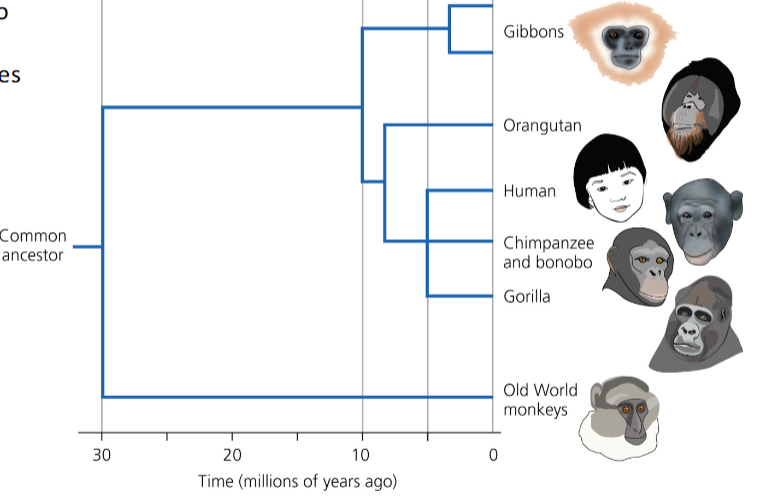
Image occlusion: name the hidden labels
48
Image occlusion: name the hidden labels
49
Image occlusion: name the hidden labels
50
Image occlusion: name the hidden labels
51
human specific adaptations
Associated with complex tool use
Capacity for symbolic thought
thicker metacarpel
Capacity for symbolic thought
thicker metacarpel
52
evidence for out of africa theory vs multiregional theory
out of africa supported by higher genetic diversity in african populations than non-african pops
53
dna sequencing revelations about human-neanderthal hybridization
mitochondrial dna inconsistent with history of interbreeding
hybridization must have occured outside of africa
hybridization was unidirectional, bc we don't have neanderthal mitochondria
hybridization must have occured outside of africa
hybridization was unidirectional, bc we don't have neanderthal mitochondria
54
example of gene change reflecting technology change
higher amylase copy count in japanese and euro-americans show switch to higher starch diet consistent with domestication of cereals grains