Lecture 12 - post surgical intervention
Study these flashcardsFree · spaced repetition · iPhone, Android, Mac & web
All cards
1
risk factors poor outcomes wound healing
nutrition/hydration
Metabolic conditions (diabetes, renal disease, cardiovascular disease)
collagen disease
aging
social habits
activity level
mental state
social support
knowledge of health
Metabolic conditions (diabetes, renal disease, cardiovascular disease)
collagen disease
aging
social habits
activity level
mental state
social support
knowledge of health
2
Examination
systems review
Mobility assessment
muscle performance
Mobility assessment
muscle performance
3
systems
integumentary - wound integrity, temperature, color, moisture, edema, distal extremity
cardiovascular - HR, BP, perfusion in distal limbs
Pulmonary - RR
Neurological - cutaneous sensory integrity, assess for neuropathy or nociception
cardiovascular - HR, BP, perfusion in distal limbs
Pulmonary - RR
Neurological - cutaneous sensory integrity, assess for neuropathy or nociception
4
RTC Repair indications
>1-1.5 cm symptomatic tears should be considered for repair in younger individuals
Tear size, acuity, presence of irreparable changes to RTC and GH joint and patient age should all be considered in decision to repair
Failed conservative care or indication of progression through MRI and symptoms would warrant repair
Tear size, acuity, presence of irreparable changes to RTC and GH joint and patient age should all be considered in decision to repair
Failed conservative care or indication of progression through MRI and symptoms would warrant repair
5
RTC Repair Risks for Post Op RTC Failure
increased age
poor tissue quality/fatty infiltrate
muscle atrophy
smoking
hypercholesterolemia
poorly managed diabetes
poor tissue quality/fatty infiltrate
muscle atrophy
smoking
hypercholesterolemia
poorly managed diabetes
6
Mobility assessment
total shoulder passive ROM limited by guidelines and time
elbow/forearm mobility assessment
Joint mobility of SC/AC joints
elbow/forearm mobility assessment
Joint mobility of SC/AC joints
7
muscle performance
no active contraction of RTC
Isometric scapula
Isometric scapula
8
post op protocols
start with isometrics, bc no shortening or lengthening so won't affect procedure
9
protected PROM should be considered during the
first 6 weeks after arthroscopic RCR of small to medium tears
10
supervised rehab should monitor ....... and .... as indicators of progress
ER in neutral abduction
Elevation ROM
Elevation ROM
11
stiffnss after arhtroscopic RCR at 1 year is not common (3%-10%) but individuals with .... may benefit from additional focus on their PROM during the first 6 weeks
diabetes, thyroid disorders, acute RTC tears, partial thickness tears, and adhesive capsulitis
12
muscle performance strategies should begin with
AROM exercises with the upper extremity in a short lever or gravity minimized position with a <15% supra EMG activity level, followed by progresive stresses with a longer lever or higher loads
13
Patient education is important to .... after athroscopic RCR and should include
success
short-term activity modifications, compliance with home exercises, and resolution of shoulder stiffness balanced with long-term healing of the rotator cuff
short-term activity modifications, compliance with home exercises, and resolution of shoulder stiffness balanced with long-term healing of the rotator cuff
14
Phase 1 (4-6 weeks) intervention RTC
maintain integrity of repair
Minimize pain and inflammation
Achieve ROM goals
Educate patient post op precautions
Normalize Scapula mobility
Minimize pain and inflammation
Achieve ROM goals
Educate patient post op precautions
Normalize Scapula mobility
15
Phase 2 (6-12 weeks) Intervention
Promote healing of soft tissue: NOT Overstress
Achieve ROM Goals
Minimal Pain and Inflammation
Initiate Light Muscle Performance Activities
Perform Light Non-repetitive ADL activities at chest level
Achieve ROM Goals
Minimal Pain and Inflammation
Initiate Light Muscle Performance Activities
Perform Light Non-repetitive ADL activities at chest level
16
Phase 2-3 (8-16 weeks) intervention
Full P/AROM
Optimize neuromuscular control
Gradually restore strength
Return to ADL's, work, as long as not powerful or repetitive movements
NO OVERHEAD
Optimize neuromuscular control
Gradually restore strength
Return to ADL's, work, as long as not powerful or repetitive movements
NO OVERHEAD
17
open shoulder stabilization precaution
when open performed need to be aware of muscles that were released to access joint capsule
18
athroscopic anterior stabilization precautions
-remain in sling, only removing for showering and elbow/wrist ROM
-patient education regarding avoidance of abduction/external rotation activity to avoid inferior capsule stress
-No passive ROM or active ROM of shoulder
-No lifting of objects with operative shoulder
-keep incisions clean and dry
-patient education regarding avoidance of abduction/external rotation activity to avoid inferior capsule stress
-No passive ROM or active ROM of shoulder
-No lifting of objects with operative shoulder
-keep incisions clean and dry
19
-postoperative brace (typically gunslinger type) in 30-45 deg abduction, 15 deg external rot for 4-6 weeks
-brace to be worn at all times (even when sleeping) with the exception of exercise activity and bathing
-no overhead activity
-no flexion for first 6 weeks
-brace to be worn at all times (even when sleeping) with the exception of exercise activity and bathing
-no overhead activity
-no flexion for first 6 weeks
20
surgical GH stabilization Phase 1 (1-21 days)
protect the repair - emphasis on ST muscle control and gentle low level isometrics of RTC
21
surgical GH stabilization Phase 2 (4-5 weeks) and Phase 3 (6-7 weeks)
controlled ST mobility with osteokinematic control in cardinal plane (CONE) flex and abd to 90, ER to O at side IR to belly (depends on direction of instability)
progress from ST control within 0-30 to 30-90
technically establishin arthrokinematic control prior to osteokinematic control
progress from ST control within 0-30 to 30-90
technically establishin arthrokinematic control prior to osteokinematic control
22
surgicl gh stabilization phase 4 ( 8-12 weeks)
Active movement through full motion if movement without deviation, initiate some strengthening
23
surgical GH stabilization phase 5 (12-20 weeks)
initiate functional tasks
24
SLAP repair, brigham protocol Types I/III
intact biceps anchor
25
SLAP repair, Brigham Protocol types II/IV
Involve Biceps repair (tenodesis) or removal (tenotmy)
26
SLAP repair PT exam
-Determine type of intervention
-If not biceps repair may allow movement early
-Labrum repair vs debride will dictace exercise progression
-If not biceps repair may allow movement early
-Labrum repair vs debride will dictace exercise progression
27
SLAP Type I/II Phase 1 (days 1-14)
Goals - re establish nonpainful ROM, minimize muscular atrophy, decrease pain/inflammation
Sling - 3-4 days postoperatively
ROM - Passive/AA ROM
-pendulums
-pulleys when pt has adequate GH elevation 90-110
-cane exercises - flex/ext, abd/add, ER/IR begin at 0 deg and, progress to 45 then 90
-Self stretches (capsular stretches)
Strengthening
-isometrics
-no biceps isometrics for five to seven days postoperative
-may initiate band exercises for ER/IR at 0deg and late phase (7-10 says postop)
Decrease Pain and Inflammation
-ice, medication, modalities
Criteria to progress to phase II
-full PROM
Minimal pain and tenderness
Sling - 3-4 days postoperatively
ROM - Passive/AA ROM
-pendulums
-pulleys when pt has adequate GH elevation 90-110
-cane exercises - flex/ext, abd/add, ER/IR begin at 0 deg and, progress to 45 then 90
-Self stretches (capsular stretches)
Strengthening
-isometrics
-no biceps isometrics for five to seven days postoperative
-may initiate band exercises for ER/IR at 0deg and late phase (7-10 says postop)
Decrease Pain and Inflammation
-ice, medication, modalities
Criteria to progress to phase II
-full PROM
Minimal pain and tenderness
28
SLAP Type I/II Phase 2 (intermediate 2-4 weeks)
Goals - enhance muscular strength, normalize arthrokinematics, improve neuromuscular control of shoulder complex
Week 2 - begin AROM all directions to tolerance
Week 3
Exercises - initiate isotonic program for shoulder and ST muscles with appropriate
-resisted ER/IR at 0 deg abduction
-sidelying ER, abd, hor abd, and add
-prone rowing
-PNF manual resistance with dynamic stabilization
Normalize arthrokinematics of shoulder complex
-joint mob
-continue stretching of shoulder (ER/IR at 90 deg abd)
-initiate neuromuscular control exercises
-initiate trunk exercises
-Initiate UE endurance exercises
Decrease Pain/inflammation
-continue use of modalities prn
Week 4
Exercises
-Begin throwers ten program
-emphasis on RTC and ST Strengthening
-dynamic stabilization drills
Criteria to enter phase III
-Full nonpainful AROM and PROM
-No pain or tenderness
-4+/5 strength in deltoid and RTC
Week 2 - begin AROM all directions to tolerance
Week 3
Exercises - initiate isotonic program for shoulder and ST muscles with appropriate
-resisted ER/IR at 0 deg abduction
-sidelying ER, abd, hor abd, and add
-prone rowing
-PNF manual resistance with dynamic stabilization
Normalize arthrokinematics of shoulder complex
-joint mob
-continue stretching of shoulder (ER/IR at 90 deg abd)
-initiate neuromuscular control exercises
-initiate trunk exercises
-Initiate UE endurance exercises
Decrease Pain/inflammation
-continue use of modalities prn
Week 4
Exercises
-Begin throwers ten program
-emphasis on RTC and ST Strengthening
-dynamic stabilization drills
Criteria to enter phase III
-Full nonpainful AROM and PROM
-No pain or tenderness
-4+/5 strength in deltoid and RTC
29
SLAP Type I/II Phase III - dynamic + advanced strengthening phase (week 5-7)
Goals - enhance strength, power, and endurance
Exercises
-continue thrower's ten program
-dumbell strengthening (RTC, deltoid)
-initiate strengthening exercises in the 90/90 for ER/IR
-strengthening of ST musculature
-biceps stregnthening
-initiate plyometrics
-Diagonal patterns (PNF)
-may initiate isokinetic strengthening
-continue endurance exercises - neuromuscular control exercises
-continue proprioception exercises
Criteria for progression to phase IV
-Full ROM, no pain or tenderness, satisfactory clinical examination
Exercises
-continue thrower's ten program
-dumbell strengthening (RTC, deltoid)
-initiate strengthening exercises in the 90/90 for ER/IR
-strengthening of ST musculature
-biceps stregnthening
-initiate plyometrics
-Diagonal patterns (PNF)
-may initiate isokinetic strengthening
-continue endurance exercises - neuromuscular control exercises
-continue proprioception exercises
Criteria for progression to phase IV
-Full ROM, no pain or tenderness, satisfactory clinical examination
30
SLAP Type I/II Phase IV return to activity (week 8 and beyond)
Goal - progressively increase activities to prepare pt for full functional return
Exercises
-Initiate intervals sport program
-Continue all exercises as in phase 3
-Progress interval program
Exercises
-Initiate intervals sport program
-Continue all exercises as in phase 3
-Progress interval program
31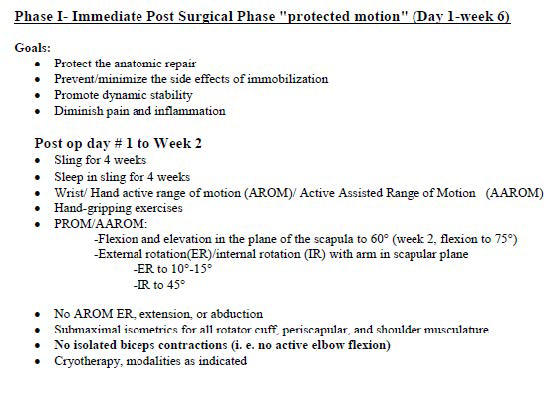
SLAP Type II/IV Phase I - Day 1 -week 6 (only day 1-week2)
32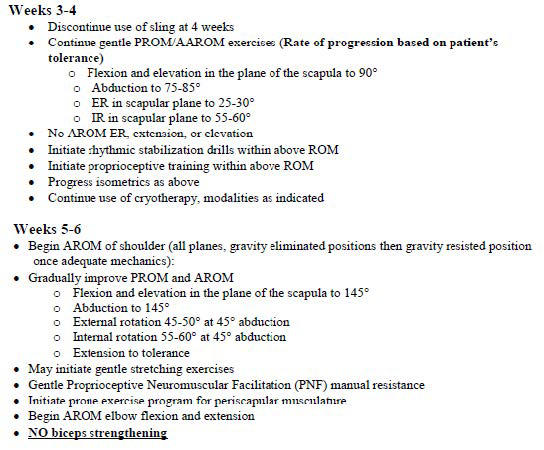
SLAP Type II/IV Phase I (weeks 3-4 and 5-6)
33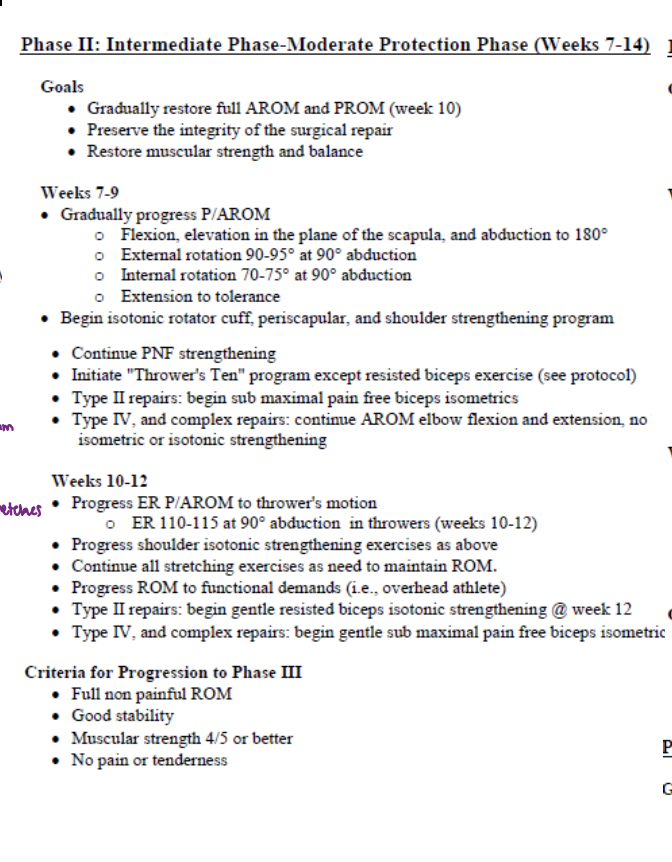
SLAP Type II/IV Phase II (weeks 7-14)
34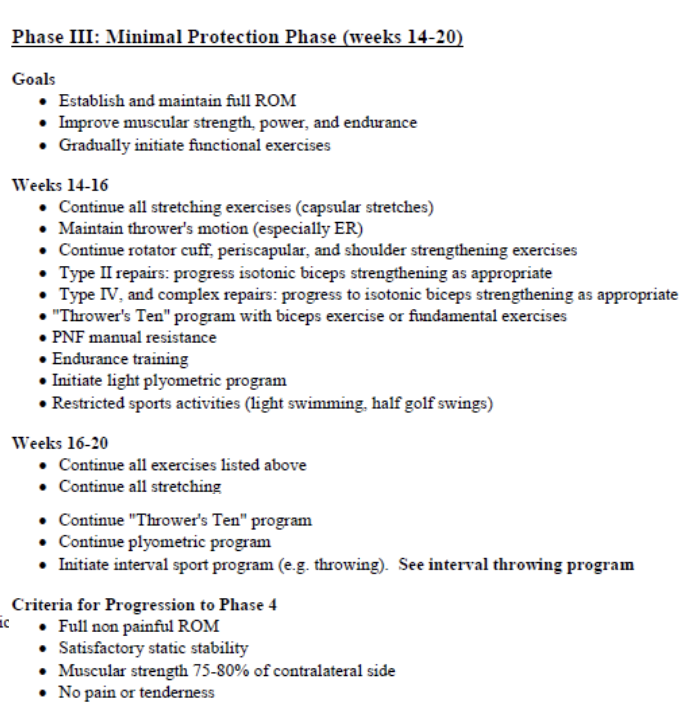
SLAP Type II/IV Phase 3 (weeks 14-20)
35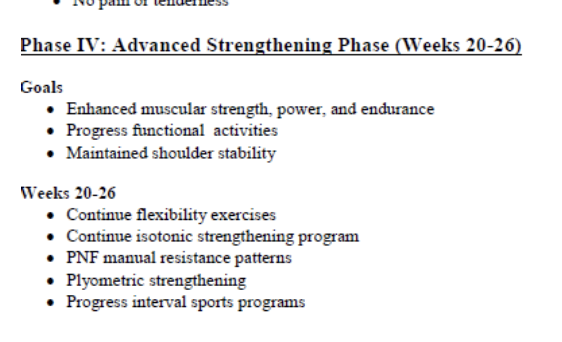
SLAP Type II/IV Phase IV (weeks 20-26)
36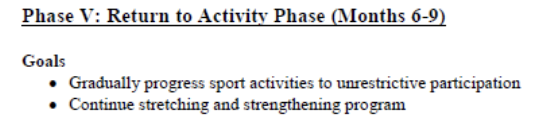
SLAP Type II/IV Phase 5 (months 6-9)
37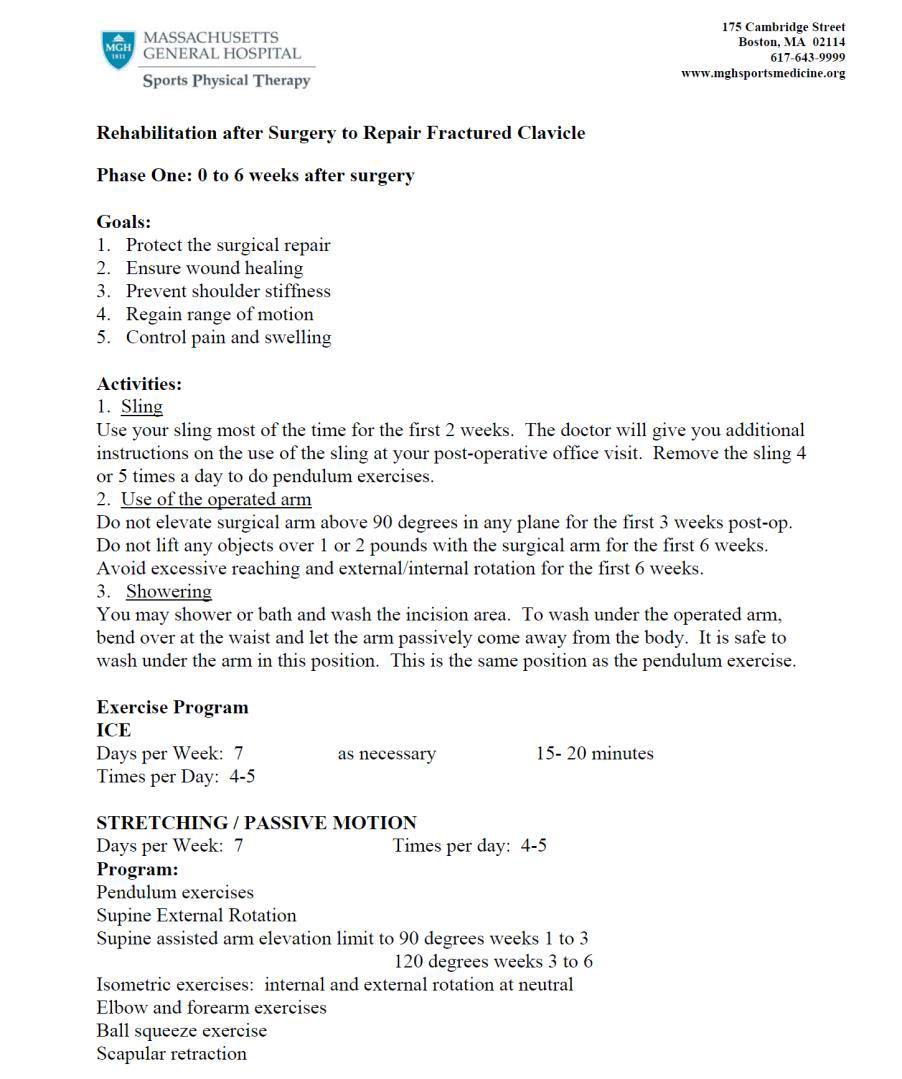
Clavicel Fracture Phase I
38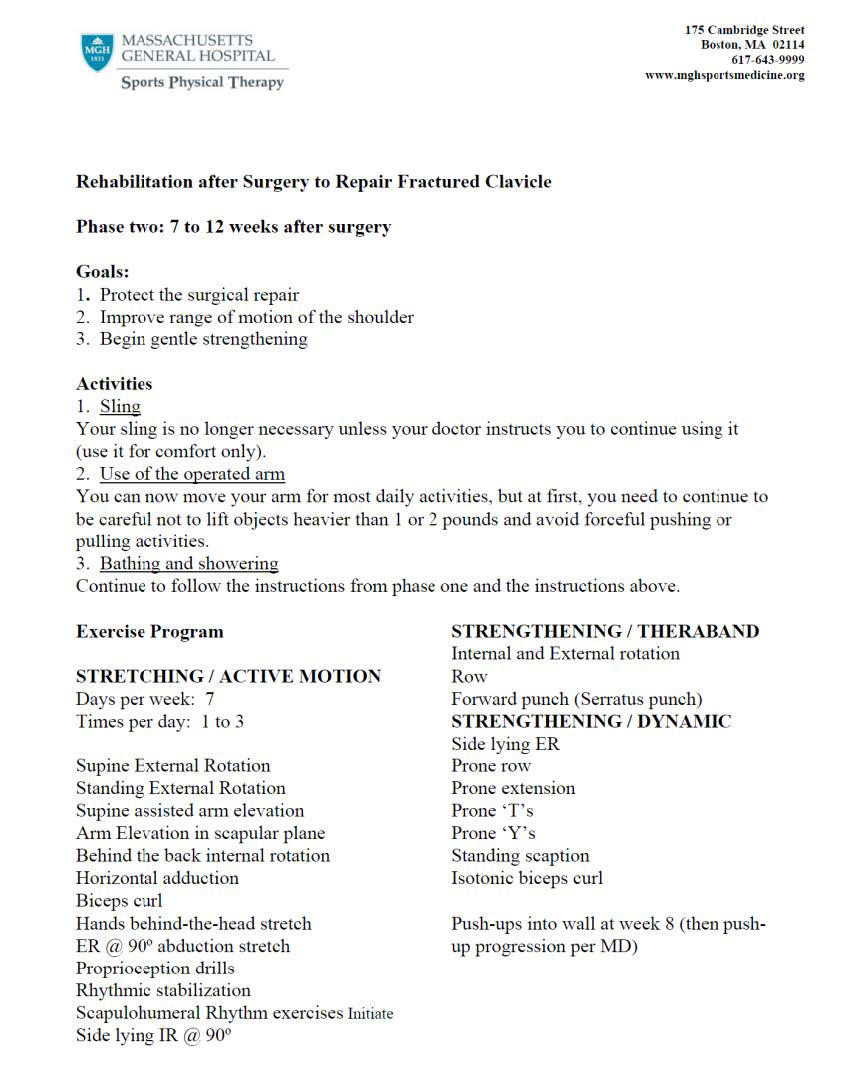
Clavicle Fracture phase 2
39
Humeral Fracture Phase 1 (1-4 weeks)
Minimize pain and inflammatory response
Protect the Fracture and optimize boney healing
Restore shoulder PROM
Maintain elbow, forearm, wrist and hand function
Protect the Fracture and optimize boney healing
Restore shoulder PROM
Maintain elbow, forearm, wrist and hand function
40
Humeral Fracture Phase 2 (4-8 weeks)
Full PROM by 8 weeks, Initiate AAROM
Initiate Active ROM ~6 weeks
Initiate Elbow forearm strengthening
Minimize compensatory(maladaptive) movements
NO STRENGTHENING to Shoulder Yet
Initiate Active ROM ~6 weeks
Initiate Elbow forearm strengthening
Minimize compensatory(maladaptive) movements
NO STRENGTHENING to Shoulder Yet
41
Humeral Fracture Phase 3 (8-12 weeks)
Full shoulder AROM by 12 weeks
Initiate shoulder strengthening
Progress Elbow Forearm and hand strengthening
Pain Management
Initiate shoulder strengthening
Progress Elbow Forearm and hand strengthening
Pain Management
42
Humeral fracture Phase 4 Goals: (12 weeks plus)
Progression of Functional Optimization, including strength, endurance and power
43
Criteria for Progression of Strength and power
80% OR > STRENDTH COMPARED TO UNINVOLVED UE MEASURED WITH
DYNOMOMETRY
DYNOMOMETRY