Foot and Ankle
Study these flashcardsFree · spaced repetition · iPhone, Android, Mac & web
All cards
1
3 components of foot
rearfoot - talus, calcaneus
midfoot - navicular, cuboid, 3 cuneiform
forefoot - metatarsals, phalanges
midfoot - navicular, cuboid, 3 cuneiform
forefoot - metatarsals, phalanges
2
primary role of foot/ankle -
secondary roles -
secondary roles -
to bear weight
promote stability, but also mobility depending on functional needs
respond to forces from the ground and imposed forces from joints above
promote stability, but also mobility depending on functional needs
respond to forces from the ground and imposed forces from joints above
3
motions at the ankle
dorsiflexion/plantar flexion
inversion/eversion
abduction/adduction
inversion/eversion
abduction/adduction
4
foot and ankle joints
proximal tibiofibular joints
distal tibiofibular joint
talocrural joint (ankle)
talocalcaneal joint (subtalar)
transverse tarsal joint (talonavicular and calcaneocuboid joint)
5 tarsometatarsal joints
5 metatarsophalangeal joints
9 interphalangeal joints
distal tibiofibular joint
talocrural joint (ankle)
talocalcaneal joint (subtalar)
transverse tarsal joint (talonavicular and calcaneocuboid joint)
5 tarsometatarsal joints
5 metatarsophalangeal joints
9 interphalangeal joints
5
what type of joint is proximal tibiofibular joint?
reinforced by -
reinforced by -
plane, synovial joint with convex tibial facet and concave fibular facet
joint capsule, ant and post tibiofibular ligaments
joint capsule, ant and post tibiofibular ligaments
6
whatt type of joint is the distal tibiofibular joint?
joint capsule?
role?
joint capsule?
role?
syndesmotic joint - concave tibia and convex fibula
no joint capsule, but many ligaments
interosseous membrane, ant and post tibiofibular ligaments
stability: ligaments responsible for maintaining stable mortise, fibular will provide mobility for function of these joints
no joint capsule, but many ligaments
interosseous membrane, ant and post tibiofibular ligaments
stability: ligaments responsible for maintaining stable mortise, fibular will provide mobility for function of these joints
7
what kind of joint is the talocrural joint (ankle joint)?
ankle mortise?
ankle mortise?
synovial hinge joint - concave distal tibia, convex talus
fibula extends more on the lateral side than the tibia on the medial side - therefore doesn't lie in 1 axis so very hard to isolate movements
fibula extends more on the lateral side than the tibia on the medial side - therefore doesn't lie in 1 axis so very hard to isolate movements
8
lateral ligaments at the ankle joint + function
anterior talofibular (resists plantarflexion), posterior talofibular (resists dorsiflexionn), calcaneofibular (control inversion)
control inversion of the ankle/talus
weaker, more susceptible to injury
supports the talocrural and subtalar joints
control inversion of the ankle/talus
weaker, more susceptible to injury
supports the talocrural and subtalar joints
9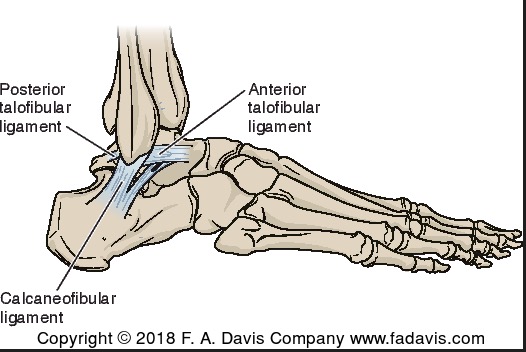
Image occlusion: name the hidden labels
10
Image occlusion: name the hidden labels
11
Image occlusion: name the hidden labels
12
primary role of anterior talofibular ligament
limits anterior translation of the talus
ankle sprains!
ankle sprains!
13
if ATFL is disrupted, the talus will sit _______ and will cause the ankle to have limited ______
anteriorly
dorsiflexion
dorsiflexion
14
medial ligaments at ankle joint and their function
deltoid ligament
medial malleolus -> nevicular, talus, calcaneus
controls eversion and abduction of the ankle/talus - extremely strong
supports talocrural and subtalar joints
medial malleolus -> nevicular, talus, calcaneus
controls eversion and abduction of the ankle/talus - extremely strong
supports talocrural and subtalar joints
15
subtalar joint
receives support from -
receives support from -
articulation between the talus and calcaneus
posterior - concave talus convex calcaneus
anteiror - convex talus, concave calcaneus
cervical ligament
posterior - concave talus convex calcaneus
anteiror - convex talus, concave calcaneus
cervical ligament
16
what joint can be the most manipulated?
subtalar joint
17
transverse tarsal joint is made up of what two joints?
talonavicular (medial): anterior talus and navicular
calcaneocuboid (lateral): anterior calcaneus and cuboid
calcaneocuboid (lateral): anterior calcaneus and cuboid
18
tarsometatarsal joint
supports?
supports?
plane, synovial joint
distal row of tarsals posteriorly, bases of the metatarsals anteriorly
1st metatarsal and medial cuneiform
2nd metatarsal and middle cuneiform
3rd metatarsal and lateral cuneiform
4th and 5th metatatsals and cuboid
many ligamentous supports: deep transverse metatarsal ligament (keeps the metatarsals from spreading)
distal row of tarsals posteriorly, bases of the metatarsals anteriorly
1st metatarsal and medial cuneiform
2nd metatarsal and middle cuneiform
3rd metatarsal and lateral cuneiform
4th and 5th metatatsals and cuboid
many ligamentous supports: deep transverse metatarsal ligament (keeps the metatarsals from spreading)
19
metatarsophalageal joints (MTP)
weight bearing?
weight bearing?
condyloid with 2 DoF: flexion/ext, ab/adduction
convex metatarsal heads, concave bases of proximal phalanges
all metatarsal heads bear weight in stance
2 seasamoid bones at the first metatarsal
convex metatarsal heads, concave bases of proximal phalanges
all metatarsal heads bear weight in stance
2 seasamoid bones at the first metatarsal
20
stability at MTP provided by
joint capsule
plantar plates
collateral ligaments
deep transverse metatarsal ligament
plantar plates
collateral ligaments
deep transverse metatarsal ligament
21
the 2 seasamoid bones at the 1st metatarsal do what?
act as a pulley for FHB, and protext FHL
22
interphalangeal joints
synovial hinge joints with one degree of freedom: flex/ext
23
primary function of interphalangeal joints
smooth the weight shift to the opposite foot in gait
help maintain stability by pressing against the ground in standing
help maintain stability by pressing against the ground in standing
24
normal PROM for talocrural joint
DF: 0-20 deg
PF: 0-50 deg
PF: 0-50 deg
25
since the axis does not lie in 1 plane, what motions can occur at the talocrural joint?
DF/PF
inversion/eversion
ab/adduction
inversion/eversion
ab/adduction
26
talus is wider anteriorly than posteiorly, what does that mean for function?
limited dorsiflexion compared to plantarflexion
as the talus glides posteriorly, tighter fit
more likely to see ankle sprains in positions of PF and inversion
as the talus glides posteriorly, tighter fit
more likely to see ankle sprains in positions of PF and inversion
27
as the talus rolls anteriorly, glides posteriorly during ankle DF, what does the distal fibula need to do to accommodate this? anything else?
posterior glide of talus
muscle length of gastroc
posterior glide of distal fibula
anterior glide of proximal fibula
muscle length of gastroc
posterior glide of distal fibula
anterior glide of proximal fibula
28
ankle PF/DF primarily restricted by
what is not common?
what is not common?
soft tissue structures:
medial and lateral ankle ligaments
active or passive tension in which muscles
bony end feel not common
medial and lateral ankle ligaments
active or passive tension in which muscles
bony end feel not common
29
you suspect that your patient has limited muscle length of their gastroc. Would you expect their ankle DF ROM to be more limited when measured in knee flexion or extension?
extension - lengthened across the knee, passively insufficient
30
in real life, most function of talocrural joint is
weight bearing
31
where in the gait cycle would you need the most ankle DF ROM?
swing
32
triplanar motions of the talus:
what does this produce?
what does this produce?
AP axis - inversion/eversion
vertical axis - adduction/abduction
horizontal/ML axis - DF/PF (slightly)
-first 2 in equal parts
pronation/supination
vertical axis - adduction/abduction
horizontal/ML axis - DF/PF (slightly)
-first 2 in equal parts
pronation/supination
33
non weight bearing subtalar motion
NWB supination
NWB pronation
NWB supination
NWB pronation
movement of the calcaneus on a relatively stationary talus and lower leg
supination - calcaneal adduction, inversion, and PF (calcaneal varus)
pronation - calcaneal abduction, eversion, and DF (calcaneal valgus)
supination - calcaneal adduction, inversion, and PF (calcaneal varus)
pronation - calcaneal abduction, eversion, and DF (calcaneal valgus)
34
weight bearing subtalar joint motion
pronation -> Tibial IR, Talar add and pf, calcaneal eversion -> arch flatters
supination -> Tibial ER, Talar abd and df, calcaneal inversion -> arch lifts
supination -> Tibial ER, Talar abd and df, calcaneal inversion -> arch lifts
35
limited in WB ankle DF can lead to what
excessive pronation to increase DF
Tibia IR
increased Q angle
valgus
hip IR or adduction
Tibia IR
increased Q angle
valgus
hip IR or adduction
36
transverse tarsal joint TTJ primary roles
transitional link between rearfoot and forefoot
adds to pronation/supination ROM at subtalar joint
compensates the forefoot for rearfoot position and movement
-basically opposite of what subtalar joint is doing in order to keep the foot on the ground
-useful when on uneven ground, ability to twist through the midfoot so that the rear and forefoot can do separate movements
adds to pronation/supination ROM at subtalar joint
compensates the forefoot for rearfoot position and movement
-basically opposite of what subtalar joint is doing in order to keep the foot on the ground
-useful when on uneven ground, ability to twist through the midfoot so that the rear and forefoot can do separate movements
37
tarsometatarsal joints (TMT) primary role
augment the function of the TTJ
regulate position of the metatarsals and phalanges in relation to WB surface
-like a backup to TTJ when inadequate to accomodate the forefoot
regulate position of the metatarsals and phalanges in relation to WB surface
-like a backup to TTJ when inadequate to accomodate the forefoot
38
MTP joint primary roles
allow the WB foot to roate over the toes through MTP extension - metatarsal break
push off in late phase of gait - particularly first MTP joint
push off in late phase of gait - particularly first MTP joint
39
how does MTP joint extension pain affect gait?
significantly reduces step length
most noticable right before toe off
most noticable right before toe off
40
plantar arches
medial longitudinal arch
lateral longitudinal arch
transverse arch
lateral longitudinal arch
transverse arch
41
why plantar arches important?
need to serve both contrasting mobility and stability
need to be mobile in order to dampen the impact of WB forces, superimposed rotational motions, and adapt to changes in surfaces
also need stability and to allow distribution of weight for conversion of a flexible foot to a rigid level for push off
need to be mobile in order to dampen the impact of WB forces, superimposed rotational motions, and adapt to changes in surfaces
also need stability and to allow distribution of weight for conversion of a flexible foot to a rigid level for push off
42
plantar fascia plays a role in -
arch support
43
Windlass mechanism!
great toe extension -> tightens ? ->
great toe extension -> tightens ? ->
tightens plantar fascia
heel and MTP are drawn closer together
arch is raised
contributes to supination for rigid lever for push off in gait
basically extending the big toe makes the foot arch
heel and MTP are drawn closer together
arch is raised
contributes to supination for rigid lever for push off in gait
basically extending the big toe makes the foot arch
44
extrinsic muscles in the posterior compartment
gastroc
soleus
tibialis posterior
FDL
FHL
all can plantarflex the ankle
also helps with postural control
soleus
tibialis posterior
FDL
FHL
all can plantarflex the ankle
also helps with postural control
45
extrinsic muscles lateral compartment
peroneus longus, brevis, tertius - PF
EDL - DF
- all evert the foot
EDL - DF
- all evert the foot
46
anterior compartment
tibialis anterior
EHL - 2 joint muscle
EHL - 2 joint muscle
47
intrinsic muscles of the foot are all active during
weight bearing tasks
even supporting the arches in static standing
even supporting the arches in static standing
48
common pathologies in the foot and ankle
fractures
tendinopathies
plantar heel pain
lateral ankle pain
tendinopathies
plantar heel pain
lateral ankle pain