Lecture 14 +15 - Neuroanatomy
Study these flashcardsFree · spaced repetition · iPhone, Android, Mac & web
All cards
1
Neuropathy Causes
Immobilization
Stretch
Compression
Laceration
Repetitive Stress
Stretch
Compression
Laceration
Repetitive Stress
2
Immobilization
induces cell biological changes in axons and axon terminas, myelin degeneration, deposition of collagen in endoneurium, 6 weeks deposition of collagen and alteration in large diameter myelinated fibers
3
Lengthening/Stretch
6-8% strain for short duration are tolerable no injury to nerve, increasing tensile load in nerve results in structural separtion in core-sheath interface and then axons and finally cells
lengthening creates compression in diameter and disruption of vascular flow blocking conduction and resulting in inflammatory effects
lengthening creates compression in diameter and disruption of vascular flow blocking conduction and resulting in inflammatory effects
4
Compression
20-30 mm Hg has been shown to reduce nerve blood flow and result in injury
50 mm Hg sustained for 2 minutes has been shown to result in 30% axon demyelination
50 mm Hg sustained for 2 minutes has been shown to result in 30% axon demyelination
5
repetitive stress
vibration causes loss in sensory and motor performance, dennervation and reinnervation.
repetitive motion chronic inflammation, hydrostatic compressive stress and increased stiffness
repetitive motion chronic inflammation, hydrostatic compressive stress and increased stiffness
6
Radiculopathy symptoms
pain, tingling, numbness that radiates from neck into shoulder, arm, hand, fingers
Neck pain, periscapular pain, elbow pain, wrist and hand pain
+ Spurlings
Neck pain, periscapular pain, elbow pain, wrist and hand pain
+ Spurlings
7
C5 dermatome, myotome, and reflex
Dermatome - lateral upper arm
Myotome - shoulder abduction, elbow flexion
Reflex - Biceps
Myotome - shoulder abduction, elbow flexion
Reflex - Biceps
8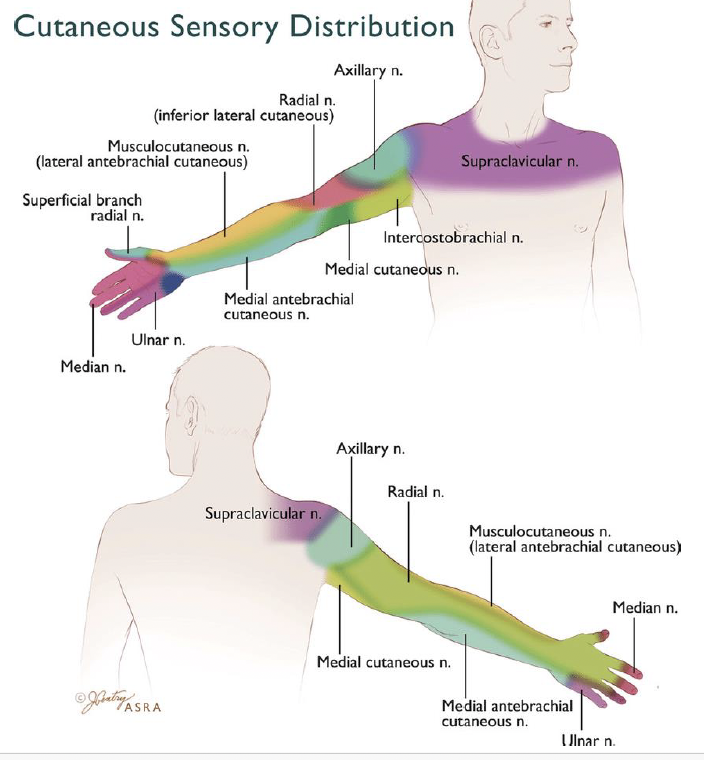
Image occlusion: name the hidden labels
9
Image occlusion: name the hidden labels
10
Image occlusion: name the hidden labels
11
Image occlusion: name the hidden labels
12
Image occlusion: name the hidden labels
13
Image occlusion: name the hidden labels
14
C6 dermatome, myotome, reflex
lateral forearm to the thumb and 2nd digit
wrist extension, elbow flexion
brachioradialis
wrist extension, elbow flexion
brachioradialis
15
C7 derm, myotome, reflex
anterior and posterior 3rd digit and hand
wrist flexion and elbow extension
triceps
wrist flexion and elbow extension
triceps
16
C8 dermatome, myotome, and reflex
ulnar side 4-5th digits and proximal wrist
finger flexion and thumb pinch
finger flexors
finger flexion and thumb pinch
finger flexors
17
Risk factors for thoracic outlet
women
late teens-40s
obesity, hypermobility, postural abnormalities
repetitive use of hands
young athletic males
late teens-40s
obesity, hypermobility, postural abnormalities
repetitive use of hands
young athletic males
18
neurogenic TOS
numbness, tingling, dead arm
pain at rest/night
weakness/clumsiness
caused by compression of brachial plexus
pain at rest/night
weakness/clumsiness
caused by compression of brachial plexus
19
Venous TOS
compression of subclavian vein
sweling in arm/hand/fingers
bluish skin
fatigue in limb
tingling/numbness/ burning
progressive in nature, increases with activity
sweling in arm/hand/fingers
bluish skin
fatigue in limb
tingling/numbness/ burning
progressive in nature, increases with activity
20
arterial TOS
rarest - subclavian artery
cold, pale, discolored
weak/absent pulse
pain
tingling/numbness/ burning
progressive in nature: increases with activity
cold, pale, discolored
weak/absent pulse
pain
tingling/numbness/ burning
progressive in nature: increases with activity
21
Nonspecific TOS
can present as both vascular and nerve
no specific pattern
change in pain with use of arm
no specific pattern
change in pain with use of arm
22
osseous cause of TOS
trauma - fracture of 1st rib or clavicle
congenital - 1st rib anomalies, cervical rib (extra rib from 7th vertebra), elongated C7 transverse process
congenital - 1st rib anomalies, cervical rib (extra rib from 7th vertebra), elongated C7 transverse process
23
soft tissue cause TOS
trauma - scalene (anterior/middle)
congenital/acquired - abnormal cervical ligaments/ bands which tighten the space
congenital/acquired - abnormal cervical ligaments/ bands which tighten the space
24
risk for peripheral neuropathy
fracture of upper extemity consider anatomy near or around nerve
surgical interventions
joint dislocations or instability
chronic tendon disorders
surgical interventions
joint dislocations or instability
chronic tendon disorders
25
Long Thoracic Nerve Injury causes
direct blow
traction - lateral flexion of the cervical spine with the arm over head
compression against the chest wall
heav effort above shoulder height
repetitive strain
traction - lateral flexion of the cervical spine with the arm over head
compression against the chest wall
heav effort above shoulder height
repetitive strain
26
Suprascapular Injury Risk
Erb's point direct impact
Compression in the suprascapular notch
Spenoglenoid notch
forceful scapula depression with cervical sidebending
RTC Tear
Compression in the suprascapular notch
Spenoglenoid notch
forceful scapula depression with cervical sidebending
RTC Tear
27
Axillary nerve Risk
anterior shoulder dislocation
surgical procedures for capsular repair
aggressive manipulatio of adhesive capsulitis
surgical procedures for capsular repair
aggressive manipulatio of adhesive capsulitis
28
Musculocutaneous nerve risk
entrapment in coracobrachialis
heavy weight lifting with flexion, elbow flexion, and forearm pronation
mid-shaft humeral fracture
heavy weight lifting with flexion, elbow flexion, and forearm pronation
mid-shaft humeral fracture
29
Long thoracic motor and sensory distribution
serratus anterior
no sensory
no sensory
30
suprascapular motor and sensory distribution
supraspinatus, infraspinatus
small area on shoulder above spine of scapula
small area on shoulder above spine of scapula
31
axillary motor and sensory
deltoid, teres minor
lateral upper arm over deltoid
lateral upper arm over deltoid
32
musculocutaneous motor and sensory distribution
biceps, coracobrachialis, brachialis
lateral forearm anterior/posterior to wrist
lateral forearm anterior/posterior to wrist
33
median nerve before anterior interosseous muscles
Pronator teres
flexor carpi radialis
Palmaris longus
flexor carpi radialis
Palmaris longus
34
anterior interosseous muscles (median nerve) and sensory
FDS, FPL, FDP (2+3), pronator quadratus
no sensory
no sensory
35
Median nerve at wrist muscles and sensory
Thenar muscles: APB, FPB, OP,
first and 2nd lumbricals
finger flexors?
palmar surface of thumb through middle half of 4, posterior tip of DIPs
first and 2nd lumbricals
finger flexors?
palmar surface of thumb through middle half of 4, posterior tip of DIPs
36
Ulnar nerve high muscles and sensory
FCU, FDP 4+5, ECU
dorsal and palmar 4th and 5th digits of hand to wrist crease
dorsal and palmar 4th and 5th digits of hand to wrist crease
37
Ulnar nerve wrist muscles and sensory
interossei
4th and 5th digits
ADpollicis
1 head of FPB
lumbricals 3, 4
Abd Digiti minimi
ODM
FDM
PB
4th and 5th digits
ADpollicis
1 head of FPB
lumbricals 3, 4
Abd Digiti minimi
ODM
FDM
PB
38
radial nerve high (axilla) muscles and sensory
triceps, supinator, brachioradialis, ECRL
dorsal surface of hand, thumb-3rd
dorsal surface of hand, thumb-3rd
39
posterior interosseous (radial) muscles and sensory
abductor pollicis longus
extensor pollicis longus
extensor digitorum
supinator
ECU
extensor pollicis brevis + longus
extensor digitorum
extensor digiti minimi
abductor pollicis longus
extensor indicis
ECRL and ECRB
no sensory
extensor pollicis longus
extensor digitorum
supinator
ECU
extensor pollicis brevis + longus
extensor digitorum
extensor digiti minimi
abductor pollicis longus
extensor indicis
ECRL and ECRB
no sensory
40
radial nerve after radial groove muscles
brachialis - mostly musculocutaneous though
brachioradialis
brachioradialis
41
median nerve risk
repetitive tasks using pronation/supination of forearm, medial instability, fractures distal humerus and proximal ulna
42
radial nerve risk
sustained compression in axilla, fracture of mid shaft of humerus, posteriolateral rotary instability, chronic lateral epicondylitis, surgical debridement LET, radial head instability, sustained prolonged BP cuff inflation
43
ulnar nerve risk
valgus instability, chronic medial epicondylitis, direct or indirect trauma to medial elbow, throwing (traction injuries), positions that increase stretch
44
muscles of the hand ulnar
Add pollicis brevis
Flex DM
Abd DM
OP DM
Flex DM
Abd DM
OP DM
45
muscles of the hand median
FPB
OP
Abd PB
OP
Abd PB
46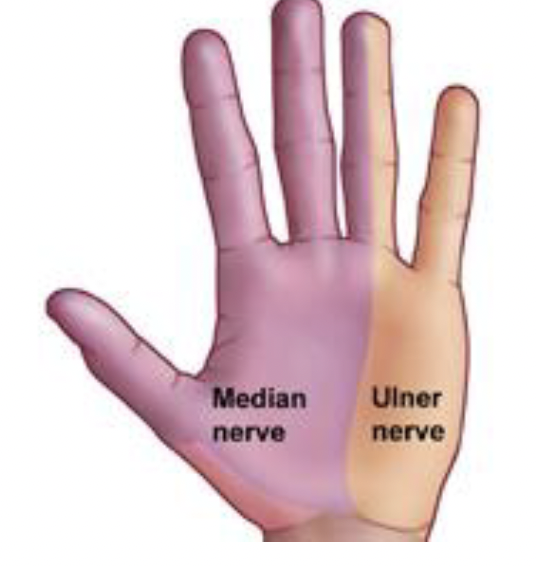
Image occlusion: name the hidden labels
47
Image occlusion: name the hidden labels
48
Most common peripheral neuropathy in UE
Carpal Tunnel Syndrome
49
__ % of the population will experience carpal tunnelin their lifetime
8
50
what gender more likely to get carpal tunnel?
women
common with pregnancy because of fluid retentiono
changes in estrogen with higher BMI + repetitive movement of limb
common with pregnancy because of fluid retentiono
changes in estrogen with higher BMI + repetitive movement of limb
51
increased incidence of carpal tunnel with
aging
synovial fluid is thicker, bigger joint = less space for the nerve
synovial fluid is thicker, bigger joint = less space for the nerve
52
Ulnar tunnel compression cause by
individuals with vibration exposure through work or recreation
53
Intrinsic Risk Factors for Carpal Tunnel
female
BMI >30
Diabetes
Reduced physical activity
OA
Pregnancy
Estrogen replacement therapy
Genetics
CV disease
Hypothyroidism
BMI >30
Diabetes
Reduced physical activity
OA
Pregnancy
Estrogen replacement therapy
Genetics
CV disease
Hypothyroidism
54
Extrinsic Risk factors carpal tunnel
forceful exertion wrist and hand
repetitive use
vibration
wrist position
repetitive use
vibration
wrist position
55
Katz score classic (3)
tingling, numbness, burning or pain in at least 2 of the digits (thumb index and long)
excluded if symptoms in the palm and dorsum of hand
small finger symptoms, wrist pain, or radiation proximal to the wrist allowed
excluded if symptoms in the palm and dorsum of hand
small finger symptoms, wrist pain, or radiation proximal to the wrist allowed
56
Clinical Examination Carpal tunnel
Vitals
AROM of cervical spine
Sensory Integrity in entire UE: distal thumb, 3rd and 5th digit; monofilament middle finger and tip of thumb 3.22; two point discrimination testing less than 4-5 mm
Motor assessment wrist/hand, all lumbricals (median vs ulnar)
Reflexes in UE
Mobility Wrist/elbow/forearm
joint play intercarpal bones/CMC of thumb
Specific Tissue tests: carpal compression, phalens, reverse phalens, tinnels, wrist ratio
AROM of cervical spine
Sensory Integrity in entire UE: distal thumb, 3rd and 5th digit; monofilament middle finger and tip of thumb 3.22; two point discrimination testing less than 4-5 mm
Motor assessment wrist/hand, all lumbricals (median vs ulnar)
Reflexes in UE
Mobility Wrist/elbow/forearm
joint play intercarpal bones/CMC of thumb
Specific Tissue tests: carpal compression, phalens, reverse phalens, tinnels, wrist ratio
57
specific tissue tests carpal tunnel
wrist ratio
phalen
carpal compression
tinel's sign median
monofilament testing
phalen
carpal compression
tinel's sign median
monofilament testing
58
3 gold standard carpal tunnel
age >45
shaking hands provide relief
wrist ratio greater than 0.67
dimished light touch in median nerve distribution
CTQ-SSS >1.9
shaking hands provide relief
wrist ratio greater than 0.67
dimished light touch in median nerve distribution
CTQ-SSS >1.9
59
wrist ratio
AP/ML
>.7 at risk for carpal tunnel
>.7 at risk for carpal tunnel
60
froment sign
ulnar nerve - paper in fingers
forearm
intrinsic is weak, extrinsic wants to take over, bend the knuckles
forearm
intrinsic is weak, extrinsic wants to take over, bend the knuckles
61
median nerve issues
pronator syndrome
anterior interosseous syndrome
anterior interosseous syndrome
62
ulnar nerve issues
cubital tunnel syndrome
63
radial nerve issues
high radial
radial sensory
posterior interosseous syndrome
radial sensory
posterior interosseous syndrome
64
pronator syndrome
median nerve compressed by pronator teres
everything distal is affected - FDS, palmaris longus, FCR
pain and weakness through the 1st and 3 fingers similar to CTS, numbness at proximal wrist distal thumb
pain in the forearm
everything distal is affected - FDS, palmaris longus, FCR
pain and weakness through the 1st and 3 fingers similar to CTS, numbness at proximal wrist distal thumb
pain in the forearm
65
exam findings pronator syndrome
impaired sensory and motor in the 1st and 3 digits of the hand
impaired sensation in base of wrist
proximal muscle weakness
-carpal tunnel maneuvers for provocation
+ pronator compression test
Break tests:
pronator teres
biceps aponeurosis
FDP
reflexes intact
impaired sensation in base of wrist
proximal muscle weakness
-carpal tunnel maneuvers for provocation
+ pronator compression test
Break tests:
pronator teres
biceps aponeurosis
FDP
reflexes intact
66
anterior interosseous syndrome
motor only
pronator quadratus
FDP 2,3
FPL
Pain in forearm, clumsiness of fingers
loss of grip of thumb and 1st finger
no atropgt of thenar eminence
no numbness or tingling only motor loss
pronator quadratus
FDP 2,3
FPL
Pain in forearm, clumsiness of fingers
loss of grip of thumb and 1st finger
no atropgt of thenar eminence
no numbness or tingling only motor loss
67
anterior interosseous exam findings
impaired motor only of the FDP of lateral hand
FPL and pronator quadratus
+Anterior Interosseous Sign
+Pronator Compression Sign
no loss of sensation
reflexes in tact
FPL and pronator quadratus
+Anterior Interosseous Sign
+Pronator Compression Sign
no loss of sensation
reflexes in tact
68
Cubital Tunnel Syndrome
ulnar nerve proximal most irritated
FCU, FDP 4+5, hand things
if compressed at wrist, then FDP and FCU are fine
if elbow, weak and sensory motor loss hand
FCU, FDP 4+5, hand things
if compressed at wrist, then FDP and FCU are fine
if elbow, weak and sensory motor loss hand
69
radial nerve can be compressed at
elbow, humerus, sensory branch more distal
70
posterior interosseous syndrome
deep digital muscles, thumb abd and ext
wrist extensors
below elbow ECRB
above elbow ECRL and brachioradialis
wrist extensors
below elbow ECRB
above elbow ECRL and brachioradialis
71
high radial exam findings and patient presentation
pain in posterior lateral arm and dorsal hand
significant loss of motor function in all wrist and finger/thumb extensors, brachioradialis, supinator
sensory loss in the dorsal arm and hand
motor loss in all muscles innervated by radial nerve, elbow, wrist and hand
significant loss of motor function in all wrist and finger/thumb extensors, brachioradialis, supinator
sensory loss in the dorsal arm and hand
motor loss in all muscles innervated by radial nerve, elbow, wrist and hand
72
radial sensory
pain along the radial distribution of the lateral forearm and dorsal wrist and thumb
loss of sensation along the dorsal lateral arm ad hand
loss of sensation along the dorsal lateral arm ad hand
73
posterior interosseous presentation and examinations
pain in the lateral elbow and forearm
loss of MCP extension, thumb IP extension and abduction
motor loss only: ECRB, supinator, ECU, EDM, EI, ED, APL, EPL, EPB
loss of MCP extension, thumb IP extension and abduction
motor loss only: ECRB, supinator, ECU, EDM, EI, ED, APL, EPL, EPB
74
ulnar nerve cubital tunnel elbow presentation and findings
medial elbow pain
snapping or popping with elbow motion
numbness and tingling in 4th and 5th digits
clumsiness of hand, loss of coordination of fingers
sensory loss of ulnar boarder ofhand, 4th and 5th digit
weakness of FDP 4th and 5th, FCU
ADM, FDM, ODM, DI, VI, 4th and 5th lumbricals, Add Pol, FPB
snapping or popping with elbow motion
numbness and tingling in 4th and 5th digits
clumsiness of hand, loss of coordination of fingers
sensory loss of ulnar boarder ofhand, 4th and 5th digit
weakness of FDP 4th and 5th, FCU
ADM, FDM, ODM, DI, VI, 4th and 5th lumbricals, Add Pol, FPB
75
clinical examination specific forearm
P/A rule out cervical spine
sensory assessment of involved UE
motor assessment of intrinsic vs extrinsic
UE reflex testing
Range of motion elbow/forearm/wrist
Selective tissue testing: anterior interosseous sign, pronator compression test, ulnar nerve compression test
sensory assessment of involved UE
motor assessment of intrinsic vs extrinsic
UE reflex testing
Range of motion elbow/forearm/wrist
Selective tissue testing: anterior interosseous sign, pronator compression test, ulnar nerve compression test
76
clinical exam specific shoulder
p/a rule out cervical spine
sensory assessment of involved UE
Motor assessment of muscles innervated by peripheral nerves
UE reflex testing
Range of motino of shoulder girdle
muscle length pectoralis minor/scales
Selective tissue testing: upper limb tension testing and thoracic outlet tests
sensory assessment of involved UE
Motor assessment of muscles innervated by peripheral nerves
UE reflex testing
Range of motino of shoulder girdle
muscle length pectoralis minor/scales
Selective tissue testing: upper limb tension testing and thoracic outlet tests
77
TOS tests
Adson's Vascular
Allen's (Wrights) pec minor test
Costoclavicular test
Allen's (Wrights) pec minor test
Costoclavicular test