D1.1(a)- DNA Replication
Study these flashcardsFree · spaced repetition · iPhone, Android, Mac & web
All cards
1
Semi-Conservative Replication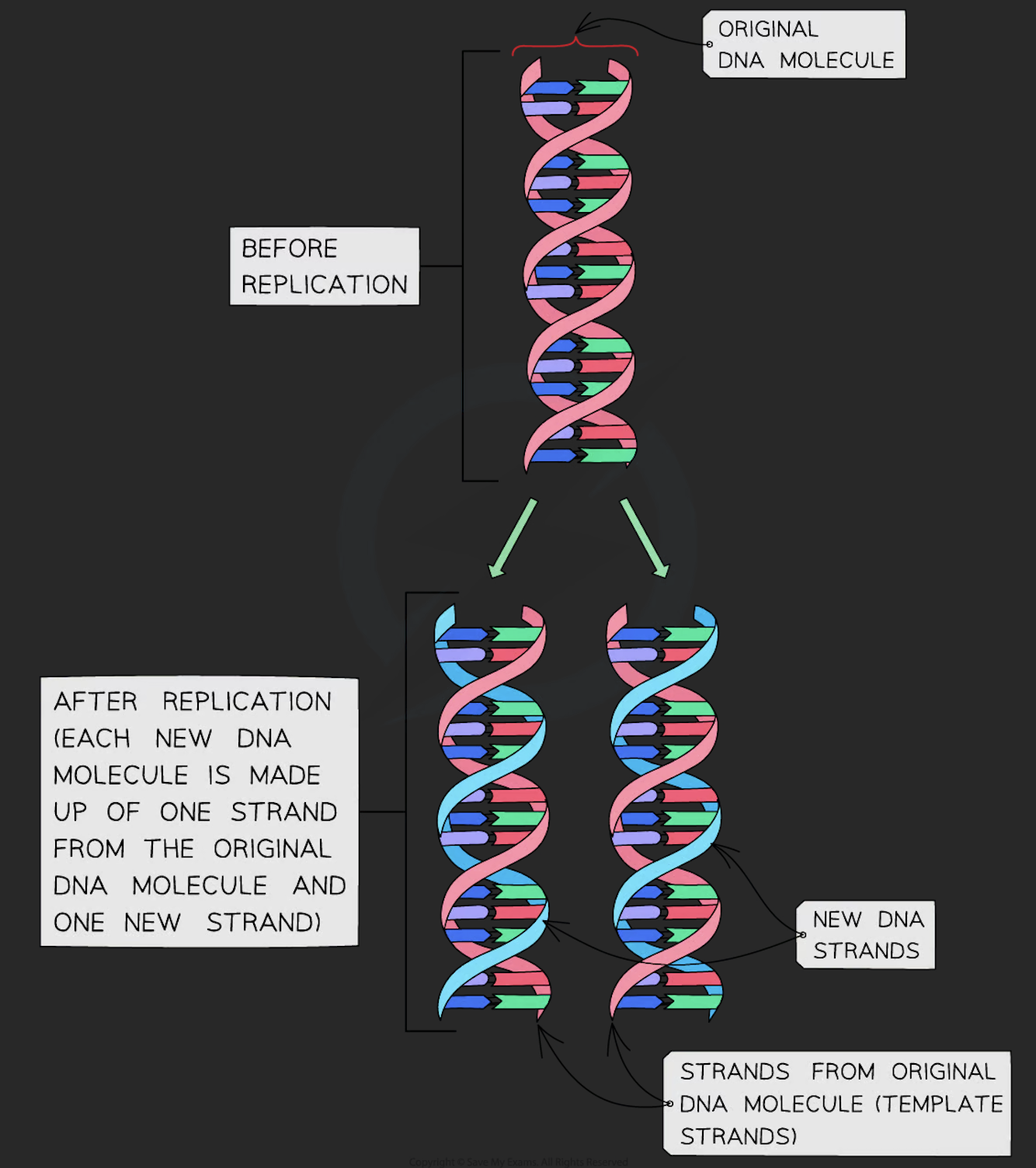
In semi-conservative replication, each new DNA molecule retains one strand from the original DNA and synthesizes a complementary strand from free nucleotides, preserving half of the original DNA.
one strand of the 'parent' DNA is kept in the 'daughter' molecule -
This is called the template strand
DNA polymerase links nucleotides together to form a new strand, using the pre-existing strand as a template
Before a (parent) cell divides, it needs to copy the DNA contained within itThis is so that the two new (daughter) cells produced will both receive the full copies of the parental DNA
The DNA is copied via a process known as semi-conservative replication (half the DNA is kept)The process is called so because in each new DNA molecule produced, one of the polynucleotide DNA strands (half of the new DNA molecule) is from the original DNA molecule being copiedThe other polynucleotide DNA strand (the other half of the new DNA molecule) has to be newly created by the cell
one strand of the 'parent' DNA is kept in the 'daughter' molecule -
This is called the template strand
DNA polymerase links nucleotides together to form a new strand, using the pre-existing strand as a template
Before a (parent) cell divides, it needs to copy the DNA contained within itThis is so that the two new (daughter) cells produced will both receive the full copies of the parental DNA
The DNA is copied via a process known as semi-conservative replication (half the DNA is kept)The process is called so because in each new DNA molecule produced, one of the polynucleotide DNA strands (half of the new DNA molecule) is from the original DNA molecule being copiedThe other polynucleotide DNA strand (the other half of the new DNA molecule) has to be newly created by the cell
2
Role of Helicase in DNA Replication
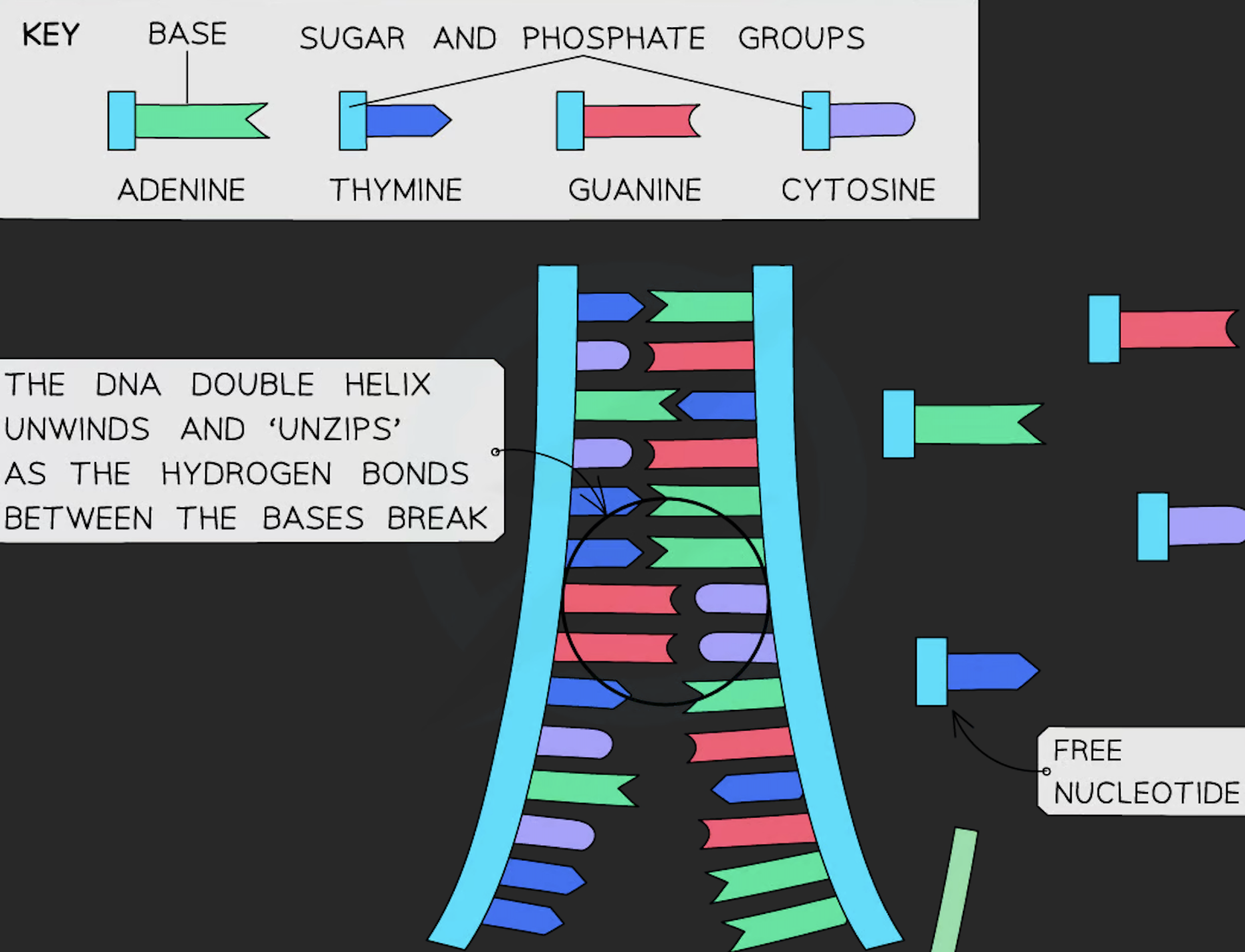
Helicase unwinds the double helix and separates the DNA strands by breaking the hydrogen bonds between complementary bases, preparing the strands for replication.
3
Hydrogen Bonds in DNA Replication
Form between complementary nucleotides (A-T and C-G) on the new and template strands, ensuring accurate base pairing and stability of the new DNA structure.
4
Importance of Semi-Conservative Replication
Ensures genetic continuity by preserving the sequence integrity across generations, allowing each new cell to have a copy of the original DNA, with correct sequence of DNA bases
5
Function of DNA Replication in Cells
Provides a basis for growth, repair, and reproduction in multicellular organisms by duplicating DNA before cell division.
6
Semi-Conservative vs. Conservative Replication
Semi-conservative replication retains one original DNA strand in each new molecule, whereas conservative replication would create one entirely new and one entirely old DNA molecule.
7
Importance of DNA Replication
DNA replication is essential in multicellular organisms for growth, repairing old or damaged cells, and reproduction. It ensures that each new cell receives a complete set of genetic instructions.
8
Role of Complementary Base Pairing
Complementary base pairing is critical in DNA replication, ensuring that each adenine pairs with a thymine, and each cytosine with a guanine, forming the new DNA strand.
9
Function of the Template Strand
The template strand of the original DNA serves as a guide for assembling the new strand, ensuring genetic continuity by preserving the sequence of bases.
10
Location of DNA Replication
DNA replication occurs in the nucleus of the cell where the DNA is located.
11
Role of DNA Polymerase
DNA polymerase links nucleotides together to form a new strand, using the pre-existing strand as a templateFollowing the action of helicase, the template strand is exposed and new nucleotides are joined together by DNA polymerase, which catalyses condensation reactions, to form a new strandThese reactions occur between the deoxyribose sugar and phosphate groups of adjacent nucleotides within the new strands, creating the sugar-phosphate backbone of the new DNA strandsDNA polymerase always works in the same direction along a strand of DNA, the 5' to 3' directionThis means that it adds the 5' terminal of the new nucleotide to the 3' terminal of the strand being builtHydrogen bonds then form between the complementary base pairs of the template and new DNA strands
12
Role of Helicase
DNA replication occurs in preparation for mitosis, when DNA must be doubled before the parent cell can divide to produce two genetically identical daughter cells
The enzyme helicase first unwinds the DNA, by flattening out its helical structureAnalogy - think about untwisting a rope ladder
Helicase then causes the hydrogen bonds to break between pairs of bases, exposing bases on either strandAnalogy - unzipping a zipper
Each of these single polynucleotide DNA strands acts as a template for the formation of a new strand made from free nucleotides that are attracted to the exposed DNA bases by base pairing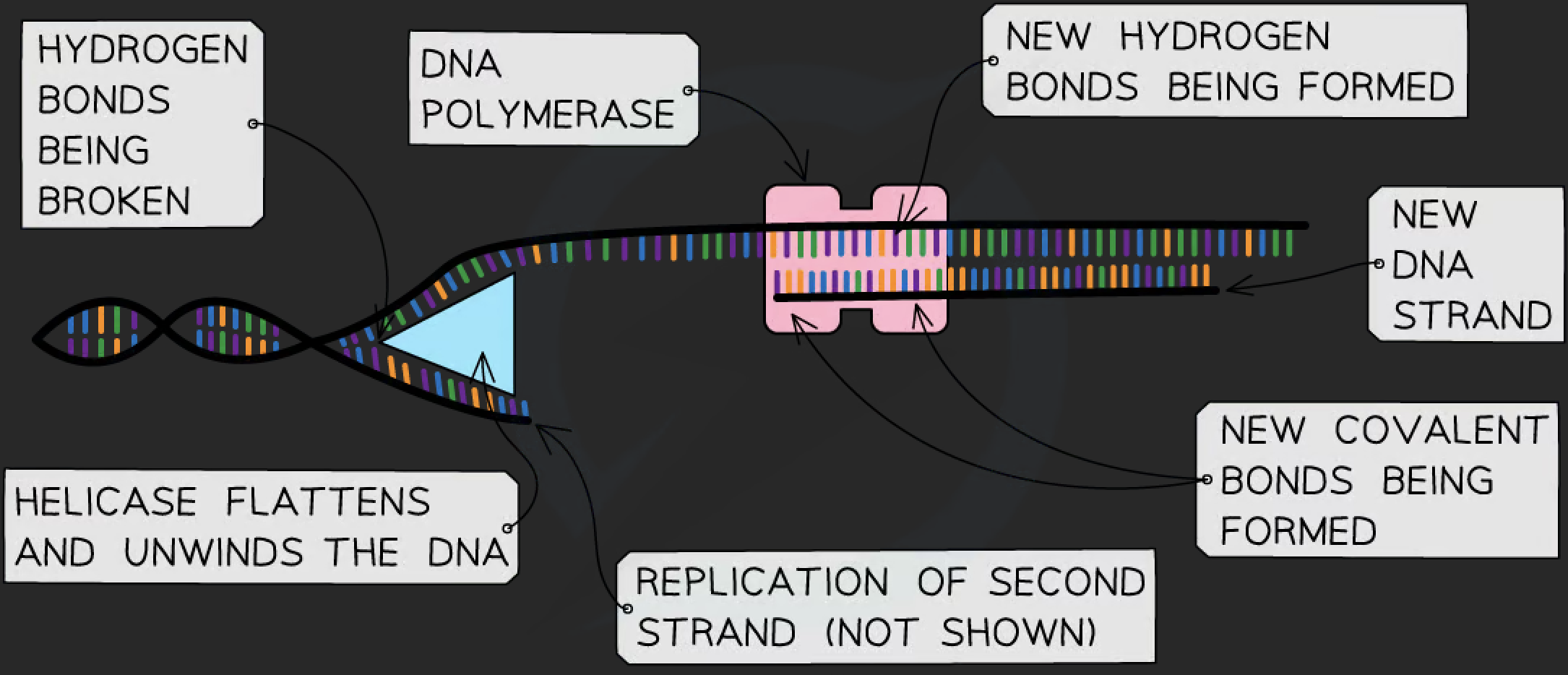
The enzyme helicase first unwinds the DNA, by flattening out its helical structureAnalogy - think about untwisting a rope ladder
Helicase then causes the hydrogen bonds to break between pairs of bases, exposing bases on either strandAnalogy - unzipping a zipper
Each of these single polynucleotide DNA strands acts as a template for the formation of a new strand made from free nucleotides that are attracted to the exposed DNA bases by base pairing
13
Historical Context of Semi-conservative Replication
Crick and Watson proposed the semi-conservative model of replication, which was later confirmed experimentally by Meselson and Stahl, providing crucial evidence for this method of DNA copying.
14
Overview
During replication, nucleotides are added to the 3' end of the new strand, with hydrogen bonds forming between the bases of the template strand and the new strand, ensuring accuracy in the replication process.