Chemotherapy Drugs Part 1
Study these flashcardsFree · spaced repetition · iPhone, Android, Mac & web
All cards
1
How are drugs that target DNA selective for cancer?
DNA is not vulnerable to drugs damaging it when it is being stored, only during replication. So these drugs damage cells that frequently replicate, which will hit cancer cells more often due to their fast rate of replication. However, they do still damage other cells when they replicate, and this leads to common side effects such as hair loss, nausea, etc (hair and stomach cells replicates very frequently).
2
How do alkylating agents work?
They covalently bind nucleophilic substances to nucleosides which is toxic to DNA replication. This causes lots of mutations and apoptosis, however it can also cause other cancers to form due to this rapid rate of mutation. This is not cell cycle specific, as it also alkylates proteins. However toxicity is expressed in S phase and prevents progression to G2.
3
mechanisms of resistance to alkylating agents
Decreased permeation of alkylating drugs
Addition of nucleophilic substrates that acts to block cancerous DNA (glutathione)
Upregulation of DNA repair genes
Increased drug metabolism
Addition of nucleophilic substrates that acts to block cancerous DNA (glutathione)
Upregulation of DNA repair genes
Increased drug metabolism
4
Alkylating agent side effects
Hematopoetic system, rapid growth of white blood cells get killed by alkylating agents, succeptible to disease
Reproductive system damage
Damage to intestinal mucosa and hair
CNS effects
Reproductive system damage
Damage to intestinal mucosa and hair
CNS effects
5
What base is the most succeptible to alkylation?
Guanine, specifically the N7 on guanine.
6
What is this compound?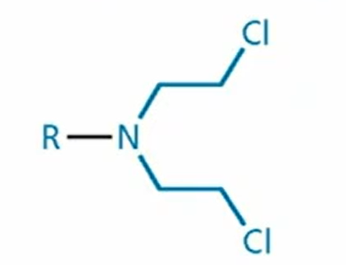
Nitrogen Mustard. They are very reactive alkylating agents that can crosslink two dna helixes.
7
What is Chlormethine?
The first nitrogen mustard, derived from mustard gas, highly reactive and IV only.
8
What is cyclophosphamide?
A prodrug that is converted to phosphoramide, a nitrogen mustard. Substrate of cytochrome P450, after which it undergoes a few more reactions before activating. This multistep process makes it more stable and less reactive, less side effects.
9
Cyclophosphamide side effects?
Regular side effects from alkylating agents, leukopenia etc. However in the process of being metabolized into phosphoramide, it creates acrolein as a byproduct, which is toxic.
10
What is ifosfamide?
A prodrug converted to isophosphoramide, a nitrogen mustard. Slower metabolism than cyclophosphamide.
11
Ifosfamide side effects?
Alkylating agent side effects, plus creates chloroacetaldehyde as a byproduct, which is toxic.
12
What is cisplatin?
An alkylating agent that binds *platinum* (if structure contains platinum it is cisplatin or a derivative) to DNA, which leads to breaks and miscoding.
13
Cisplatin side effects?
Renal damage, hearing loss, alkylating agent effects
14
What is carboplatin?
Derivative of cisplatin with a longer half life and less side effects due to lower reactivity, however less effective.
15
What is oxaliplatin?
A cisplatin derivative which has a longer half life. However, it can still be effective against cisplatin resistant cancers which use DNA repair as a method of resistance, as it is harder to repair.
16
What are temzolamide and dacarbazine?
Triazine derivatives, which are alkylating agents which methylate DNA. They can cross the BBB so are often used for brain cancer.
17
What does dihydrofolate rectase (DHFR) do
It metabolises dihydrofolate (FH2) into tetrahydrofolate (FH4)
18
What does tetrahydrofolate (FH4) do?l
It is crucial in the synthesis of dTMP (deoxythymidine monophosphate (thymine))
19
What does thymidylate synthase (TS) do?
It uses FH4 to convert dUMP (deoxyuridine monophosphate (uracil)) into dTMP (thymine). This is the only way for the body to make thymine.
20
Methotrexate MOA
It has a similar structure to dihydrofolate, so it binds to DHFR and inhibits it. This stops production of FH4, which means the cell cannot use it to produce dTMP. It is also metabolized into methotrexate polyglutamate, which has a much longer half life in cells.
21
Methotrexate selectivity
Kills cells in the S phase, as they cannot get the dTMP required for DNA replication.
22
What is Leucovorin rescue?
It is given with methotrexate to reduce bone marrow side effects/toxicity. Inversely, it is given with flouracil to increase binding to TS, therebye increasing efficacy/toxicity.
23
Methods of methotrexate resistance
polyglutamylation resistance, half life much shorter if not polyglutamylated
Needs active transport into the cell, can have transportation resistance
Increased concentration of DHFR or DHFR with less afinity for methotrexate
Needs active transport into the cell, can have transportation resistance
Increased concentration of DHFR or DHFR with less afinity for methotrexate
24
What are pyrimidine analogs
drugs that look like pyrimidines
25
Fluorouracil (5FU) MOA
Pyrimidine analog. 5FU is converted into both FdUMP (fluorodeoxyuracil) and FUTP (fluorouraciltriphosphate). FdUMP is its main mechanism of action, where TS binds to it mistaking it for dUMP. After it binds, it is unable to continue the reaction and is irreversably inhibited, preventing the cell from making dTMP. FUTP is also mistaken for UTP by rna polymerase and leads to RNA damage.
26
What is Capecitabine?
Prodrug for 5FU, which can be taken orally.
27
What is pemetrexed (Alimta)?
It is a TS cofactor mimic that works through many different pathways.
28
Cytarabine MOA
Pyrimidine Analog. AraCMP (cytosine bound to arabanose instead of deoxyribose) that is converted to AraCTP to become active. Mistakenly bound by DNA polymerase thinking it was CTP and inactivates it.
29
Methods of Cytarabine resistance
Upregulation of cytidine deaminase and deoxycytidine deaminase, both of which inactivate it.
downregulation of deoxycytidine kinase, which activates it, the first addition of phosphorus is the rate limiting step
downregulation of deoxycytidine kinase, which activates it, the first addition of phosphorus is the rate limiting step
30
What is gemcitabine
Same MOA and considerations as cytarabine, but it adds flourine to deoxyribose instead of using arabanose
31
What are purine analogs?
Drugs that look like purines
32
Fludarabine MOA
purine analog. Inhibits DNA polymerase
33
Cladrabine MOA
purine analog. Inhibits ribonucleotide reductase (makes ribonucleotides into deoxyribonucleotides used in DNA)
34
Clofarabine MOA
purine analog. Inhibits DNA polymerase and ribonucleotide reductase, and is designed to improve efficacy and reduce toxicity.
35
Pentostatin MOA
Purine analog, adenine nucleotide analog. Inhibits adenosine deaminase, which leads to a buildup of deoxyadenosine and cell death.
36
What is this structure?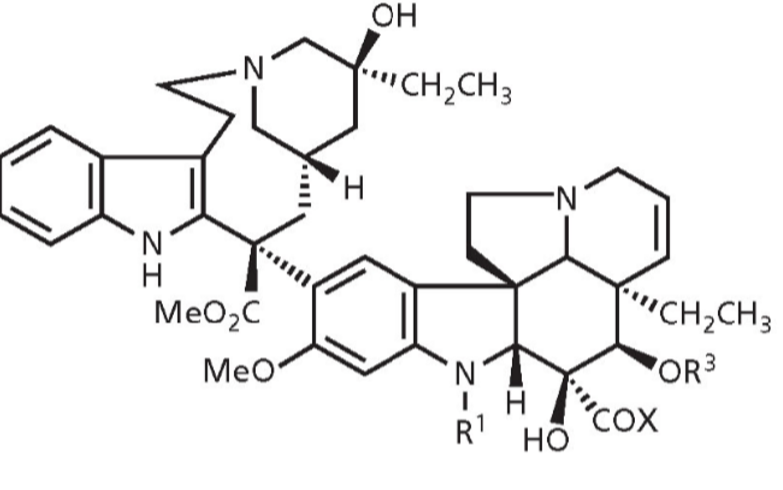
A vinca alkaloid
37
Vinca alkaloids MOA
Binds to tubulin, preventing it from polymerizing during anaphase and leading to cell death. Kills cells in M phase.
38
What vinca alkaloids do we have to know?
Vinblastine
Vincristine
Vinorelbine
Differing side effect profiles between the three
Vincristine
Vinorelbine
Differing side effect profiles between the three
39
Taxanes MOA
Blocks dissasembly of polymerized tubulin dimers, preventing cells from splitting and causing cell death in M phase.
40
What taxanes do we have to know?
Paclitaxel (Taxol)
Docetaxel (Taxotere)
Docetaxel (Taxotere)
41
What is this structure?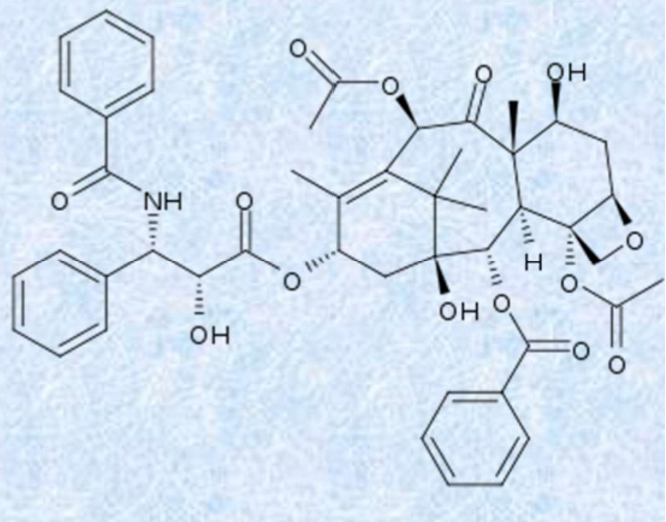
Taxol (paclitaxel)
42
What changed about the formulation of paclitaxel and why?
It previously used cremaphor, which caused allergic reactions. Now it is bound to albumin which reduces toxicity, and accumulates in tumors.
43
What is ixabepilone?
Same MOA as taxol. Not used very frequently.
44
What is this structure?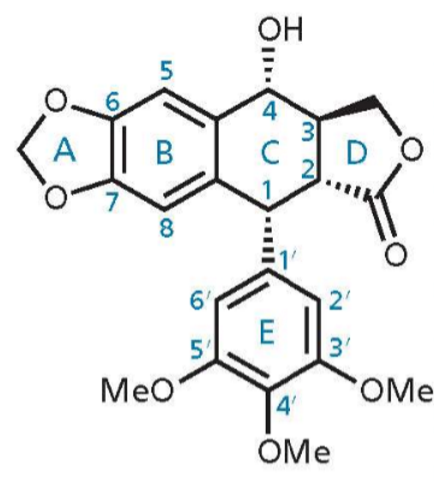
Podophyllotoxin
45
What are podophyllotoxins?
Inhibitors of type II topoisomerase. It still binds to and cuts both of the DNA strands, but is then unable to repair them, killing them late in S phase.
46
What podophyllotoxins do we have to know?
Etoposide and teniposide
47
What is this structure?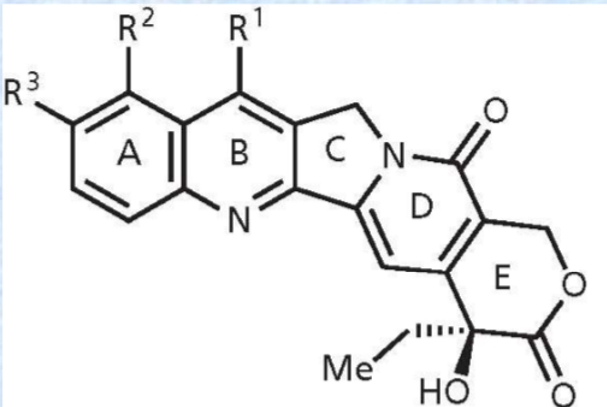
Camptothecin Analog
48
Camptothecin analogs MOA
Inhibit type 1 topoisomerase, leading to an accumulation of DNA strand breaks
49
What camptothecin analogs do we have to know?
Topotecan and Irinotecan (prodrug). Camptothecin itself is poorly soluble and has toxic side effects.
50
What is this structure?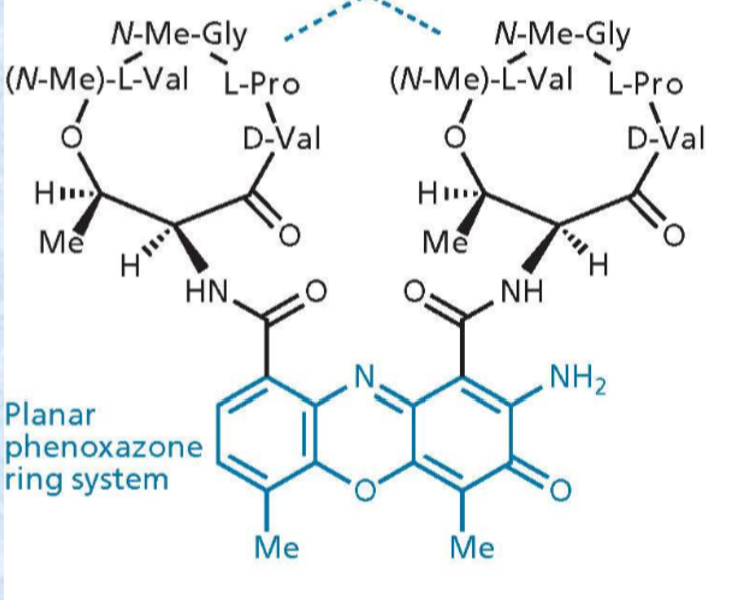
Anthracycline antibiotic, note triple ring structure
51
How do anthracycline antibiotics work?
Forms oxygen radicals and inhibit topoisomerase II. Triple ring structure intercalates the drug to DNA.
52
What anthracycline antibiotics do we have to know?
Daunorubicin, doxorubicin, idarubicin (altered metabolism and longer half life)
Can cause irreversable cardiomyopathy
Can cause irreversable cardiomyopathy
53
What is this structure?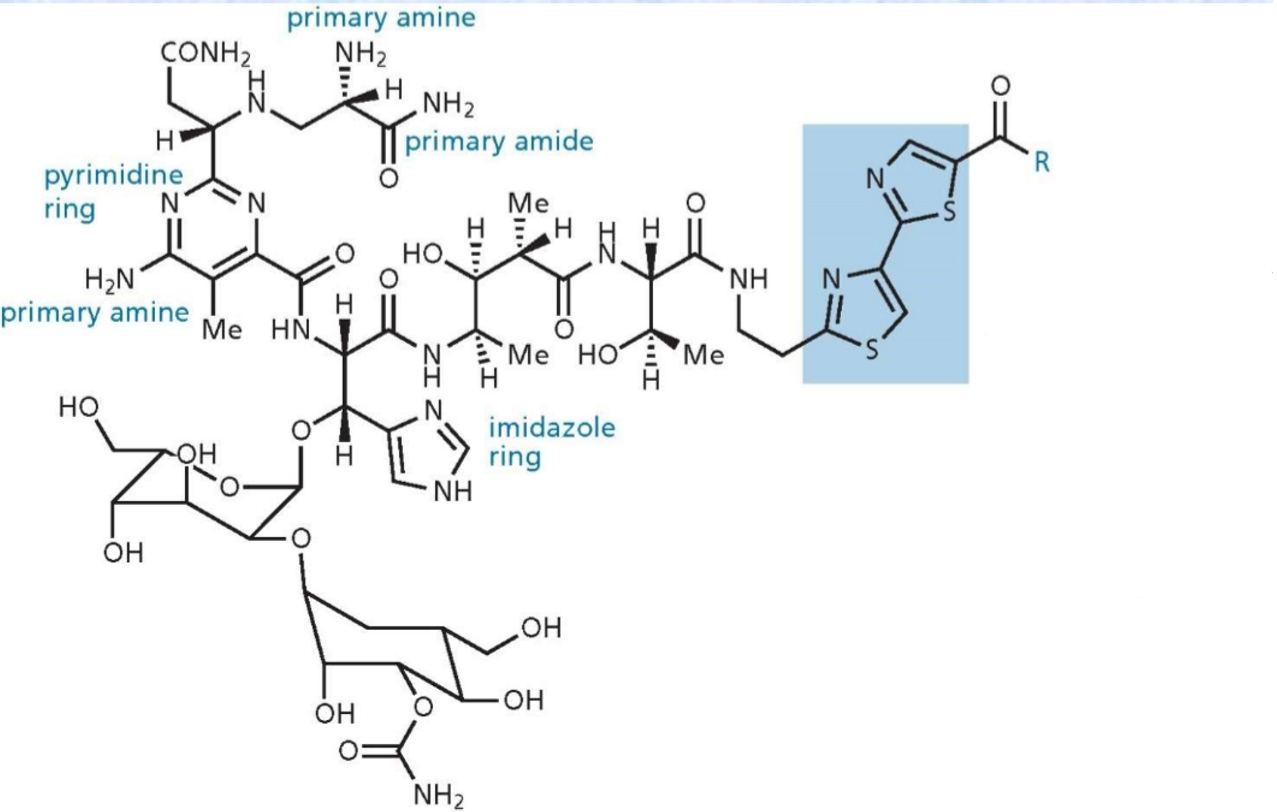
Bleomycin
54
What is important to know about bleomycin?
It is specific to the G2 phase
Does not cause myelosupression
localizes to DNA with intercalating double ring structure, then chelates a ferric iron to form oxygen radicals
Does not cause myelosupression
localizes to DNA with intercalating double ring structure, then chelates a ferric iron to form oxygen radicals
55
asparaginase MOA
Cancer cells use a lot of asparagine, asparaginase breaks it down and prevents protein synthesis with it, causing apoptosis. Used in combination with other therapy. Purified from E.Coli.
56
What is pegasparaginase?
asparaginase conjugated to PEG, for use in patients with an E.Coli enzyme allergy.