Non-TK Inhibitor Targeted Drugs
Study these flashcardsFree · spaced repetition · iPhone, Android, Mac & web
All cards
1
What are proteasomes?
Cell structures which break down proteins
2
How are proteasome inhibitors effective against cancer?
They inhibit proteasomes, stopping the breakdown of protein and leading to higher levels of protein in the cancer cells. The exact mechanism is not known, but in some cancers, such as multiple myeloma, this leads to cell death.
3
What is velcade (bortezomib)?
A proteasome inhibitor, which reversibly inhibits proteasomes and causes cell death of some cancers such as multiple myelomas.
4
What is this structure?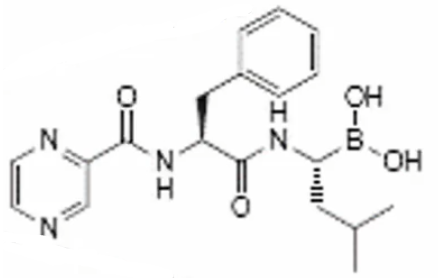
Velcade (bortezomib)
Note the boron which is a powerful electrophile and reacts with the active site of proteasomes
Note the boron which is a powerful electrophile and reacts with the active site of proteasomes
5
What is carflizomib?
Second generation proteasome inhibitor, irreversably inhibits proteasomes which is effective against multiple myelomas.
Effective against bortezomib resistance cancer lines
Effective against bortezomib resistance cancer lines
6
What is this structure?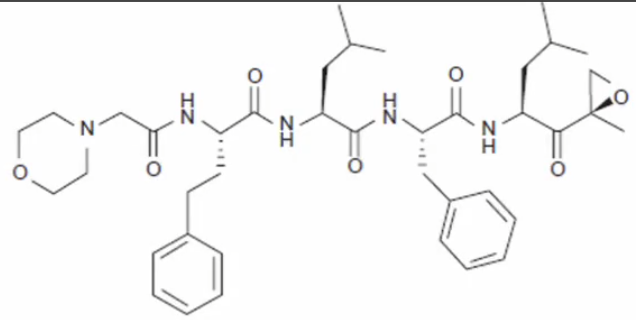
Carflizomib
Epoxyketone ring structure on the righthand side, which is more reactive than boron of bortezomib and irreversibly inhibits proteasomes
Epoxyketone ring structure on the righthand side, which is more reactive than boron of bortezomib and irreversibly inhibits proteasomes
7
What are HDAC enzymes?
Histone deacetylases. They alter the acetylation state of lysine residues on histones, which causes them to change from a relaxed form, in which the genes from the histones can be transcribed, to a condensed form, which is unable to be transcribed.
8
What is epigenetic regulation and what role does it play in regads to HDACs and cancer?
Epigenetic regulation is the idea of changing gene expression without a mutation or change within the DNA itself. In the context of HDACs and cancer, this is done by the cancer cell upregulating HDACs which acytelate lysine residues on tumor supressor gene histones. This causes these histones to condense, making them unable to be transcribed, so there is a lower expression of tumor supressor genes in the cell.
9
How do HDAC inhibitors work to fight cancer?
They inhibit the action of HDACs, meaning less histones will be condensed and there will be greater protein transcription. In cancer cells which are condensing tumor supressor gene histones, this will lead to greater production of tumor supressor genes.
10
What is vorinostat (SAHA)
A lysine mimic, which inhibits HDACs by binding to zinc. Effective against T-cell lymphomas.
11
What is this structure?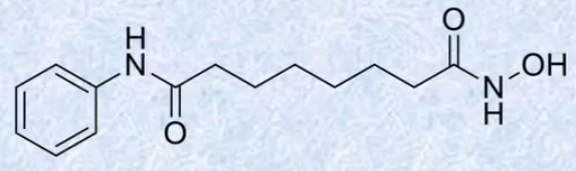
Vorinostat
12
What is mTOR?
A major component of the signaling pathway for the cell cycle, which increases survival and proliferation
13
What is Everolimus?
An mTOR inhibitor, commonly used in renal cancer and breast cancer (after hormonal therapy failure)
14
What is this structure?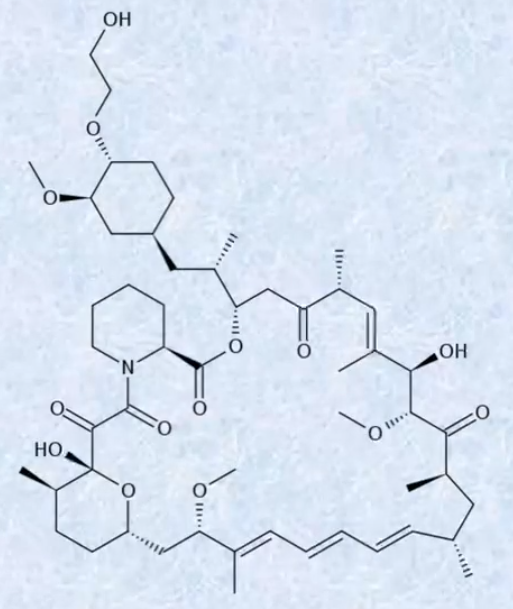
Everolimus
15
What is the hedgehog (Hh) pathway?
Typically an embryonic pathway that is supressed in adults. However some cancers reactivate this pathway and use it for cell growth.
Activation of this pathway leads to PTCH1 (patched) inactivation, which normally inactivates SMO (smoothened). So when PTCH1 is inactivated, SMO stops being inactivated. SMO activation leads to increased cell growth in some cancers, such as basal cell carcinoma.
Activation of this pathway leads to PTCH1 (patched) inactivation, which normally inactivates SMO (smoothened). So when PTCH1 is inactivated, SMO stops being inactivated. SMO activation leads to increased cell growth in some cancers, such as basal cell carcinoma.
16
What is vismodegib?
Directly binds to SMO, inactivating it. This stops SMO from increasing cell growth in some cancers such as basal cell carcinoma.
17
What are thalidomide and it's derivatives?
Thalidomide was used in the past for morning sickness and insomnia, but lead to thousands of birth defects. However, it was discovered to be effective against multiple myeloma cancers through unknown mechanisms.
18
What are the thalidomide derivatives?
Thalidomide
Lanalidomide
Pomalidomide
Derivatives have less teratogenic properties
Lanalidomide
Pomalidomide
Derivatives have less teratogenic properties
19
What is this structure/class?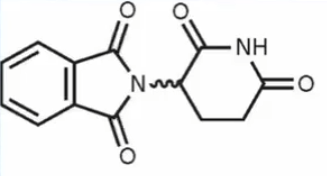
thalidomide, all the derivatives have the nitrogen swirlydo
20
What is PARP?
Poly ADP Ribose polymerase, which causes poly ribosylation at DNA single strand breaks, signaling to repair enzymes that it needs to be fixed.
21
How do PARP inhibitors work against cancer cells?
PARP inhibitors stop PARP from signaling to repair enzymes, leading to an accumulation of single strand which eventually lead to double strand breaks. In normal, non-mutated cells, the BRCA gene will cause HR (homologous recombination), which will fix the double stranded breaks before they cause problems, making PARP inhibition have little effect on cell function. However, in cells with BRCA1/2 mutations (remeber, these are inherited mutations which greatly increase risk of breast cancer), HR no longer occurs, which leads to cell death after double strand break accumulation.
Often BRCA1/2 mutant breast cancers will be TNBC (tripple negative breast cancer), meaning they aren't effected by any other targeted therapy such as therapies against ER+ or HER2+ breast cancers. Because of this, PARP inhibitors are often the only effective targeted treatment for these patients.
Often BRCA1/2 mutant breast cancers will be TNBC (tripple negative breast cancer), meaning they aren't effected by any other targeted therapy such as therapies against ER+ or HER2+ breast cancers. Because of this, PARP inhibitors are often the only effective targeted treatment for these patients.
22
What are the PARP inhibitors?
Olaparib
Rucaparib
Niraparib
Talazoparib
All have par in the name ("PAR"P inhibitors)
Rucaparib
Niraparib
Talazoparib
All have par in the name ("PAR"P inhibitors)
23
What is this structure?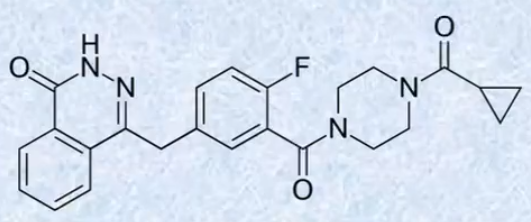
Olaparib
24
What is this structure?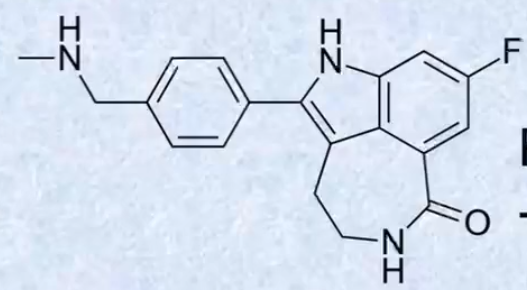
Rucaparib
25
What is this structure?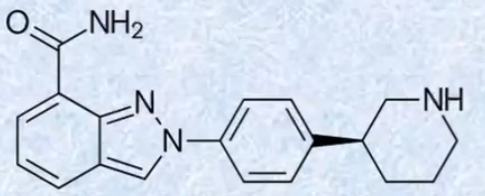
Niraparib
26
What is this structure?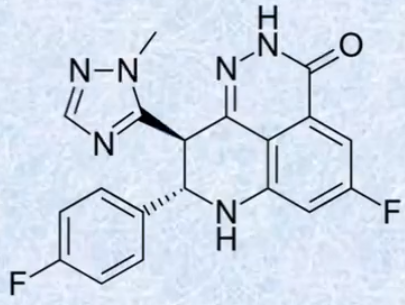
Talazoparib
27
Review/Quiz/Summary time! List all the non-TK inhibitor drug classes we have to know, their methods of action, and the cancers they treat!
Proteasome Inhibitors: Inhibit action of proteasomes, which leads to protein buildup and cell death in some cancers like multiple myelomas
HDAC Inhibitors: Inhibit HDACs, which in some cancers are used to inhbit expression of tumor supressing genes. Effective against T-cell lymphomas
mTOR Inhibitors: Inhibits mTOR, which without inhibition increase survival and proliferation of the cell and is upregulated in some cancers. Effective against renal cancer and breast cancer after hormonal therapy has failed.
SMO Inhibitors: Inhibits SMO, a party of the Hh pathway which becomes reactivated in some cancers. By inhibiting SMO, they decrease cell growth and proliferation. Effective against basal cell carinomas.
Thalidomide & derivatives: Effective against multiple myelomas through not fully understood mechanisms.
PAPR Inhibitors: Inhibits PARP, which leads to a buildup of double strand breaks which become fatal in BRCA1/2 mutated breast cancers, but not in unmutated cells.
HDAC Inhibitors: Inhibit HDACs, which in some cancers are used to inhbit expression of tumor supressing genes. Effective against T-cell lymphomas
mTOR Inhibitors: Inhibits mTOR, which without inhibition increase survival and proliferation of the cell and is upregulated in some cancers. Effective against renal cancer and breast cancer after hormonal therapy has failed.
SMO Inhibitors: Inhibits SMO, a party of the Hh pathway which becomes reactivated in some cancers. By inhibiting SMO, they decrease cell growth and proliferation. Effective against basal cell carinomas.
Thalidomide & derivatives: Effective against multiple myelomas through not fully understood mechanisms.
PAPR Inhibitors: Inhibits PARP, which leads to a buildup of double strand breaks which become fatal in BRCA1/2 mutated breast cancers, but not in unmutated cells.
28
Review/Quiz/Summary time! List all the non-TK inhibitor drugs we have to know, and their classes!
Proteasome Inhibitors: Velcade (bortezomib), carflizomib
HDAC Inhibitors: vorinostat (SAHA)
mTOR Inhibitors: everolimus
SMO Inhibitors: vismodegib
Thalidomide & derivatives: Thalidomide, lanalidomide, pomalidomide
PARP Inhibitors: olaparib, rucaparib, niraparib, talazoparib
HDAC Inhibitors: vorinostat (SAHA)
mTOR Inhibitors: everolimus
SMO Inhibitors: vismodegib
Thalidomide & derivatives: Thalidomide, lanalidomide, pomalidomide
PARP Inhibitors: olaparib, rucaparib, niraparib, talazoparib