Antivirals
Study these flashcardsFree · spaced repetition · iPhone, Android, Mac & web
All cards
1
What are DNA viruses?
Viruses which have their genomic material made of DNA and are incorperated into the nucleus of host cells for transcription of said DNA into mRNA by host polymerases
2
What are RNA viruses?
Viruses which have their genomic material made of RNA and use their own enzymes to synthesize mRNA in the cytoplasm
Can be positive sense (which is what our normal mRNA is and can be directly used by ribosomes to make viral protein)
negative sense (which has to then have synthesis into positive sense mRNA)
Or both
Can be positive sense (which is what our normal mRNA is and can be directly used by ribosomes to make viral protein)
negative sense (which has to then have synthesis into positive sense mRNA)
Or both
3
What is a retrovirus?
It is a type of RNA virus which rather than being directly used by ribosomes to make proteins or used to make mRNA, it instead encodes for DNA, which is then incorperated into the host nucleus
4
Are viruses with an enveloped or nonenveloped coating more stable in the outside environment
nonenveloped viruses are more stable
5
What type of virus are corona viruses and what kind of coating do they have?
+RNA viruses (can be directly used to produce viral proteins)
enveloped (less stable outside the host)
enveloped (less stable outside the host)
6
What are a-coronaviruses?
Infect upper respiratory tract only, about 15% of common colds?
7
What are B-coronaviruses?
Infect lower respiratory tract, high mortality, zoonotic
8
What are zoonotic viruses?
Viruses which jump from another animal to humans. Tend to be the source of more deadly viruses as viruses ideally don't want to kill their host, but animal viruses are not well attuned to infecting humans
9
What is ACE2?
A protein found on the membranes of human cells, mainly in the respiratory tract
10
How do Coronaviruses infect cells?
They are covered in spike proteins, which bind to ACE2 on vulnerable (permissive) cells, and allows them to enter the cell (vaccines make these spike proteins so that antibodies know to target them when coronavirus enters the body)
These spike proteins mutate often which is why there is vaccine resistance and new variants of COVID
These spike proteins mutate often which is why there is vaccine resistance and new variants of COVID
11
What is adsorption?
Virus attaches to target cell
12
What is entry?
Virus penetrates into cell
13
What is uncoating?
Viral genomic material is unleashed into the cell
14
What is transcription?
Production of viral mRNA from viral genome (not needed for +RNA viruses as they come ready to translate)
15
What is translation?
Synthesis of viral proteins and nucleic acids from viral mRNA
16
What is assembly?
Creation of a new capsid and virus using the viral proteins made by the cell
17
What is release?
Buddy from the cell membrane (in enveloped viruses) or rupture of the cell (in nonenveloped viruses) to release newly formed viruses and allow further infection
18
What are the cell surface proteins of influenza?
Hemagglutinin (HA)
M2
Neuraminidase (NA)
M2
Neuraminidase (NA)
19
What does hemagglutinin do?
Binds to terminal sialic acids on target cells which triggers endocytosis of the virus
20
What does M2 do?
Activates once in the low pH environment of the endosome. This lets acid into the virus and triggers the release of the viral ribonucleoprotein (RPN)
21
What does neuraminidase do?
After replication, it cleaves sialic acids from the cell receptors and allows release of influenza to non infected cells
22
What is influenza A and how are different influenza strains classified?
Zoonotic strains of influenza, H1N1, H2N2, H3N2, etc. These classifications are named for the different variations of hemagglutinin and neuraminidase on the virus
23
What is influenza B?
Mostly exclusive to humans, slower mutation with less diversity
24
What is influenza C?
Humans and dogs, less common
25
What is influenza D?
Pigs and cattle, little human transmission
26
How do amantadine and derivatives work?
Not super clear, but seem to interfere with M2, preventing uncoating of influenza to stop release of viral components into the cell
27
What are the amantadine derivatives
amantadine
rimantadine
memantine
rimantadine
memantine
28
What is this drug?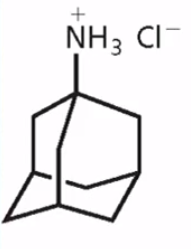
amantadine
29
Amantadine resistance?
M2 alterations, high levels of resistance
30
How do transition state inhibitors work?
They mimic the intermediate of the reaction neuraminidase (NA) performs to cleave sialic acids from the host membrane. This causes them to bind to NA and prevent them from completing the cleave, leaving the newly made influenza stuck in the membrane of the host cell. Effective in influenza A and B
31
What transition state inhibitors should we know?
zanamivir
oseltamivir
oseltamivir
32
What is this drug?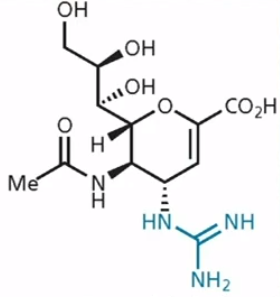
a transition state inhibitor (zanamivir)
33
Transition state inhibitor limitations
Have to take very early in the course of the disease
high resistance through conformation changes of NA
high resistance through conformation changes of NA
34
What type of viruses are influenzas?
-RNA viruses, use RNA-dependent RNA polymerase to make +RNA (mRNA) from the -RNA which can then be used by ribosomes in the cell to make viral proteins
35
What is a 5'-cap?
In order for a ribosome to read mRNA and produce proteins from it, it requires a specific 5'-cap which is difficult for viruses to make. Different viruses have different methods to cap their mRNA so that our cells will make proteins with them.
36
How does influenza put a 5'-cap on it's mRNA?
It steals the 5'-cap from mRNA that is in the cell already using an endonuclease and attaches it to the mRNA that it is producing
37
What is baloxavir marboxil?
Inhibits the endonucleases of influenza to prevent them from stealing 5'-caps from host mRNA
38
What is this drug?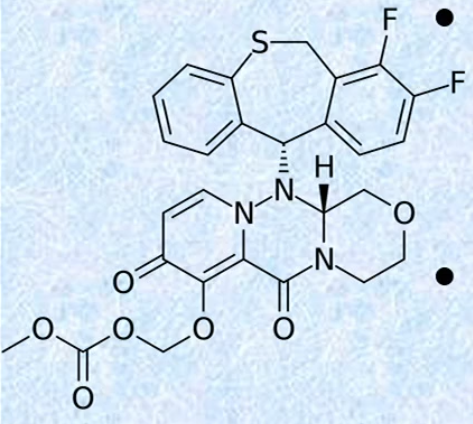
baloxavir marboxil
39
What to know about baloxavir marboxil?
High potency, only taken with a single dose
Frequent resistance
Frequent resistance
40
What are nucleoside antimetabolites?
Drugs that look like nucleosides, but when they are incorperated into the RNA or DNA chain will cause some type of issue. Chain terminators prevent the addition of more nucleosides, mutagenetic nucleosides cause rapid mutations that make the virus unstable
41
How does aciclovir work?
It is a prodrug which is only activated by viral thymidine kinase, after which it is incorperated into the viral DNA and prevent additon of the next nucleoside in the chain. Very little side effect because without the viral thymidine kinase it will not be activates and won't be incorperated into human RNA or DNA. Used against HSV
42
What is this drug?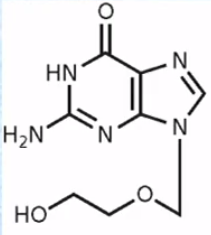
Aciclovir
43
Aciclovir resistance?
Loss of the viral thymidine kinase which activates it, not very common
44
What other "ciclovir" drugs should we know?
Valaciclovir
Penciclovir
Ganciclovir
Penciclovir
Ganciclovir
45
What should we know about ganciclovir?
Doesn't cause chain termination like aciclovir and valaciclovir, instead caused mutations. Also doesn't require activation by viral thymidine kinase
46
How does idoxuridine, cytarabine, vidarabine, and trifluradine work?
It is used by and inhibits DNA polymerase and causes rapid mutations or inhibition, used for herpes. Nucleoside antimetabolites
47
How does cidofovir work?
Doesn't require activation like aciclovir because it has an analog of the first phosphate group which allows human cells to finish activation. Gets around aciclovir resistance but much more toxic.
48
What is this drug?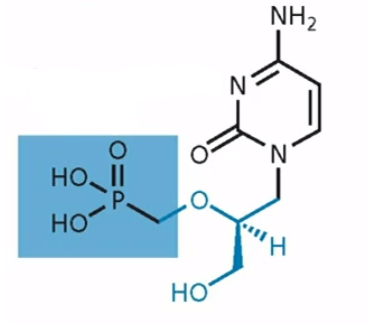
Cidofovir
49
How does ribavirin work?
Incorperated into viral RNA, and allows pairing with both cytidine and uridine depending on configuration. Eventually leads to lethal mutagenesis
Fairly broad spectrum against RNA viruses
Fairly broad spectrum against RNA viruses
50
What is this drug?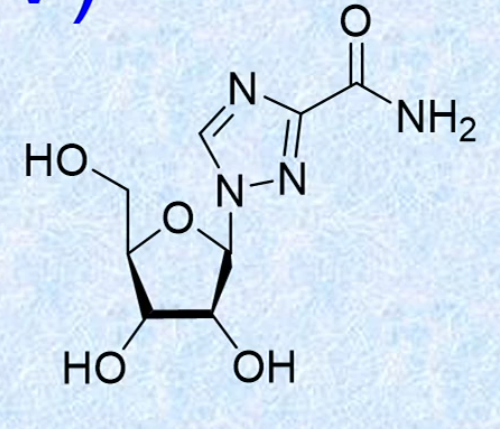
Ribavirin
51
How do hepatitis C protease inhibitors work?
They inhibit proteases which hepatitis C uses to process their proteins
52
What hepatitis C protease inhibitors do we have to know?
boceprevir
telaprevir
telaprevir
53
What are NS5A inhibitors?
They inhibit NS5A in hepatis C. It is unknown what NS5A does, but it's inhibition leads to cell death
54
What NS5A inhibitors should we know?
Ombitasvir
Daclatasvir
Ledipasvir
Daclatasvir
Ledipasvir
55
What are NS5B polymerase inhibitors?
Inhibitors of the RNA dependent RNA polymerase found in hepatitis B viruses, used together with NS5A inhibitors as the mainstay of anti hepatits C therapy
56
What NS5B polymerase inhibitors should we know?
Dasabuvir
Sofosbuvir
Sofosbuvir
57
What is Harvoni?
Combination of ledipasvir and sofosbuvir, curative for hepatitis C
58
Why do many of the neucleotide antimetabolites like ribavirin not work against COVID?
It contains a proofreading exonuclease that detects the error and cuts it out
59
What nucleotide antimetabolite does work against COVID?
Remdesivir
Molnupiravir
Molnupiravir
60
What does nirmatrelvir (combined with ritanovir in paxlovid) target?
C3-like protease in COVID which prevents processing of COVID proteins
61
What type of virus is HIV?
Retrovirus
62
What does reverse transcriptase do in HIV?
It acts as an RNA dependent DNA polymerase that makes DNA from the RNA strand
Then it acts as an RNase that breaks down the RNA strand
Then it acts as a DNA dependent DNA polymerase to make a new strand from the now single DNA strand
Then it acts as an RNase that breaks down the RNA strand
Then it acts as a DNA dependent DNA polymerase to make a new strand from the now single DNA strand
63
What are nonnuceloside RT inhibitors for HIV?
They inhibit reverse transcriptase by binding to an allosteric site and preventing its function
64
What nonnucleoside RT inhibitors should we know?
Nevirapine
Efavirenz
Etravirine
Efavirenz
Etravirine