Antifungals
Study these flashcardsFree · spaced repetition · iPhone, Android, Mac & web
All cards
1
What polyenes do we have to know?
Amphotericin B
Nystatin
Nystatin
2
How do polyenes work?
They are inserted into fungal cell membranes, causing them to become leaky and die due to loss of ions and small molecules. 8 amphotericin B molecules link together to form a channel in the membrane
3
What type of drug is this?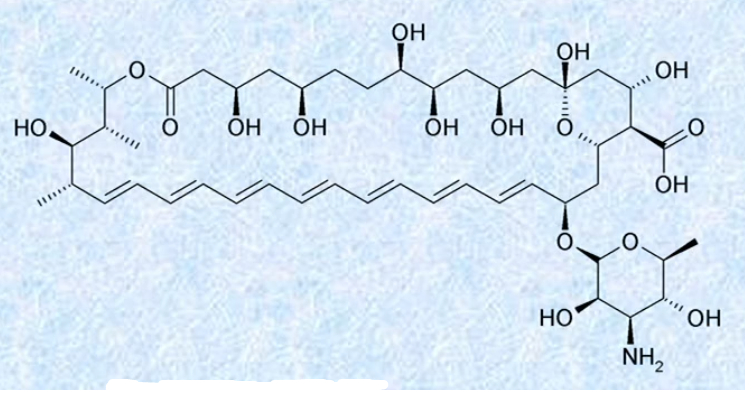
Polyene (amphotericin B)
4
How are polyenes selective?
They target ergosterol present in fungal cell membranes, while human cell membranes use cholesterol. However, the structure of ergosterol and cholesterol are very similar, so there is a lot of toxicity associated with them, used for life threatening infections
5
What to know about nystatin?
Used topically, too toxic for systemic use
6
Side effects of amphotericin B and how to reduce them?
Primarily kidney toxicity
Can be reduced with liposomal encapsulation formula, however it is very expensive and only used in high risk patients
Can be reduced with liposomal encapsulation formula, however it is very expensive and only used in high risk patients
7
Polyene resistance
Rare, sometimes happens through a decrease in ergosterol or an increase in chitin.
8
What is lanosterol?
It is converted into ergosterol
9
What is 14a-demethylase?
A CYP450 that removes the 14a-methyl group from lanosterol which is one of the steps in the conversion to ergosterol
10
What do azoles target?
They inhibit 14a-demethylase which prevents the production of ergosterol. This then stops fungal cells from building their membranes and leads to inhibition of growth or death at high concentrations.
11
What is the mechanism of azole toxicity?
It inhibits 14a-demethylase, but also inhibits other CYP450 enzymes which leads to many DDIs
12
What are imidazoles?
Azoles which have a 5 membered ring containing 2 nitrogens
13
What are triazoles?
Azoles which have a 5 membered ring containing 3 nitrogens
14
What does the N3 nitrogen in azoles do?
It is basic and binds to the heme iron of CYP450s, mainly 14a-demethylase, the rest of the azole determines selectivity
15
What is this drug?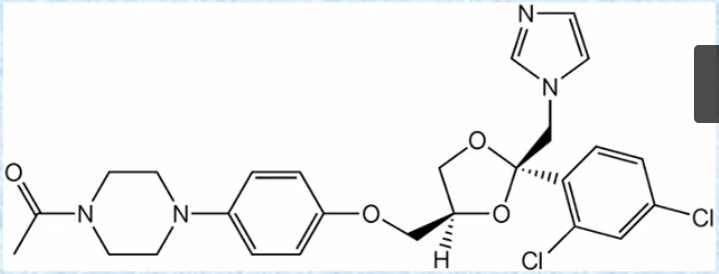
An imidazole (ketoconazole) (2 nitrogens)
16
What to know about ketoconazole?
Effective against candida, not effective against aspergillus
DDIs with CYP3A4
DDIs with CYP3A4
17
What is this drug?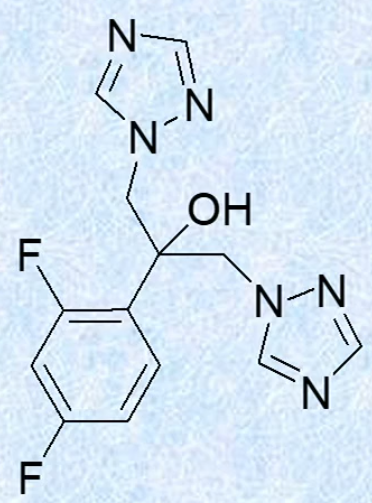
Triazole (fluconazole) (3 nitrogens)
18
What to know about fluconazole?
Very water soluble, only drug with high penetration into the CSF, treat brain infections
Increased spectrum of activity, not effective against glabrata and krusei
DDIs with CYP2C9
Increased spectrum of activity, not effective against glabrata and krusei
DDIs with CYP2C9
19
What to know about itraconazole?
Broad spectrum, effective against aspergillosis
CYP3A4 DDIs
CYP3A4 DDIs
20
What to know about voriconazole?
2nd generation triazole, standard of care against aspergillosis
CYP2C19, 2C9, and 3A4 DDIs
CYP2C19, 2C9, and 3A4 DDIs
21
What to know about posaconazole?
Lessened CYP interactions, mostly only interacts with 3A4
22
What to know about isavuconazole?
Effective against aspergillosis and mucormycoses
Lessened CYP3A4 interactions
Lessened CYP3A4 interactions
23
What is Erg11?
The gene that encodes for 14a-demethylase
24
How does C.albicans resist azoles?
mutations in Erg11 which cause 14a-demethylase to block azoles from binding with the heme iron. Grants resistance against all azoles
25
What other mechanisms are there for azole resistance?
Efflux by ABC-1, most effective against fluconazole
Increased production of 14a-demethylase
Increased production of 14a-demethylase
26
What to know about clotrimazole and miconazole?
Typically used topically
27
How do echinocandins (caspofungins) work?
Non competitive inhibition of B-1,3-glucan synthase found in fungal cell membranes, which is used by fungal cells to create their cell wall, and is not found in human cells.
28
What is this drug?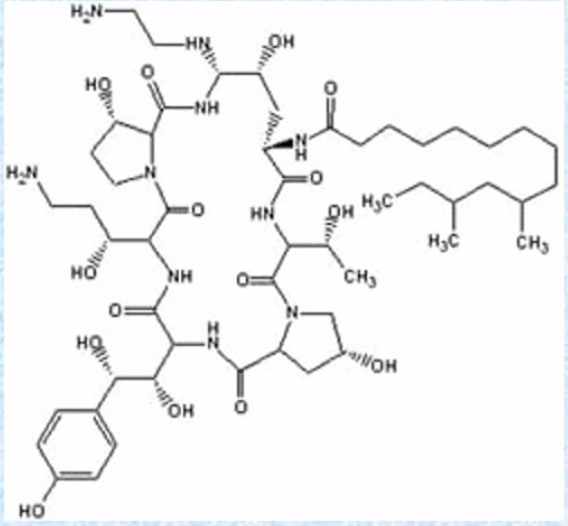
An echinocandin
29
What echinocandins do we have to know?
anidulafungin
micafungin
micafungin
30
Echinocandin resistance
Rare, can have mutations in FKS1 and FKS2 which which make the catalytic sites for B-1,3-glucan synthase, gives resistance to all echinocandins
31
What is squaline?
A molecule up the pathway which is eventually converted into lanosterol and then ergosterol
32
What is squaline epoxidase?
An enzyme that converts squaline into 2,3 oxidosqualine which is then converted further into lanosterol
33
How do allyl amines work?
They inhibit squaline epoxidase, stopping the eventual conversion of squaline to ergosterol and preventing growth of the fungal cell membrane
34
What allyl amines do we have to know?
naftifine
terbinafin
terbinafin
35
What to know about allyl amines?
Limited spectrum, usually used against dermatophytes which cause topical nail bed infections, takes a long time to be effective
Few resistances, some resistance through efflux transporters
Few resistances, some resistance through efflux transporters
36
What is this drug?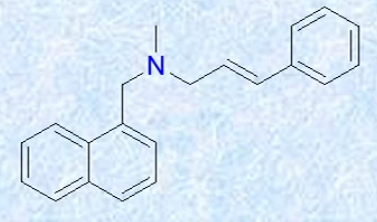
Allyl amine (naftifine)
37
How does flucytosine work?
It is converted to 5FU, which is highly toxic, but only by fungal cytosine deaminase, so it is only active and toxic if it becomes activated by a fungal cell
Some intestinal flora can also activate it which leads to toxicity
Some intestinal flora can also activate it which leads to toxicity
38
What is this drug?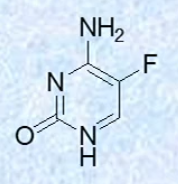
Flucytosine
39
What is this drug?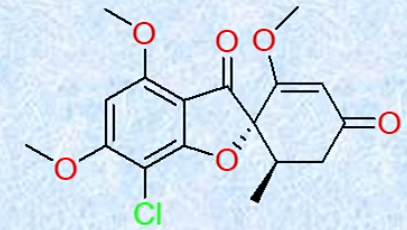
Griseofulvin
40
How does griseofulvin work?
It is highly incorperated into keratin in the nails, kills fungal cells present on the nails by tubulin binding
41
What is candida auris?
Infectious fungal species which rapidly spreads between people similar to a bacteria
High levels of resistance, naturally azole resistant
High levels of resistance, naturally azole resistant