Hormonal and TK Targeting Therapies
Study these flashcardsFree · spaced repetition · iPhone, Android, Mac & web
All cards
1
What are BRCA1 and BRACA2 mutations?
These genes encode for tumor suppressing function, mutations supress these genes and lead to a 50-80% risk of developing breast cancer, inherited gene mutation that causes 5-10% of breast cancer
2
What is HER2 and what is the significance of breast cancer being HER2 +/-?
HER2 is human growth factor receptor 2, and helps control cell growth. HER2+ breast cancer has overexpression of HER2, making it a faster proliferator and more agressive, but allowing for more specific HER2 targeting treatments.
Also known as ErbB2
Also known as ErbB2
3
What is ER in breast cancer?
Estrogen receptor
4
What are ER +/- breast cancers?
ER+ need estrogen to grow and can be treated by drugs that block estrogen from binding
ER- don't have estrogen receptors and don't need estrogen to grow
About 70% of breast cancer is ER+, but it can mutate to become ER-
ER- don't have estrogen receptors and don't need estrogen to grow
About 70% of breast cancer is ER+, but it can mutate to become ER-
5
What are SERMs?
Selective estrogen receptor modulators
6
What are SERDs?
Selective estrogen receptor downregulators
7
How do SERMs work?
They look like estrogen and bind to estrogen receptors better than estrogen, blocking estrogen binding and inactivating the receptor. Target specifically ER+ breast cancer so fewer side effects and often used as a long term maintenance medication. Since they bind to ER stronger than estrogen does, they can be used in both pre and post menopausal women as the high levels of estrogen in pre menopausal women don't have much impact on their efficacy.
8
What SERMs should we know?
Tamoxifen, the first SERM
Raloxifene
Raloxifene
9
What is this structure?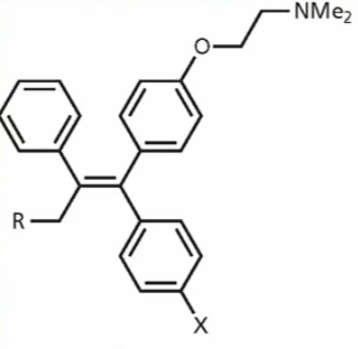
Tamoxifen
10
What is this structure?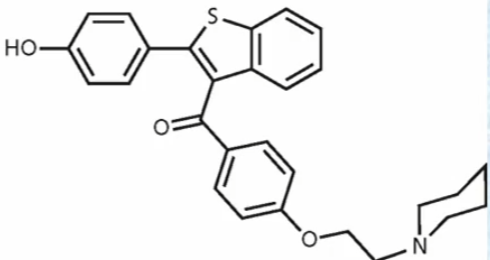
Raloxifene
11
What is aromatase?
It is the product of cytochrome P450, which converts androstenedione and testosterone into estrogens. Men and women have the same hormonal pathway, but the action of aromatase further converts male sex hormones into female ones.
12
What are aromatase inhibitors?
They inhibit the action of aromatase, preventing the creation of estrogen.
13
What group are aromatase inhibitors used in?
Post-menopausal women, pre menopausal women have too much estrogen production to effectively stop
14
How do type one aromatase inhibitors work?
They are steroidal and look like the androstenedione that aromatase normally binds to, inhibiting it by irreversably binding with a covalent bond. Many side effects and not commonly used anymore.
15
How do type two aromatase inhibitors work?
Non steroidal, they reversably bind to the heme iron group of aromatase. CYP inhibitors, can lead to side effects and interactions.
16
What aromatase inhibitors do we have to know?
Anastrozole and letrozole, these are third generation type two aromatase inhibitors that are very potent and selective, less side effects
17
What are these structures?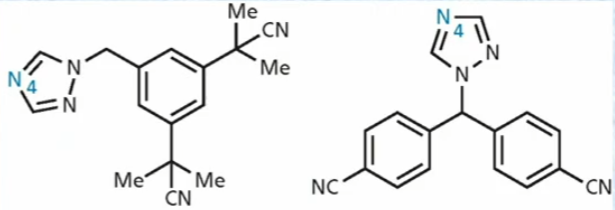
Anastrozole and letrozole, the third generation type two aromatase inhibitors. Note the 1, 2, 4 nitrogren ring structure
18
What is androgen deprivation therapy?
Depriving prostate cancer cells of androgen, which leads to their death. High incidence of sex related side effects due to lack of androgen, development of feminine characteristics, etc, so treatment not always used depending on patient age and risk factors.
19
What are LHRH/GnRH agonists?
Luteinizing hormone-releasing hormone/Gonadotropin releasing hormone agonists
20
What are AR blockers?
Androgen receptor blockers (similar to SERMs but fopr androgen)
21
What does LHRH do?
LHRH is released from the hypothalamus, which causes the anterior pituitary to release FSH, which stimulates the testis to produce testosterone.
22
How do LHRH agonists work?
LHRH agonists look like LHRH but are more resistant to degridation by replacing gly6 with a d-configuration amino acid and so cause more release of FSH than LHRH does, leading to even greater testosterone production. However, this increased agonism eventually leads to desensitization, leading to long term decrease in testosterone levels. Lag time associated with desensitization.
23
What LHRH agonists should we know?
Leoprolide
Goserelin
Goserelin
24
What is a mechanism of resistance against AR blockers?
The androgen receptors will change shape to no longer bind AR blcokers but still bind androgens.
25
How does abiraterone work?
It binds to P450(17a), which is involved in testosterone synthesis. Similar to aromatase inhibitors, where it blocks production of the hormone.
26
What AR blockers do we have to know?
Flutamide
Cyproterone acetate
Enzalutamide
Cyproterone acetate
Enzalutamide
27
What do we have to know about enzalutamide?
Newest AR blocker that has shown significant survival benefit
28
What is this structure?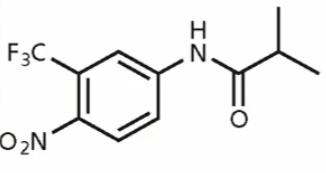
Flutamide
29
What is this structure?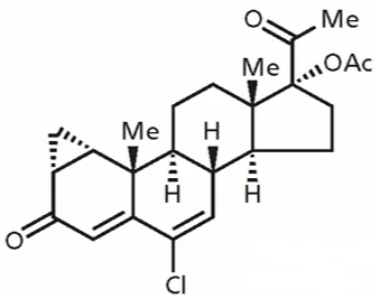
Cyproterone acetate
30
What is this structure?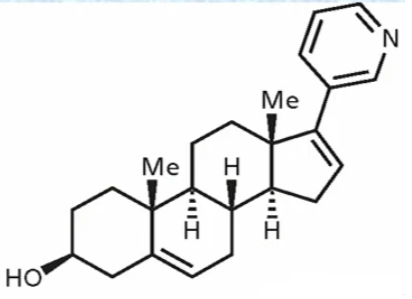
Abiraterone
31
What is this structure?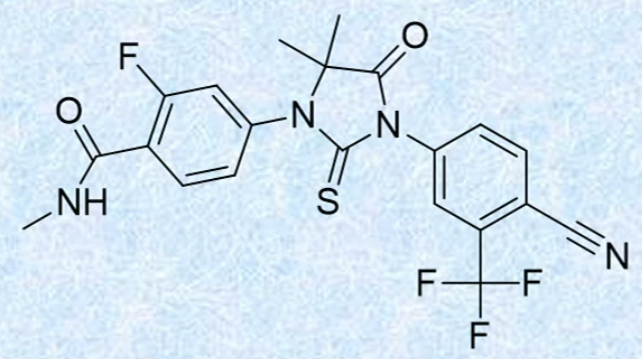
Enzalutamide
32
What do kinases and phosphatases do?
They add (kinases) or remove (phosphatases) a phophorus group to an oxygen on an amino acid. Specifically in this context, they target either tyrosine, or serine and threonine. Kinases tend to be oncogenes, turning on growth factors, while phosphatases tend to be tumor supressor genes.
33
What are RTKs and NRTKs?
Receptor and non-receptor tirosine kinases. RTKs have a transmembrane region with an extracellular ligand binding domain, NRTKs don't.
34
How do ATP mimicking tyrosine kinase inhibitors work?
They mimic ATP, binding to R/NRTKs instead of ATP and stopping signaling. While all kinases bind to ATP, there are enough conformational changes in tyrosine kinases to make the action of these drugs specific to inhibiting them.
35
How do monoclonal antibody's that target receptor tyrosine kinases work?
They target the ligand proteins that binds to RTKs
36
Why don't any monoclonal antibody's target NTRKs?
Because monoclonal antibody's target the ligand that binds to the extracellular binding domain, which isn't present with NRTKs.
37
How does trastuzumab work?
It is a monoclonal antibody which targets HER2 (ErbB2)
38
How does cetuximab work?
It is a monoclonal antibody which targets EGFR (ErbB1)
39
What is the philadelphia chromosome?
It is a mutation which is caused by a translocation between chromosomes 9 and 22. This creates the philadelphia chromosome which juxtaposes the sequences of bcr, a harmless protein which is found in very high levels within cells, and c-abl, which encodes for an NRTK, which are oncogenes. This leads to rapid production of NRTKs, causing rapid cell growth and proliferation. This mutation is found in 95% of chronic myelogenous leukemia (CML) patients.
40
What is Bcr-Abl Tyrosine Kinase?
A NRTK caused by the philadelphia chromosome mutation
41
What does imatinib target?
Bcr-Abl kinase, an NRTK mutation commonly found in CML (chronic myelogenous leukemia).
Very effective and with minimal side effects since Bcr-Abl kinase is not found in healthy cells.
Very effective and with minimal side effects since Bcr-Abl kinase is not found in healthy cells.
42
Imatinib MOA
ATP mimic, binds to the ATP binding site on Bcr-Abl kinase and antagonizes it, preventing signaling
43
Imatinib efficacy considerations
Since the drug has a very high specificity, it is very effective against it's target with minimal side effects. However, in patients that don't have this philadelphia chromosome mutation, or if there is further mutation in this receptor, efficacy becomes very low. High specificity leads to little side effects, but also leads to a narrow range of efficacy.
44
Imatinib side effects?
Not many since they are very selective to cancer cells.
Reduction in Ph chromosome positive cells
Also inhibits c-Kit receptor and PDGFR
Inhibition of c-Kit allows it to also be used in patients with gastrointestinal stromal tumors (GIST)
Reduction in Ph chromosome positive cells
Also inhibits c-Kit receptor and PDGFR
Inhibition of c-Kit allows it to also be used in patients with gastrointestinal stromal tumors (GIST)
45
What are gatekeeper residues?
An amino acid in the active site that gives specificity about what a receptor will bind to, and can determine efficacy and specificity of kinase inhibitors.
46
What are the mechanisms of imatinib resistance?
In the T315I mutation, a Thr gatekeeper residue in the Bcr-Abl kinase can mutate to Ile, which majorly lowers the affinity for imatinib. Since this is an easy single mutation, drug resistance to imatinib is relatively high.
Found in 10-20% of patients with imatinib treatment failure, this mutation keeps the kinase constantly activated.
Found in 10-20% of patients with imatinib treatment failure, this mutation keeps the kinase constantly activated.
47
What is dasatinib?
A second generation version of imatinib, which inhibits several tirosine kinases.
This can inhibit the active form of the enzyme as well, kicking out ATP, while imatinib can only bind to inactivated kinases
About 20x more potent than imatinib
Still doesn't work against T315I
This can inhibit the active form of the enzyme as well, kicking out ATP, while imatinib can only bind to inactivated kinases
About 20x more potent than imatinib
Still doesn't work against T315I
48
What is Nilotinib?
Another second generation imatinib, which also targets several tirosine kinases
Like imatinib, it only targets the inactive form of th enzyme
While it does show promise against many imatinib resistant kinases, the T315I mutation still is resistant
Like imatinib, it only targets the inactive form of th enzyme
While it does show promise against many imatinib resistant kinases, the T315I mutation still is resistant
49
What is ponatinib?
A 3rd generation Bcr-Abl inhibitor which is effective against the T315I mutation
50
What is Bosutinib?
Another 3rd generation Bcr-Abl inhibitor for CML which works against the T315I mutation.
51
What do Bcr-Abl inhibitors target?
The Bcr-Abl NRTK mutation, caused by the philidelphia chromosome which is found in many CML patients
52
What first generation Bcr-Abl inhibitors do we have to know
Imatinib
53
What second generation Bcr-Abl inhibitors do we have to know and what is important about them?
Dasatinib
Nilotinib
More potent and effective against some resistances. However less selective and still not able to get around the T315I mutation
Nilotinib
More potent and effective against some resistances. However less selective and still not able to get around the T315I mutation
54
What third generation Bcr-Abl inhibitors do we have to know and what is important about them?
Ponatinib
Bosutanib
Effective against both wild type and T315I mutatant Bcr-Abl
Bosutanib
Effective against both wild type and T315I mutatant Bcr-Abl
55
What is EGFR?
epidermal growth factor receptor, it is an RTK (meaning a extracellular ligand binding and intracellular tyrosine kinase domain), often overexpressed in cancer cells and leading to increased growth/proliferation.
Frequently overexpressed in NSCLC (non-small cell lung cancer)
Frequently overexpressed in NSCLC (non-small cell lung cancer)
56
What are erlotinib and gefitinib?
1st generation EGFR inhibitors. ATP mimics which target EGFR, binding to and reversably inhibiting them. Erlotinib more commonly used, gefitinib has more side effects such as lung disease.
57
What populations are gefitinib and erlotinib used in?
Found to not work with most patients in trial, however certain subgroups, such as women and east asian descent, had very high efficacy. Only works well in certain mutations which cause EGFR to become more active and causes the cells to become more dependent on it, do genomic sequencing is essential to effective use.
58
Gefitinib and erlotinib resistance?
T790M, which increases EGFR's affinity for ATP over the inhibitors. This makes it bind much more quickly to ATP than to the inhibitors and therefore makes it much more likely that it will bind to ATP whenever it is unbound. Resistance appears in almost 100% of patients after extended use.
59
What is the point of irreversable (second generation) EGFR inhibitors?
The T790M mutation increases affinity for ATP, therefore making it more likely to bind to ATP, and since gefitinib and erlotinib are reversable, even if one of the EGFRs binds to them, it will eventually release it and continue its function being much more likely to grab ATP again. However, with an irreversable inhibitor, it will eventually bind to one, even though binding to ATP is much more likely, and then it will be permanently shut down, making irreversable inhibitors effective even against the T790M mutation.
**Note, we don't have to know any specific irreversable EGFR inhibitors for the exam
**Note, we don't have to know any specific irreversable EGFR inhibitors for the exam
60
If a structure has two nitrogens in a ring connected to an external nitrogen, what do we have to be able to identify it as?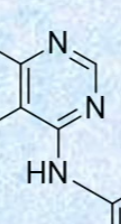
A kinase inhibitor, "pyrimidine structure"
Not all the kinase inhibitors have this structure, but if he asks us to identify a kinase inhibitor on the exam it will have this, and we won't have to identify it any further than it being a kinase inhibitor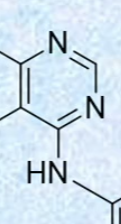
Not all the kinase inhibitors have this structure, but if he asks us to identify a kinase inhibitor on the exam it will have this, and we won't have to identify it any further than it being a kinase inhibitor
61
What is lapatinib?
ATP mimic that inhibits HER2, effective against HER2 positive breast cancer
62
What is angiogenisis (neovascularization)?
The formation of new blood vessels from existing ones
63
What is VEGF?
Vascular epidermal growth factor, a ligand that binds to VEGFR (VEGF receptor), triggering angiogensis. Used by cancer cells to support faster and larger growth using nutrients brought in from this new vasculature.
64
What are VEGFR inhibitors primarily used to treat?
Kidney cancer, which is highly vascularized
65
What is Sunitinib (Sutent)?
TK inhibitor that blocks VEGFR and some other TK receptors.
Hits VEGFR1, 2, and 3
Blocks vascularization and kills tumors from the inside out, as the outermost cells are the ones with the most access to blood supply.
Hits VEGFR1, 2, and 3
Blocks vascularization and kills tumors from the inside out, as the outermost cells are the ones with the most access to blood supply.
66
What is an EML4-ALK fusion?
A microtubule associated protein (EML4) fused with the kinase domain of ALK, present in 3-13% of NSCLC (non-small cell lung disease).
67
What is crizotinib?
ATP mimic that binds to and inhibits ALK, halting proliferation of NSCLC (non-small cell lung cancer) lines with an ALK infusion
68
What is B-RAF?
An RTK which activates the Ras/RAF/MEK/ERK signaling pathway and is frequently mutated in melanoma.
69
What is the most common B-RAF mutation?
BRAF V600E, which destabilizes the inactive form of B-RAF and causes it to be activated. 500x activated compared to non-mutated BRAF.
70
What is vemurafenib?
An ATP mimic that targets BRAF V600E, inhibiting it's activation. Effective against melanoma, with little impact on other kinases.
Has raf in the name (B-RAF inhibitor)
Has raf in the name (B-RAF inhibitor)
71
Quiz/Review/Summary time! List all the ATP mimic TK inhibitor classes we have to know, their methods of action, and what they treat!
ATP mimics: Look like ATP in order to bind to and antagonize TK. Can target all types of TK, whether RTK or NRTK, as all TK use ATP. ATP mimic drugs are specific, only inhibiting certain tyrosine kinases. For this exam, we have to know Bcr-Abl inhibitors, EGFR inhibitors, HER2 inhibitors, VEGFR inhibitors, ALK inhibitors, and BRAF V600E inhibitors, which are all different classes of ATP mimicking drugs.
1st generation Bcr-Abl inhibitors: ATP mimics which bind to Bcr-Abl, a mutated kinase commonly found in CML
2nd generation Bcr-Abl inhibitors: More potent less selective than first generation, effective against some drug resistant CMLs, but not against the T315I mutation
3rd generation Bcr-Abl inhibitors: Effective against T315I mutations
1st generation EGFR inhibitors: ATP mimics which reversibly bind to EGFR, which are highly expressed in some cancers such as NSCLC. Even within these types of cancer, these inhibitors are only effective in patient populations with specific mutations, so genomic testing is required.
2nd generation EGFR inhibitors: ATP mimics which *irreversibly* bind EGFR, making them effective against the T790M mutation (don't need to know specific examples)
HER2 inhibitors: ATP mimics which bind to HER2, effective against HER2+ breast cancer
VEGFR inhibitors: ATP mimics which bind to VEGFR, effective against cancers that are highly vascularized, such as kidney cancer
ALK inhibitors: ATP mimics which bind to ALK, Effective against ALK positive forms of NSCLC
BRAF V600E inhibitors: ATP mimics which bind to BRAF with the V600E mutation, effective against melanoma with the BRAF V600E mutation
1st generation Bcr-Abl inhibitors: ATP mimics which bind to Bcr-Abl, a mutated kinase commonly found in CML
2nd generation Bcr-Abl inhibitors: More potent less selective than first generation, effective against some drug resistant CMLs, but not against the T315I mutation
3rd generation Bcr-Abl inhibitors: Effective against T315I mutations
1st generation EGFR inhibitors: ATP mimics which reversibly bind to EGFR, which are highly expressed in some cancers such as NSCLC. Even within these types of cancer, these inhibitors are only effective in patient populations with specific mutations, so genomic testing is required.
2nd generation EGFR inhibitors: ATP mimics which *irreversibly* bind EGFR, making them effective against the T790M mutation (don't need to know specific examples)
HER2 inhibitors: ATP mimics which bind to HER2, effective against HER2+ breast cancer
VEGFR inhibitors: ATP mimics which bind to VEGFR, effective against cancers that are highly vascularized, such as kidney cancer
ALK inhibitors: ATP mimics which bind to ALK, Effective against ALK positive forms of NSCLC
BRAF V600E inhibitors: ATP mimics which bind to BRAF with the V600E mutation, effective against melanoma with the BRAF V600E mutation
72
Quiz/Review/Summary time! List all the non ATP mimic TK inhibitors (monoclonal antibodies) or hormonal targeting drug classes we have to know, their methods of action, and what they treat!
Monoclonal antibodies: Target ligands that bind to the extracellular domain of RTK, antagonizing their activation. Can only be used against RTKs, as NRTKs don't bind to ligands.
SERMs: Selective estrogen receptor modulators, which mimic estrogen and bind to estrogen receptors, antagonizing their action. Effective against ER+ breast cancer
SERDs: Selective estrogen receptor downregulators, limit expression of estrogen receptors, not commonly used/don't need to know any specific drugs
Type 1 aromatase inhibitors: Inhibits the action of aromatase, which turns male sex hormones into female ones. Mimics androstenedione which aromatase normally converts, covalently binding to aromatase and irreversably inhbiting it. Many side effects so not commonly used anymore/don't need to know any specific drugs
Type 2 aromatase inhibitors: Non-steroidal aromatase inhibitors, which reversably bind to heme iron to inhibit aromatase. Effective against ER+ breast cancer in post-menopausal women where estrogen production has already slowed down enough for aromatase inhibitors to have an impact.
LHRH agonists: luteinizing hormone releasing hormone agonists which initially stimulates testosterone production, however after a lag period will cause desensitization and a massive decrease in testosterone production. Effective against prostate cancers which are typically testosterone dependent.
AR blockers: Androgen receptor blockers, which bind to and inhibit androgen receptors, effective against prostate cancers which are typically testosterone dependent.
Abiraterone: Binds to P450(17a), inhibiting it and blocking the synthesis of testosterone. Effective against testosterone dependent prostate cancers.
SERMs: Selective estrogen receptor modulators, which mimic estrogen and bind to estrogen receptors, antagonizing their action. Effective against ER+ breast cancer
SERDs: Selective estrogen receptor downregulators, limit expression of estrogen receptors, not commonly used/don't need to know any specific drugs
Type 1 aromatase inhibitors: Inhibits the action of aromatase, which turns male sex hormones into female ones. Mimics androstenedione which aromatase normally converts, covalently binding to aromatase and irreversably inhbiting it. Many side effects so not commonly used anymore/don't need to know any specific drugs
Type 2 aromatase inhibitors: Non-steroidal aromatase inhibitors, which reversably bind to heme iron to inhibit aromatase. Effective against ER+ breast cancer in post-menopausal women where estrogen production has already slowed down enough for aromatase inhibitors to have an impact.
LHRH agonists: luteinizing hormone releasing hormone agonists which initially stimulates testosterone production, however after a lag period will cause desensitization and a massive decrease in testosterone production. Effective against prostate cancers which are typically testosterone dependent.
AR blockers: Androgen receptor blockers, which bind to and inhibit androgen receptors, effective against prostate cancers which are typically testosterone dependent.
Abiraterone: Binds to P450(17a), inhibiting it and blocking the synthesis of testosterone. Effective against testosterone dependent prostate cancers.
73
Quiz/Review/Summary time! List all the kinase inhibitor and hormonal drugs we have to know and their class!
SERMs: Tamoxifen, Raloxifene
Type 2 Aromatase Inhibitors: Anastrazole, Letrozole
LHRH agonists: Leuprolide, Goserelin
Abiraterone: Abiraterone
AR Blockers: Flutamide, Cyproterone acetate, Enzalutemide (newest with survival benefit)
Monoclonal antibodies: Trastuzumab (against HER2), Cetuximab (against EGFR)
1st Generation Bcr-Abl Inhibitors: Imatinib
2nd Generation Bcr-Abl Inhibitors: Dasatinib, Nilotinib
3rd Generation Bcr-Abl Inhbitors: Ponatinib, Bosutinib
1st Generation EGFR Inhibitors: Erlotinib, Gefitinib
HER2 Inhibitors: Lapatinib
VEGFR Inhibitors: Sunitinib (Sutent)
ALK Inhibitors: Crizotinib
BRAF V600E Inhibitors: Vemurafenib
Type 2 Aromatase Inhibitors: Anastrazole, Letrozole
LHRH agonists: Leuprolide, Goserelin
Abiraterone: Abiraterone
AR Blockers: Flutamide, Cyproterone acetate, Enzalutemide (newest with survival benefit)
Monoclonal antibodies: Trastuzumab (against HER2), Cetuximab (against EGFR)
1st Generation Bcr-Abl Inhibitors: Imatinib
2nd Generation Bcr-Abl Inhibitors: Dasatinib, Nilotinib
3rd Generation Bcr-Abl Inhbitors: Ponatinib, Bosutinib
1st Generation EGFR Inhibitors: Erlotinib, Gefitinib
HER2 Inhibitors: Lapatinib
VEGFR Inhibitors: Sunitinib (Sutent)
ALK Inhibitors: Crizotinib
BRAF V600E Inhibitors: Vemurafenib