Exam 3 Study Guide
Study these flashcardsFree · spaced repetition · iPhone, Android, Mac & web
All cards
1
Rosalind Franklin
Took an aray photo of DNA and saw it was a double helix.
2
Watson & Crick
Made a 3d model of DNA
3
Darwin
Discovered and defined natural selection
4
Genome
Your genetic code or book of you
5
Chromosomes
Super coiled and highly packed DNA
6
DNA
Is located in the nucleus and is gentic material
7
Double helix
Structure of DNA. There is one strand, and a complementary strand.
8
Genes
Are physical traits, passed down from parents.
9
Mutation
Are errors in the DNA or a random mis-copy of DNA
10
biodiversty
Is the variety of organisms in a given area
11
Food chain
show the flow of energy in an ecosystem
12
Food web
Show the interconnectiond food chain within an ecosystem
13
Energy Pyramid
Shows the amount of energy in each trophic levels
14
Trophic level
Feeding position
15
Ecology
The study of the interactions among organisms and their enviroment or interactions between biotic and abiotic interactions
16
Producer
Makes it's own food
17
Consumer
Has to eat others to get it's food
18
Carnivore
A consumer that eats animals
19
Herbivore
A consumer that eats plants
20
Omnivore
A consumer that eats animals and plants
21
Scavenger
A consumer that eats remains of animals
22
Decomposer
A consumer that feeds on dead material, and turns it to nutrients for the soil.
23
Primary Consumer
Eats the producer and gets 10%
24
Secondary Consumer
Eats the primary consumer and gets 10% from the consumer
25
Tertiary Consumer
Eats the secondary consumer and gets 10% from the consumer
26
Artificial Selection
Biological process where humans select certain animal traits. Breeders selecting specific traits to breed animals and have offspring with preferred traits.
27
Natural Selection
Process which organisms change and adapt over time. The process by which random evolutionary changes are selected for by consistent orderly, non-random based way.
28
Draw the parts of a nucleotide: Phosphate, Sugar, Nitrogenous Base
See picture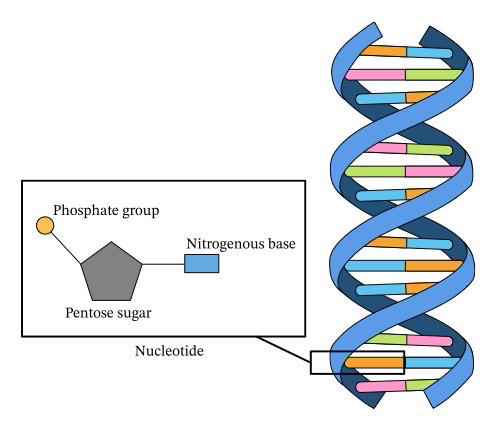
29
What are the different DNA bases? Which ones pair together?
A-T C-G
CCGTATCGTAC
GGCATAGCATG
CCGTATCGTAC
GGCATAGCATG
30
How many chromosomes do humans have? How do we get them?
46 chromosomes coming from 23 from each parent. 23 from Dad, 23 from Mom = Total of 46 in humans.
31
How do some cells know to be muscle or bone?
From the gentic code
32
Why is there variety within a species?
There is variety within a species because when a species reproduces they get different traits, they also get variety from genetic mutations.
33
What is the central dogma of Biology?
DNA codes for proteins. Proteins code for traits. DNA ----> Proteins ---> Traits
34
What do mutations do?
It is a change in genetic code. They can be benefitial, neutral, and harmful.
35
What can make mutations more likely?
Chemicals, radiation, DNA replication issues, and random mutations can also occur
36
Write down and define 3 gene mutations:
1) Substitution: is a type of mutation in which one nucleotide is replaced by a different nucleotide.
2) Deletion: is a type of mutation that involves the loss of one or more nucleotides from a segment of DNA
3) Insertion: is a type of mutation that involves the addition of one or more nucleotides into a segment of DNA
2) Deletion: is a type of mutation that involves the loss of one or more nucleotides from a segment of DNA
3) Insertion: is a type of mutation that involves the addition of one or more nucleotides into a segment of DNA
37
Write down and define the 5 chromosome mutations:
1) Duplication: A section of the chromosome is copied, leading to extra genetic material.
2) Inversion: A piece of the chromosome breaks off, flips, and reattaches in reverse order.
3) Insertion: A section of a chromosome is added into another chromosome, which can cause problems with how genes work.
4) Deletion: A part of the chromosome is missing, causing the loss of important genetic information. (this will change traits)
5) Translocation: A piece of one chromosome breaks off and attaches to a different chromosome.
2) Inversion: A piece of the chromosome breaks off, flips, and reattaches in reverse order.
3) Insertion: A section of a chromosome is added into another chromosome, which can cause problems with how genes work.
4) Deletion: A part of the chromosome is missing, causing the loss of important genetic information. (this will change traits)
5) Translocation: A piece of one chromosome breaks off and attaches to a different chromosome.
38
List examples of benefitial mutations:
Super Sleeper: A mutation that allows some people to function well with much less sleep than average, often needing only 4-6 hours of sleep per night.
Super Taster: A mutation that gives some people extra taste buds, making them more sensitive to bitter and sweet flavors.
Super Coffee Consumer: A mutation that allows some people to metabolize caffeine faster, letting them drink more coffee without feeling jittery or experiencing side effects.
Additional examples not on test:
Malaria Protector: A mutation like the sickle cell trait that helps protect against malaria by altering red blood cells, making it harder for the malaria parasite to survive.
Tetrachromacy: A mutation that allows some people (especially women) to have four types of color receptors in their eyes, enabling them to see millions more colors than the average person.
Super Lungs: A mutation found in some high-altitude populations (e.g., Tibetans), which allows their lungs to use oxygen more efficiently in low-oxygen environments.
Mutated Almond Trees: A mutation in wild almond trees that removes toxins (like cyanide) from the almonds, making them safe to eat. This mutation led to the cultivation of edible almonds.
Lactose Tolerance: A mutation that allows some adults to digest lactose, making it possible to drink milk and consume dairy products without discomfort.
Super Taster: A mutation that gives some people extra taste buds, making them more sensitive to bitter and sweet flavors.
Super Coffee Consumer: A mutation that allows some people to metabolize caffeine faster, letting them drink more coffee without feeling jittery or experiencing side effects.
Additional examples not on test:
Malaria Protector: A mutation like the sickle cell trait that helps protect against malaria by altering red blood cells, making it harder for the malaria parasite to survive.
Tetrachromacy: A mutation that allows some people (especially women) to have four types of color receptors in their eyes, enabling them to see millions more colors than the average person.
Super Lungs: A mutation found in some high-altitude populations (e.g., Tibetans), which allows their lungs to use oxygen more efficiently in low-oxygen environments.
Mutated Almond Trees: A mutation in wild almond trees that removes toxins (like cyanide) from the almonds, making them safe to eat. This mutation led to the cultivation of edible almonds.
Lactose Tolerance: A mutation that allows some adults to digest lactose, making it possible to drink milk and consume dairy products without discomfort.
39
Explain what harmful mutations do to genes. What do they do to traits?
Harmful mutations do to a gene is that the mutation makes errors in the gene causing a body malfunction or gene malfunction.
40
What are the 3 kinds of diversity that make up Biodiversity?
1) ecosystem
2) species
3) genetics
2) species
3) genetics
41
Be able to describe 1. ecosystem 2. species 3. genetics in a specific habitat
1) ecosystem: dry and warm
2) species: Cactus and Coyotes
3) genetics: A Cactus saves water in their leaves / trunk
2) species: Cactus and Coyotes
3) genetics: A Cactus saves water in their leaves / trunk
42
1. Climate Change: Rapid changes in climate can alter habitats and put stress on species that aren't able to adapt quickly enough.
2. Disease: Outbreaks of disease can wipe out large populations, especially if there is low genetic diversity within a species.
3. Habitat Destruction: When natural habitats are destroyed by human activities like deforestation, urbanization, or agriculture, populations become isolated or reduced in size.
What are 3 threats to genetic biodiversity and what do they mean?
1. Climate Change: Rapid changes in climate can alter habitats and put stress on species that aren't able to adapt quickly enough.
2. Disease: Outbreaks of disease can wipe out large populations, especially if there is low genetic diversity within a species.
3. Habitat Destruction: When natural habitats are destroyed by human activities like deforestation, urbanization, or agriculture, populations become isolated or reduced in size.
43
Explain who is a keystone species in a kelp forest. Why is that?
Keystone species in a Kelp Forest are Sea Otters. Without sea otters, sea urchin populations can explode, causing them to overgraze and devastate the kelp forests. This loss of kelp would lead to the collapse of the entire ecosystem, as many species rely on the kelp for food and shelter. By keeping sea urchin numbers in check, sea otters help preserve the biodiversity and health of kelp forests, making them a keystone species.
44
What is the difference between a food chain and a food web?
A food chain shows a simple, straight line of who eats whom, starting from plants and moving up to top predators. A food web is more complex and shows how different food chains are connected, with many animals eating more than one kind of food. The food web gives a better picture of how energy moves through an entire ecosystem.
45
How much energy is lost on each trophic lecel of an energy pryamid? Be able to calculate energy units at each level!
Each trophic level of an energy pyramid only take 10%. Which means they lost 10%.
46
What is the role of the sun in the Energy Pyramid? Food Chain?
The role of the sun is the energy source. In both the Energy Pyramid and the Food Chain, the sun is the primary source of energy. Plants use sunlight to make food through photosynthesis, and this energy is passed to other organisms when they eat the plants.
47
Be able to identify organism relationships: Predators and Preys:
The predators hunt the prey.
48
Be able to identify organism relationships: Cooperative
Members of some populations work together for their survival.
49
Be able to identify organism relationships: Symbiotic: Mutualism:
Both organisms benefit.
50
Be able to identify organism relationships: Symbiotic: Commensalism
One organism is not effected whil the other benefits.
51
Be able to identify organism relationships: Symbiotic: Parasitism
One organsim is harmed while the other benefits.
52
What do arrows indicate in food webs and food chains?
The arrows shows the energy getting transferred from one another.
53
Symbiotic
Means long term relationships.